
Ready to ace the conversation part of your Spanish oral...
 Spanish1 visualizzazioni·Aggiornato Jun 15, 2026·6 pagine
Exploring Complex Social and Ethical Topics

1 / 6
1
of 6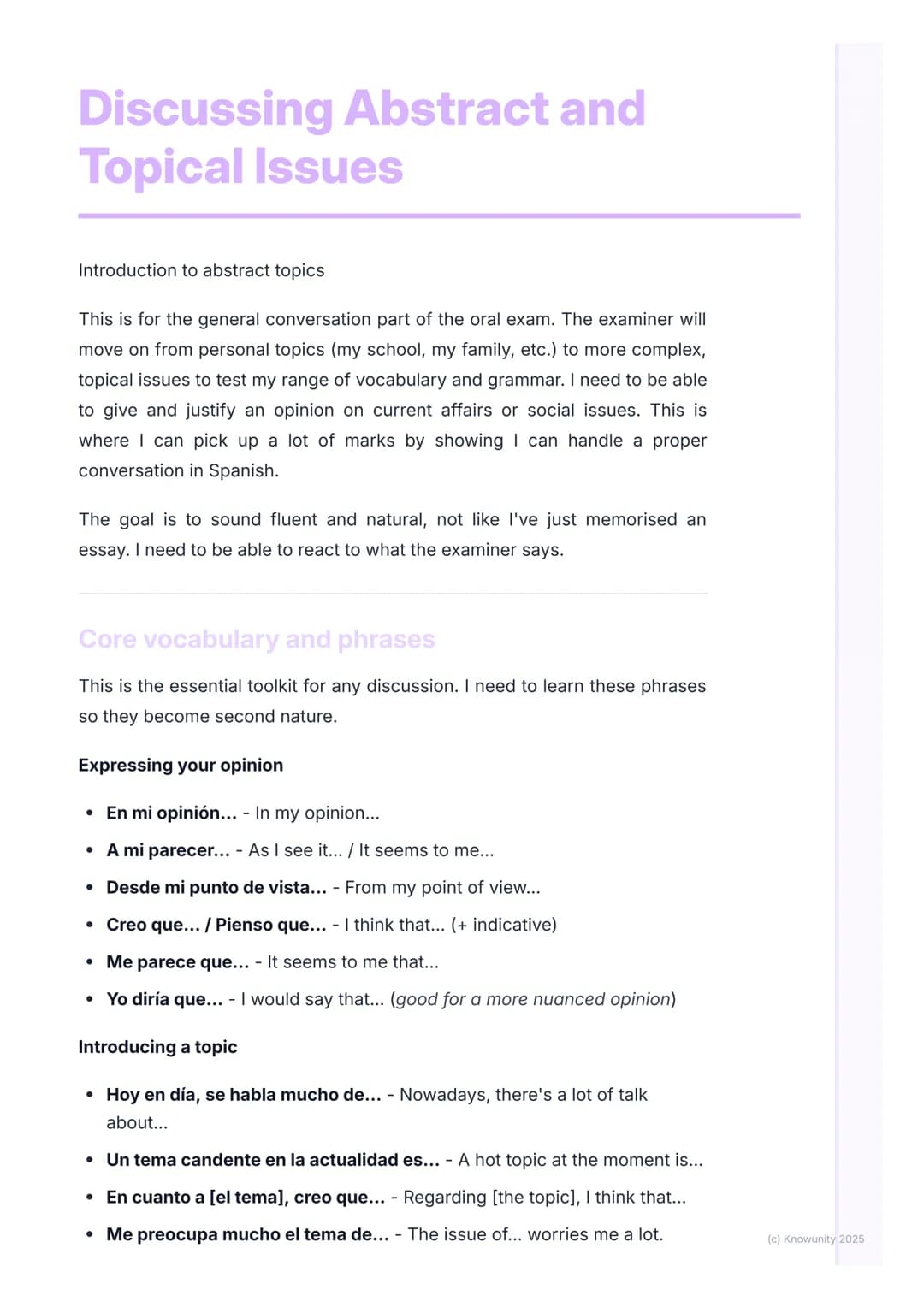
Getting Started with Abstract Topics
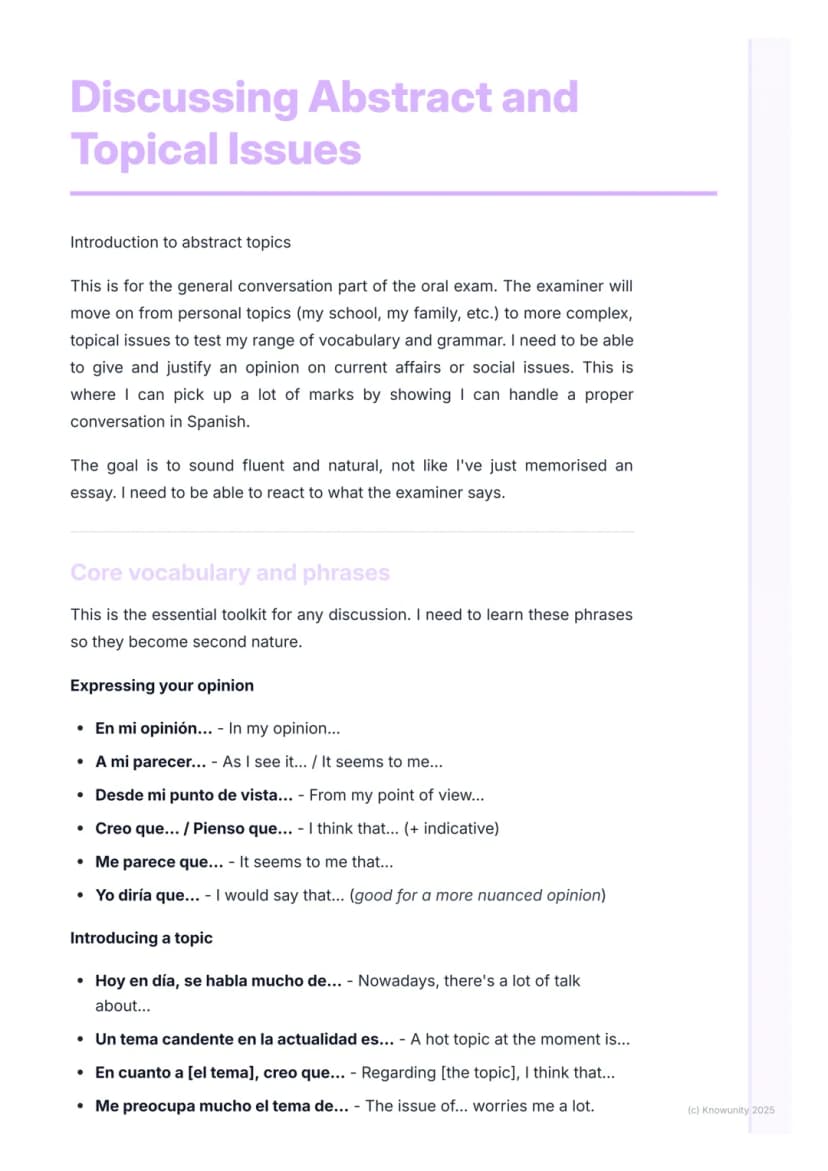
Your examiner wants to see you handle topical issues and current affairs, not just chat about your family or school. This is where you can really shine by showing your range of vocabulary and grammar. The goal isn't to sound like you've memorised an essay - you need to react naturally to what the examiner says.
Think of this as a proper conversation where you're discussing real-world problems. You'll need to give and justify opinions on things like social media, environmental issues, or problems facing Ireland today. This is your chance to pick up serious marks.
Essential opinion phrases include "En mi opinión..." (In my opinion), "Desde mi punto de vista..." (From my point of view), and "Yo diría que..." (I would say that). Learn these until they become second nature - you'll use them constantly.
Top Tip: Master phrases like "Hoy en día, se habla mucho de..." (Nowadays, there's a lot of talk about...) to introduce topics smoothly and sound sophisticated from the start.
2
of 6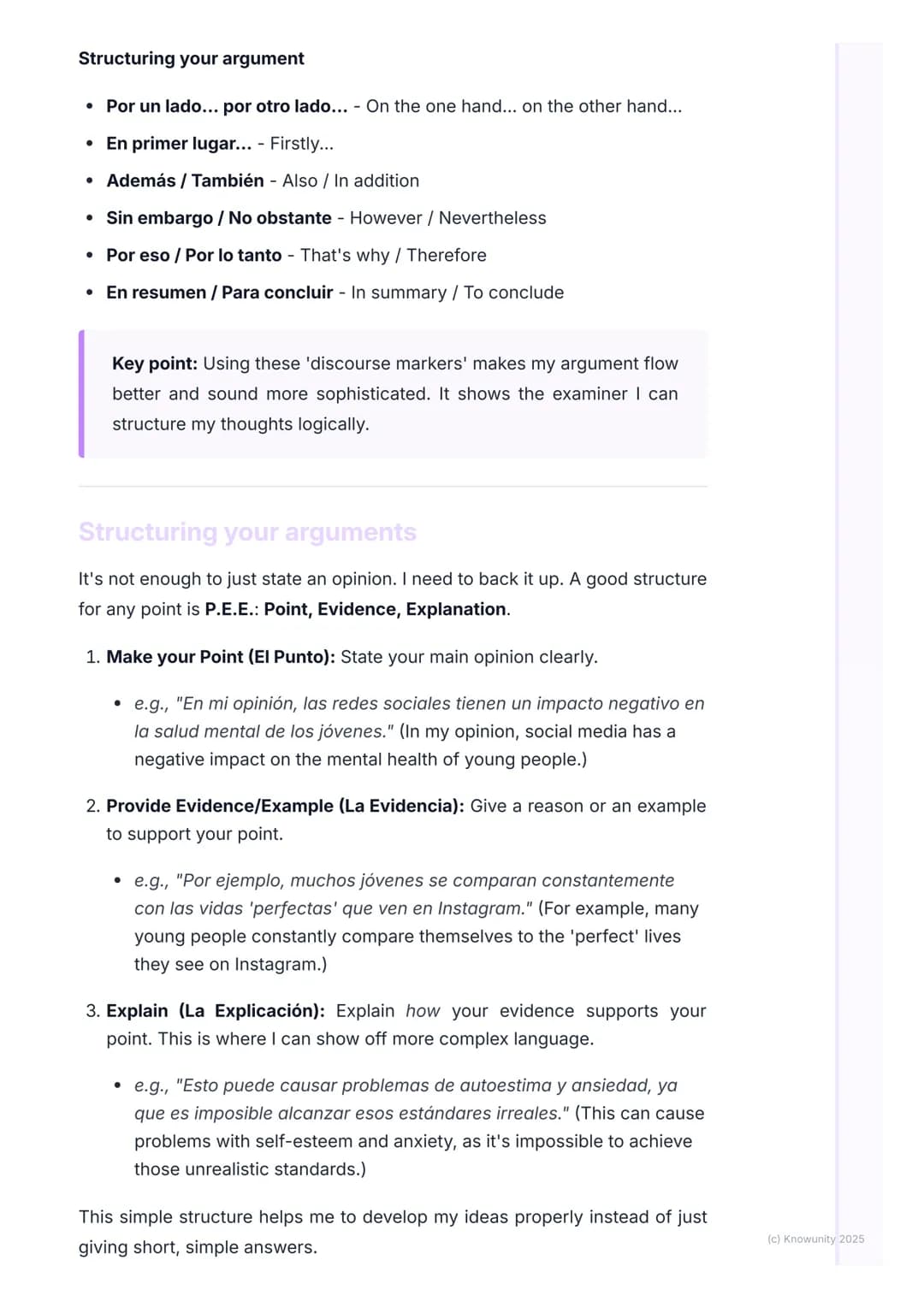
Structuring Your Arguments Like a Pro
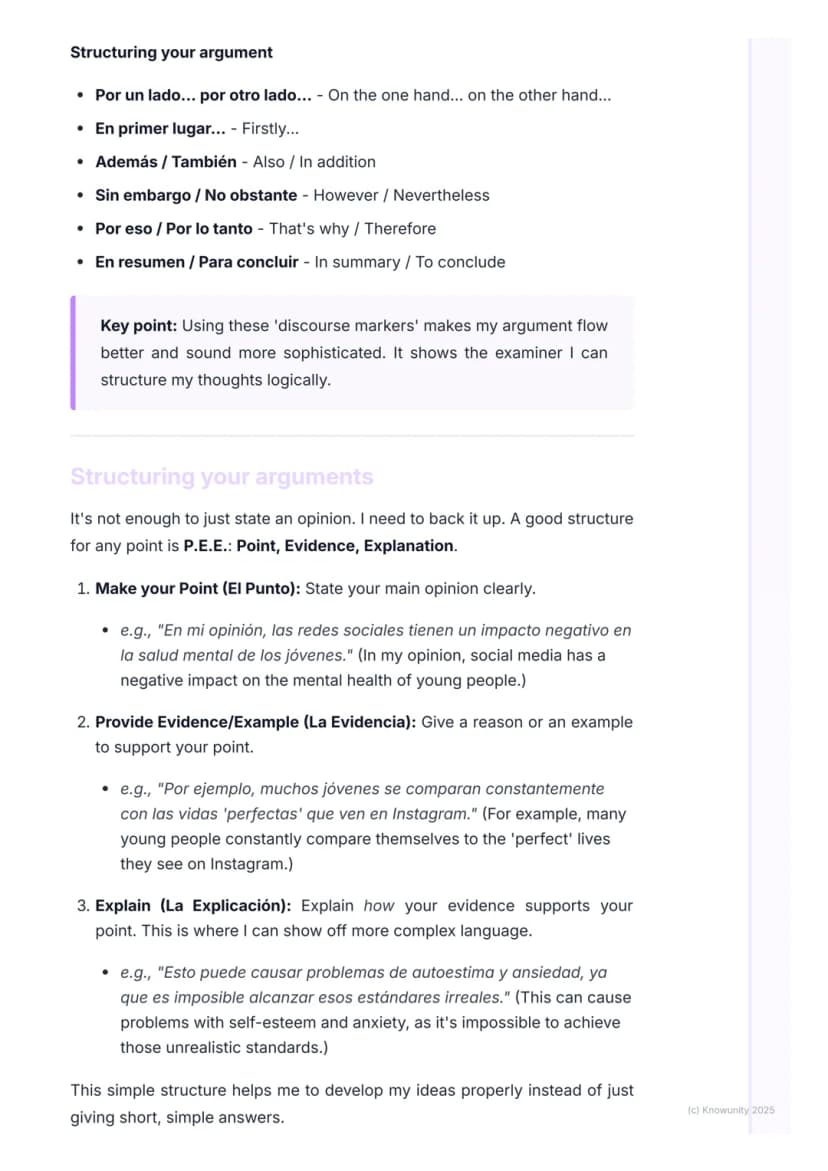
Don't just throw out random opinions - structure them properly using discourse markers. Start with "Por un lado... por otro lado..." (On the one hand... on the other hand) or "En primer lugar..." (Firstly). These phrases make your argument flow beautifully and show the examiner you can think logically.
The P.E.E. structure is your secret weapon: Point, Evidence, Explanation. First, state your opinion clearly. Then give an example or reason to back it up. Finally, explain how your evidence supports your point - this is where you can show off complex language.
For example: "Las redes sociales tienen un impacto negativo" (Point), "muchos jóvenes se comparan con vidas 'perfectas' en Instagram" (Evidence), "esto causa problemas de autoestima porque es imposible alcanzar esos estándares" (Explanation).
Grammar Gold: Use discourse markers like "Sin embargo" (However) and "Por lo tanto" (Therefore) to connect your ideas - it instantly makes you sound more sophisticated and organised.
3
of 6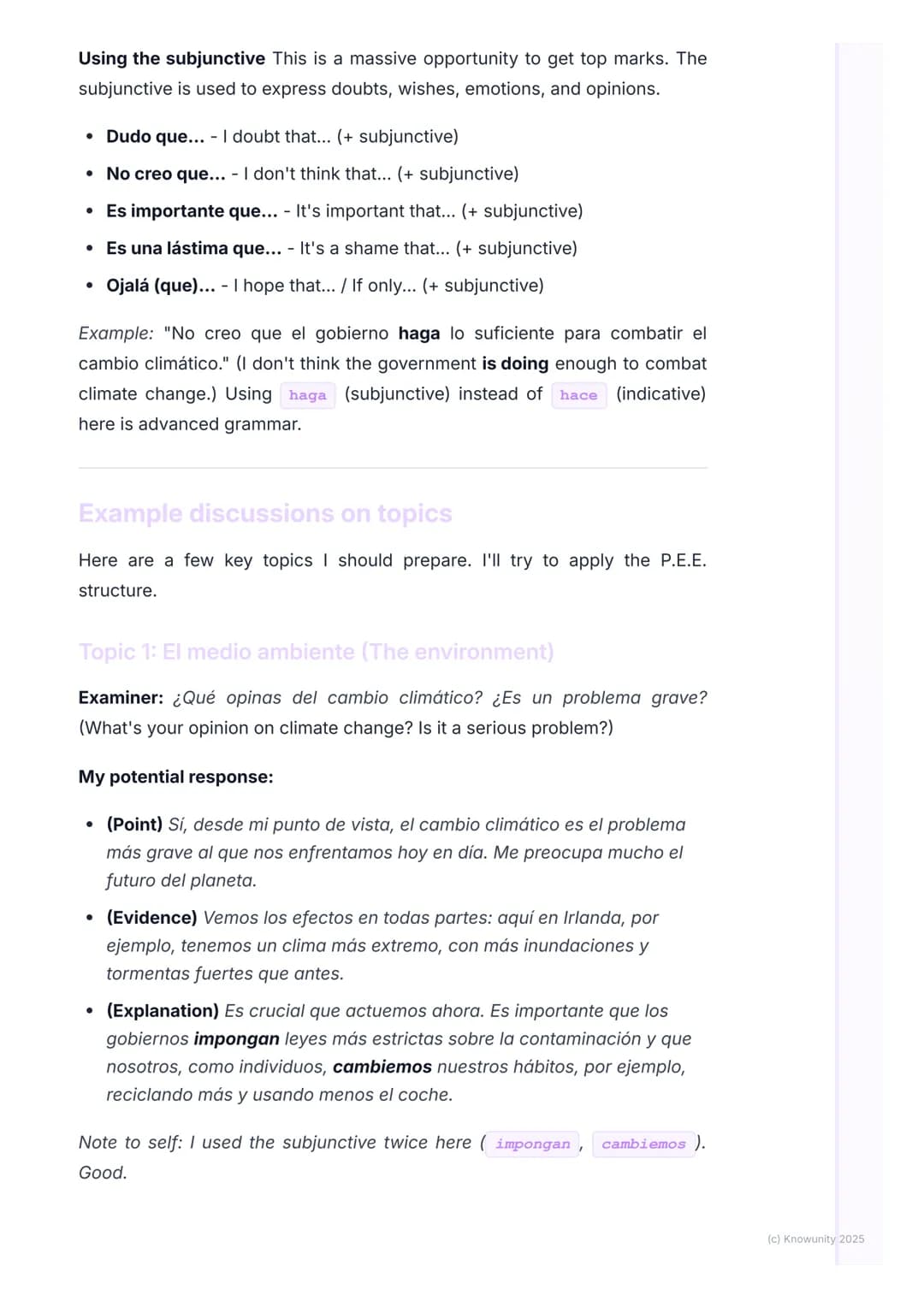
Mastering the Subjunctive for Top Marks
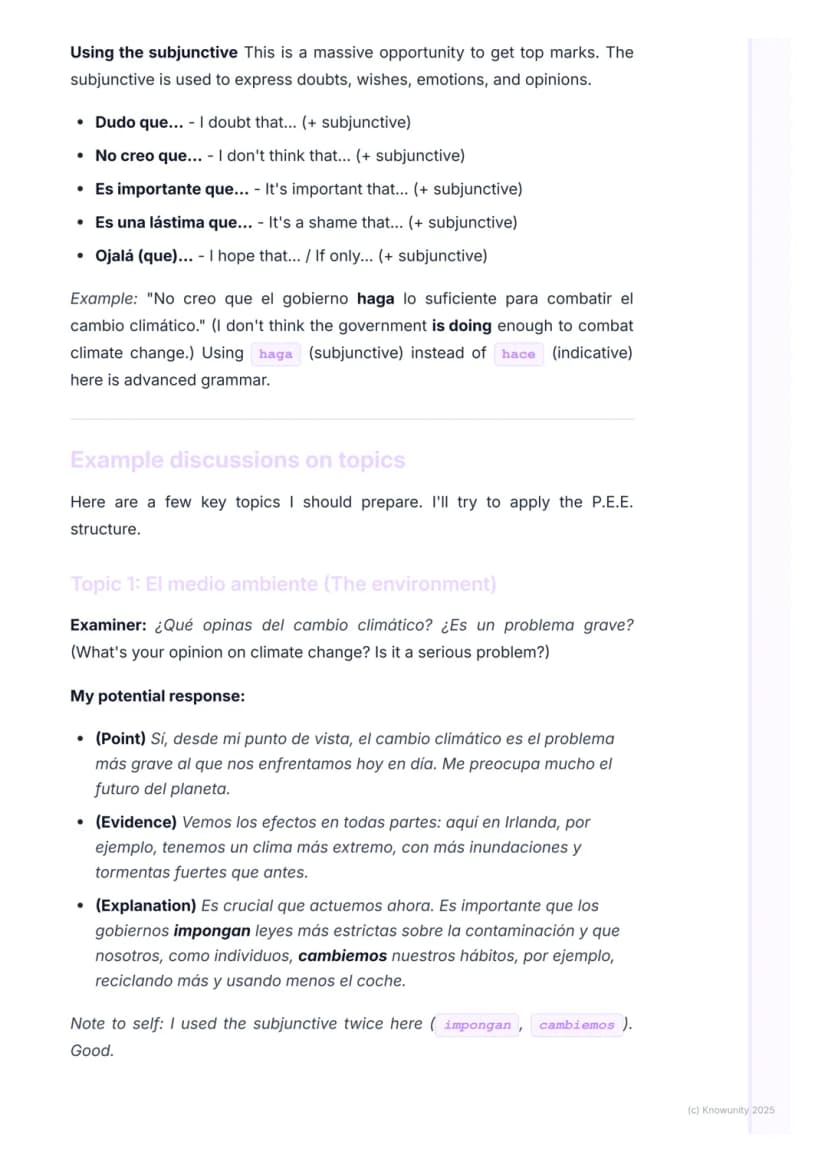
Here's your opportunity to absolutely smash the exam: using the subjunctive properly. This advanced grammar shows you're operating at a high level. Use it after phrases like "No creo que..." (I don't think that), "Es importante que..." (It's important that), and "Es una lástima que..." (It's a shame that).
Let's look at a climate change discussion. When asked about environmental problems, structure your response using P.E.E. Start with your point: "El cambio climático es el problema más grave." Add evidence from Ireland: "Tenemos más inundaciones y tormentas que antes." Then explain with subjunctive: "Es crucial que los gobiernos impongan leyes más estrictas."
Notice how "impongan" (subjunctive) sounds much more advanced than "imponen" (indicative). The examiner will definitely notice this level of grammar.
Subjunctive Success: Remember trigger phrases like "Ojalá que..." (I hope that) and "Dudo que..." automatically need the subjunctive - practise these until they're automatic.
4
of 6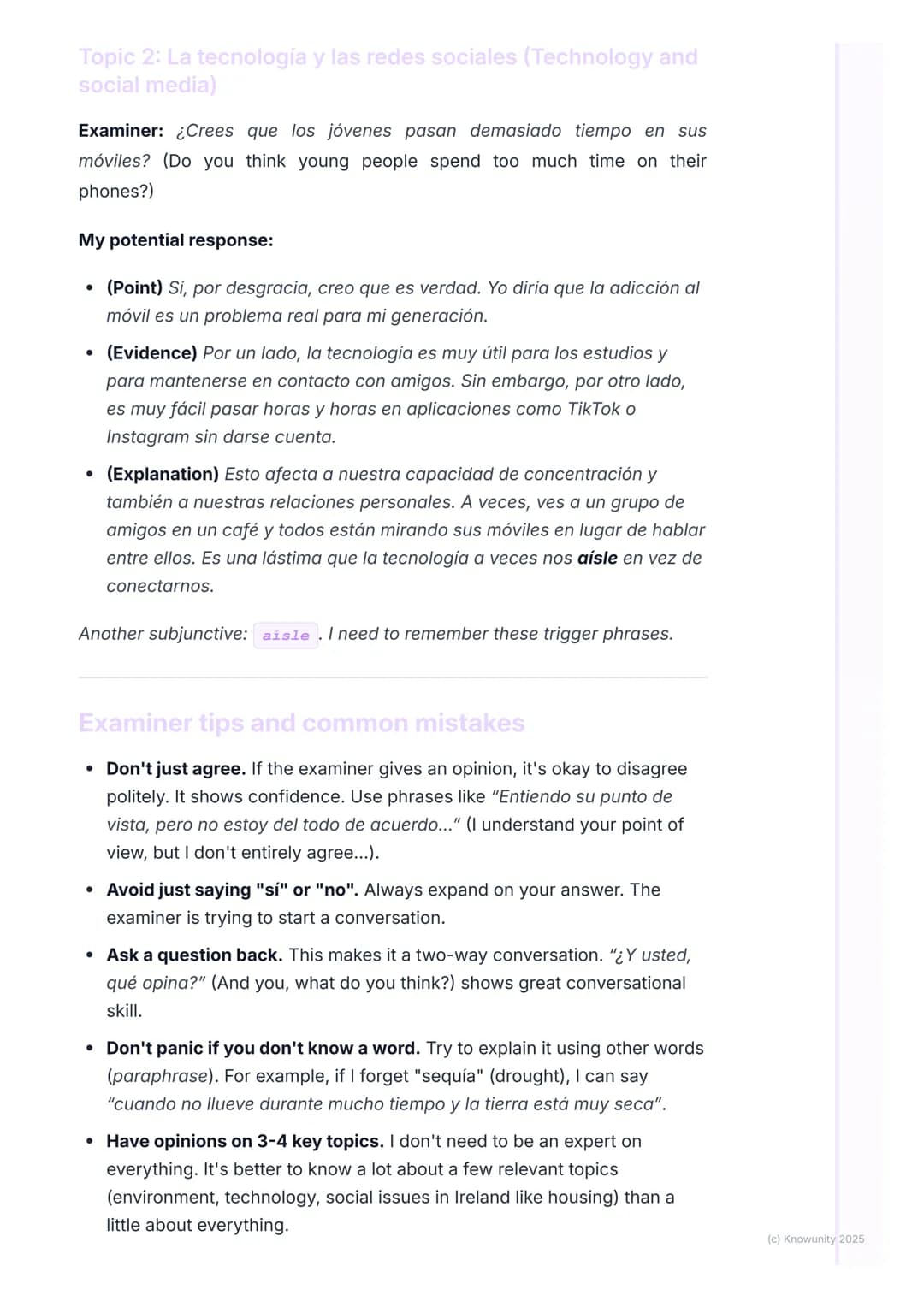
Tackling Technology and Social Media Topics
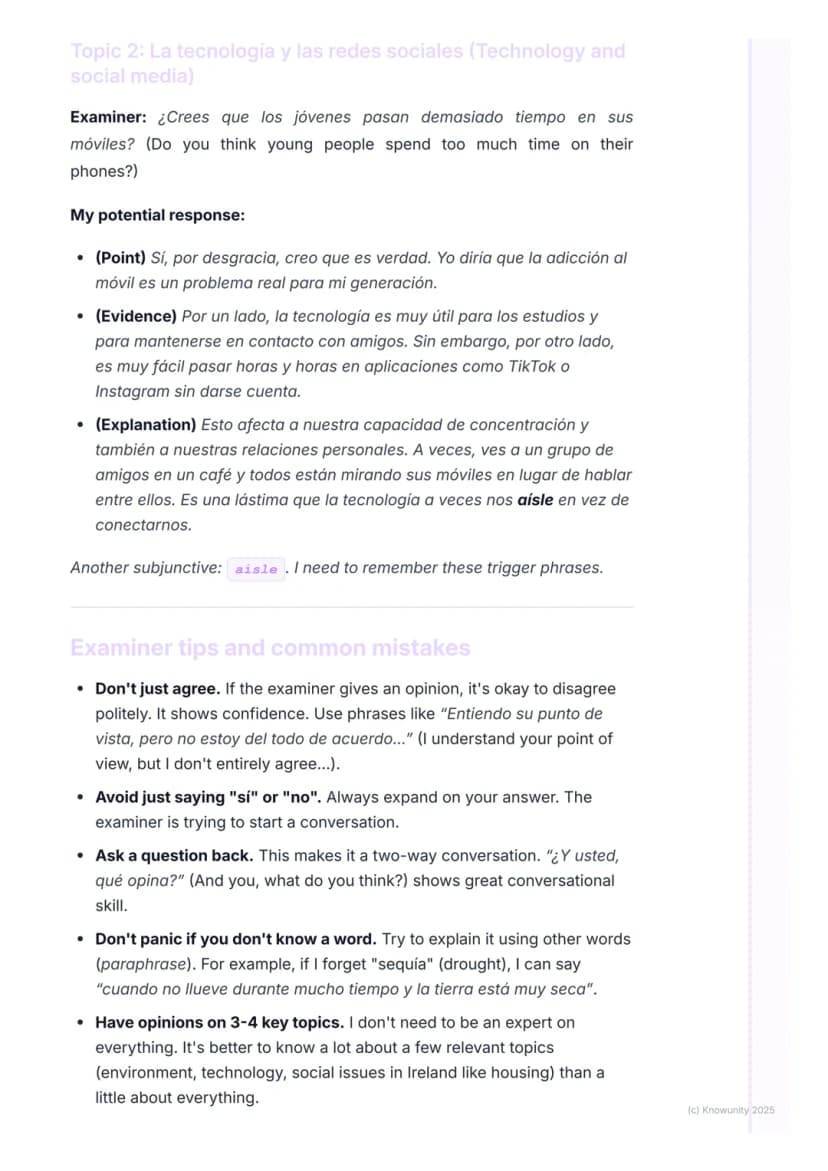
Technology discussions are exam favourites, so be ready. When asked about young people and mobile phones, don't just agree or disagree - show nuance. You might say: "Por un lado, la tecnología es útil para los estudios, sin embargo, es fácil pasar horas en TikTok sin darse cuenta."
Use personal observations to strengthen your arguments. Mention seeing groups of friends in cafés all staring at their phones instead of talking. This shows you can connect abstract issues to real-life situations.
Advanced phrases like "Yo diría que la adicción al móvil es un problema real" (I would say mobile addiction is a real problem) demonstrate sophisticated opinion-giving. The conditional "diría" is much better than simple "digo."
Conversation Hack: Don't just answer questions - ask them back! "¿Y usted, qué opina?" (And you, what do you think?) turns it into a real conversation and shows confident Spanish skills.
5
of 6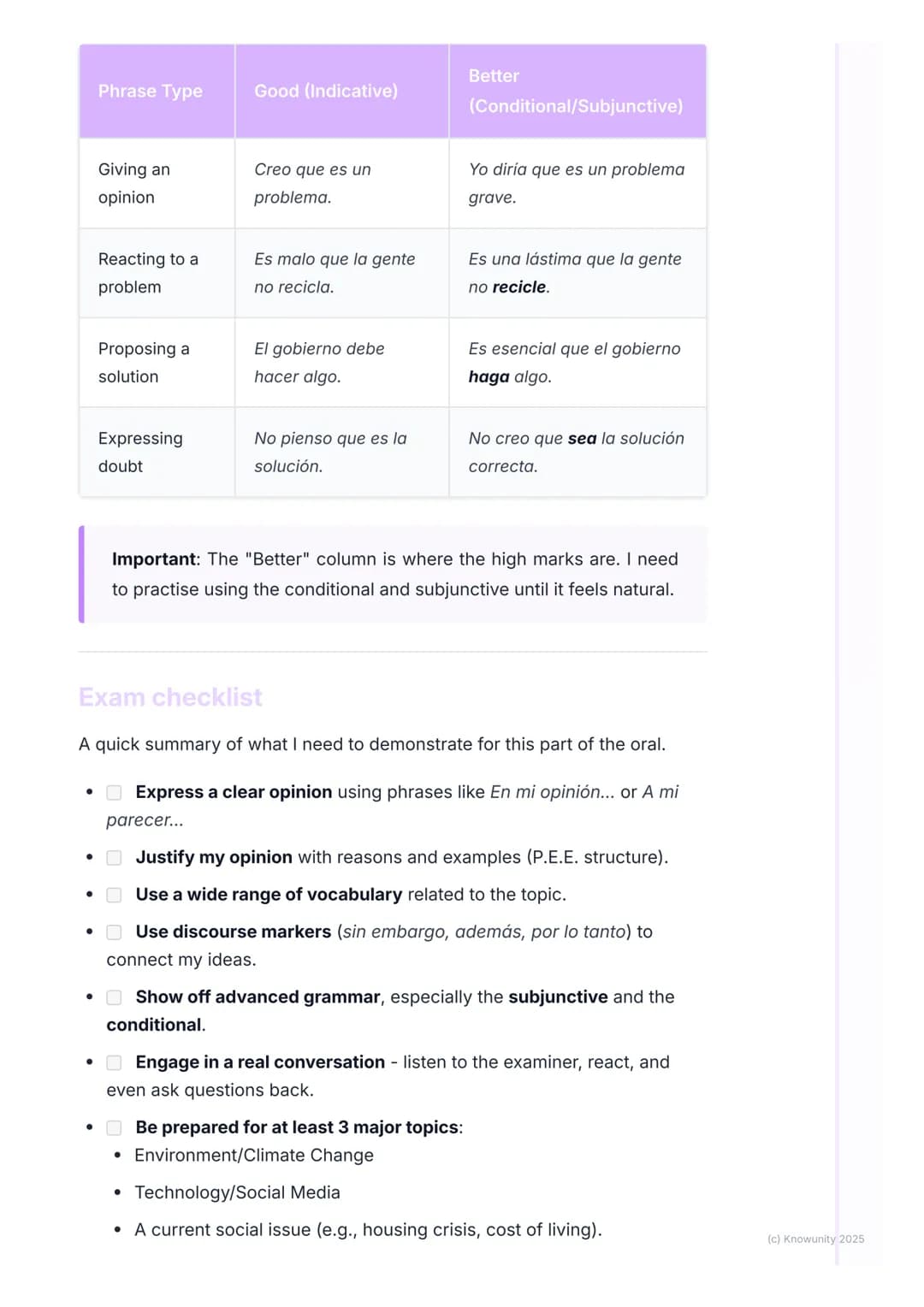
Exam Strategy and Advanced Grammar
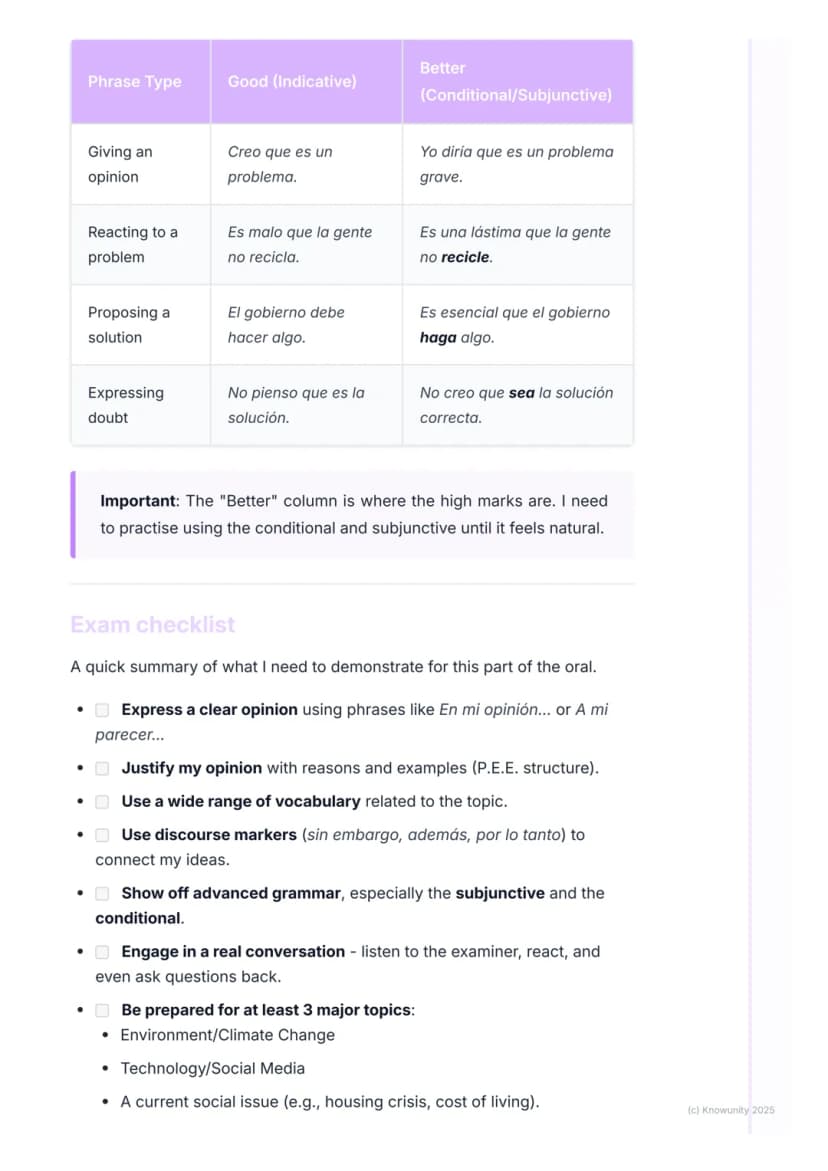
Your grammar choices make or break this section. Compare "Creo que es un problema" (basic) with "Yo diría que es un problema grave" (advanced). The conditional and subjunctive are where high marks live, so practise using phrases like "Es esencial que el gobierno haga algo" instead of "El gobierno debe hacer algo."
Don't panic if you forget a word - paraphrase instead. Can't remember "sequía" (drought)? Say "cuando no llueve durante mucho tiempo y la tierra está muy seca." This shows real language skills.
Prepare thoroughly for three key topics: environment/climate change, technology/social media, and a current Irish issue like housing costs. It's better to know lots about a few topics than a little about everything.
Confidence Builder: Remember, it's perfectly fine to disagree with the examiner politely - "Entiendo su punto de vista, pero no estoy del todo de acuerdo..." shows real conversational confidence and language maturity.
6
of 6
Pensavamo che non l'avreste mai chiesto....
Che cos'è l'assistente AI di Knowunity?
Il nostro assistente AI è costruito specificamente per le esigenze degli studenti. Sulla base dei milioni di contenuti presenti sulla piattaforma, possiamo fornire agli studenti risposte davvero significative e pertinenti. Ma non si tratta solo di risposte, l'assistente è in grado di guidare gli studenti attraverso le loro sfide quotidiane di studio, con piani di studio personalizzati, quiz o contenuti nella chat e una personalizzazione al 100% basata sulle competenze e sugli sviluppi degli studenti.
Dove posso scaricare l'applicazione Knowunity?
È possibile scaricare l'applicazione dal Google Play Store e dall'Apple App Store.
Knowunity è davvero gratuita?
Sì, hai accesso completamente gratuito a tutti i contenuti nell'app e puoi chattare o seguire i Creatori in qualsiasi momento. Sbloccherai nuove funzioni crescendo il tuo numero di follower. Inoltre, offriamo Knowunity Premium, che consente di studiare senza alcun limite!!
Contenuti più popolari di Spanish
2SpanishTechnology, Social Media, and Digital Life
Learners will gain vocabulary to discuss modern technology, internet usage, social networking, and their impact on daily life.
5th Year20
SpanishComparatives and Superlatives
Students will learn how to compare people and things using comparative structures ('más... que', 'menos... que') and superlative forms ('el/la más...').
TY70
Contenuti più popolari
9 Irish
IrishIrish oral questions and answers
Questions and answers for the leaving cert oral
5th Year4264
 English
Key Quotes : Sive
Key Quotes and explanations: Sive
6th Year2842
IrishIrish oral questions
Outline of oral questions
5th Year2055
IrishIníon- le hÁine Durkin
Aine Durkin’s poem, Iníon: Themes & summary
5th Year850
IrishIrish poetry 2027
Iníon + Dínit an Bhróin
5th Year1133
IrishLC HL notes- Iníon (poem)
Includes poem in English and Irish, theme, key words & phrases
5th Year2284
EnglishCultural Context : Shawshank Redemption : Sive : Small Things Like These
Comparative Study : Cultural Context : Shawshank Redemption, Sive and Small Things Like These
6th Year1430
IrishMo Ghrá-sa (Idir Lúibíní)
Notes on mo ghrá-sa
5th Year380
IrishAn Gaeilge Aiste
Irish Language essay
6th Year1320
Non c'è niente di adatto? Esplorare altre aree tematiche.
Recensioni dei nostri utenti. Ci adorano - e anche tu, vedrai .
4.6/5App Store
4.7/5Google Play
L'applicazione è molto facile da usare e ben progettata. Finora ho trovato tutto quello che cercavo e ho potuto imparare molto dalle presentazioni! Utilizzerò sicuramente l'app per i compiti in classe! È molto utile anche come fonte di ispirazione.
Stefano Sutente iOS
Questa applicazione è davvero grande! Ci sono tantissimi appunti e aiuti con lo studio [...]. La mia materia problematica, per esempio, è il francese e l'app ha così tante opzioni per aiutarmi. Grazie a questa app ho migliorato il mio francese. La consiglio a tutti.
Samantha Klichutente Android
Wow, sono davvero stupita. Ho appena provato l'app perché l'ho vista pubblicizzata molte volte e sono rimasta assolutamente sbalordita. Questa app è L'AIUTO che cercate per la scuola e soprattutto offre tantissime cose, come allenamenti e schede, che a me personalmente sono state MOLTO utili.
Annautente iOS
Spanish1 visualizzazioni·Aggiornato Jun 15, 2026·6 pagineExploring Complex Social and Ethical Topics
Ready to ace the conversation part of your Spanish oral exam? This section moves beyond personal topics to test your ability to discuss complex issues like climate change, technology, and social problems. The key is sounding natural and confident whilst...
1
of 6
Iscriviti per mostrare il contenuto. È gratis!
- Accesso a tutti i documenti
- Migliora i tuoi voti
- Unisciti a milioni di studenti
Getting Started with Abstract Topics
Your examiner wants to see you handle topical issues and current affairs, not just chat about your family or school. This is where you can really shine by showing your range of vocabulary and grammar. The goal isn't to sound like you've memorised an essay - you need to react naturally to what the examiner says.
Think of this as a proper conversation where you're discussing real-world problems. You'll need to give and justify opinions on things like social media, environmental issues, or problems facing Ireland today. This is your chance to pick up serious marks.
Essential opinion phrases include "En mi opinión..." (In my opinion), "Desde mi punto de vista..." (From my point of view), and "Yo diría que..." (I would say that). Learn these until they become second nature - you'll use them constantly.
Top Tip: Master phrases like "Hoy en día, se habla mucho de..." (Nowadays, there's a lot of talk about...) to introduce topics smoothly and sound sophisticated from the start.
2
of 6Iscriviti per mostrare il contenuto. È gratis!
- Accesso a tutti i documenti
- Migliora i tuoi voti
- Unisciti a milioni di studenti
Structuring Your Arguments Like a Pro
Don't just throw out random opinions - structure them properly using discourse markers. Start with "Por un lado... por otro lado..." (On the one hand... on the other hand) or "En primer lugar..." (Firstly). These phrases make your argument flow beautifully and show the examiner you can think logically.
The P.E.E. structure is your secret weapon: Point, Evidence, Explanation. First, state your opinion clearly. Then give an example or reason to back it up. Finally, explain how your evidence supports your point - this is where you can show off complex language.
For example: "Las redes sociales tienen un impacto negativo" (Point), "muchos jóvenes se comparan con vidas 'perfectas' en Instagram" (Evidence), "esto causa problemas de autoestima porque es imposible alcanzar esos estándares" (Explanation).
Grammar Gold: Use discourse markers like "Sin embargo" (However) and "Por lo tanto" (Therefore) to connect your ideas - it instantly makes you sound more sophisticated and organised.
3
of 6Iscriviti per mostrare il contenuto. È gratis!
- Accesso a tutti i documenti
- Migliora i tuoi voti
- Unisciti a milioni di studenti
Mastering the Subjunctive for Top Marks
Here's your opportunity to absolutely smash the exam: using the subjunctive properly. This advanced grammar shows you're operating at a high level. Use it after phrases like "No creo que..." (I don't think that), "Es importante que..." (It's important that), and "Es una lástima que..." (It's a shame that).
Let's look at a climate change discussion. When asked about environmental problems, structure your response using P.E.E. Start with your point: "El cambio climático es el problema más grave." Add evidence from Ireland: "Tenemos más inundaciones y tormentas que antes." Then explain with subjunctive: "Es crucial que los gobiernos impongan leyes más estrictas."
Notice how "impongan" (subjunctive) sounds much more advanced than "imponen" (indicative). The examiner will definitely notice this level of grammar.
Subjunctive Success: Remember trigger phrases like "Ojalá que..." (I hope that) and "Dudo que..." automatically need the subjunctive - practise these until they're automatic.
4
of 6Iscriviti per mostrare il contenuto. È gratis!
- Accesso a tutti i documenti
- Migliora i tuoi voti
- Unisciti a milioni di studenti
Tackling Technology and Social Media Topics
Technology discussions are exam favourites, so be ready. When asked about young people and mobile phones, don't just agree or disagree - show nuance. You might say: "Por un lado, la tecnología es útil para los estudios, sin embargo, es fácil pasar horas en TikTok sin darse cuenta."
Use personal observations to strengthen your arguments. Mention seeing groups of friends in cafés all staring at their phones instead of talking. This shows you can connect abstract issues to real-life situations.
Advanced phrases like "Yo diría que la adicción al móvil es un problema real" (I would say mobile addiction is a real problem) demonstrate sophisticated opinion-giving. The conditional "diría" is much better than simple "digo."
Conversation Hack: Don't just answer questions - ask them back! "¿Y usted, qué opina?" (And you, what do you think?) turns it into a real conversation and shows confident Spanish skills.
5
of 6Iscriviti per mostrare il contenuto. È gratis!
- Accesso a tutti i documenti
- Migliora i tuoi voti
- Unisciti a milioni di studenti
Exam Strategy and Advanced Grammar
Your grammar choices make or break this section. Compare "Creo que es un problema" (basic) with "Yo diría que es un problema grave" (advanced). The conditional and subjunctive are where high marks live, so practise using phrases like "Es esencial que el gobierno haga algo" instead of "El gobierno debe hacer algo."
Don't panic if you forget a word - paraphrase instead. Can't remember "sequía" (drought)? Say "cuando no llueve durante mucho tiempo y la tierra está muy seca." This shows real language skills.
Prepare thoroughly for three key topics: environment/climate change, technology/social media, and a current Irish issue like housing costs. It's better to know lots about a few topics than a little about everything.
Confidence Builder: Remember, it's perfectly fine to disagree with the examiner politely - "Entiendo su punto de vista, pero no estoy del todo de acuerdo..." shows real conversational confidence and language maturity.
6
of 6Iscriviti per mostrare il contenuto. È gratis!
- Accesso a tutti i documenti
- Migliora i tuoi voti
- Unisciti a milioni di studenti
Pensavamo che non l'avreste mai chiesto....
Che cos'è l'assistente AI di Knowunity?
Il nostro assistente AI è costruito specificamente per le esigenze degli studenti. Sulla base dei milioni di contenuti presenti sulla piattaforma, possiamo fornire agli studenti risposte davvero significative e pertinenti. Ma non si tratta solo di risposte, l'assistente è in grado di guidare gli studenti attraverso le loro sfide quotidiane di studio, con piani di studio personalizzati, quiz o contenuti nella chat e una personalizzazione al 100% basata sulle competenze e sugli sviluppi degli studenti.
Dove posso scaricare l'applicazione Knowunity?
È possibile scaricare l'applicazione dal Google Play Store e dall'Apple App Store.
Knowunity è davvero gratuita?
Sì, hai accesso completamente gratuito a tutti i contenuti nell'app e puoi chattare o seguire i Creatori in qualsiasi momento. Sbloccherai nuove funzioni crescendo il tuo numero di follower. Inoltre, offriamo Knowunity Premium, che consente di studiare senza alcun limite!!
Contenuti più popolari di Spanish
2SpanishTechnology, Social Media, and Digital Life
Learners will gain vocabulary to discuss modern technology, internet usage, social networking, and their impact on daily life.
5th Year20
SpanishComparatives and Superlatives
Students will learn how to compare people and things using comparative structures ('más... que', 'menos... que') and superlative forms ('el/la más...').
TY70
Contenuti più popolari
9IrishIrish oral questions and answers
Questions and answers for the leaving cert oral
5th Year4264
EnglishKey Quotes : Sive
Key Quotes and explanations: Sive
6th Year2842
IrishIrish oral questions
Outline of oral questions
5th Year2055
IrishIníon- le hÁine Durkin
Aine Durkin’s poem, Iníon: Themes & summary
5th Year850
IrishIrish poetry 2027
Iníon + Dínit an Bhróin
5th Year1133
IrishLC HL notes- Iníon (poem)
Includes poem in English and Irish, theme, key words & phrases
5th Year2284
EnglishCultural Context : Shawshank Redemption : Sive : Small Things Like These
Comparative Study : Cultural Context : Shawshank Redemption, Sive and Small Things Like These
6th Year1430
IrishMo Ghrá-sa (Idir Lúibíní)
Notes on mo ghrá-sa
5th Year380
IrishAn Gaeilge Aiste
Irish Language essay
6th Year1320
Non c'è niente di adatto? Esplorare altre aree tematiche.
Recensioni dei nostri utenti. Ci adorano - e anche tu, vedrai .
4.6/5App Store
4.7/5Google Play
L'applicazione è molto facile da usare e ben progettata. Finora ho trovato tutto quello che cercavo e ho potuto imparare molto dalle presentazioni! Utilizzerò sicuramente l'app per i compiti in classe! È molto utile anche come fonte di ispirazione.
Stefano Sutente iOS
Questa applicazione è davvero grande! Ci sono tantissimi appunti e aiuti con lo studio [...]. La mia materia problematica, per esempio, è il francese e l'app ha così tante opzioni per aiutarmi. Grazie a questa app ho migliorato il mio francese. La consiglio a tutti.
Samantha Klichutente Android
Wow, sono davvero stupita. Ho appena provato l'app perché l'ho vista pubblicizzata molte volte e sono rimasta assolutamente sbalordita. Questa app è L'AIUTO che cercate per la scuola e soprattutto offre tantissime cose, come allenamenti e schede, che a me personalmente sono state MOLTO utili.
Annautente iOS