
Ever wonder why things fall down instead of up, or...
 Physics56 visualizzazioni·Aggiornato Jun 8, 2026·5 pagine
Understanding Different Types of Forces
1 / 5
1
of 5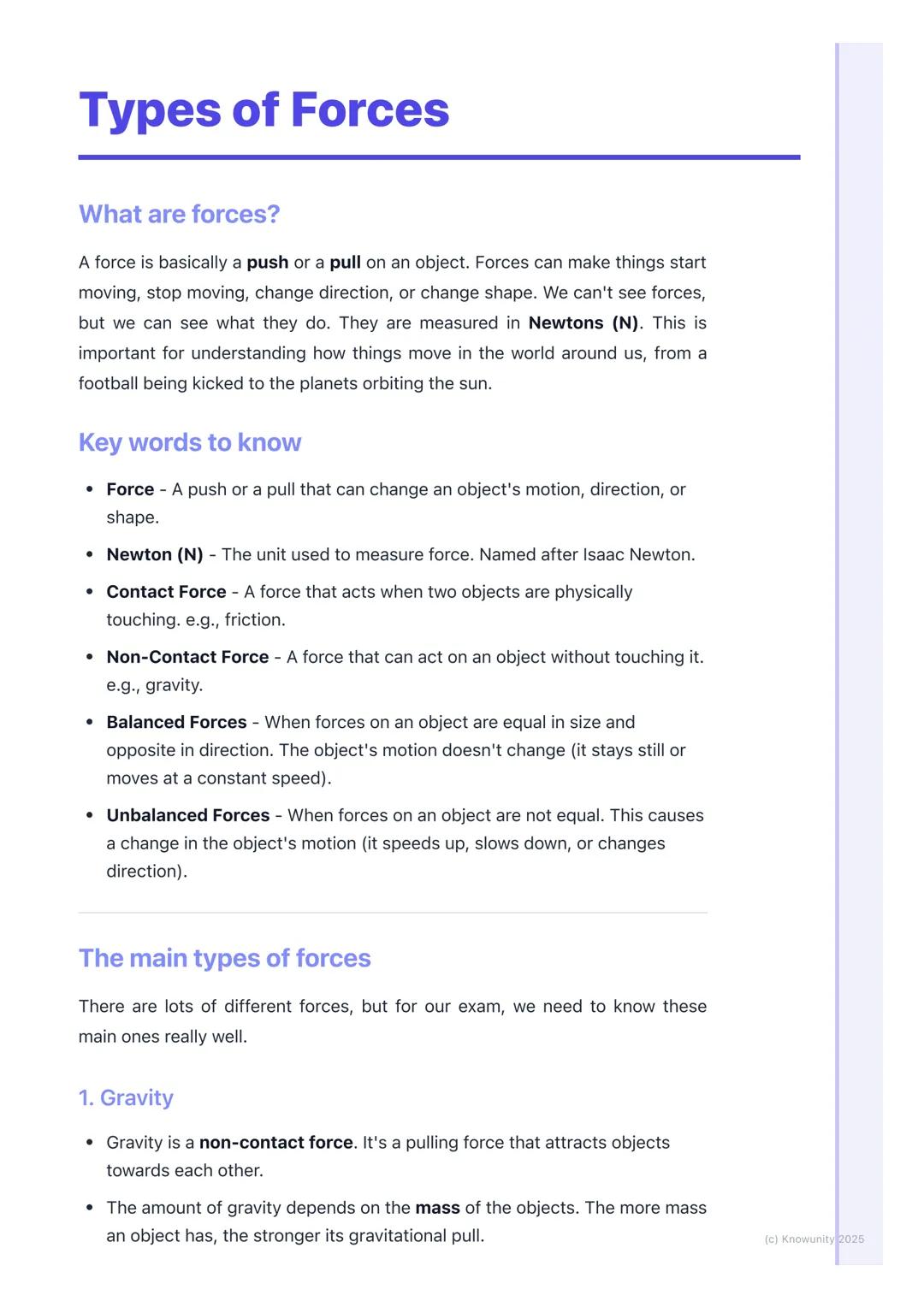
What Are Forces?
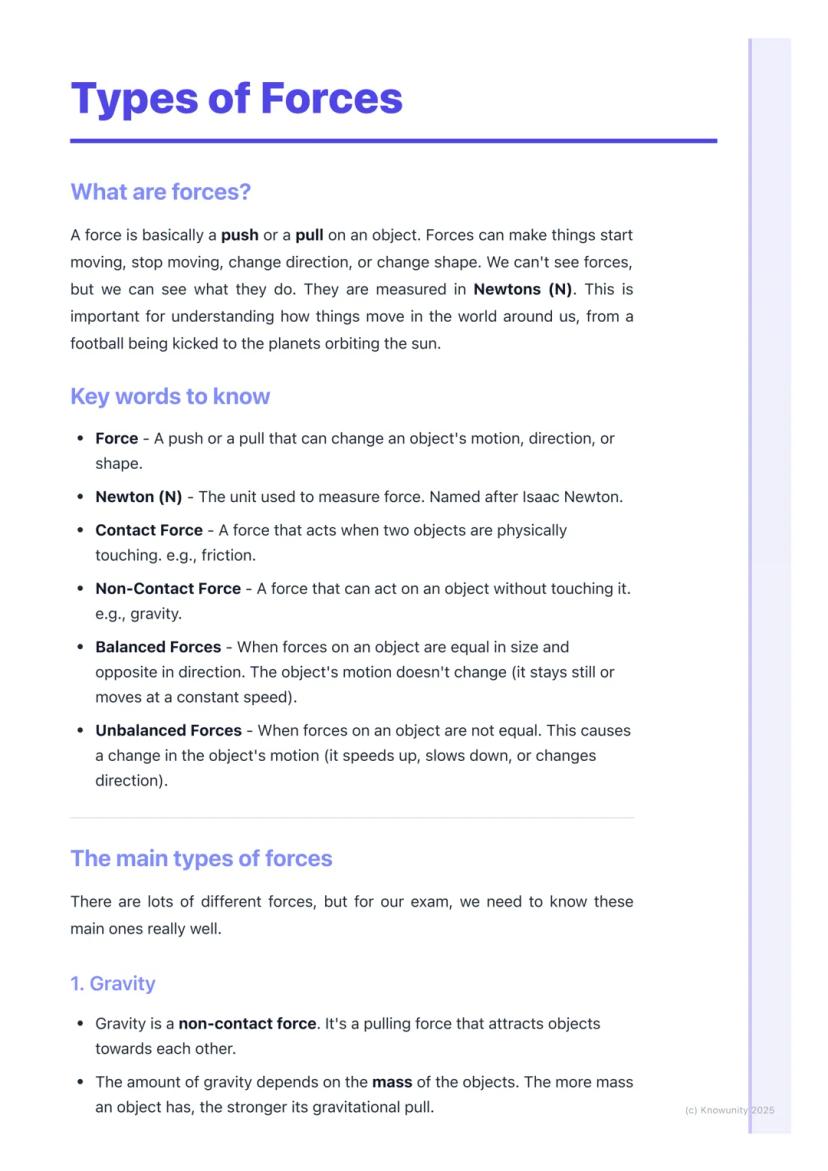
Think of forces as the invisible hands of physics - you can't see them, but you definitely see what they do! A force is simply a push or a pull that can make objects start moving, stop moving, change direction, or even change shape. We measure forces in Newtons (N), named after the famous scientist Isaac Newton.
Forces come in two main types. Contact forces happen when objects are actually touching each other, like when you push a door or rub your hands together. Non-contact forces can affect objects without touching them - gravity pulling on you right now is a perfect example.
Here's something crucial for your exams: forces can be balanced or unbalanced. When forces are balanced (equal in size but opposite in direction), nothing changes - objects stay still or keep moving at the same speed. When forces are unbalanced, that's when the action happens - things speed up, slow down, or change direction.
Remember: You experience hundreds of forces every day - from gravity keeping your feet on the ground to friction helping you walk without slipping!
2
of 5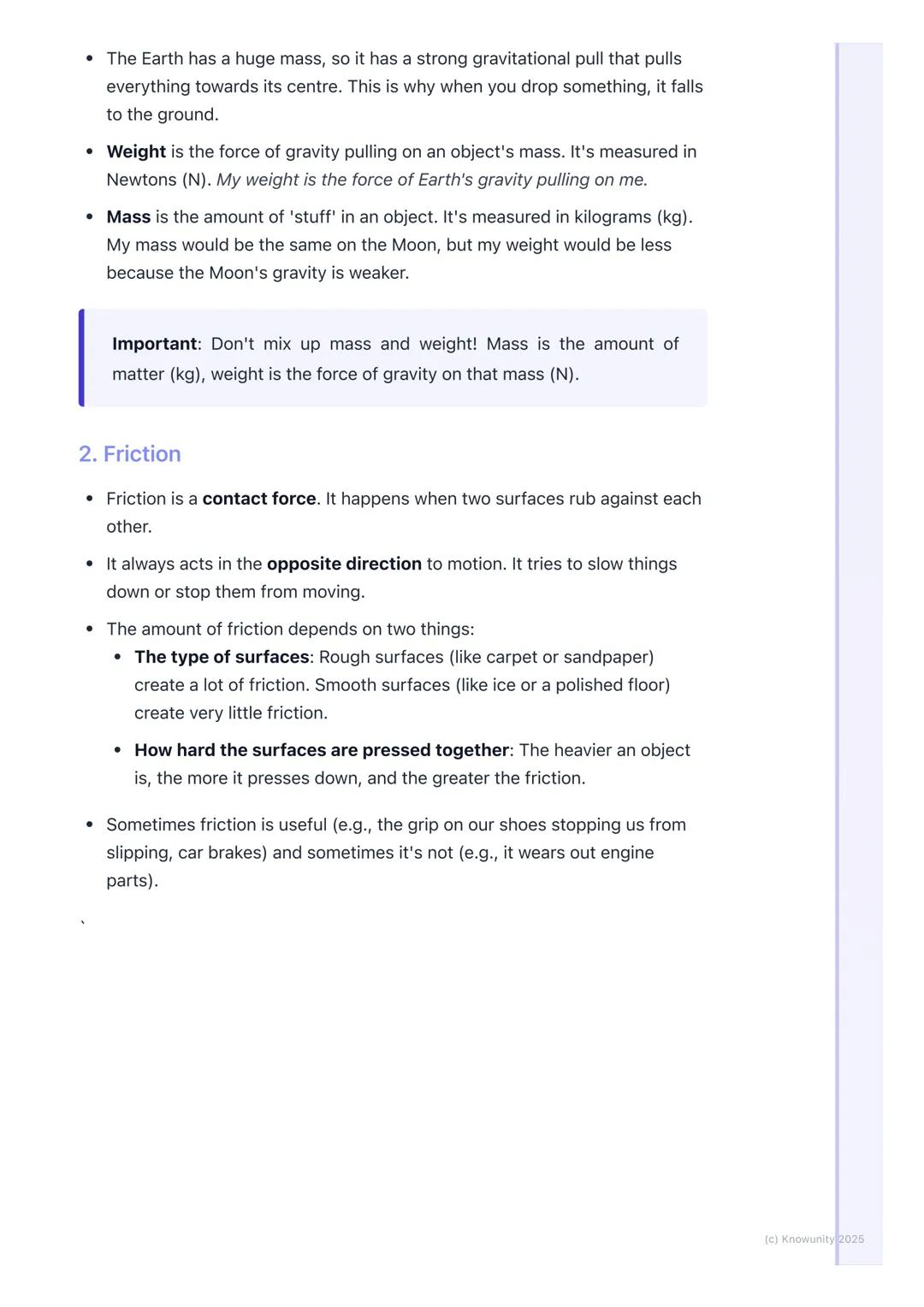
Gravity - The Ultimate Pulling Force
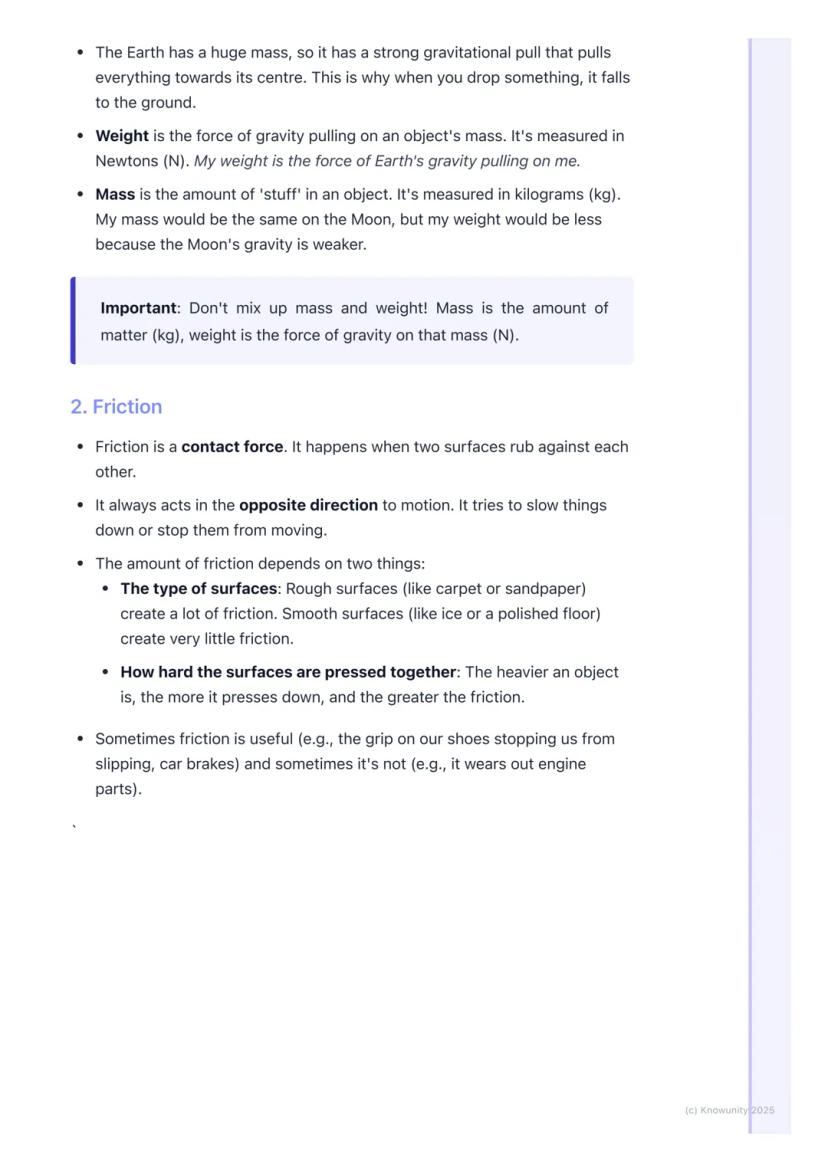
Gravity is probably the most important force you'll ever encounter - it's literally keeping you grounded right now! This non-contact force pulls objects towards each other, and the stronger the mass of an object, the stronger its gravitational pull. Earth has massive mass, so it pulls everything towards its centre.
Here's where students often get confused: mass and weight are completely different things. Your mass (measured in kg) is the amount of 'stuff' you're made of - it stays the same whether you're on Earth, the Moon, or floating in space. Your weight (measured in Newtons) is the force of gravity pulling on your mass, and it changes depending on where you are.
Think about it this way: if you went to the Moon, you'd have the same mass but weigh much less because the Moon's gravity is weaker than Earth's. That's why astronauts can bounce around so easily up there!
Exam Tip: Questions about mass vs weight are guaranteed to appear - mass is in kg, weight is the gravitational force in Newtons!
3
of 5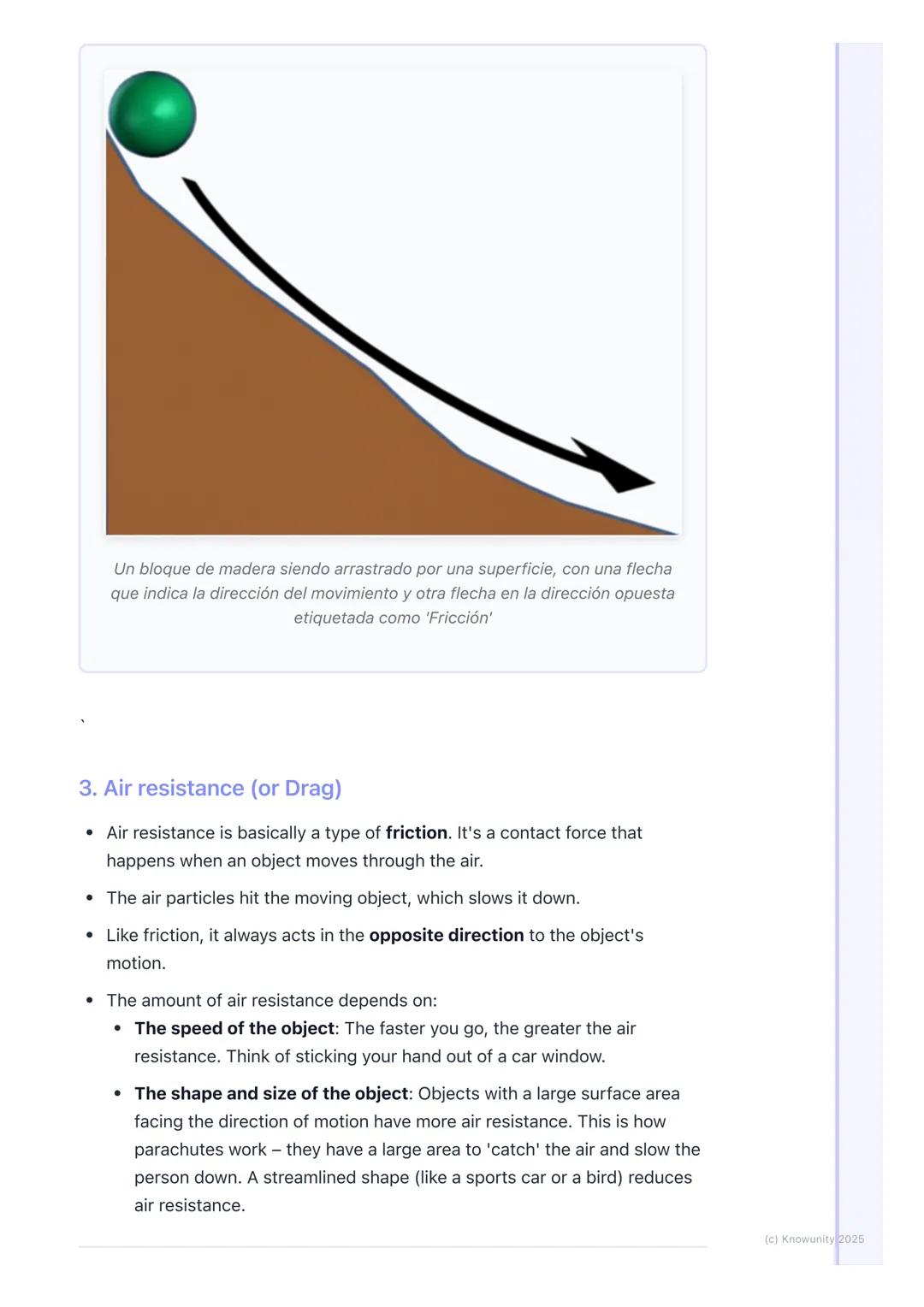
Friction - The Force That Fights Movement
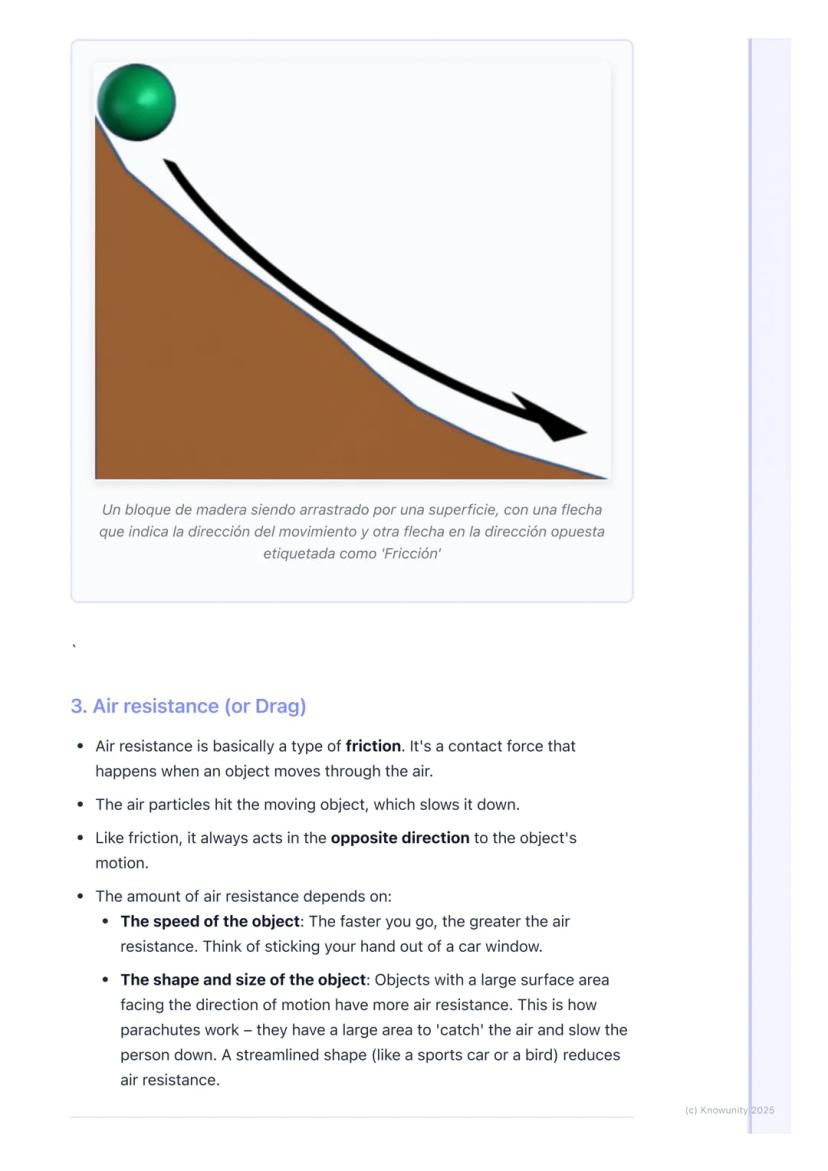
Friction is the rebel of the force world - it always tries to oppose motion! This contact force happens when two surfaces rub against each other, and it always acts in the opposite direction to movement. Without friction, you'd slide helplessly across the floor like you're on ice.
The amount of friction depends on two key things. First, the type of surfaces involved - rough surfaces like sandpaper create loads of friction, while smooth surfaces like polished floors create very little. Second, how hard the surfaces press together - heavier objects create more friction because they press down harder.
Friction can be your best friend or your worst enemy. It's brilliant when you need grip (like football boots on grass or car brakes stopping you safely), but it's annoying when it wears out moving parts in engines or makes it harder to push heavy objects.
Real-world Connection: Next time you're walking, think about how friction between your shoes and the ground stops you from slipping with every step!
4
of 5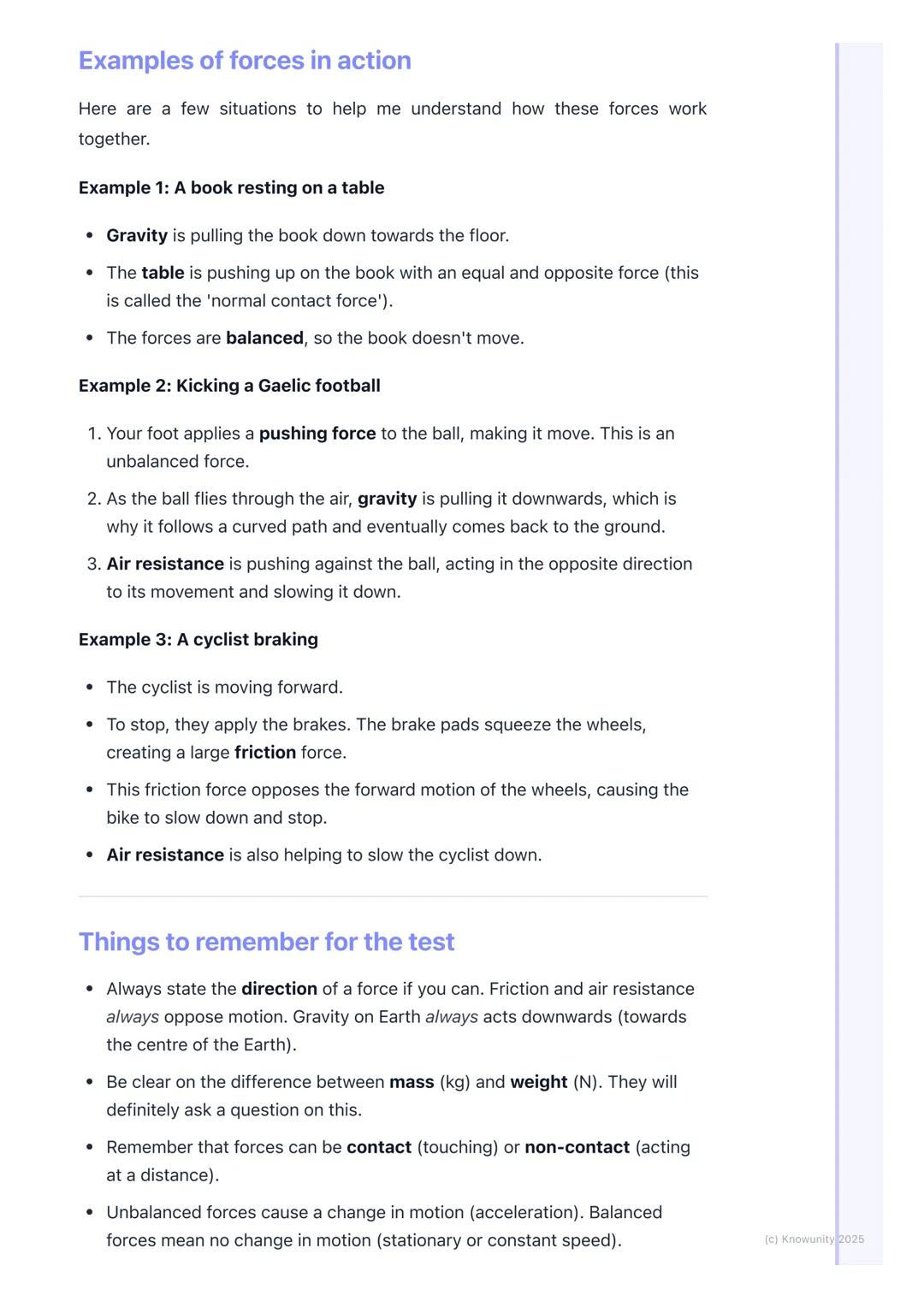
Air Resistance - Friction's Flying Cousin
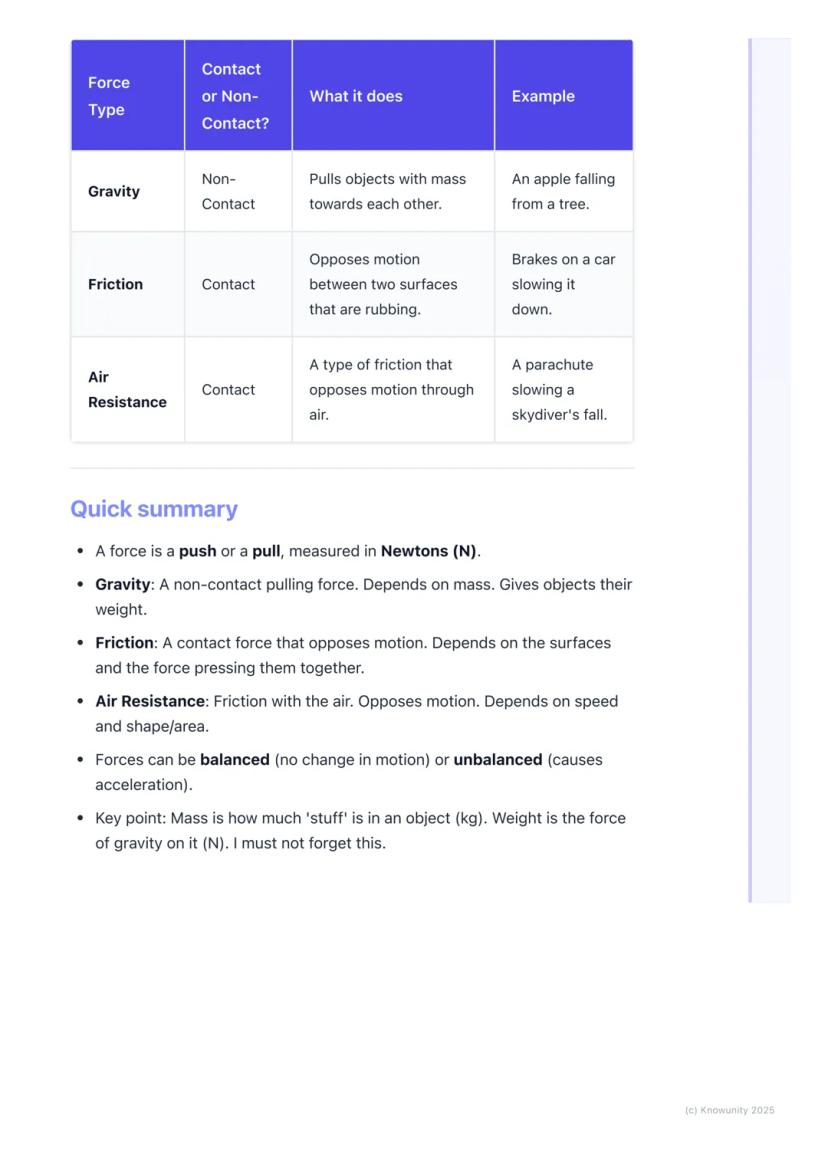
Air resistance (also called drag) is basically friction's cousin that works in the air. When objects move through air, tiny air particles bash into them, creating a contact force that opposes the motion. It's like trying to run through water - the faster you go, the harder it pushes back.
Two main factors affect how much air resistance you experience. Speed is the big one - stick your hand out of a car window and you'll feel how air resistance increases with speed. The shape and size of the object matter too - that's why parachutes work so well with their huge surface area catching air, while sports cars are streamlined to slice through air easily.
Air resistance explains why feathers fall slowly while stones drop quickly, and why cyclists crouch down to go faster. It's constantly working against moving objects, gradually slowing them down unless another force keeps pushing them forward.
Think About It: Birds have naturally streamlined shapes to reduce air resistance - evolution's way of making flight more efficient!
5
of 5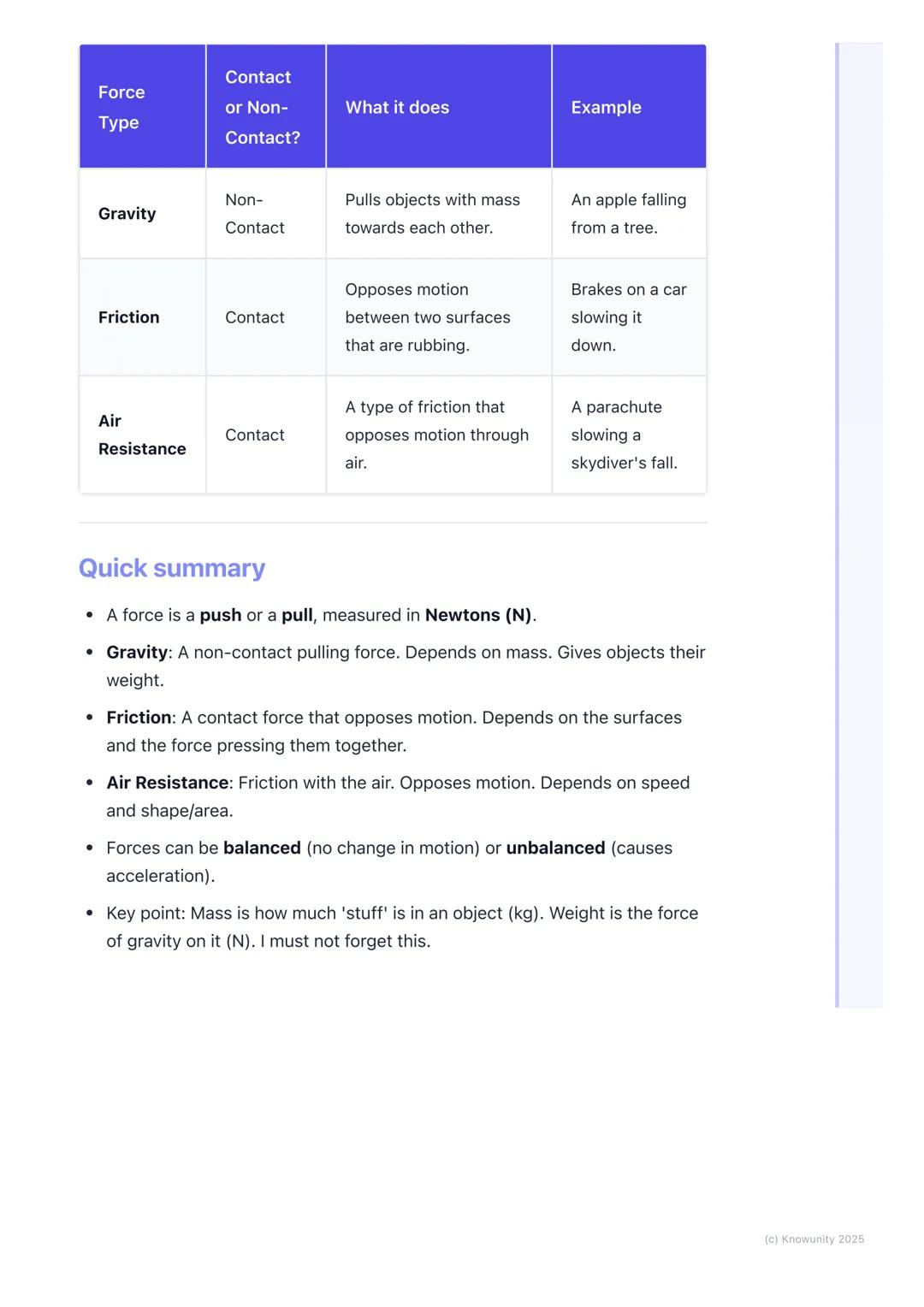
Forces Working Together - Real Examples
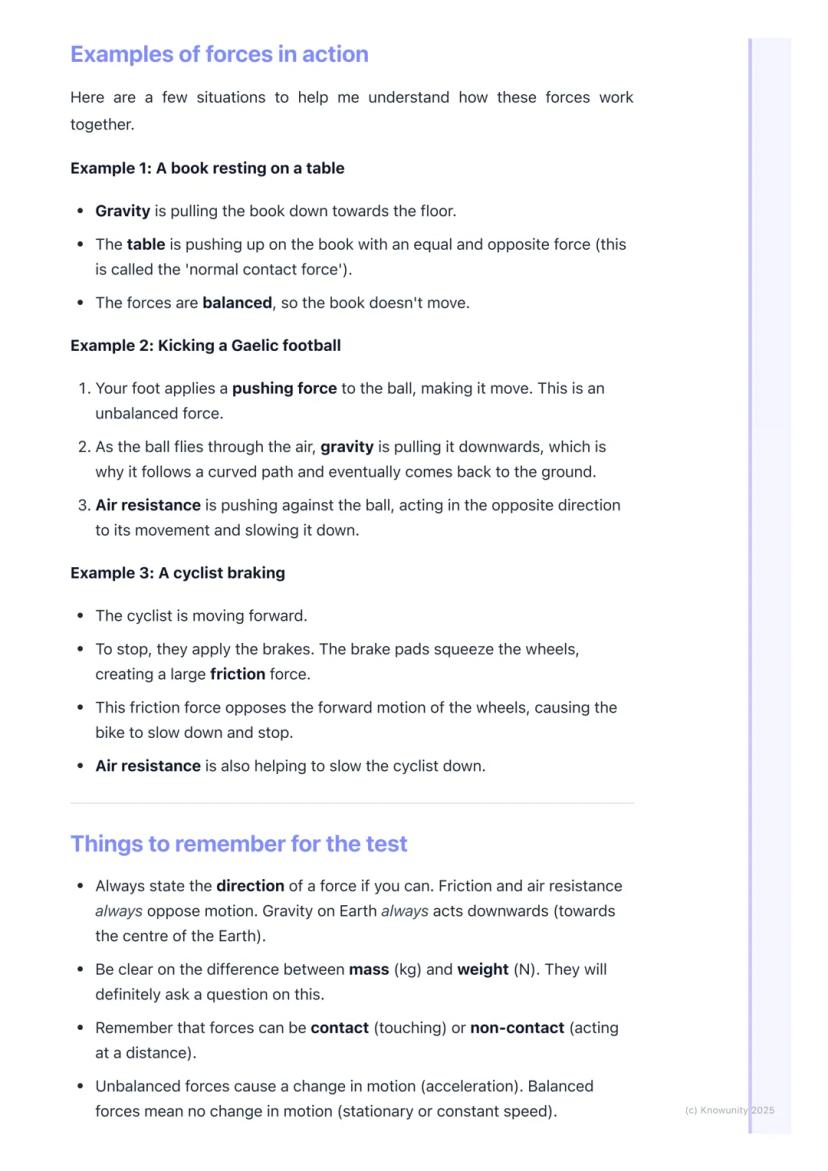
Let's see how these forces team up in everyday situations you'll recognise. When a book sits on your desk, gravity pulls it downward while the table pushes up with equal force - these balanced forces keep the book perfectly still.
Kicking a football shows unbalanced forces in action. Your foot applies a pushing force that gets the ball moving, gravity curves its path downward, and air resistance gradually slows it down. All three forces work together to create that familiar arc through the air.
When you're cycling and need to brake, friction becomes the hero. The brake pads squeeze your wheels, creating friction that opposes your forward motion. Combined with air resistance, these forces bring you safely to a stop.
Exam Success: Always remember to state the direction of forces - gravity pulls down, friction opposes motion, and air resistance works against the direction you're moving!
Pensavamo che non l'avreste mai chiesto....
Che cos'è l'assistente AI di Knowunity?
Il nostro assistente AI è costruito specificamente per le esigenze degli studenti. Sulla base dei milioni di contenuti presenti sulla piattaforma, possiamo fornire agli studenti risposte davvero significative e pertinenti. Ma non si tratta solo di risposte, l'assistente è in grado di guidare gli studenti attraverso le loro sfide quotidiane di studio, con piani di studio personalizzati, quiz o contenuti nella chat e una personalizzazione al 100% basata sulle competenze e sugli sviluppi degli studenti.
Dove posso scaricare l'applicazione Knowunity?
È possibile scaricare l'applicazione dal Google Play Store e dall'Apple App Store.
Knowunity è davvero gratuita?
Sì, hai accesso completamente gratuito a tutti i contenuti nell'app e puoi chattare o seguire i Creatori in qualsiasi momento. Sbloccherai nuove funzioni crescendo il tuo numero di follower. Inoltre, offriamo Knowunity Premium, che consente di studiare senza alcun limite!!
Contenuti più popolari di Physics
2 Science
Contenuti più popolari
9 English
Key Quotes : Sive
Key Quotes and explanations: Sive
6th Year2842
 Irish
IrishIrish oral questions and answers
Questions and answers for the leaving cert oral
5th Year4264
PhysicsBalanced and Unbalanced Forces
Students will explore how balanced forces result in no change in motion, while unbalanced forces cause an object to accelerate or change direction.
2nd Year522
IrishIníon- le hÁine Durkin
Aine Durkin’s poem, Iníon: Themes & summary
5th Year890
EnglishCultural Context : Shawshank Redemption : Sive : Small Things Like These
Comparative Study : Cultural Context : Shawshank Redemption, Sive and Small Things Like These
6th Year1430
IrishLC HL notes- Iníon (poem)
Includes poem in English and Irish, theme, key words & phrases
5th Year2304
IrishIrish oral questions
Outline of oral questions
5th Year2055
IrishMo Ghrá-sa (Idir Lúibíní)
Notes on mo ghrá-sa
5th Year380
IrishAn Gaeilge Aiste
Irish Language essay
6th Year1320
Non c'è niente di adatto? Esplorare altre aree tematiche.
Recensioni dei nostri utenti. Ci adorano - e anche tu, vedrai .
4.6/5App Store
4.7/5Google Play
L'applicazione è molto facile da usare e ben progettata. Finora ho trovato tutto quello che cercavo e ho potuto imparare molto dalle presentazioni! Utilizzerò sicuramente l'app per i compiti in classe! È molto utile anche come fonte di ispirazione.
Stefano Sutente iOS
Questa applicazione è davvero grande! Ci sono tantissimi appunti e aiuti con lo studio [...]. La mia materia problematica, per esempio, è il francese e l'app ha così tante opzioni per aiutarmi. Grazie a questa app ho migliorato il mio francese. La consiglio a tutti.
Samantha Klichutente Android
Wow, sono davvero stupita. Ho appena provato l'app perché l'ho vista pubblicizzata molte volte e sono rimasta assolutamente sbalordita. Questa app è L'AIUTO che cercate per la scuola e soprattutto offre tantissime cose, come allenamenti e schede, che a me personalmente sono state MOLTO utili.
Annautente iOS
Physics56 visualizzazioni·Aggiornato Jun 8, 2026·5 pagineUnderstanding Different Types of Forces
Ever wonder why things fall down instead of up, or why you can't slide forever on a smooth floor? Forces are everywhere around us - they're the invisible pushes and pulls that make everything move, stop, or change direction. Understanding...
1
of 5
Iscriviti per mostrare il contenuto. È gratis!
- Accesso a tutti i documenti
- Migliora i tuoi voti
- Unisciti a milioni di studenti
What Are Forces?
Think of forces as the invisible hands of physics - you can't see them, but you definitely see what they do! A force is simply a push or a pull that can make objects start moving, stop moving, change direction, or even change shape. We measure forces in Newtons (N), named after the famous scientist Isaac Newton.
Forces come in two main types. Contact forces happen when objects are actually touching each other, like when you push a door or rub your hands together. Non-contact forces can affect objects without touching them - gravity pulling on you right now is a perfect example.
Here's something crucial for your exams: forces can be balanced or unbalanced. When forces are balanced (equal in size but opposite in direction), nothing changes - objects stay still or keep moving at the same speed. When forces are unbalanced, that's when the action happens - things speed up, slow down, or change direction.
Remember: You experience hundreds of forces every day - from gravity keeping your feet on the ground to friction helping you walk without slipping!
2
of 5Iscriviti per mostrare il contenuto. È gratis!
- Accesso a tutti i documenti
- Migliora i tuoi voti
- Unisciti a milioni di studenti
Gravity - The Ultimate Pulling Force
Gravity is probably the most important force you'll ever encounter - it's literally keeping you grounded right now! This non-contact force pulls objects towards each other, and the stronger the mass of an object, the stronger its gravitational pull. Earth has massive mass, so it pulls everything towards its centre.
Here's where students often get confused: mass and weight are completely different things. Your mass (measured in kg) is the amount of 'stuff' you're made of - it stays the same whether you're on Earth, the Moon, or floating in space. Your weight (measured in Newtons) is the force of gravity pulling on your mass, and it changes depending on where you are.
Think about it this way: if you went to the Moon, you'd have the same mass but weigh much less because the Moon's gravity is weaker than Earth's. That's why astronauts can bounce around so easily up there!
Exam Tip: Questions about mass vs weight are guaranteed to appear - mass is in kg, weight is the gravitational force in Newtons!
3
of 5Iscriviti per mostrare il contenuto. È gratis!
- Accesso a tutti i documenti
- Migliora i tuoi voti
- Unisciti a milioni di studenti
Friction - The Force That Fights Movement
Friction is the rebel of the force world - it always tries to oppose motion! This contact force happens when two surfaces rub against each other, and it always acts in the opposite direction to movement. Without friction, you'd slide helplessly across the floor like you're on ice.
The amount of friction depends on two key things. First, the type of surfaces involved - rough surfaces like sandpaper create loads of friction, while smooth surfaces like polished floors create very little. Second, how hard the surfaces press together - heavier objects create more friction because they press down harder.
Friction can be your best friend or your worst enemy. It's brilliant when you need grip (like football boots on grass or car brakes stopping you safely), but it's annoying when it wears out moving parts in engines or makes it harder to push heavy objects.
Real-world Connection: Next time you're walking, think about how friction between your shoes and the ground stops you from slipping with every step!
4
of 5Iscriviti per mostrare il contenuto. È gratis!
- Accesso a tutti i documenti
- Migliora i tuoi voti
- Unisciti a milioni di studenti
Air Resistance - Friction's Flying Cousin
Air resistance (also called drag) is basically friction's cousin that works in the air. When objects move through air, tiny air particles bash into them, creating a contact force that opposes the motion. It's like trying to run through water - the faster you go, the harder it pushes back.
Two main factors affect how much air resistance you experience. Speed is the big one - stick your hand out of a car window and you'll feel how air resistance increases with speed. The shape and size of the object matter too - that's why parachutes work so well with their huge surface area catching air, while sports cars are streamlined to slice through air easily.
Air resistance explains why feathers fall slowly while stones drop quickly, and why cyclists crouch down to go faster. It's constantly working against moving objects, gradually slowing them down unless another force keeps pushing them forward.
Think About It: Birds have naturally streamlined shapes to reduce air resistance - evolution's way of making flight more efficient!
5
of 5Iscriviti per mostrare il contenuto. È gratis!
- Accesso a tutti i documenti
- Migliora i tuoi voti
- Unisciti a milioni di studenti
Forces Working Together - Real Examples
Let's see how these forces team up in everyday situations you'll recognise. When a book sits on your desk, gravity pulls it downward while the table pushes up with equal force - these balanced forces keep the book perfectly still.
Kicking a football shows unbalanced forces in action. Your foot applies a pushing force that gets the ball moving, gravity curves its path downward, and air resistance gradually slows it down. All three forces work together to create that familiar arc through the air.
When you're cycling and need to brake, friction becomes the hero. The brake pads squeeze your wheels, creating friction that opposes your forward motion. Combined with air resistance, these forces bring you safely to a stop.
Exam Success: Always remember to state the direction of forces - gravity pulls down, friction opposes motion, and air resistance works against the direction you're moving!
Pensavamo che non l'avreste mai chiesto....
Che cos'è l'assistente AI di Knowunity?
Il nostro assistente AI è costruito specificamente per le esigenze degli studenti. Sulla base dei milioni di contenuti presenti sulla piattaforma, possiamo fornire agli studenti risposte davvero significative e pertinenti. Ma non si tratta solo di risposte, l'assistente è in grado di guidare gli studenti attraverso le loro sfide quotidiane di studio, con piani di studio personalizzati, quiz o contenuti nella chat e una personalizzazione al 100% basata sulle competenze e sugli sviluppi degli studenti.
Dove posso scaricare l'applicazione Knowunity?
È possibile scaricare l'applicazione dal Google Play Store e dall'Apple App Store.
Knowunity è davvero gratuita?
Sì, hai accesso completamente gratuito a tutti i contenuti nell'app e puoi chattare o seguire i Creatori in qualsiasi momento. Sbloccherai nuove funzioni crescendo il tuo numero di follower. Inoltre, offriamo Knowunity Premium, che consente di studiare senza alcun limite!!
Contenuti più popolari di Physics
2Contenuti più popolari
9EnglishKey Quotes : Sive
Key Quotes and explanations: Sive
6th Year2842
IrishIrish oral questions and answers
Questions and answers for the leaving cert oral
5th Year4264
PhysicsBalanced and Unbalanced Forces
Students will explore how balanced forces result in no change in motion, while unbalanced forces cause an object to accelerate or change direction.
2nd Year522
IrishIníon- le hÁine Durkin
Aine Durkin’s poem, Iníon: Themes & summary
5th Year890
EnglishCultural Context : Shawshank Redemption : Sive : Small Things Like These
Comparative Study : Cultural Context : Shawshank Redemption, Sive and Small Things Like These
6th Year1430
IrishLC HL notes- Iníon (poem)
Includes poem in English and Irish, theme, key words & phrases
5th Year2304
IrishIrish oral questions
Outline of oral questions
5th Year2055
IrishMo Ghrá-sa (Idir Lúibíní)
Notes on mo ghrá-sa
5th Year380
IrishAn Gaeilge Aiste
Irish Language essay
6th Year1320
Non c'è niente di adatto? Esplorare altre aree tematiche.
Recensioni dei nostri utenti. Ci adorano - e anche tu, vedrai .
4.6/5App Store
4.7/5Google Play
L'applicazione è molto facile da usare e ben progettata. Finora ho trovato tutto quello che cercavo e ho potuto imparare molto dalle presentazioni! Utilizzerò sicuramente l'app per i compiti in classe! È molto utile anche come fonte di ispirazione.
Stefano Sutente iOS
Questa applicazione è davvero grande! Ci sono tantissimi appunti e aiuti con lo studio [...]. La mia materia problematica, per esempio, è il francese e l'app ha così tante opzioni per aiutarmi. Grazie a questa app ho migliorato il mio francese. La consiglio a tutti.
Samantha Klichutente Android
Wow, sono davvero stupita. Ho appena provato l'app perché l'ho vista pubblicizzata molte volte e sono rimasta assolutamente sbalordita. Questa app è L'AIUTO che cercate per la scuola e soprattutto offre tantissime cose, come allenamenti e schede, che a me personalmente sono state MOLTO utili.
Annautente iOS