
Ever wondered why you can see yourself in a mirror...
 Physics4 visualizzazioni·Aggiornato Jun 7, 2026·6 pagine
Understanding the Laws of Light Reflection
1 / 6
1
of 6
Getting Started with Reflection
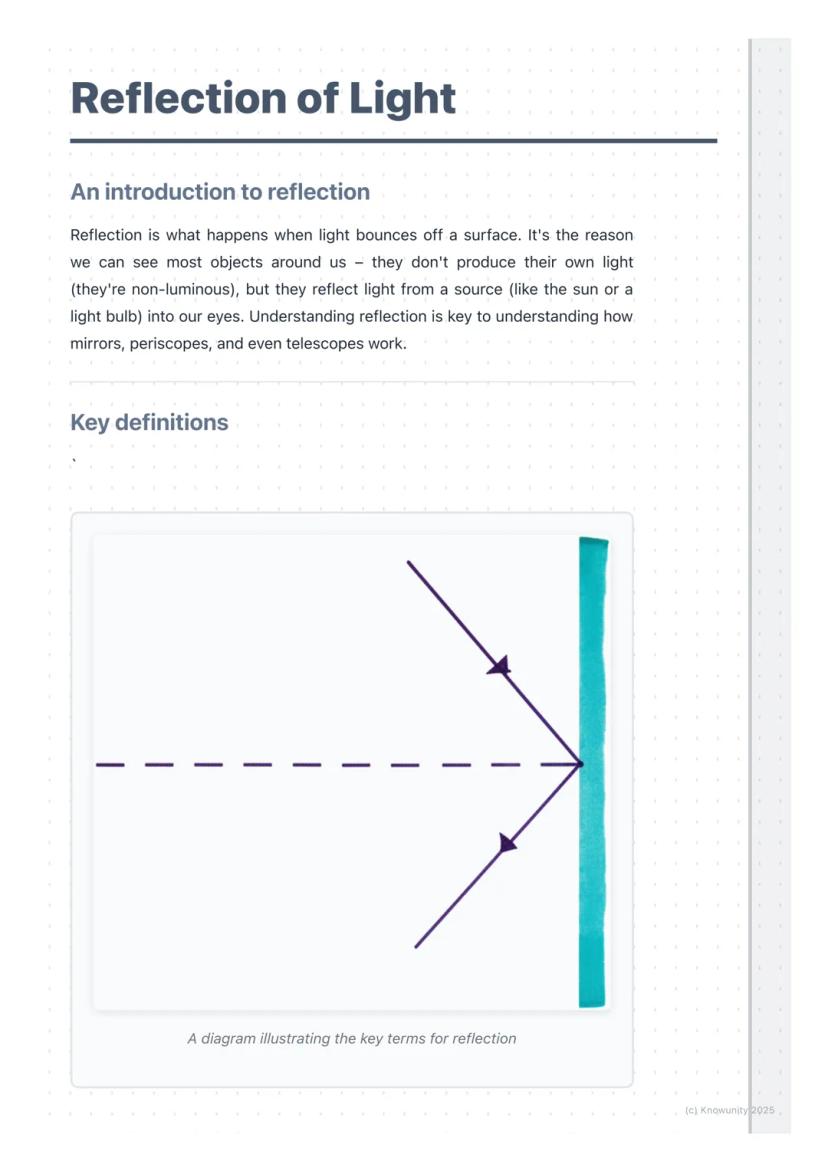
Reflection is simply what happens when light bounces off a surface. This is actually how you see most things around you - objects don't make their own light (they're non-luminous), but they reflect light from sources like the sun or light bulbs straight into your eyes.
Once you get your head around reflection, you'll understand how mirrors, periscopes, and even telescopes do their magic. The key is learning a few important terms and two simple laws that govern how light behaves.
Quick Tip: Think of light like a ball bouncing off a wall - it follows predictable patterns that we can measure and use!
2
of 6
Key Terms You Need to Know
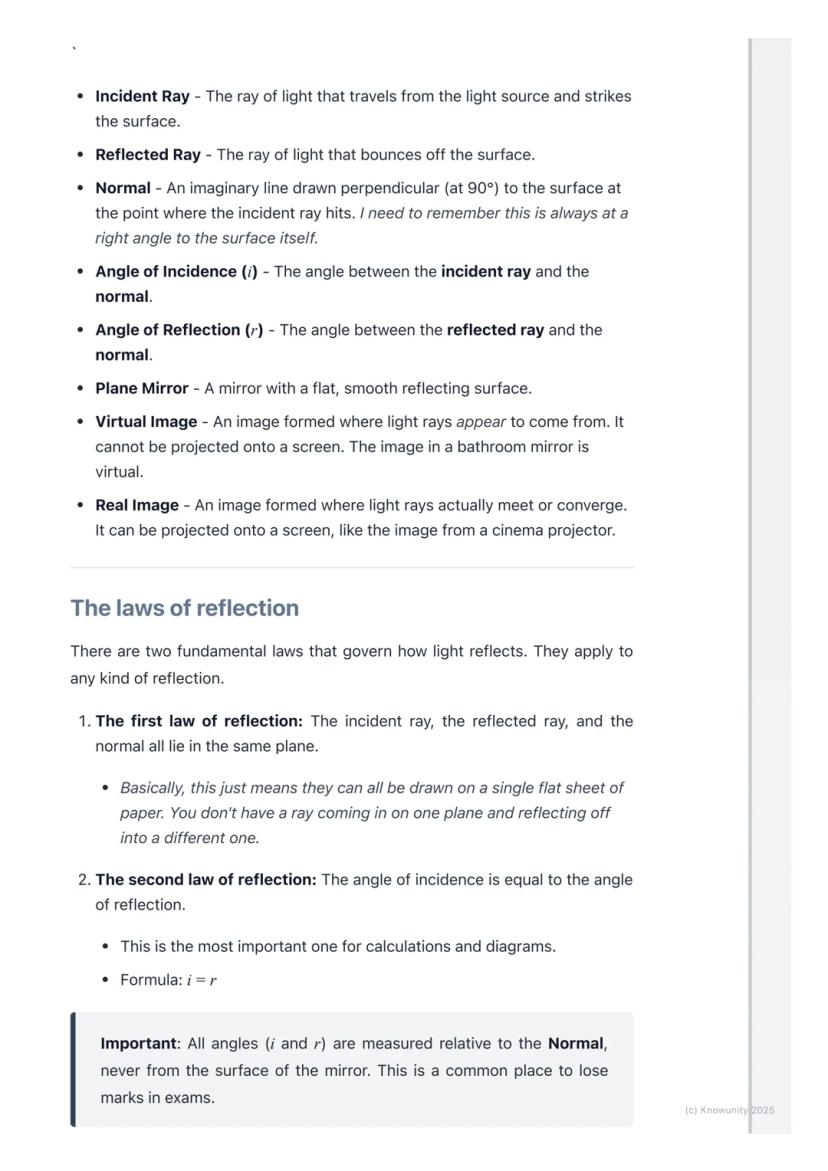
Learning reflection means getting comfortable with some specific vocabulary. The incident ray is the light beam travelling from its source toward a surface, whilst the reflected ray is what bounces off after hitting that surface.
The normal is crucial - it's an imaginary line drawn at exactly 90° to the surface where the light hits. All your angle measurements come from this normal line, not the surface itself. The angle of incidence (i) is between the incident ray and the normal, and the angle of reflection (r) is between the reflected ray and the normal.
You'll also encounter plane mirrors (flat, smooth mirrors), virtual images , and real images (like cinema projections that can be displayed on screens).
Remember: Always measure angles from the normal, never from the mirror surface - this catches loads of students out in exams!
3
of 6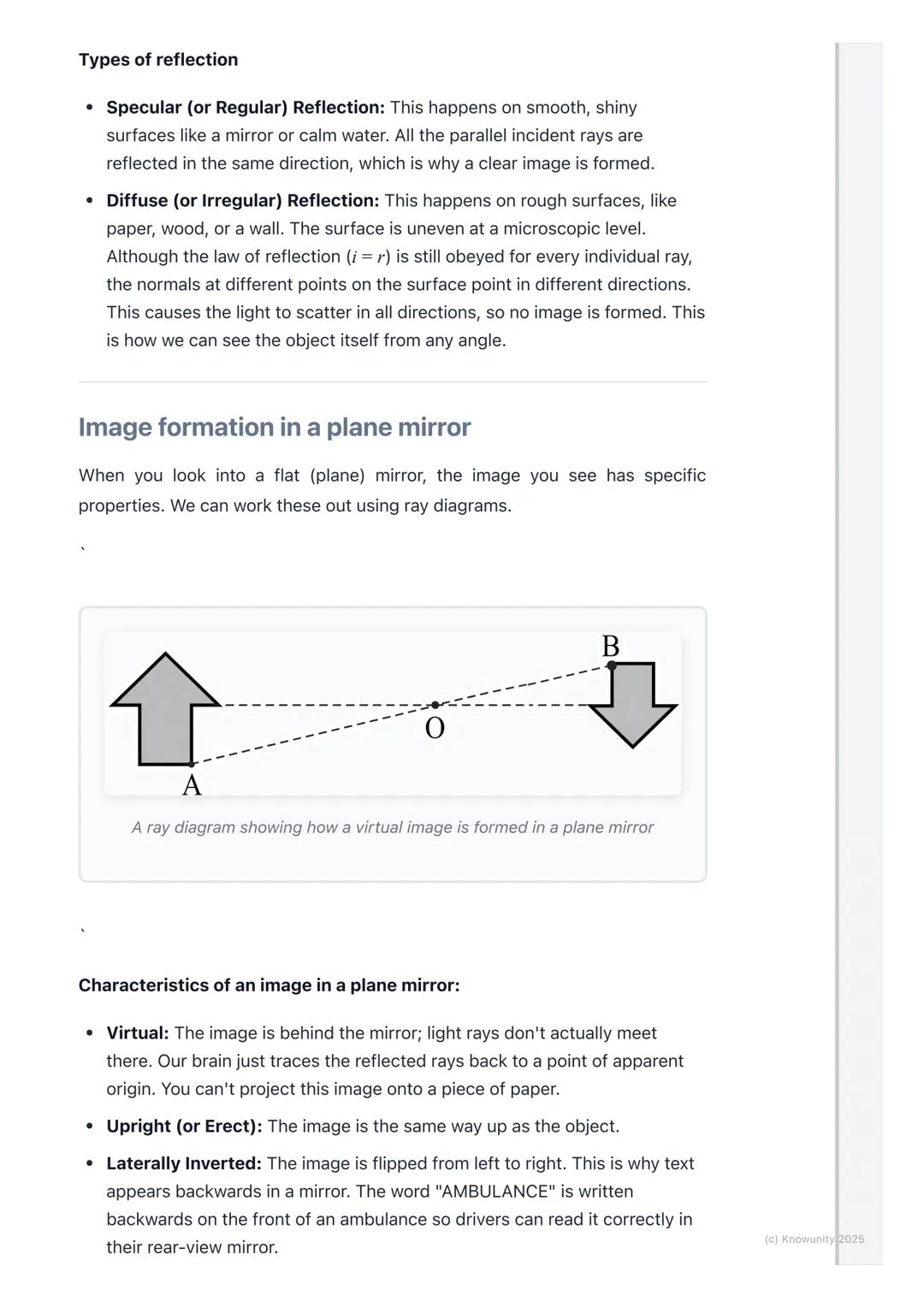
The Laws of Reflection
There are two fundamental laws of reflection that work every single time. The first law states that the incident ray, reflected ray, and normal all lie in the same flat plane - basically, you can draw them all on one piece of paper.
The second law is the real game-changer: the angle of incidence equals the angle of reflection . This mathematical relationship lets you predict exactly where light will go after bouncing off any surface.
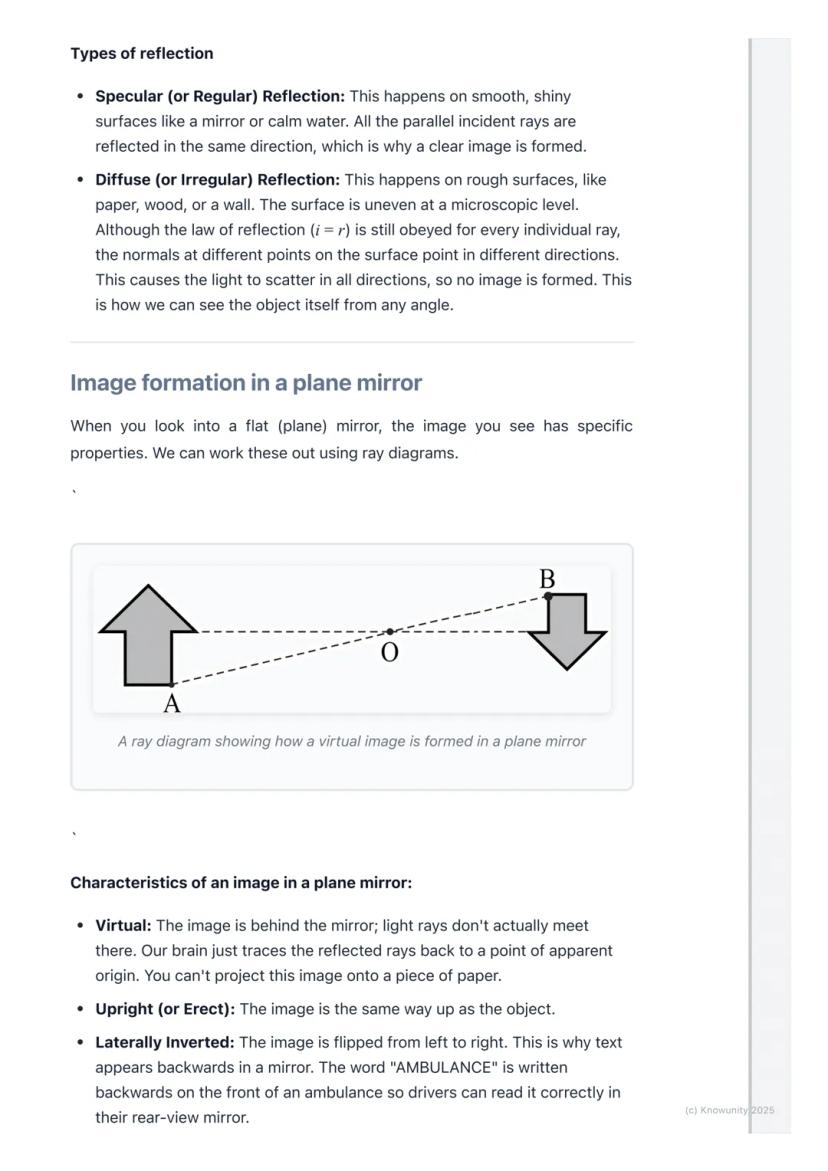
Specular reflection happens on smooth surfaces like mirrors or calm water, creating clear images because all parallel rays reflect in the same direction. Diffuse reflection occurs on rough surfaces like paper or walls, scattering light in all directions so you can see the object from any angle but no clear image forms.
Exam Smart: The formula i = r is your best friend - memorise it and always show it in your working!
4
of 6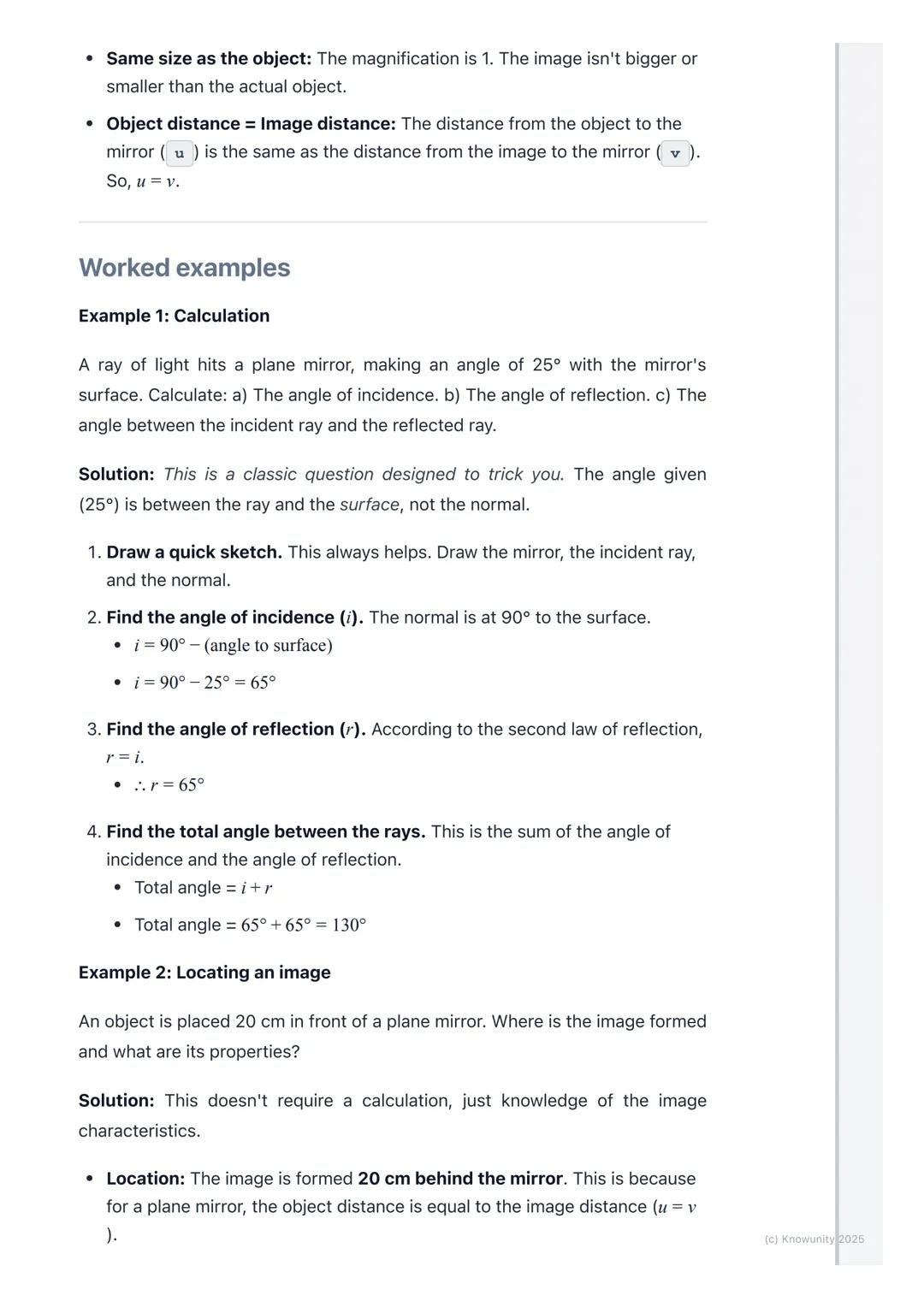
Images in Plane Mirrors
When you look in a flat mirror, the image formation follows specific rules. Your reflection appears behind the mirror as a virtual image - your brain traces the reflected rays backwards to where they seem to meet.
Plane mirror images have five key characteristics: they're virtual (behind the mirror), upright (same way up as you), laterally inverted (left and right are flipped), the same size as the original object, and located the same distance behind the mirror as you are in front of it.
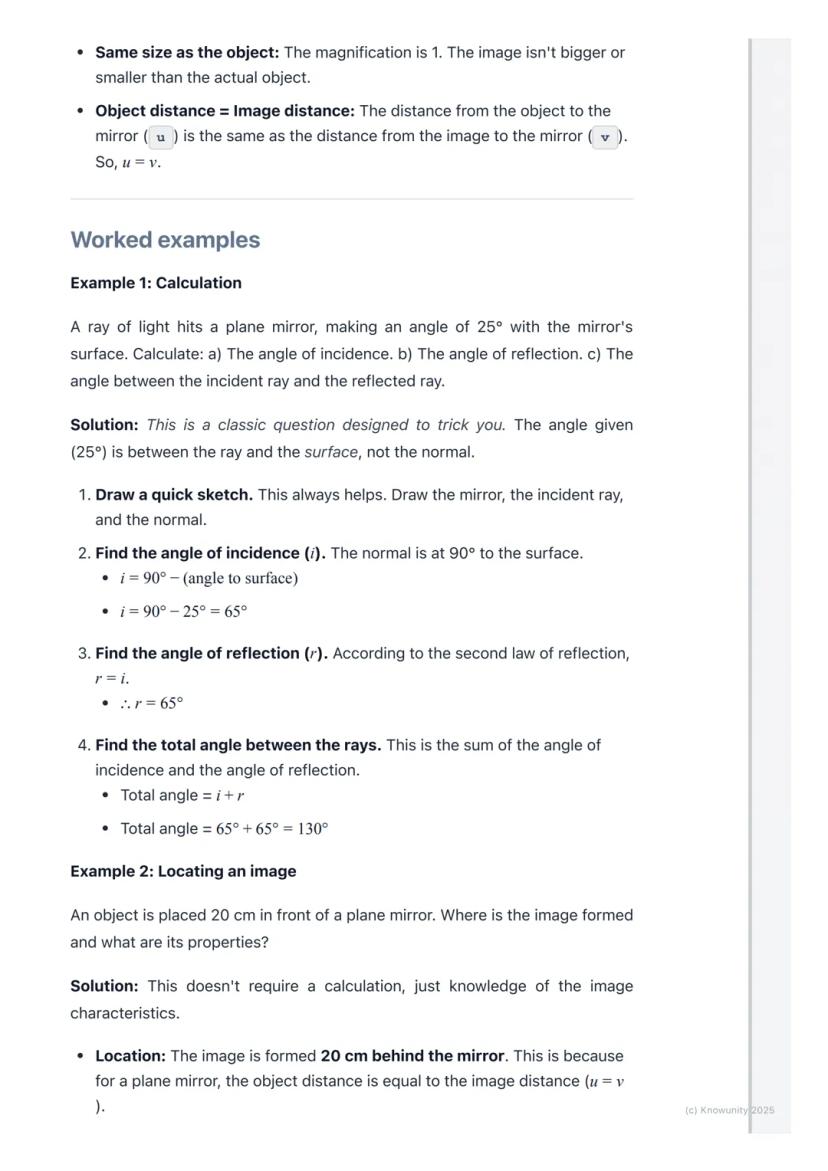
This lateral inversion explains why "AMBULANCE" is written backwards on emergency vehicles - so you can read it correctly in your rear-view mirror. The distance relationship means if you're 2 metres from a mirror, your image appears 2 metres behind it.
Real World: Understanding lateral inversion helps explain why learning to write feels weird when you watch yourself in a mirror!
5
of 6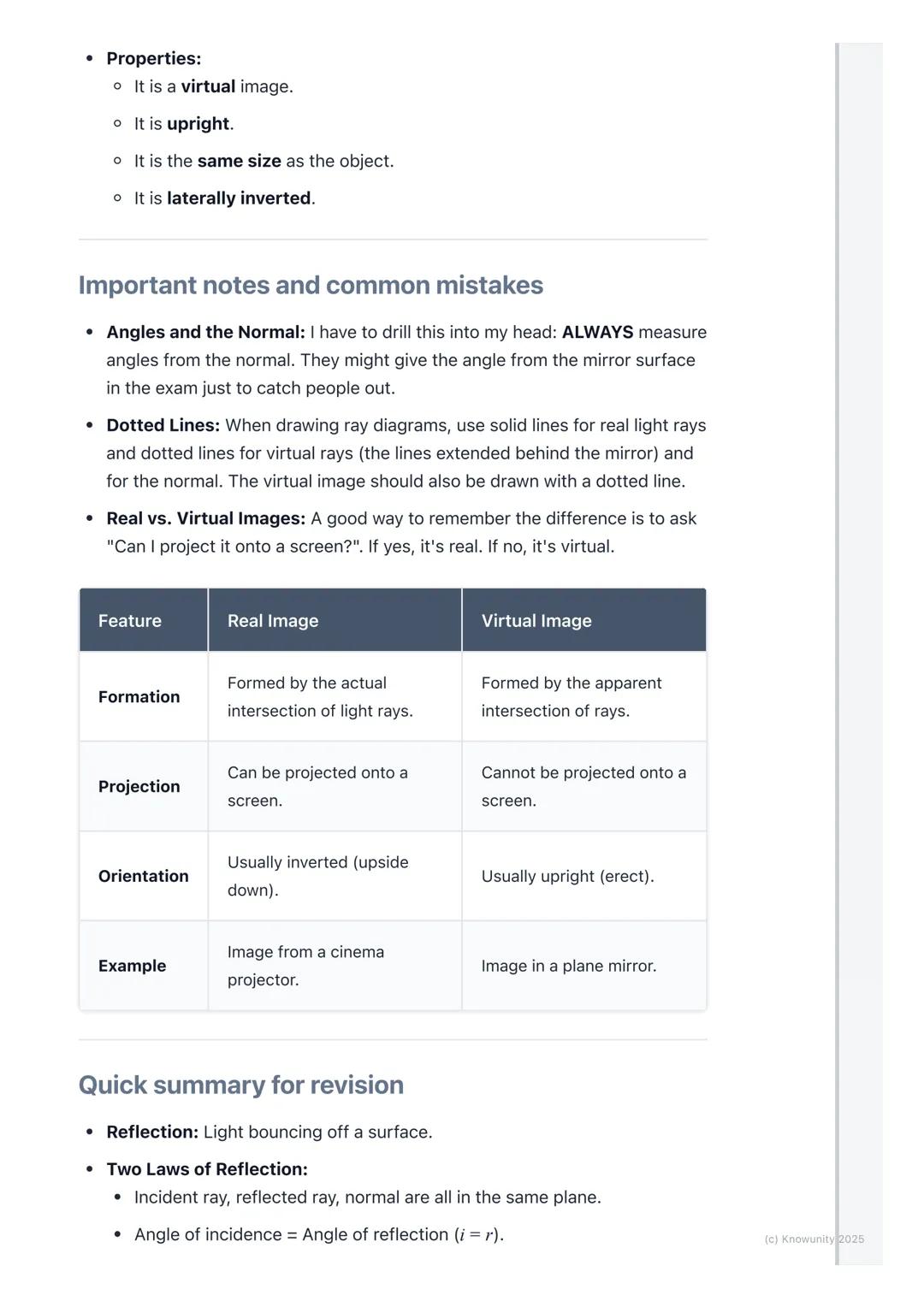
Working Through Problems
Reflection calculations often try to trip you up by giving angles measured from the mirror surface instead of the normal. Always convert these first: if a ray hits at 25° to the surface, the angle of incidence is 90° - 25° = 65°.
For ray diagrams, use solid lines for actual light rays and dotted lines for virtual rays (the ones you extend behind mirrors) and normals. Virtual images should also be drawn with dotted lines to show they're not formed by real light convergence.
The difference between real and virtual images is simple: ask yourself "Can I project this onto a screen?" If yes, it's real (like cinema images). If no, it's virtual (like mirror reflections). Real images usually appear upside down, whilst virtual ones stay upright.
Drawing Tip: A quick sketch always helps with reflection problems - draw the mirror, normal, and rays to visualise what's happening!
6
of 6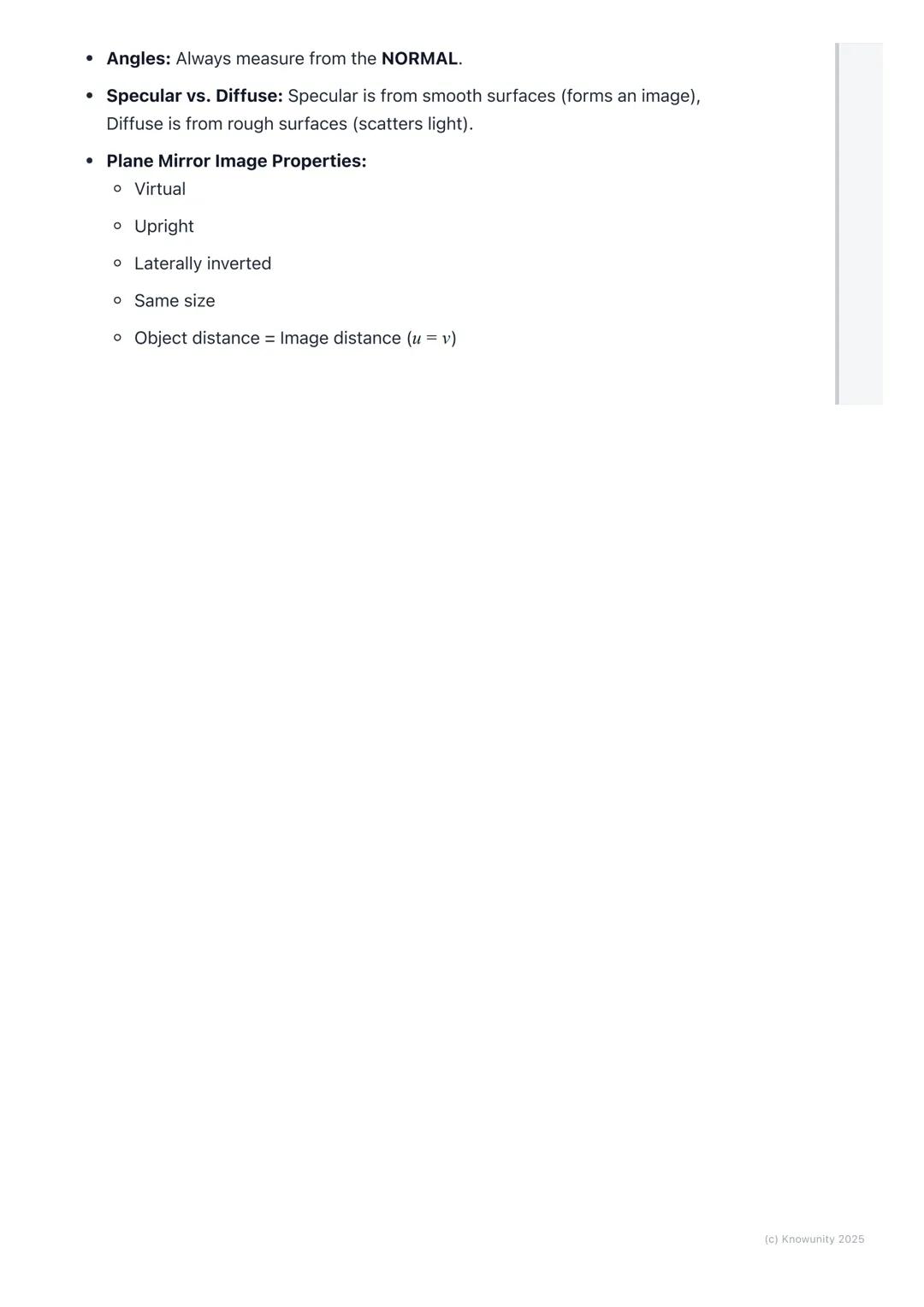
Quick Revision Summary
Reflection means light bouncing off surfaces, following two key laws: everything happens in one plane, and angle of incidence equals angle of reflection . Always measure angles from the normal, not the surface.
Specular reflection from smooth surfaces creates clear images, whilst diffuse reflection from rough surfaces scatters light. Plane mirror images are virtual, upright, laterally inverted, same size, with object distance equalling image distance .
For problem-solving, convert surface angles to normal angles, use dotted lines for virtual elements in diagrams, and remember that real images can be projected whilst virtual ones cannot.
Exam Success: Practice measuring angles from the normal and drawing ray diagrams - these skills will serve you well in physics!
Pensavamo che non l'avreste mai chiesto....
Che cos'è l'assistente AI di Knowunity?
Il nostro assistente AI è costruito specificamente per le esigenze degli studenti. Sulla base dei milioni di contenuti presenti sulla piattaforma, possiamo fornire agli studenti risposte davvero significative e pertinenti. Ma non si tratta solo di risposte, l'assistente è in grado di guidare gli studenti attraverso le loro sfide quotidiane di studio, con piani di studio personalizzati, quiz o contenuti nella chat e una personalizzazione al 100% basata sulle competenze e sugli sviluppi degli studenti.
Dove posso scaricare l'applicazione Knowunity?
È possibile scaricare l'applicazione dal Google Play Store e dall'Apple App Store.
Knowunity è davvero gratuita?
Sì, hai accesso completamente gratuito a tutti i contenuti nell'app e puoi chattare o seguire i Creatori in qualsiasi momento. Sbloccherai nuove funzioni crescendo il tuo numero di follower. Inoltre, offriamo Knowunity Premium, che consente di studiare senza alcun limite!!
Contenuti più popolari di Physics
3PhysicsBalanced and Unbalanced Forces
Students will explore how balanced forces result in no change in motion, while unbalanced forces cause an object to accelerate or change direction.
2nd Year522
PhysicsTypes of Forces
Students will identify common forces such as gravity (pulling objects down), friction (opposing motion), and air resistance (slowing objects in the air).
2nd Year550
 Science
Science/Physics notes - Speed, density, work
Speed density work formulas
3rd Year81
Contenuti più popolari
9 Irish
IrishIrish oral questions and answers
Questions and answers for the leaving cert oral
5th Year4264
 English
Key Quotes : Sive
Key Quotes and explanations: Sive
6th Year2842
IrishIrish oral questions
Outline of oral questions
5th Year2055
IrishIníon- le hÁine Durkin
Aine Durkin’s poem, Iníon: Themes & summary
5th Year850
IrishIrish poetry 2027
Iníon + Dínit an Bhróin
5th Year1133
IrishLC HL notes- Iníon (poem)
Includes poem in English and Irish, theme, key words & phrases
5th Year2284
EnglishCultural Context : Shawshank Redemption : Sive : Small Things Like These
Comparative Study : Cultural Context : Shawshank Redemption, Sive and Small Things Like These
6th Year1430
IrishMo Ghrá-sa (Idir Lúibíní)
Notes on mo ghrá-sa
5th Year380
IrishAn Gaeilge Aiste
Irish Language essay
6th Year1320
Non c'è niente di adatto? Esplorare altre aree tematiche.
Recensioni dei nostri utenti. Ci adorano - e anche tu, vedrai .
4.6/5App Store
4.7/5Google Play
L'applicazione è molto facile da usare e ben progettata. Finora ho trovato tutto quello che cercavo e ho potuto imparare molto dalle presentazioni! Utilizzerò sicuramente l'app per i compiti in classe! È molto utile anche come fonte di ispirazione.
Stefano Sutente iOS
Questa applicazione è davvero grande! Ci sono tantissimi appunti e aiuti con lo studio [...]. La mia materia problematica, per esempio, è il francese e l'app ha così tante opzioni per aiutarmi. Grazie a questa app ho migliorato il mio francese. La consiglio a tutti.
Samantha Klichutente Android
Wow, sono davvero stupita. Ho appena provato l'app perché l'ho vista pubblicizzata molte volte e sono rimasta assolutamente sbalordita. Questa app è L'AIUTO che cercate per la scuola e soprattutto offre tantissime cose, come allenamenti e schede, che a me personalmente sono state MOLTO utili.
Annautente iOS
Physics4 visualizzazioni·Aggiornato Jun 7, 2026·6 pagineUnderstanding the Laws of Light Reflection
Ever wondered why you can see yourself in a mirror or why ambulances have backwards writing on their front? It's all down to reflection - the physics behind how light bounces off surfaces. Understanding reflection helps explain everything from how...
1
of 6
Iscriviti per mostrare il contenuto. È gratis!
- Accesso a tutti i documenti
- Migliora i tuoi voti
- Unisciti a milioni di studenti
Getting Started with Reflection
Reflection is simply what happens when light bounces off a surface. This is actually how you see most things around you - objects don't make their own light (they're non-luminous), but they reflect light from sources like the sun or light bulbs straight into your eyes.
Once you get your head around reflection, you'll understand how mirrors, periscopes, and even telescopes do their magic. The key is learning a few important terms and two simple laws that govern how light behaves.
Quick Tip: Think of light like a ball bouncing off a wall - it follows predictable patterns that we can measure and use!
2
of 6Iscriviti per mostrare il contenuto. È gratis!
- Accesso a tutti i documenti
- Migliora i tuoi voti
- Unisciti a milioni di studenti
Key Terms You Need to Know
Learning reflection means getting comfortable with some specific vocabulary. The incident ray is the light beam travelling from its source toward a surface, whilst the reflected ray is what bounces off after hitting that surface.
The normal is crucial - it's an imaginary line drawn at exactly 90° to the surface where the light hits. All your angle measurements come from this normal line, not the surface itself. The angle of incidence (i) is between the incident ray and the normal, and the angle of reflection (r) is between the reflected ray and the normal.
You'll also encounter plane mirrors (flat, smooth mirrors), virtual images , and real images (like cinema projections that can be displayed on screens).
Remember: Always measure angles from the normal, never from the mirror surface - this catches loads of students out in exams!
3
of 6Iscriviti per mostrare il contenuto. È gratis!
- Accesso a tutti i documenti
- Migliora i tuoi voti
- Unisciti a milioni di studenti
The Laws of Reflection
There are two fundamental laws of reflection that work every single time. The first law states that the incident ray, reflected ray, and normal all lie in the same flat plane - basically, you can draw them all on one piece of paper.
The second law is the real game-changer: the angle of incidence equals the angle of reflection . This mathematical relationship lets you predict exactly where light will go after bouncing off any surface.
Specular reflection happens on smooth surfaces like mirrors or calm water, creating clear images because all parallel rays reflect in the same direction. Diffuse reflection occurs on rough surfaces like paper or walls, scattering light in all directions so you can see the object from any angle but no clear image forms.
Exam Smart: The formula i = r is your best friend - memorise it and always show it in your working!
4
of 6Iscriviti per mostrare il contenuto. È gratis!
- Accesso a tutti i documenti
- Migliora i tuoi voti
- Unisciti a milioni di studenti
Images in Plane Mirrors
When you look in a flat mirror, the image formation follows specific rules. Your reflection appears behind the mirror as a virtual image - your brain traces the reflected rays backwards to where they seem to meet.
Plane mirror images have five key characteristics: they're virtual (behind the mirror), upright (same way up as you), laterally inverted (left and right are flipped), the same size as the original object, and located the same distance behind the mirror as you are in front of it.
This lateral inversion explains why "AMBULANCE" is written backwards on emergency vehicles - so you can read it correctly in your rear-view mirror. The distance relationship means if you're 2 metres from a mirror, your image appears 2 metres behind it.
Real World: Understanding lateral inversion helps explain why learning to write feels weird when you watch yourself in a mirror!
5
of 6Iscriviti per mostrare il contenuto. È gratis!
- Accesso a tutti i documenti
- Migliora i tuoi voti
- Unisciti a milioni di studenti
Working Through Problems
Reflection calculations often try to trip you up by giving angles measured from the mirror surface instead of the normal. Always convert these first: if a ray hits at 25° to the surface, the angle of incidence is 90° - 25° = 65°.
For ray diagrams, use solid lines for actual light rays and dotted lines for virtual rays (the ones you extend behind mirrors) and normals. Virtual images should also be drawn with dotted lines to show they're not formed by real light convergence.
The difference between real and virtual images is simple: ask yourself "Can I project this onto a screen?" If yes, it's real (like cinema images). If no, it's virtual (like mirror reflections). Real images usually appear upside down, whilst virtual ones stay upright.
Drawing Tip: A quick sketch always helps with reflection problems - draw the mirror, normal, and rays to visualise what's happening!
6
of 6Iscriviti per mostrare il contenuto. È gratis!
- Accesso a tutti i documenti
- Migliora i tuoi voti
- Unisciti a milioni di studenti
Quick Revision Summary
Reflection means light bouncing off surfaces, following two key laws: everything happens in one plane, and angle of incidence equals angle of reflection . Always measure angles from the normal, not the surface.
Specular reflection from smooth surfaces creates clear images, whilst diffuse reflection from rough surfaces scatters light. Plane mirror images are virtual, upright, laterally inverted, same size, with object distance equalling image distance .
For problem-solving, convert surface angles to normal angles, use dotted lines for virtual elements in diagrams, and remember that real images can be projected whilst virtual ones cannot.
Exam Success: Practice measuring angles from the normal and drawing ray diagrams - these skills will serve you well in physics!
Pensavamo che non l'avreste mai chiesto....
Che cos'è l'assistente AI di Knowunity?
Il nostro assistente AI è costruito specificamente per le esigenze degli studenti. Sulla base dei milioni di contenuti presenti sulla piattaforma, possiamo fornire agli studenti risposte davvero significative e pertinenti. Ma non si tratta solo di risposte, l'assistente è in grado di guidare gli studenti attraverso le loro sfide quotidiane di studio, con piani di studio personalizzati, quiz o contenuti nella chat e una personalizzazione al 100% basata sulle competenze e sugli sviluppi degli studenti.
Dove posso scaricare l'applicazione Knowunity?
È possibile scaricare l'applicazione dal Google Play Store e dall'Apple App Store.
Knowunity è davvero gratuita?
Sì, hai accesso completamente gratuito a tutti i contenuti nell'app e puoi chattare o seguire i Creatori in qualsiasi momento. Sbloccherai nuove funzioni crescendo il tuo numero di follower. Inoltre, offriamo Knowunity Premium, che consente di studiare senza alcun limite!!
Contenuti più popolari di Physics
3PhysicsBalanced and Unbalanced Forces
Students will explore how balanced forces result in no change in motion, while unbalanced forces cause an object to accelerate or change direction.
2nd Year522
PhysicsTypes of Forces
Students will identify common forces such as gravity (pulling objects down), friction (opposing motion), and air resistance (slowing objects in the air).
2nd Year550
ScienceScience/Physics notes - Speed, density, work
Speed density work formulas
3rd Year81
Contenuti più popolari
9IrishIrish oral questions and answers
Questions and answers for the leaving cert oral
5th Year4264
EnglishKey Quotes : Sive
Key Quotes and explanations: Sive
6th Year2842
IrishIrish oral questions
Outline of oral questions
5th Year2055
IrishIníon- le hÁine Durkin
Aine Durkin’s poem, Iníon: Themes & summary
5th Year850
IrishIrish poetry 2027
Iníon + Dínit an Bhróin
5th Year1133
IrishLC HL notes- Iníon (poem)
Includes poem in English and Irish, theme, key words & phrases
5th Year2284
EnglishCultural Context : Shawshank Redemption : Sive : Small Things Like These
Comparative Study : Cultural Context : Shawshank Redemption, Sive and Small Things Like These
6th Year1430
IrishMo Ghrá-sa (Idir Lúibíní)
Notes on mo ghrá-sa
5th Year380
IrishAn Gaeilge Aiste
Irish Language essay
6th Year1320
Non c'è niente di adatto? Esplorare altre aree tematiche.
Recensioni dei nostri utenti. Ci adorano - e anche tu, vedrai .
4.6/5App Store
4.7/5Google Play
L'applicazione è molto facile da usare e ben progettata. Finora ho trovato tutto quello che cercavo e ho potuto imparare molto dalle presentazioni! Utilizzerò sicuramente l'app per i compiti in classe! È molto utile anche come fonte di ispirazione.
Stefano Sutente iOS
Questa applicazione è davvero grande! Ci sono tantissimi appunti e aiuti con lo studio [...]. La mia materia problematica, per esempio, è il francese e l'app ha così tante opzioni per aiutarmi. Grazie a questa app ho migliorato il mio francese. La consiglio a tutti.
Samantha Klichutente Android
Wow, sono davvero stupita. Ho appena provato l'app perché l'ho vista pubblicizzata molte volte e sono rimasta assolutamente sbalordita. Questa app è L'AIUTO che cercate per la scuola e soprattutto offre tantissime cose, come allenamenti e schede, che a me personalmente sono state MOLTO utili.
Annautente iOS