
Ever wondered why a metal spoon gets scorching hot in...
 Physics7 visualizzazioni·Aggiornato Jun 16, 2026·8 pagine
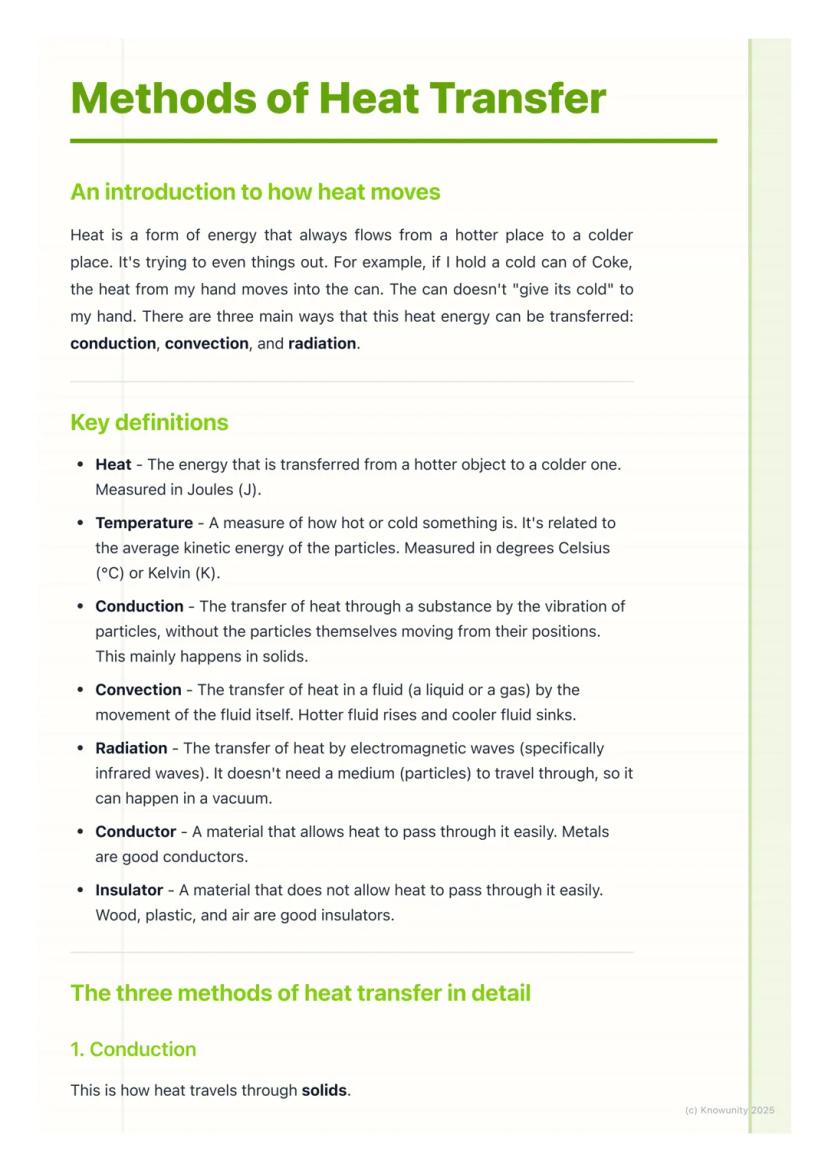
How Heat Transfers: Exploring Conduction, Convection, and Radiation

1 / 8
1
of 8
The Basics: What Heat Actually Does
Heat always has one mission: to move from hot places to cold places until everything evens out. When you grab a cold can of Coke, heat energy flows from your warm hand into the chilly can - the can doesn't "give you its cold."
There are exactly three ways heat can travel: conduction, convection, and radiation. Each method works differently and happens in different situations.
Temperature measures how hot something is (in °C), whilst heat is the actual energy moving between objects (measured in Joules). Think of temperature as the "level" and heat as the energy doing the moving.
Conductors like metals let heat pass through easily, whilst insulators like wood and plastic block heat transfer. This is why metal spoons get hot quickly but wooden spoons stay cool.
Quick Check: Touch a metal door handle and a wooden door frame on a cold morning - they're the same temperature, but the metal feels much colder because it conducts heat away from your hand faster!
2
of 8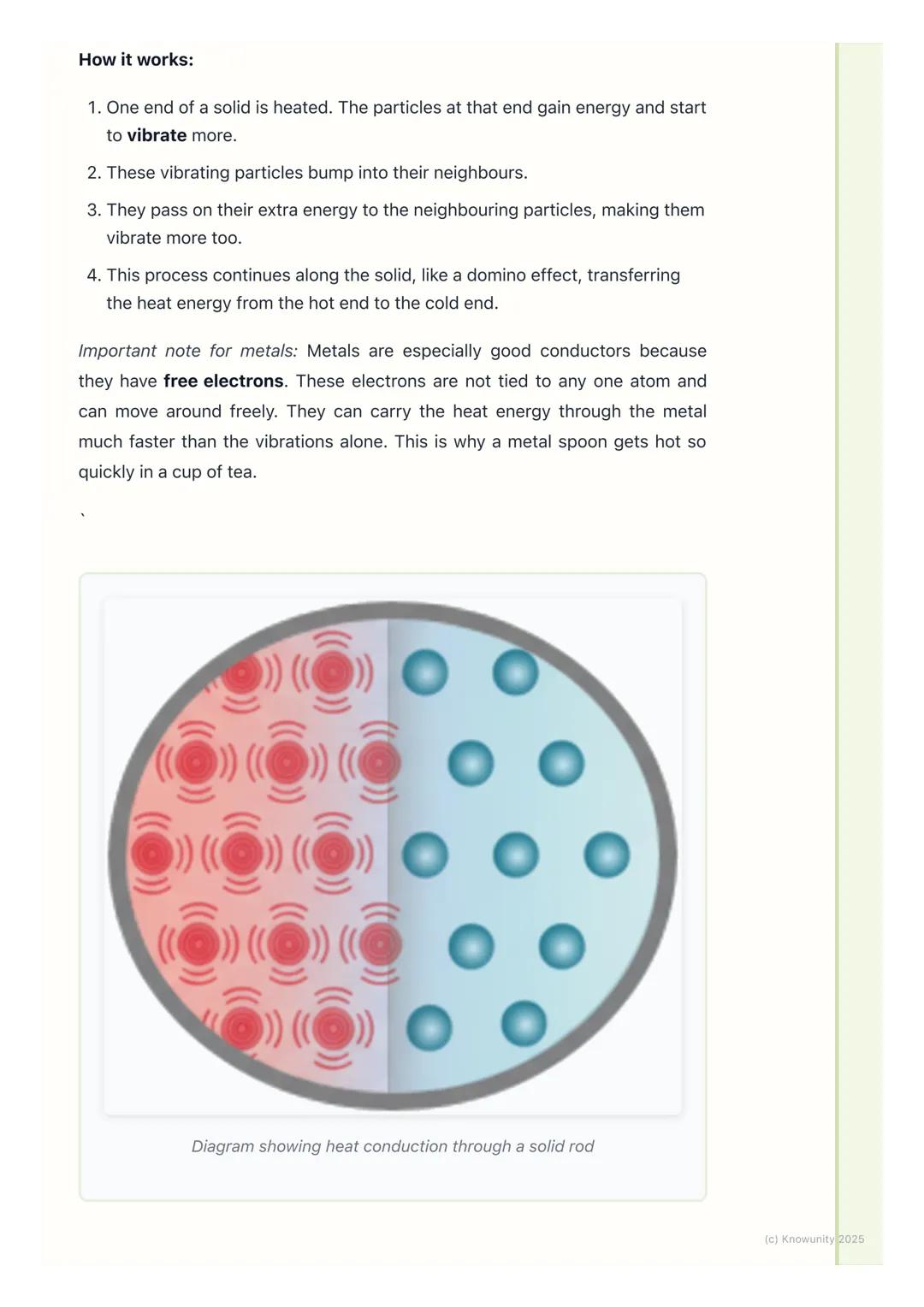
Conduction: Heat Through Solids
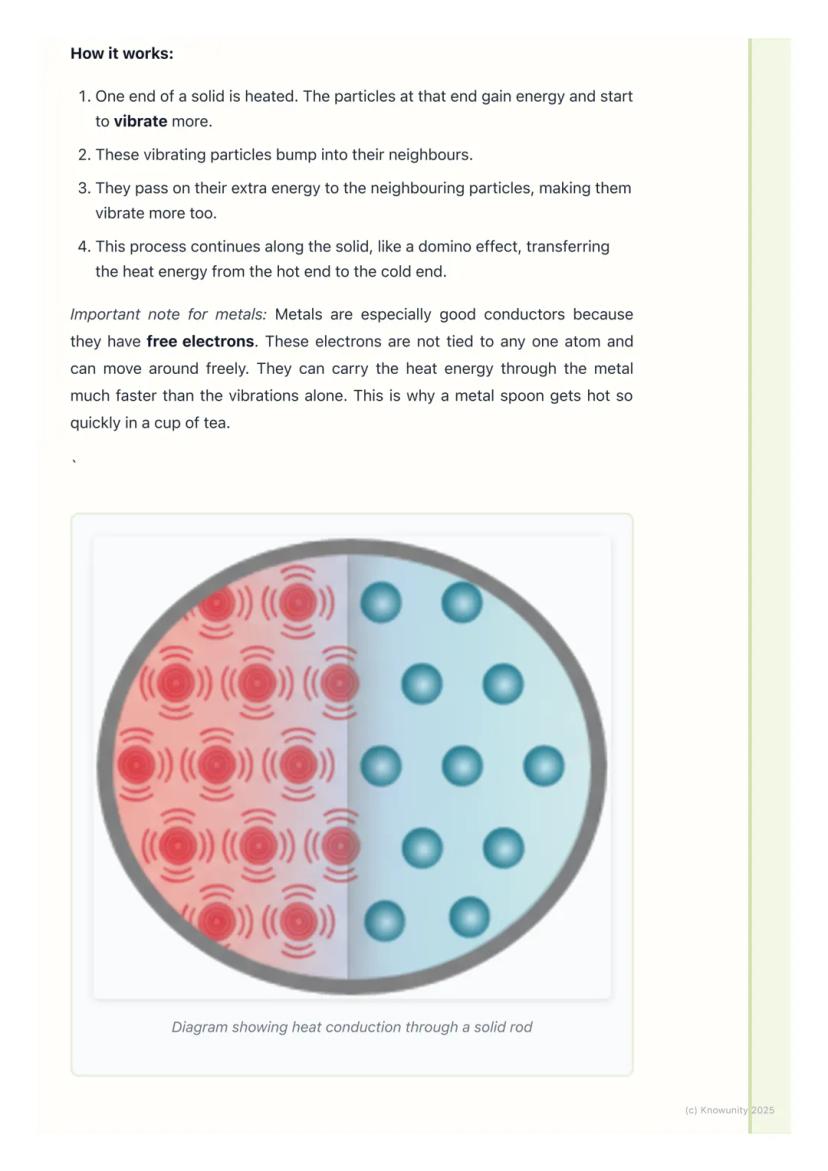
Conduction is how heat travels through solid materials, and it's basically like a particle domino effect. When you heat one end of a solid, those particles start vibrating more energetically.
These excited particles bump into their neighbours, passing on their extra energy and making them vibrate more too. This continues along the solid like a chain reaction, transferring heat from the hot end to the cold end.
Metals are superstar conductors because they have free electrons that aren't tied to specific atoms. These electrons zip around carrying heat energy much faster than particle vibrations alone - that's why a metal spoon heats up so quickly in hot tea.
Common examples include a saucepan handle getting hot on the hob, or holding a metal poker near a fire and feeling it warm up along its length.
Remember: In conduction, the particles vibrate but don't actually move from their positions - they're just passing energy along like a relay race with stationary runners!
3
of 8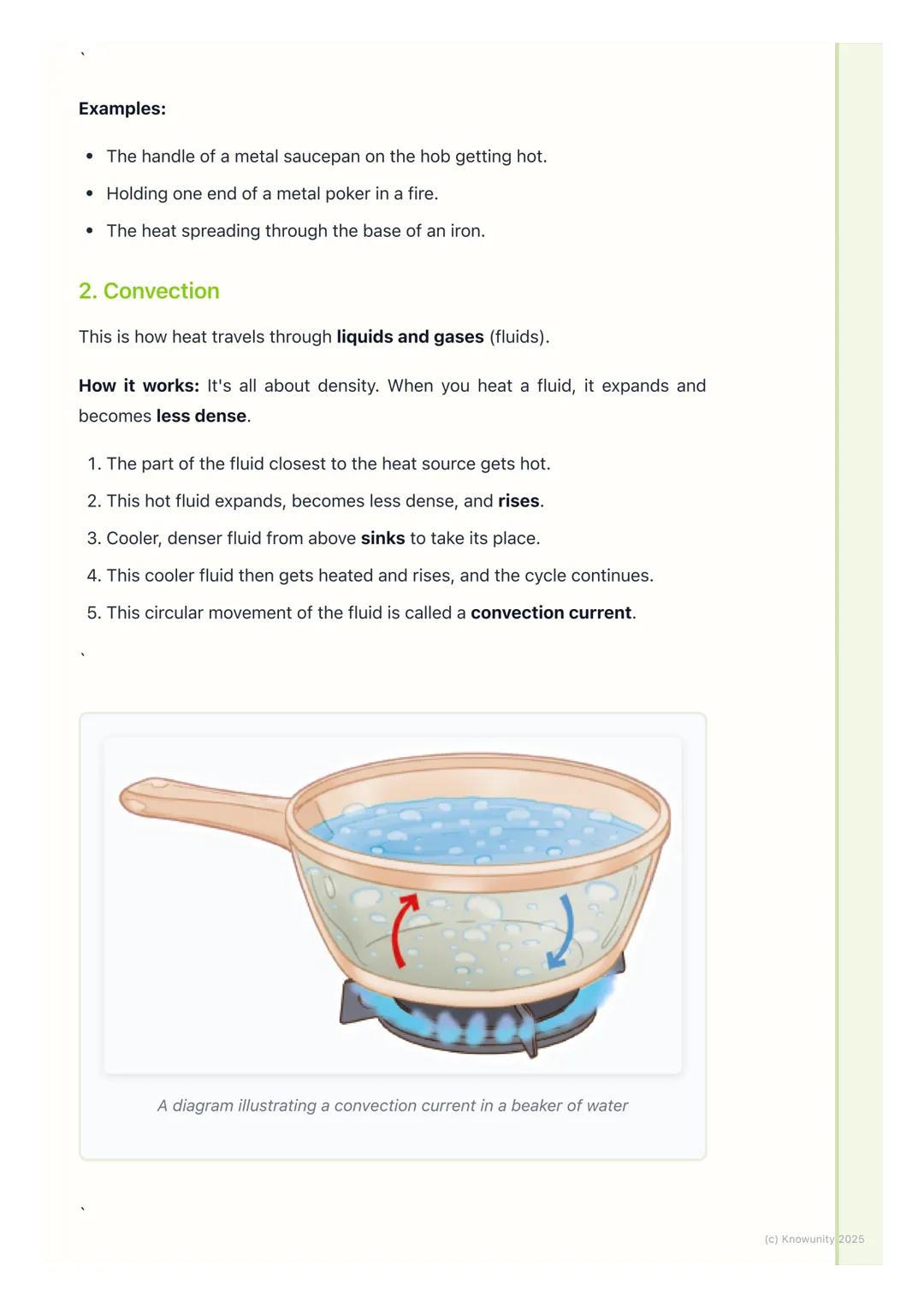
Convection: Heat on the Move
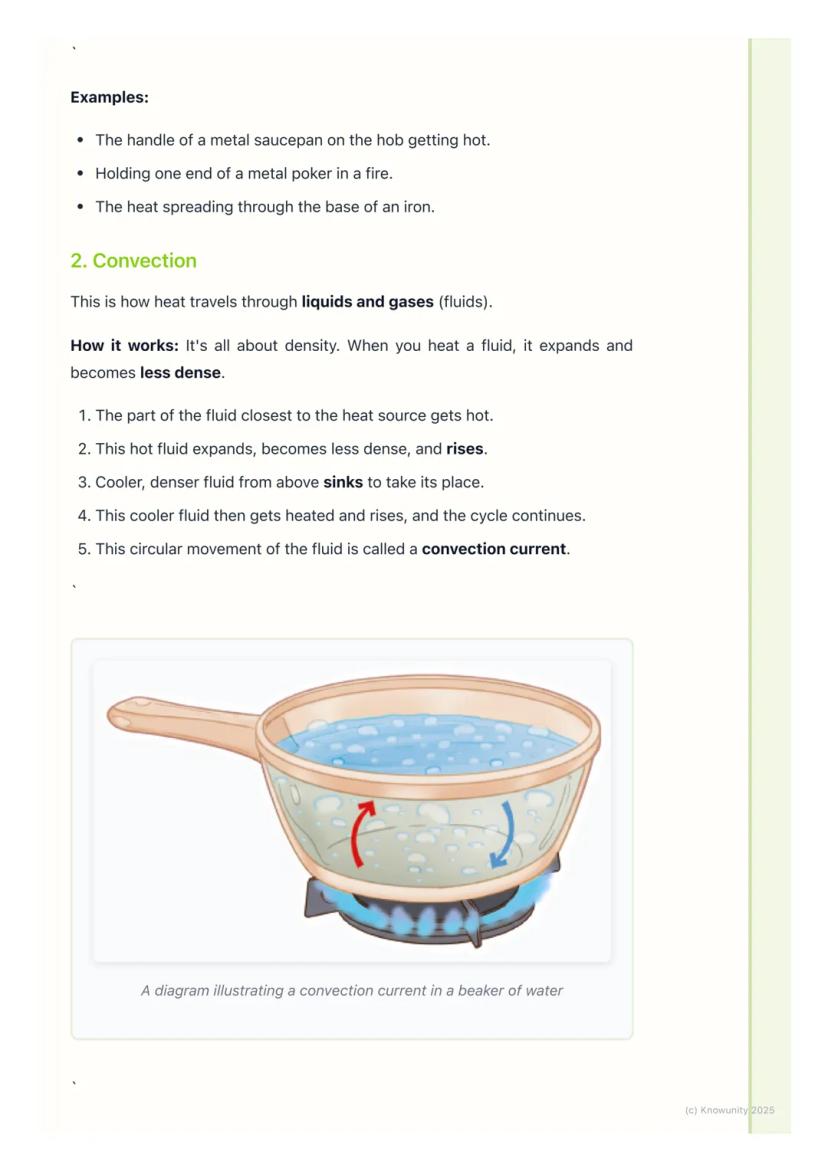
Convection only happens in fluids (liquids and gases) because it relies on the actual movement of the substance itself. It's all about density changes that create circular currents.
Here's how it works: when you heat a fluid, it expands and becomes less dense than the cooler fluid around it. This lighter, hot fluid rises whilst denser, cooler fluid sinks to take its place. The cycle continues, creating convection currents.
Think about boiling water - the heating element warms water at the bottom, which rises, whilst cooler water from the top sinks down to be heated. This creates a continuous circulation pattern.
Room heaters work the same way: they heat nearby air, which rises, moves across the ceiling, cools down, and sinks on the far side of the room. That's how one radiator can warm an entire space.
Key Point: Convection can't happen in solids because particles are fixed in place and can't create the flowing currents needed for this type of heat transfer.
4
of 8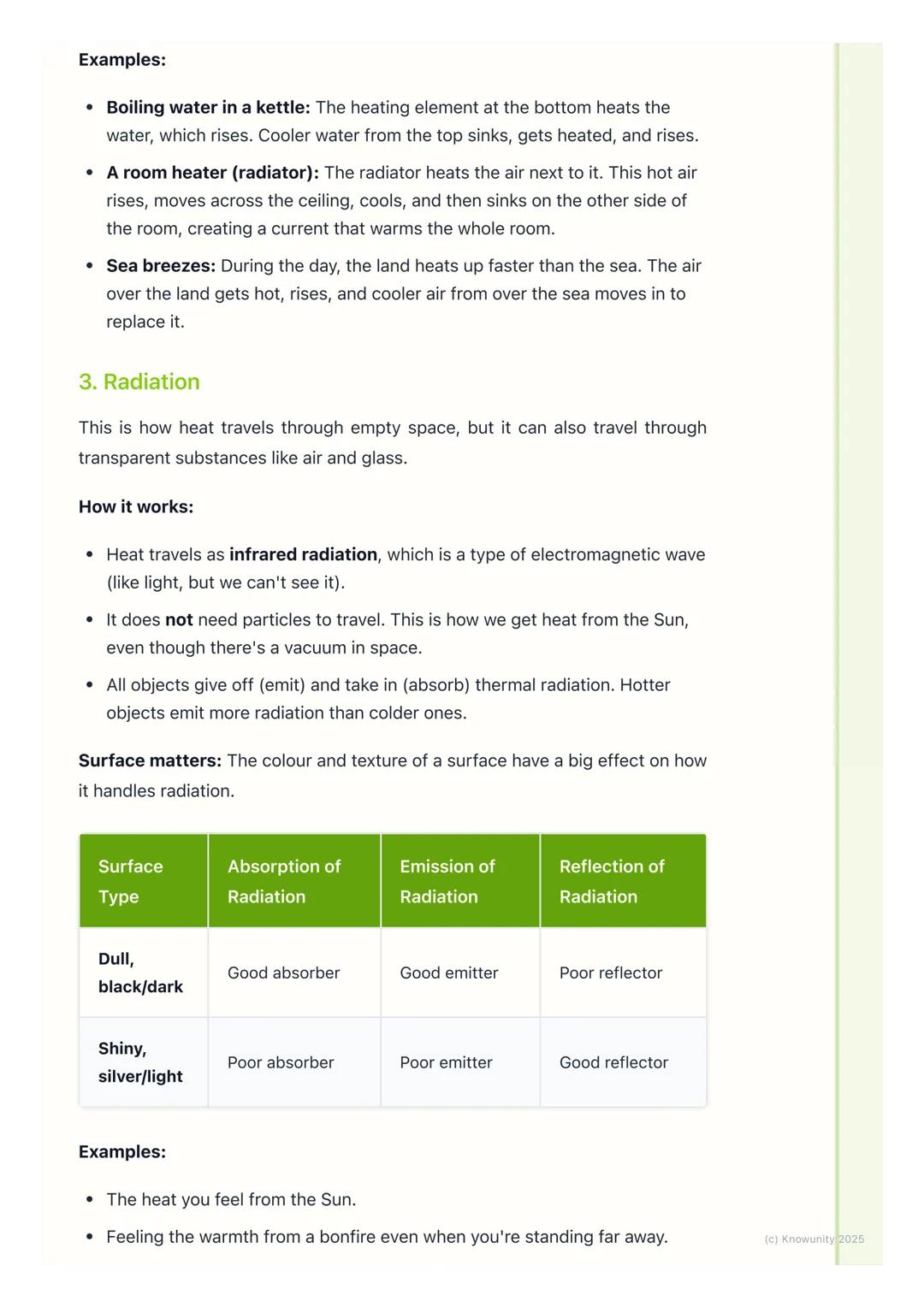
Radiation: Heat Waves Through Space
Radiation is the most impressive heat transfer method because it doesn't need any particles at all - it travels as infrared electromagnetic waves. This is how the Sun's energy reaches Earth through the vacuum of space.
All objects constantly emit and absorb thermal radiation, but hotter objects give off much more than cooler ones. You can feel this when you stand near a bonfire - you're sensing the infrared waves hitting your skin.
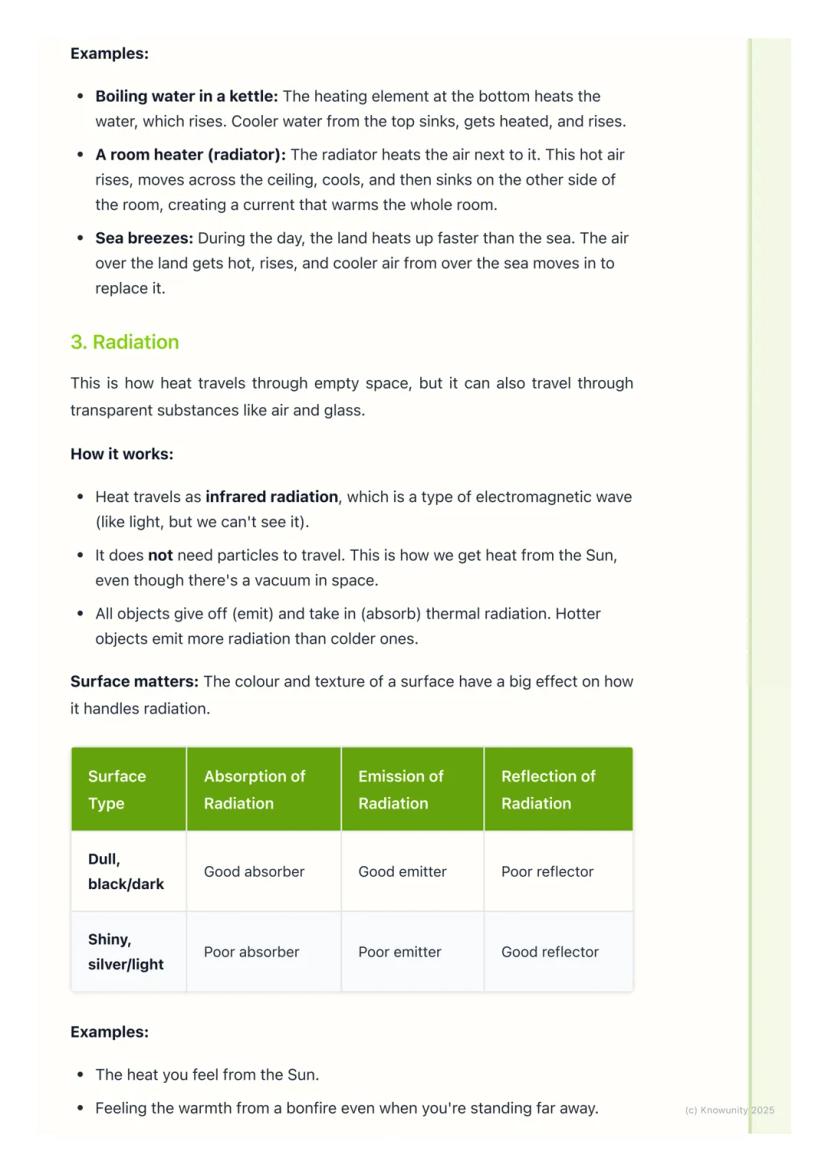
Surface properties matter enormously for radiation. Dark, dull surfaces are excellent absorbers and emitters of heat radiation, whilst shiny, light surfaces are brilliant reflectors but poor absorbers.
This explains why people wear black in winter (to absorb more solar heat) but white in summer (to reflect heat away). Car manufacturers often use light colours in hot climates for the same reason.
Think About It: You can feel heat from a toaster's glowing elements even before they turn red - that's infrared radiation your skin can detect but your eyes can't see!
5
of 8
Real-World Application: The Vacuum Flask
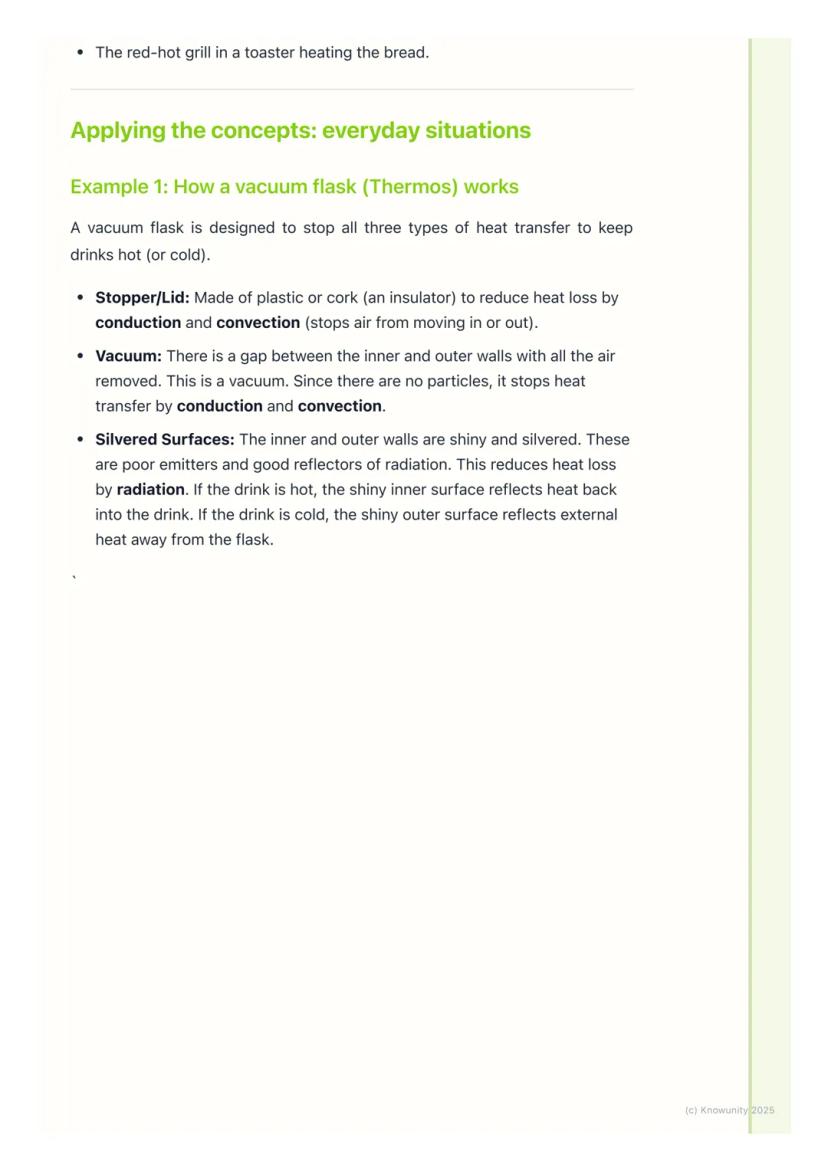
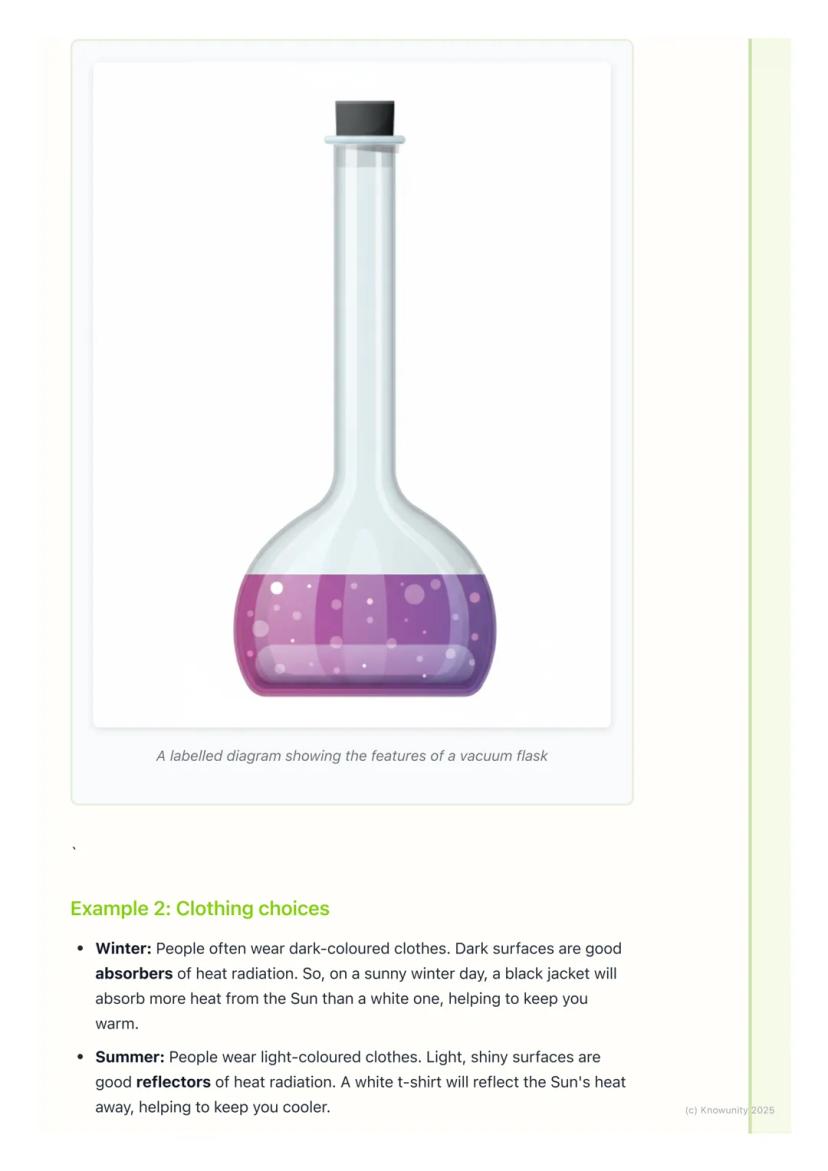
A vacuum flask (or Thermos) brilliantly demonstrates how to block all three heat transfer methods to keep drinks at the right temperature.
The plastic or cork stopper stops conduction and convection by using insulating materials and preventing air movement. The vacuum between the inner and outer walls is genius - with no particles present, there's nothing to conduct heat or create convection currents.
The silvered surfaces handle radiation by reflecting heat waves. If your drink is hot, the shiny inner surface bounces heat back into the liquid. If it's cold, the shiny outer surface reflects external heat away.
This design works for both hot and cold drinks because it simply prevents heat from moving in either direction. It's like creating a thermal barrier around your beverage.
Cool Fact: The vacuum gap is the same technology used in space - without particles to transfer heat, astronauts rely heavily on radiation management to control temperature!
6
of 8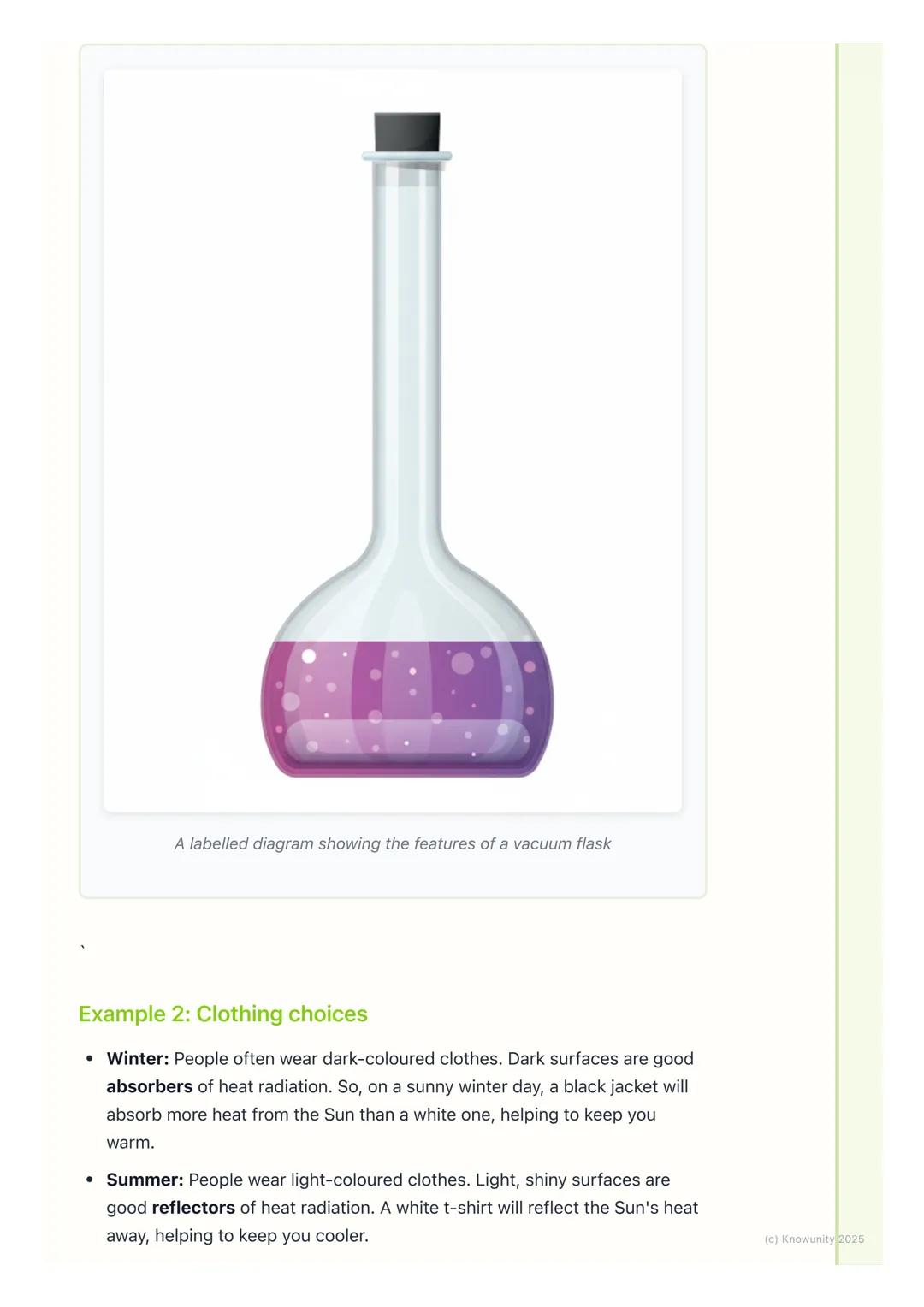
Exam Success: Key Points to Remember
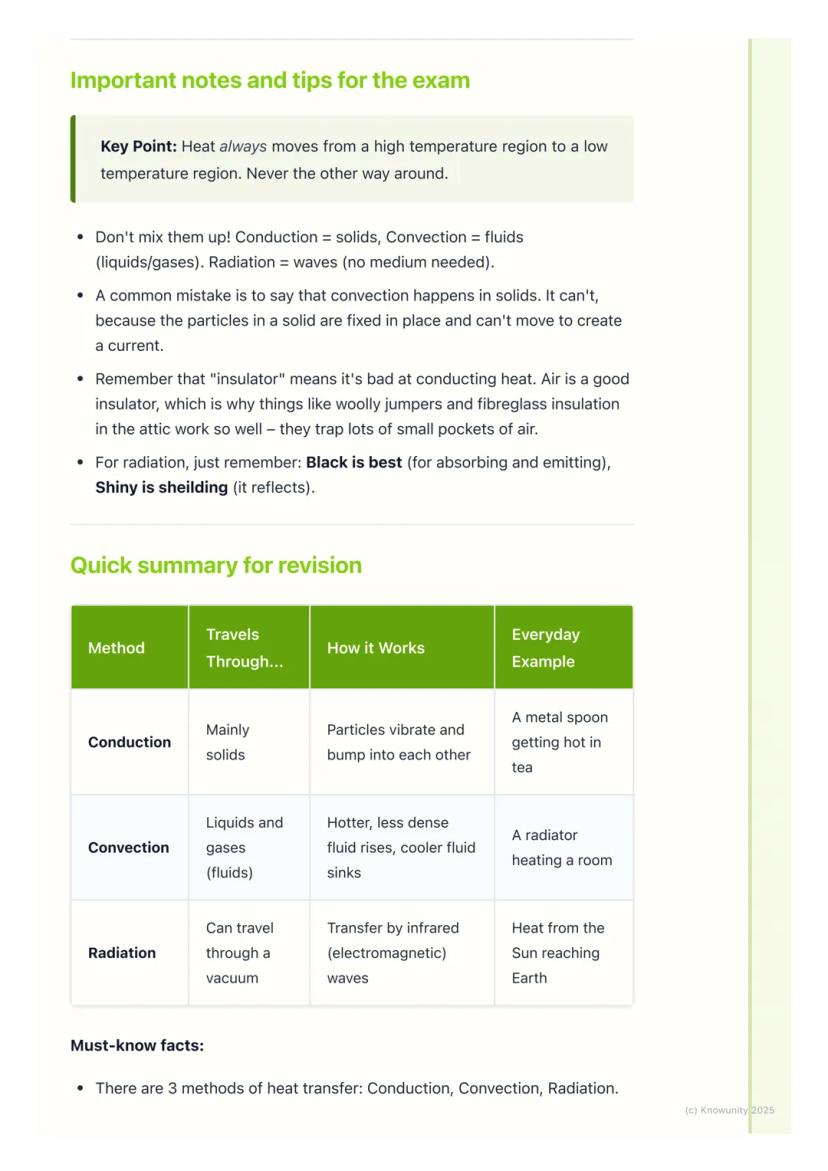
Heat always flows from high to low temperature - never the opposite direction. This is fundamental to every heat transfer question you'll encounter.
Conduction = solids only (particles vibrating in place). Convection = fluids only (actual movement of liquid or gas). Radiation = electromagnetic waves that need no medium.
Don't fall for the common trap of saying convection happens in solids - it can't because solid particles are fixed in position and can't create flowing currents.
Air is actually an excellent insulator, which is why fluffy jumpers and loft insulation work so well - they trap lots of tiny air pockets that prevent heat transfer.
Memory Trick: For radiation surfaces, remember "Black is Best" (for absorbing and emitting heat) and "Shiny Shields" (reflects heat away).
7
of 8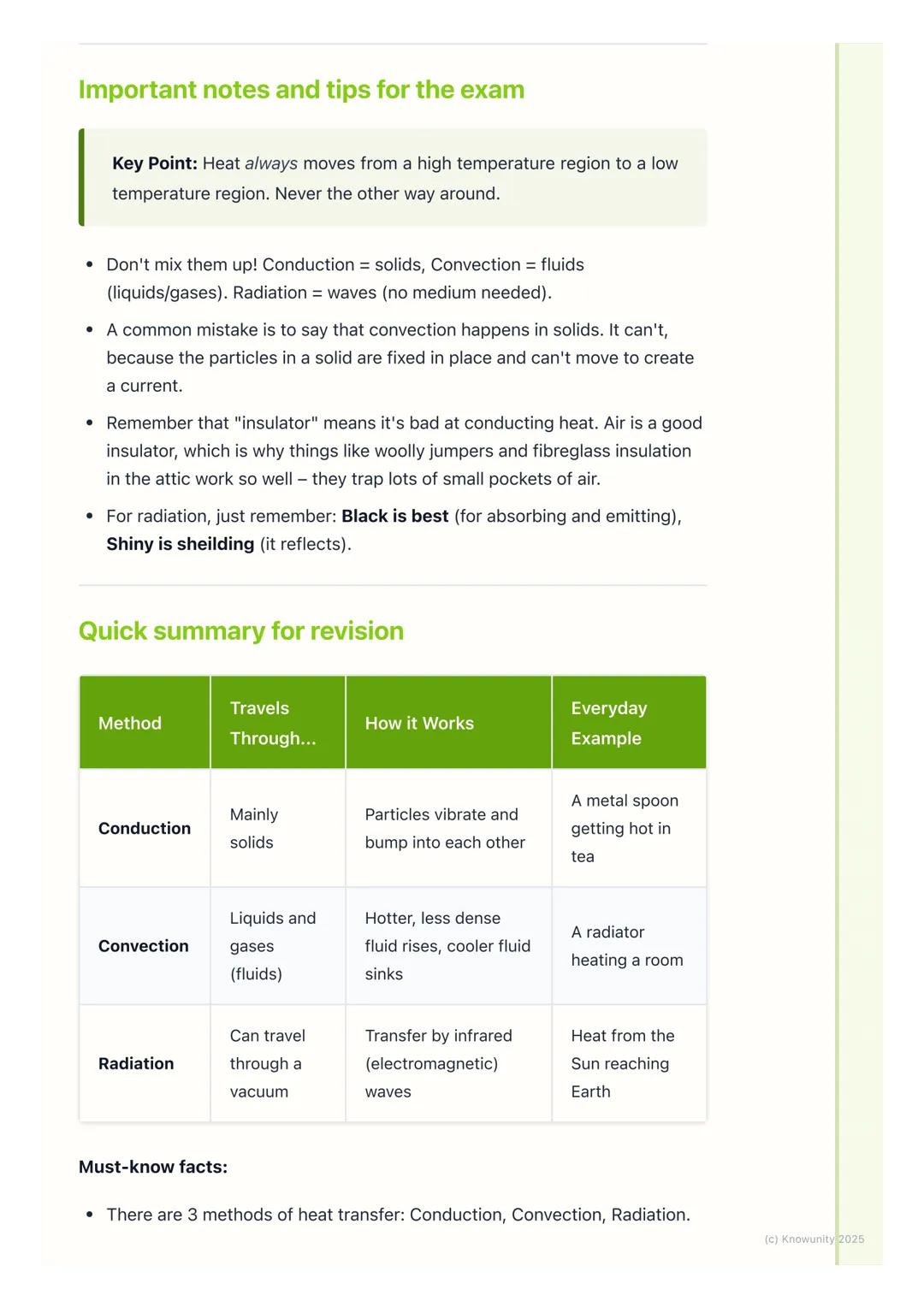
8
of 8
Pensavamo che non l'avreste mai chiesto....
Che cos'è l'assistente AI di Knowunity?
Il nostro assistente AI è costruito specificamente per le esigenze degli studenti. Sulla base dei milioni di contenuti presenti sulla piattaforma, possiamo fornire agli studenti risposte davvero significative e pertinenti. Ma non si tratta solo di risposte, l'assistente è in grado di guidare gli studenti attraverso le loro sfide quotidiane di studio, con piani di studio personalizzati, quiz o contenuti nella chat e una personalizzazione al 100% basata sulle competenze e sugli sviluppi degli studenti.
Dove posso scaricare l'applicazione Knowunity?
È possibile scaricare l'applicazione dal Google Play Store e dall'Apple App Store.
Knowunity è davvero gratuita?
Sì, hai accesso completamente gratuito a tutti i contenuti nell'app e puoi chattare o seguire i Creatori in qualsiasi momento. Sbloccherai nuove funzioni crescendo il tuo numero di follower. Inoltre, offriamo Knowunity Premium, che consente di studiare senza alcun limite!!
Contenuti più popolari di Physics
3PhysicsBalanced and Unbalanced Forces
Students will explore how balanced forces result in no change in motion, while unbalanced forces cause an object to accelerate or change direction.
2nd Year522
PhysicsTypes of Forces
Students will identify common forces such as gravity (pulling objects down), friction (opposing motion), and air resistance (slowing objects in the air).
2nd Year550
 Science
Science/Physics notes - Speed, density, work
Speed density work formulas
3rd Year81
Contenuti più popolari
9 Irish
IrishIrish oral questions and answers
Questions and answers for the leaving cert oral
5th Year4264
 English
Key Quotes : Sive
Key Quotes and explanations: Sive
6th Year2842
IrishIrish oral questions
Outline of oral questions
5th Year2055
IrishIníon- le hÁine Durkin
Aine Durkin’s poem, Iníon: Themes & summary
5th Year850
IrishIrish poetry 2027
Iníon + Dínit an Bhróin
5th Year1133
IrishLC HL notes- Iníon (poem)
Includes poem in English and Irish, theme, key words & phrases
5th Year2284
EnglishCultural Context : Shawshank Redemption : Sive : Small Things Like These
Comparative Study : Cultural Context : Shawshank Redemption, Sive and Small Things Like These
6th Year1430
IrishMo Ghrá-sa (Idir Lúibíní)
Notes on mo ghrá-sa
5th Year380
IrishAn Gaeilge Aiste
Irish Language essay
6th Year1320
Non c'è niente di adatto? Esplorare altre aree tematiche.
Recensioni dei nostri utenti. Ci adorano - e anche tu, vedrai .
4.6/5App Store
4.7/5Google Play
L'applicazione è molto facile da usare e ben progettata. Finora ho trovato tutto quello che cercavo e ho potuto imparare molto dalle presentazioni! Utilizzerò sicuramente l'app per i compiti in classe! È molto utile anche come fonte di ispirazione.
Stefano Sutente iOS
Questa applicazione è davvero grande! Ci sono tantissimi appunti e aiuti con lo studio [...]. La mia materia problematica, per esempio, è il francese e l'app ha così tante opzioni per aiutarmi. Grazie a questa app ho migliorato il mio francese. La consiglio a tutti.
Samantha Klichutente Android
Wow, sono davvero stupita. Ho appena provato l'app perché l'ho vista pubblicizzata molte volte e sono rimasta assolutamente sbalordita. Questa app è L'AIUTO che cercate per la scuola e soprattutto offre tantissime cose, come allenamenti e schede, che a me personalmente sono state MOLTO utili.
Annautente iOS
Physics7 visualizzazioni·Aggiornato Jun 16, 2026·8 pagineHow Heat Transfers: Exploring Conduction, Convection, and Radiation
Ever wondered why a metal spoon gets scorching hot in your tea, or how the Sun's warmth reaches Earth through empty space? Heat transfer is happening all around you every day, and understanding it will help you make sense of...
1
of 8
Iscriviti per mostrare il contenuto. È gratis!
- Accesso a tutti i documenti
- Migliora i tuoi voti
- Unisciti a milioni di studenti
The Basics: What Heat Actually Does
Heat always has one mission: to move from hot places to cold places until everything evens out. When you grab a cold can of Coke, heat energy flows from your warm hand into the chilly can - the can doesn't "give you its cold."
There are exactly three ways heat can travel: conduction, convection, and radiation. Each method works differently and happens in different situations.
Temperature measures how hot something is (in °C), whilst heat is the actual energy moving between objects (measured in Joules). Think of temperature as the "level" and heat as the energy doing the moving.
Conductors like metals let heat pass through easily, whilst insulators like wood and plastic block heat transfer. This is why metal spoons get hot quickly but wooden spoons stay cool.
Quick Check: Touch a metal door handle and a wooden door frame on a cold morning - they're the same temperature, but the metal feels much colder because it conducts heat away from your hand faster!
2
of 8Iscriviti per mostrare il contenuto. È gratis!
- Accesso a tutti i documenti
- Migliora i tuoi voti
- Unisciti a milioni di studenti
Conduction: Heat Through Solids
Conduction is how heat travels through solid materials, and it's basically like a particle domino effect. When you heat one end of a solid, those particles start vibrating more energetically.
These excited particles bump into their neighbours, passing on their extra energy and making them vibrate more too. This continues along the solid like a chain reaction, transferring heat from the hot end to the cold end.
Metals are superstar conductors because they have free electrons that aren't tied to specific atoms. These electrons zip around carrying heat energy much faster than particle vibrations alone - that's why a metal spoon heats up so quickly in hot tea.
Common examples include a saucepan handle getting hot on the hob, or holding a metal poker near a fire and feeling it warm up along its length.
Remember: In conduction, the particles vibrate but don't actually move from their positions - they're just passing energy along like a relay race with stationary runners!
3
of 8Iscriviti per mostrare il contenuto. È gratis!
- Accesso a tutti i documenti
- Migliora i tuoi voti
- Unisciti a milioni di studenti
Convection: Heat on the Move
Convection only happens in fluids (liquids and gases) because it relies on the actual movement of the substance itself. It's all about density changes that create circular currents.
Here's how it works: when you heat a fluid, it expands and becomes less dense than the cooler fluid around it. This lighter, hot fluid rises whilst denser, cooler fluid sinks to take its place. The cycle continues, creating convection currents.
Think about boiling water - the heating element warms water at the bottom, which rises, whilst cooler water from the top sinks down to be heated. This creates a continuous circulation pattern.
Room heaters work the same way: they heat nearby air, which rises, moves across the ceiling, cools down, and sinks on the far side of the room. That's how one radiator can warm an entire space.
Key Point: Convection can't happen in solids because particles are fixed in place and can't create the flowing currents needed for this type of heat transfer.
4
of 8Iscriviti per mostrare il contenuto. È gratis!
- Accesso a tutti i documenti
- Migliora i tuoi voti
- Unisciti a milioni di studenti
Radiation: Heat Waves Through Space
Radiation is the most impressive heat transfer method because it doesn't need any particles at all - it travels as infrared electromagnetic waves. This is how the Sun's energy reaches Earth through the vacuum of space.
All objects constantly emit and absorb thermal radiation, but hotter objects give off much more than cooler ones. You can feel this when you stand near a bonfire - you're sensing the infrared waves hitting your skin.
Surface properties matter enormously for radiation. Dark, dull surfaces are excellent absorbers and emitters of heat radiation, whilst shiny, light surfaces are brilliant reflectors but poor absorbers.
This explains why people wear black in winter (to absorb more solar heat) but white in summer (to reflect heat away). Car manufacturers often use light colours in hot climates for the same reason.
Think About It: You can feel heat from a toaster's glowing elements even before they turn red - that's infrared radiation your skin can detect but your eyes can't see!
5
of 8Iscriviti per mostrare il contenuto. È gratis!
- Accesso a tutti i documenti
- Migliora i tuoi voti
- Unisciti a milioni di studenti
Real-World Application: The Vacuum Flask
A vacuum flask (or Thermos) brilliantly demonstrates how to block all three heat transfer methods to keep drinks at the right temperature.
The plastic or cork stopper stops conduction and convection by using insulating materials and preventing air movement. The vacuum between the inner and outer walls is genius - with no particles present, there's nothing to conduct heat or create convection currents.
The silvered surfaces handle radiation by reflecting heat waves. If your drink is hot, the shiny inner surface bounces heat back into the liquid. If it's cold, the shiny outer surface reflects external heat away.
This design works for both hot and cold drinks because it simply prevents heat from moving in either direction. It's like creating a thermal barrier around your beverage.
Cool Fact: The vacuum gap is the same technology used in space - without particles to transfer heat, astronauts rely heavily on radiation management to control temperature!
6
of 8Iscriviti per mostrare il contenuto. È gratis!
- Accesso a tutti i documenti
- Migliora i tuoi voti
- Unisciti a milioni di studenti
Exam Success: Key Points to Remember
Heat always flows from high to low temperature - never the opposite direction. This is fundamental to every heat transfer question you'll encounter.
Conduction = solids only (particles vibrating in place). Convection = fluids only (actual movement of liquid or gas). Radiation = electromagnetic waves that need no medium.
Don't fall for the common trap of saying convection happens in solids - it can't because solid particles are fixed in position and can't create flowing currents.
Air is actually an excellent insulator, which is why fluffy jumpers and loft insulation work so well - they trap lots of tiny air pockets that prevent heat transfer.
Memory Trick: For radiation surfaces, remember "Black is Best" (for absorbing and emitting heat) and "Shiny Shields" (reflects heat away).
7
of 8Iscriviti per mostrare il contenuto. È gratis!
- Accesso a tutti i documenti
- Migliora i tuoi voti
- Unisciti a milioni di studenti
8
of 8Iscriviti per mostrare il contenuto. È gratis!
- Accesso a tutti i documenti
- Migliora i tuoi voti
- Unisciti a milioni di studenti
Pensavamo che non l'avreste mai chiesto....
Che cos'è l'assistente AI di Knowunity?
Il nostro assistente AI è costruito specificamente per le esigenze degli studenti. Sulla base dei milioni di contenuti presenti sulla piattaforma, possiamo fornire agli studenti risposte davvero significative e pertinenti. Ma non si tratta solo di risposte, l'assistente è in grado di guidare gli studenti attraverso le loro sfide quotidiane di studio, con piani di studio personalizzati, quiz o contenuti nella chat e una personalizzazione al 100% basata sulle competenze e sugli sviluppi degli studenti.
Dove posso scaricare l'applicazione Knowunity?
È possibile scaricare l'applicazione dal Google Play Store e dall'Apple App Store.
Knowunity è davvero gratuita?
Sì, hai accesso completamente gratuito a tutti i contenuti nell'app e puoi chattare o seguire i Creatori in qualsiasi momento. Sbloccherai nuove funzioni crescendo il tuo numero di follower. Inoltre, offriamo Knowunity Premium, che consente di studiare senza alcun limite!!
Contenuti più popolari di Physics
3PhysicsBalanced and Unbalanced Forces
Students will explore how balanced forces result in no change in motion, while unbalanced forces cause an object to accelerate or change direction.
2nd Year522
PhysicsTypes of Forces
Students will identify common forces such as gravity (pulling objects down), friction (opposing motion), and air resistance (slowing objects in the air).
2nd Year550
ScienceScience/Physics notes - Speed, density, work
Speed density work formulas
3rd Year81
Contenuti più popolari
9IrishIrish oral questions and answers
Questions and answers for the leaving cert oral
5th Year4264
EnglishKey Quotes : Sive
Key Quotes and explanations: Sive
6th Year2842
IrishIrish oral questions
Outline of oral questions
5th Year2055
IrishIníon- le hÁine Durkin
Aine Durkin’s poem, Iníon: Themes & summary
5th Year850
IrishIrish poetry 2027
Iníon + Dínit an Bhróin
5th Year1133
IrishLC HL notes- Iníon (poem)
Includes poem in English and Irish, theme, key words & phrases
5th Year2284
EnglishCultural Context : Shawshank Redemption : Sive : Small Things Like These
Comparative Study : Cultural Context : Shawshank Redemption, Sive and Small Things Like These
6th Year1430
IrishMo Ghrá-sa (Idir Lúibíní)
Notes on mo ghrá-sa
5th Year380
IrishAn Gaeilge Aiste
Irish Language essay
6th Year1320
Non c'è niente di adatto? Esplorare altre aree tematiche.
Recensioni dei nostri utenti. Ci adorano - e anche tu, vedrai .
4.6/5App Store
4.7/5Google Play
L'applicazione è molto facile da usare e ben progettata. Finora ho trovato tutto quello che cercavo e ho potuto imparare molto dalle presentazioni! Utilizzerò sicuramente l'app per i compiti in classe! È molto utile anche come fonte di ispirazione.
Stefano Sutente iOS
Questa applicazione è davvero grande! Ci sono tantissimi appunti e aiuti con lo studio [...]. La mia materia problematica, per esempio, è il francese e l'app ha così tante opzioni per aiutarmi. Grazie a questa app ho migliorato il mio francese. La consiglio a tutti.
Samantha Klichutente Android
Wow, sono davvero stupita. Ho appena provato l'app perché l'ho vista pubblicizzata molte volte e sono rimasta assolutamente sbalordita. Questa app è L'AIUTO che cercate per la scuola e soprattutto offre tantissime cose, come allenamenti e schede, che a me personalmente sono state MOLTO utili.
Annautente iOS