
Forces are everywhere - when you kick a football, sit...
 Physics52 visualizzazioni·Aggiornato Jun 9, 2026·7 pagine
Understanding Balanced and Unbalanced Forces: Effects on Motion
1 / 7
1
of 7
What Are Forces?
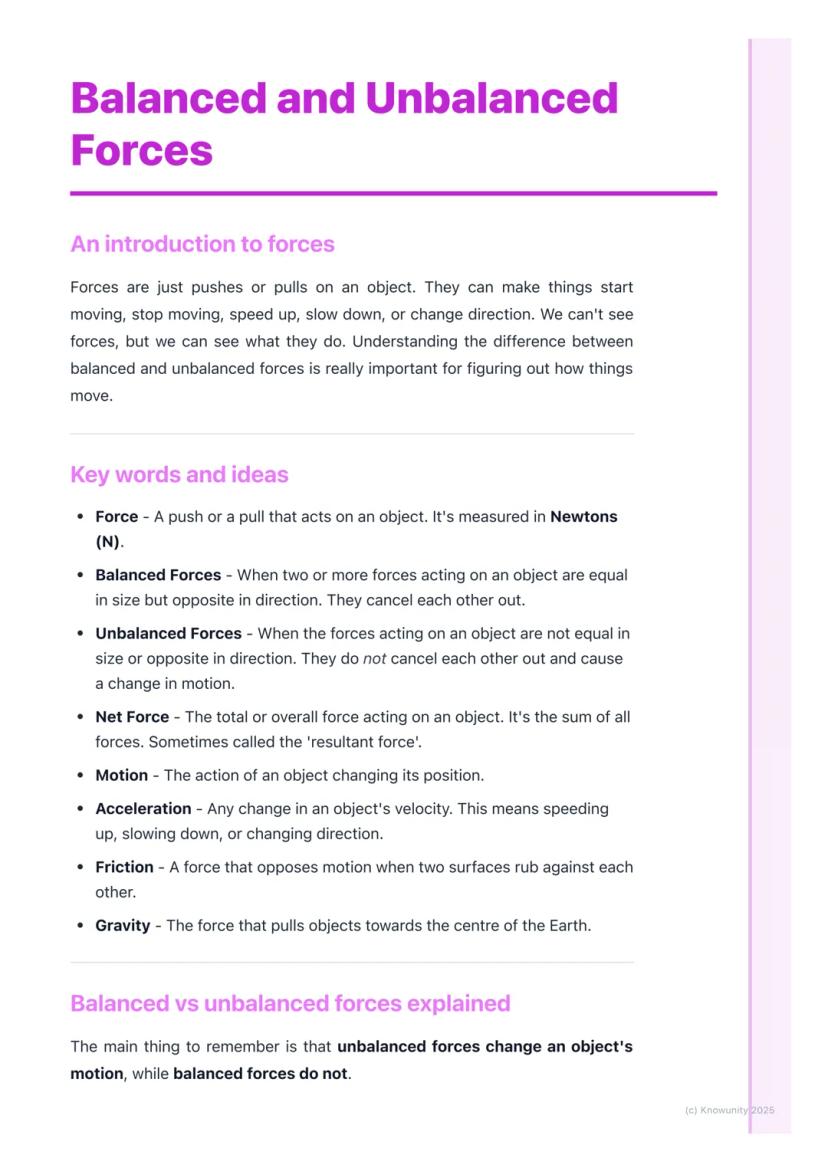
Think of forces as invisible pushes and pulls that are constantly acting on everything around you. You can't see them, but you definitely see what they do - like when you push a door open or gravity pulls your phone to the ground when you drop it.
Forces are measured in Newtons (N), named after Sir Isaac Newton. Every time something starts moving, stops, speeds up, or changes direction, it's because of forces doing their job.
The big idea here is simple: balanced forces keep things as they are, whilst unbalanced forces create change. Master this concept and you'll understand why a book stays on your desk and why a football flies through the air when you kick it.
Key Insight: Forces might be invisible, but their effects are everywhere - from the friction that stops you sliding off your chair to the gravity that keeps your feet on the ground!
2
of 7
Balanced Forces - When Nothing Changes
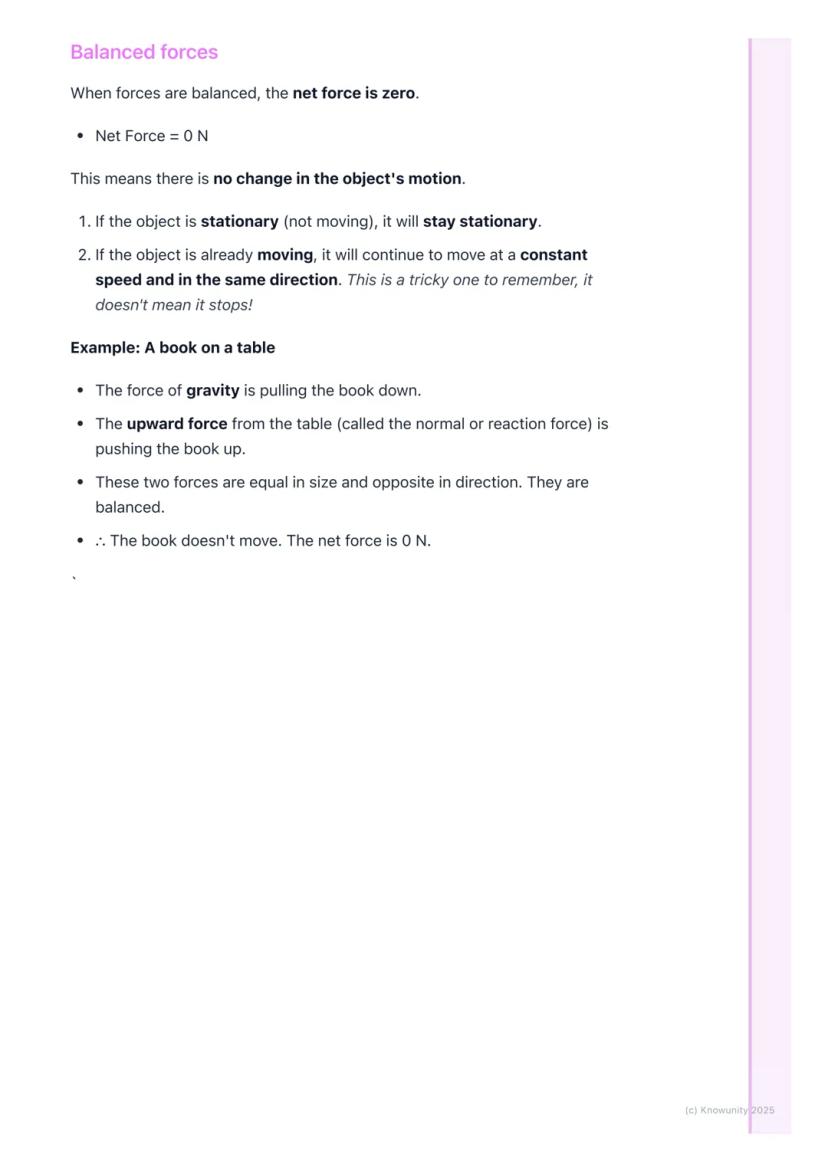
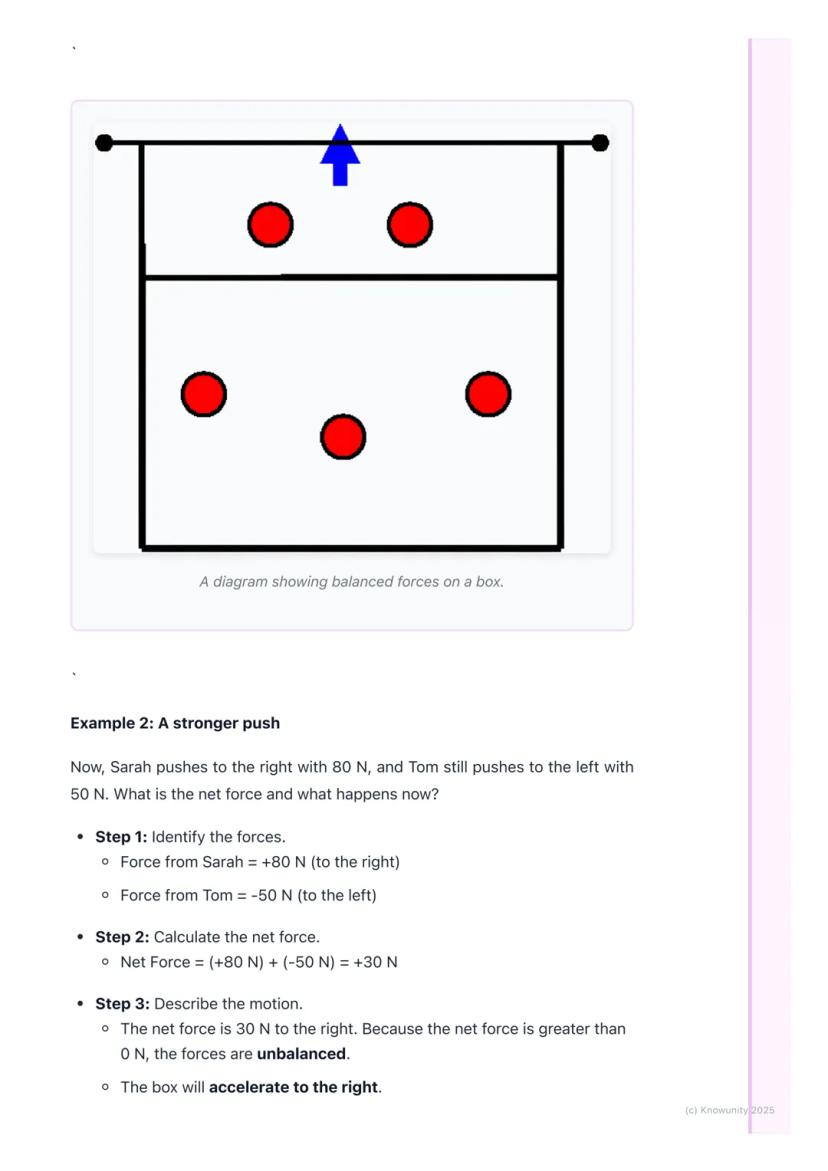
Balanced forces are like a perfectly even tug-of-war - both sides pull with equal strength, so nobody moves. When forces acting on an object are equal in size but opposite in direction, they cancel each other out completely.
The magic number here is zero. When forces are balanced, the net force (the total of all forces) equals 0 N. This means the object's motion won't change at all.
Here's the tricky bit that catches loads of students: if something is already moving when forces become balanced, it doesn't stop - it keeps moving at the same speed in the same direction! Think of a car on cruise control on a straight motorway.
Take a book on your desk. Gravity pulls it down whilst the normal force from the desk pushes up with exactly the same strength. These balanced forces mean your book stays put instead of falling through the desk or floating to the ceiling.
Remember: Balanced forces don't always mean "not moving" - they mean "not changing motion"!
3
of 7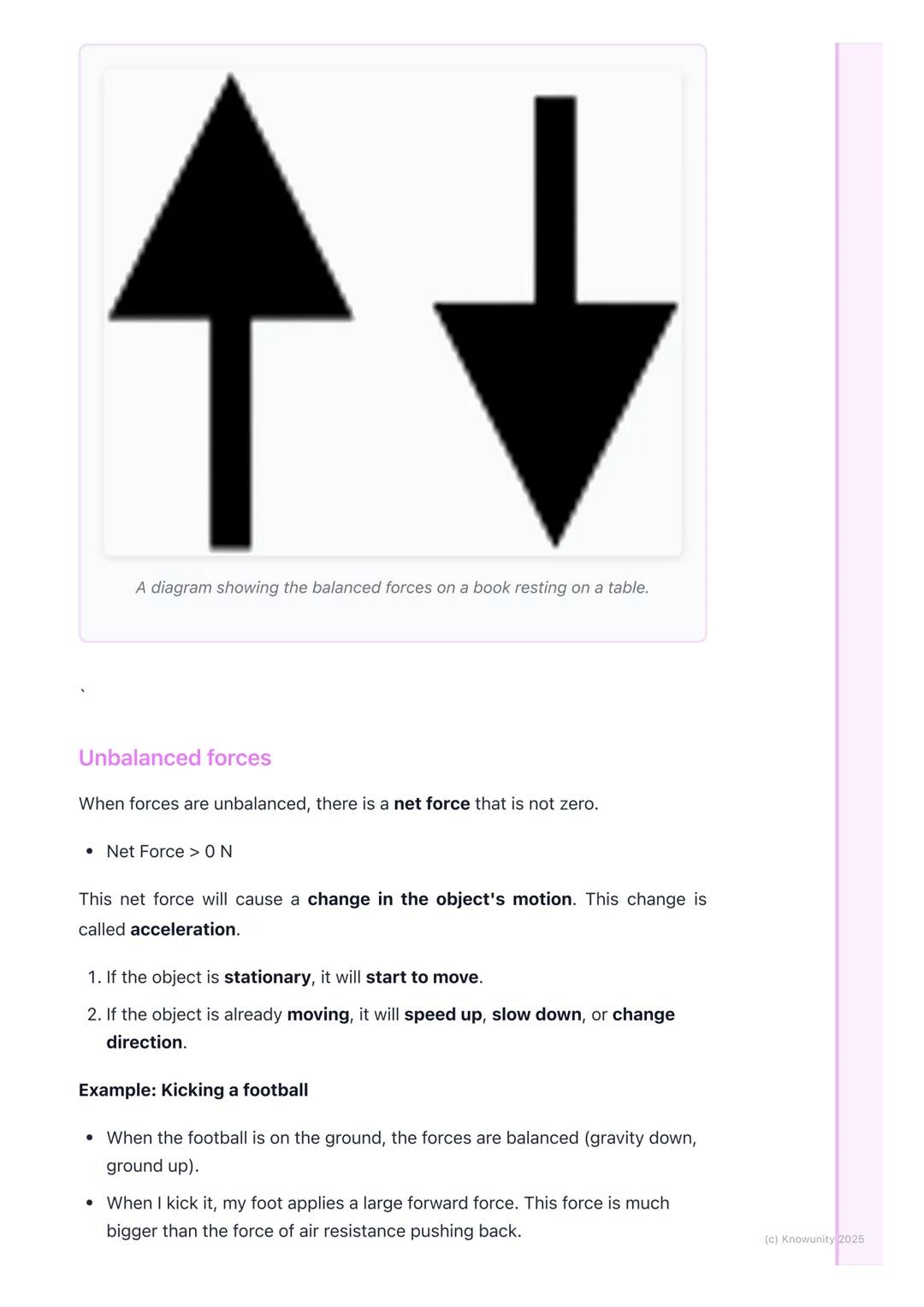
Unbalanced Forces - When Change Happens
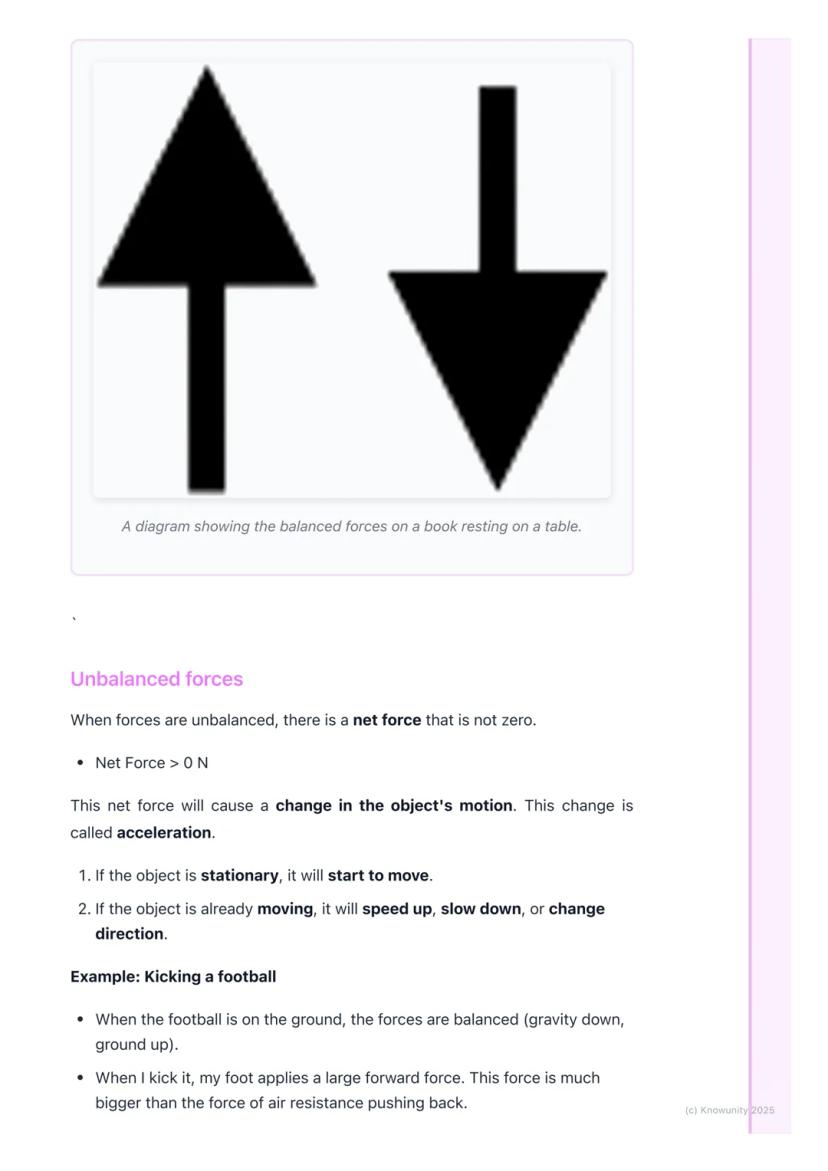
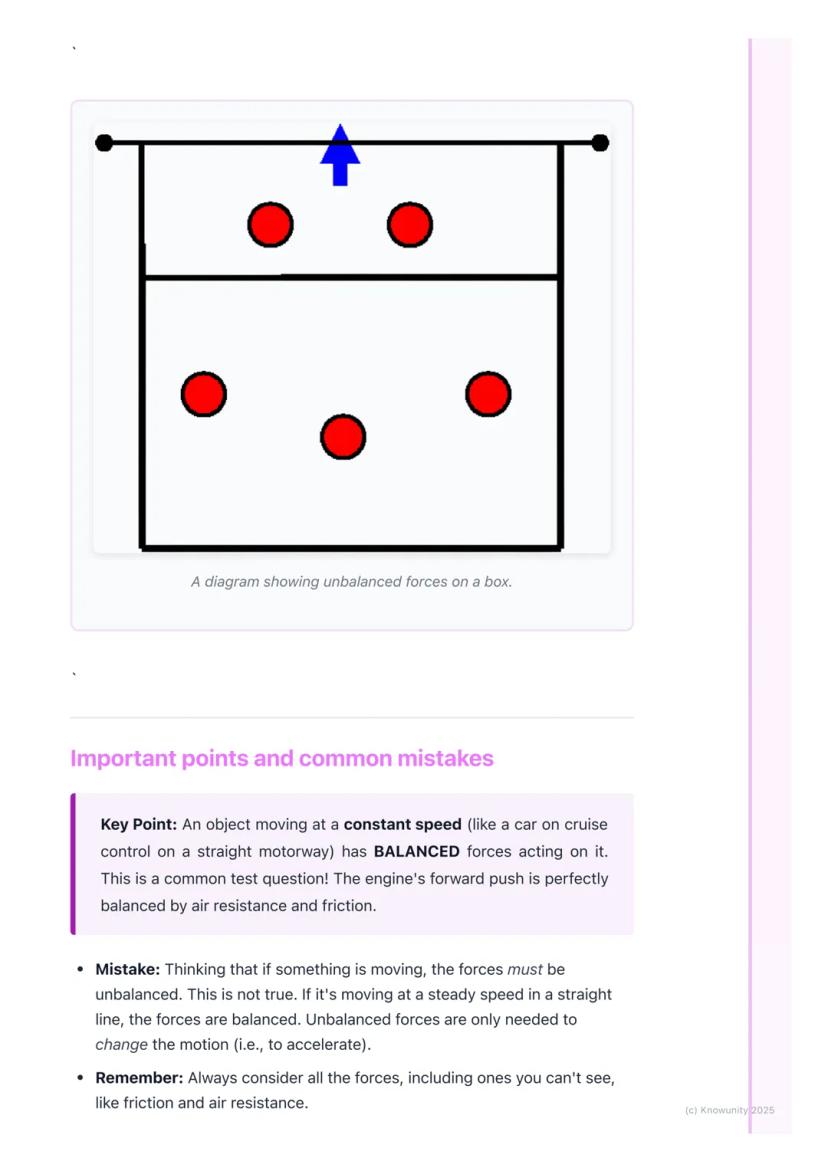
This is where things get exciting! Unbalanced forces occur when the forces acting on an object aren't equal - one direction "wins" over the other. The net force is greater than 0 N, and that's when you see acceleration.
Acceleration doesn't just mean speeding up - it's any change in motion. Things can speed up, slow down, or change direction. All of these count as acceleration in physics.
Picture kicking a football. Before you kick it, the ball sits still because gravity downwards equals the ground's upward push. But when your foot applies a massive forward force, suddenly the forces become unbalanced.
Your kick creates a much bigger force than air resistance can provide in the opposite direction. The net force sends the ball flying forward, and that's unbalanced forces in action!
Test Tip: If you see acceleration happening, you know the forces must be unbalanced - no exceptions!
4
of 7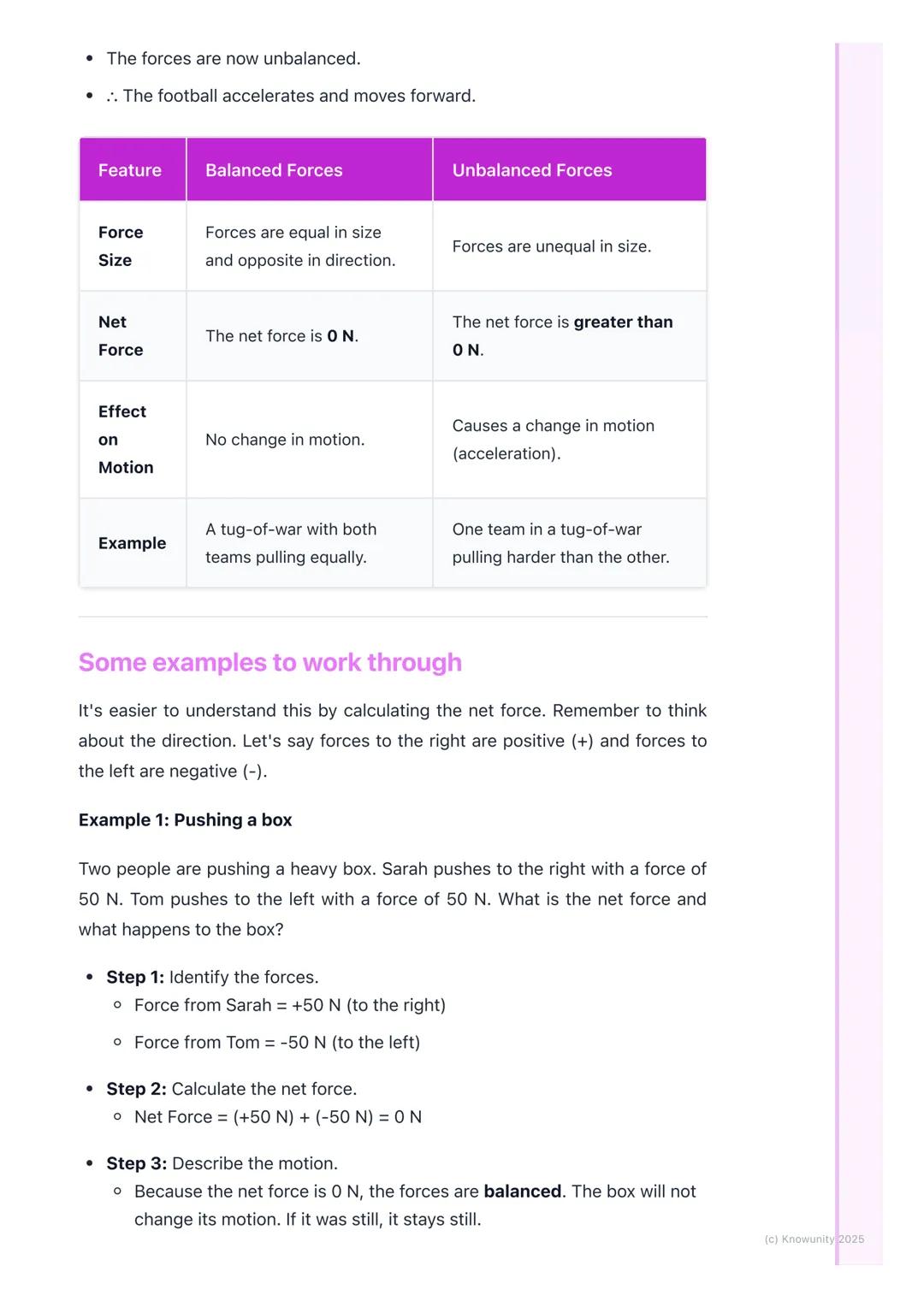
Working Out Net Force
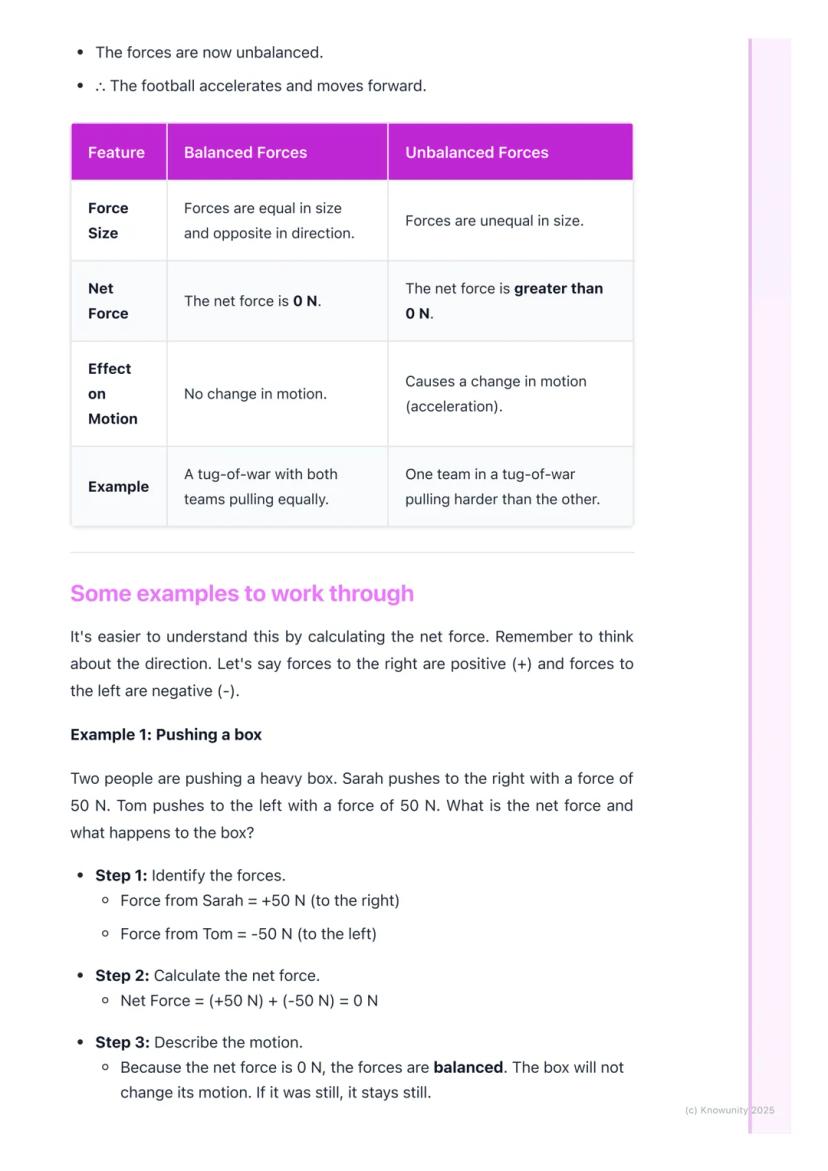
Let's make this practical with some maths - don't worry, it's easier than it looks! You just need to add up all the forces, keeping track of which direction they're pushing or pulling.
Example 1: Sarah pushes a box right with 50 N, whilst Tom pushes left with 50 N. Net force = 50 N + = 0 N. The forces are balanced, so the box won't change its motion.
Example 2: Now Sarah pushes right with 80 N, and Tom still pushes left with 50 N. Net force = 80 N + = 30 N to the right. These unbalanced forces will accelerate the box rightward.
The trick is picking a direction as positive (usually right or up) and making the opposite direction negative. Then it's just simple addition and subtraction to find your net force.
Study Hack: Always draw arrows showing force direction - it makes the maths much clearer and helps avoid silly mistakes!
5
of 7
Common Mistakes and Key Points
Here's the mistake that trips up nearly everyone: thinking that moving objects always have unbalanced forces acting on them. That's completely wrong! A car travelling at steady speed on a straight road has perfectly balanced forces - the engine's push forward exactly equals friction and air resistance pushing back.
Unbalanced forces are only needed when motion changes. If something moves at constant speed in a straight line, the forces are balanced. It's only when things speed up, slow down, or turn that you need unbalanced forces.
Don't forget about invisible forces like friction and air resistance - they're always there, even if you can't see them. These forces often balance out the more obvious pushes and pulls.
The direction of your net force always matches the direction of acceleration. If the net force points left, the object accelerates left. If it points right, acceleration goes right too.
Exam Success: Remember that constant velocity (steady speed, straight line) always means balanced forces - this question appears on nearly every test!
6
of 7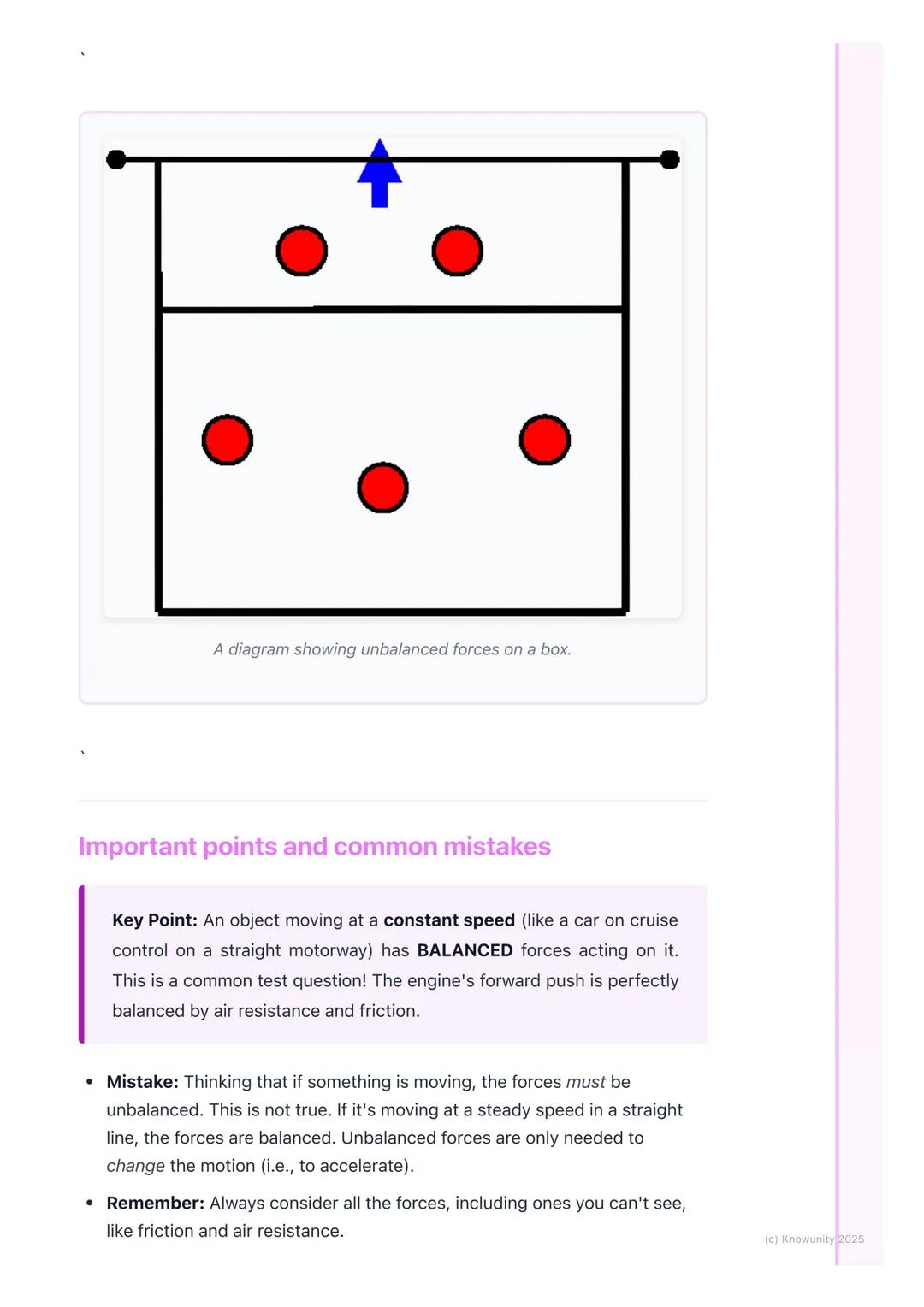
Quick Revision Summary
Forces are pushes or pulls measured in Newtons (N). When they're balanced (equal and opposite), the net force is 0 N and motion doesn't change. When they're unbalanced (not equal), you get a net force greater than 0 N that causes acceleration.
To find net force, add all forces together, remembering that direction matters. Use positive for one direction and negative for the opposite.
Objects at rest have balanced forces. Objects moving at constant speed also have balanced forces. Only accelerating objects have unbalanced forces acting on them.
Final Tip: If you can remember that balanced forces mean "no change" and unbalanced forces mean "change happens", you'll ace this topic!
7
of 7
Pensavamo che non l'avreste mai chiesto....
Che cos'è l'assistente AI di Knowunity?
Il nostro assistente AI è costruito specificamente per le esigenze degli studenti. Sulla base dei milioni di contenuti presenti sulla piattaforma, possiamo fornire agli studenti risposte davvero significative e pertinenti. Ma non si tratta solo di risposte, l'assistente è in grado di guidare gli studenti attraverso le loro sfide quotidiane di studio, con piani di studio personalizzati, quiz o contenuti nella chat e una personalizzazione al 100% basata sulle competenze e sugli sviluppi degli studenti.
Dove posso scaricare l'applicazione Knowunity?
È possibile scaricare l'applicazione dal Google Play Store e dall'Apple App Store.
Knowunity è davvero gratuita?
Sì, hai accesso completamente gratuito a tutti i contenuti nell'app e puoi chattare o seguire i Creatori in qualsiasi momento. Sbloccherai nuove funzioni crescendo il tuo numero di follower. Inoltre, offriamo Knowunity Premium, che consente di studiare senza alcun limite!!
Contenuti più popolari di Physics
2 Science
Contenuti più popolari
9 English
Key Quotes : Sive
Key Quotes and explanations: Sive
6th Year2842
 Irish
IrishIrish oral questions and answers
Questions and answers for the leaving cert oral
5th Year4264
IrishIníon- le hÁine Durkin
Aine Durkin’s poem, Iníon: Themes & summary
5th Year890
EnglishCultural Context : Shawshank Redemption : Sive : Small Things Like These
Comparative Study : Cultural Context : Shawshank Redemption, Sive and Small Things Like These
6th Year1430
IrishLC HL notes- Iníon (poem)
Includes poem in English and Irish, theme, key words & phrases
5th Year2304
IrishIrish oral questions
Outline of oral questions
5th Year2055
IrishMo Ghrá-sa (Idir Lúibíní)
Notes on mo ghrá-sa
5th Year380
IrishAn Gaeilge Aiste
Irish Language essay
6th Year1320
EnglishElizabeth Bishop notes
Elizabeth Bishop notes
6th Year1271
Non c'è niente di adatto? Esplorare altre aree tematiche.
Recensioni dei nostri utenti. Ci adorano - e anche tu, vedrai .
4.6/5App Store
4.7/5Google Play
L'applicazione è molto facile da usare e ben progettata. Finora ho trovato tutto quello che cercavo e ho potuto imparare molto dalle presentazioni! Utilizzerò sicuramente l'app per i compiti in classe! È molto utile anche come fonte di ispirazione.
Stefano Sutente iOS
Questa applicazione è davvero grande! Ci sono tantissimi appunti e aiuti con lo studio [...]. La mia materia problematica, per esempio, è il francese e l'app ha così tante opzioni per aiutarmi. Grazie a questa app ho migliorato il mio francese. La consiglio a tutti.
Samantha Klichutente Android
Wow, sono davvero stupita. Ho appena provato l'app perché l'ho vista pubblicizzata molte volte e sono rimasta assolutamente sbalordita. Questa app è L'AIUTO che cercate per la scuola e soprattutto offre tantissime cose, come allenamenti e schede, che a me personalmente sono state MOLTO utili.
Annautente iOS
Physics52 visualizzazioni·Aggiornato Jun 9, 2026·7 pagineUnderstanding Balanced and Unbalanced Forces: Effects on Motion
Forces are everywhere - when you kick a football, sit on a chair, or even just stand still, forces are acting on you and everything around you. Understanding whether these forces are balanced or unbalanced helps explain why things move...
1
of 7
Iscriviti per mostrare il contenuto. È gratis!
- Accesso a tutti i documenti
- Migliora i tuoi voti
- Unisciti a milioni di studenti
What Are Forces?
Think of forces as invisible pushes and pulls that are constantly acting on everything around you. You can't see them, but you definitely see what they do - like when you push a door open or gravity pulls your phone to the ground when you drop it.
Forces are measured in Newtons (N), named after Sir Isaac Newton. Every time something starts moving, stops, speeds up, or changes direction, it's because of forces doing their job.
The big idea here is simple: balanced forces keep things as they are, whilst unbalanced forces create change. Master this concept and you'll understand why a book stays on your desk and why a football flies through the air when you kick it.
Key Insight: Forces might be invisible, but their effects are everywhere - from the friction that stops you sliding off your chair to the gravity that keeps your feet on the ground!
2
of 7Iscriviti per mostrare il contenuto. È gratis!
- Accesso a tutti i documenti
- Migliora i tuoi voti
- Unisciti a milioni di studenti
Balanced Forces - When Nothing Changes
Balanced forces are like a perfectly even tug-of-war - both sides pull with equal strength, so nobody moves. When forces acting on an object are equal in size but opposite in direction, they cancel each other out completely.
The magic number here is zero. When forces are balanced, the net force (the total of all forces) equals 0 N. This means the object's motion won't change at all.
Here's the tricky bit that catches loads of students: if something is already moving when forces become balanced, it doesn't stop - it keeps moving at the same speed in the same direction! Think of a car on cruise control on a straight motorway.
Take a book on your desk. Gravity pulls it down whilst the normal force from the desk pushes up with exactly the same strength. These balanced forces mean your book stays put instead of falling through the desk or floating to the ceiling.
Remember: Balanced forces don't always mean "not moving" - they mean "not changing motion"!
3
of 7Iscriviti per mostrare il contenuto. È gratis!
- Accesso a tutti i documenti
- Migliora i tuoi voti
- Unisciti a milioni di studenti
Unbalanced Forces - When Change Happens
This is where things get exciting! Unbalanced forces occur when the forces acting on an object aren't equal - one direction "wins" over the other. The net force is greater than 0 N, and that's when you see acceleration.
Acceleration doesn't just mean speeding up - it's any change in motion. Things can speed up, slow down, or change direction. All of these count as acceleration in physics.
Picture kicking a football. Before you kick it, the ball sits still because gravity downwards equals the ground's upward push. But when your foot applies a massive forward force, suddenly the forces become unbalanced.
Your kick creates a much bigger force than air resistance can provide in the opposite direction. The net force sends the ball flying forward, and that's unbalanced forces in action!
Test Tip: If you see acceleration happening, you know the forces must be unbalanced - no exceptions!
4
of 7Iscriviti per mostrare il contenuto. È gratis!
- Accesso a tutti i documenti
- Migliora i tuoi voti
- Unisciti a milioni di studenti
Working Out Net Force
Let's make this practical with some maths - don't worry, it's easier than it looks! You just need to add up all the forces, keeping track of which direction they're pushing or pulling.
Example 1: Sarah pushes a box right with 50 N, whilst Tom pushes left with 50 N. Net force = 50 N + = 0 N. The forces are balanced, so the box won't change its motion.
Example 2: Now Sarah pushes right with 80 N, and Tom still pushes left with 50 N. Net force = 80 N + = 30 N to the right. These unbalanced forces will accelerate the box rightward.
The trick is picking a direction as positive (usually right or up) and making the opposite direction negative. Then it's just simple addition and subtraction to find your net force.
Study Hack: Always draw arrows showing force direction - it makes the maths much clearer and helps avoid silly mistakes!
5
of 7Iscriviti per mostrare il contenuto. È gratis!
- Accesso a tutti i documenti
- Migliora i tuoi voti
- Unisciti a milioni di studenti
Common Mistakes and Key Points
Here's the mistake that trips up nearly everyone: thinking that moving objects always have unbalanced forces acting on them. That's completely wrong! A car travelling at steady speed on a straight road has perfectly balanced forces - the engine's push forward exactly equals friction and air resistance pushing back.
Unbalanced forces are only needed when motion changes. If something moves at constant speed in a straight line, the forces are balanced. It's only when things speed up, slow down, or turn that you need unbalanced forces.
Don't forget about invisible forces like friction and air resistance - they're always there, even if you can't see them. These forces often balance out the more obvious pushes and pulls.
The direction of your net force always matches the direction of acceleration. If the net force points left, the object accelerates left. If it points right, acceleration goes right too.
Exam Success: Remember that constant velocity (steady speed, straight line) always means balanced forces - this question appears on nearly every test!
6
of 7Iscriviti per mostrare il contenuto. È gratis!
- Accesso a tutti i documenti
- Migliora i tuoi voti
- Unisciti a milioni di studenti
Quick Revision Summary
Forces are pushes or pulls measured in Newtons (N). When they're balanced (equal and opposite), the net force is 0 N and motion doesn't change. When they're unbalanced (not equal), you get a net force greater than 0 N that causes acceleration.
To find net force, add all forces together, remembering that direction matters. Use positive for one direction and negative for the opposite.
Objects at rest have balanced forces. Objects moving at constant speed also have balanced forces. Only accelerating objects have unbalanced forces acting on them.
Final Tip: If you can remember that balanced forces mean "no change" and unbalanced forces mean "change happens", you'll ace this topic!
7
of 7Iscriviti per mostrare il contenuto. È gratis!
- Accesso a tutti i documenti
- Migliora i tuoi voti
- Unisciti a milioni di studenti
Pensavamo che non l'avreste mai chiesto....
Che cos'è l'assistente AI di Knowunity?
Il nostro assistente AI è costruito specificamente per le esigenze degli studenti. Sulla base dei milioni di contenuti presenti sulla piattaforma, possiamo fornire agli studenti risposte davvero significative e pertinenti. Ma non si tratta solo di risposte, l'assistente è in grado di guidare gli studenti attraverso le loro sfide quotidiane di studio, con piani di studio personalizzati, quiz o contenuti nella chat e una personalizzazione al 100% basata sulle competenze e sugli sviluppi degli studenti.
Dove posso scaricare l'applicazione Knowunity?
È possibile scaricare l'applicazione dal Google Play Store e dall'Apple App Store.
Knowunity è davvero gratuita?
Sì, hai accesso completamente gratuito a tutti i contenuti nell'app e puoi chattare o seguire i Creatori in qualsiasi momento. Sbloccherai nuove funzioni crescendo il tuo numero di follower. Inoltre, offriamo Knowunity Premium, che consente di studiare senza alcun limite!!
Contenuti più popolari di Physics
2Contenuti più popolari
9EnglishKey Quotes : Sive
Key Quotes and explanations: Sive
6th Year2842
IrishIrish oral questions and answers
Questions and answers for the leaving cert oral
5th Year4264
IrishIníon- le hÁine Durkin
Aine Durkin’s poem, Iníon: Themes & summary
5th Year890
EnglishCultural Context : Shawshank Redemption : Sive : Small Things Like These
Comparative Study : Cultural Context : Shawshank Redemption, Sive and Small Things Like These
6th Year1430
IrishLC HL notes- Iníon (poem)
Includes poem in English and Irish, theme, key words & phrases
5th Year2304
IrishIrish oral questions
Outline of oral questions
5th Year2055
IrishMo Ghrá-sa (Idir Lúibíní)
Notes on mo ghrá-sa
5th Year380
IrishAn Gaeilge Aiste
Irish Language essay
6th Year1320
EnglishElizabeth Bishop notes
Elizabeth Bishop notes
6th Year1271
Non c'è niente di adatto? Esplorare altre aree tematiche.
Recensioni dei nostri utenti. Ci adorano - e anche tu, vedrai .
4.6/5App Store
4.7/5Google Play
L'applicazione è molto facile da usare e ben progettata. Finora ho trovato tutto quello che cercavo e ho potuto imparare molto dalle presentazioni! Utilizzerò sicuramente l'app per i compiti in classe! È molto utile anche come fonte di ispirazione.
Stefano Sutente iOS
Questa applicazione è davvero grande! Ci sono tantissimi appunti e aiuti con lo studio [...]. La mia materia problematica, per esempio, è il francese e l'app ha così tante opzioni per aiutarmi. Grazie a questa app ho migliorato il mio francese. La consiglio a tutti.
Samantha Klichutente Android
Wow, sono davvero stupita. Ho appena provato l'app perché l'ho vista pubblicizzata molte volte e sono rimasta assolutamente sbalordita. Questa app è L'AIUTO che cercate per la scuola e soprattutto offre tantissime cose, come allenamenti e schede, che a me personalmente sono state MOLTO utili.
Annautente iOS