
Ever wondered what makes your favourite songs so catchy? It's... Mostra di più
 Music5 visualizzazioni·Aggiornato May 27, 2026·5 pagine
Understanding Beat and Rhythm in Music
1 / 5
1
of 5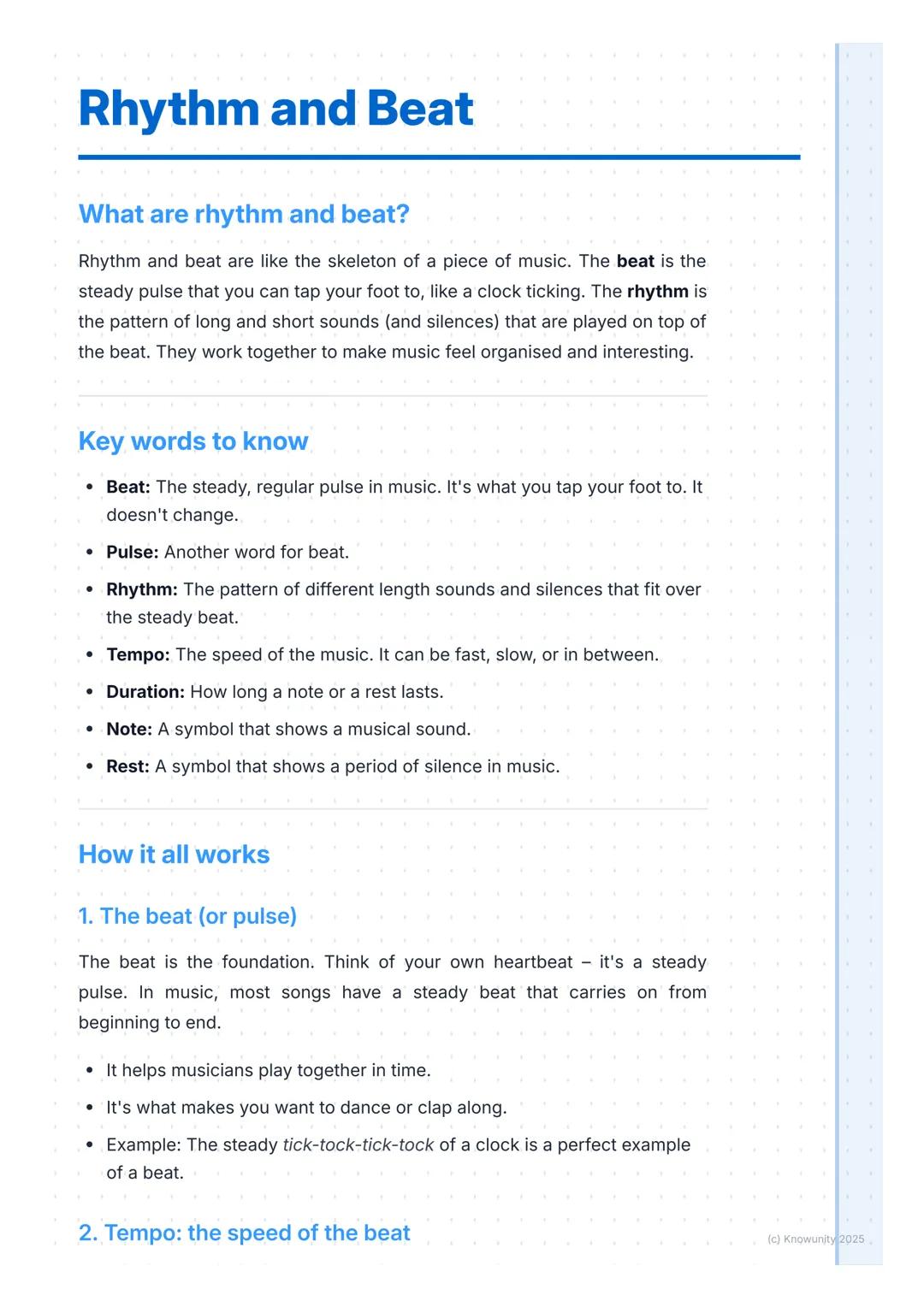
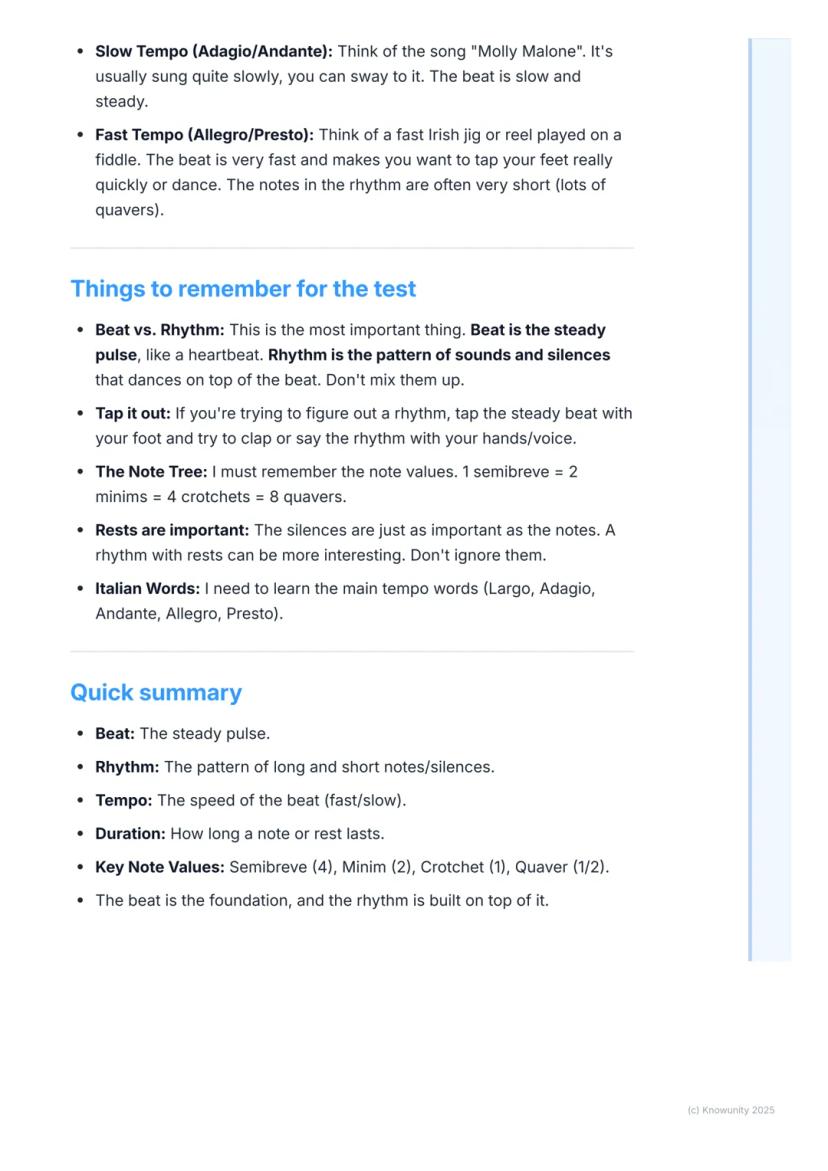
What Are Rhythm and Beat?
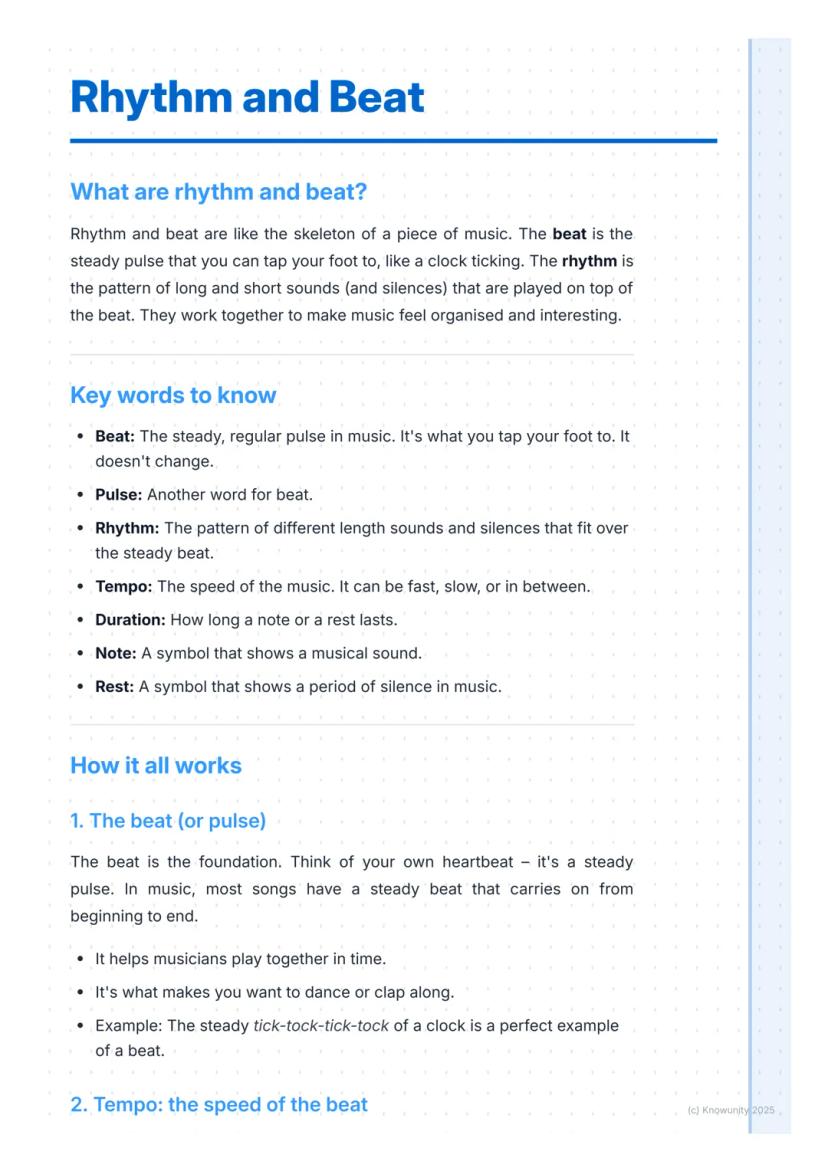
Think of music like a skeleton - the beat is the steady backbone that holds everything together, whilst the rhythm is the exciting pattern that dances on top. The beat is that steady pulse you naturally tap your foot to, just like a clock ticking away. It never changes and keeps everything organised.
Rhythm is much more interesting - it's the pattern of long and short sounds (plus the silences) that make each song unique. When you combine beat and rhythm, you get music that feels both steady and exciting at the same time.
Musicians use the beat to stay together when playing, which is why bands don't fall apart on stage! The pulse is just another word for beat, so don't get confused if you see both terms.
Quick Tip: Try listening to any song and tapping your foot - that steady tap is the beat, whilst everything else happening is the rhythm!
2
of 5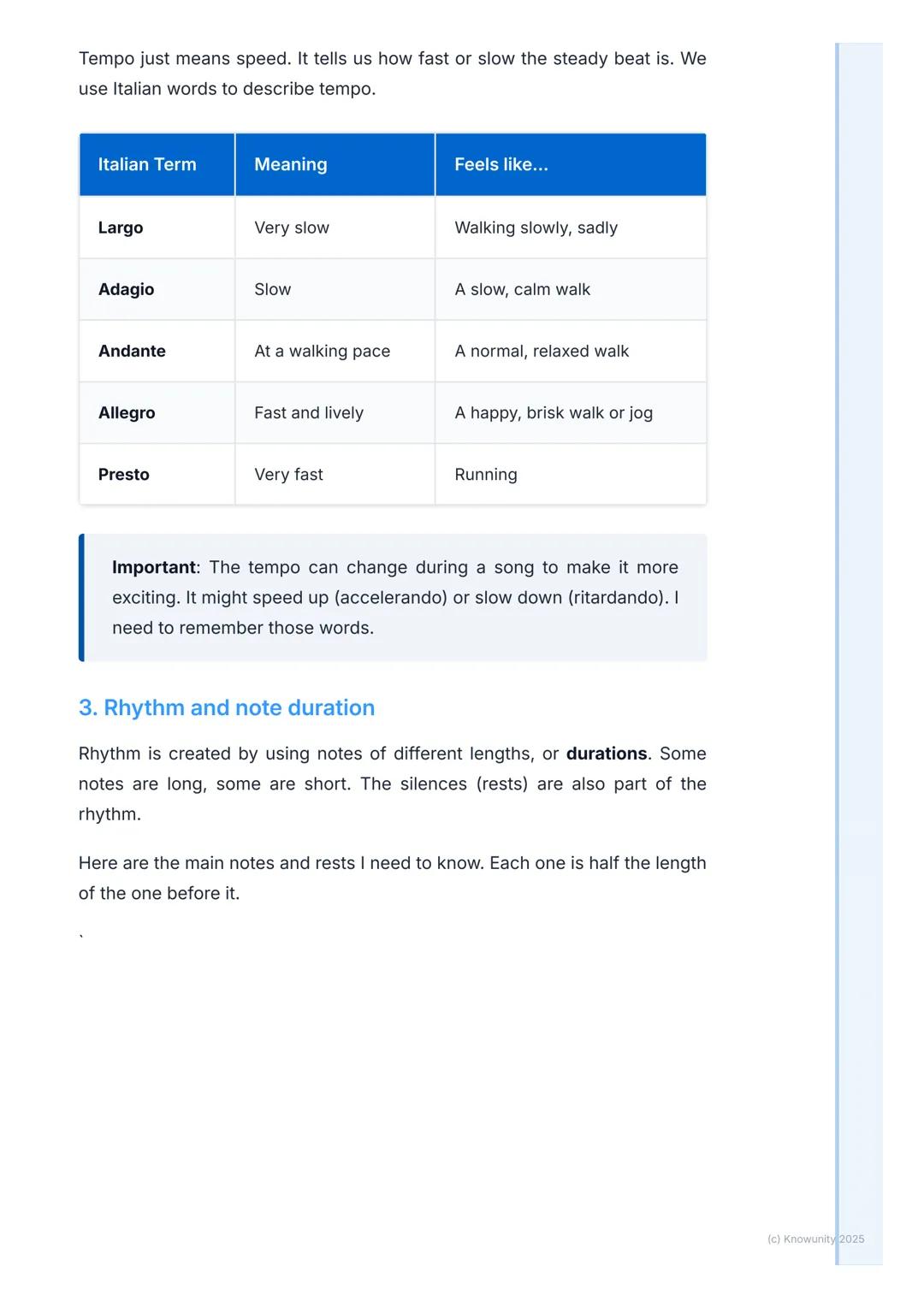
Understanding Tempo
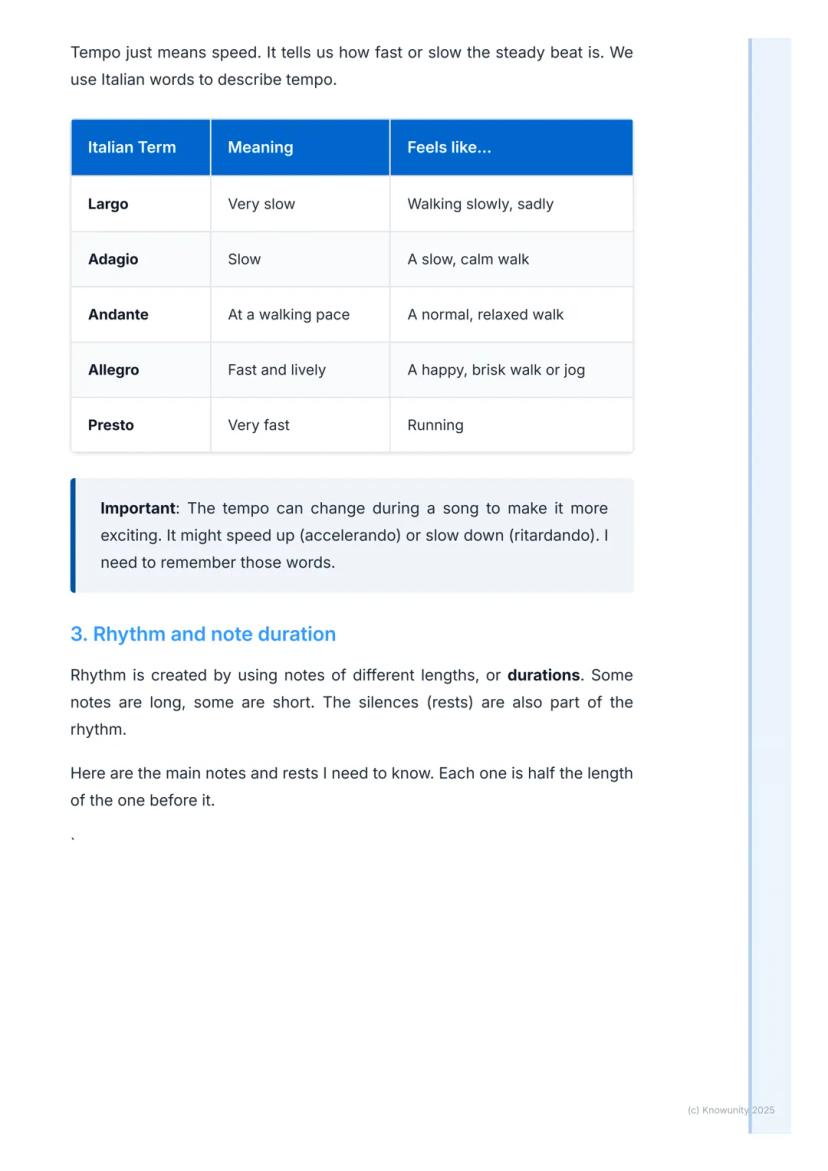
Tempo simply means how fast or slow the music goes. Musicians use fancy Italian words to describe different speeds, but they're actually quite logical once you think about them as different types of walking.
Largo means very slow - imagine walking sadly after losing a match. Adagio is slow like a calm, peaceful walk. Andante feels like your normal walking pace to school. Allegro is fast and lively, like rushing to meet your mates. Presto is super fast - basically running!
Here's the cool bit: tempo can change during a song to create excitement. When music speeds up, it's called accelerando. When it slows down, it's called ritardando. Think about how film music builds up during action scenes!
Remember This: Most Irish jigs are Allegro or Presto, whilst traditional ballads like "Molly Malone" are usually Andante or Adagio.
3
of 5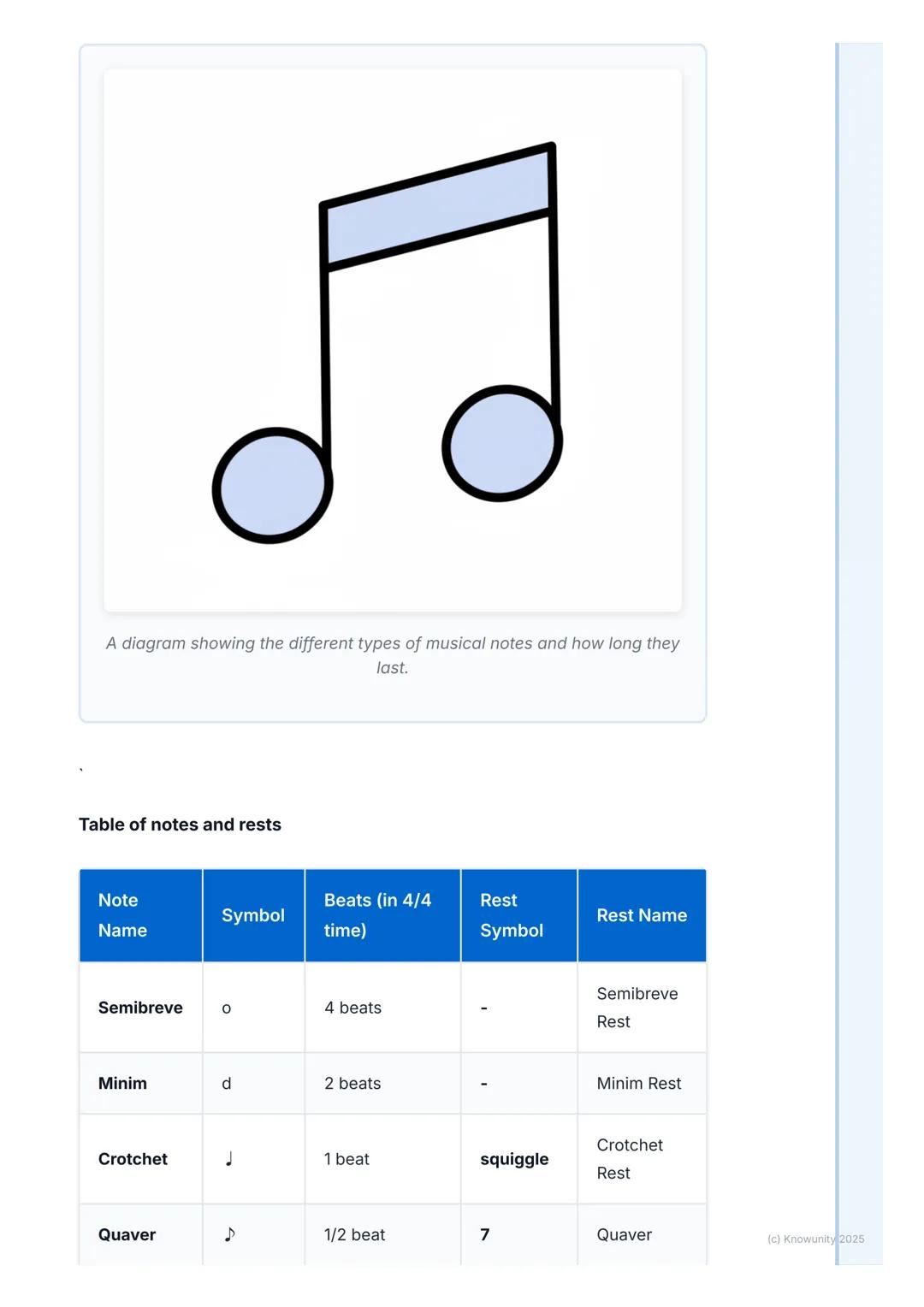
Note Values and Duration
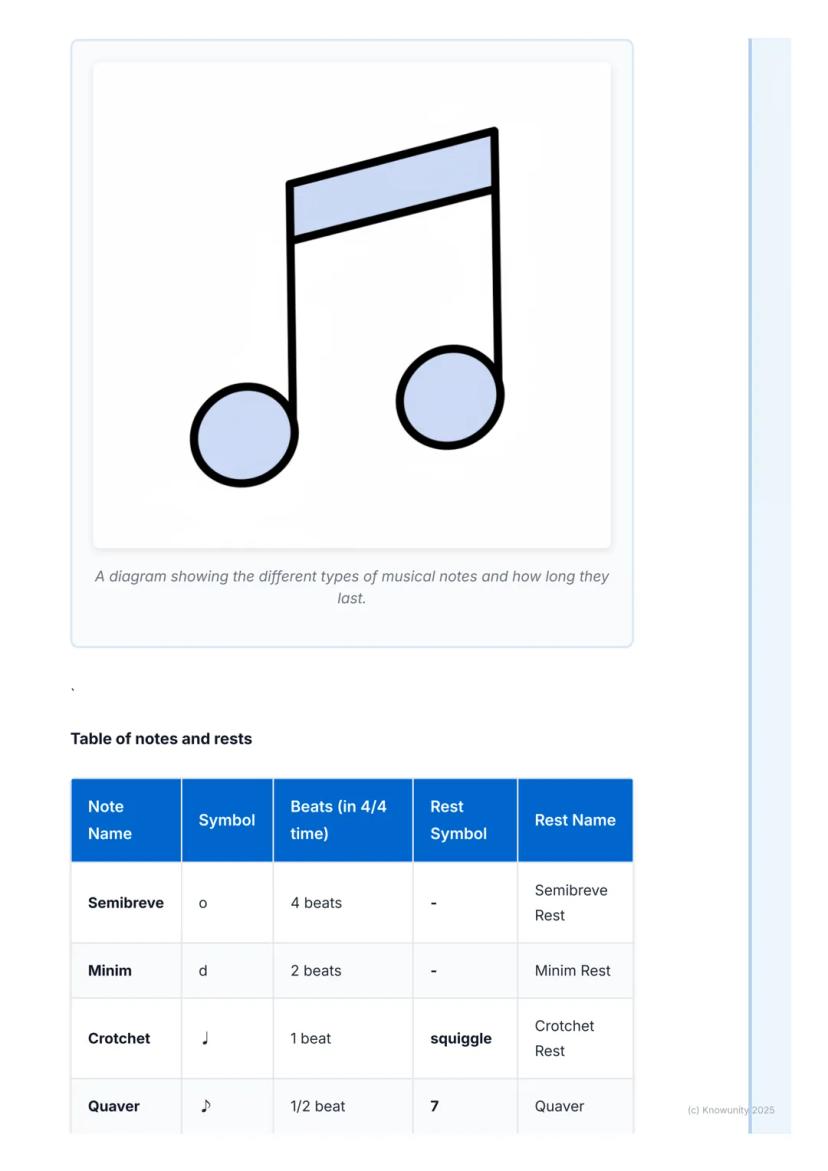
This is where rhythm gets its building blocks. Different notes last for different amounts of time - some are long, some are short. Think of it like a family tree where each note is exactly half the length of the one above it.
A semibreve lasts for 4 beats (the longest), a minim lasts for 2 beats, a crotchet lasts for 1 beat, and a quaver lasts for half a beat. It's like cutting a pizza in half, then in half again!
Rests are the silent gaps in music, and they're just as important as the notes themselves. Each note has a matching rest that lasts the same amount of time. The silences often make rhythms more interesting than constant noise would.
Memory Trick: Remember "1 semibreve = 2 minims = 4 crotchets = 8 quavers" - it's like a mathematical pattern that never changes!
4
of 5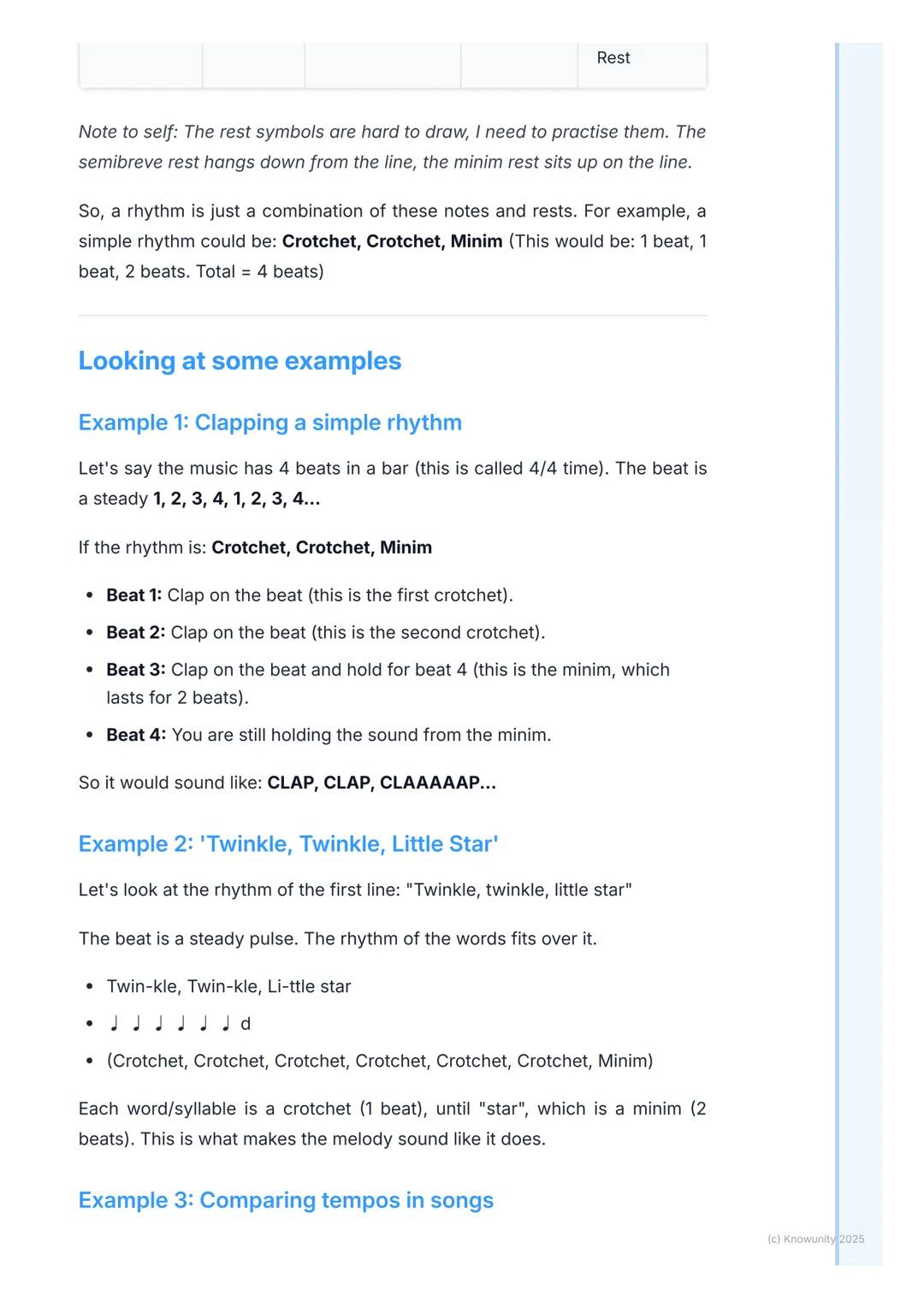
Putting It All Together
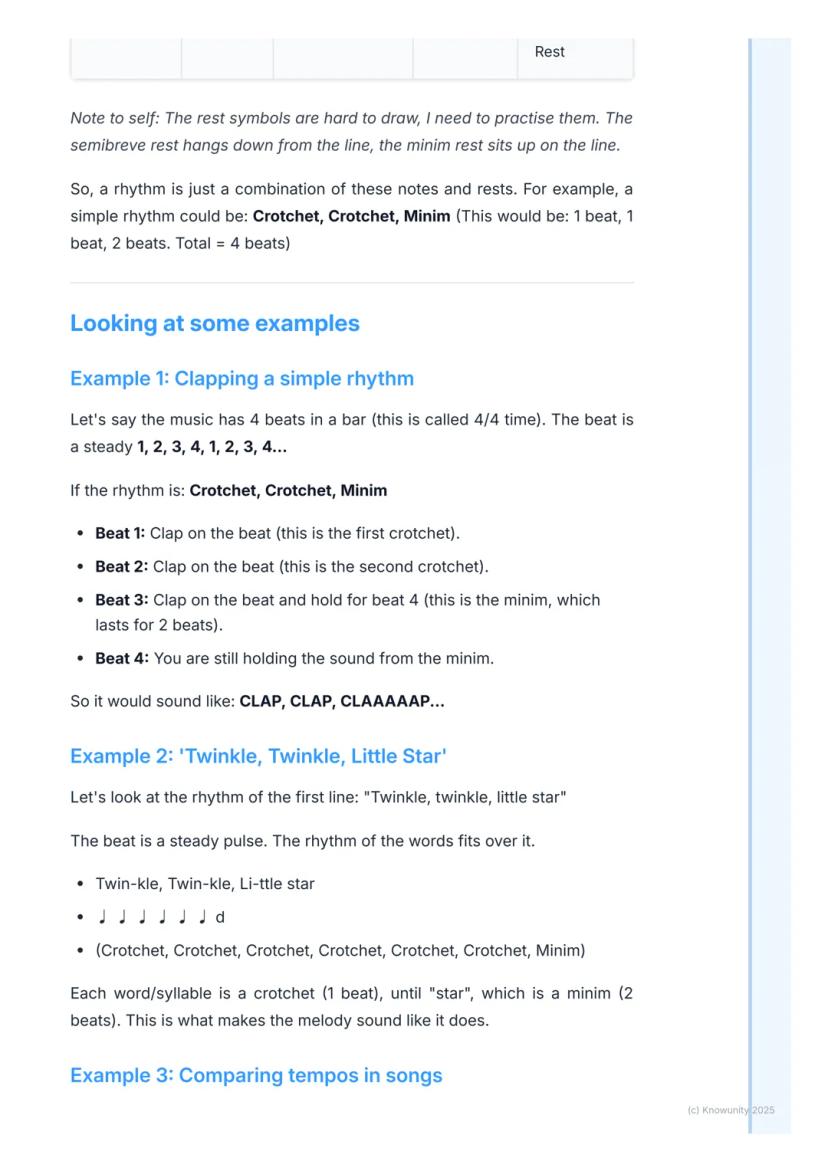
Let's see how this works with something you know. In "Twinkle, Twinkle, Little Star", each syllable gets one beat (crotchet), but "star" gets stretched out for two beats (minim). That's why it sounds complete at the end of the line.
When you're clapping rhythms, keep your foot tapping the steady beat whilst your hands clap the rhythm pattern. It's like patting your head and rubbing your stomach - tricky at first, but brilliant once you've got it!
Most popular music uses 4/4 time, which means there are 4 beats in each section (called a bar). Count along: 1, 2, 3, 4, 1, 2, 3, 4... and you'll hear how songs are organised into these groups.
Practice Tip: Try clapping simple patterns like "clap, clap, clap-hold-hold, clap" whilst keeping your foot tapping steadily - this builds your rhythm skills!
5
of 5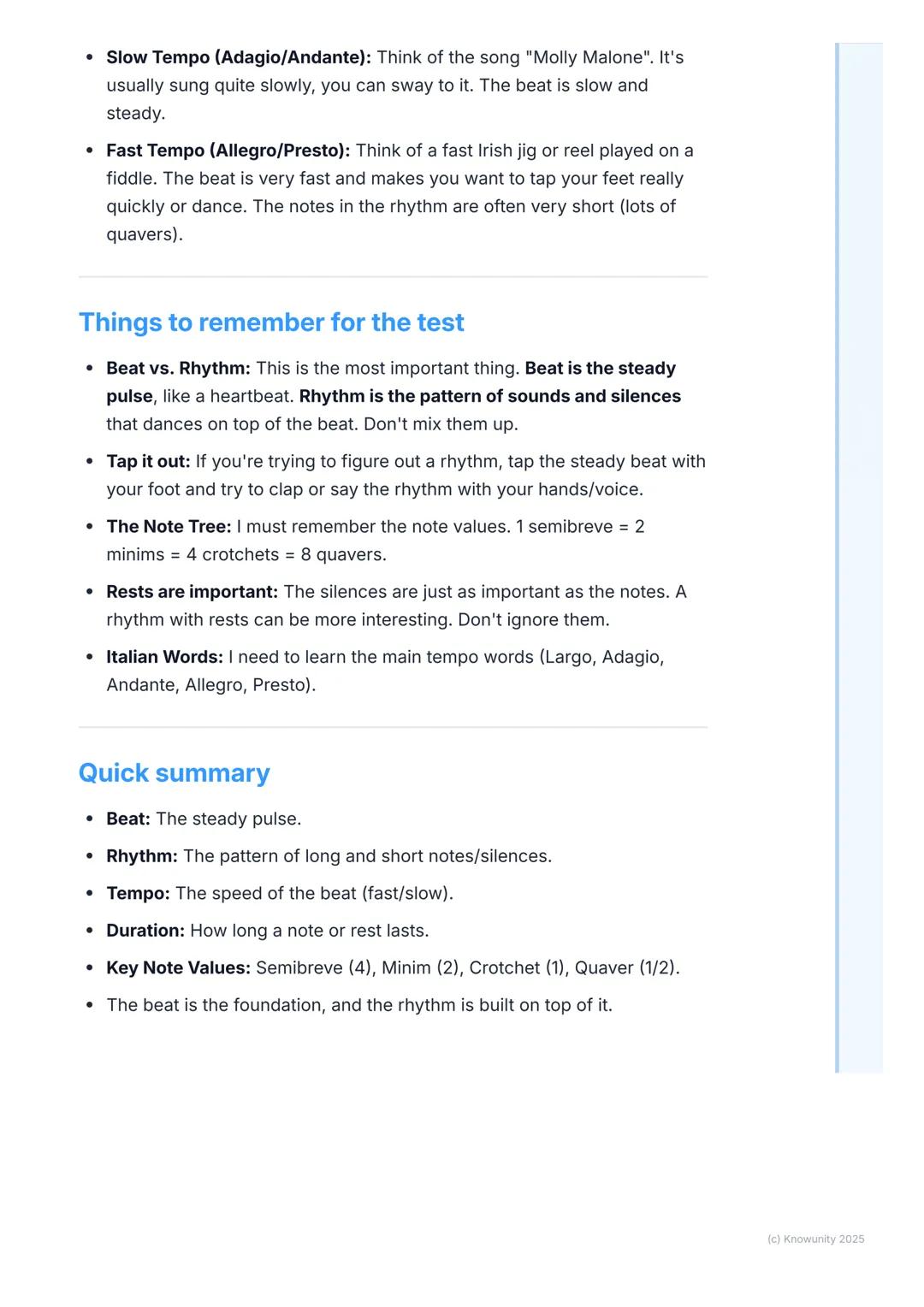
Test Success Tips
The most important thing to remember is that beat and rhythm are different. Beat = steady pulse (like your heartbeat), rhythm = the exciting pattern on top. Mix these up and you'll lose marks, so drill this difference into your brain!
For your exams, practice the note value relationships. Know that a semibreve equals 4 crotchets, and be able to work out simple rhythm patterns. The Italian tempo terms pop up regularly, so memorise Largo through to Presto.
Don't forget about rests - they're not just empty space, they're crucial parts of rhythms that create interest and breathing room. Many students ignore rests in exams and miss easy marks.
Exam Strategy: If you're stuck on a rhythm question, tap out the beat first, then work out where the sounds and silences fit over that steady pulse.
Pensavamo che non l'avreste mai chiesto....
Che cos'è l'assistente AI di Knowunity?
Il nostro assistente AI è costruito specificamente per le esigenze degli studenti. Sulla base dei milioni di contenuti presenti sulla piattaforma, possiamo fornire agli studenti risposte davvero significative e pertinenti. Ma non si tratta solo di risposte, l'assistente è in grado di guidare gli studenti attraverso le loro sfide quotidiane di studio, con piani di studio personalizzati, quiz o contenuti nella chat e una personalizzazione al 100% basata sulle competenze e sugli sviluppi degli studenti.
Dove posso scaricare l'applicazione Knowunity?
È possibile scaricare l'applicazione dal Google Play Store e dall'Apple App Store.
Knowunity è davvero gratuita?
Sì, hai accesso completamente gratuito a tutti i contenuti nell'app e puoi chattare o seguire i Creatori in qualsiasi momento. Sbloccherai nuove funzioni crescendo il tuo numero di follower. Inoltre, offriamo Knowunity Premium, che consente di studiare senza alcun limite!!
Contenuti più popolari di Music
1Contenuti più popolari
9 Irish
IrishIrish oral questions and answers
Questions and answers for the leaving cert oral
5th Year4264
IrishIrish oral questions
Outline of oral questions
5th Year2055
 English
Key Quotes : Sive
Key Quotes and explanations: Sive
6th Year2822
IrishIníon- le hÁine Durkin
Aine Durkin’s poem, Iníon: Themes & summary
5th Year850
IrishIrish poetry 2027
Iníon + Dínit an Bhróin
5th Year1133
IrishLC HL notes- Iníon (poem)
Includes poem in English and Irish, theme, key words & phrases
5th Year2284
IrishGaeilge Grammar Office
All the basics you need to know on Irish grammar.
6th Year1063
EnglishCultural Context : Shawshank Redemption : Sive : Small Things Like These
Comparative Study : Cultural Context : Shawshank Redemption, Sive and Small Things Like These
6th Year1420
IrishAn Gaeilge Aiste
Irish Language essay
6th Year1320
Non c'è niente di adatto? Esplorare altre aree tematiche.
Recensioni dei nostri utenti. Ci adorano - e anche tu, vedrai .
4.6/5App Store
4.7/5Google Play
L'applicazione è molto facile da usare e ben progettata. Finora ho trovato tutto quello che cercavo e ho potuto imparare molto dalle presentazioni! Utilizzerò sicuramente l'app per i compiti in classe! È molto utile anche come fonte di ispirazione.
Stefano Sutente iOS
Questa applicazione è davvero grande! Ci sono tantissimi appunti e aiuti con lo studio [...]. La mia materia problematica, per esempio, è il francese e l'app ha così tante opzioni per aiutarmi. Grazie a questa app ho migliorato il mio francese. La consiglio a tutti.
Samantha Klichutente Android
Wow, sono davvero stupita. Ho appena provato l'app perché l'ho vista pubblicizzata molte volte e sono rimasta assolutamente sbalordita. Questa app è L'AIUTO che cercate per la scuola e soprattutto offre tantissime cose, come allenamenti e schede, che a me personalmente sono state MOLTO utili.
Annautente iOS
Music5 visualizzazioni·Aggiornato May 27, 2026·5 pagineUnderstanding Beat and Rhythm in Music
Ever wondered what makes your favourite songs so catchy? It's all about rhythm and beat - the musical elements that make you want to tap your feet and dance along. Understanding these concepts is like learning the secret language that... Mostra di più
1
of 5Iscriviti per mostrare il contenuto. È gratis!
- Accesso a tutti i documenti
- Migliora i tuoi voti
- Unisciti a milioni di studenti
What Are Rhythm and Beat?
Think of music like a skeleton - the beat is the steady backbone that holds everything together, whilst the rhythm is the exciting pattern that dances on top. The beat is that steady pulse you naturally tap your foot to, just like a clock ticking away. It never changes and keeps everything organised.
Rhythm is much more interesting - it's the pattern of long and short sounds (plus the silences) that make each song unique. When you combine beat and rhythm, you get music that feels both steady and exciting at the same time.
Musicians use the beat to stay together when playing, which is why bands don't fall apart on stage! The pulse is just another word for beat, so don't get confused if you see both terms.
Quick Tip: Try listening to any song and tapping your foot - that steady tap is the beat, whilst everything else happening is the rhythm!
2
of 5Iscriviti per mostrare il contenuto. È gratis!
- Accesso a tutti i documenti
- Migliora i tuoi voti
- Unisciti a milioni di studenti
Understanding Tempo
Tempo simply means how fast or slow the music goes. Musicians use fancy Italian words to describe different speeds, but they're actually quite logical once you think about them as different types of walking.
Largo means very slow - imagine walking sadly after losing a match. Adagio is slow like a calm, peaceful walk. Andante feels like your normal walking pace to school. Allegro is fast and lively, like rushing to meet your mates. Presto is super fast - basically running!
Here's the cool bit: tempo can change during a song to create excitement. When music speeds up, it's called accelerando. When it slows down, it's called ritardando. Think about how film music builds up during action scenes!
Remember This: Most Irish jigs are Allegro or Presto, whilst traditional ballads like "Molly Malone" are usually Andante or Adagio.
3
of 5Iscriviti per mostrare il contenuto. È gratis!
- Accesso a tutti i documenti
- Migliora i tuoi voti
- Unisciti a milioni di studenti
Note Values and Duration
This is where rhythm gets its building blocks. Different notes last for different amounts of time - some are long, some are short. Think of it like a family tree where each note is exactly half the length of the one above it.
A semibreve lasts for 4 beats (the longest), a minim lasts for 2 beats, a crotchet lasts for 1 beat, and a quaver lasts for half a beat. It's like cutting a pizza in half, then in half again!
Rests are the silent gaps in music, and they're just as important as the notes themselves. Each note has a matching rest that lasts the same amount of time. The silences often make rhythms more interesting than constant noise would.
Memory Trick: Remember "1 semibreve = 2 minims = 4 crotchets = 8 quavers" - it's like a mathematical pattern that never changes!
4
of 5Iscriviti per mostrare il contenuto. È gratis!
- Accesso a tutti i documenti
- Migliora i tuoi voti
- Unisciti a milioni di studenti
Putting It All Together
Let's see how this works with something you know. In "Twinkle, Twinkle, Little Star", each syllable gets one beat (crotchet), but "star" gets stretched out for two beats (minim). That's why it sounds complete at the end of the line.
When you're clapping rhythms, keep your foot tapping the steady beat whilst your hands clap the rhythm pattern. It's like patting your head and rubbing your stomach - tricky at first, but brilliant once you've got it!
Most popular music uses 4/4 time, which means there are 4 beats in each section (called a bar). Count along: 1, 2, 3, 4, 1, 2, 3, 4... and you'll hear how songs are organised into these groups.
Practice Tip: Try clapping simple patterns like "clap, clap, clap-hold-hold, clap" whilst keeping your foot tapping steadily - this builds your rhythm skills!
5
of 5Iscriviti per mostrare il contenuto. È gratis!
- Accesso a tutti i documenti
- Migliora i tuoi voti
- Unisciti a milioni di studenti
Test Success Tips
The most important thing to remember is that beat and rhythm are different. Beat = steady pulse (like your heartbeat), rhythm = the exciting pattern on top. Mix these up and you'll lose marks, so drill this difference into your brain!
For your exams, practice the note value relationships. Know that a semibreve equals 4 crotchets, and be able to work out simple rhythm patterns. The Italian tempo terms pop up regularly, so memorise Largo through to Presto.
Don't forget about rests - they're not just empty space, they're crucial parts of rhythms that create interest and breathing room. Many students ignore rests in exams and miss easy marks.
Exam Strategy: If you're stuck on a rhythm question, tap out the beat first, then work out where the sounds and silences fit over that steady pulse.
Pensavamo che non l'avreste mai chiesto....
Che cos'è l'assistente AI di Knowunity?
Il nostro assistente AI è costruito specificamente per le esigenze degli studenti. Sulla base dei milioni di contenuti presenti sulla piattaforma, possiamo fornire agli studenti risposte davvero significative e pertinenti. Ma non si tratta solo di risposte, l'assistente è in grado di guidare gli studenti attraverso le loro sfide quotidiane di studio, con piani di studio personalizzati, quiz o contenuti nella chat e una personalizzazione al 100% basata sulle competenze e sugli sviluppi degli studenti.
Dove posso scaricare l'applicazione Knowunity?
È possibile scaricare l'applicazione dal Google Play Store e dall'Apple App Store.
Knowunity è davvero gratuita?
Sì, hai accesso completamente gratuito a tutti i contenuti nell'app e puoi chattare o seguire i Creatori in qualsiasi momento. Sbloccherai nuove funzioni crescendo il tuo numero di follower. Inoltre, offriamo Knowunity Premium, che consente di studiare senza alcun limite!!
Contenuti più popolari di Music
1Contenuti più popolari
9IrishIrish oral questions and answers
Questions and answers for the leaving cert oral
5th Year4264
IrishIrish oral questions
Outline of oral questions
5th Year2055
EnglishKey Quotes : Sive
Key Quotes and explanations: Sive
6th Year2822
IrishIníon- le hÁine Durkin
Aine Durkin’s poem, Iníon: Themes & summary
5th Year850
IrishIrish poetry 2027
Iníon + Dínit an Bhróin
5th Year1133
IrishLC HL notes- Iníon (poem)
Includes poem in English and Irish, theme, key words & phrases
5th Year2284
IrishGaeilge Grammar Office
All the basics you need to know on Irish grammar.
6th Year1063
EnglishCultural Context : Shawshank Redemption : Sive : Small Things Like These
Comparative Study : Cultural Context : Shawshank Redemption, Sive and Small Things Like These
6th Year1420
IrishAn Gaeilge Aiste
Irish Language essay
6th Year1320
Non c'è niente di adatto? Esplorare altre aree tematiche.
Recensioni dei nostri utenti. Ci adorano - e anche tu, vedrai .
4.6/5App Store
4.7/5Google Play
L'applicazione è molto facile da usare e ben progettata. Finora ho trovato tutto quello che cercavo e ho potuto imparare molto dalle presentazioni! Utilizzerò sicuramente l'app per i compiti in classe! È molto utile anche come fonte di ispirazione.
Stefano Sutente iOS
Questa applicazione è davvero grande! Ci sono tantissimi appunti e aiuti con lo studio [...]. La mia materia problematica, per esempio, è il francese e l'app ha così tante opzioni per aiutarmi. Grazie a questa app ho migliorato il mio francese. La consiglio a tutti.
Samantha Klichutente Android
Wow, sono davvero stupita. Ho appena provato l'app perché l'ho vista pubblicizzata molte volte e sono rimasta assolutamente sbalordita. Questa app è L'AIUTO che cercate per la scuola e soprattutto offre tantissime cose, come allenamenti e schede, che a me personalmente sono state MOLTO utili.
Annautente iOS