
Ever wonder why some songs make you feel happy whilst... Mostra di più
 Irish
Irish English
 Mathematics
Iscriviti per mostrare il contenutoÈ gratis!
Accesso a tutti i documenti
Migliora i tuoi voti
Unisciti a milioni di studenti
Knowunity AI
Materie
Triangle Congruence and Similarity Theorems
Triangle Properties and Classification
Linear Equations and Graphs
Geometric Angle Relationships
Trigonometric Functions and Identities
Equation Solving Techniques
Circle Geometry Fundamentals
Division Operations and Methods
Basic Differentiation Rules
Exponent and Logarithm Properties
Mostra tutti gli argomenti
Human Organ Systems
Reproductive Cell Cycles
Biological Sciences Subdisciplines
Cellular Energy Metabolism
Autotrophic Energy Processes
Inheritance Patterns and Principles
Biomolecular Structure and Organization
Cell Cycle and Division Mechanics
Cellular Organization and Development
Biological Structural Organization
Mostra tutti gli argomenti
Chemical Sciences and Applications
Atomic Structure and Composition
Molecular Electron Structure Representation
Atomic Electron Behavior
Matter Properties and Water
Mole Concept and Calculations
Gas Laws and Behavior
Periodic Table Organization
Chemical Thermodynamics Fundamentals
Chemical Bond Types and Properties
Mostra tutti gli argomenti
European Renaissance and Enlightenment
European Cultural Movements 800-1920
American Revolution Era 1763-1797
American Civil War 1861-1865
Global Imperial Systems
Mongol and Chinese Dynasties
U.S. Presidents and World Leaders
Historical Sources and Documentation
World Wars Era and Impact
World Religious Systems
Mostra tutti gli argomenti
Classic and Contemporary Novels
Literary Character Analysis
Rhetorical Theory and Practice
Classic Literary Narratives
Reading Analysis and Interpretation
Narrative Structure and Techniques
English Language Components
Influential English-Language Authors
Basic Sentence Structure
Narrative Voice and Perspective
Mostra tutti gli argomenti
1
•
Aggiornato Mar 12, 2026
•
Ever wonder why some songs make you feel happy whilst... Mostra di più
Music is basically made up of two main elements that work together. Melody is the tune you'd hum along to - that sequence of single notes that gets stuck in your head. Harmony happens when multiple notes are played simultaneously to create chords that support and enhance the melody.
Think of melody as the main character in a film, whilst harmony is the supporting cast that makes the story richer. For your aural exam, you'll need to identify different parts of both by ear.
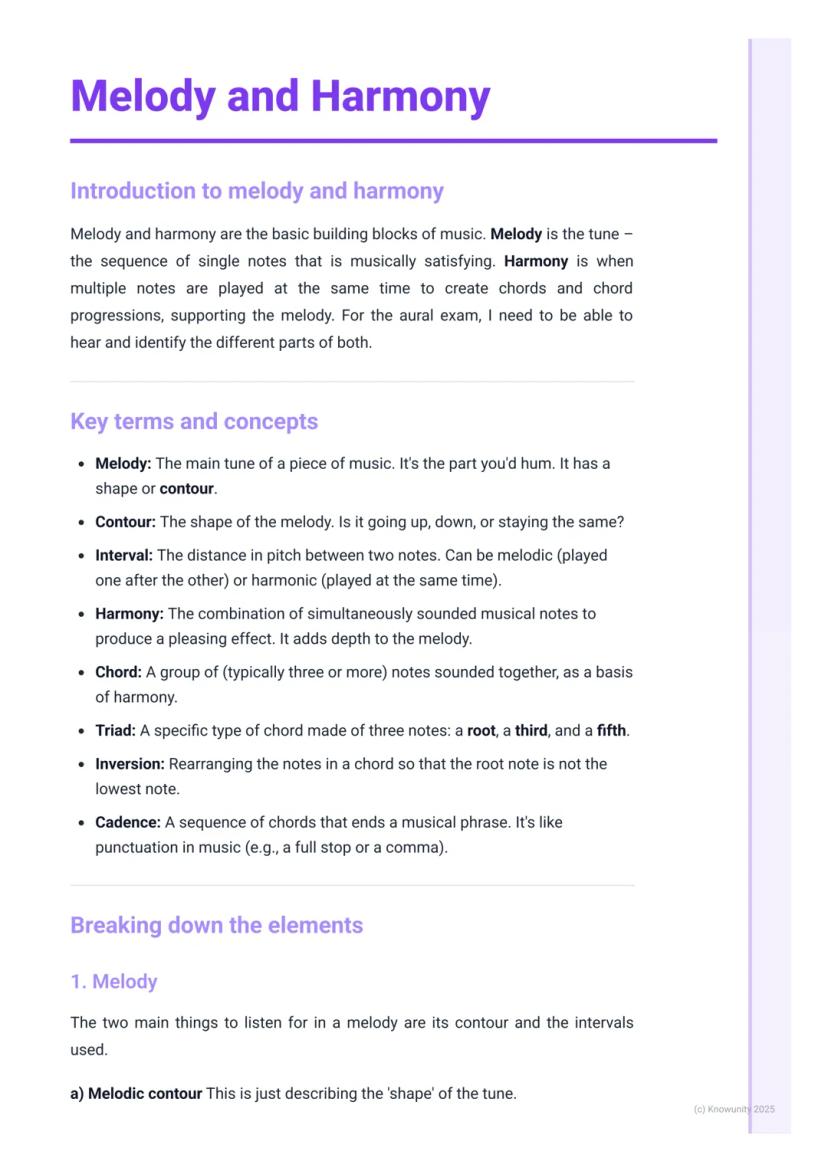
Melody has a shape called contour - it can go up, down, or stay roughly the same. The distance between any two notes is called an interval, and these can be played one after another (melodic) or at the same time (harmonic).
Exam Tip: The contour is often the easiest thing to identify first - just trace the shape with your finger in the air as you listen!
Your melody can move in several different ways, and each creates a distinct sound. Ascending melodies go up in pitch, whilst descending ones go down. Some melodies create an arch shape - rising then falling like a wave.
Conjunct motion means the melody moves by step (like C to D to E), creating a smooth, flowing sound. Disjunct motion involves leaps between notes (like C to G to E), which sounds more dramatic and jagged.
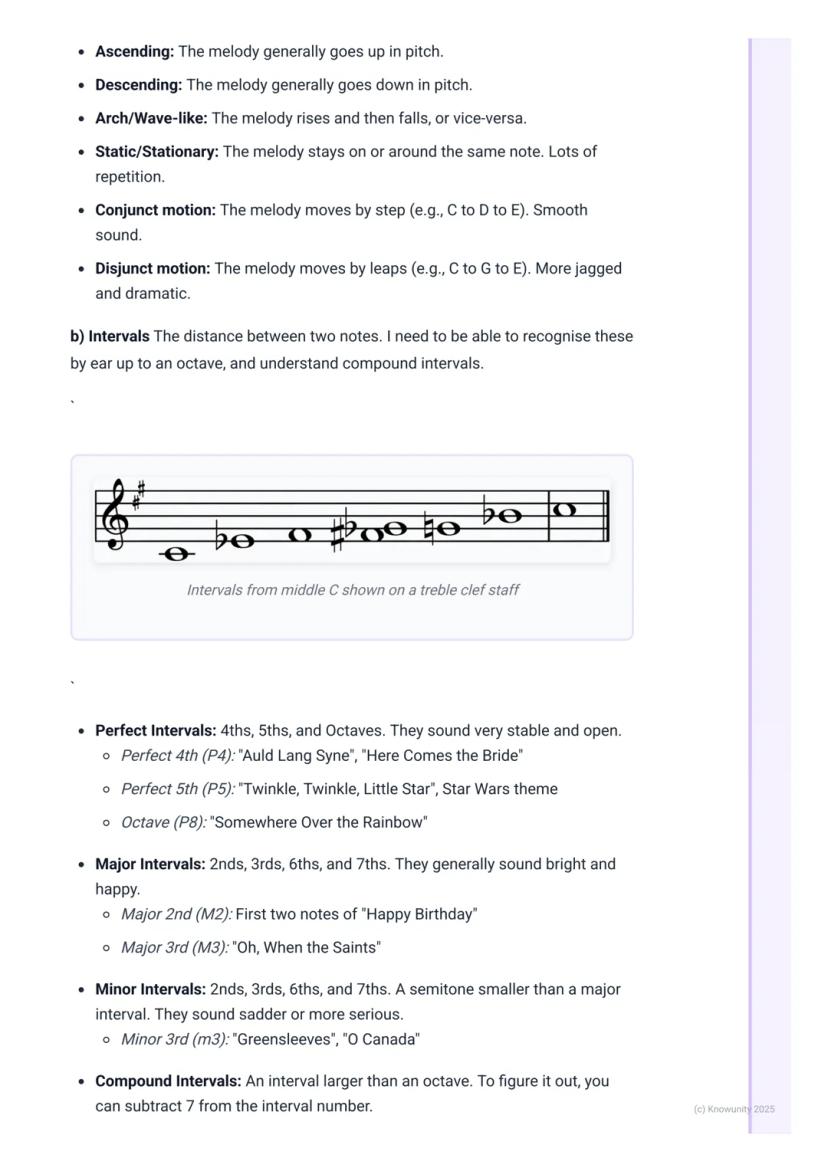
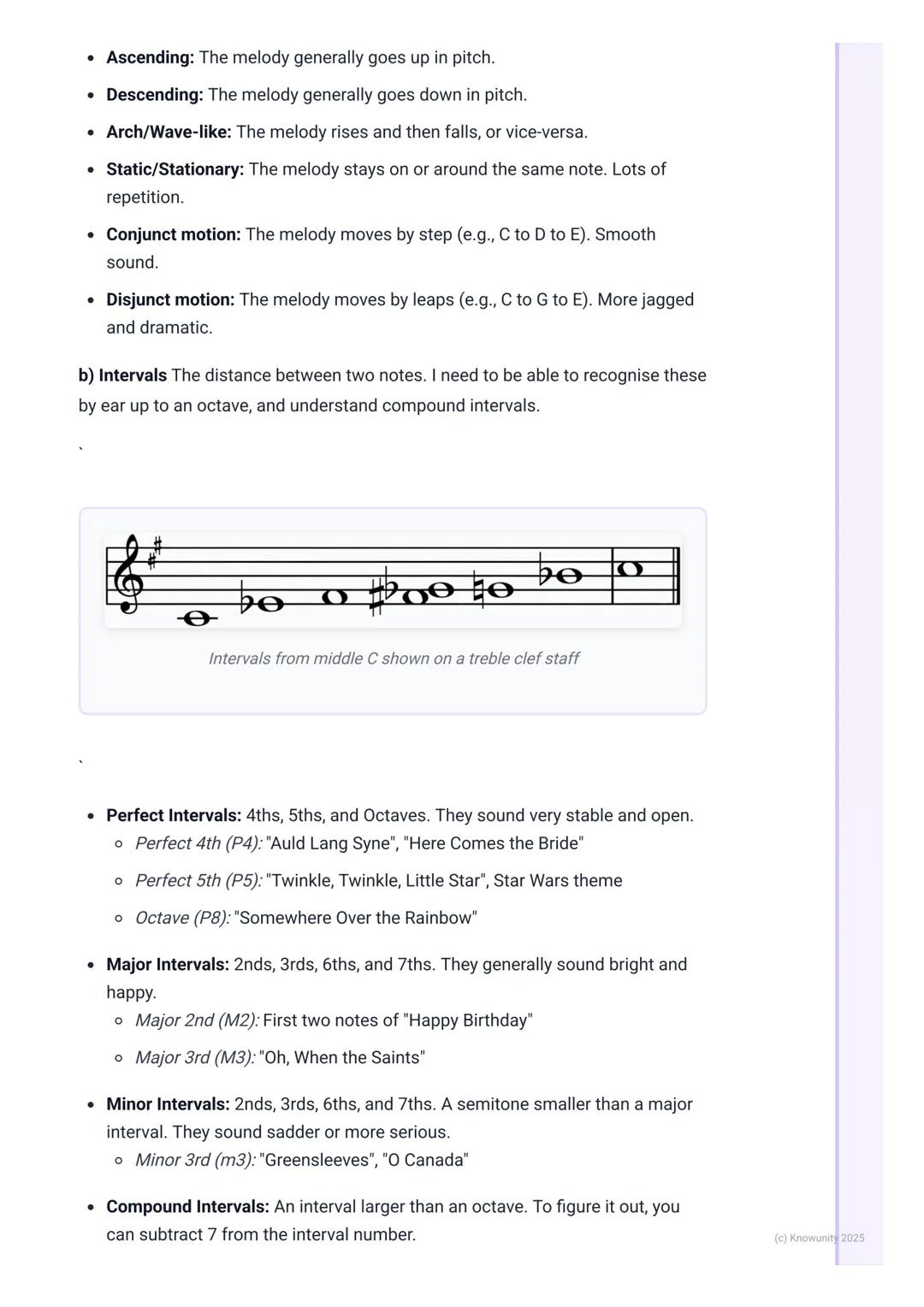
Intervals are crucial for aural recognition. Perfect intervals (4ths, 5ths, and octaves) sound very stable and open. Think "Here Comes the Bride" for a perfect 4th, or the Star Wars theme for a perfect 5th. Major intervals generally sound bright and happy, whilst minor intervals are a semitone smaller and sound sadder.
Compound intervals are simply intervals larger than an octave. To work them out, subtract 7 from the interval number - so a major 9th is really just a major 2nd played much further apart.
Memory Trick: Use familiar songs as references - "Somewhere Over the Rainbow" starts with an octave leap!
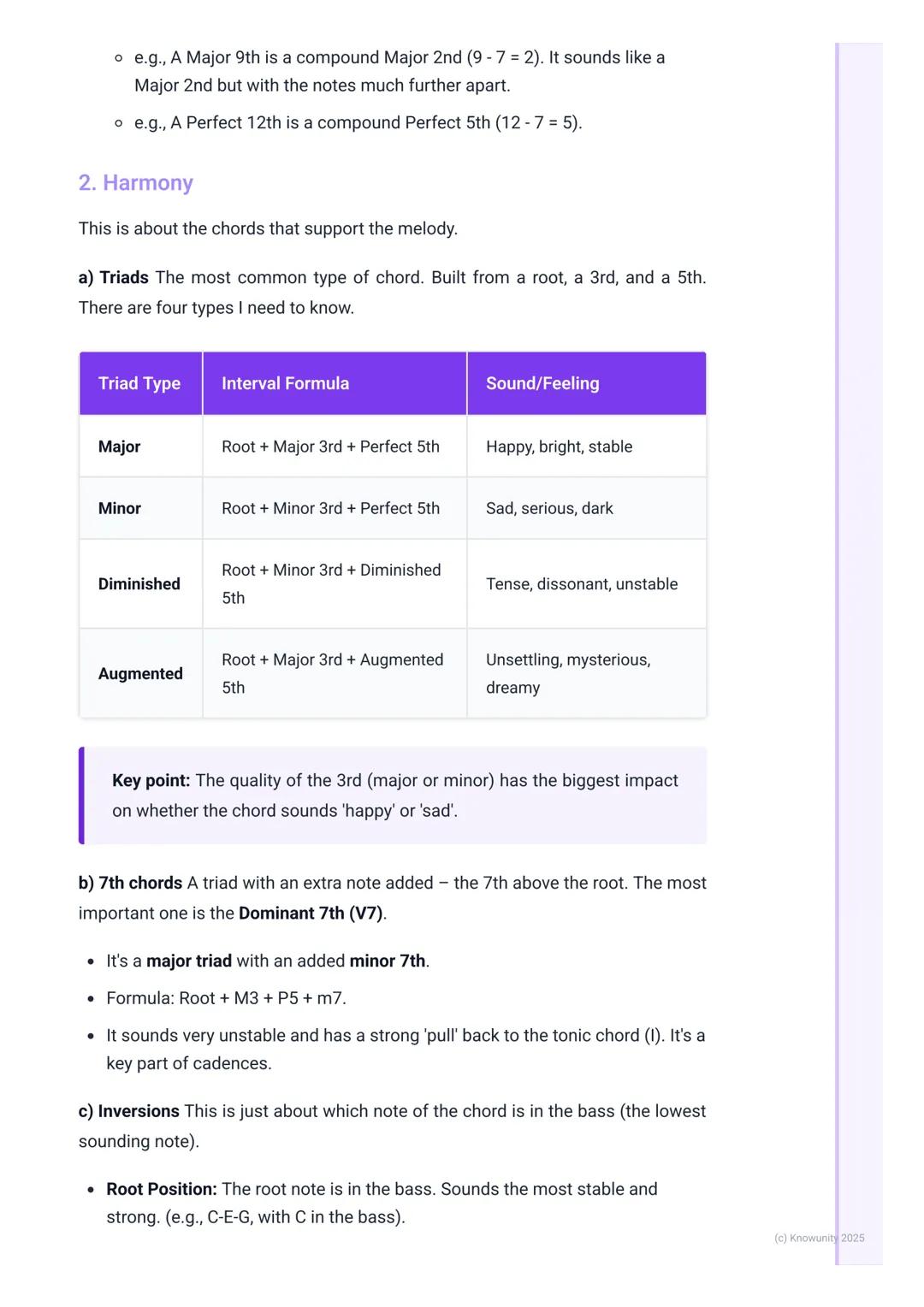
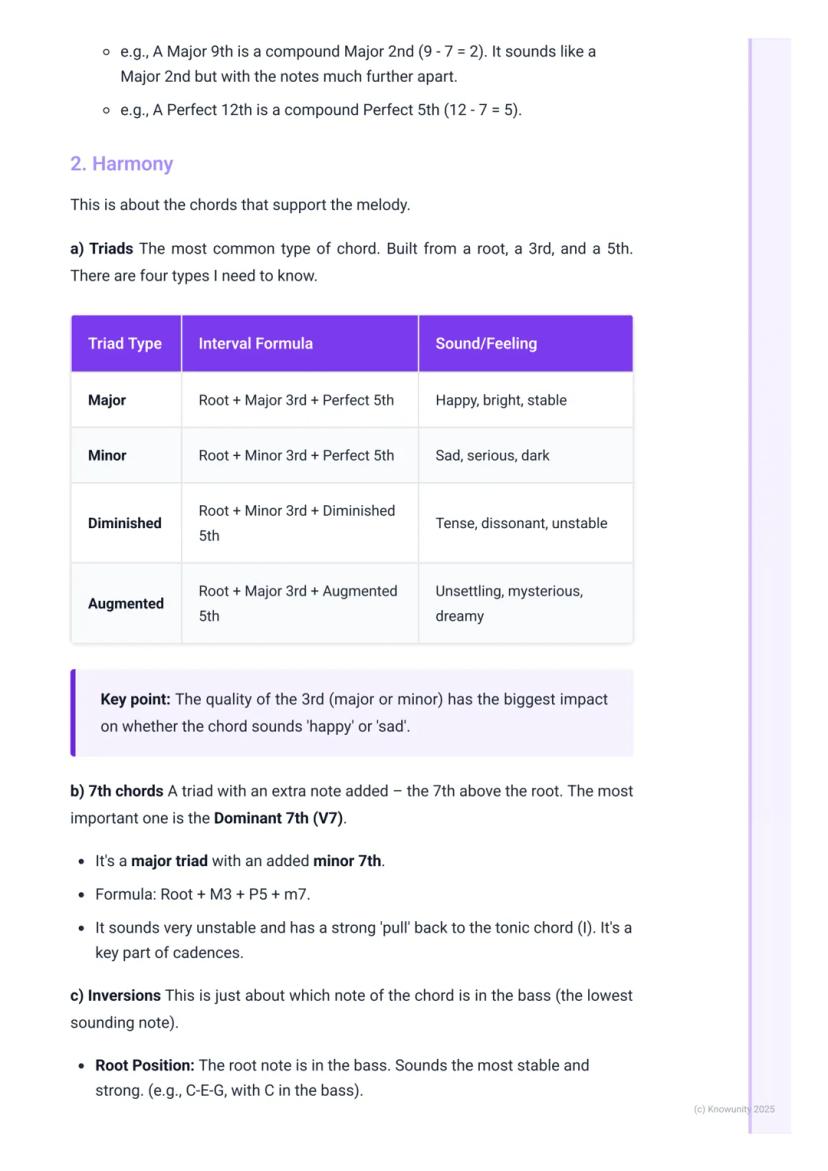
Triads are the most common chords you'll encounter, built from three notes: a root, a 3rd, and a 5th. There are four main types you need to recognise by ear.
Major triads sound happy, bright, and stable. Minor triads use a minor 3rd instead, creating that sad or serious feeling. Diminished triads sound tense and unstable, whilst augmented triads have an unsettling, mysterious quality.
The secret is that the quality of the 3rd (major or minor) has the biggest impact on whether a chord sounds happy or sad. This makes it the most important note to focus on when identifying triads.
Seventh chords add an extra layer of complexity. The most important is the dominant 7th (V7), which creates a strong pull back to the home chord. It's built from a major triad with an added minor 7th, giving it that distinctive "needs to resolve" sound.
Quick Check: If a chord sounds like it desperately wants to go somewhere else, it's probably a dominant 7th!
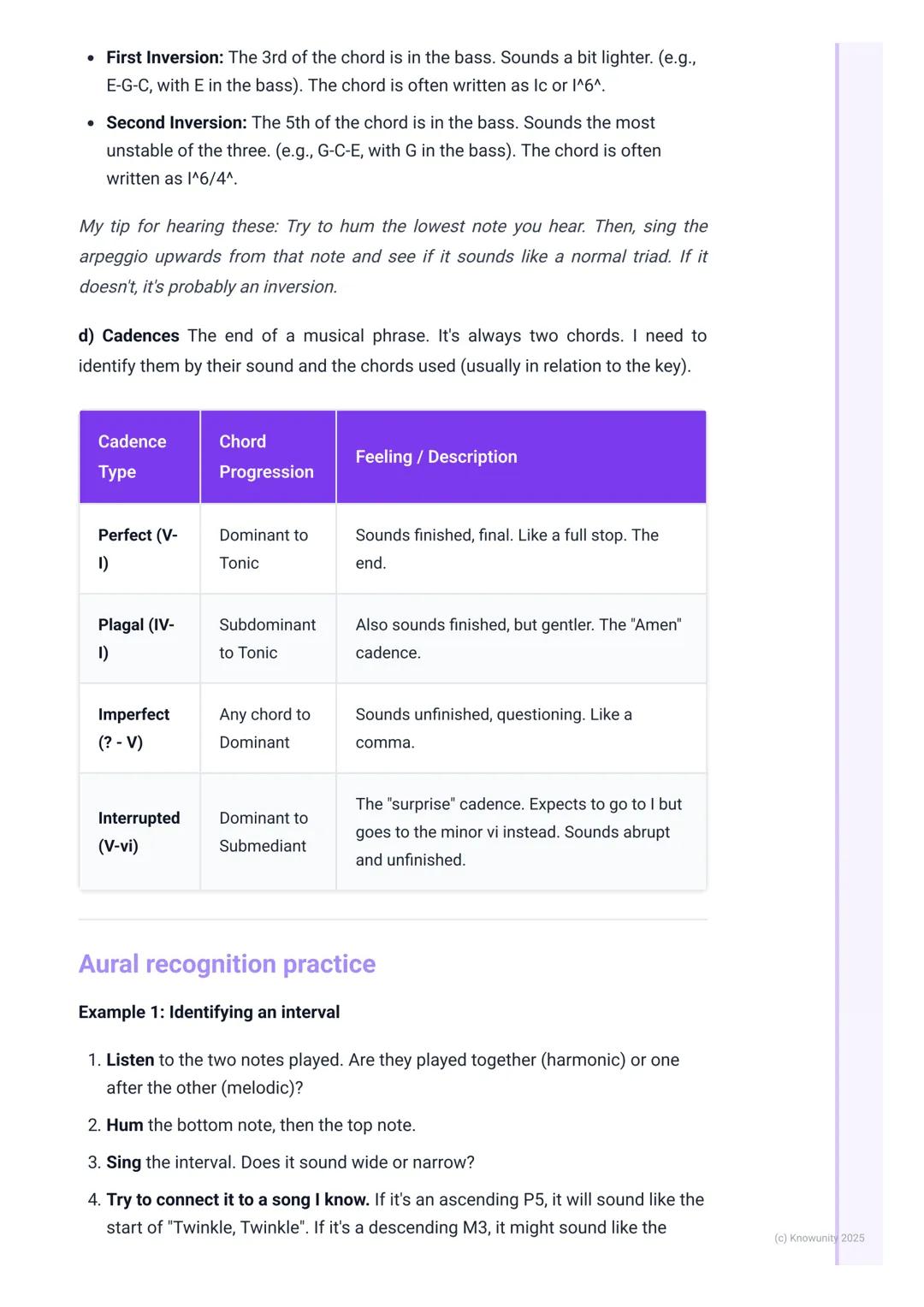
Inversions simply refer to which note of the chord is in the bass (lowest part). Root position has the root note in the bass and sounds most stable. First inversion puts the 3rd in the bass, creating a lighter feel, whilst second inversion has the 5th in the bass and sounds the most unstable.
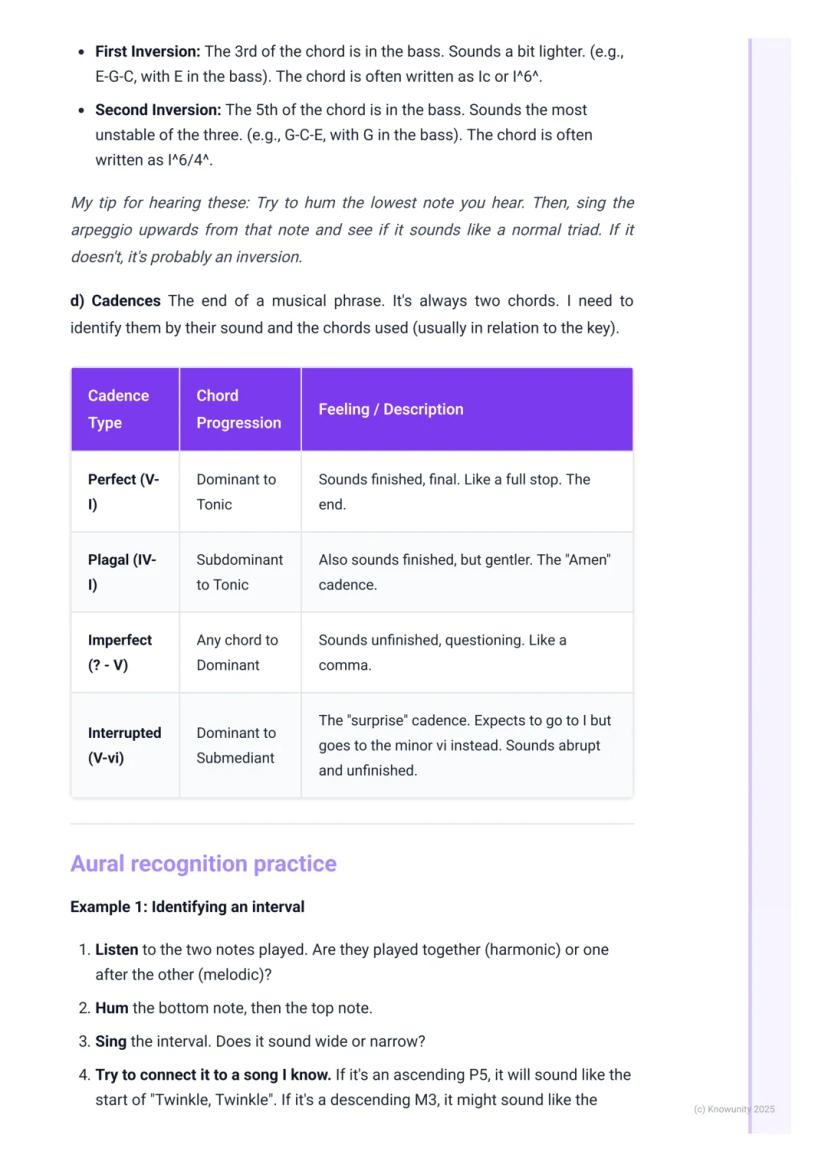
Cadences are like punctuation marks in music - they're always two chords that end a musical phrase. Perfect cadences sound completely finished, like a full stop. Plagal cadences also sound finished but gentler, often called the "Amen" cadence.
Imperfect cadences end on the dominant chord and sound unfinished, like a comma asking a question. Interrupted cadences are the surprise ending - they trick your ear by going to the minor vi chord instead of the expected I.
For your exam, don't just memorise chord numbers - learn how each cadence feels. Under pressure, recognising the emotional effect is much more reliable than trying to analyse chord progressions.
Exam Strategy: Always listen to the bass line first when identifying inversions - it's your biggest clue!
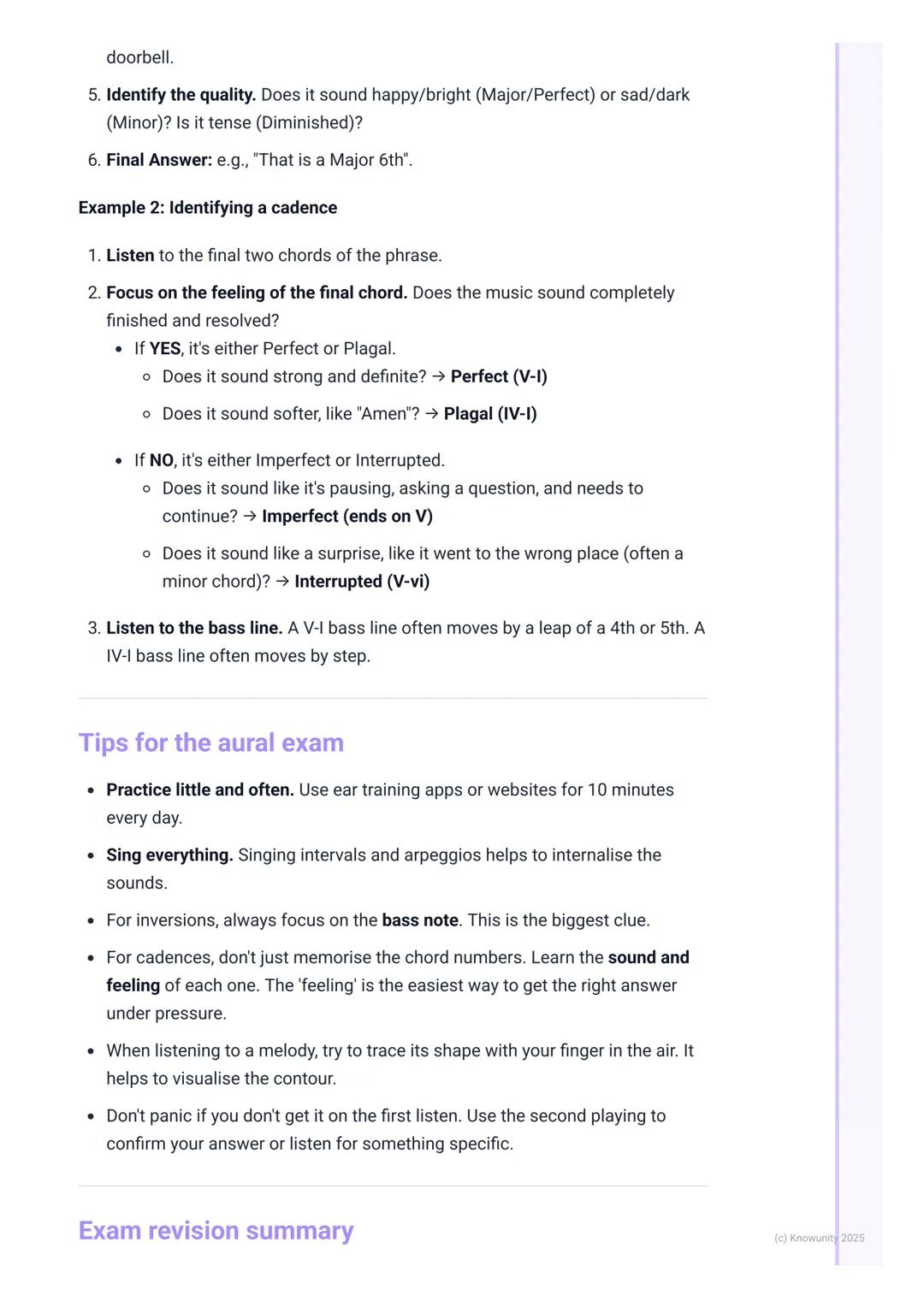
When identifying intervals in your exam, start by determining if they're played together (harmonic) or separately (melodic). Hum both notes, then connect the sound to a song you know - this reference method is incredibly reliable under exam pressure.
For cadences, focus on the feeling of the final chord first. Does the music sound completely resolved and finished? If yes, it's either perfect or plagal. If it sounds unfinished or questioning, it's either imperfect or interrupted.
The bass line movement gives you additional clues. A V-I progression often moves by a leap of a 4th or 5th, whilst a IV-I progression typically moves by step.
Singing everything helps massively with internalising these sounds. Spend just 10 minutes daily with ear training apps, and always sing intervals and arpeggios rather than just listening passively.
Golden Rule: Don't panic if you don't get it on first listen - use the second playing to confirm your answer or focus on one specific element!
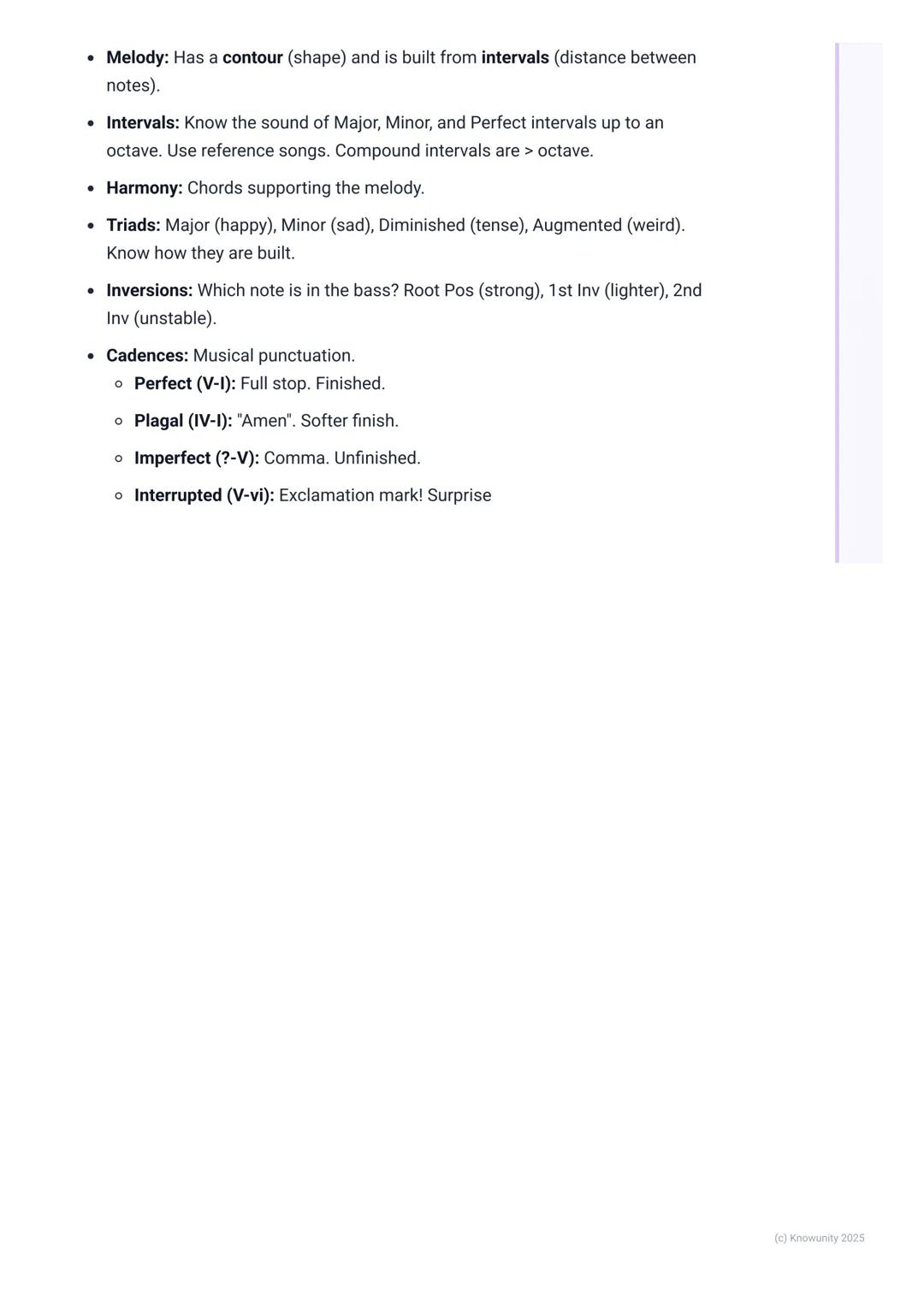
Melody is all about contour (shape) and intervals (distances between notes). Know your major, minor, and perfect intervals up to an octave, and remember that compound intervals are just regular intervals played more than an octave apart.
Harmony centres on chords supporting the melody. Master your triad recognition: major sounds happy, minor sounds sad, diminished sounds tense, and augmented sounds mysterious.
Inversions depend on which note is in the bass - root position sounds strongest, first inversion lighter, and second inversion most unstable.
Cadences are musical punctuation: perfect is a full stop, plagal is a gentle "Amen," imperfect ending on V is a questioning comma, and interrupted is a surprise exclamation mark.
Remember, the feeling of the music is often more reliable than technical analysis during exams. Trust your ears and the emotional responses these musical elements create.
Final Tip: Practice tracing melodic contours with your finger in the air - it helps visualise what you're hearing!
Il nostro assistente AI è costruito specificamente per le esigenze degli studenti. Sulla base dei milioni di contenuti presenti sulla piattaforma, possiamo fornire agli studenti risposte davvero significative e pertinenti. Ma non si tratta solo di risposte, l'assistente è in grado di guidare gli studenti attraverso le loro sfide quotidiane di studio, con piani di studio personalizzati, quiz o contenuti nella chat e una personalizzazione al 100% basata sulle competenze e sugli sviluppi degli studenti.
È possibile scaricare l'applicazione dal Google Play Store e dall'Apple App Store.
Sì, hai accesso completamente gratuito a tutti i contenuti nell'app e puoi chattare o seguire i Creatori in qualsiasi momento. Sbloccherai nuove funzioni crescendo il tuo numero di follower. Inoltre, offriamo Knowunity Premium, che consente di studiare senza alcun limite!!
App Store
Google Play
L'applicazione è molto facile da usare e ben progettata. Finora ho trovato tutto quello che cercavo e ho potuto imparare molto dalle presentazioni! Utilizzerò sicuramente l'app per i compiti in classe! È molto utile anche come fonte di ispirazione.
Stefano S
utente iOS
Questa applicazione è davvero grande! Ci sono tantissimi appunti e aiuti con lo studio [...]. La mia materia problematica, per esempio, è il francese e l'app ha così tante opzioni per aiutarmi. Grazie a questa app ho migliorato il mio francese. La consiglio a tutti.
Samantha Klich
utente Android
Wow, sono davvero stupita. Ho appena provato l'app perché l'ho vista pubblicizzata molte volte e sono rimasta assolutamente sbalordita. Questa app è L'AIUTO che cercate per la scuola e soprattutto offre tantissime cose, come allenamenti e schede, che a me personalmente sono state MOLTO utili.
Anna
utente iOS
È bellissima questa app, la adoro. È utilissima per lo studio e mi aiuta molto, anzi moltissimo, ma soprattutto mi aiutano molto i quiz, per memorizzare anche quello che non sapevo
Anastasia
utente Android
Fantastica per qualsiasi materia avere gli appunti anche di altre persone è molto utile perchè posso confrontarmi e vedere come migliorarmi. con i quiz riesco ad apprendere al meglio.
Francesca
utente Android
moooolto utile,gli appunti sono belli e funzionanti,schoolGPT da dei consigli formidabili!!
Marianna
utente Android
L'applicazione è semplicemente fantastica! Tutto ciò che devo fare è inserire l'argomento nella barra di ricerca e ottengo la risposta molto velocemente. Non devo guardare 10 video di YouTube per capire qualcosa, quindi risparmio tempo. Consigliatissima!
Sudenaz Ocak
utente Android
A scuola andavo malissimo in matematica, ma grazie a questa applicazione ora vado meglio. Vi sono molto grato per aver creato questa app.
Greenlight Bonnie
utente Android
Knowunity è un applicazione fantastica,considerando che ha degli schemi veramente molto carini e sfiziosi e che ci sono dei quiz,oltre al fatto che questa cosa dell intelligenza artificiale "school gpt" è almeno per me molto utile, perché a differenza di Chatgpt ti da le spiegazioni, ti spiega ciò che non è chiaro! Posso studiare più velocemente tramite gli schemi e che posso pubblicare io stessa gli schemi è una funzione utilissima per gli altri studenti. Knowunity è PERFETTA
Aurora
utente Android
L’app funziona benissimo e puoi trovare qualsiasi tipo di informazione. Non ho l’abbonamento ma la parte gratuita è sufficiente per uno studio approfondito.
Martina
utente iOS
I quiz E LE flashcard SONO COSÌ UTILI E ADORO Knowunity IA. È ANCHE LETTERALMENTE COME CHATGPT MA PIÙ INTELLIGENTE!! MI HA AIUTATO ANCHE COI MIEI PROBLEMI DI MASCARA!! E ANCHE CON LE MIE VERE MATERIE! OVVIO 😍😁😲🤑💗✨🎀😮
Chiara
utente IOS
Questa app è una delle migliori, nient’altro da dire.
Andrea
utente iOS
L'applicazione è molto facile da usare e ben progettata. Finora ho trovato tutto quello che cercavo e ho potuto imparare molto dalle presentazioni! Utilizzerò sicuramente l'app per i compiti in classe! È molto utile anche come fonte di ispirazione.
Stefano S
utente iOS
Questa applicazione è davvero grande! Ci sono tantissimi appunti e aiuti con lo studio [...]. La mia materia problematica, per esempio, è il francese e l'app ha così tante opzioni per aiutarmi. Grazie a questa app ho migliorato il mio francese. La consiglio a tutti.
Samantha Klich
utente Android
Wow, sono davvero stupita. Ho appena provato l'app perché l'ho vista pubblicizzata molte volte e sono rimasta assolutamente sbalordita. Questa app è L'AIUTO che cercate per la scuola e soprattutto offre tantissime cose, come allenamenti e schede, che a me personalmente sono state MOLTO utili.
Anna
utente iOS
È bellissima questa app, la adoro. È utilissima per lo studio e mi aiuta molto, anzi moltissimo, ma soprattutto mi aiutano molto i quiz, per memorizzare anche quello che non sapevo
Anastasia
utente Android
Fantastica per qualsiasi materia avere gli appunti anche di altre persone è molto utile perchè posso confrontarmi e vedere come migliorarmi. con i quiz riesco ad apprendere al meglio.
Francesca
utente Android
moooolto utile,gli appunti sono belli e funzionanti,schoolGPT da dei consigli formidabili!!
Marianna
utente Android
L'applicazione è semplicemente fantastica! Tutto ciò che devo fare è inserire l'argomento nella barra di ricerca e ottengo la risposta molto velocemente. Non devo guardare 10 video di YouTube per capire qualcosa, quindi risparmio tempo. Consigliatissima!
Sudenaz Ocak
utente Android
A scuola andavo malissimo in matematica, ma grazie a questa applicazione ora vado meglio. Vi sono molto grato per aver creato questa app.
Greenlight Bonnie
utente Android
Knowunity è un applicazione fantastica,considerando che ha degli schemi veramente molto carini e sfiziosi e che ci sono dei quiz,oltre al fatto che questa cosa dell intelligenza artificiale "school gpt" è almeno per me molto utile, perché a differenza di Chatgpt ti da le spiegazioni, ti spiega ciò che non è chiaro! Posso studiare più velocemente tramite gli schemi e che posso pubblicare io stessa gli schemi è una funzione utilissima per gli altri studenti. Knowunity è PERFETTA
Aurora
utente Android
L’app funziona benissimo e puoi trovare qualsiasi tipo di informazione. Non ho l’abbonamento ma la parte gratuita è sufficiente per uno studio approfondito.
Martina
utente iOS
I quiz E LE flashcard SONO COSÌ UTILI E ADORO Knowunity IA. È ANCHE LETTERALMENTE COME CHATGPT MA PIÙ INTELLIGENTE!! MI HA AIUTATO ANCHE COI MIEI PROBLEMI DI MASCARA!! E ANCHE CON LE MIE VERE MATERIE! OVVIO 😍😁😲🤑💗✨🎀😮
Chiara
utente IOS
Questa app è una delle migliori, nient’altro da dire.
Andrea
utente iOS
Ever wonder why some songs make you feel happy whilst others sound sad, or how musicians know when a song is "finished"? It all comes down to melody and harmony- the fundamental building blocks that create every piece of... Mostra di più
Accesso a tutti i documenti
Migliora i tuoi voti
Unisciti a milioni di studenti
Music is basically made up of two main elements that work together. Melody is the tune you'd hum along to - that sequence of single notes that gets stuck in your head. Harmony happens when multiple notes are played simultaneously to create chords that support and enhance the melody.
Think of melody as the main character in a film, whilst harmony is the supporting cast that makes the story richer. For your aural exam, you'll need to identify different parts of both by ear.
Melody has a shape called contour - it can go up, down, or stay roughly the same. The distance between any two notes is called an interval, and these can be played one after another (melodic) or at the same time (harmonic).
Exam Tip: The contour is often the easiest thing to identify first - just trace the shape with your finger in the air as you listen!
Accesso a tutti i documenti
Migliora i tuoi voti
Unisciti a milioni di studenti
Your melody can move in several different ways, and each creates a distinct sound. Ascending melodies go up in pitch, whilst descending ones go down. Some melodies create an arch shape - rising then falling like a wave.
Conjunct motion means the melody moves by step (like C to D to E), creating a smooth, flowing sound. Disjunct motion involves leaps between notes (like C to G to E), which sounds more dramatic and jagged.
Intervals are crucial for aural recognition. Perfect intervals (4ths, 5ths, and octaves) sound very stable and open. Think "Here Comes the Bride" for a perfect 4th, or the Star Wars theme for a perfect 5th. Major intervals generally sound bright and happy, whilst minor intervals are a semitone smaller and sound sadder.
Compound intervals are simply intervals larger than an octave. To work them out, subtract 7 from the interval number - so a major 9th is really just a major 2nd played much further apart.
Memory Trick: Use familiar songs as references - "Somewhere Over the Rainbow" starts with an octave leap!
Accesso a tutti i documenti
Migliora i tuoi voti
Unisciti a milioni di studenti
Triads are the most common chords you'll encounter, built from three notes: a root, a 3rd, and a 5th. There are four main types you need to recognise by ear.
Major triads sound happy, bright, and stable. Minor triads use a minor 3rd instead, creating that sad or serious feeling. Diminished triads sound tense and unstable, whilst augmented triads have an unsettling, mysterious quality.
The secret is that the quality of the 3rd (major or minor) has the biggest impact on whether a chord sounds happy or sad. This makes it the most important note to focus on when identifying triads.
Seventh chords add an extra layer of complexity. The most important is the dominant 7th (V7), which creates a strong pull back to the home chord. It's built from a major triad with an added minor 7th, giving it that distinctive "needs to resolve" sound.
Quick Check: If a chord sounds like it desperately wants to go somewhere else, it's probably a dominant 7th!
Accesso a tutti i documenti
Migliora i tuoi voti
Unisciti a milioni di studenti
Inversions simply refer to which note of the chord is in the bass (lowest part). Root position has the root note in the bass and sounds most stable. First inversion puts the 3rd in the bass, creating a lighter feel, whilst second inversion has the 5th in the bass and sounds the most unstable.
Cadences are like punctuation marks in music - they're always two chords that end a musical phrase. Perfect cadences sound completely finished, like a full stop. Plagal cadences also sound finished but gentler, often called the "Amen" cadence.
Imperfect cadences end on the dominant chord and sound unfinished, like a comma asking a question. Interrupted cadences are the surprise ending - they trick your ear by going to the minor vi chord instead of the expected I.
For your exam, don't just memorise chord numbers - learn how each cadence feels. Under pressure, recognising the emotional effect is much more reliable than trying to analyse chord progressions.
Exam Strategy: Always listen to the bass line first when identifying inversions - it's your biggest clue!
Accesso a tutti i documenti
Migliora i tuoi voti
Unisciti a milioni di studenti
When identifying intervals in your exam, start by determining if they're played together (harmonic) or separately (melodic). Hum both notes, then connect the sound to a song you know - this reference method is incredibly reliable under exam pressure.
For cadences, focus on the feeling of the final chord first. Does the music sound completely resolved and finished? If yes, it's either perfect or plagal. If it sounds unfinished or questioning, it's either imperfect or interrupted.
The bass line movement gives you additional clues. A V-I progression often moves by a leap of a 4th or 5th, whilst a IV-I progression typically moves by step.
Singing everything helps massively with internalising these sounds. Spend just 10 minutes daily with ear training apps, and always sing intervals and arpeggios rather than just listening passively.
Golden Rule: Don't panic if you don't get it on first listen - use the second playing to confirm your answer or focus on one specific element!
Accesso a tutti i documenti
Migliora i tuoi voti
Unisciti a milioni di studenti
Melody is all about contour (shape) and intervals (distances between notes). Know your major, minor, and perfect intervals up to an octave, and remember that compound intervals are just regular intervals played more than an octave apart.
Harmony centres on chords supporting the melody. Master your triad recognition: major sounds happy, minor sounds sad, diminished sounds tense, and augmented sounds mysterious.
Inversions depend on which note is in the bass - root position sounds strongest, first inversion lighter, and second inversion most unstable.
Cadences are musical punctuation: perfect is a full stop, plagal is a gentle "Amen," imperfect ending on V is a questioning comma, and interrupted is a surprise exclamation mark.
Remember, the feeling of the music is often more reliable than technical analysis during exams. Trust your ears and the emotional responses these musical elements create.
Final Tip: Practice tracing melodic contours with your finger in the air - it helps visualise what you're hearing!
Il nostro assistente AI è costruito specificamente per le esigenze degli studenti. Sulla base dei milioni di contenuti presenti sulla piattaforma, possiamo fornire agli studenti risposte davvero significative e pertinenti. Ma non si tratta solo di risposte, l'assistente è in grado di guidare gli studenti attraverso le loro sfide quotidiane di studio, con piani di studio personalizzati, quiz o contenuti nella chat e una personalizzazione al 100% basata sulle competenze e sugli sviluppi degli studenti.
È possibile scaricare l'applicazione dal Google Play Store e dall'Apple App Store.
Sì, hai accesso completamente gratuito a tutti i contenuti nell'app e puoi chattare o seguire i Creatori in qualsiasi momento. Sbloccherai nuove funzioni crescendo il tuo numero di follower. Inoltre, offriamo Knowunity Premium, che consente di studiare senza alcun limite!!
0
Strumenti Intelligenti NUOVO
Trasforma questi appunti in: ✓ 50+ Domande di Pratica ✓ Flashcard Interattive ✓ Simulazione d'esame completa ✓ Schemi per Saggi
App Store
Google Play
L'applicazione è molto facile da usare e ben progettata. Finora ho trovato tutto quello che cercavo e ho potuto imparare molto dalle presentazioni! Utilizzerò sicuramente l'app per i compiti in classe! È molto utile anche come fonte di ispirazione.
Stefano S
utente iOS
Questa applicazione è davvero grande! Ci sono tantissimi appunti e aiuti con lo studio [...]. La mia materia problematica, per esempio, è il francese e l'app ha così tante opzioni per aiutarmi. Grazie a questa app ho migliorato il mio francese. La consiglio a tutti.
Samantha Klich
utente Android
Wow, sono davvero stupita. Ho appena provato l'app perché l'ho vista pubblicizzata molte volte e sono rimasta assolutamente sbalordita. Questa app è L'AIUTO che cercate per la scuola e soprattutto offre tantissime cose, come allenamenti e schede, che a me personalmente sono state MOLTO utili.
Anna
utente iOS
È bellissima questa app, la adoro. È utilissima per lo studio e mi aiuta molto, anzi moltissimo, ma soprattutto mi aiutano molto i quiz, per memorizzare anche quello che non sapevo
Anastasia
utente Android
Fantastica per qualsiasi materia avere gli appunti anche di altre persone è molto utile perchè posso confrontarmi e vedere come migliorarmi. con i quiz riesco ad apprendere al meglio.
Francesca
utente Android
moooolto utile,gli appunti sono belli e funzionanti,schoolGPT da dei consigli formidabili!!
Marianna
utente Android
L'applicazione è semplicemente fantastica! Tutto ciò che devo fare è inserire l'argomento nella barra di ricerca e ottengo la risposta molto velocemente. Non devo guardare 10 video di YouTube per capire qualcosa, quindi risparmio tempo. Consigliatissima!
Sudenaz Ocak
utente Android
A scuola andavo malissimo in matematica, ma grazie a questa applicazione ora vado meglio. Vi sono molto grato per aver creato questa app.
Greenlight Bonnie
utente Android
Knowunity è un applicazione fantastica,considerando che ha degli schemi veramente molto carini e sfiziosi e che ci sono dei quiz,oltre al fatto che questa cosa dell intelligenza artificiale "school gpt" è almeno per me molto utile, perché a differenza di Chatgpt ti da le spiegazioni, ti spiega ciò che non è chiaro! Posso studiare più velocemente tramite gli schemi e che posso pubblicare io stessa gli schemi è una funzione utilissima per gli altri studenti. Knowunity è PERFETTA
Aurora
utente Android
L’app funziona benissimo e puoi trovare qualsiasi tipo di informazione. Non ho l’abbonamento ma la parte gratuita è sufficiente per uno studio approfondito.
Martina
utente iOS
I quiz E LE flashcard SONO COSÌ UTILI E ADORO Knowunity IA. È ANCHE LETTERALMENTE COME CHATGPT MA PIÙ INTELLIGENTE!! MI HA AIUTATO ANCHE COI MIEI PROBLEMI DI MASCARA!! E ANCHE CON LE MIE VERE MATERIE! OVVIO 😍😁😲🤑💗✨🎀😮
Chiara
utente IOS
Questa app è una delle migliori, nient’altro da dire.
Andrea
utente iOS
L'applicazione è molto facile da usare e ben progettata. Finora ho trovato tutto quello che cercavo e ho potuto imparare molto dalle presentazioni! Utilizzerò sicuramente l'app per i compiti in classe! È molto utile anche come fonte di ispirazione.
Stefano S
utente iOS
Questa applicazione è davvero grande! Ci sono tantissimi appunti e aiuti con lo studio [...]. La mia materia problematica, per esempio, è il francese e l'app ha così tante opzioni per aiutarmi. Grazie a questa app ho migliorato il mio francese. La consiglio a tutti.
Samantha Klich
utente Android
Wow, sono davvero stupita. Ho appena provato l'app perché l'ho vista pubblicizzata molte volte e sono rimasta assolutamente sbalordita. Questa app è L'AIUTO che cercate per la scuola e soprattutto offre tantissime cose, come allenamenti e schede, che a me personalmente sono state MOLTO utili.
Anna
utente iOS
È bellissima questa app, la adoro. È utilissima per lo studio e mi aiuta molto, anzi moltissimo, ma soprattutto mi aiutano molto i quiz, per memorizzare anche quello che non sapevo
Anastasia
utente Android
Fantastica per qualsiasi materia avere gli appunti anche di altre persone è molto utile perchè posso confrontarmi e vedere come migliorarmi. con i quiz riesco ad apprendere al meglio.
Francesca
utente Android
moooolto utile,gli appunti sono belli e funzionanti,schoolGPT da dei consigli formidabili!!
Marianna
utente Android
L'applicazione è semplicemente fantastica! Tutto ciò che devo fare è inserire l'argomento nella barra di ricerca e ottengo la risposta molto velocemente. Non devo guardare 10 video di YouTube per capire qualcosa, quindi risparmio tempo. Consigliatissima!
Sudenaz Ocak
utente Android
A scuola andavo malissimo in matematica, ma grazie a questa applicazione ora vado meglio. Vi sono molto grato per aver creato questa app.
Greenlight Bonnie
utente Android
Knowunity è un applicazione fantastica,considerando che ha degli schemi veramente molto carini e sfiziosi e che ci sono dei quiz,oltre al fatto che questa cosa dell intelligenza artificiale "school gpt" è almeno per me molto utile, perché a differenza di Chatgpt ti da le spiegazioni, ti spiega ciò che non è chiaro! Posso studiare più velocemente tramite gli schemi e che posso pubblicare io stessa gli schemi è una funzione utilissima per gli altri studenti. Knowunity è PERFETTA
Aurora
utente Android
L’app funziona benissimo e puoi trovare qualsiasi tipo di informazione. Non ho l’abbonamento ma la parte gratuita è sufficiente per uno studio approfondito.
Martina
utente iOS
I quiz E LE flashcard SONO COSÌ UTILI E ADORO Knowunity IA. È ANCHE LETTERALMENTE COME CHATGPT MA PIÙ INTELLIGENTE!! MI HA AIUTATO ANCHE COI MIEI PROBLEMI DI MASCARA!! E ANCHE CON LE MIE VERE MATERIE! OVVIO 😍😁😲🤑💗✨🎀😮
Chiara
utente IOS
Questa app è una delle migliori, nient’altro da dire.
Andrea
utente iOS