
Powers and roots are mathematical shortcuts that make calculations much...
 Mathematics7 visualizzazioni·Aggiornato Jun 7, 2026·5 pagine
Understanding Powers, Squares, Cubes, and Roots
1 / 5
1
of 5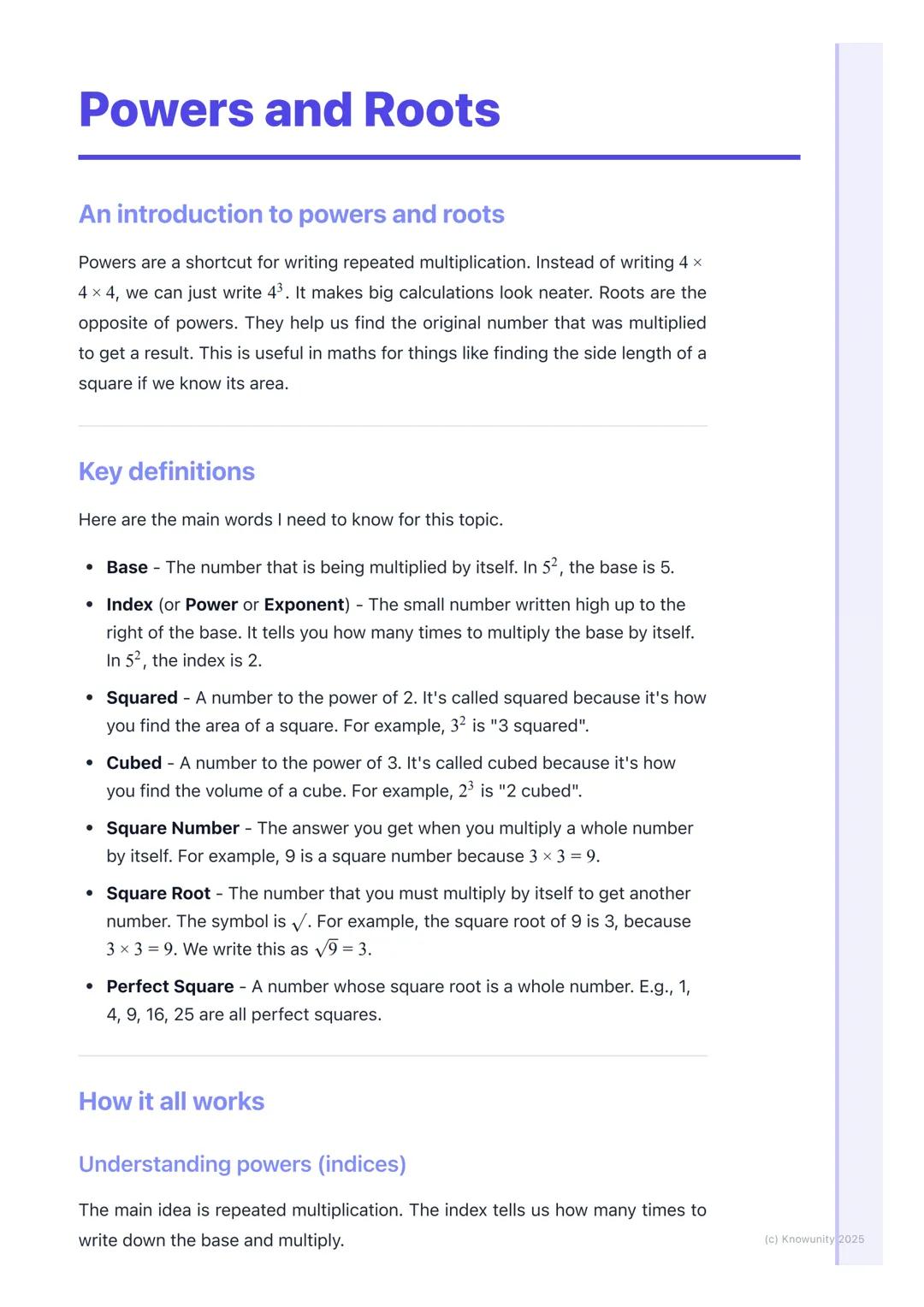
Getting Started with Powers and Roots
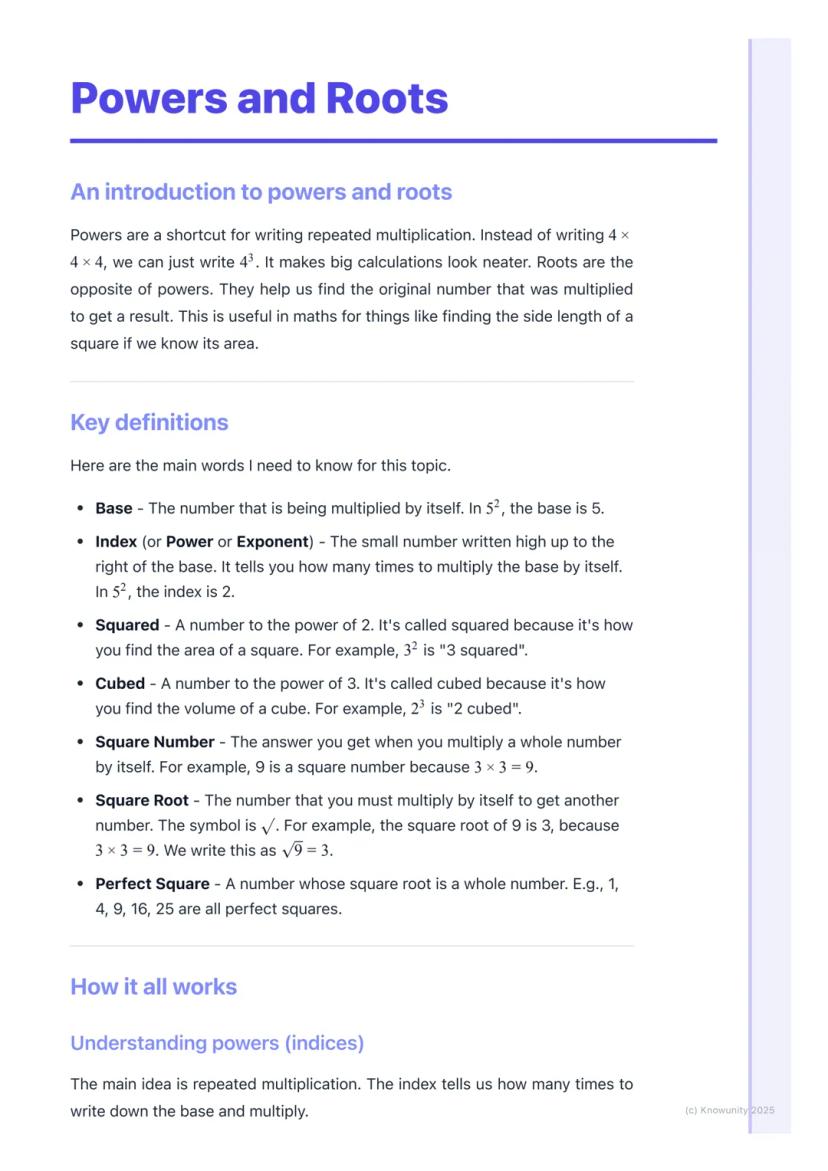
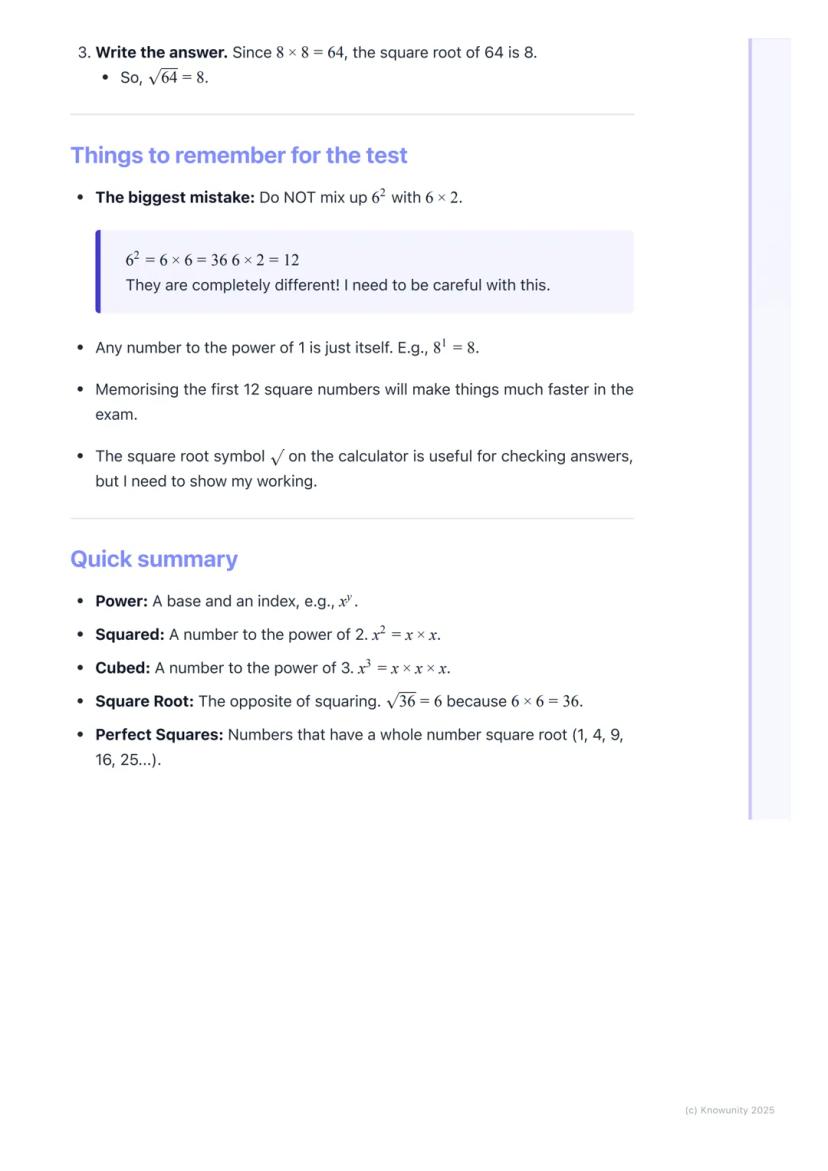
Ever wondered why we write 4³ instead of 4 × 4 × 4? Powers are basically a clever shortcut for repeated multiplication, making your maths look much tidier. The base is the number being multiplied (like the 4), and the index (also called power or exponent) is that small number up top telling you how many times to multiply.
When a number has a power of 2, we call it squared - like 3² is "3 squared". This name comes from finding the area of a square! Similarly, a power of 3 is called cubed because it's how you calculate a cube's volume.
Square numbers are what you get when you multiply any whole number by itself. For example, 9 is a square number because 3 × 3 = 9. These will pop up everywhere in your exams, so they're worth remembering!
Quick Tip: Memorising the first 12 square numbers will make your exam much faster and easier.
2
of 5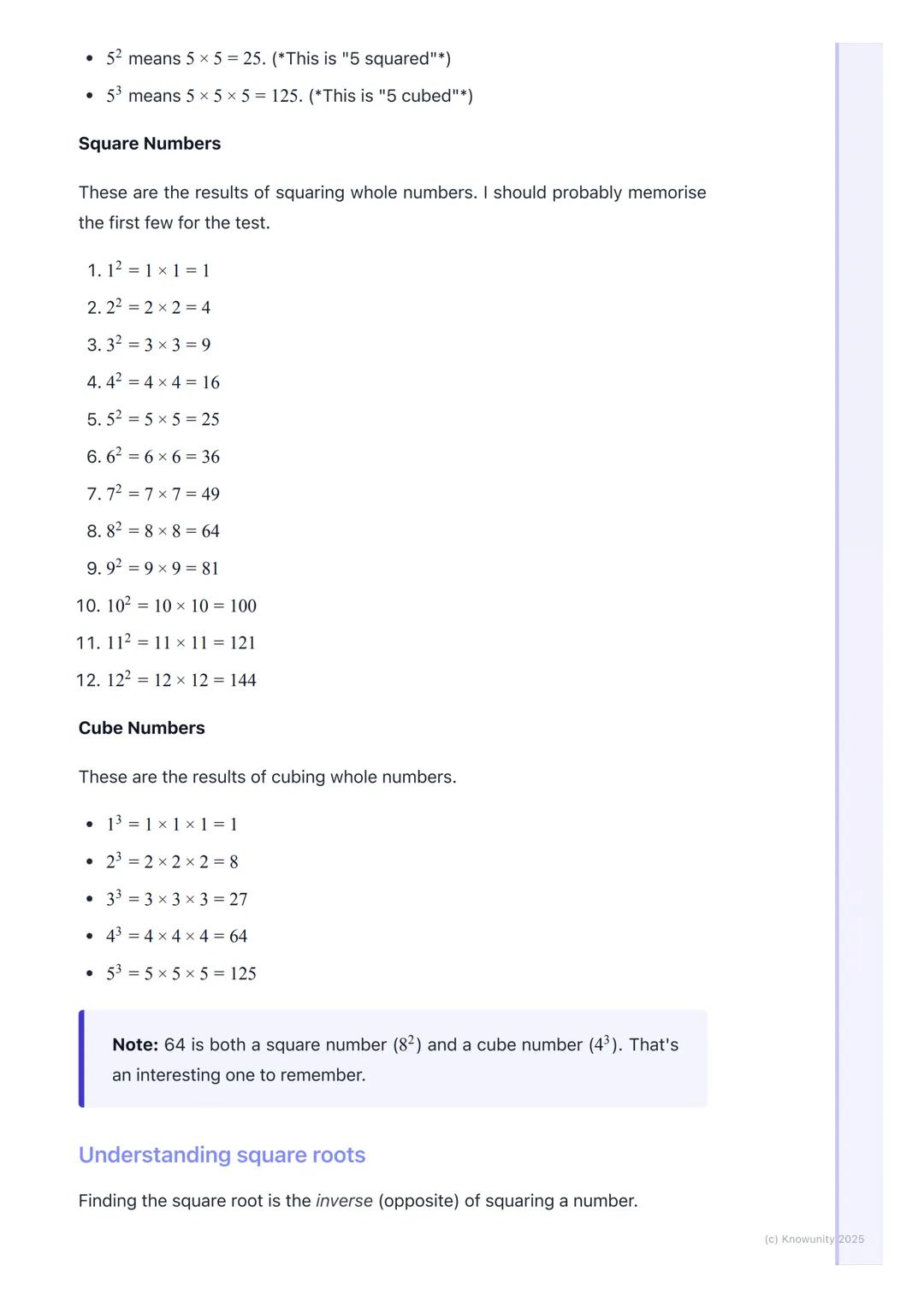
Working with Square Numbers and Cubes
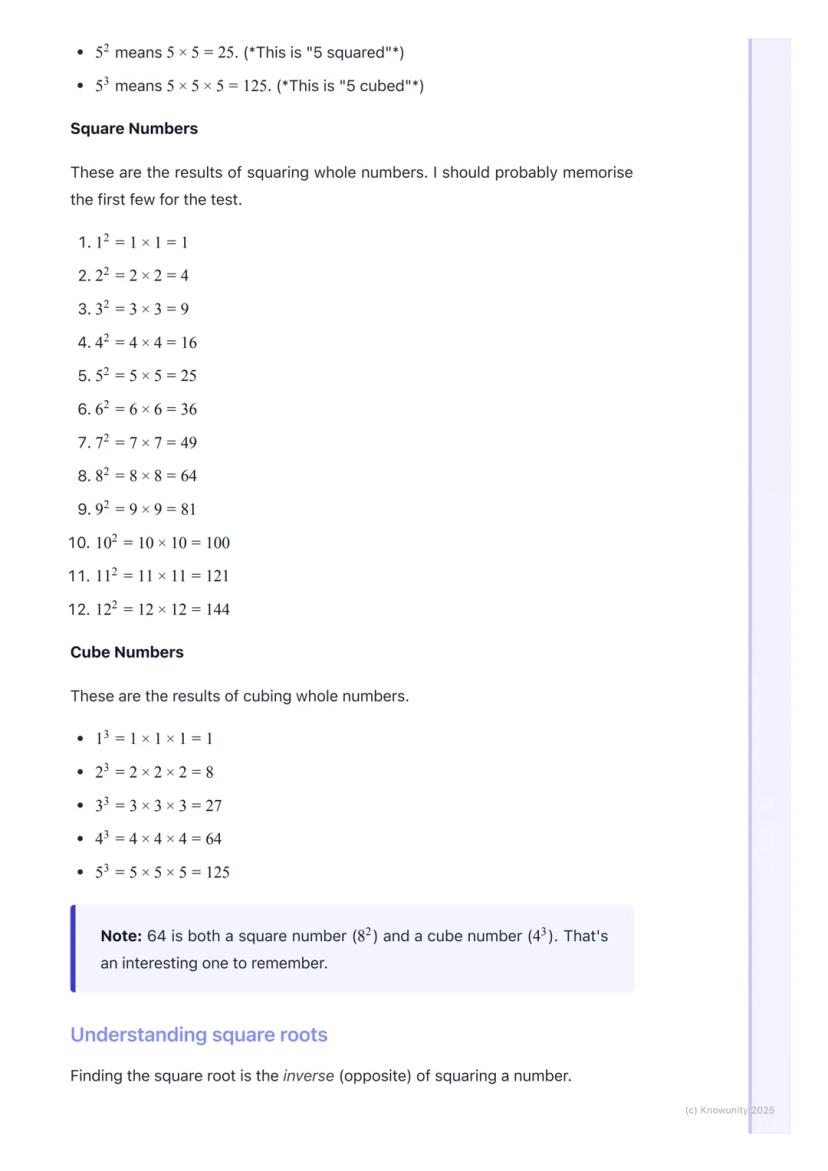
You'll definitely want to memorise these square numbers for tests: 1² = 1, 2² = 4, 3² = 9, 4² = 16, 5² = 25, 6² = 36, 7² = 49, 8² = 64, 9² = 81, 10² = 100, 11² = 121, and 12² = 144. Trust me, knowing these off by heart will save you loads of time.
Cube numbers work similarly but with three multiplications instead of two. The first few are: 1³ = 1, 2³ = 8, 3³ = 27, 4³ = 64, and 5³ = 125.
Here's something interesting - 64 is both a square number (8²) and a cube number (4³). That's definitely worth remembering for trick questions!
Remember: Don't confuse 6² with 6 × 2! The first equals 36, the second equals 12 - completely different answers.
3
of 5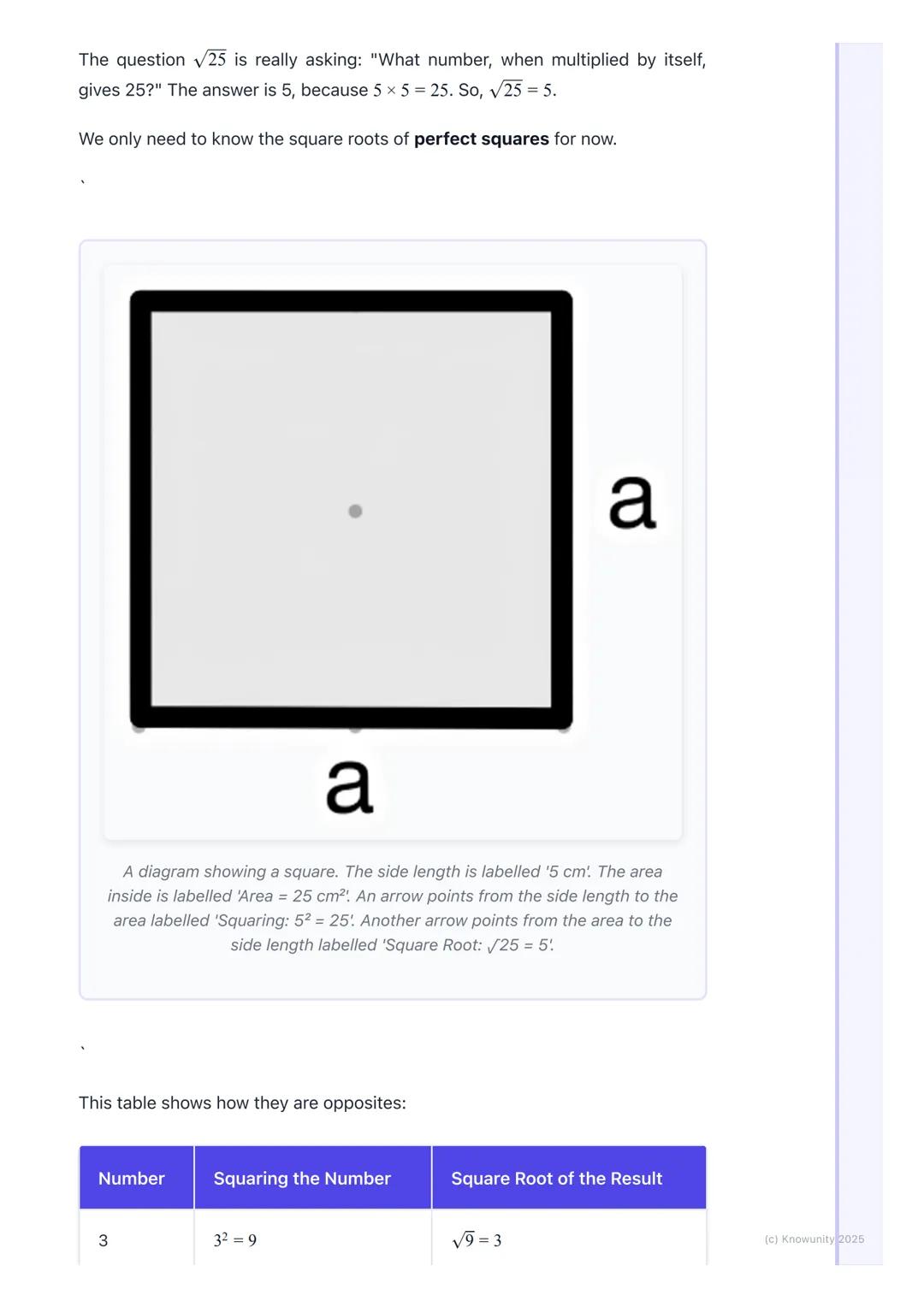
Understanding Square Roots
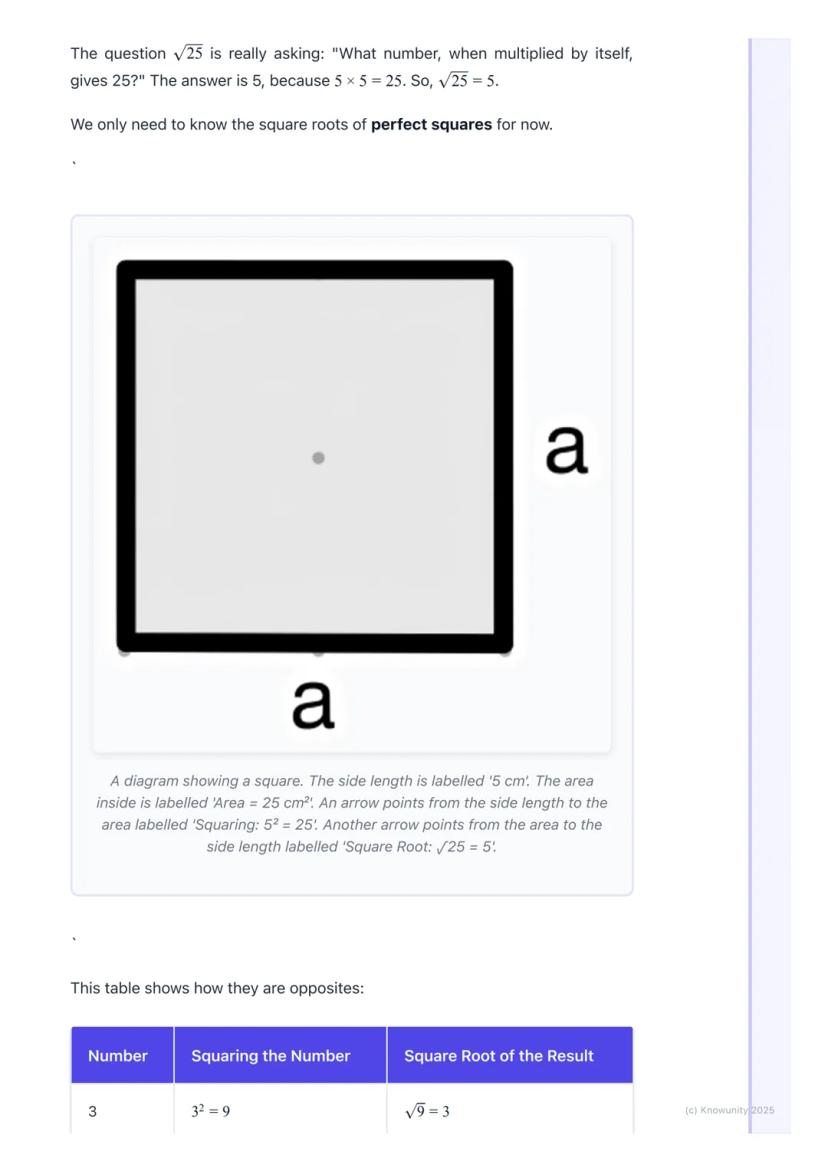
Square roots are the complete opposite of squaring - they're like mathematical detective work. When you see √25, it's asking "what number multiplied by itself gives 25?" The answer is 5, because 5 × 5 = 25.
Think of it like this: if you know a square has an area of 25 cm², the square root helps you find that each side is 5 cm long. That's why we use the square root symbol √.
Perfect squares are numbers whose square roots are whole numbers, like 1, 4, 9, 16, and 25. These are the easiest ones to work with because there's no messy decimals involved.
Visual Tip: Imagine a square with area 25 cm² - the square root finds the length of each side (5 cm).
4
of 5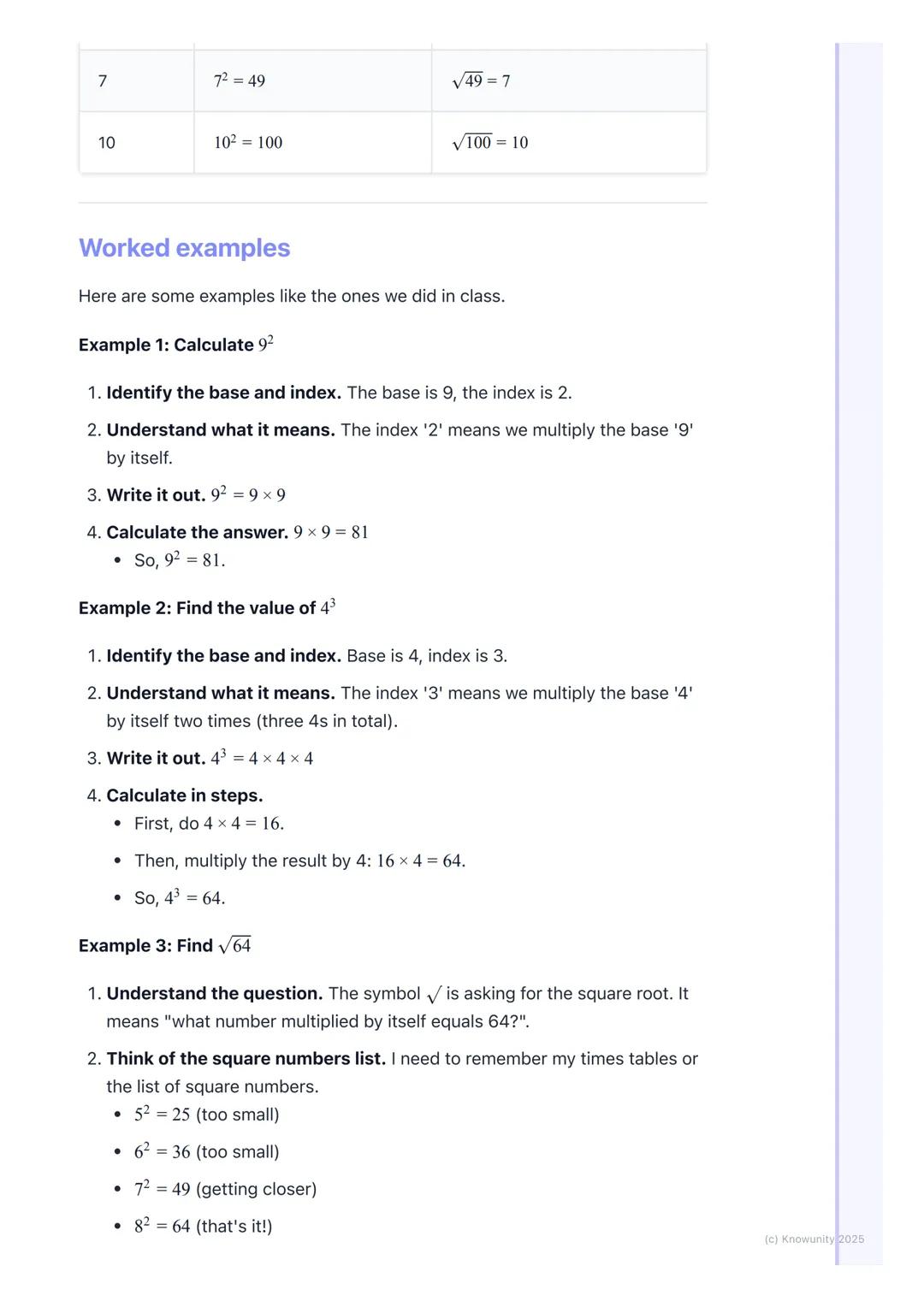
Worked Examples You Can Master
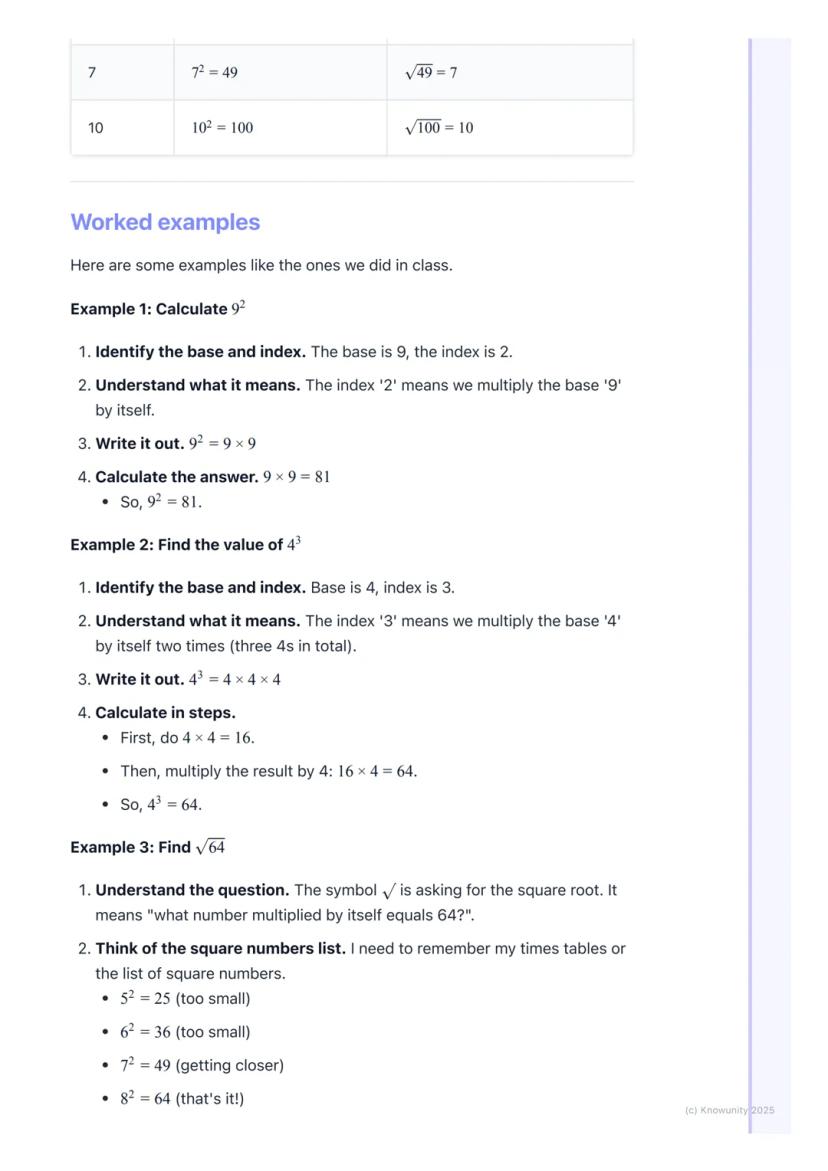
Let's tackle 9²: The base is 9, the index is 2, so we multiply 9 by itself once. That's 9 × 9 = 81. See how straightforward that is?
For 4³, we've got base 4 and index 3, meaning three 4s multiplied together: 4 × 4 × 4. First do 4 × 4 = 16, then 16 × 4 = 64. Breaking it into steps makes it much easier.
Finding √64 means asking "what number times itself equals 64?" Work through your square numbers: 6² = 36 (too small), 7² = 49 (getting closer), 8² = 64 (perfect!). So √64 = 8.
Exam Strategy: Show your working step by step - even if you use a calculator to check, you need to demonstrate your method.
5
of 5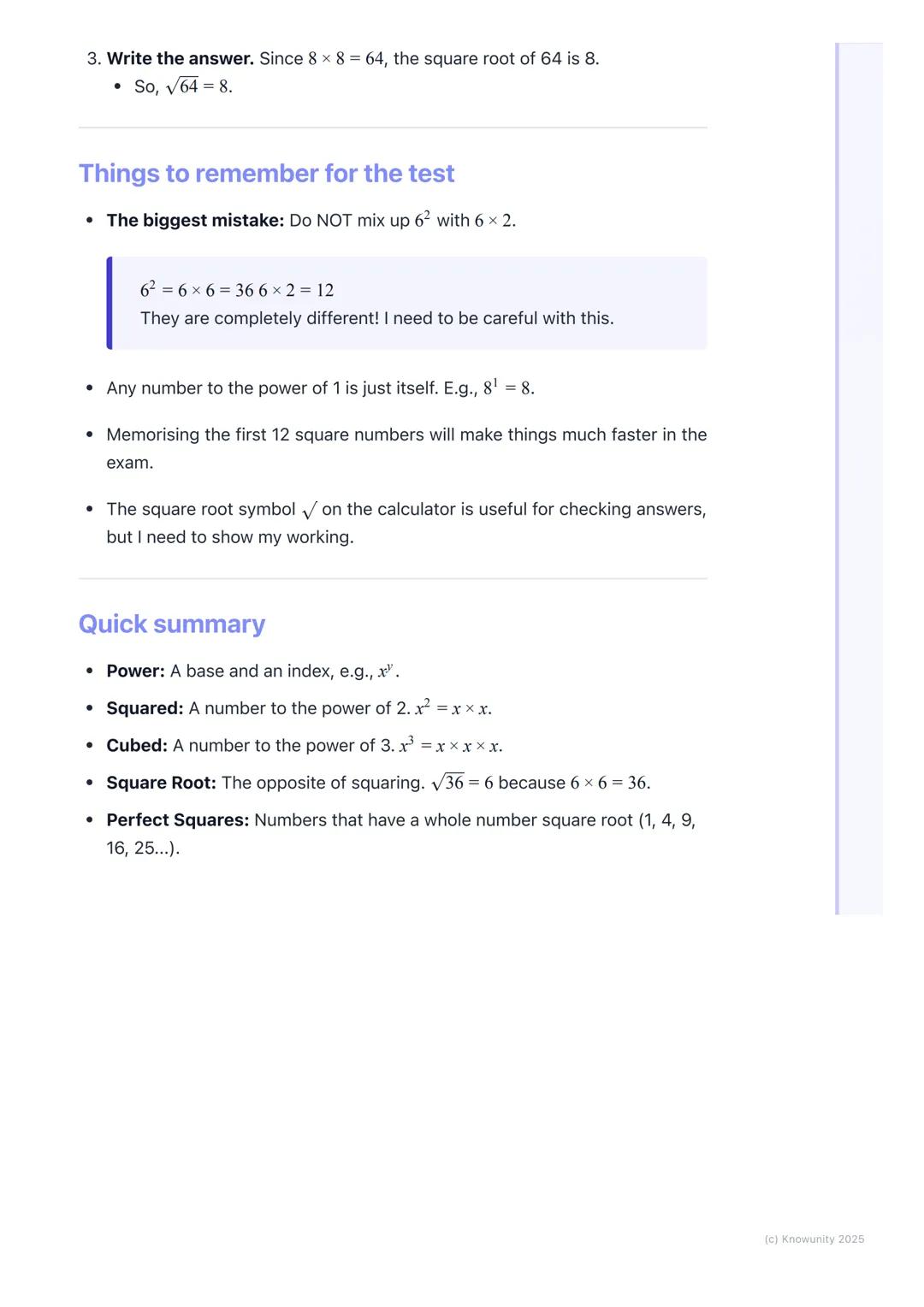
Essential Tips for Test Success
Any number to the power of 1 is just itself - so 8¹ = 8. This might seem obvious, but it catches people out in exams when they overthink it.
The calculator's √ button is handy for checking answers, but always show your working. Examiners want to see that you understand the process, not just that you can press buttons.
Your key takeaways: powers use a base and index (like 5²), squared means power of 2, cubed means power of 3, and square roots reverse the squaring process. Master these basics and you'll smash any powers and roots question.
Final Reminder: Perfect squares (1, 4, 9, 16, 25...) are your best friends - they have nice, neat whole number square roots.
Pensavamo che non l'avreste mai chiesto....
Che cos'è l'assistente AI di Knowunity?
Il nostro assistente AI è costruito specificamente per le esigenze degli studenti. Sulla base dei milioni di contenuti presenti sulla piattaforma, possiamo fornire agli studenti risposte davvero significative e pertinenti. Ma non si tratta solo di risposte, l'assistente è in grado di guidare gli studenti attraverso le loro sfide quotidiane di studio, con piani di studio personalizzati, quiz o contenuti nella chat e una personalizzazione al 100% basata sulle competenze e sugli sviluppi degli studenti.
Dove posso scaricare l'applicazione Knowunity?
È possibile scaricare l'applicazione dal Google Play Store e dall'Apple App Store.
Knowunity è davvero gratuita?
Sì, hai accesso completamente gratuito a tutti i contenuti nell'app e puoi chattare o seguire i Creatori in qualsiasi momento. Sbloccherai nuove funzioni crescendo il tuo numero di follower. Inoltre, offriamo Knowunity Premium, che consente di studiare senza alcun limite!!
Contenuti più popolari di Mathematics
8MathematicsAlgebra
Algebra
5th Year91
MathematicsAlgebra 2
Algebra notes focusing on the factor theorem, completing the square, -b formula, graphs of polynomials
5th Year130
MathematicsSolving Equations
This section focuses on solving one-step and two-step linear equations to find the value of an unknown variable.
1st Year131
MathematicsArithmetic sequences and series
With examples
5th Year130
MathematicsIntroduction to Probability
This topic introduces basic probability concepts, including calculating the probability of simple events and understanding the difference between experimental and theoretical probability.
2nd Year91
MathematicsMaths jc algebra
Maths jc
1st Year230
MathematicsNatural Numbers and Integers
Students will learn about positive whole numbers, zero, and negative whole numbers, and how to add, subtract, multiply, and divide them correctly.
1st Year131
MathematicsDifferential Calculus
Calculus is a topic that comes up nearly everywhere on your maths LC. This is just starter notes that could be useful end of 5th year or start of 6th year
5th Year271
Contenuti più popolari
9 Irish
IrishIrish oral questions and answers
Questions and answers for the leaving cert oral
5th Year4264
 English
Key Quotes : Sive
Key Quotes and explanations: Sive
6th Year2842
IrishIrish oral questions
Outline of oral questions
5th Year2055
IrishIníon- le hÁine Durkin
Aine Durkin’s poem, Iníon: Themes & summary
5th Year850
IrishIrish poetry 2027
Iníon + Dínit an Bhróin
5th Year1133
IrishLC HL notes- Iníon (poem)
Includes poem in English and Irish, theme, key words & phrases
5th Year2284
EnglishCultural Context : Shawshank Redemption : Sive : Small Things Like These
Comparative Study : Cultural Context : Shawshank Redemption, Sive and Small Things Like These
6th Year1430
IrishMo Ghrá-sa (Idir Lúibíní)
Notes on mo ghrá-sa
5th Year380
IrishAn Gaeilge Aiste
Irish Language essay
6th Year1320
Non c'è niente di adatto? Esplorare altre aree tematiche.
Recensioni dei nostri utenti. Ci adorano - e anche tu, vedrai .
4.6/5App Store
4.7/5Google Play
L'applicazione è molto facile da usare e ben progettata. Finora ho trovato tutto quello che cercavo e ho potuto imparare molto dalle presentazioni! Utilizzerò sicuramente l'app per i compiti in classe! È molto utile anche come fonte di ispirazione.
Stefano Sutente iOS
Questa applicazione è davvero grande! Ci sono tantissimi appunti e aiuti con lo studio [...]. La mia materia problematica, per esempio, è il francese e l'app ha così tante opzioni per aiutarmi. Grazie a questa app ho migliorato il mio francese. La consiglio a tutti.
Samantha Klichutente Android
Wow, sono davvero stupita. Ho appena provato l'app perché l'ho vista pubblicizzata molte volte e sono rimasta assolutamente sbalordita. Questa app è L'AIUTO che cercate per la scuola e soprattutto offre tantissime cose, come allenamenti e schede, che a me personalmente sono state MOLTO utili.
Annautente iOS
Mathematics7 visualizzazioni·Aggiornato Jun 7, 2026·5 pagineUnderstanding Powers, Squares, Cubes, and Roots
Powers and roots are mathematical shortcuts that make calculations much easier and neater. Powers let you write repeated multiplication in a compact way, whilst roots help you work backwards to find the original number that was multiplied.
1
of 5
Iscriviti per mostrare il contenuto. È gratis!
- Accesso a tutti i documenti
- Migliora i tuoi voti
- Unisciti a milioni di studenti
Getting Started with Powers and Roots
Ever wondered why we write 4³ instead of 4 × 4 × 4? Powers are basically a clever shortcut for repeated multiplication, making your maths look much tidier. The base is the number being multiplied (like the 4), and the index (also called power or exponent) is that small number up top telling you how many times to multiply.
When a number has a power of 2, we call it squared - like 3² is "3 squared". This name comes from finding the area of a square! Similarly, a power of 3 is called cubed because it's how you calculate a cube's volume.
Square numbers are what you get when you multiply any whole number by itself. For example, 9 is a square number because 3 × 3 = 9. These will pop up everywhere in your exams, so they're worth remembering!
Quick Tip: Memorising the first 12 square numbers will make your exam much faster and easier.
2
of 5Iscriviti per mostrare il contenuto. È gratis!
- Accesso a tutti i documenti
- Migliora i tuoi voti
- Unisciti a milioni di studenti
Working with Square Numbers and Cubes
You'll definitely want to memorise these square numbers for tests: 1² = 1, 2² = 4, 3² = 9, 4² = 16, 5² = 25, 6² = 36, 7² = 49, 8² = 64, 9² = 81, 10² = 100, 11² = 121, and 12² = 144. Trust me, knowing these off by heart will save you loads of time.
Cube numbers work similarly but with three multiplications instead of two. The first few are: 1³ = 1, 2³ = 8, 3³ = 27, 4³ = 64, and 5³ = 125.
Here's something interesting - 64 is both a square number (8²) and a cube number (4³). That's definitely worth remembering for trick questions!
Remember: Don't confuse 6² with 6 × 2! The first equals 36, the second equals 12 - completely different answers.
3
of 5Iscriviti per mostrare il contenuto. È gratis!
- Accesso a tutti i documenti
- Migliora i tuoi voti
- Unisciti a milioni di studenti
Understanding Square Roots
Square roots are the complete opposite of squaring - they're like mathematical detective work. When you see √25, it's asking "what number multiplied by itself gives 25?" The answer is 5, because 5 × 5 = 25.
Think of it like this: if you know a square has an area of 25 cm², the square root helps you find that each side is 5 cm long. That's why we use the square root symbol √.
Perfect squares are numbers whose square roots are whole numbers, like 1, 4, 9, 16, and 25. These are the easiest ones to work with because there's no messy decimals involved.
Visual Tip: Imagine a square with area 25 cm² - the square root finds the length of each side (5 cm).
4
of 5Iscriviti per mostrare il contenuto. È gratis!
- Accesso a tutti i documenti
- Migliora i tuoi voti
- Unisciti a milioni di studenti
Worked Examples You Can Master
Let's tackle 9²: The base is 9, the index is 2, so we multiply 9 by itself once. That's 9 × 9 = 81. See how straightforward that is?
For 4³, we've got base 4 and index 3, meaning three 4s multiplied together: 4 × 4 × 4. First do 4 × 4 = 16, then 16 × 4 = 64. Breaking it into steps makes it much easier.
Finding √64 means asking "what number times itself equals 64?" Work through your square numbers: 6² = 36 (too small), 7² = 49 (getting closer), 8² = 64 (perfect!). So √64 = 8.
Exam Strategy: Show your working step by step - even if you use a calculator to check, you need to demonstrate your method.
5
of 5Iscriviti per mostrare il contenuto. È gratis!
- Accesso a tutti i documenti
- Migliora i tuoi voti
- Unisciti a milioni di studenti
Essential Tips for Test Success
Any number to the power of 1 is just itself - so 8¹ = 8. This might seem obvious, but it catches people out in exams when they overthink it.
The calculator's √ button is handy for checking answers, but always show your working. Examiners want to see that you understand the process, not just that you can press buttons.
Your key takeaways: powers use a base and index (like 5²), squared means power of 2, cubed means power of 3, and square roots reverse the squaring process. Master these basics and you'll smash any powers and roots question.
Final Reminder: Perfect squares (1, 4, 9, 16, 25...) are your best friends - they have nice, neat whole number square roots.
Pensavamo che non l'avreste mai chiesto....
Che cos'è l'assistente AI di Knowunity?
Il nostro assistente AI è costruito specificamente per le esigenze degli studenti. Sulla base dei milioni di contenuti presenti sulla piattaforma, possiamo fornire agli studenti risposte davvero significative e pertinenti. Ma non si tratta solo di risposte, l'assistente è in grado di guidare gli studenti attraverso le loro sfide quotidiane di studio, con piani di studio personalizzati, quiz o contenuti nella chat e una personalizzazione al 100% basata sulle competenze e sugli sviluppi degli studenti.
Dove posso scaricare l'applicazione Knowunity?
È possibile scaricare l'applicazione dal Google Play Store e dall'Apple App Store.
Knowunity è davvero gratuita?
Sì, hai accesso completamente gratuito a tutti i contenuti nell'app e puoi chattare o seguire i Creatori in qualsiasi momento. Sbloccherai nuove funzioni crescendo il tuo numero di follower. Inoltre, offriamo Knowunity Premium, che consente di studiare senza alcun limite!!
Contenuti più popolari di Mathematics
8MathematicsAlgebra
Algebra
5th Year91
MathematicsAlgebra 2
Algebra notes focusing on the factor theorem, completing the square, -b formula, graphs of polynomials
5th Year130
MathematicsSolving Equations
This section focuses on solving one-step and two-step linear equations to find the value of an unknown variable.
1st Year131
MathematicsArithmetic sequences and series
With examples
5th Year130
MathematicsIntroduction to Probability
This topic introduces basic probability concepts, including calculating the probability of simple events and understanding the difference between experimental and theoretical probability.
2nd Year91
MathematicsMaths jc algebra
Maths jc
1st Year230
MathematicsNatural Numbers and Integers
Students will learn about positive whole numbers, zero, and negative whole numbers, and how to add, subtract, multiply, and divide them correctly.
1st Year131
MathematicsDifferential Calculus
Calculus is a topic that comes up nearly everywhere on your maths LC. This is just starter notes that could be useful end of 5th year or start of 6th year
5th Year271
Contenuti più popolari
9IrishIrish oral questions and answers
Questions and answers for the leaving cert oral
5th Year4264
EnglishKey Quotes : Sive
Key Quotes and explanations: Sive
6th Year2842
IrishIrish oral questions
Outline of oral questions
5th Year2055
IrishIníon- le hÁine Durkin
Aine Durkin’s poem, Iníon: Themes & summary
5th Year850
IrishIrish poetry 2027
Iníon + Dínit an Bhróin
5th Year1133
IrishLC HL notes- Iníon (poem)
Includes poem in English and Irish, theme, key words & phrases
5th Year2284
EnglishCultural Context : Shawshank Redemption : Sive : Small Things Like These
Comparative Study : Cultural Context : Shawshank Redemption, Sive and Small Things Like These
6th Year1430
IrishMo Ghrá-sa (Idir Lúibíní)
Notes on mo ghrá-sa
5th Year380
IrishAn Gaeilge Aiste
Irish Language essay
6th Year1320
Non c'è niente di adatto? Esplorare altre aree tematiche.
Recensioni dei nostri utenti. Ci adorano - e anche tu, vedrai .
4.6/5App Store
4.7/5Google Play
L'applicazione è molto facile da usare e ben progettata. Finora ho trovato tutto quello che cercavo e ho potuto imparare molto dalle presentazioni! Utilizzerò sicuramente l'app per i compiti in classe! È molto utile anche come fonte di ispirazione.
Stefano Sutente iOS
Questa applicazione è davvero grande! Ci sono tantissimi appunti e aiuti con lo studio [...]. La mia materia problematica, per esempio, è il francese e l'app ha così tante opzioni per aiutarmi. Grazie a questa app ho migliorato il mio francese. La consiglio a tutti.
Samantha Klichutente Android
Wow, sono davvero stupita. Ho appena provato l'app perché l'ho vista pubblicizzata molte volte e sono rimasta assolutamente sbalordita. Questa app è L'AIUTO che cercate per la scuola e soprattutto offre tantissime cose, come allenamenti e schede, che a me personalmente sono state MOLTO utili.
Annautente iOS