
Probability is everywhere in your life - from the chance... Mostra di più
 Mathematics8 visualizzazioni·Aggiornato May 29, 2026·5 pagine
Understanding Basic Probability Concepts
1 / 5
1
of 5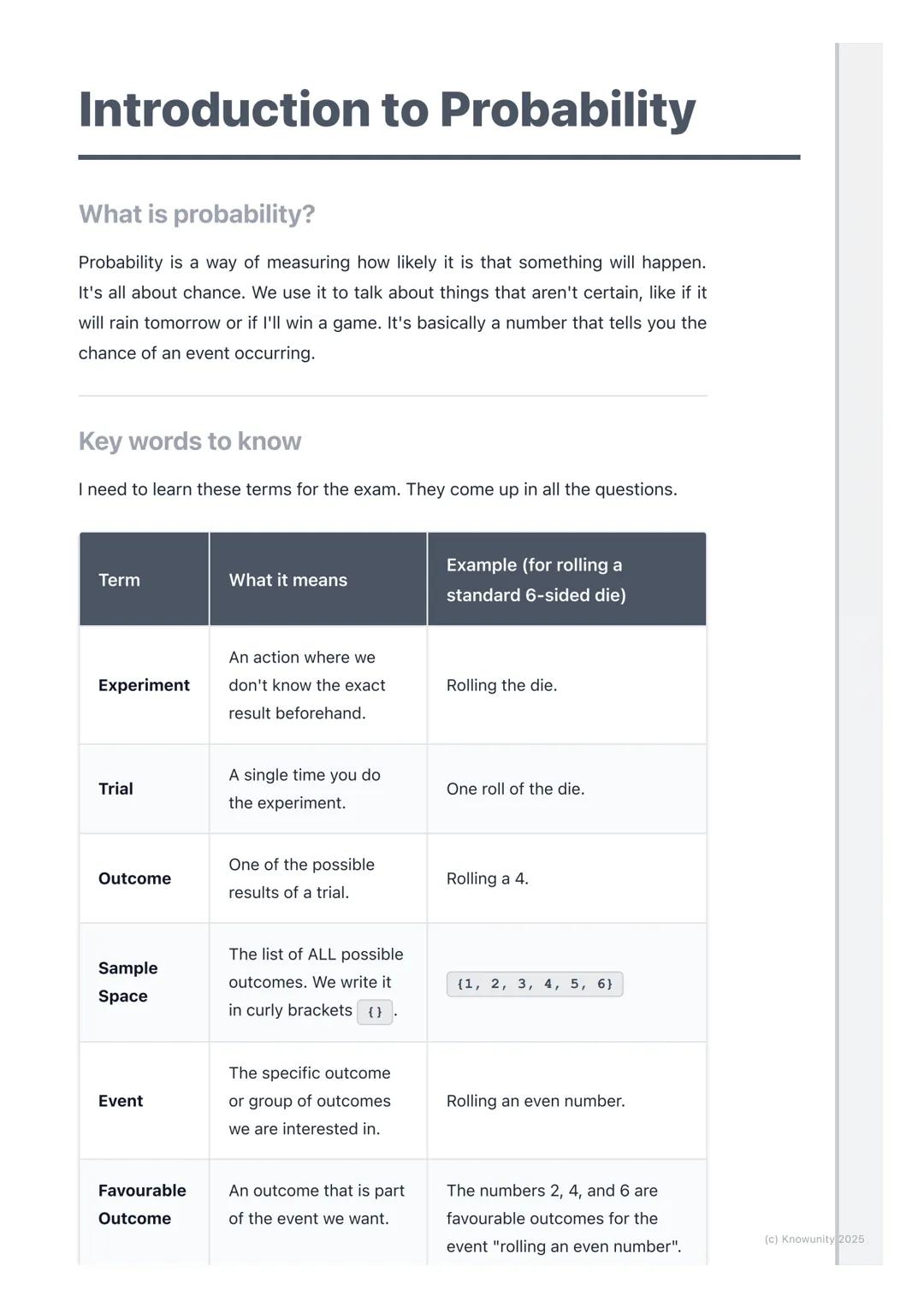
What is Probability?
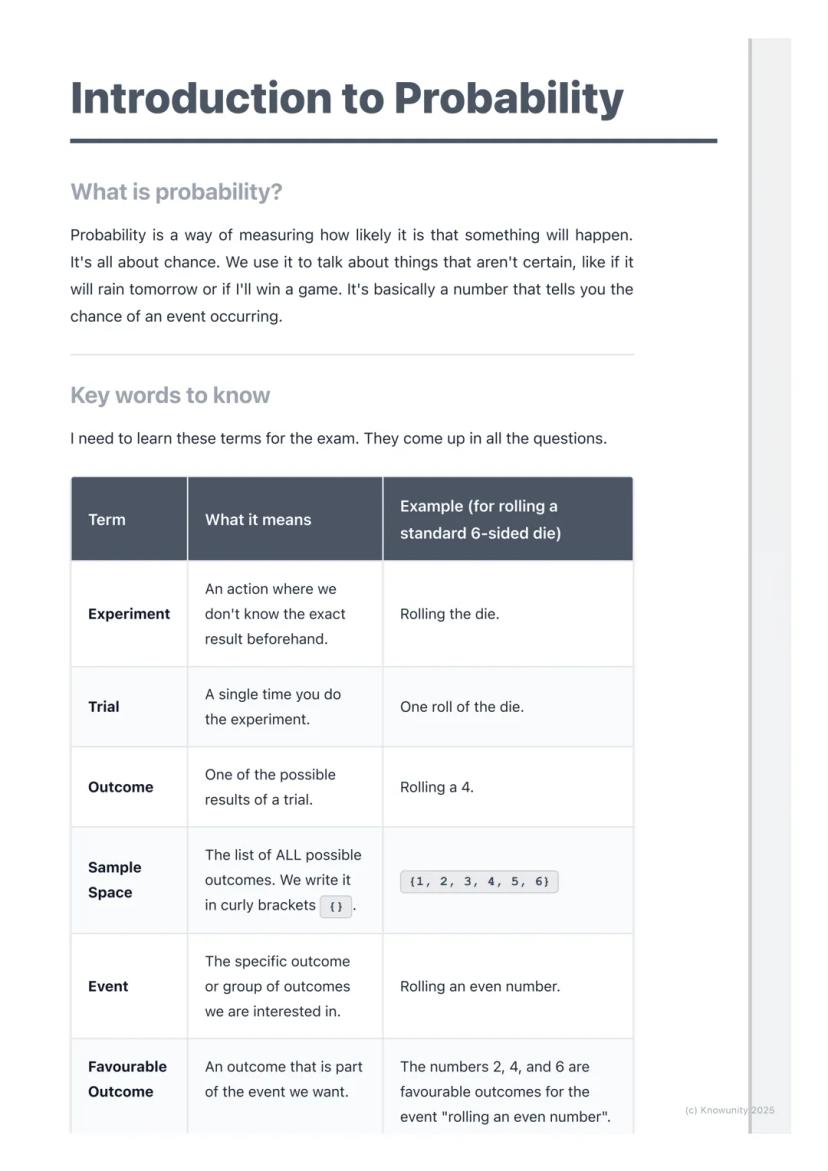
Ever wondered how to work out if something will actually happen? Probability gives you the answer by measuring chance using numbers. It's perfect for situations where you can't be 100% certain of the outcome.
Before diving into calculations, you need to master some key terms that'll pop up in every exam question. An experiment is any action where you don't know the exact result beforehand, like rolling a die. Each single attempt is called a trial.
The sample space lists every possible result in curly brackets - for a standard die, that's {1, 2, 3, 4, 5, 6}. An outcome is just one specific result, whilst an event is what you're actually interested in finding out about.
Quick Tip: Always start by writing down your sample space - it helps you spot all the possibilities and avoid missing any!
2
of 5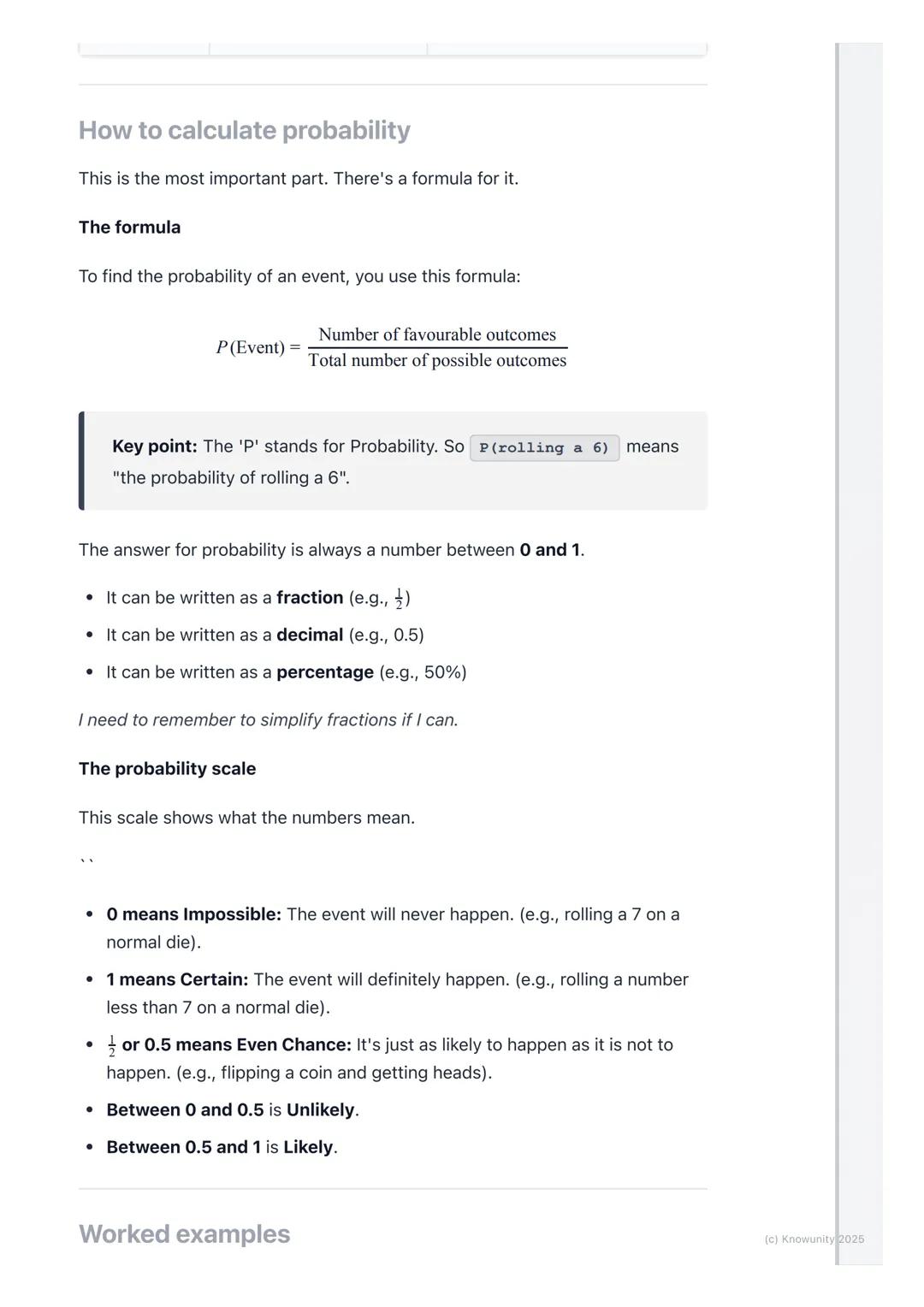
The Probability Formula
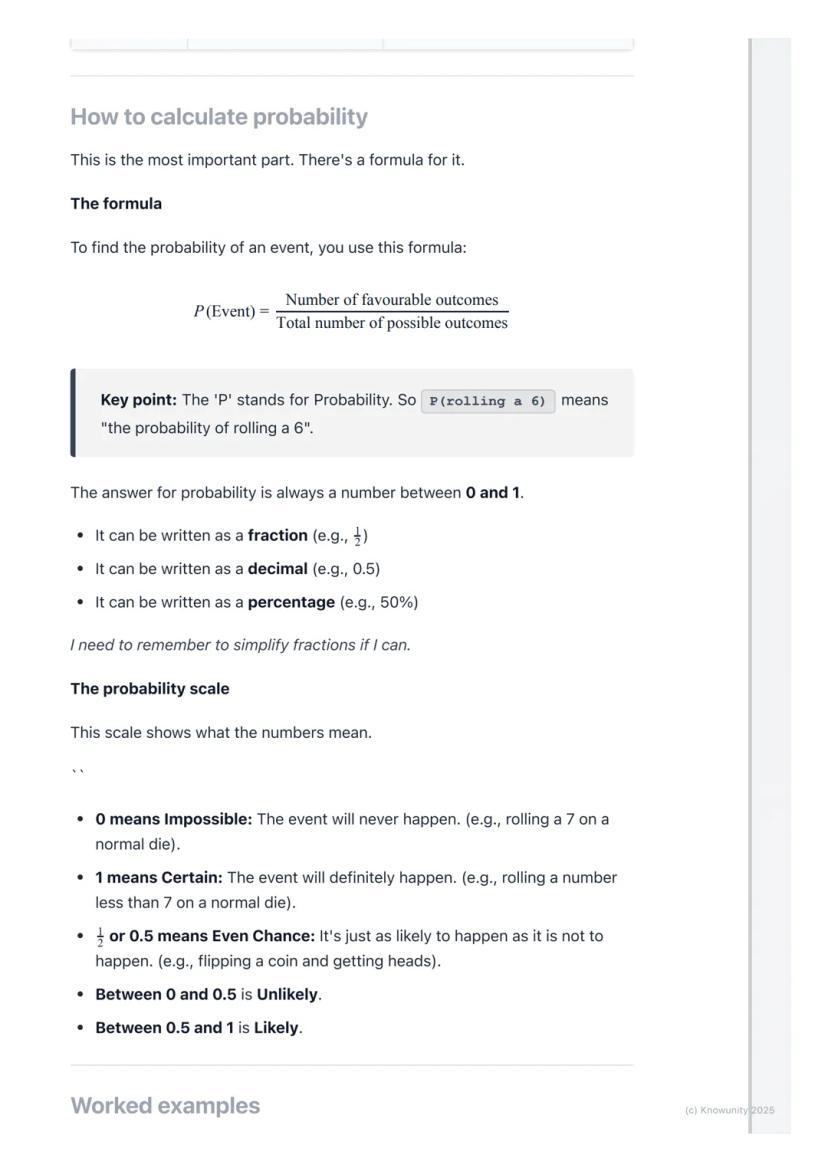
Here's the formula that'll solve every probability problem you'll face: P(Event) = Number of favourable outcomes ÷ Total number of possible outcomes. The 'P' simply stands for probability, so P(rolling a 6) means "the probability of rolling a 6".
Your answer will always be a number between 0 and 1. You can write it as a fraction, decimal, or percentage - just remember to simplify fractions when possible.
The probability scale is dead useful for understanding what your answers mean. 0 means impossible (like rolling a 7 on a normal die), whilst 1 means certain (like rolling less than 7). If you get 0.5, that's an even chance - exactly like flipping a coin.
Remember: Numbers between 0 and 0.5 are unlikely, whilst numbers between 0.5 and 1 are likely to happen.
3
of 5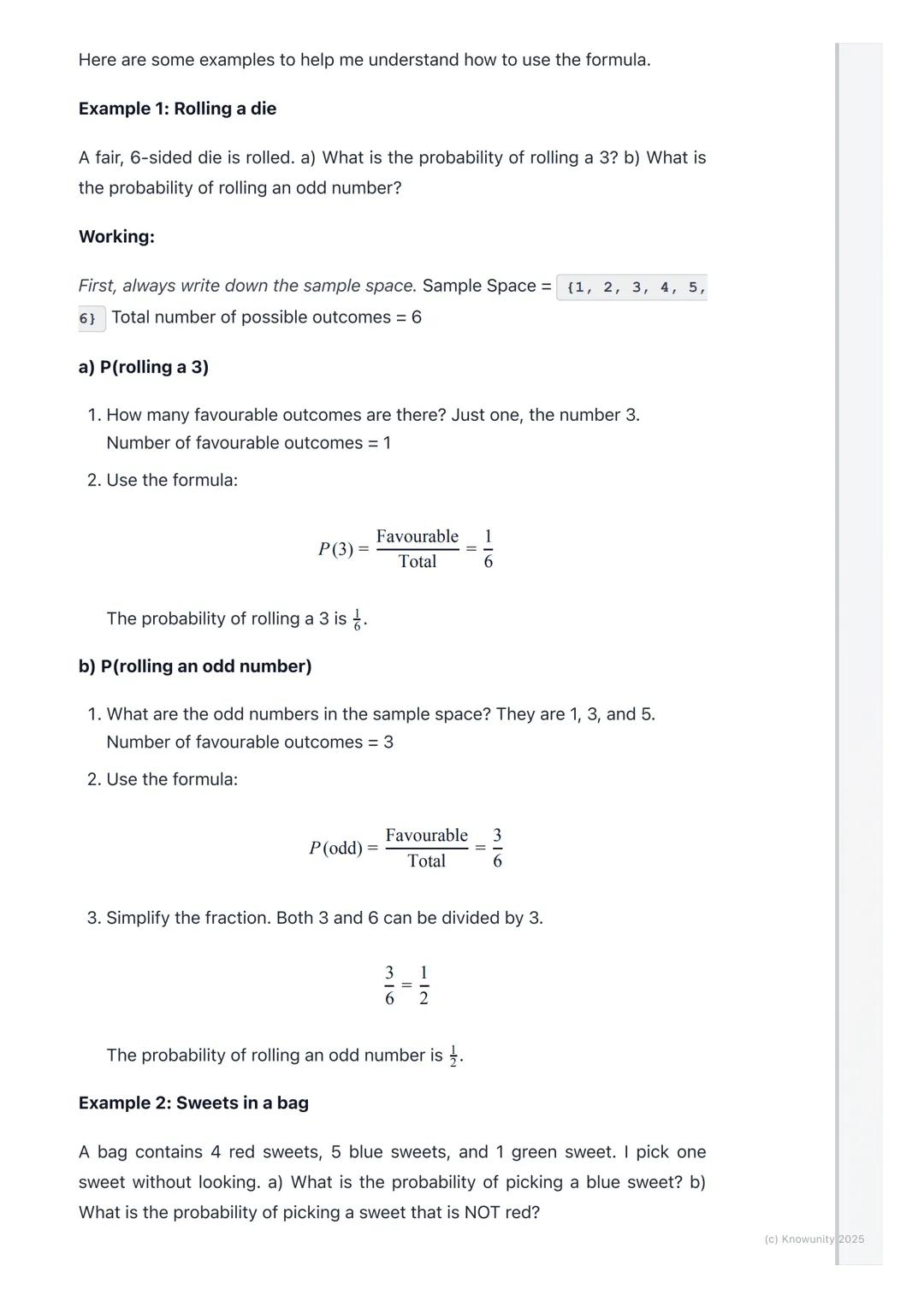
Working Through Examples
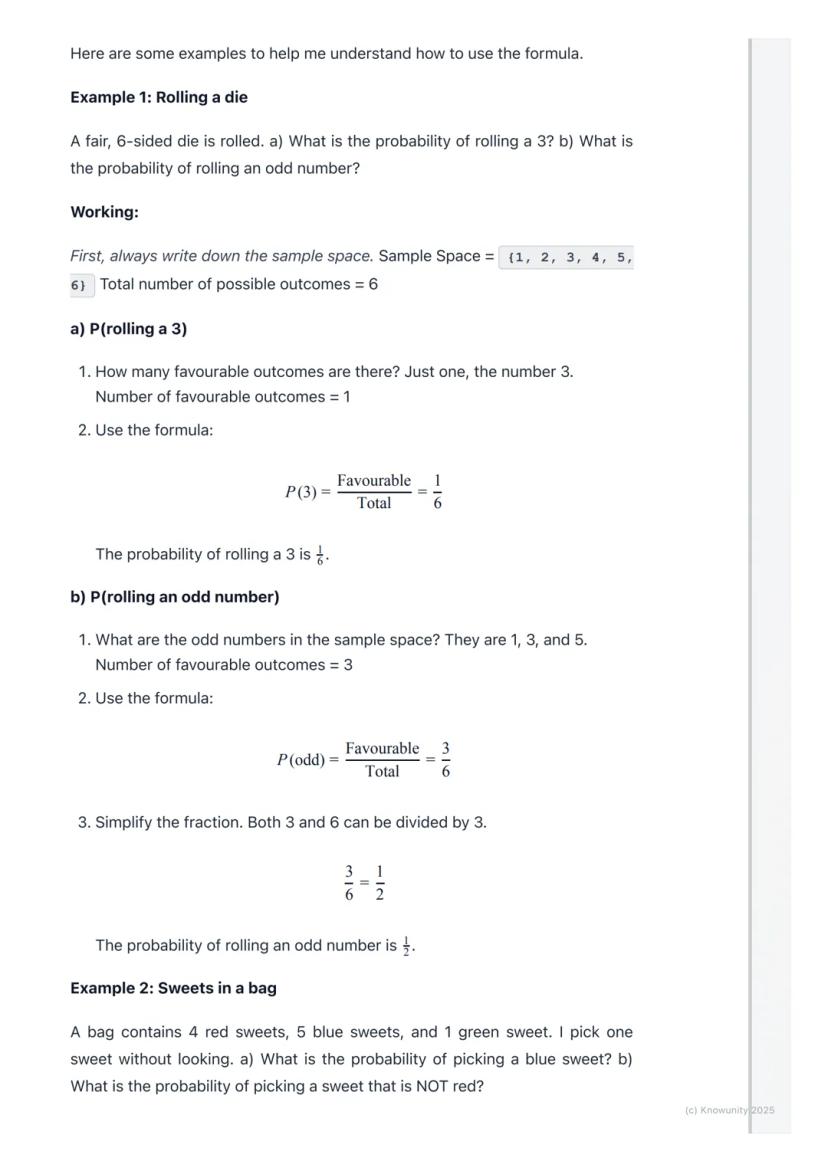
Let's tackle a classic die problem to see the formula in action. When rolling a fair 6-sided die, always start by writing your sample space: {1, 2, 3, 4, 5, 6}, giving you 6 total possible outcomes.
For finding P(rolling a 3), there's only one favourable outcome (the number 3), so you get 1÷6 = 1/6. For P(rolling an odd number), count the odd numbers: 1, 3, and 5 give you 3 favourable outcomes, so 3÷6 = 1/2 after simplifying.
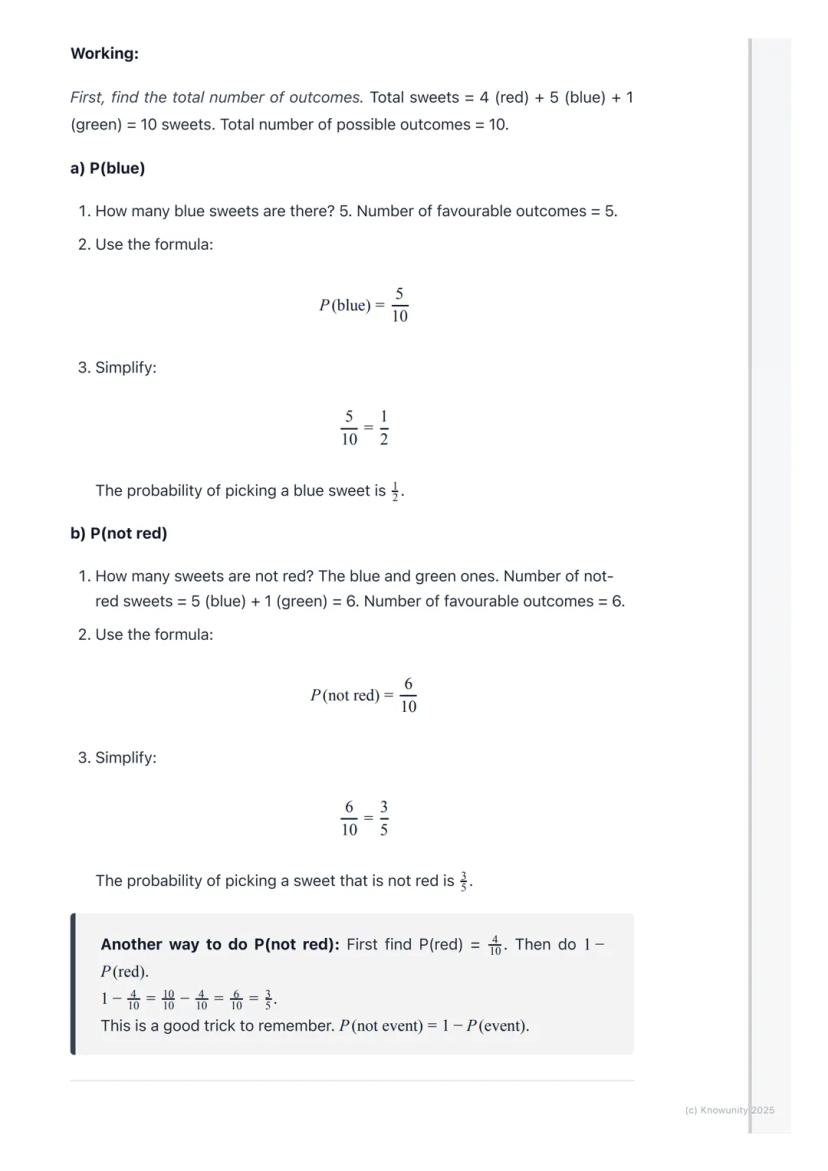
Sweet problems work exactly the same way. With 4 red, 5 blue, and 1 green sweet (10 total), P(blue) = 5÷10 = 1/2. The key is always counting your total first, then identifying what counts as "favourable" for your specific question.
Pro Tip: For "not red" events, you can either count non-red sweets directly, or use the shortcut: 1 - P(red) = 1 - 4/10 = 6/10 = 3/5.
4
of 5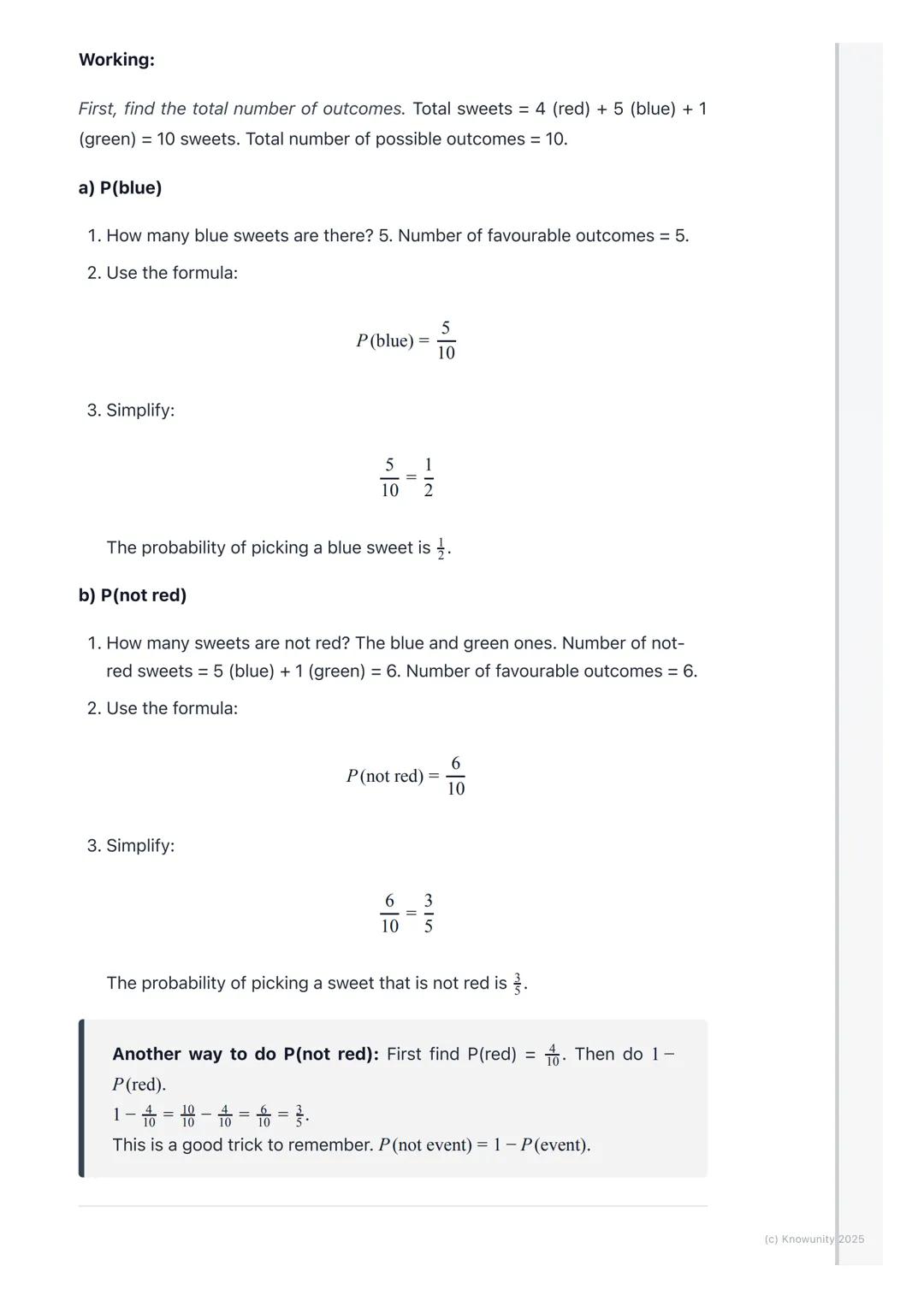
Advanced Techniques and Shortcuts
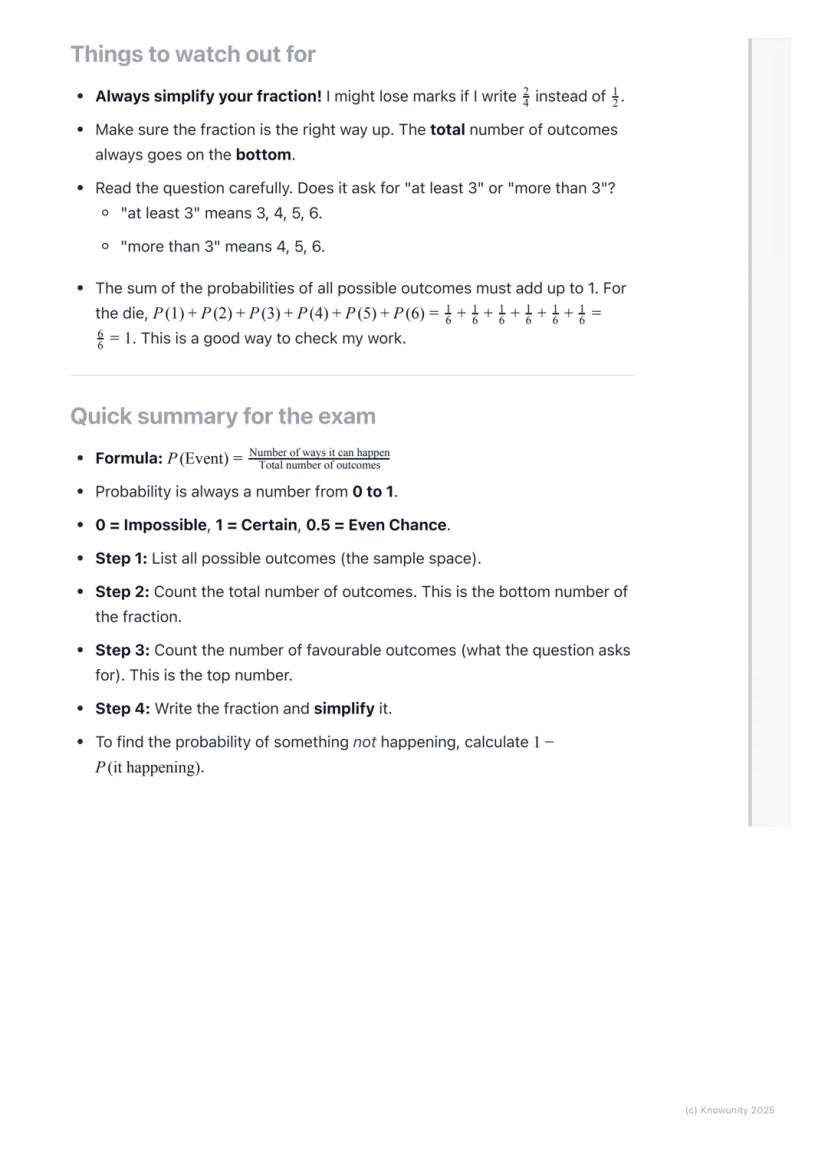
The "1 minus" trick is brilliant for complementary events. Instead of counting everything that's "not red", just work out P(red) first, then subtract from 1. This method often saves time and reduces mistakes.
Watch out for tricky wording in questions. "At least 3" includes 3, 4, 5, and 6, whilst "more than 3" only includes 4, 5, and 6. These small differences can completely change your answer.
Here's a clever way to check your work: all probabilities for every possible outcome must add up to 1. For a die, P(1) + P(2) + P(3) + P(4) + P(5) + P(6) = 6 × 1/6 = 1. If your total doesn't equal 1, you've made an error somewhere.
Check Yourself: Always verify that your fraction is the right way up - total outcomes go on the bottom, favourable outcomes on top!
5
of 5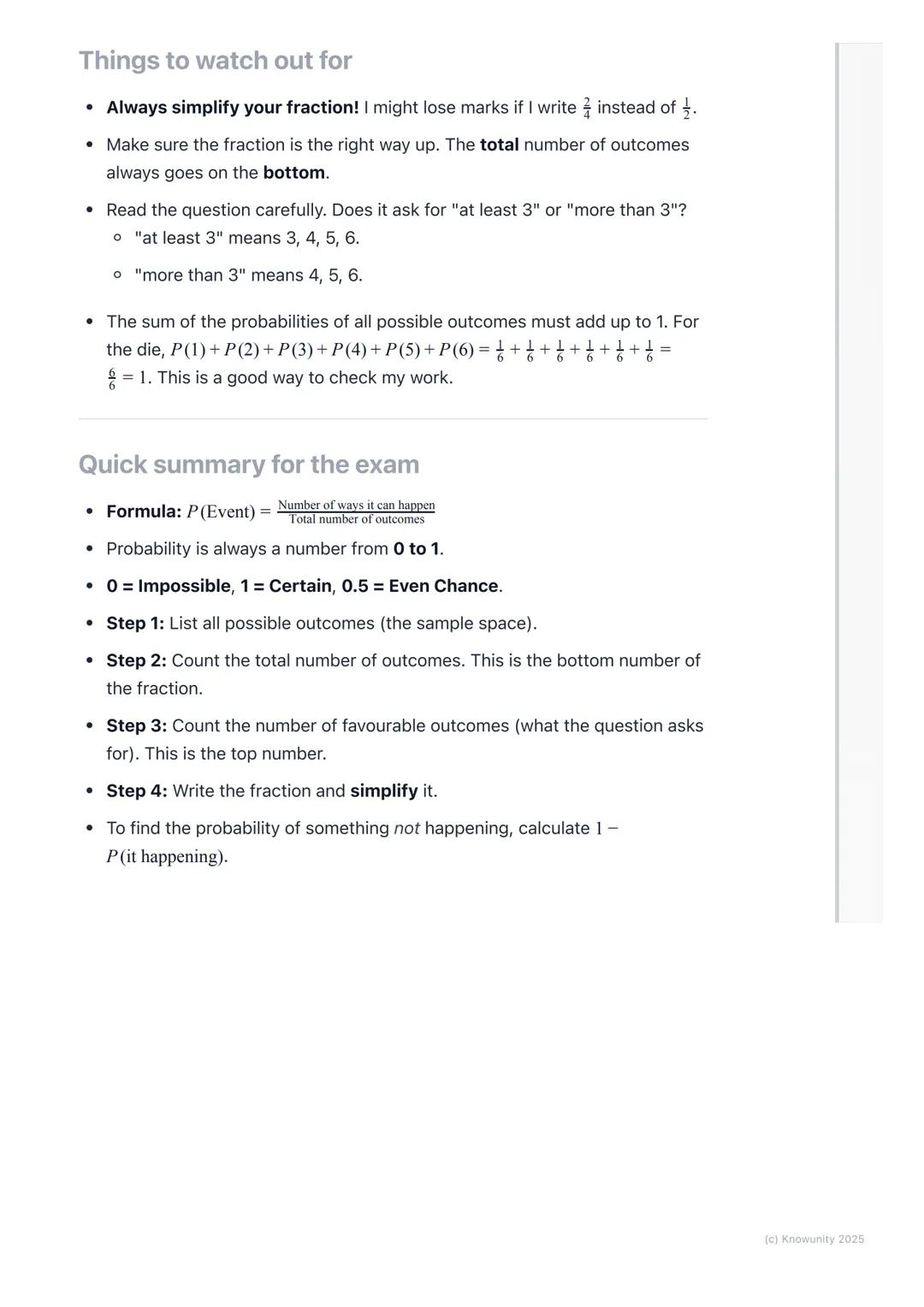
Exam Success Tips
Your step-by-step method should become automatic: list the sample space, count total outcomes (bottom of fraction), count favourable outcomes (top of fraction), then write and simplify your fraction.
Common mistakes to avoid include forgetting to simplify fractions and misreading questions. Always double-check whether the question asks for "at least" or "more than" - they're not the same thing.
Remember that probability always ranges from 0 to 1. If you get a number outside this range, you've definitely made an error. The formula P(Event) = Favourable outcomes ÷ Total outcomes will solve any basic probability problem you encounter.
Final Reminder: Take your time reading questions carefully - most mistakes happen from rushing, not from lack of understanding!
Pensavamo che non l'avreste mai chiesto....
Che cos'è l'assistente AI di Knowunity?
Il nostro assistente AI è costruito specificamente per le esigenze degli studenti. Sulla base dei milioni di contenuti presenti sulla piattaforma, possiamo fornire agli studenti risposte davvero significative e pertinenti. Ma non si tratta solo di risposte, l'assistente è in grado di guidare gli studenti attraverso le loro sfide quotidiane di studio, con piani di studio personalizzati, quiz o contenuti nella chat e una personalizzazione al 100% basata sulle competenze e sugli sviluppi degli studenti.
Dove posso scaricare l'applicazione Knowunity?
È possibile scaricare l'applicazione dal Google Play Store e dall'Apple App Store.
Knowunity è davvero gratuita?
Sì, hai accesso completamente gratuito a tutti i contenuti nell'app e puoi chattare o seguire i Creatori in qualsiasi momento. Sbloccherai nuove funzioni crescendo il tuo numero di follower. Inoltre, offriamo Knowunity Premium, che consente di studiare senza alcun limite!!
Contenuti più popolari di Mathematics
7Contenuti più popolari
9Non c'è niente di adatto? Esplorare altre aree tematiche.
Recensioni dei nostri utenti. Ci adorano - e anche tu, vedrai .
4.6/5App Store
4.7/5Google Play
L'applicazione è molto facile da usare e ben progettata. Finora ho trovato tutto quello che cercavo e ho potuto imparare molto dalle presentazioni! Utilizzerò sicuramente l'app per i compiti in classe! È molto utile anche come fonte di ispirazione.
Stefano Sutente iOS
Questa applicazione è davvero grande! Ci sono tantissimi appunti e aiuti con lo studio [...]. La mia materia problematica, per esempio, è il francese e l'app ha così tante opzioni per aiutarmi. Grazie a questa app ho migliorato il mio francese. La consiglio a tutti.
Samantha Klichutente Android
Wow, sono davvero stupita. Ho appena provato l'app perché l'ho vista pubblicizzata molte volte e sono rimasta assolutamente sbalordita. Questa app è L'AIUTO che cercate per la scuola e soprattutto offre tantissime cose, come allenamenti e schede, che a me personalmente sono state MOLTO utili.
Annautente iOS
Mathematics8 visualizzazioni·Aggiornato May 29, 2026·5 pagineUnderstanding Basic Probability Concepts
Probability is everywhere in your life - from the chance of rain to winning a game or picking your favourite sweet from a bag. It's simply a way to measure how likely something is to happen, using numbers between 0... Mostra di più
1
of 5Iscriviti per mostrare il contenuto. È gratis!
- Accesso a tutti i documenti
- Migliora i tuoi voti
- Unisciti a milioni di studenti
What is Probability?
Ever wondered how to work out if something will actually happen? Probability gives you the answer by measuring chance using numbers. It's perfect for situations where you can't be 100% certain of the outcome.
Before diving into calculations, you need to master some key terms that'll pop up in every exam question. An experiment is any action where you don't know the exact result beforehand, like rolling a die. Each single attempt is called a trial.
The sample space lists every possible result in curly brackets - for a standard die, that's {1, 2, 3, 4, 5, 6}. An outcome is just one specific result, whilst an event is what you're actually interested in finding out about.
Quick Tip: Always start by writing down your sample space - it helps you spot all the possibilities and avoid missing any!
2
of 5Iscriviti per mostrare il contenuto. È gratis!
- Accesso a tutti i documenti
- Migliora i tuoi voti
- Unisciti a milioni di studenti
The Probability Formula
Here's the formula that'll solve every probability problem you'll face: P(Event) = Number of favourable outcomes ÷ Total number of possible outcomes. The 'P' simply stands for probability, so P(rolling a 6) means "the probability of rolling a 6".
Your answer will always be a number between 0 and 1. You can write it as a fraction, decimal, or percentage - just remember to simplify fractions when possible.
The probability scale is dead useful for understanding what your answers mean. 0 means impossible (like rolling a 7 on a normal die), whilst 1 means certain (like rolling less than 7). If you get 0.5, that's an even chance - exactly like flipping a coin.
Remember: Numbers between 0 and 0.5 are unlikely, whilst numbers between 0.5 and 1 are likely to happen.
3
of 5Iscriviti per mostrare il contenuto. È gratis!
- Accesso a tutti i documenti
- Migliora i tuoi voti
- Unisciti a milioni di studenti
Working Through Examples
Let's tackle a classic die problem to see the formula in action. When rolling a fair 6-sided die, always start by writing your sample space: {1, 2, 3, 4, 5, 6}, giving you 6 total possible outcomes.
For finding P(rolling a 3), there's only one favourable outcome (the number 3), so you get 1÷6 = 1/6. For P(rolling an odd number), count the odd numbers: 1, 3, and 5 give you 3 favourable outcomes, so 3÷6 = 1/2 after simplifying.
Sweet problems work exactly the same way. With 4 red, 5 blue, and 1 green sweet (10 total), P(blue) = 5÷10 = 1/2. The key is always counting your total first, then identifying what counts as "favourable" for your specific question.
Pro Tip: For "not red" events, you can either count non-red sweets directly, or use the shortcut: 1 - P(red) = 1 - 4/10 = 6/10 = 3/5.
4
of 5Iscriviti per mostrare il contenuto. È gratis!
- Accesso a tutti i documenti
- Migliora i tuoi voti
- Unisciti a milioni di studenti
Advanced Techniques and Shortcuts
The "1 minus" trick is brilliant for complementary events. Instead of counting everything that's "not red", just work out P(red) first, then subtract from 1. This method often saves time and reduces mistakes.
Watch out for tricky wording in questions. "At least 3" includes 3, 4, 5, and 6, whilst "more than 3" only includes 4, 5, and 6. These small differences can completely change your answer.
Here's a clever way to check your work: all probabilities for every possible outcome must add up to 1. For a die, P(1) + P(2) + P(3) + P(4) + P(5) + P(6) = 6 × 1/6 = 1. If your total doesn't equal 1, you've made an error somewhere.
Check Yourself: Always verify that your fraction is the right way up - total outcomes go on the bottom, favourable outcomes on top!
5
of 5Iscriviti per mostrare il contenuto. È gratis!
- Accesso a tutti i documenti
- Migliora i tuoi voti
- Unisciti a milioni di studenti
Exam Success Tips
Your step-by-step method should become automatic: list the sample space, count total outcomes (bottom of fraction), count favourable outcomes (top of fraction), then write and simplify your fraction.
Common mistakes to avoid include forgetting to simplify fractions and misreading questions. Always double-check whether the question asks for "at least" or "more than" - they're not the same thing.
Remember that probability always ranges from 0 to 1. If you get a number outside this range, you've definitely made an error. The formula P(Event) = Favourable outcomes ÷ Total outcomes will solve any basic probability problem you encounter.
Final Reminder: Take your time reading questions carefully - most mistakes happen from rushing, not from lack of understanding!
Pensavamo che non l'avreste mai chiesto....
Che cos'è l'assistente AI di Knowunity?
Il nostro assistente AI è costruito specificamente per le esigenze degli studenti. Sulla base dei milioni di contenuti presenti sulla piattaforma, possiamo fornire agli studenti risposte davvero significative e pertinenti. Ma non si tratta solo di risposte, l'assistente è in grado di guidare gli studenti attraverso le loro sfide quotidiane di studio, con piani di studio personalizzati, quiz o contenuti nella chat e una personalizzazione al 100% basata sulle competenze e sugli sviluppi degli studenti.
Dove posso scaricare l'applicazione Knowunity?
È possibile scaricare l'applicazione dal Google Play Store e dall'Apple App Store.
Knowunity è davvero gratuita?
Sì, hai accesso completamente gratuito a tutti i contenuti nell'app e puoi chattare o seguire i Creatori in qualsiasi momento. Sbloccherai nuove funzioni crescendo il tuo numero di follower. Inoltre, offriamo Knowunity Premium, che consente di studiare senza alcun limite!!
Contenuti più popolari di Mathematics
7Contenuti più popolari
9Non c'è niente di adatto? Esplorare altre aree tematiche.
Recensioni dei nostri utenti. Ci adorano - e anche tu, vedrai .
4.6/5App Store
4.7/5Google Play
L'applicazione è molto facile da usare e ben progettata. Finora ho trovato tutto quello che cercavo e ho potuto imparare molto dalle presentazioni! Utilizzerò sicuramente l'app per i compiti in classe! È molto utile anche come fonte di ispirazione.
Stefano Sutente iOS
Questa applicazione è davvero grande! Ci sono tantissimi appunti e aiuti con lo studio [...]. La mia materia problematica, per esempio, è il francese e l'app ha così tante opzioni per aiutarmi. Grazie a questa app ho migliorato il mio francese. La consiglio a tutti.
Samantha Klichutente Android
Wow, sono davvero stupita. Ho appena provato l'app perché l'ho vista pubblicizzata molte volte e sono rimasta assolutamente sbalordita. Questa app è L'AIUTO che cercate per la scuola e soprattutto offre tantissime cose, come allenamenti e schede, che a me personalmente sono state MOLTO utili.
Annautente iOS