
Stability and balance are fundamental principles in biomechanics that impact...
 LCPE9 visualizzazioni·Aggiornato Jun 18, 2026·5 pagine
Understanding Stability and Balance

1 / 5
1
of 5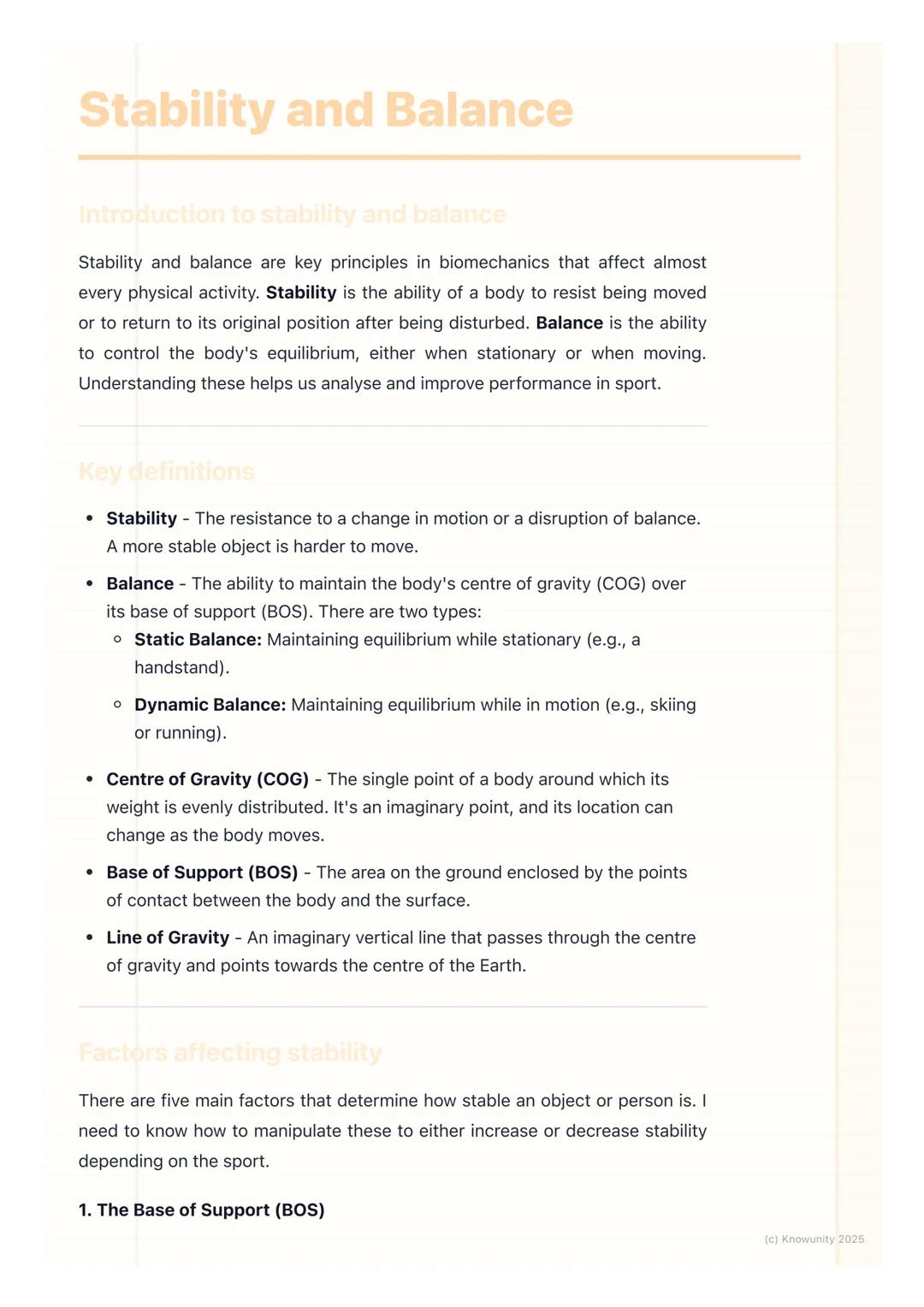
Understanding Stability and Balance
Stability is your body's ability to resist movement or return to its original position when disturbed. Balance, meanwhile, is how you control your body's equilibrium, whether you're standing still (static balance) or moving (dynamic balance).
The foundation of stability relies on understanding several key elements. Your Centre of Gravity (COG) is the single point around which your body weight is evenly distributed—it's an imaginary point that shifts as you move. The Base of Support (BOS) is the area between all points of contact with the ground. For example, when standing, it's the area between and including your feet.
The Line of Gravity is an imaginary vertical line passing through your centre of gravity toward the Earth's centre. When this line falls within your base of support, you maintain balance; when it moves outside, you'll either fall or need to adjust your position.
Did you know? You don't need to be highly stable in all sports! Sometimes being less stable allows for quicker movement and better performance, like in badminton where players need to change direction rapidly.
2
of 5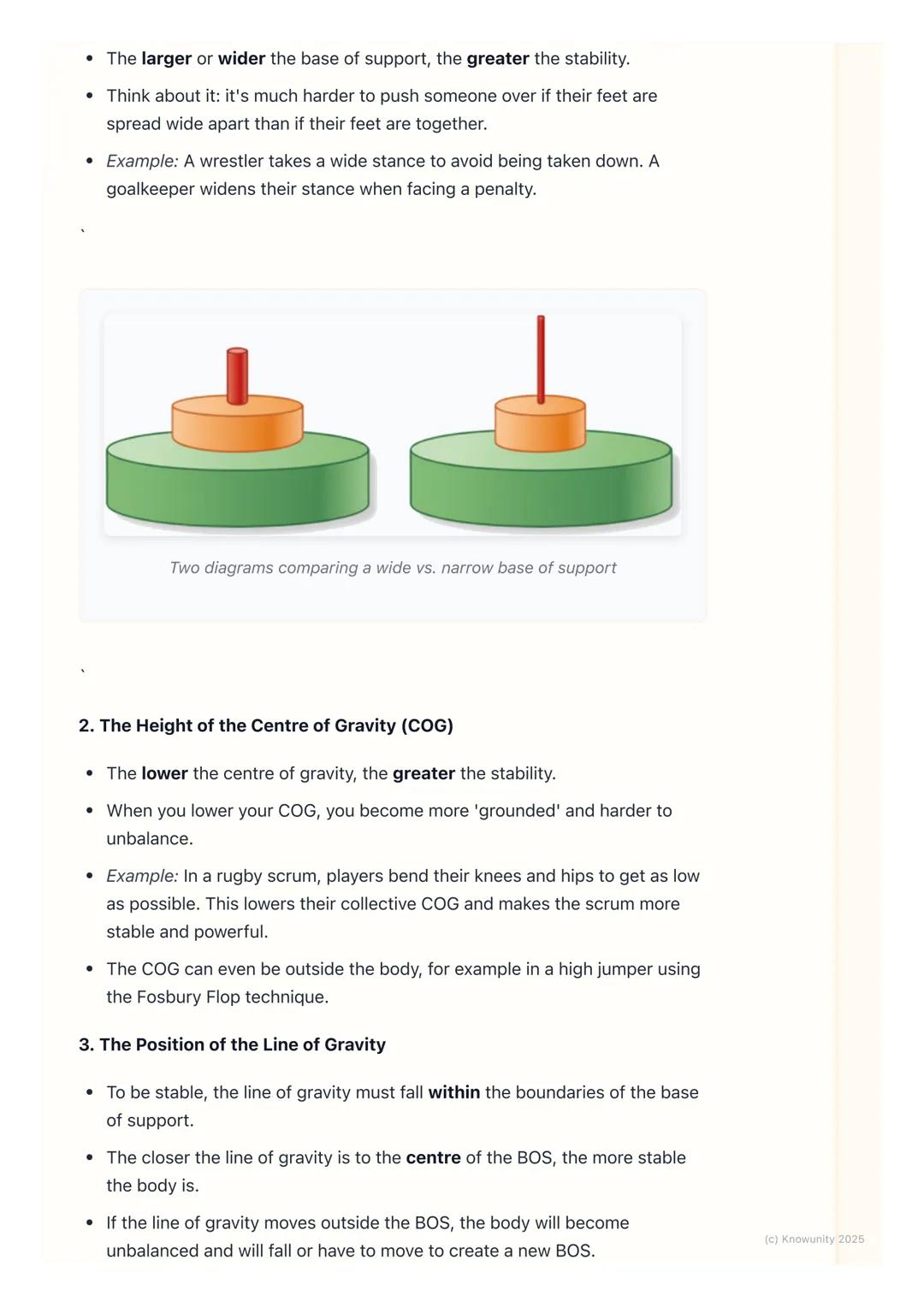
Factors Affecting Stability
Your stability is influenced by five key factors that you can manipulate to either increase or decrease stability depending on what your sport requires.
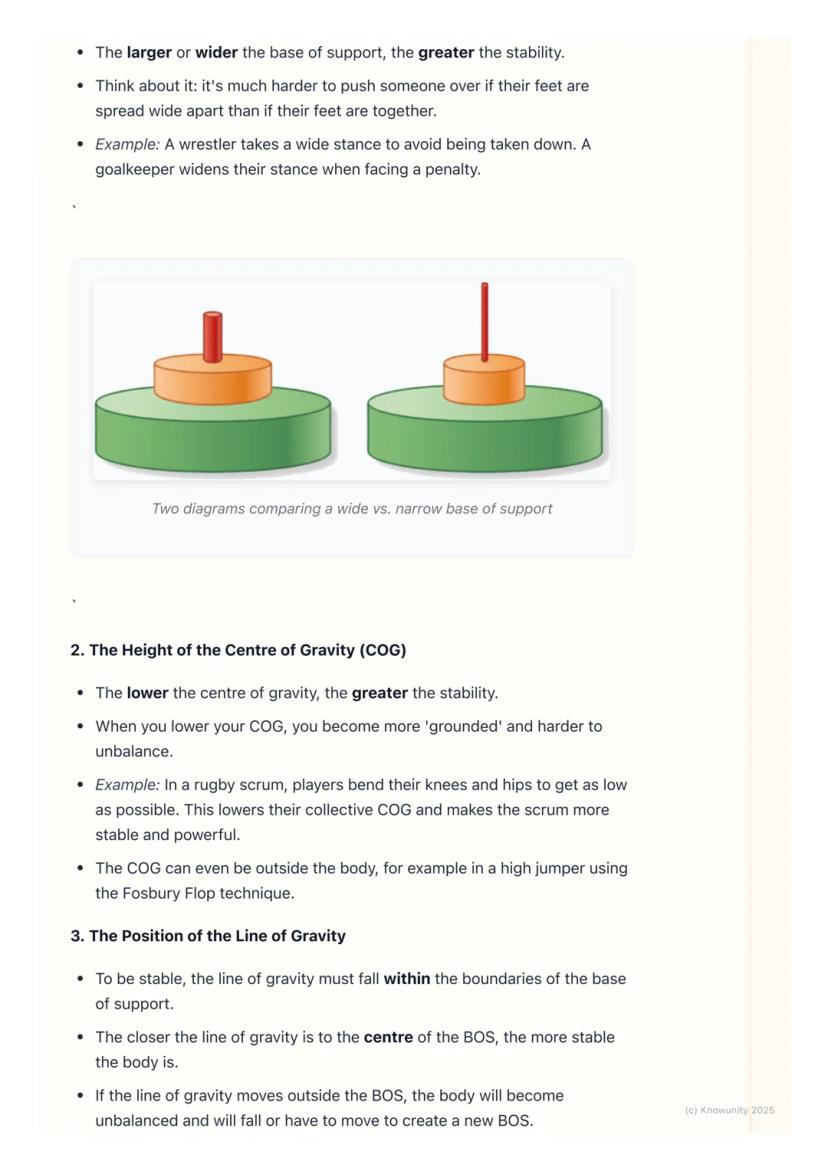
1. Base of Support (BOS) - A wider base makes you more stable. Think about how difficult it is to push someone over when their feet are spread apart compared to when they're close together. Rugby players in a scrum take wide stances to resist being moved, while gymnasts often use narrow stances when they need to rotate quickly.
2. Height of Centre of Gravity (COG) - The lower your centre of gravity, the more stable you become. That's why rugby players bend their knees and hips to get low in a scrum, increasing their stability. Interestingly, in the Fosbury Flop high jump technique, the athlete's centre of gravity actually passes underneath the bar while their body goes over it!
3. Position of Line of Gravity - For optimal stability, your line of gravity should fall in the centre of your base of support. The closer it gets to the edge, the less stable you become. Athletes sometimes intentionally create "controlled instability" by shifting their line of gravity toward the edge of their base to help them start moving quickly—like sprinters in the blocks.
3
of 5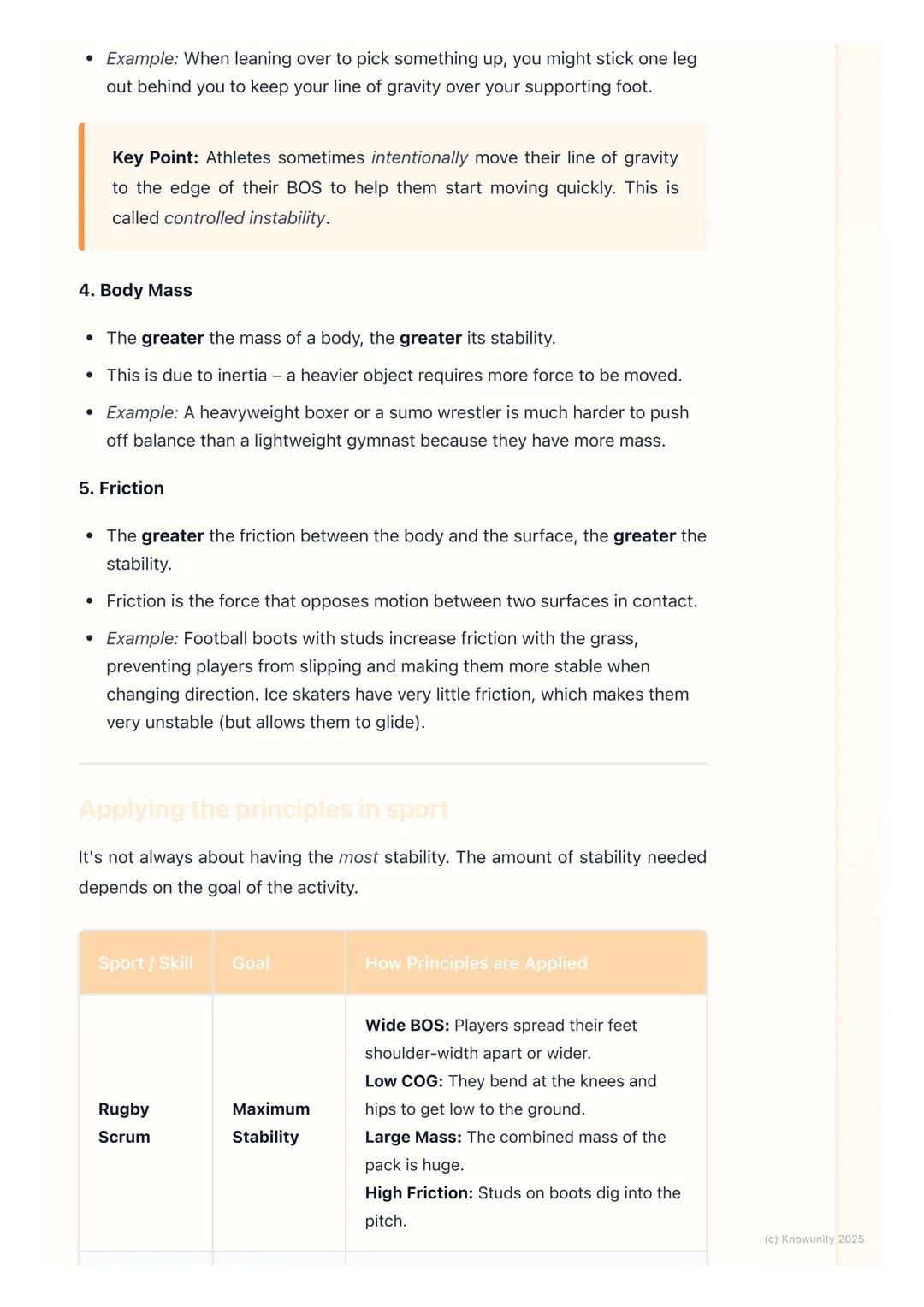
More Stability Factors and Sport Applications
4. Body Mass - Greater mass means greater stability due to inertia. Heavier objects require more force to move. This is why heavyweight boxers or sumo wrestlers are significantly more difficult to unbalance than lightweight gymnasts.
5. Friction - More friction between your body and the surface increases stability. Football boots with studs create friction with the grass, preventing slipping and enhancing stability when changing direction. Conversely, ice skaters work with very little friction, which reduces stability but enables gliding.
The amount of stability needed varies dramatically depending on your sport's objectives. Different activities require different stability strategies:
Top Tip: When analysing sports performance, always ask yourself whether the athlete needs to be stable and immovable or whether they need mobility and quick movement. This will help you understand how they should apply stability principles.
Sports often involve a trade-off between stability and mobility. High stability typically means lower mobility (like a sumo wrestler), while low stability allows greater mobility (like a badminton player needing quick directional changes).
4
of 5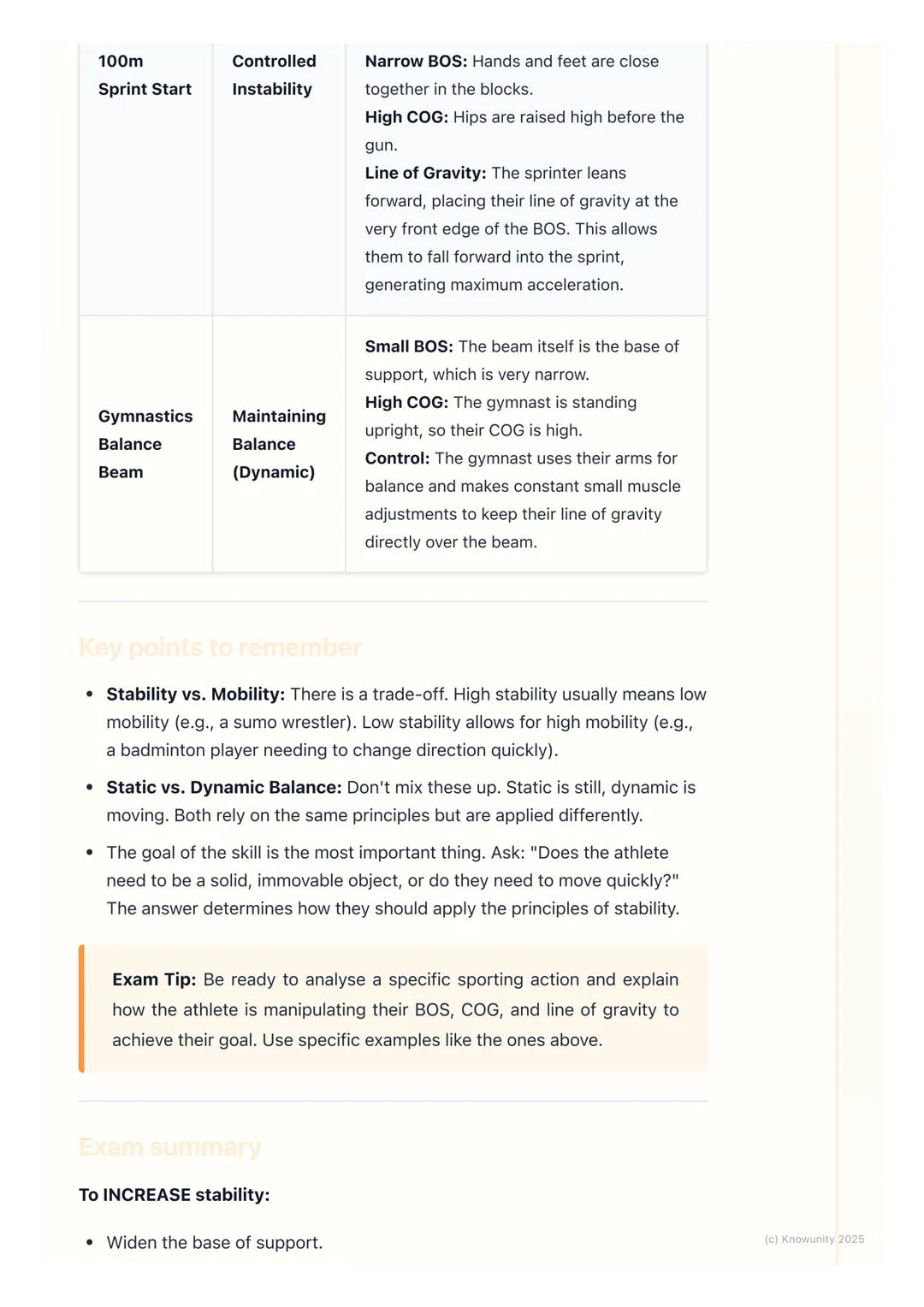
Applying Stability Principles in Sport
Let's look at how athletes manipulate stability principles in specific sports:
100m Sprint Start - Sprinters use controlled instability to their advantage. They create a narrow base of support in the blocks, raise their hips to elevate their centre of gravity, and lean forward to place their line of gravity at the front edge of their base. This deliberate instability allows them to "fall" forward into their first steps, generating maximum acceleration.
Gymnastics Balance Beam - Gymnasts face the challenge of maintaining balance on an extremely narrow base of support. With a high centre of gravity while standing upright, they must make constant small muscle adjustments to keep their line of gravity directly over the beam. They often use their arms as counterbalances to maintain this precarious equilibrium.
Understanding these principles helps you analyse techniques across any sport. For example, a basketball player widening their stance when defending, a goalkeeper spreading their arms and legs when facing a shot, or a skier lowering their body position when taking a turn are all applications of stability principles.
Exam Tip: When asked about stability in exams, always relate your answer to a specific sporting action and explain precisely how the athlete manipulates their base of support, centre of gravity, and line of gravity to achieve their goal.
5
of 5
Practical Applications for Stability Control
Knowing how to manipulate stability gives you a powerful tool for analysing and improving sporting performance. Here's a quick summary of how to adjust stability:
To increase stability:
- Widen your base of support (spread your feet)
- Lower your centre of gravity (bend knees, crouch)
- Keep your line of gravity centred in your base of support
- Increase body mass (more relevant for sports like rugby or sumo)
- Increase friction (appropriate footwear for the surface)
To decrease stability (for quicker movement):
- Narrow your base of support
- Raise your centre of gravity
- Move your line of gravity toward the edge of your base of support
Being able to identify and explain these principles in various sporting contexts will help you excel in both practical performance and theoretical examinations. Remember that different sports require different stability strategies, and the best athletes instinctively know when to prioritize stability and when to sacrifice it for mobility.
Pensavamo che non l'avreste mai chiesto....
Che cos'è l'assistente AI di Knowunity?
Il nostro assistente AI è costruito specificamente per le esigenze degli studenti. Sulla base dei milioni di contenuti presenti sulla piattaforma, possiamo fornire agli studenti risposte davvero significative e pertinenti. Ma non si tratta solo di risposte, l'assistente è in grado di guidare gli studenti attraverso le loro sfide quotidiane di studio, con piani di studio personalizzati, quiz o contenuti nella chat e una personalizzazione al 100% basata sulle competenze e sugli sviluppi degli studenti.
Dove posso scaricare l'applicazione Knowunity?
È possibile scaricare l'applicazione dal Google Play Store e dall'Apple App Store.
Knowunity è davvero gratuita?
Sì, hai accesso completamente gratuito a tutti i contenuti nell'app e puoi chattare o seguire i Creatori in qualsiasi momento. Sbloccherai nuove funzioni crescendo il tuo numero di follower. Inoltre, offriamo Knowunity Premium, che consente di studiare senza alcun limite!!
Contenuti più popolari di LCPE
4LCPEBiomechanics of Movement
Applying fundamental biomechanical principles such as force, motion, levers, and stability to analyse and improve human movement efficiency and performance in sport.
6th Year220
LCPEHealthy Eating Guidelines
This section explores national healthy eating guidelines, such as the food pyramid or healthy eating plate, to promote balanced dietary choices.
5th Year50
LCPETechnology in Sport
Investigating how technology is used in areas such as performance analysis, equipment design, officiating, and athlete monitoring to enhance training and competition.
6th Year50
LCPEFactors effecting sports psychology ( confidence and self efficacy)
Higher Level LCPE psychological preprration notes
5th Year230
Contenuti più popolari
9 English
Key Quotes : Sive
Key Quotes and explanations: Sive
6th Year2842
 Irish
IrishIrish oral questions and answers
Questions and answers for the leaving cert oral
5th Year4264
 Physics
Balanced and Unbalanced Forces
Students will explore how balanced forces result in no change in motion, while unbalanced forces cause an object to accelerate or change direction.
2nd Year522
IrishIníon- le hÁine Durkin
Aine Durkin’s poem, Iníon: Themes & summary
5th Year890
EnglishCultural Context : Shawshank Redemption : Sive : Small Things Like These
Comparative Study : Cultural Context : Shawshank Redemption, Sive and Small Things Like These
6th Year1430
IrishLC HL notes- Iníon (poem)
Includes poem in English and Irish, theme, key words & phrases
5th Year2304
IrishIrish oral questions
Outline of oral questions
5th Year2055
IrishMo Ghrá-sa (Idir Lúibíní)
Notes on mo ghrá-sa
5th Year380
IrishAn Gaeilge Aiste
Irish Language essay
6th Year1320
Non c'è niente di adatto? Esplorare altre aree tematiche.
Recensioni dei nostri utenti. Ci adorano - e anche tu, vedrai .
4.6/5App Store
4.7/5Google Play
L'applicazione è molto facile da usare e ben progettata. Finora ho trovato tutto quello che cercavo e ho potuto imparare molto dalle presentazioni! Utilizzerò sicuramente l'app per i compiti in classe! È molto utile anche come fonte di ispirazione.
Stefano Sutente iOS
Questa applicazione è davvero grande! Ci sono tantissimi appunti e aiuti con lo studio [...]. La mia materia problematica, per esempio, è il francese e l'app ha così tante opzioni per aiutarmi. Grazie a questa app ho migliorato il mio francese. La consiglio a tutti.
Samantha Klichutente Android
Wow, sono davvero stupita. Ho appena provato l'app perché l'ho vista pubblicizzata molte volte e sono rimasta assolutamente sbalordita. Questa app è L'AIUTO che cercate per la scuola e soprattutto offre tantissime cose, come allenamenti e schede, che a me personalmente sono state MOLTO utili.
Annautente iOS
LCPE9 visualizzazioni·Aggiornato Jun 18, 2026·5 pagineUnderstanding Stability and Balance
Stability and balance are fundamental principles in biomechanics that impact virtually every sport and physical activity. These concepts help us understand how athletes maintain control over their bodies and how they can manipulate these factors to optimize their performance. Mastering...
1
of 5
Iscriviti per mostrare il contenuto. È gratis!
- Accesso a tutti i documenti
- Migliora i tuoi voti
- Unisciti a milioni di studenti
Understanding Stability and Balance
Stability is your body's ability to resist movement or return to its original position when disturbed. Balance, meanwhile, is how you control your body's equilibrium, whether you're standing still (static balance) or moving (dynamic balance).
The foundation of stability relies on understanding several key elements. Your Centre of Gravity (COG) is the single point around which your body weight is evenly distributed—it's an imaginary point that shifts as you move. The Base of Support (BOS) is the area between all points of contact with the ground. For example, when standing, it's the area between and including your feet.
The Line of Gravity is an imaginary vertical line passing through your centre of gravity toward the Earth's centre. When this line falls within your base of support, you maintain balance; when it moves outside, you'll either fall or need to adjust your position.
Did you know? You don't need to be highly stable in all sports! Sometimes being less stable allows for quicker movement and better performance, like in badminton where players need to change direction rapidly.
2
of 5Iscriviti per mostrare il contenuto. È gratis!
- Accesso a tutti i documenti
- Migliora i tuoi voti
- Unisciti a milioni di studenti
Factors Affecting Stability
Your stability is influenced by five key factors that you can manipulate to either increase or decrease stability depending on what your sport requires.
1. Base of Support (BOS) - A wider base makes you more stable. Think about how difficult it is to push someone over when their feet are spread apart compared to when they're close together. Rugby players in a scrum take wide stances to resist being moved, while gymnasts often use narrow stances when they need to rotate quickly.
2. Height of Centre of Gravity (COG) - The lower your centre of gravity, the more stable you become. That's why rugby players bend their knees and hips to get low in a scrum, increasing their stability. Interestingly, in the Fosbury Flop high jump technique, the athlete's centre of gravity actually passes underneath the bar while their body goes over it!
3. Position of Line of Gravity - For optimal stability, your line of gravity should fall in the centre of your base of support. The closer it gets to the edge, the less stable you become. Athletes sometimes intentionally create "controlled instability" by shifting their line of gravity toward the edge of their base to help them start moving quickly—like sprinters in the blocks.
3
of 5Iscriviti per mostrare il contenuto. È gratis!
- Accesso a tutti i documenti
- Migliora i tuoi voti
- Unisciti a milioni di studenti
More Stability Factors and Sport Applications
4. Body Mass - Greater mass means greater stability due to inertia. Heavier objects require more force to move. This is why heavyweight boxers or sumo wrestlers are significantly more difficult to unbalance than lightweight gymnasts.
5. Friction - More friction between your body and the surface increases stability. Football boots with studs create friction with the grass, preventing slipping and enhancing stability when changing direction. Conversely, ice skaters work with very little friction, which reduces stability but enables gliding.
The amount of stability needed varies dramatically depending on your sport's objectives. Different activities require different stability strategies:
Top Tip: When analysing sports performance, always ask yourself whether the athlete needs to be stable and immovable or whether they need mobility and quick movement. This will help you understand how they should apply stability principles.
Sports often involve a trade-off between stability and mobility. High stability typically means lower mobility (like a sumo wrestler), while low stability allows greater mobility (like a badminton player needing quick directional changes).
4
of 5Iscriviti per mostrare il contenuto. È gratis!
- Accesso a tutti i documenti
- Migliora i tuoi voti
- Unisciti a milioni di studenti
Applying Stability Principles in Sport
Let's look at how athletes manipulate stability principles in specific sports:
100m Sprint Start - Sprinters use controlled instability to their advantage. They create a narrow base of support in the blocks, raise their hips to elevate their centre of gravity, and lean forward to place their line of gravity at the front edge of their base. This deliberate instability allows them to "fall" forward into their first steps, generating maximum acceleration.
Gymnastics Balance Beam - Gymnasts face the challenge of maintaining balance on an extremely narrow base of support. With a high centre of gravity while standing upright, they must make constant small muscle adjustments to keep their line of gravity directly over the beam. They often use their arms as counterbalances to maintain this precarious equilibrium.
Understanding these principles helps you analyse techniques across any sport. For example, a basketball player widening their stance when defending, a goalkeeper spreading their arms and legs when facing a shot, or a skier lowering their body position when taking a turn are all applications of stability principles.
Exam Tip: When asked about stability in exams, always relate your answer to a specific sporting action and explain precisely how the athlete manipulates their base of support, centre of gravity, and line of gravity to achieve their goal.
5
of 5Iscriviti per mostrare il contenuto. È gratis!
- Accesso a tutti i documenti
- Migliora i tuoi voti
- Unisciti a milioni di studenti
Practical Applications for Stability Control
Knowing how to manipulate stability gives you a powerful tool for analysing and improving sporting performance. Here's a quick summary of how to adjust stability:
To increase stability:
- Widen your base of support (spread your feet)
- Lower your centre of gravity (bend knees, crouch)
- Keep your line of gravity centred in your base of support
- Increase body mass (more relevant for sports like rugby or sumo)
- Increase friction (appropriate footwear for the surface)
To decrease stability (for quicker movement):
- Narrow your base of support
- Raise your centre of gravity
- Move your line of gravity toward the edge of your base of support
Being able to identify and explain these principles in various sporting contexts will help you excel in both practical performance and theoretical examinations. Remember that different sports require different stability strategies, and the best athletes instinctively know when to prioritize stability and when to sacrifice it for mobility.
Pensavamo che non l'avreste mai chiesto....
Che cos'è l'assistente AI di Knowunity?
Il nostro assistente AI è costruito specificamente per le esigenze degli studenti. Sulla base dei milioni di contenuti presenti sulla piattaforma, possiamo fornire agli studenti risposte davvero significative e pertinenti. Ma non si tratta solo di risposte, l'assistente è in grado di guidare gli studenti attraverso le loro sfide quotidiane di studio, con piani di studio personalizzati, quiz o contenuti nella chat e una personalizzazione al 100% basata sulle competenze e sugli sviluppi degli studenti.
Dove posso scaricare l'applicazione Knowunity?
È possibile scaricare l'applicazione dal Google Play Store e dall'Apple App Store.
Knowunity è davvero gratuita?
Sì, hai accesso completamente gratuito a tutti i contenuti nell'app e puoi chattare o seguire i Creatori in qualsiasi momento. Sbloccherai nuove funzioni crescendo il tuo numero di follower. Inoltre, offriamo Knowunity Premium, che consente di studiare senza alcun limite!!
Contenuti più popolari di LCPE
4LCPEBiomechanics of Movement
Applying fundamental biomechanical principles such as force, motion, levers, and stability to analyse and improve human movement efficiency and performance in sport.
6th Year220
LCPEHealthy Eating Guidelines
This section explores national healthy eating guidelines, such as the food pyramid or healthy eating plate, to promote balanced dietary choices.
5th Year50
LCPETechnology in Sport
Investigating how technology is used in areas such as performance analysis, equipment design, officiating, and athlete monitoring to enhance training and competition.
6th Year50
LCPEFactors effecting sports psychology ( confidence and self efficacy)
Higher Level LCPE psychological preprration notes
5th Year230
Contenuti più popolari
9EnglishKey Quotes : Sive
Key Quotes and explanations: Sive
6th Year2842
IrishIrish oral questions and answers
Questions and answers for the leaving cert oral
5th Year4264
PhysicsBalanced and Unbalanced Forces
Students will explore how balanced forces result in no change in motion, while unbalanced forces cause an object to accelerate or change direction.
2nd Year522
IrishIníon- le hÁine Durkin
Aine Durkin’s poem, Iníon: Themes & summary
5th Year890
EnglishCultural Context : Shawshank Redemption : Sive : Small Things Like These
Comparative Study : Cultural Context : Shawshank Redemption, Sive and Small Things Like These
6th Year1430
IrishLC HL notes- Iníon (poem)
Includes poem in English and Irish, theme, key words & phrases
5th Year2304
IrishIrish oral questions
Outline of oral questions
5th Year2055
IrishMo Ghrá-sa (Idir Lúibíní)
Notes on mo ghrá-sa
5th Year380
IrishAn Gaeilge Aiste
Irish Language essay
6th Year1320
Non c'è niente di adatto? Esplorare altre aree tematiche.
Recensioni dei nostri utenti. Ci adorano - e anche tu, vedrai .
4.6/5App Store
4.7/5Google Play
L'applicazione è molto facile da usare e ben progettata. Finora ho trovato tutto quello che cercavo e ho potuto imparare molto dalle presentazioni! Utilizzerò sicuramente l'app per i compiti in classe! È molto utile anche come fonte di ispirazione.
Stefano Sutente iOS
Questa applicazione è davvero grande! Ci sono tantissimi appunti e aiuti con lo studio [...]. La mia materia problematica, per esempio, è il francese e l'app ha così tante opzioni per aiutarmi. Grazie a questa app ho migliorato il mio francese. La consiglio a tutti.
Samantha Klichutente Android
Wow, sono davvero stupita. Ho appena provato l'app perché l'ho vista pubblicizzata molte volte e sono rimasta assolutamente sbalordita. Questa app è L'AIUTO che cercate per la scuola e soprattutto offre tantissime cose, come allenamenti e schede, che a me personalmente sono state MOLTO utili.
Annautente iOS