
Ever wondered how your body creates the power to kick...
 LCPE2 visualizzazioni·Aggiornato Jun 12, 2026·6 pagine
Understanding Levers in the Human Body
1 / 6
1
of 6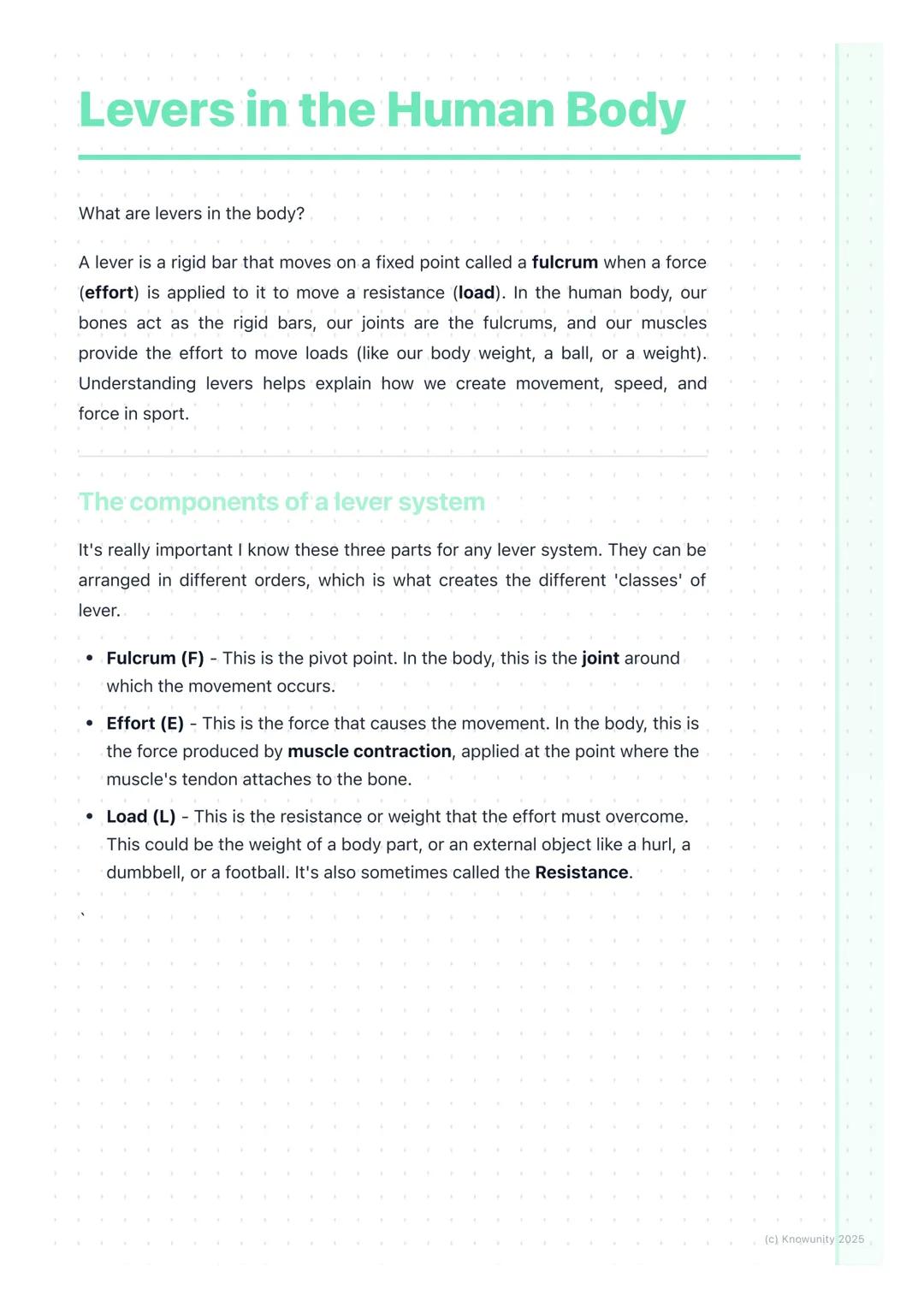
Levers in the Human Body
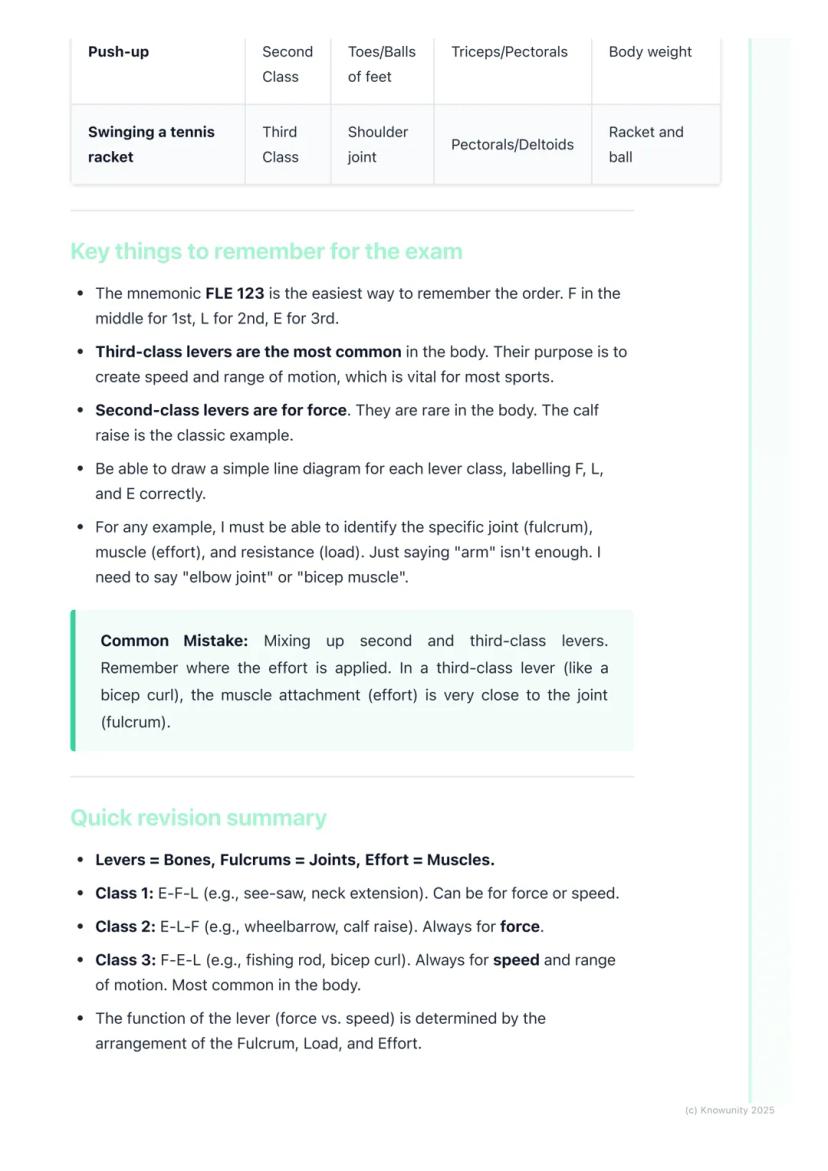
Your body is basically a collection of lever systems working together to create movement. A lever is simply a rigid bar (your bones) that moves around a fixed point (your joints) when force is applied (your muscles contracting).
Think of it this way: every time you move, you're using these three essential components. The fulcrum is your joint - the pivot point where movement happens. The effort is the force your muscles produce when they contract and pull on bones. The load (or resistance) is whatever you're trying to move - whether that's your own body weight, a hurley, or a dumbbell.
Understanding these lever systems isn't just theory - it's the key to explaining how athletes generate explosive power and lightning-fast movements in sport. Once you grasp these basics, you'll see lever systems everywhere in human movement.
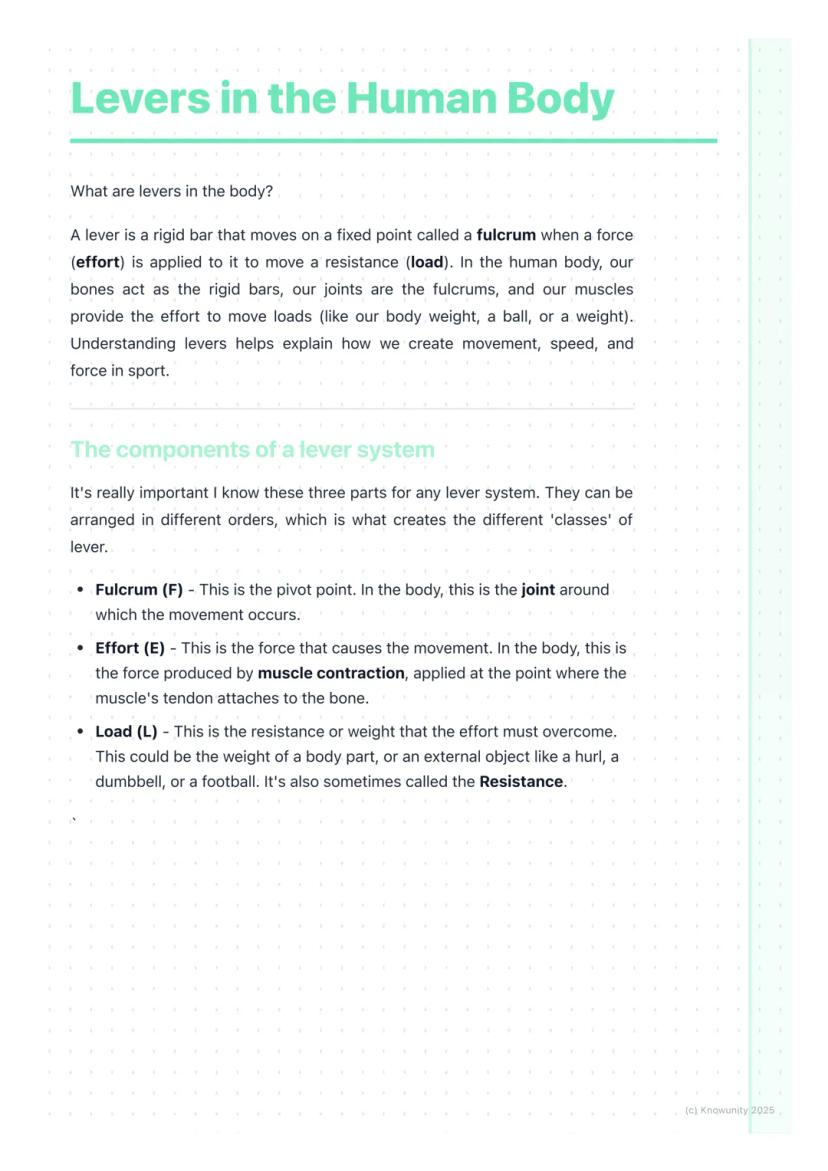
Key Insight: The way these three components are arranged determines what type of lever you have and whether it's best for generating force or speed.
2
of 6
The Three Classes of Lever
Here's where it gets interesting - there are three different ways to arrange fulcrum, load, and effort, creating three distinct classes of lever. Each class has its own superpower in terms of movement.
The easiest way to remember them? Use the mnemonic FLE 123. First-class has the Fulcrum in the middle, second-class has the Load in the middle, and third-class has the Effort in the middle.
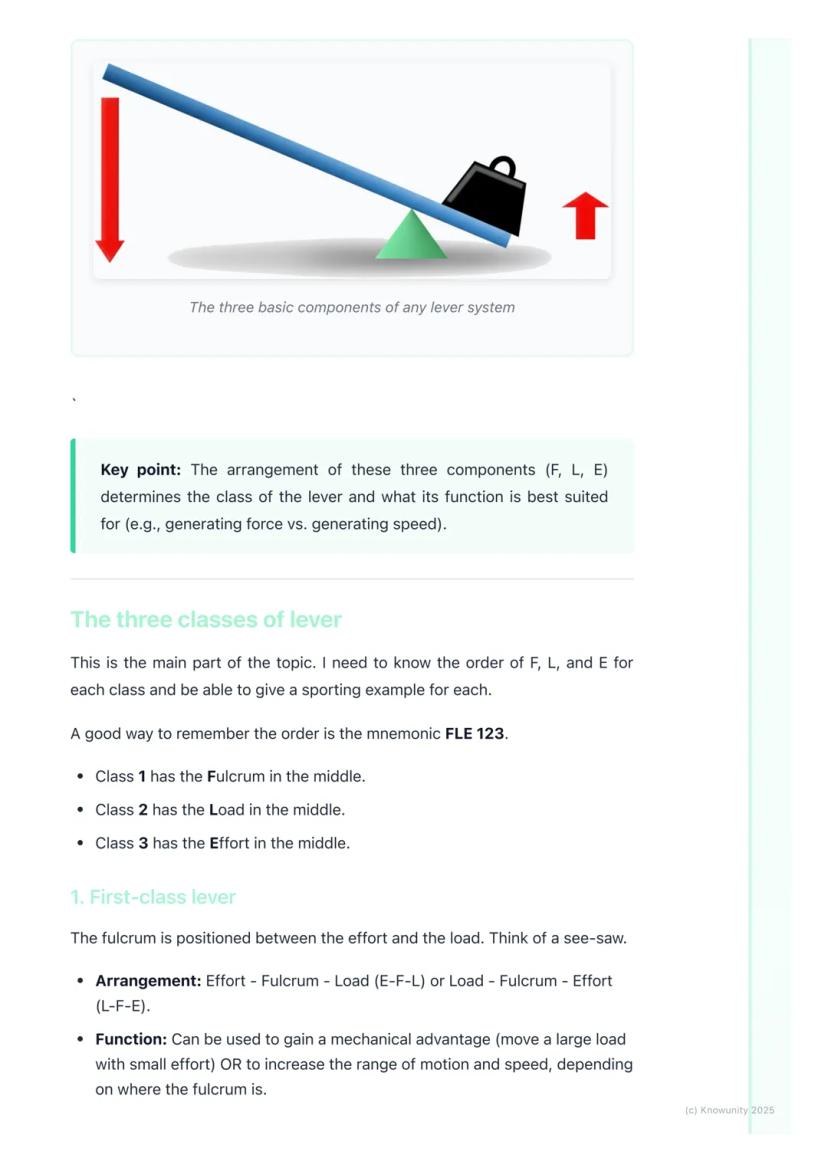
First-class levers work like a see-saw, with the fulcrum sitting between effort and load . These versatile levers can either give you a mechanical advantage to move heavy loads or help you achieve greater speed and range of motion - it all depends on where that fulcrum sits.
A perfect sporting example? Heading a football. Your neck joint acts as the fulcrum, your neck muscles provide the effort, and your head (plus the ball) is the load you're moving.
Sport Connection: First-class levers are brilliant because they're adaptable - they can be optimised for either power or speed depending on what the movement requires.
3
of 6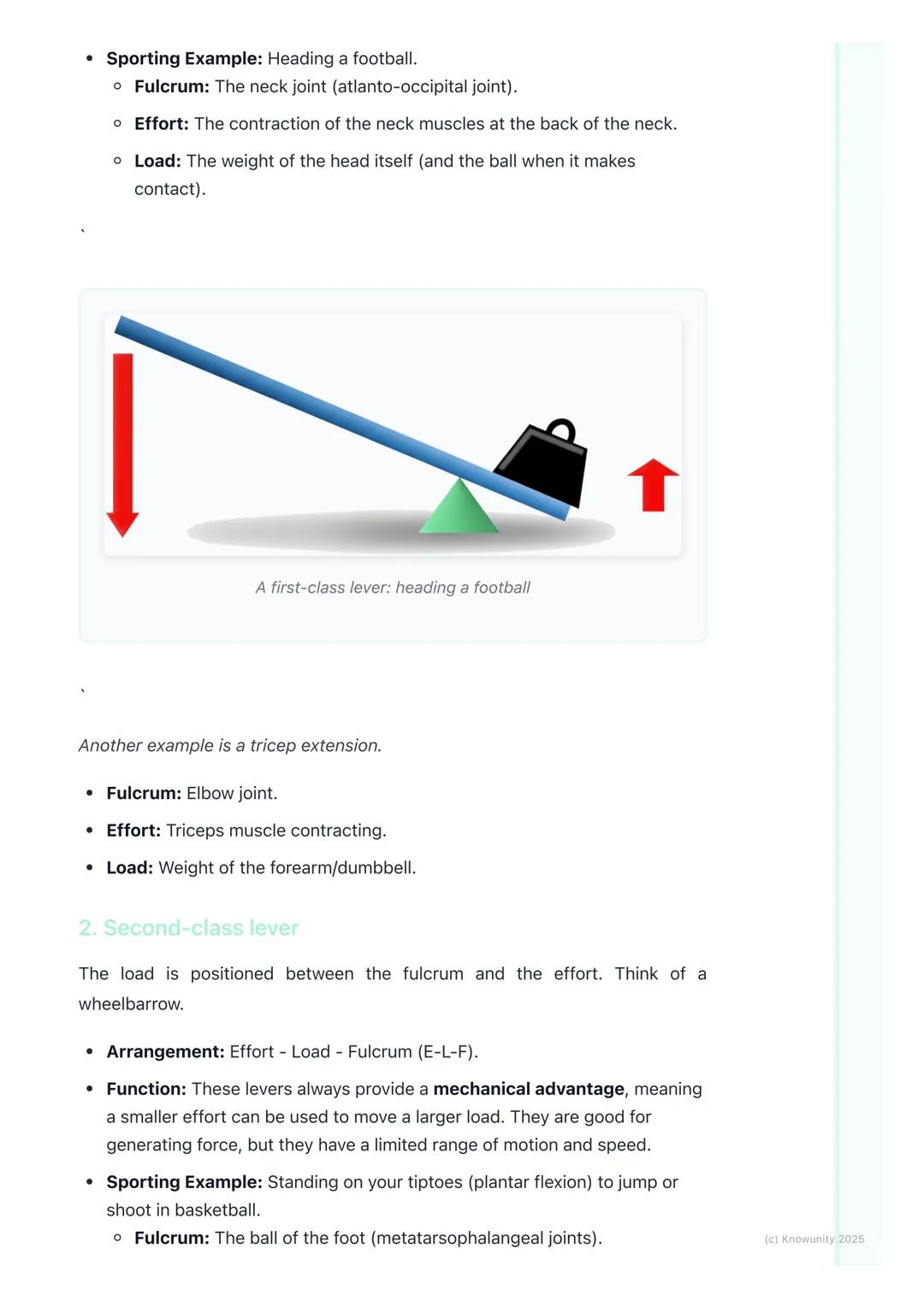
Second-Class Levers: The Powerhouses
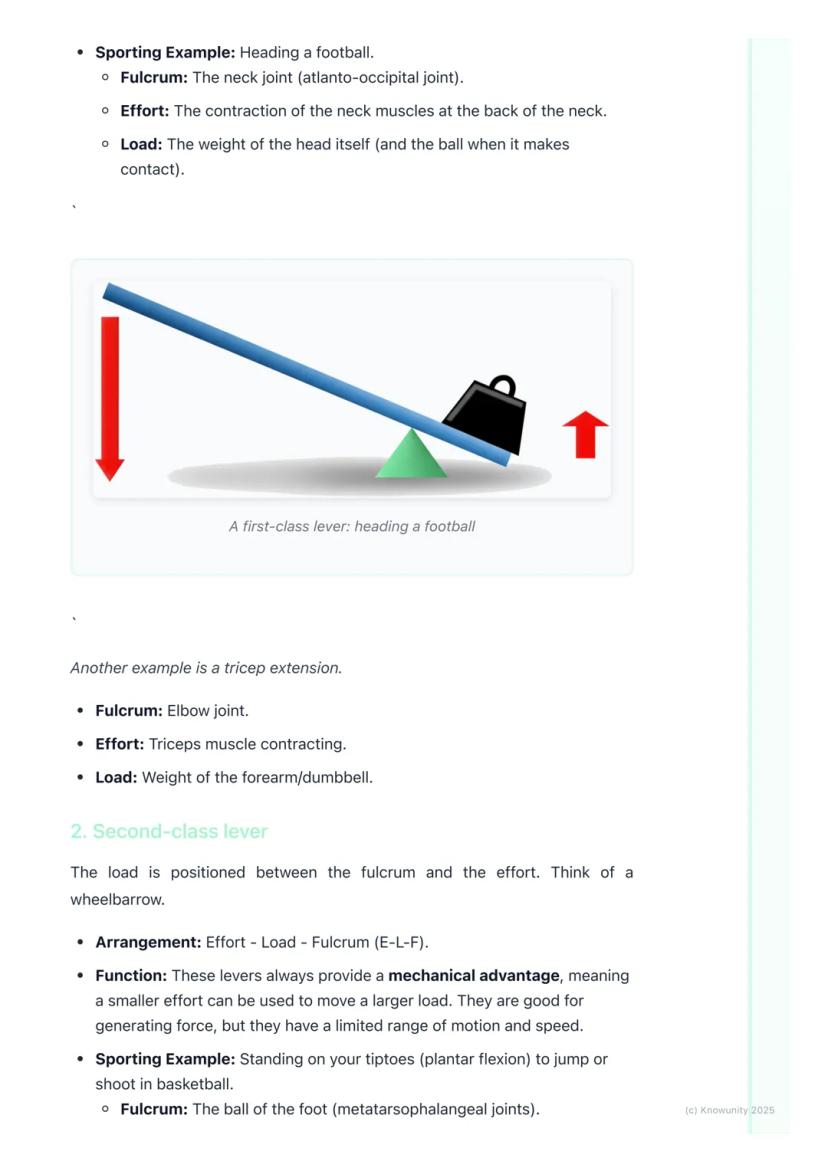
Second-class levers are the powerhouses of the body - think wheelbarrow style with the load sandwiched between effort and fulcrum . These levers always give you a mechanical advantage, meaning you can move heavy loads with relatively small effort.
The trade-off? You sacrifice speed and range of motion for that extra force. That's why second-class levers are quite rare in the human body - most sports need speed more than raw power.
The classic example you need to know is standing on your tiptoes (like when jumping for a basketball shot). Your toes act as the fulcrum, your body weight is the load pressing down through your ankle, and your powerful calf muscles provide the effort by pulling up on your heel.
Remember This: Second-class levers are uncommon in the body because sport usually demands speed over pure force - but when you need that extra power (like in a vertical jump), they're invaluable.
4
of 6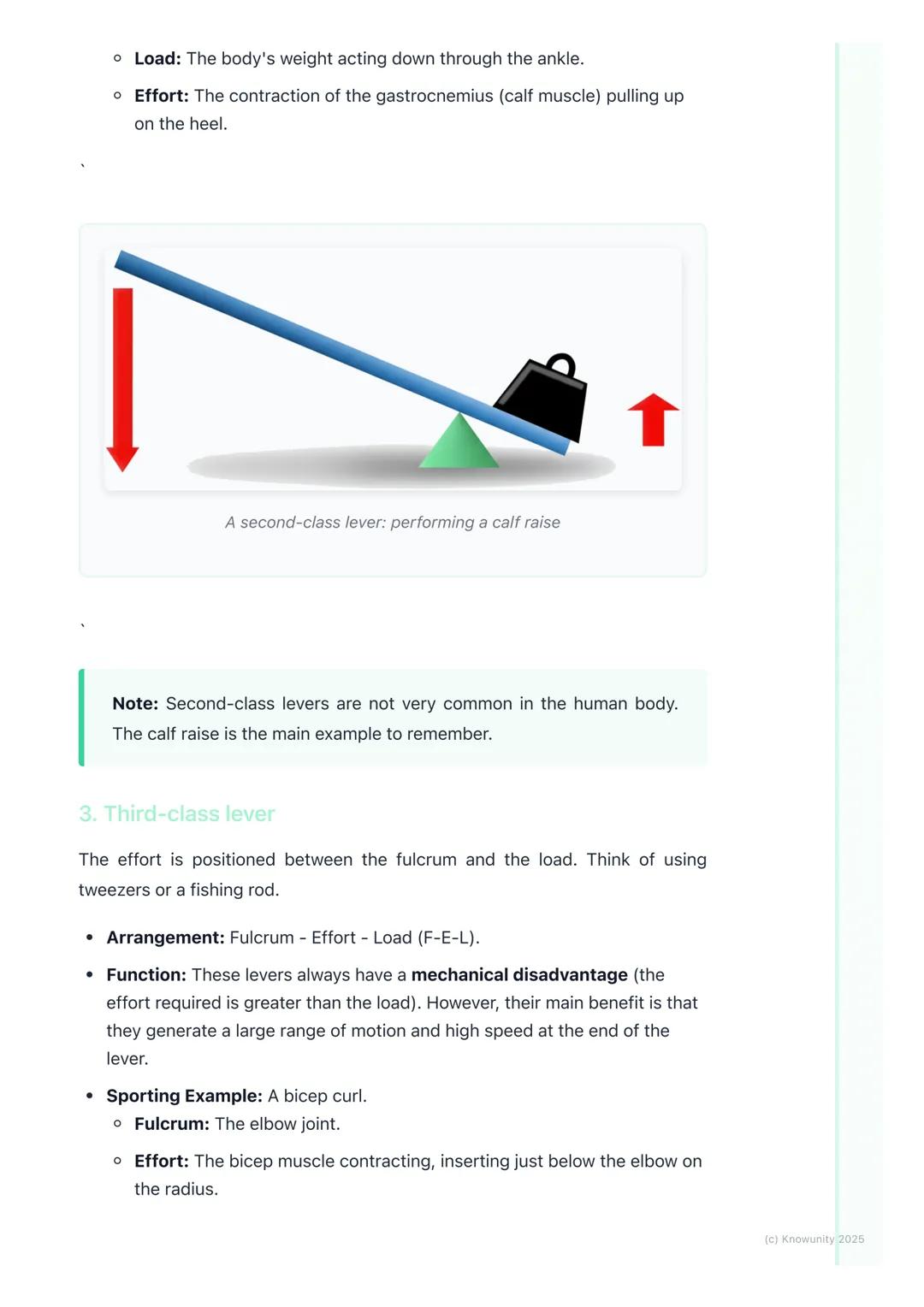
Third-Class Levers: Built for Speed
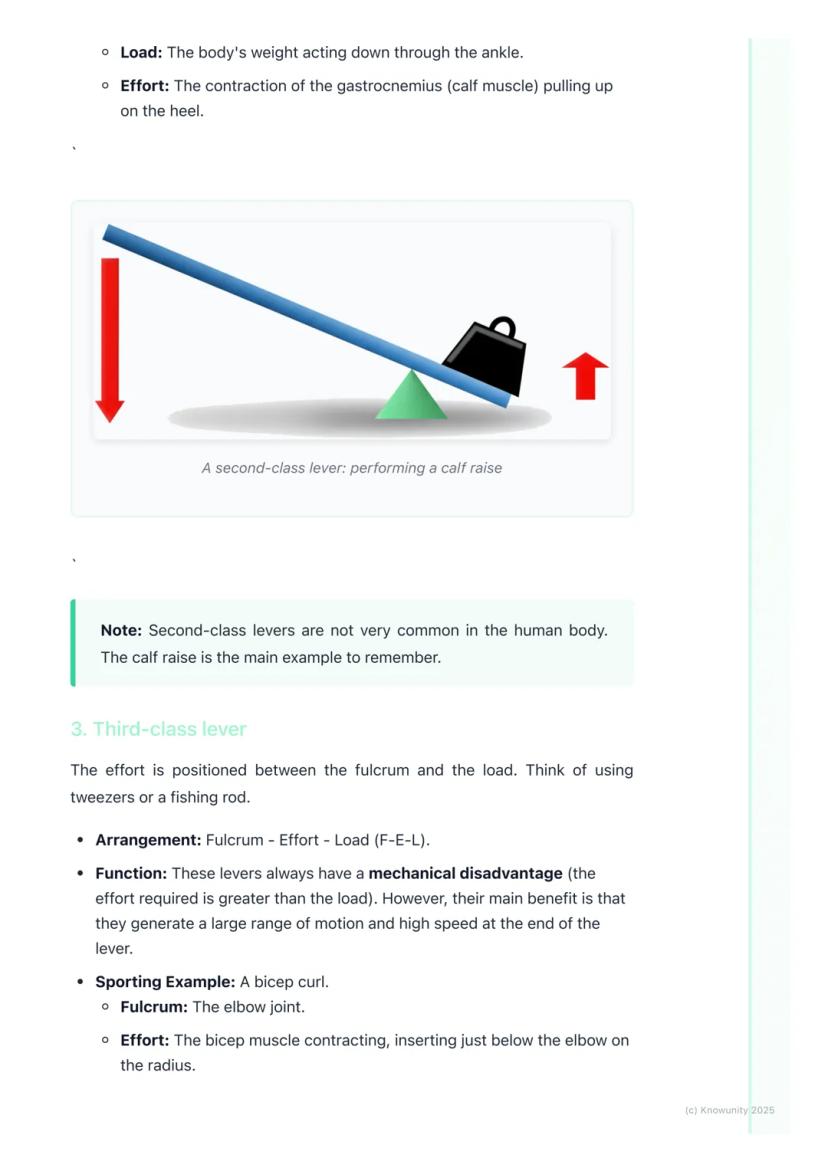
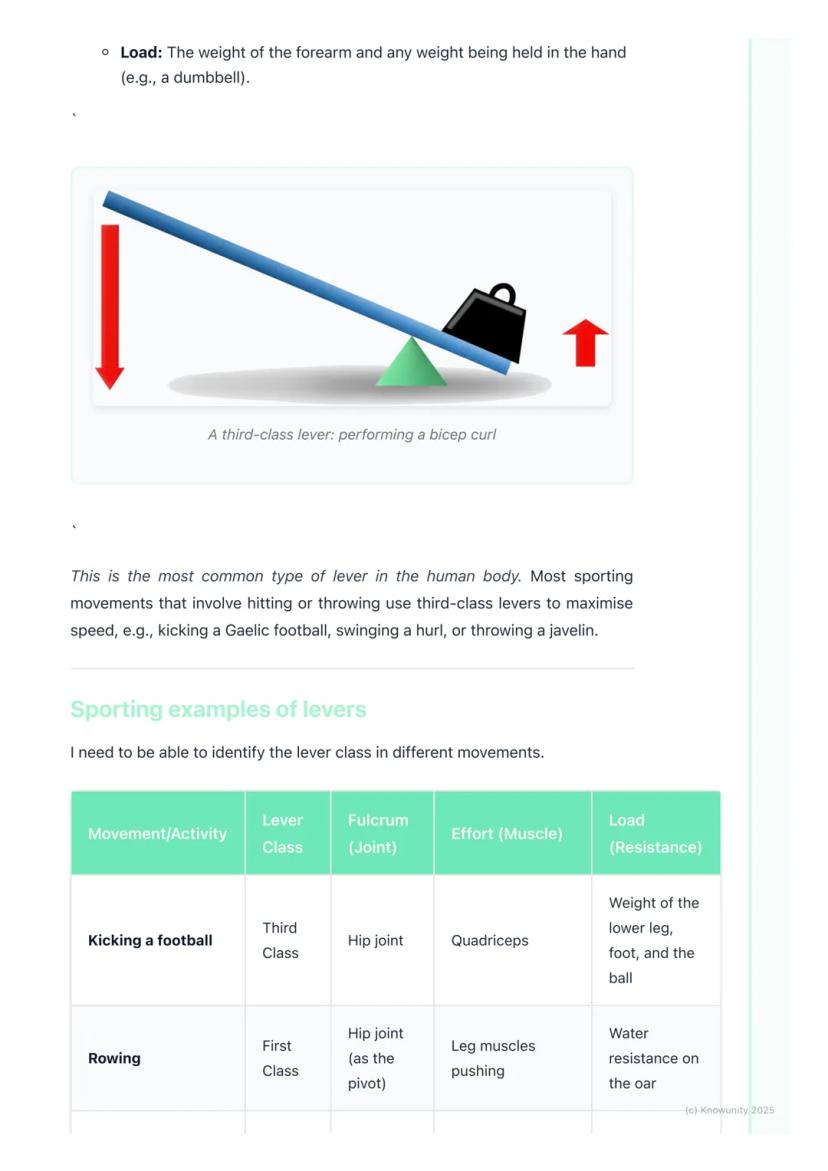
Third-class levers are absolutely everywhere in your body - they're the speed demons of human movement. With the effort positioned between fulcrum and load , they work like tweezers or a fishing rod.
Here's the catch: these levers always work at a mechanical disadvantage, meaning you need more effort than the actual load you're moving. So why does your body love them? Because they create massive speed and range of motion at the end of the lever.
A bicep curl perfectly demonstrates this. Your elbow joint is the fulcrum, your bicep muscle (attaching just below the elbow) provides the effort, and the weight of your forearm plus any dumbbell is the load.
Most explosive sporting movements use third-class levers - kicking a Gaelic football, swinging a hurley, or throwing a javelin. They sacrifice force for that crucial speed that makes the difference between a good shot and a spectacular one.
Game Changer: Third-class levers are why humans can achieve such incredible speeds in sport - your muscles work harder, but the payoff in speed and range of motion is massive.
5
of 6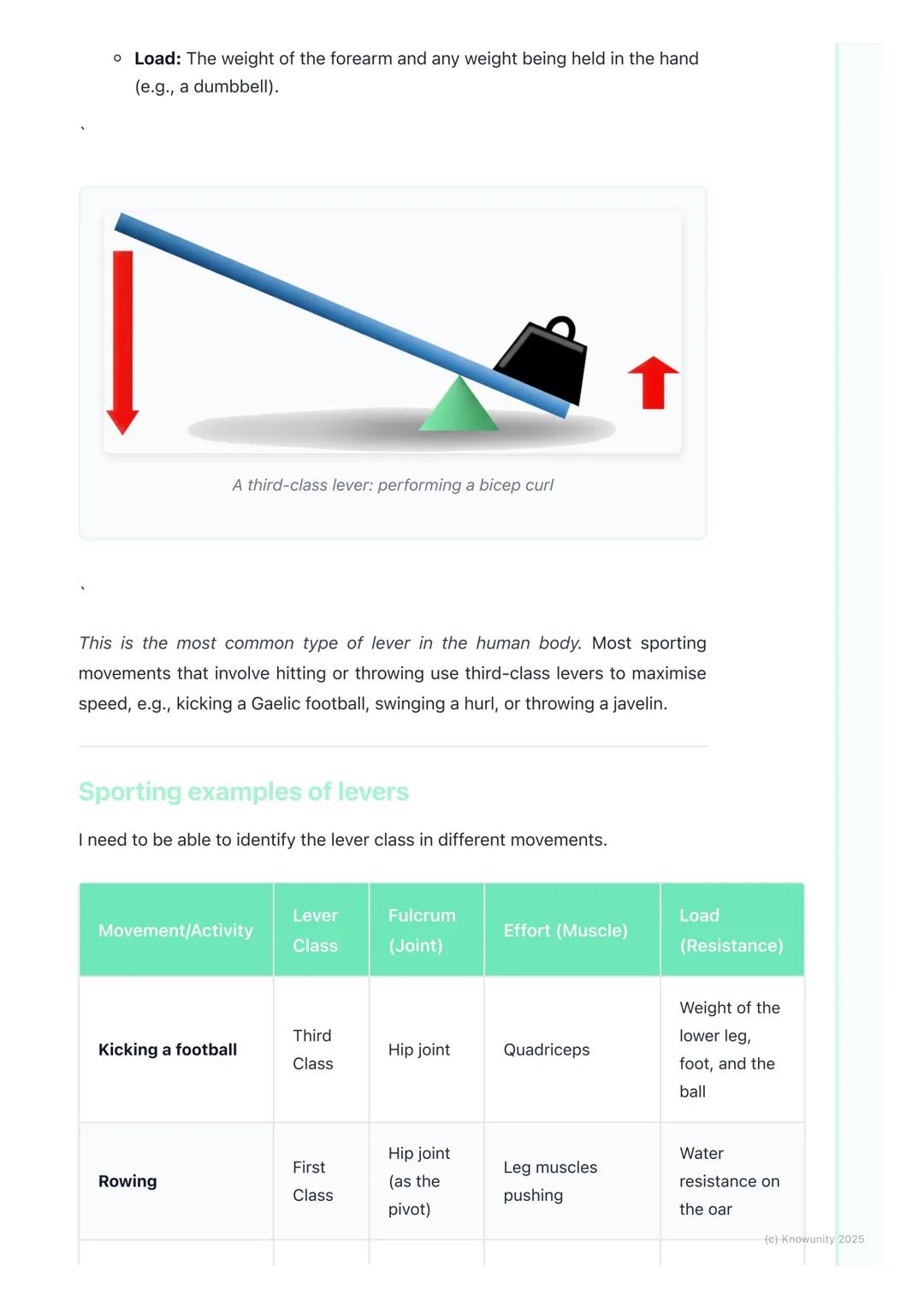
Sporting Examples You Need to Know
Let's put this into practice with movements you'll recognise from sport. Kicking a football uses a third-class lever: your hip joint as fulcrum, quadriceps muscles as effort, and your lower leg plus the ball as the load.
Rowing demonstrates a first-class lever in action. Your hip joint acts as the pivot point, your leg muscles provide the pushing effort, and the water resistance on the oar becomes your load to overcome.
A push-up might surprise you - it's actually a second-class lever! Your toes form the fulcrum, your triceps and pectorals provide the effort, and your body weight is the load being moved. Meanwhile, swinging a tennis racket is classic third-class: shoulder joint as fulcrum, chest and shoulder muscles as effort, racket and ball as load.
Exam Success: Don't just say "arm muscle" or "leg joint" - be specific! Say "bicep muscle" and "elbow joint" to show you really understand the anatomy.
6
of 6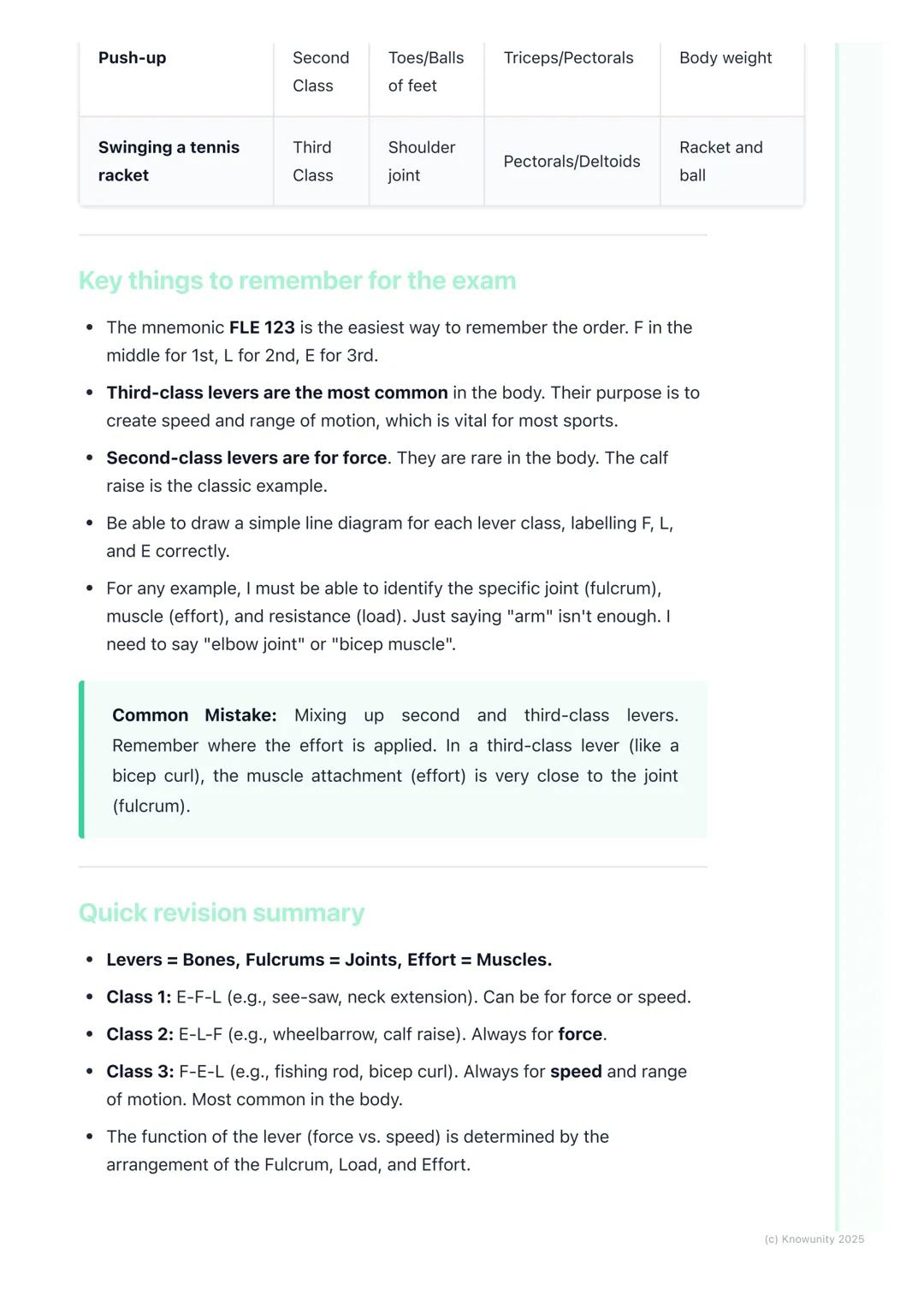
Pensavamo che non l'avreste mai chiesto....
Che cos'è l'assistente AI di Knowunity?
Il nostro assistente AI è costruito specificamente per le esigenze degli studenti. Sulla base dei milioni di contenuti presenti sulla piattaforma, possiamo fornire agli studenti risposte davvero significative e pertinenti. Ma non si tratta solo di risposte, l'assistente è in grado di guidare gli studenti attraverso le loro sfide quotidiane di studio, con piani di studio personalizzati, quiz o contenuti nella chat e una personalizzazione al 100% basata sulle competenze e sugli sviluppi degli studenti.
Dove posso scaricare l'applicazione Knowunity?
È possibile scaricare l'applicazione dal Google Play Store e dall'Apple App Store.
Knowunity è davvero gratuita?
Sì, hai accesso completamente gratuito a tutti i contenuti nell'app e puoi chattare o seguire i Creatori in qualsiasi momento. Sbloccherai nuove funzioni crescendo il tuo numero di follower. Inoltre, offriamo Knowunity Premium, che consente di studiare senza alcun limite!!
Contenuti più popolari di LCPE
4LCPEHealthy Eating Guidelines
This section explores national healthy eating guidelines, such as the food pyramid or healthy eating plate, to promote balanced dietary choices.
5th Year50
LCPEBiomechanics of Movement
Applying fundamental biomechanical principles such as force, motion, levers, and stability to analyse and improve human movement efficiency and performance in sport.
6th Year200
LCPEFactors effecting sports psychology ( confidence and self efficacy)
Higher Level LCPE psychological preprration notes
5th Year230
LCPETechnology in Sport
Investigating how technology is used in areas such as performance analysis, equipment design, officiating, and athlete monitoring to enhance training and competition.
6th Year50
Contenuti più popolari
9 Irish
IrishIrish oral questions and answers
Questions and answers for the leaving cert oral
5th Year4264
 English
Key Quotes : Sive
Key Quotes and explanations: Sive
6th Year2842
IrishIrish oral questions
Outline of oral questions
5th Year2055
IrishIníon- le hÁine Durkin
Aine Durkin’s poem, Iníon: Themes & summary
5th Year850
IrishIrish poetry 2027
Iníon + Dínit an Bhróin
5th Year1133
IrishLC HL notes- Iníon (poem)
Includes poem in English and Irish, theme, key words & phrases
5th Year2284
EnglishCultural Context : Shawshank Redemption : Sive : Small Things Like These
Comparative Study : Cultural Context : Shawshank Redemption, Sive and Small Things Like These
6th Year1430
IrishMo Ghrá-sa (Idir Lúibíní)
Notes on mo ghrá-sa
5th Year380
IrishAn Gaeilge Aiste
Irish Language essay
6th Year1320
Non c'è niente di adatto? Esplorare altre aree tematiche.
Recensioni dei nostri utenti. Ci adorano - e anche tu, vedrai .
4.6/5App Store
4.7/5Google Play
L'applicazione è molto facile da usare e ben progettata. Finora ho trovato tutto quello che cercavo e ho potuto imparare molto dalle presentazioni! Utilizzerò sicuramente l'app per i compiti in classe! È molto utile anche come fonte di ispirazione.
Stefano Sutente iOS
Questa applicazione è davvero grande! Ci sono tantissimi appunti e aiuti con lo studio [...]. La mia materia problematica, per esempio, è il francese e l'app ha così tante opzioni per aiutarmi. Grazie a questa app ho migliorato il mio francese. La consiglio a tutti.
Samantha Klichutente Android
Wow, sono davvero stupita. Ho appena provato l'app perché l'ho vista pubblicizzata molte volte e sono rimasta assolutamente sbalordita. Questa app è L'AIUTO che cercate per la scuola e soprattutto offre tantissime cose, come allenamenti e schede, che a me personalmente sono state MOLTO utili.
Annautente iOS
LCPE2 visualizzazioni·Aggiornato Jun 12, 2026·6 pagineUnderstanding Levers in the Human Body
Ever wondered how your body creates the power to kick a football or lift weights? The secret lies in understanding how your bones, joints, and muscles work together as lever systems to generate movement, speed, and force in sport.
1
of 6
Iscriviti per mostrare il contenuto. È gratis!
- Accesso a tutti i documenti
- Migliora i tuoi voti
- Unisciti a milioni di studenti
Levers in the Human Body
Your body is basically a collection of lever systems working together to create movement. A lever is simply a rigid bar (your bones) that moves around a fixed point (your joints) when force is applied (your muscles contracting).
Think of it this way: every time you move, you're using these three essential components. The fulcrum is your joint - the pivot point where movement happens. The effort is the force your muscles produce when they contract and pull on bones. The load (or resistance) is whatever you're trying to move - whether that's your own body weight, a hurley, or a dumbbell.
Understanding these lever systems isn't just theory - it's the key to explaining how athletes generate explosive power and lightning-fast movements in sport. Once you grasp these basics, you'll see lever systems everywhere in human movement.
Key Insight: The way these three components are arranged determines what type of lever you have and whether it's best for generating force or speed.
2
of 6Iscriviti per mostrare il contenuto. È gratis!
- Accesso a tutti i documenti
- Migliora i tuoi voti
- Unisciti a milioni di studenti
The Three Classes of Lever
Here's where it gets interesting - there are three different ways to arrange fulcrum, load, and effort, creating three distinct classes of lever. Each class has its own superpower in terms of movement.
The easiest way to remember them? Use the mnemonic FLE 123. First-class has the Fulcrum in the middle, second-class has the Load in the middle, and third-class has the Effort in the middle.
First-class levers work like a see-saw, with the fulcrum sitting between effort and load . These versatile levers can either give you a mechanical advantage to move heavy loads or help you achieve greater speed and range of motion - it all depends on where that fulcrum sits.
A perfect sporting example? Heading a football. Your neck joint acts as the fulcrum, your neck muscles provide the effort, and your head (plus the ball) is the load you're moving.
Sport Connection: First-class levers are brilliant because they're adaptable - they can be optimised for either power or speed depending on what the movement requires.
3
of 6Iscriviti per mostrare il contenuto. È gratis!
- Accesso a tutti i documenti
- Migliora i tuoi voti
- Unisciti a milioni di studenti
Second-Class Levers: The Powerhouses
Second-class levers are the powerhouses of the body - think wheelbarrow style with the load sandwiched between effort and fulcrum . These levers always give you a mechanical advantage, meaning you can move heavy loads with relatively small effort.
The trade-off? You sacrifice speed and range of motion for that extra force. That's why second-class levers are quite rare in the human body - most sports need speed more than raw power.
The classic example you need to know is standing on your tiptoes (like when jumping for a basketball shot). Your toes act as the fulcrum, your body weight is the load pressing down through your ankle, and your powerful calf muscles provide the effort by pulling up on your heel.
Remember This: Second-class levers are uncommon in the body because sport usually demands speed over pure force - but when you need that extra power (like in a vertical jump), they're invaluable.
4
of 6Iscriviti per mostrare il contenuto. È gratis!
- Accesso a tutti i documenti
- Migliora i tuoi voti
- Unisciti a milioni di studenti
Third-Class Levers: Built for Speed
Third-class levers are absolutely everywhere in your body - they're the speed demons of human movement. With the effort positioned between fulcrum and load , they work like tweezers or a fishing rod.
Here's the catch: these levers always work at a mechanical disadvantage, meaning you need more effort than the actual load you're moving. So why does your body love them? Because they create massive speed and range of motion at the end of the lever.
A bicep curl perfectly demonstrates this. Your elbow joint is the fulcrum, your bicep muscle (attaching just below the elbow) provides the effort, and the weight of your forearm plus any dumbbell is the load.
Most explosive sporting movements use third-class levers - kicking a Gaelic football, swinging a hurley, or throwing a javelin. They sacrifice force for that crucial speed that makes the difference between a good shot and a spectacular one.
Game Changer: Third-class levers are why humans can achieve such incredible speeds in sport - your muscles work harder, but the payoff in speed and range of motion is massive.
5
of 6Iscriviti per mostrare il contenuto. È gratis!
- Accesso a tutti i documenti
- Migliora i tuoi voti
- Unisciti a milioni di studenti
Sporting Examples You Need to Know
Let's put this into practice with movements you'll recognise from sport. Kicking a football uses a third-class lever: your hip joint as fulcrum, quadriceps muscles as effort, and your lower leg plus the ball as the load.
Rowing demonstrates a first-class lever in action. Your hip joint acts as the pivot point, your leg muscles provide the pushing effort, and the water resistance on the oar becomes your load to overcome.
A push-up might surprise you - it's actually a second-class lever! Your toes form the fulcrum, your triceps and pectorals provide the effort, and your body weight is the load being moved. Meanwhile, swinging a tennis racket is classic third-class: shoulder joint as fulcrum, chest and shoulder muscles as effort, racket and ball as load.
Exam Success: Don't just say "arm muscle" or "leg joint" - be specific! Say "bicep muscle" and "elbow joint" to show you really understand the anatomy.
6
of 6Iscriviti per mostrare il contenuto. È gratis!
- Accesso a tutti i documenti
- Migliora i tuoi voti
- Unisciti a milioni di studenti
Pensavamo che non l'avreste mai chiesto....
Che cos'è l'assistente AI di Knowunity?
Il nostro assistente AI è costruito specificamente per le esigenze degli studenti. Sulla base dei milioni di contenuti presenti sulla piattaforma, possiamo fornire agli studenti risposte davvero significative e pertinenti. Ma non si tratta solo di risposte, l'assistente è in grado di guidare gli studenti attraverso le loro sfide quotidiane di studio, con piani di studio personalizzati, quiz o contenuti nella chat e una personalizzazione al 100% basata sulle competenze e sugli sviluppi degli studenti.
Dove posso scaricare l'applicazione Knowunity?
È possibile scaricare l'applicazione dal Google Play Store e dall'Apple App Store.
Knowunity è davvero gratuita?
Sì, hai accesso completamente gratuito a tutti i contenuti nell'app e puoi chattare o seguire i Creatori in qualsiasi momento. Sbloccherai nuove funzioni crescendo il tuo numero di follower. Inoltre, offriamo Knowunity Premium, che consente di studiare senza alcun limite!!
Contenuti più popolari di LCPE
4LCPEHealthy Eating Guidelines
This section explores national healthy eating guidelines, such as the food pyramid or healthy eating plate, to promote balanced dietary choices.
5th Year50
LCPEBiomechanics of Movement
Applying fundamental biomechanical principles such as force, motion, levers, and stability to analyse and improve human movement efficiency and performance in sport.
6th Year200
LCPEFactors effecting sports psychology ( confidence and self efficacy)
Higher Level LCPE psychological preprration notes
5th Year230
LCPETechnology in Sport
Investigating how technology is used in areas such as performance analysis, equipment design, officiating, and athlete monitoring to enhance training and competition.
6th Year50
Contenuti più popolari
9IrishIrish oral questions and answers
Questions and answers for the leaving cert oral
5th Year4264
EnglishKey Quotes : Sive
Key Quotes and explanations: Sive
6th Year2842
IrishIrish oral questions
Outline of oral questions
5th Year2055
IrishIníon- le hÁine Durkin
Aine Durkin’s poem, Iníon: Themes & summary
5th Year850
IrishIrish poetry 2027
Iníon + Dínit an Bhróin
5th Year1133
IrishLC HL notes- Iníon (poem)
Includes poem in English and Irish, theme, key words & phrases
5th Year2284
EnglishCultural Context : Shawshank Redemption : Sive : Small Things Like These
Comparative Study : Cultural Context : Shawshank Redemption, Sive and Small Things Like These
6th Year1430
IrishMo Ghrá-sa (Idir Lúibíní)
Notes on mo ghrá-sa
5th Year380
IrishAn Gaeilge Aiste
Irish Language essay
6th Year1320
Non c'è niente di adatto? Esplorare altre aree tematiche.
Recensioni dei nostri utenti. Ci adorano - e anche tu, vedrai .
4.6/5App Store
4.7/5Google Play
L'applicazione è molto facile da usare e ben progettata. Finora ho trovato tutto quello che cercavo e ho potuto imparare molto dalle presentazioni! Utilizzerò sicuramente l'app per i compiti in classe! È molto utile anche come fonte di ispirazione.
Stefano Sutente iOS
Questa applicazione è davvero grande! Ci sono tantissimi appunti e aiuti con lo studio [...]. La mia materia problematica, per esempio, è il francese e l'app ha così tante opzioni per aiutarmi. Grazie a questa app ho migliorato il mio francese. La consiglio a tutti.
Samantha Klichutente Android
Wow, sono davvero stupita. Ho appena provato l'app perché l'ho vista pubblicizzata molte volte e sono rimasta assolutamente sbalordita. Questa app è L'AIUTO che cercate per la scuola e soprattutto offre tantissime cose, come allenamenti e schede, che a me personalmente sono state MOLTO utili.
Annautente iOS