
Ever wondered how you actually get better at sports? It's...
 LCPE2 visualizzazioni·Aggiornato Jun 12, 2026·5 pagine
The Power of Feedback in Learning New Skills
1 / 5
1
of 5
Understanding Feedback in Sports
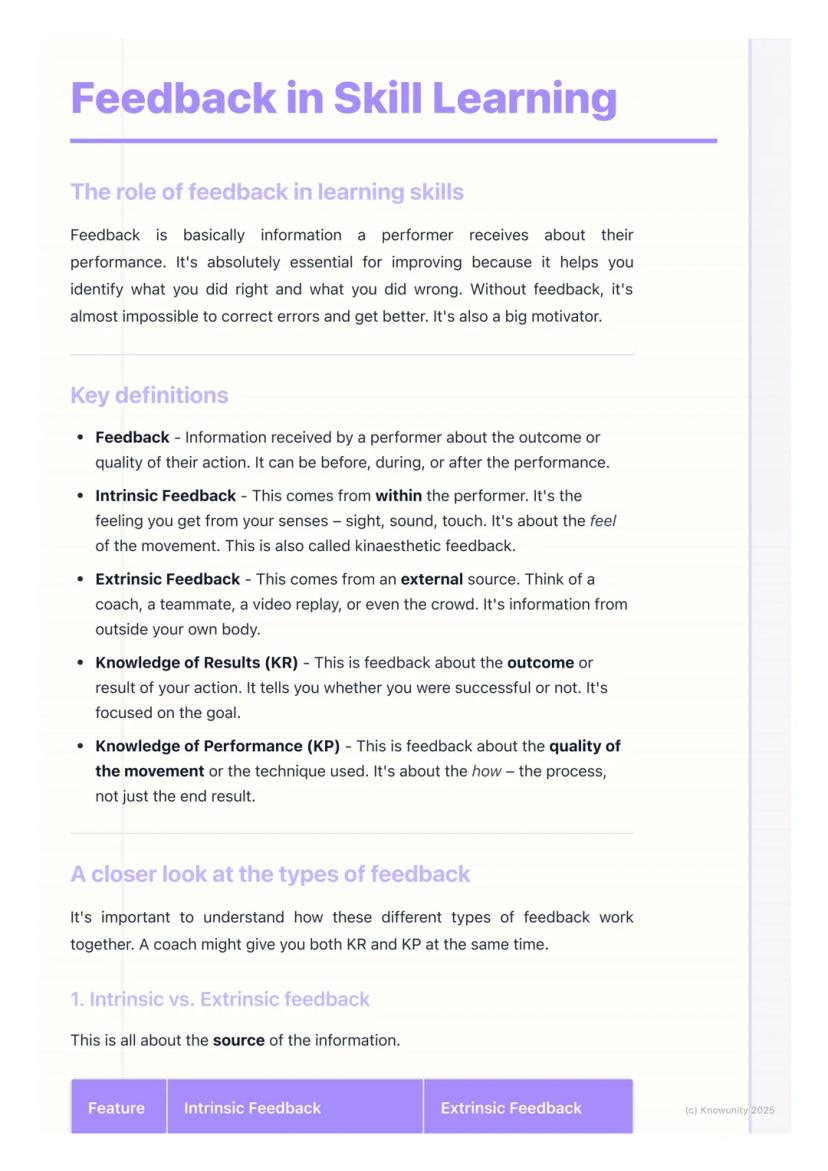
Think about the last time you improved at something - chances are, someone told you what you were doing right or wrong. Feedback is simply information you receive about your performance, and it's absolutely crucial for getting better at any skill.
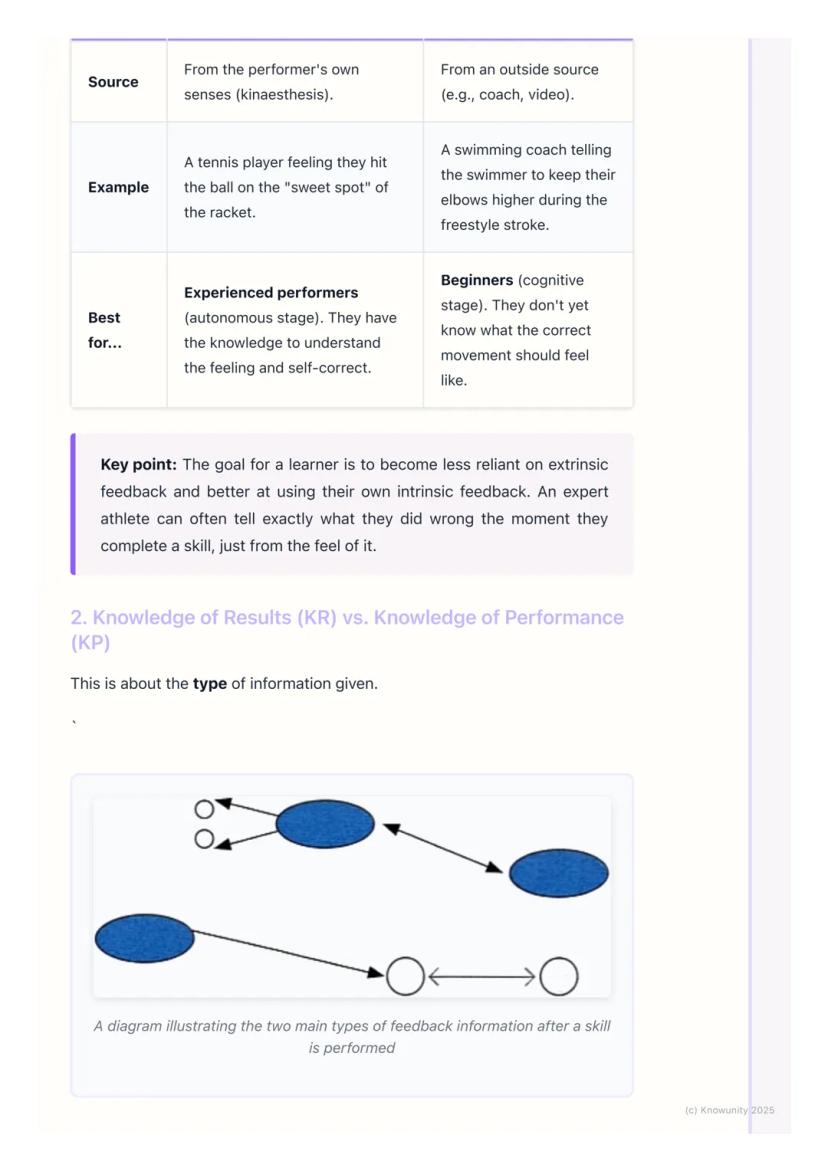
There are two main sources where this information comes from. Intrinsic feedback comes from within yourself - it's that feeling when you know you've hit the sweet spot of a tennis racket or when a football feels perfectly balanced on your boot. This is also called kinaesthetic feedback because it comes through your senses.
Extrinsic feedback comes from outside sources like coaches, teammates, video replays, or even the crowd. A GAA coach shouting "keep your head up" or watching yourself on video are perfect examples of extrinsic feedback.
Remember: The goal is to eventually rely more on your own internal feelings (intrinsic) and less on others telling you what to do (extrinsic).
2
of 5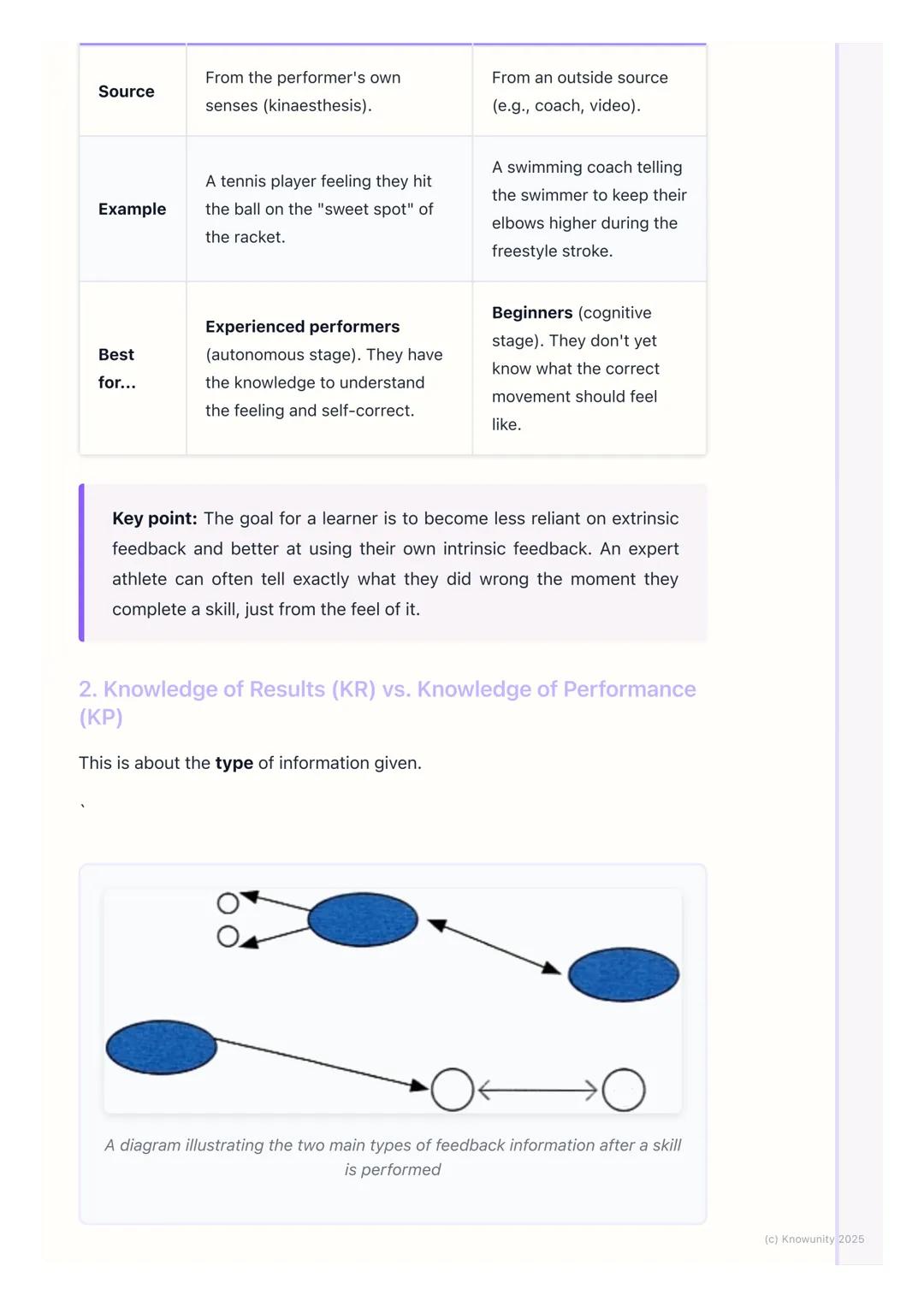
Types of Feedback Information
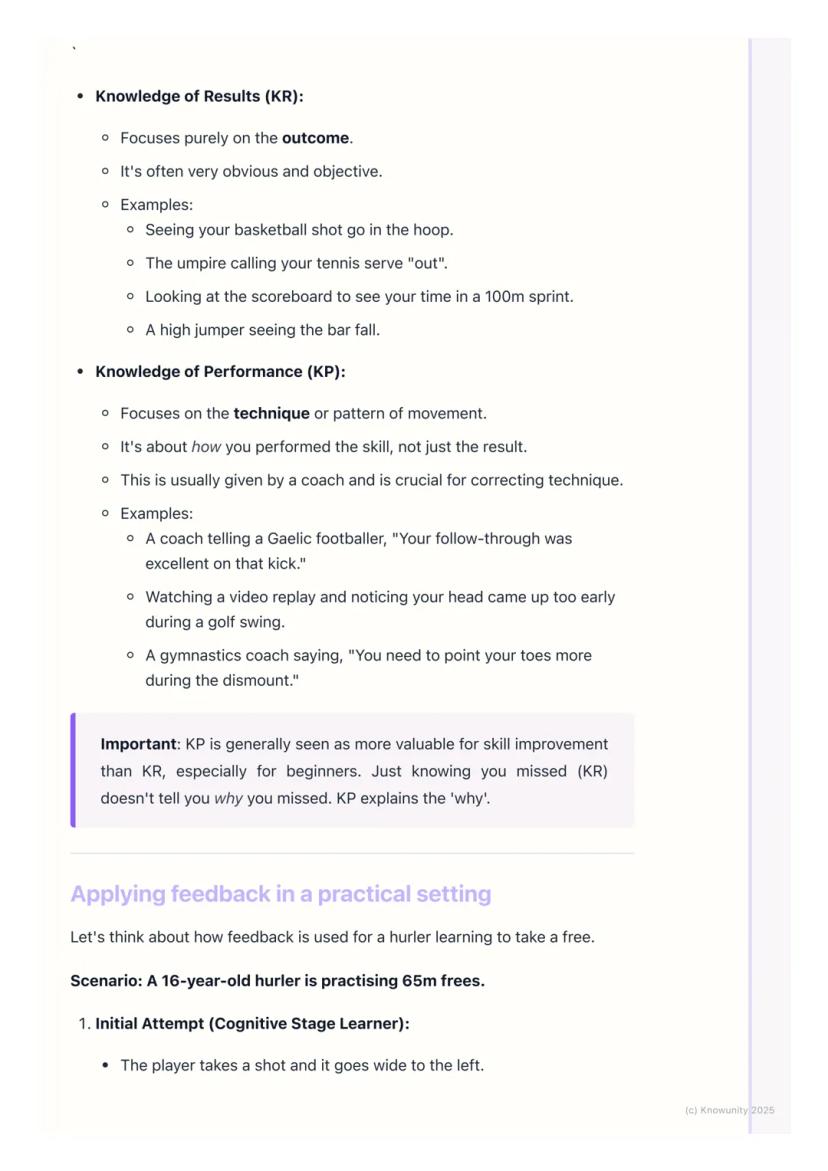
Not all feedback tells you the same thing. Knowledge of Results (KR) is about the outcome - did you score, miss, win, or lose? It's usually pretty obvious: seeing your basketball shot go through the hoop or watching the umpire wave your tennis serve "out."
Knowledge of Performance (KP) is much more valuable for improvement. This focuses on your technique and how you performed the skill, not just the result. When a coach tells a Gaelic footballer "your follow-through was excellent on that kick," that's KP in action.
Here's the thing - just knowing you missed (KR) doesn't help you improve. You need to know why you missed, and that's where KP becomes crucial, especially for beginners who don't yet understand what correct movement should feel like.
Key Point: KP is generally more valuable than KR for skill improvement because it explains the 'why' behind your performance.
3
of 5
Putting Feedback into Practice
Let's imagine you're a hurler learning to take 65m frees. On your first attempt, the ball goes wide left. You can see it missed (KR), and you might feel the strike was "off" (intrinsic feedback). But the most useful information comes when your coach says, "You lifted your head too early - keep your eye on the ball through the entire swing" (extrinsic KP).
As you progress and reach the associative stage of learning, something interesting happens. You start to develop better internal awareness. When you take another shot, you feel a clean connection and smooth follow-through. Your intrinsic feedback tells you "that felt good" even before you see the ball sail over the bar.
The coach's job then becomes reinforcing what you did right: "Great! See how your body was perfectly balanced that time?" This helps you connect the feeling with the successful outcome.
Pro Tip: Timing matters - feedback works best when given immediately after the skill, so you can connect it to what you just did.
4
of 5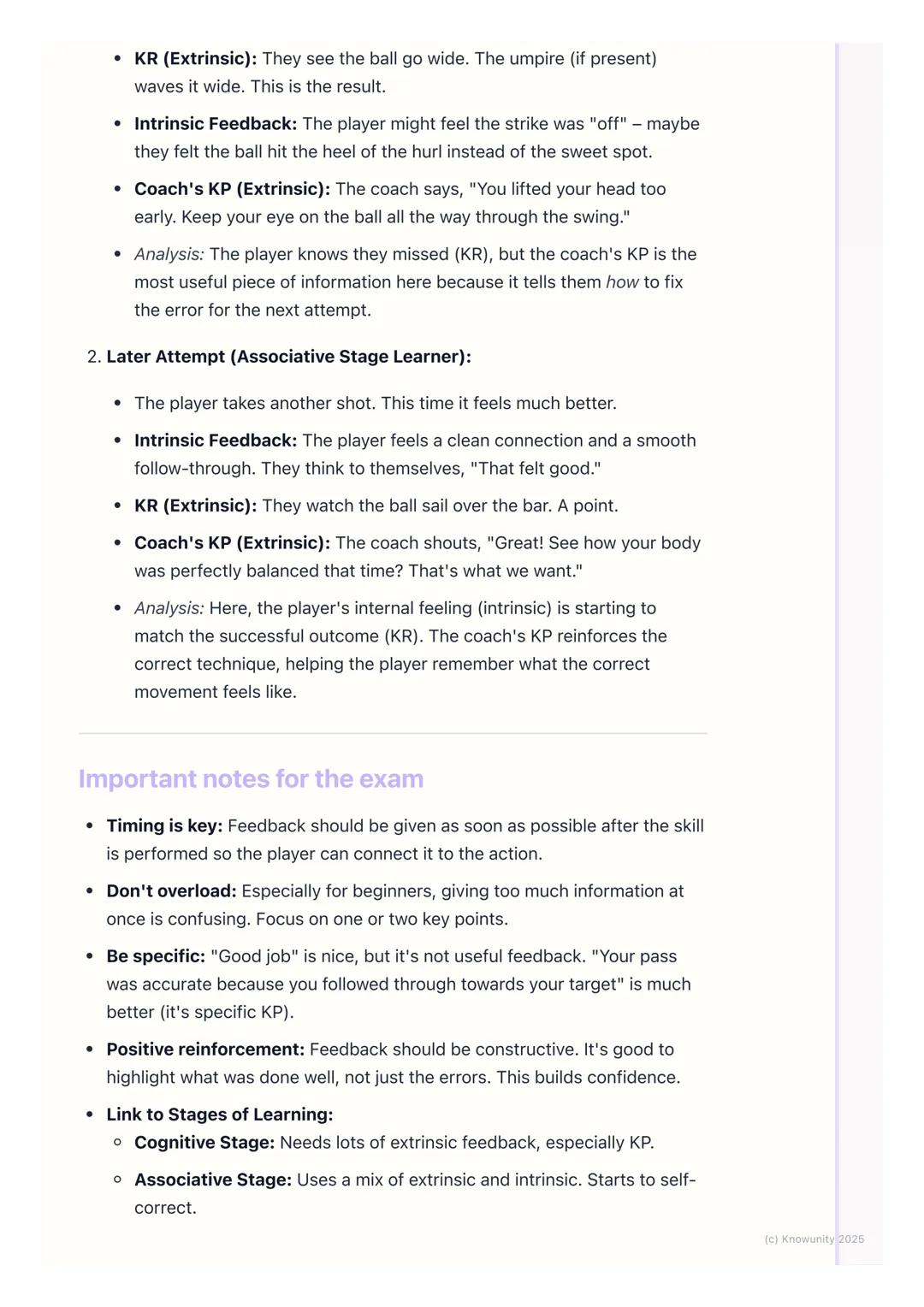
Feedback and Learning Stages
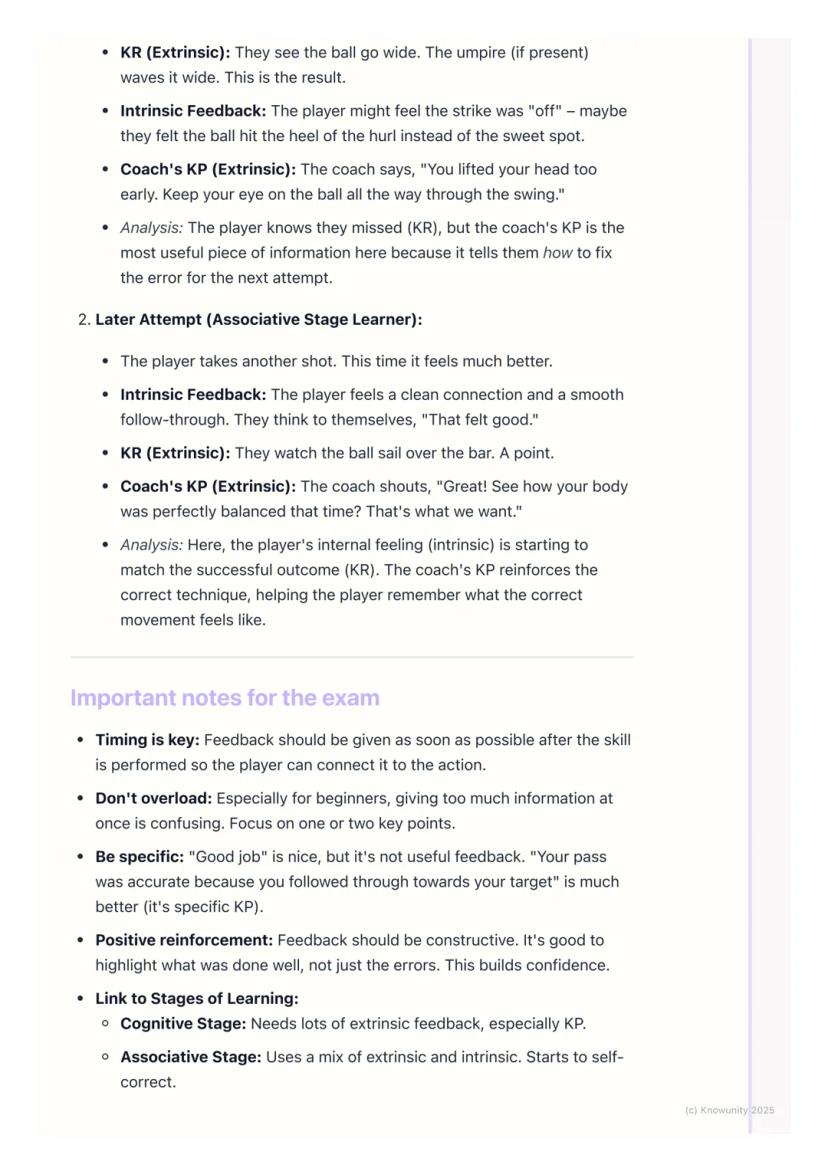
Your feedback needs change dramatically as you improve. In the cognitive stage (complete beginner), you need loads of extrinsic feedback, especially KP. You simply don't know what correct movement feels like yet, so coaches and external guidance are essential.
During the associative stage (getting better), you'll use a mix of both types. You're starting to self-correct based on how things feel, but you still benefit from external guidance for refining your technique.
By the autonomous stage (expert level), you rely mainly on intrinsic feedback for minor adjustments. You can feel exactly what went wrong the moment you complete a skill and adjust accordingly.
Remember: Don't overload beginners with information - focus on one or two key points at a time, and always be specific rather than just saying "good job."
5
of 5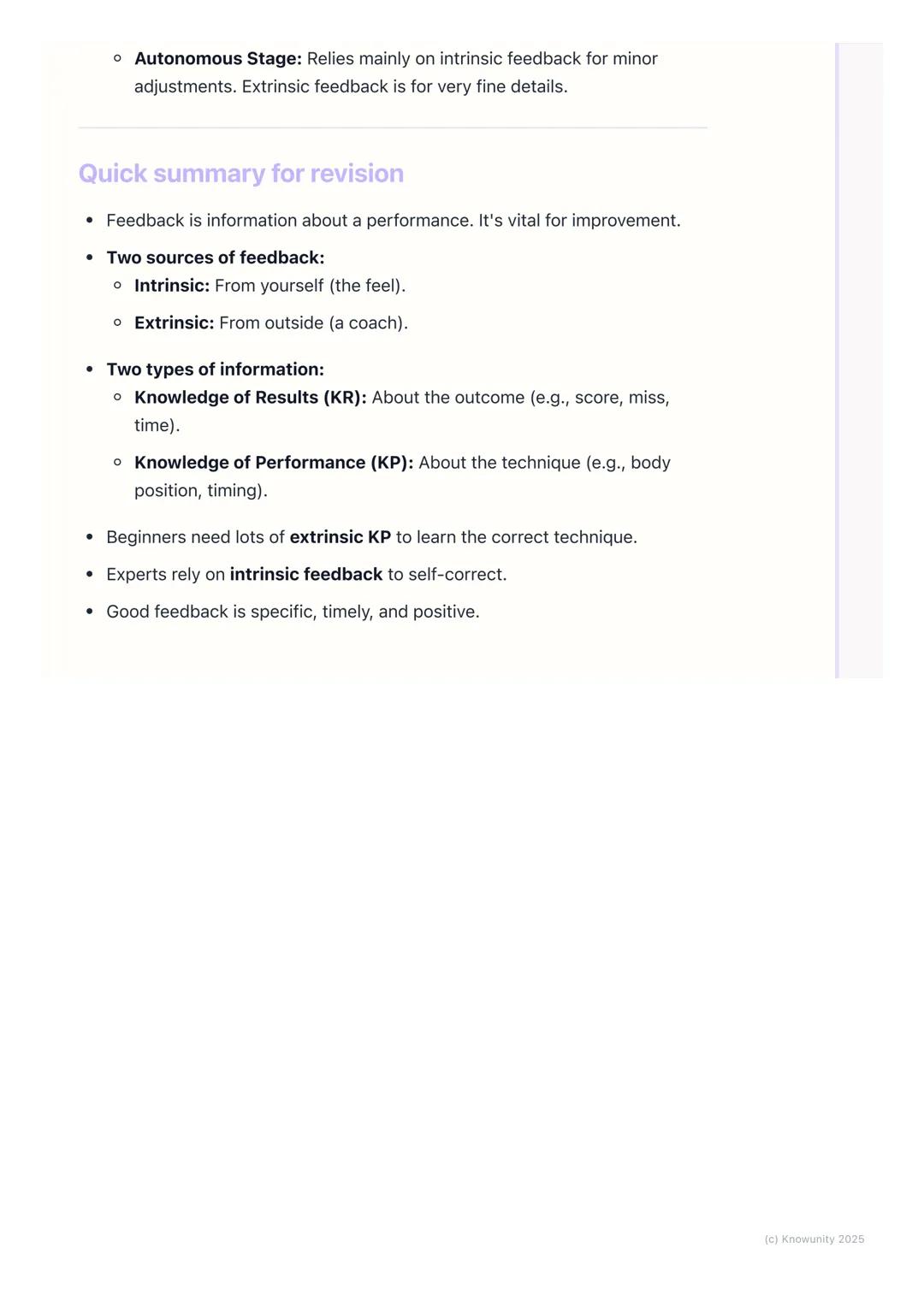
Quick Revision Summary
Here's everything you need to remember about feedback for your exams. Feedback is information about performance that's vital for improvement, and it comes from two sources: intrinsic (from yourself) and extrinsic (from outside sources like coaches).
The information itself falls into two categories: Knowledge of Results (about the outcome) and Knowledge of Performance (about technique). Beginners need lots of extrinsic KP to learn correct technique, while experts rely on intrinsic feedback to self-correct.
The golden rules for effective feedback are simple: make it specific, give it immediately after performance, and keep it positive and constructive. Remember that your feedback needs will change as you progress through the stages of learning.
Exam Tip: Be able to give practical examples of each type of feedback using sports you know well - it shows you really understand the concepts.
Pensavamo che non l'avreste mai chiesto....
Che cos'è l'assistente AI di Knowunity?
Il nostro assistente AI è costruito specificamente per le esigenze degli studenti. Sulla base dei milioni di contenuti presenti sulla piattaforma, possiamo fornire agli studenti risposte davvero significative e pertinenti. Ma non si tratta solo di risposte, l'assistente è in grado di guidare gli studenti attraverso le loro sfide quotidiane di studio, con piani di studio personalizzati, quiz o contenuti nella chat e una personalizzazione al 100% basata sulle competenze e sugli sviluppi degli studenti.
Dove posso scaricare l'applicazione Knowunity?
È possibile scaricare l'applicazione dal Google Play Store e dall'Apple App Store.
Knowunity è davvero gratuita?
Sì, hai accesso completamente gratuito a tutti i contenuti nell'app e puoi chattare o seguire i Creatori in qualsiasi momento. Sbloccherai nuove funzioni crescendo il tuo numero di follower. Inoltre, offriamo Knowunity Premium, che consente di studiare senza alcun limite!!
Contenuti più popolari di LCPE
4LCPEHealthy Eating Guidelines
This section explores national healthy eating guidelines, such as the food pyramid or healthy eating plate, to promote balanced dietary choices.
5th Year50
LCPEBiomechanics of Movement
Applying fundamental biomechanical principles such as force, motion, levers, and stability to analyse and improve human movement efficiency and performance in sport.
6th Year200
LCPEFactors effecting sports psychology ( confidence and self efficacy)
Higher Level LCPE psychological preprration notes
5th Year230
LCPETechnology in Sport
Investigating how technology is used in areas such as performance analysis, equipment design, officiating, and athlete monitoring to enhance training and competition.
6th Year50
Contenuti più popolari
9 Irish
IrishIrish oral questions and answers
Questions and answers for the leaving cert oral
5th Year4264
 English
Key Quotes : Sive
Key Quotes and explanations: Sive
6th Year2842
IrishIrish oral questions
Outline of oral questions
5th Year2055
IrishIníon- le hÁine Durkin
Aine Durkin’s poem, Iníon: Themes & summary
5th Year850
IrishIrish poetry 2027
Iníon + Dínit an Bhróin
5th Year1133
IrishLC HL notes- Iníon (poem)
Includes poem in English and Irish, theme, key words & phrases
5th Year2284
EnglishCultural Context : Shawshank Redemption : Sive : Small Things Like These
Comparative Study : Cultural Context : Shawshank Redemption, Sive and Small Things Like These
6th Year1430
IrishMo Ghrá-sa (Idir Lúibíní)
Notes on mo ghrá-sa
5th Year380
IrishAn Gaeilge Aiste
Irish Language essay
6th Year1320
Non c'è niente di adatto? Esplorare altre aree tematiche.
Recensioni dei nostri utenti. Ci adorano - e anche tu, vedrai .
4.6/5App Store
4.7/5Google Play
L'applicazione è molto facile da usare e ben progettata. Finora ho trovato tutto quello che cercavo e ho potuto imparare molto dalle presentazioni! Utilizzerò sicuramente l'app per i compiti in classe! È molto utile anche come fonte di ispirazione.
Stefano Sutente iOS
Questa applicazione è davvero grande! Ci sono tantissimi appunti e aiuti con lo studio [...]. La mia materia problematica, per esempio, è il francese e l'app ha così tante opzioni per aiutarmi. Grazie a questa app ho migliorato il mio francese. La consiglio a tutti.
Samantha Klichutente Android
Wow, sono davvero stupita. Ho appena provato l'app perché l'ho vista pubblicizzata molte volte e sono rimasta assolutamente sbalordita. Questa app è L'AIUTO che cercate per la scuola e soprattutto offre tantissime cose, come allenamenti e schede, che a me personalmente sono state MOLTO utili.
Annautente iOS
LCPE2 visualizzazioni·Aggiornato Jun 12, 2026·5 pagineThe Power of Feedback in Learning New Skills
Ever wondered how you actually get better at sports? It's all about feedback - the information you receive about your performance. Whether it's the feeling of a perfect strike or a coach's advice, feedback is what transforms you from a...
1
of 5
Iscriviti per mostrare il contenuto. È gratis!
- Accesso a tutti i documenti
- Migliora i tuoi voti
- Unisciti a milioni di studenti
Understanding Feedback in Sports
Think about the last time you improved at something - chances are, someone told you what you were doing right or wrong. Feedback is simply information you receive about your performance, and it's absolutely crucial for getting better at any skill.
There are two main sources where this information comes from. Intrinsic feedback comes from within yourself - it's that feeling when you know you've hit the sweet spot of a tennis racket or when a football feels perfectly balanced on your boot. This is also called kinaesthetic feedback because it comes through your senses.
Extrinsic feedback comes from outside sources like coaches, teammates, video replays, or even the crowd. A GAA coach shouting "keep your head up" or watching yourself on video are perfect examples of extrinsic feedback.
Remember: The goal is to eventually rely more on your own internal feelings (intrinsic) and less on others telling you what to do (extrinsic).
2
of 5Iscriviti per mostrare il contenuto. È gratis!
- Accesso a tutti i documenti
- Migliora i tuoi voti
- Unisciti a milioni di studenti
Types of Feedback Information
Not all feedback tells you the same thing. Knowledge of Results (KR) is about the outcome - did you score, miss, win, or lose? It's usually pretty obvious: seeing your basketball shot go through the hoop or watching the umpire wave your tennis serve "out."
Knowledge of Performance (KP) is much more valuable for improvement. This focuses on your technique and how you performed the skill, not just the result. When a coach tells a Gaelic footballer "your follow-through was excellent on that kick," that's KP in action.
Here's the thing - just knowing you missed (KR) doesn't help you improve. You need to know why you missed, and that's where KP becomes crucial, especially for beginners who don't yet understand what correct movement should feel like.
Key Point: KP is generally more valuable than KR for skill improvement because it explains the 'why' behind your performance.
3
of 5Iscriviti per mostrare il contenuto. È gratis!
- Accesso a tutti i documenti
- Migliora i tuoi voti
- Unisciti a milioni di studenti
Putting Feedback into Practice
Let's imagine you're a hurler learning to take 65m frees. On your first attempt, the ball goes wide left. You can see it missed (KR), and you might feel the strike was "off" (intrinsic feedback). But the most useful information comes when your coach says, "You lifted your head too early - keep your eye on the ball through the entire swing" (extrinsic KP).
As you progress and reach the associative stage of learning, something interesting happens. You start to develop better internal awareness. When you take another shot, you feel a clean connection and smooth follow-through. Your intrinsic feedback tells you "that felt good" even before you see the ball sail over the bar.
The coach's job then becomes reinforcing what you did right: "Great! See how your body was perfectly balanced that time?" This helps you connect the feeling with the successful outcome.
Pro Tip: Timing matters - feedback works best when given immediately after the skill, so you can connect it to what you just did.
4
of 5Iscriviti per mostrare il contenuto. È gratis!
- Accesso a tutti i documenti
- Migliora i tuoi voti
- Unisciti a milioni di studenti
Feedback and Learning Stages
Your feedback needs change dramatically as you improve. In the cognitive stage (complete beginner), you need loads of extrinsic feedback, especially KP. You simply don't know what correct movement feels like yet, so coaches and external guidance are essential.
During the associative stage (getting better), you'll use a mix of both types. You're starting to self-correct based on how things feel, but you still benefit from external guidance for refining your technique.
By the autonomous stage (expert level), you rely mainly on intrinsic feedback for minor adjustments. You can feel exactly what went wrong the moment you complete a skill and adjust accordingly.
Remember: Don't overload beginners with information - focus on one or two key points at a time, and always be specific rather than just saying "good job."
5
of 5Iscriviti per mostrare il contenuto. È gratis!
- Accesso a tutti i documenti
- Migliora i tuoi voti
- Unisciti a milioni di studenti
Quick Revision Summary
Here's everything you need to remember about feedback for your exams. Feedback is information about performance that's vital for improvement, and it comes from two sources: intrinsic (from yourself) and extrinsic (from outside sources like coaches).
The information itself falls into two categories: Knowledge of Results (about the outcome) and Knowledge of Performance (about technique). Beginners need lots of extrinsic KP to learn correct technique, while experts rely on intrinsic feedback to self-correct.
The golden rules for effective feedback are simple: make it specific, give it immediately after performance, and keep it positive and constructive. Remember that your feedback needs will change as you progress through the stages of learning.
Exam Tip: Be able to give practical examples of each type of feedback using sports you know well - it shows you really understand the concepts.
Pensavamo che non l'avreste mai chiesto....
Che cos'è l'assistente AI di Knowunity?
Il nostro assistente AI è costruito specificamente per le esigenze degli studenti. Sulla base dei milioni di contenuti presenti sulla piattaforma, possiamo fornire agli studenti risposte davvero significative e pertinenti. Ma non si tratta solo di risposte, l'assistente è in grado di guidare gli studenti attraverso le loro sfide quotidiane di studio, con piani di studio personalizzati, quiz o contenuti nella chat e una personalizzazione al 100% basata sulle competenze e sugli sviluppi degli studenti.
Dove posso scaricare l'applicazione Knowunity?
È possibile scaricare l'applicazione dal Google Play Store e dall'Apple App Store.
Knowunity è davvero gratuita?
Sì, hai accesso completamente gratuito a tutti i contenuti nell'app e puoi chattare o seguire i Creatori in qualsiasi momento. Sbloccherai nuove funzioni crescendo il tuo numero di follower. Inoltre, offriamo Knowunity Premium, che consente di studiare senza alcun limite!!
Contenuti più popolari di LCPE
4LCPEHealthy Eating Guidelines
This section explores national healthy eating guidelines, such as the food pyramid or healthy eating plate, to promote balanced dietary choices.
5th Year50
LCPEBiomechanics of Movement
Applying fundamental biomechanical principles such as force, motion, levers, and stability to analyse and improve human movement efficiency and performance in sport.
6th Year200
LCPEFactors effecting sports psychology ( confidence and self efficacy)
Higher Level LCPE psychological preprration notes
5th Year230
LCPETechnology in Sport
Investigating how technology is used in areas such as performance analysis, equipment design, officiating, and athlete monitoring to enhance training and competition.
6th Year50
Contenuti più popolari
9IrishIrish oral questions and answers
Questions and answers for the leaving cert oral
5th Year4264
EnglishKey Quotes : Sive
Key Quotes and explanations: Sive
6th Year2842
IrishIrish oral questions
Outline of oral questions
5th Year2055
IrishIníon- le hÁine Durkin
Aine Durkin’s poem, Iníon: Themes & summary
5th Year850
IrishIrish poetry 2027
Iníon + Dínit an Bhróin
5th Year1133
IrishLC HL notes- Iníon (poem)
Includes poem in English and Irish, theme, key words & phrases
5th Year2284
EnglishCultural Context : Shawshank Redemption : Sive : Small Things Like These
Comparative Study : Cultural Context : Shawshank Redemption, Sive and Small Things Like These
6th Year1430
IrishMo Ghrá-sa (Idir Lúibíní)
Notes on mo ghrá-sa
5th Year380
IrishAn Gaeilge Aiste
Irish Language essay
6th Year1320
Non c'è niente di adatto? Esplorare altre aree tematiche.
Recensioni dei nostri utenti. Ci adorano - e anche tu, vedrai .
4.6/5App Store
4.7/5Google Play
L'applicazione è molto facile da usare e ben progettata. Finora ho trovato tutto quello che cercavo e ho potuto imparare molto dalle presentazioni! Utilizzerò sicuramente l'app per i compiti in classe! È molto utile anche come fonte di ispirazione.
Stefano Sutente iOS
Questa applicazione è davvero grande! Ci sono tantissimi appunti e aiuti con lo studio [...]. La mia materia problematica, per esempio, è il francese e l'app ha così tante opzioni per aiutarmi. Grazie a questa app ho migliorato il mio francese. La consiglio a tutti.
Samantha Klichutente Android
Wow, sono davvero stupita. Ho appena provato l'app perché l'ho vista pubblicizzata molte volte e sono rimasta assolutamente sbalordita. Questa app è L'AIUTO che cercate per la scuola e soprattutto offre tantissime cose, come allenamenti e schede, che a me personalmente sono state MOLTO utili.
Annautente iOS