
Ever wonder why we call certain periods in history a...
 History13 visualizzazioni·Aggiornato Jun 15, 2026·7 pagine
Exploring the Renaissance: Art, Ideas, and Innovations
1 / 7
1
of 7
The Renaissance Begins
The Renaissance literally means "rebirth" in French, and it marked Europe's dramatic shift away from medieval thinking. Starting in Italian cities like Florence, this period saw wealthy merchants and families become patrons - essentially sponsors who paid artists to create masterpieces.
Humanism became the driving force behind this change. Instead of focusing solely on God and the afterlife, people started celebrating human achievements and potential. This was revolutionary for its time.
Artists developed new techniques like perspective (making paintings look 3D) and began writing in the vernacular (everyday language) instead of Latin. This made art and literature accessible to ordinary people, not just scholars and priests.
Key Insight: The Renaissance wasn't just about pretty paintings - it completely changed how Europeans saw themselves and their place in the world.
2
of 7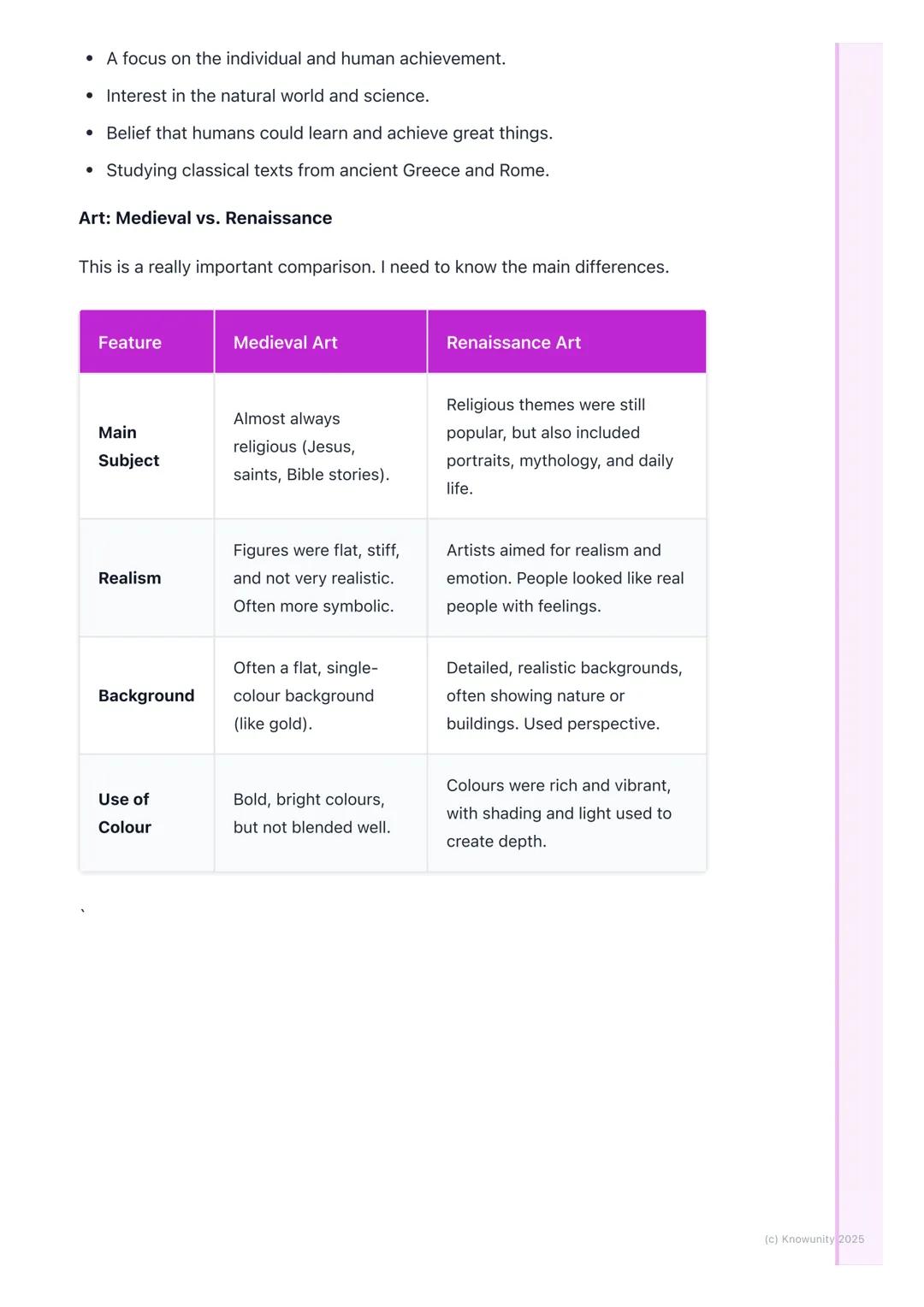
Medieval vs Renaissance Art
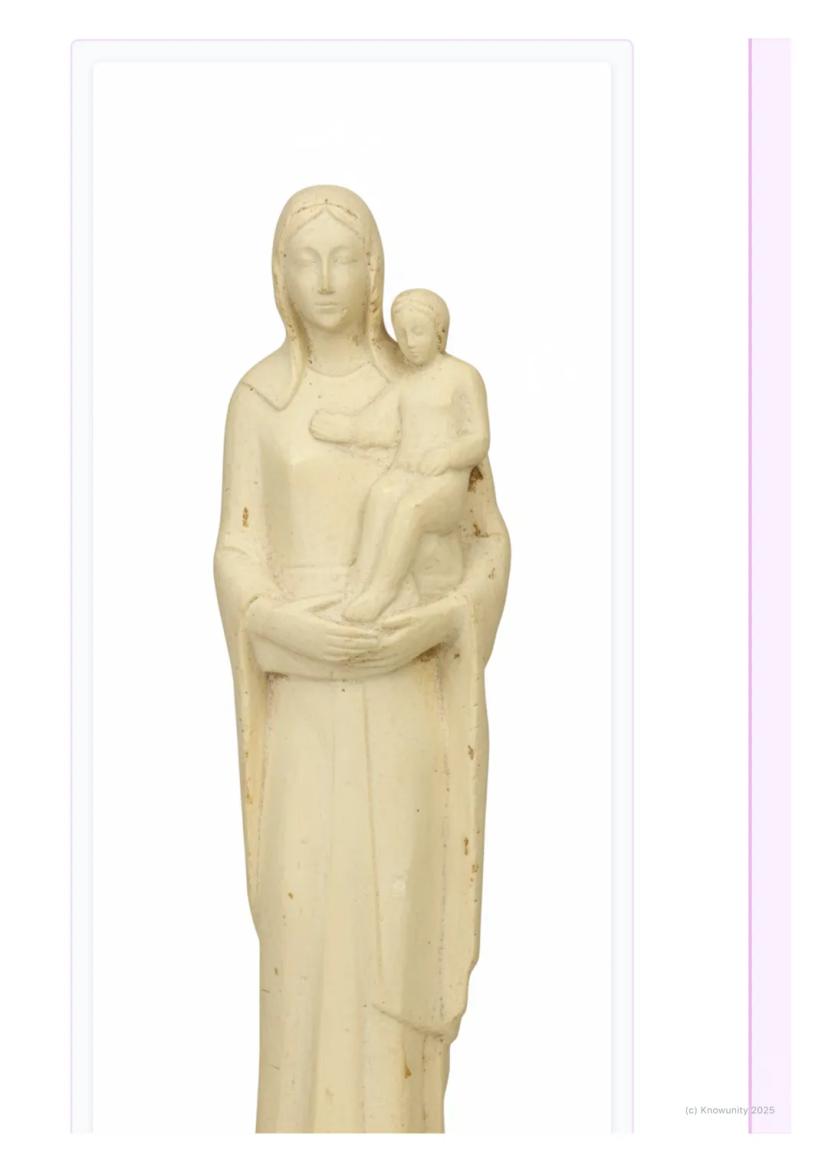
Here's where things get really interesting - the art styles couldn't be more different! Medieval art was flat, symbolic, and focused entirely on religious themes. Figures looked stiff and unrealistic because artists weren't trying to copy real life.
Renaissance art was all about realism and emotion. Artists studied human anatomy (sometimes by dissecting corpses!) to make their work lifelike. They used perspective to create depth and sfumato - a smoky blending technique that made paintings look incredibly realistic.
The subject matter changed too. While religious themes remained popular, artists also painted portraits, mythological scenes, and everyday life. People became just as important as saints in artwork.
Exam Tip: Remember that Renaissance artists were like scientists - they observed, experimented, and constantly tried to improve their techniques.
3
of 7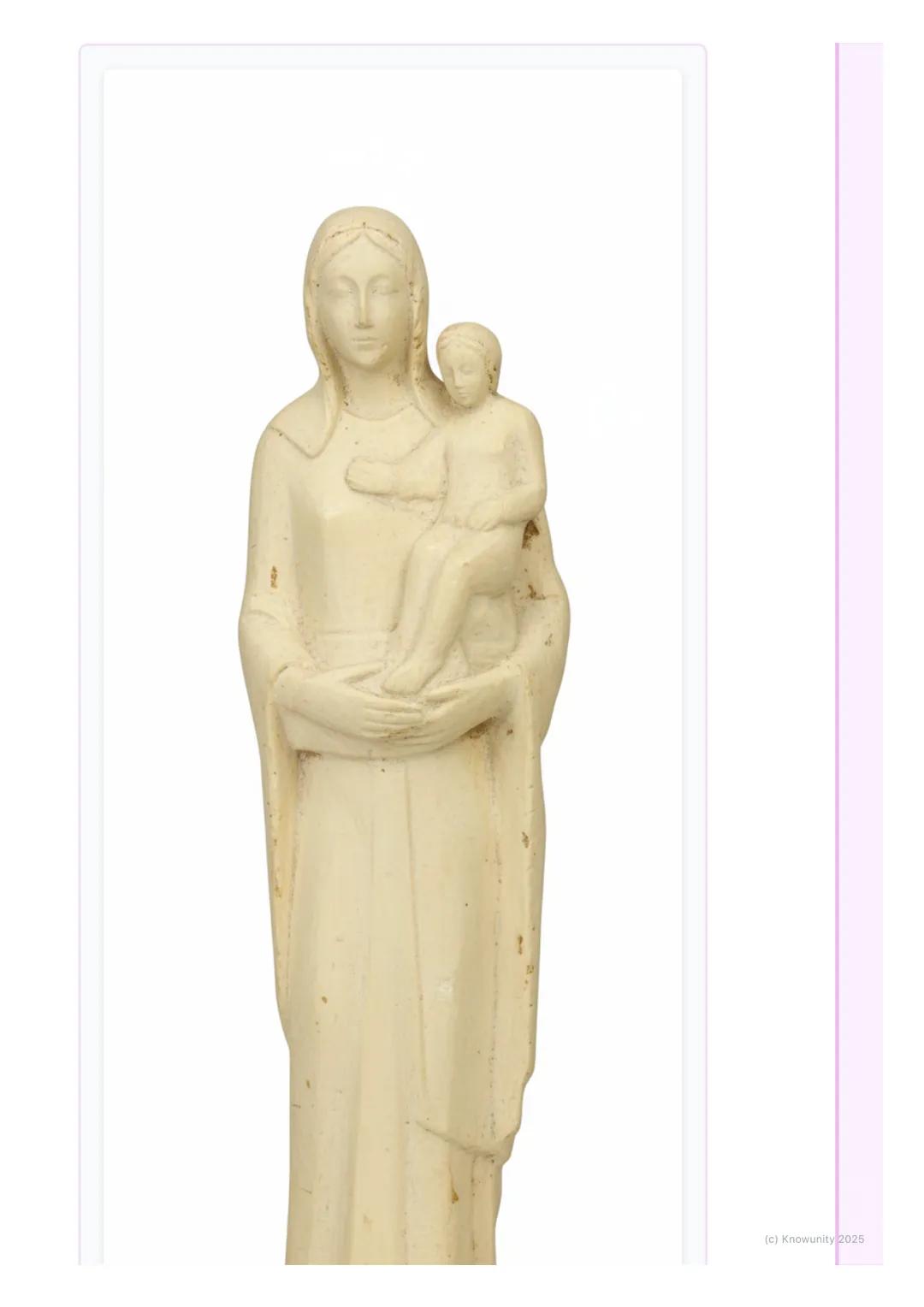
Leonardo da Vinci: The Ultimate Renaissance Man
Leonardo da Vinci proves why we call some people "Renaissance Men" - he mastered everything he touched. As a painter, he created the Mona Lisa with her mysterious smile and The Last Supper, showing incredible emotion and detail.
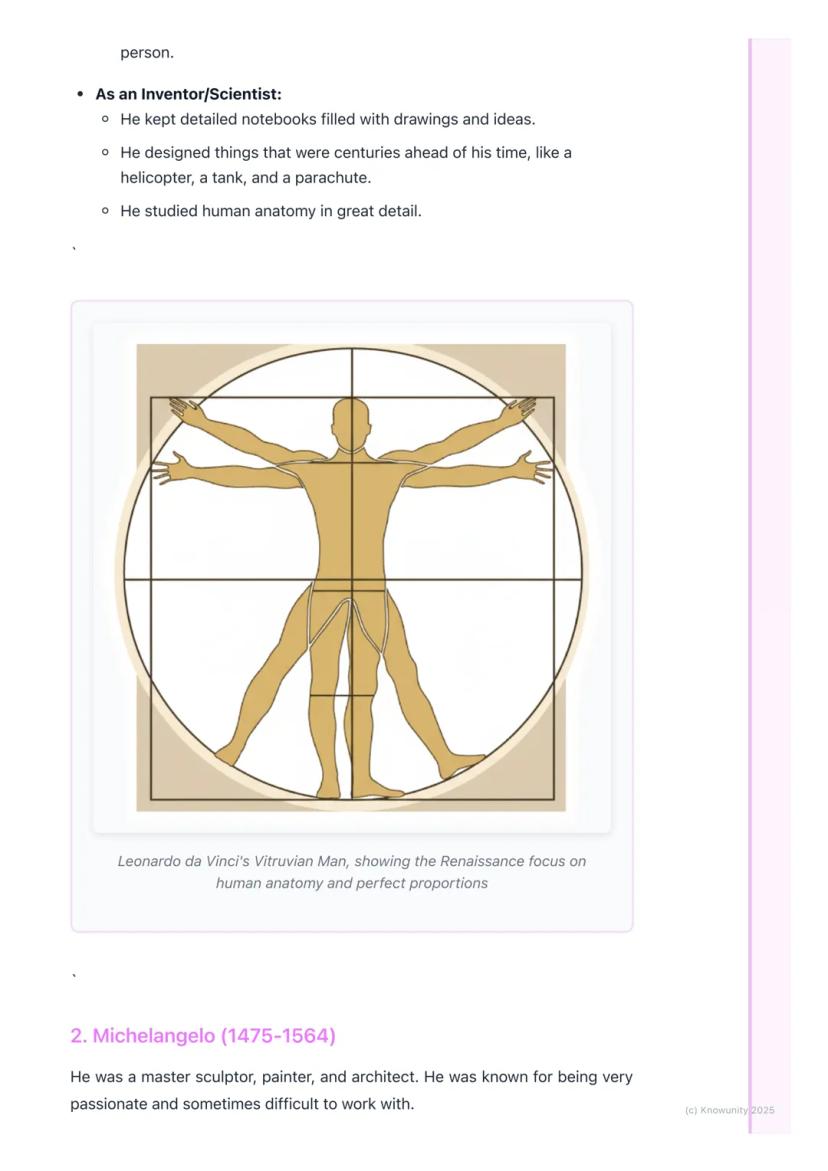
But Leonardo wasn't just an artist. His notebooks were filled with designs for helicopters, tanks, and parachutes - centuries before these were actually built! He studied human anatomy in incredible detail, creating the famous Vitruvian Man drawing.
This combination of art, science, and invention perfectly captures Renaissance thinking. People believed they could understand and improve everything around them through careful observation and experimentation.
Did You Know? Leonardo wrote his notes backwards (mirror writing) - you need a mirror to read them properly!
4
of 7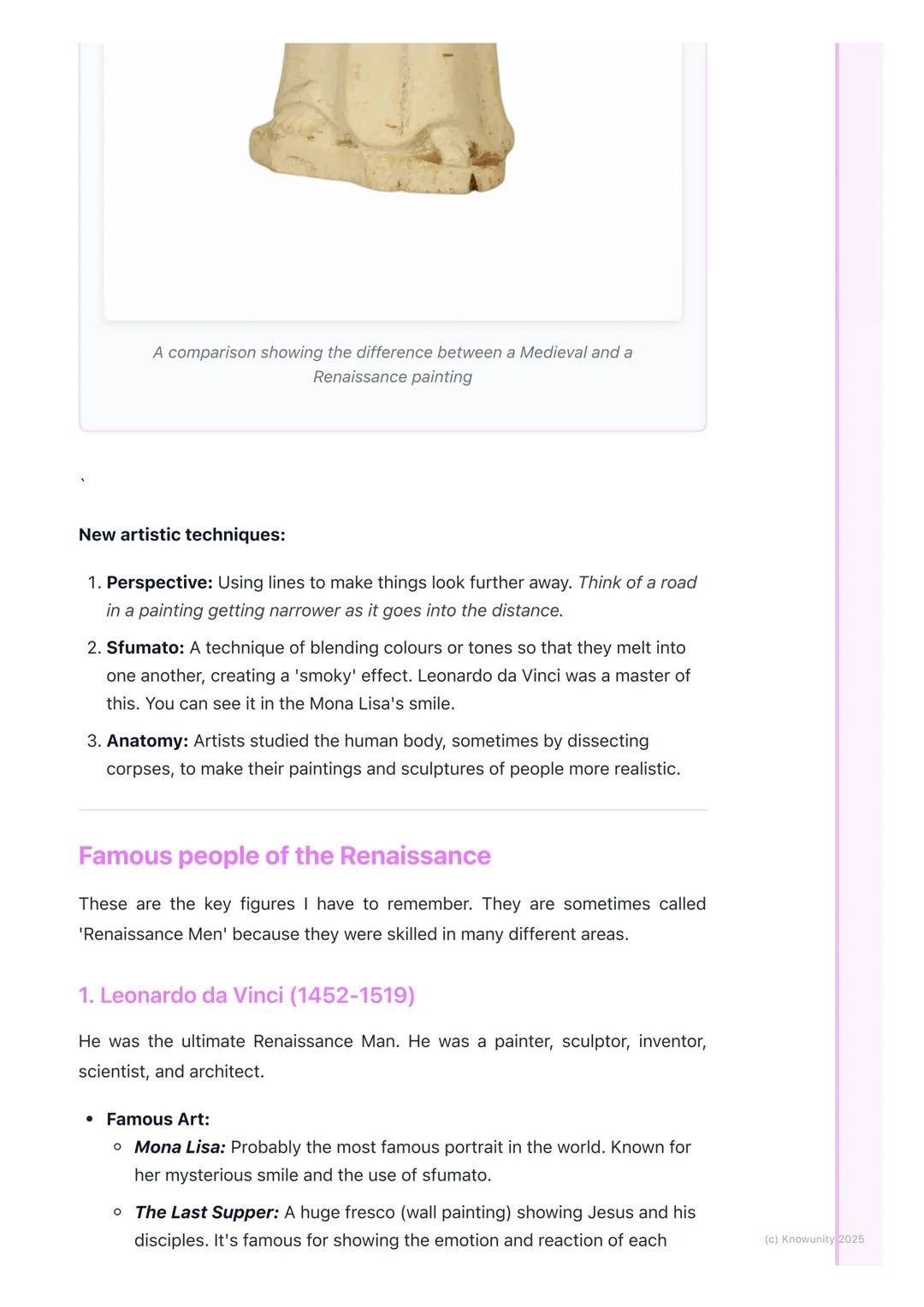
Michelangelo and Other Renaissance Stars
Michelangelo was Leonardo's rival and completely different personality - passionate and sometimes difficult to work with. His statue of David shows incredible anatomical detail and has become a symbol of Florence. The Sistine Chapel ceiling took him four years to complete, lying on his back on scaffolding.
The Renaissance wasn't just Italian though. William Shakespeare in England wrote plays that explored human emotions and flaws - very humanist ideas. Galileo Galilei used telescopes to study space and proved Earth revolves around the Sun, getting him in trouble with the Church.
Don't forget Gutenberg's printing press (around 1440) - this invention spread Renaissance ideas across Europe faster than ever before. Books became cheaper and more available to ordinary people.
Exam Success: Focus on why these people were important, not just memorising dates and names.
5
of 7
Why Italy? The Perfect Storm
Italy became the Renaissance birthplace for practical reasons. Italian city-states like Florence and Venice grew incredibly wealthy from trade, creating a class of rich merchants and families like the Medici.
These wealthy patrons had money to spend on art, architecture, and learning. They competed with each other to commission the best artists, creating a perfect environment for creativity to flourish.
Italy also had direct connections to ancient Roman ruins and manuscripts, making it easier to rediscover classical knowledge. The combination of money, competition, and access to ancient wisdom created the perfect conditions for the Renaissance to begin.
Remember: The Renaissance needed three things - wealthy patrons, rediscovered classical knowledge, and cities where ideas could spread quickly.
6
of 7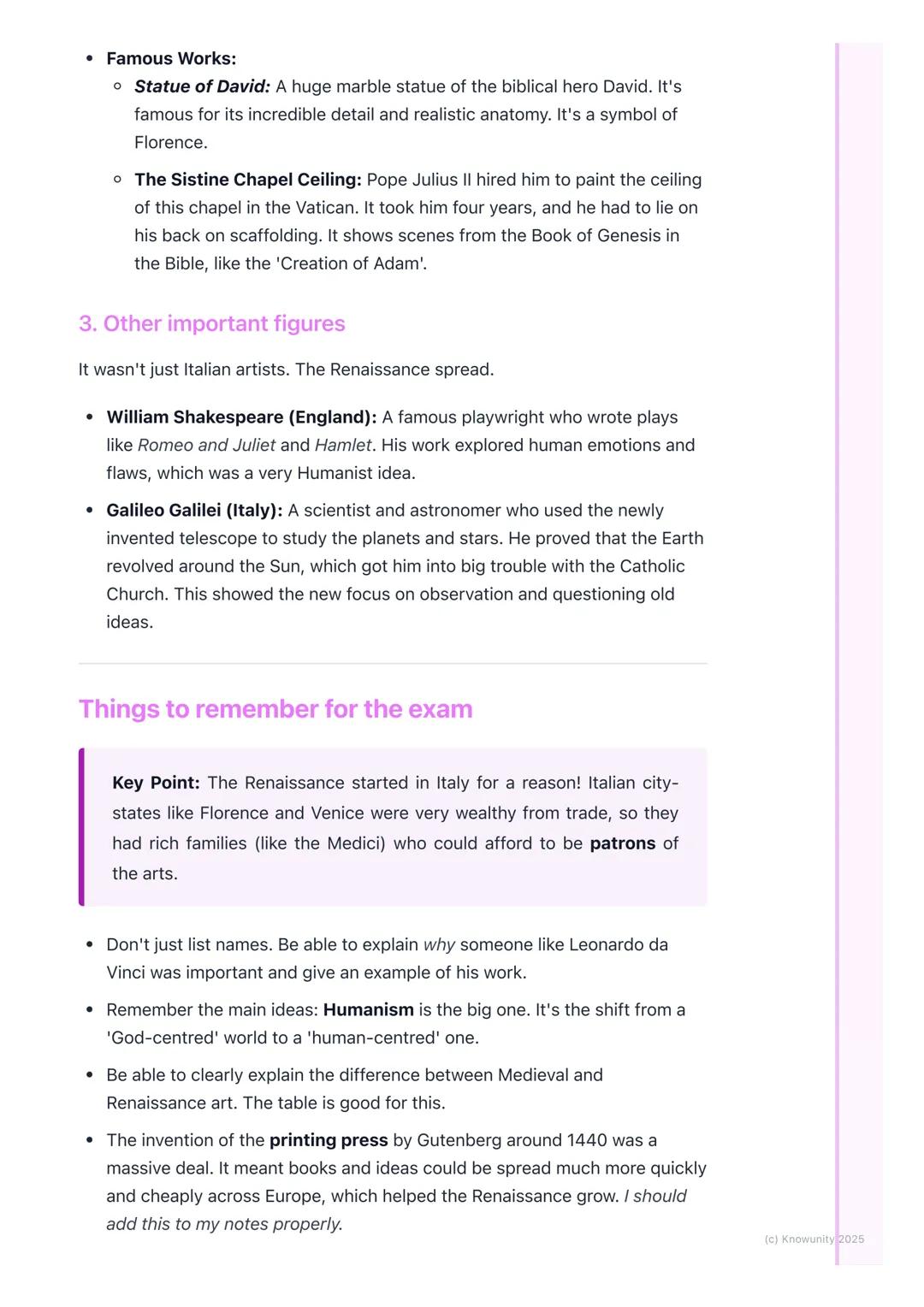
The Renaissance Legacy
The Renaissance fundamentally changed European society by placing humans at the centre of art, literature, and scientific inquiry. Humanism encouraged people to question old ideas and explore new possibilities through observation and reason.
This period gave us masterpieces like the Mona Lisa and revolutionary scientific discoveries that challenged Church authority. The printing press spread these new ideas rapidly across Europe, paving the way for future developments like the Scientific Revolution.
Most importantly, the Renaissance proved that humans could achieve incredible things through creativity, study, and determination. This confidence in human potential became a cornerstone of modern Western thinking.
Big Picture: The Renaissance didn't just create beautiful art - it laid the foundations for the modern world by encouraging questioning, observation, and human achievement.
7
of 7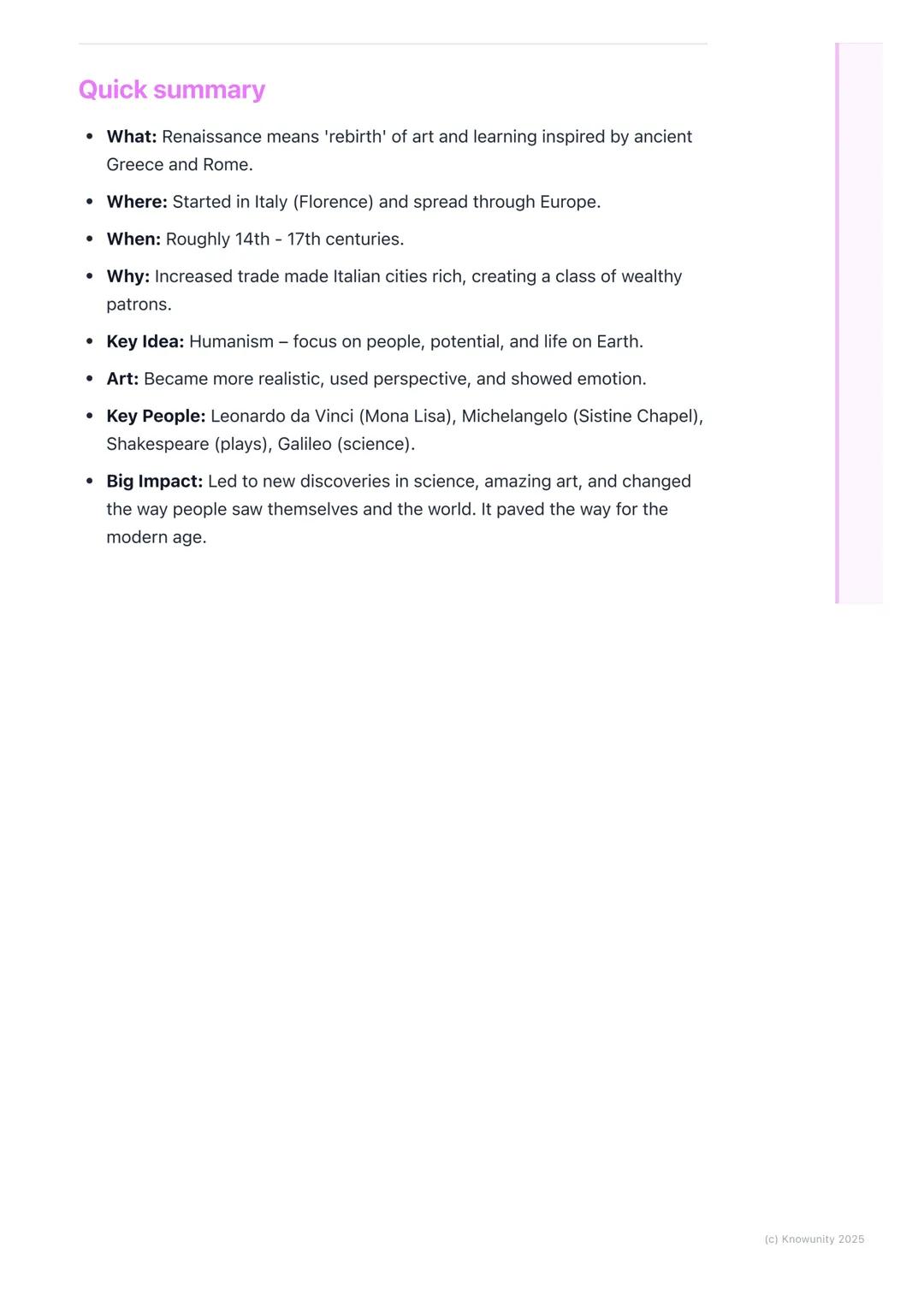
Pensavamo che non l'avreste mai chiesto....
Che cos'è l'assistente AI di Knowunity?
Il nostro assistente AI è costruito specificamente per le esigenze degli studenti. Sulla base dei milioni di contenuti presenti sulla piattaforma, possiamo fornire agli studenti risposte davvero significative e pertinenti. Ma non si tratta solo di risposte, l'assistente è in grado di guidare gli studenti attraverso le loro sfide quotidiane di studio, con piani di studio personalizzati, quiz o contenuti nella chat e una personalizzazione al 100% basata sulle competenze e sugli sviluppi degli studenti.
Dove posso scaricare l'applicazione Knowunity?
È possibile scaricare l'applicazione dal Google Play Store e dall'Apple App Store.
Knowunity è davvero gratuita?
Sì, hai accesso completamente gratuito a tutti i contenuti nell'app e puoi chattare o seguire i Creatori in qualsiasi momento. Sbloccherai nuove funzioni crescendo il tuo numero di follower. Inoltre, offriamo Knowunity Premium, che consente di studiare senza alcun limite!!
Contenuti più popolari di History
9HistoryThe Great Famine (An Gorta Mór)
Students will learn about the causes, devastating impact, and long-term consequences of the potato famine on Irish population and society.
2nd Year282
HistoryThe renaissance
junior cert renaissance summary
1st Year361
HistoryCauses and Consequences of World War II
This subtopic covers the origins of the Second World War, its global scale, and its devastating human and political consequences, including the atomic bomb.
3rd Year152
HistoryThe 1798 Rebellion in Ireland
Learning about the causes, events, and aftermath of the United Irishmen's rebellion against British rule, inspired by revolutionary ideals.
3rd Year211
HistoryAmerican revolution
junior cert american revolution summary
1st Year442
HistoryThe Great Famine (An Gorta Mór)
This critical subtopic examines the causes, devastating impact, and long-term consequences of the potato famine on Irish society, population, and emigration.
3rd Year140
HistoryThe Renaissance
Students will learn about a time of 'rebirth' in Europe, where new ideas in art, science, and literature flourished.
1st Year140
History1916 Rising Revison Sheet
revision sheet
3rd Year211
HistoryThe Reformation in Europe
Students will learn about the causes and key figures of the Protestant Reformation and its impact on European society and politics.
3rd Year110
Contenuti più popolari
9 Irish
IrishIrish oral questions and answers
Questions and answers for the leaving cert oral
5th Year4264
 English
Key Quotes : Sive
Key Quotes and explanations: Sive
6th Year2842
IrishIrish oral questions
Outline of oral questions
5th Year2055
IrishIníon- le hÁine Durkin
Aine Durkin’s poem, Iníon: Themes & summary
5th Year850
IrishIrish poetry 2027
Iníon + Dínit an Bhróin
5th Year1133
IrishLC HL notes- Iníon (poem)
Includes poem in English and Irish, theme, key words & phrases
5th Year2284
EnglishCultural Context : Shawshank Redemption : Sive : Small Things Like These
Comparative Study : Cultural Context : Shawshank Redemption, Sive and Small Things Like These
6th Year1430
IrishMo Ghrá-sa (Idir Lúibíní)
Notes on mo ghrá-sa
5th Year380
IrishAn Gaeilge Aiste
Irish Language essay
6th Year1320
Non c'è niente di adatto? Esplorare altre aree tematiche.
Recensioni dei nostri utenti. Ci adorano - e anche tu, vedrai .
4.6/5App Store
4.7/5Google Play
L'applicazione è molto facile da usare e ben progettata. Finora ho trovato tutto quello che cercavo e ho potuto imparare molto dalle presentazioni! Utilizzerò sicuramente l'app per i compiti in classe! È molto utile anche come fonte di ispirazione.
Stefano Sutente iOS
Questa applicazione è davvero grande! Ci sono tantissimi appunti e aiuti con lo studio [...]. La mia materia problematica, per esempio, è il francese e l'app ha così tante opzioni per aiutarmi. Grazie a questa app ho migliorato il mio francese. La consiglio a tutti.
Samantha Klichutente Android
Wow, sono davvero stupita. Ho appena provato l'app perché l'ho vista pubblicizzata molte volte e sono rimasta assolutamente sbalordita. Questa app è L'AIUTO che cercate per la scuola e soprattutto offre tantissime cose, come allenamenti e schede, che a me personalmente sono state MOLTO utili.
Annautente iOS
History13 visualizzazioni·Aggiornato Jun 15, 2026·7 pagineExploring the Renaissance: Art, Ideas, and Innovations
Ever wonder why we call certain periods in history a "rebirth"? The Renaissance was exactly that - a massive cultural awakening that transformed Europe from the 14th to 17th centuries. It started in wealthy Italian cities and brought us legendary...
1
of 7
Iscriviti per mostrare il contenuto. È gratis!
- Accesso a tutti i documenti
- Migliora i tuoi voti
- Unisciti a milioni di studenti
The Renaissance Begins
The Renaissance literally means "rebirth" in French, and it marked Europe's dramatic shift away from medieval thinking. Starting in Italian cities like Florence, this period saw wealthy merchants and families become patrons - essentially sponsors who paid artists to create masterpieces.
Humanism became the driving force behind this change. Instead of focusing solely on God and the afterlife, people started celebrating human achievements and potential. This was revolutionary for its time.
Artists developed new techniques like perspective (making paintings look 3D) and began writing in the vernacular (everyday language) instead of Latin. This made art and literature accessible to ordinary people, not just scholars and priests.
Key Insight: The Renaissance wasn't just about pretty paintings - it completely changed how Europeans saw themselves and their place in the world.
2
of 7Iscriviti per mostrare il contenuto. È gratis!
- Accesso a tutti i documenti
- Migliora i tuoi voti
- Unisciti a milioni di studenti
Medieval vs Renaissance Art
Here's where things get really interesting - the art styles couldn't be more different! Medieval art was flat, symbolic, and focused entirely on religious themes. Figures looked stiff and unrealistic because artists weren't trying to copy real life.
Renaissance art was all about realism and emotion. Artists studied human anatomy (sometimes by dissecting corpses!) to make their work lifelike. They used perspective to create depth and sfumato - a smoky blending technique that made paintings look incredibly realistic.
The subject matter changed too. While religious themes remained popular, artists also painted portraits, mythological scenes, and everyday life. People became just as important as saints in artwork.
Exam Tip: Remember that Renaissance artists were like scientists - they observed, experimented, and constantly tried to improve their techniques.
3
of 7Iscriviti per mostrare il contenuto. È gratis!
- Accesso a tutti i documenti
- Migliora i tuoi voti
- Unisciti a milioni di studenti
Leonardo da Vinci: The Ultimate Renaissance Man
Leonardo da Vinci proves why we call some people "Renaissance Men" - he mastered everything he touched. As a painter, he created the Mona Lisa with her mysterious smile and The Last Supper, showing incredible emotion and detail.
But Leonardo wasn't just an artist. His notebooks were filled with designs for helicopters, tanks, and parachutes - centuries before these were actually built! He studied human anatomy in incredible detail, creating the famous Vitruvian Man drawing.
This combination of art, science, and invention perfectly captures Renaissance thinking. People believed they could understand and improve everything around them through careful observation and experimentation.
Did You Know? Leonardo wrote his notes backwards (mirror writing) - you need a mirror to read them properly!
4
of 7Iscriviti per mostrare il contenuto. È gratis!
- Accesso a tutti i documenti
- Migliora i tuoi voti
- Unisciti a milioni di studenti
Michelangelo and Other Renaissance Stars
Michelangelo was Leonardo's rival and completely different personality - passionate and sometimes difficult to work with. His statue of David shows incredible anatomical detail and has become a symbol of Florence. The Sistine Chapel ceiling took him four years to complete, lying on his back on scaffolding.
The Renaissance wasn't just Italian though. William Shakespeare in England wrote plays that explored human emotions and flaws - very humanist ideas. Galileo Galilei used telescopes to study space and proved Earth revolves around the Sun, getting him in trouble with the Church.
Don't forget Gutenberg's printing press (around 1440) - this invention spread Renaissance ideas across Europe faster than ever before. Books became cheaper and more available to ordinary people.
Exam Success: Focus on why these people were important, not just memorising dates and names.
5
of 7Iscriviti per mostrare il contenuto. È gratis!
- Accesso a tutti i documenti
- Migliora i tuoi voti
- Unisciti a milioni di studenti
Why Italy? The Perfect Storm
Italy became the Renaissance birthplace for practical reasons. Italian city-states like Florence and Venice grew incredibly wealthy from trade, creating a class of rich merchants and families like the Medici.
These wealthy patrons had money to spend on art, architecture, and learning. They competed with each other to commission the best artists, creating a perfect environment for creativity to flourish.
Italy also had direct connections to ancient Roman ruins and manuscripts, making it easier to rediscover classical knowledge. The combination of money, competition, and access to ancient wisdom created the perfect conditions for the Renaissance to begin.
Remember: The Renaissance needed three things - wealthy patrons, rediscovered classical knowledge, and cities where ideas could spread quickly.
6
of 7Iscriviti per mostrare il contenuto. È gratis!
- Accesso a tutti i documenti
- Migliora i tuoi voti
- Unisciti a milioni di studenti
The Renaissance Legacy
The Renaissance fundamentally changed European society by placing humans at the centre of art, literature, and scientific inquiry. Humanism encouraged people to question old ideas and explore new possibilities through observation and reason.
This period gave us masterpieces like the Mona Lisa and revolutionary scientific discoveries that challenged Church authority. The printing press spread these new ideas rapidly across Europe, paving the way for future developments like the Scientific Revolution.
Most importantly, the Renaissance proved that humans could achieve incredible things through creativity, study, and determination. This confidence in human potential became a cornerstone of modern Western thinking.
Big Picture: The Renaissance didn't just create beautiful art - it laid the foundations for the modern world by encouraging questioning, observation, and human achievement.
7
of 7Iscriviti per mostrare il contenuto. È gratis!
- Accesso a tutti i documenti
- Migliora i tuoi voti
- Unisciti a milioni di studenti
Pensavamo che non l'avreste mai chiesto....
Che cos'è l'assistente AI di Knowunity?
Il nostro assistente AI è costruito specificamente per le esigenze degli studenti. Sulla base dei milioni di contenuti presenti sulla piattaforma, possiamo fornire agli studenti risposte davvero significative e pertinenti. Ma non si tratta solo di risposte, l'assistente è in grado di guidare gli studenti attraverso le loro sfide quotidiane di studio, con piani di studio personalizzati, quiz o contenuti nella chat e una personalizzazione al 100% basata sulle competenze e sugli sviluppi degli studenti.
Dove posso scaricare l'applicazione Knowunity?
È possibile scaricare l'applicazione dal Google Play Store e dall'Apple App Store.
Knowunity è davvero gratuita?
Sì, hai accesso completamente gratuito a tutti i contenuti nell'app e puoi chattare o seguire i Creatori in qualsiasi momento. Sbloccherai nuove funzioni crescendo il tuo numero di follower. Inoltre, offriamo Knowunity Premium, che consente di studiare senza alcun limite!!
Contenuti più popolari di History
9HistoryThe Great Famine (An Gorta Mór)
Students will learn about the causes, devastating impact, and long-term consequences of the potato famine on Irish population and society.
2nd Year282
HistoryThe renaissance
junior cert renaissance summary
1st Year361
HistoryCauses and Consequences of World War II
This subtopic covers the origins of the Second World War, its global scale, and its devastating human and political consequences, including the atomic bomb.
3rd Year152
HistoryThe 1798 Rebellion in Ireland
Learning about the causes, events, and aftermath of the United Irishmen's rebellion against British rule, inspired by revolutionary ideals.
3rd Year211
HistoryAmerican revolution
junior cert american revolution summary
1st Year442
HistoryThe Great Famine (An Gorta Mór)
This critical subtopic examines the causes, devastating impact, and long-term consequences of the potato famine on Irish society, population, and emigration.
3rd Year140
HistoryThe Renaissance
Students will learn about a time of 'rebirth' in Europe, where new ideas in art, science, and literature flourished.
1st Year140
History1916 Rising Revison Sheet
revision sheet
3rd Year211
HistoryThe Reformation in Europe
Students will learn about the causes and key figures of the Protestant Reformation and its impact on European society and politics.
3rd Year110
Contenuti più popolari
9IrishIrish oral questions and answers
Questions and answers for the leaving cert oral
5th Year4264
EnglishKey Quotes : Sive
Key Quotes and explanations: Sive
6th Year2842
IrishIrish oral questions
Outline of oral questions
5th Year2055
IrishIníon- le hÁine Durkin
Aine Durkin’s poem, Iníon: Themes & summary
5th Year850
IrishIrish poetry 2027
Iníon + Dínit an Bhróin
5th Year1133
IrishLC HL notes- Iníon (poem)
Includes poem in English and Irish, theme, key words & phrases
5th Year2284
EnglishCultural Context : Shawshank Redemption : Sive : Small Things Like These
Comparative Study : Cultural Context : Shawshank Redemption, Sive and Small Things Like These
6th Year1430
IrishMo Ghrá-sa (Idir Lúibíní)
Notes on mo ghrá-sa
5th Year380
IrishAn Gaeilge Aiste
Irish Language essay
6th Year1320
Non c'è niente di adatto? Esplorare altre aree tematiche.
Recensioni dei nostri utenti. Ci adorano - e anche tu, vedrai .
4.6/5App Store
4.7/5Google Play
L'applicazione è molto facile da usare e ben progettata. Finora ho trovato tutto quello che cercavo e ho potuto imparare molto dalle presentazioni! Utilizzerò sicuramente l'app per i compiti in classe! È molto utile anche come fonte di ispirazione.
Stefano Sutente iOS
Questa applicazione è davvero grande! Ci sono tantissimi appunti e aiuti con lo studio [...]. La mia materia problematica, per esempio, è il francese e l'app ha così tante opzioni per aiutarmi. Grazie a questa app ho migliorato il mio francese. La consiglio a tutti.
Samantha Klichutente Android
Wow, sono davvero stupita. Ho appena provato l'app perché l'ho vista pubblicizzata molte volte e sono rimasta assolutamente sbalordita. Questa app è L'AIUTO che cercate per la scuola e soprattutto offre tantissime cose, come allenamenti e schede, che a me personalmente sono state MOLTO utili.
Annautente iOS