
Ever wondered who the Irish people were before Christianity arrived?...
 History1 visualizzazioni·Aggiornato Jun 8, 2026·7 pagine
The Celts and Their Iron Age Legacy in Ireland

1 / 7
1
of 7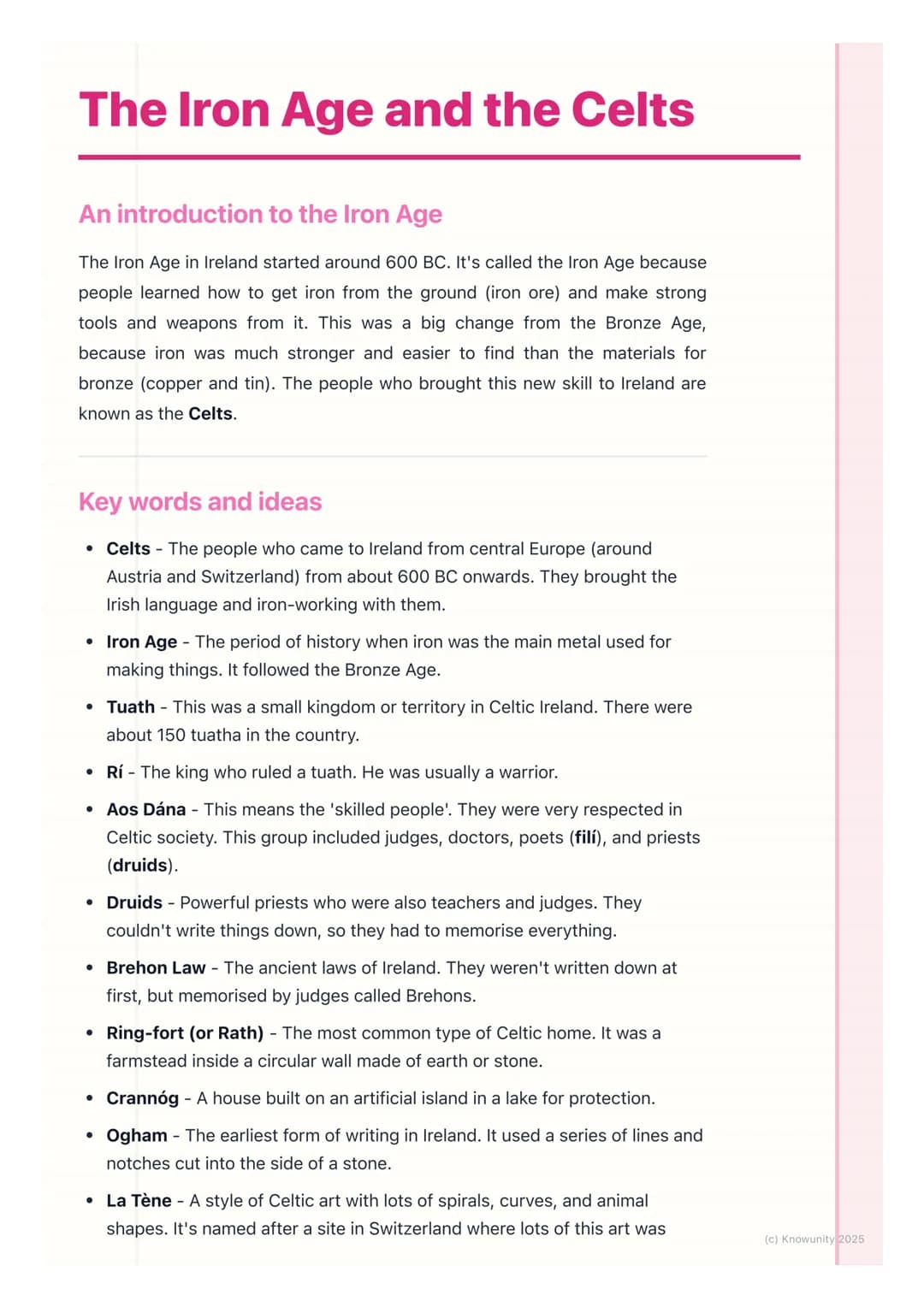
The Iron Age Arrives in Ireland
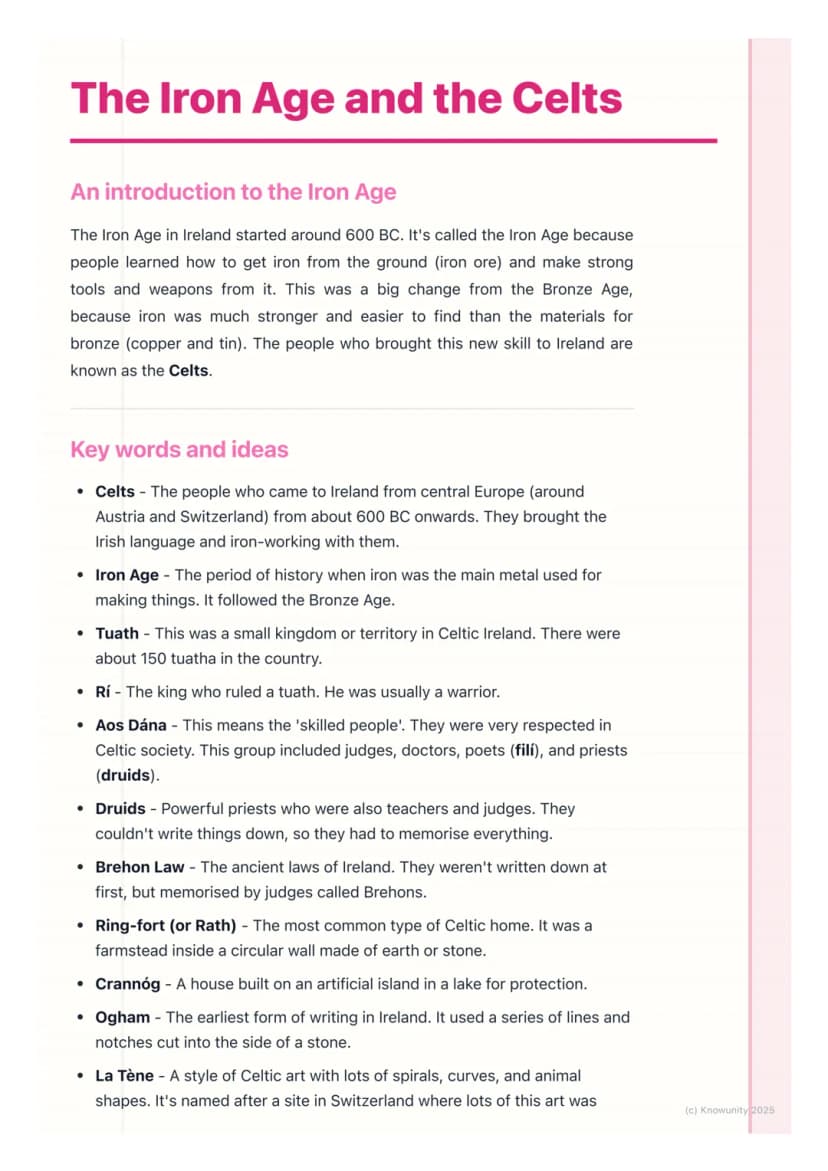
Picture Ireland around 600 BC - everything's about to change! The Celts arrived from central Europe (think Austria and Switzerland) bringing something revolutionary: the ability to make tools and weapons from iron ore. This was massive because iron was way stronger than bronze and much easier to find.
The Iron Age wasn't just about better metal - the Celts brought the Irish language, incredible art, and a whole new way of organizing society. They divided Ireland into about 150 small kingdoms called tuatha , each ruled by a warrior king called a Rí.
The Aos Dána were the celebrities of Celtic society - these "skilled people" included powerful druids (priests who memorized everything because they couldn't write), poets called filí, doctors, and judges. They were so respected that even kings had to listen to them!
Did you know? Druids had to memorize 20 years' worth of laws, stories, and religious knowledge because writing was forbidden in their training!
2
of 7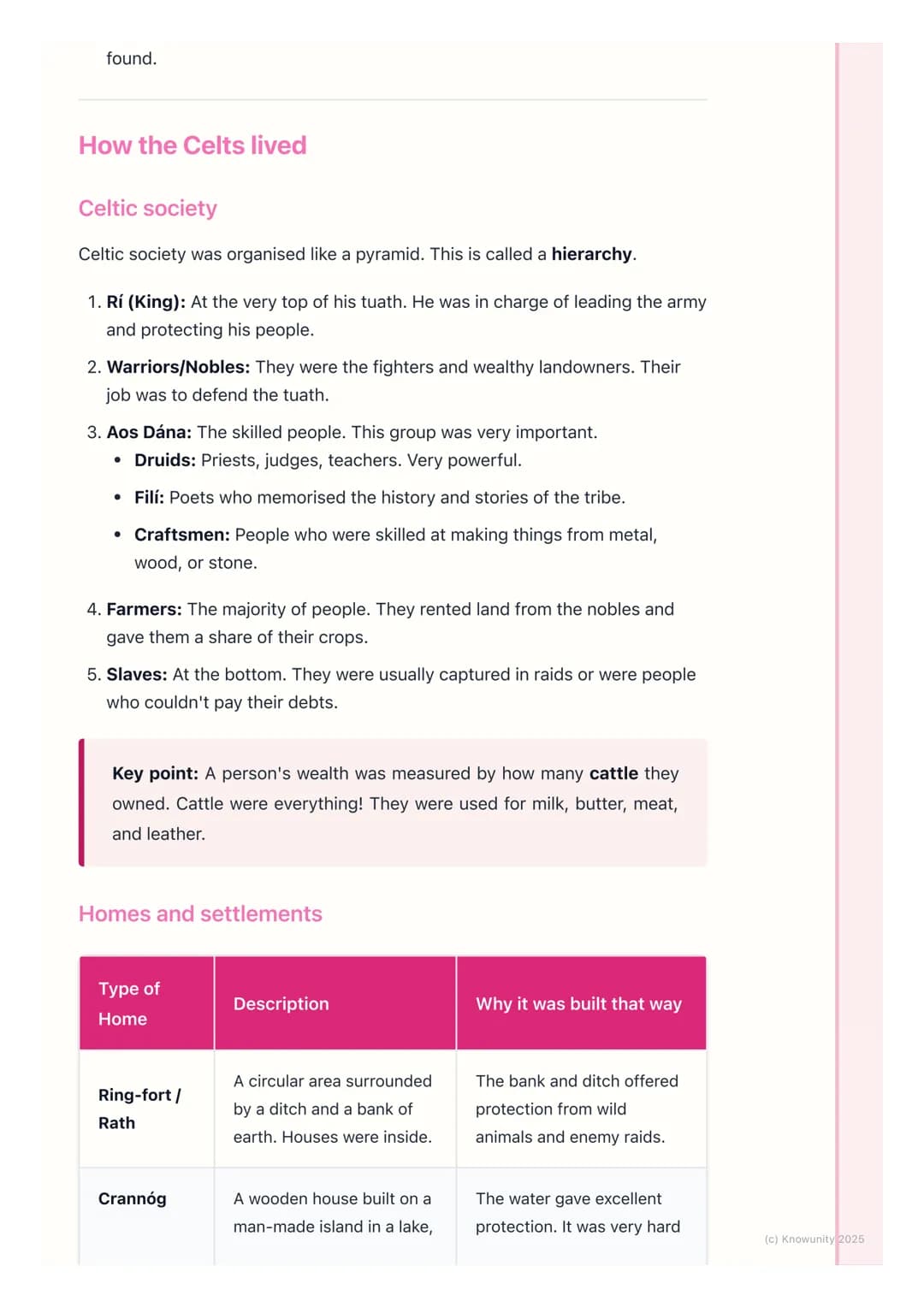
Celtic Society: All About the Pyramid
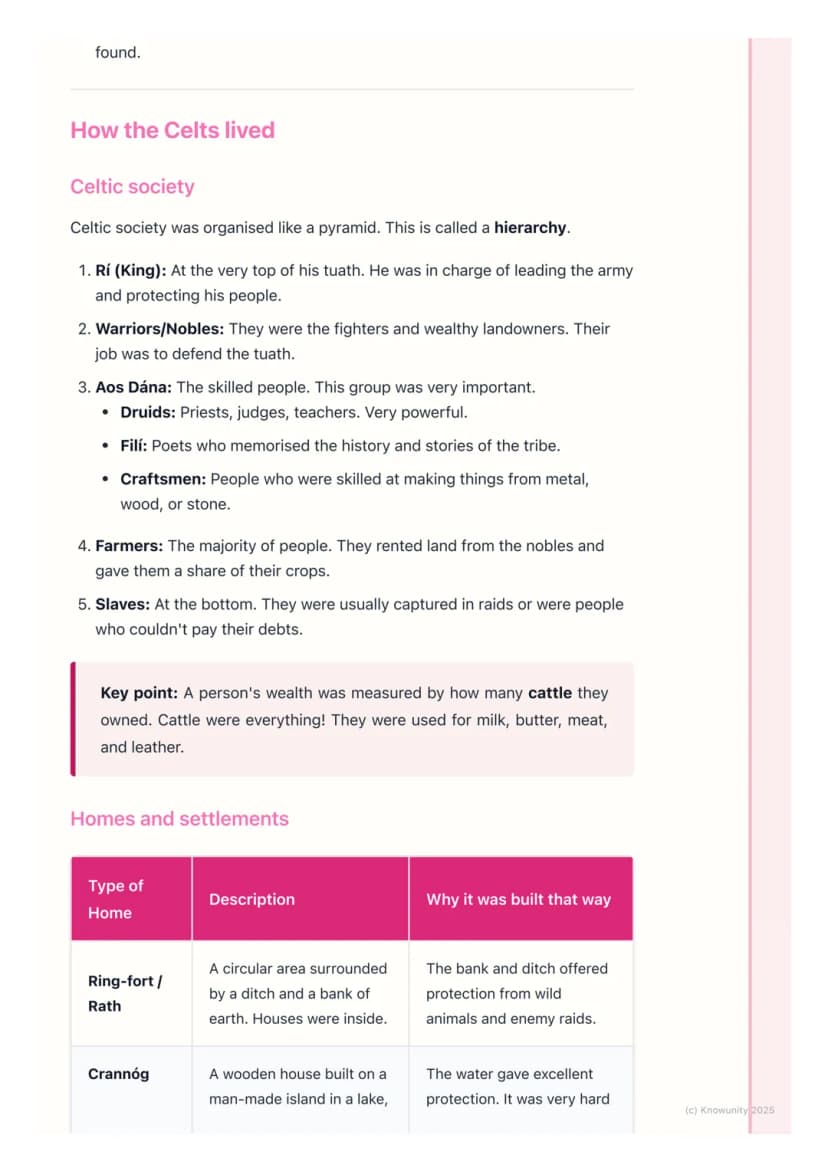
Think of Celtic society like a pyramid with the Rí (king) at the top of each tuath. Below him were warriors and nobles who owned land and fought battles. The Aos Dána came next - these skilled people were incredibly important even though they weren't necessarily warriors.
Most people were farmers who rented land from nobles and paid them with crops. At the bottom were slaves - usually people captured in raids or those who couldn't pay their debts. Here's the key thing: wealth was measured in cattle. No joke - cows were literally money! They provided milk, butter, meat, and leather.
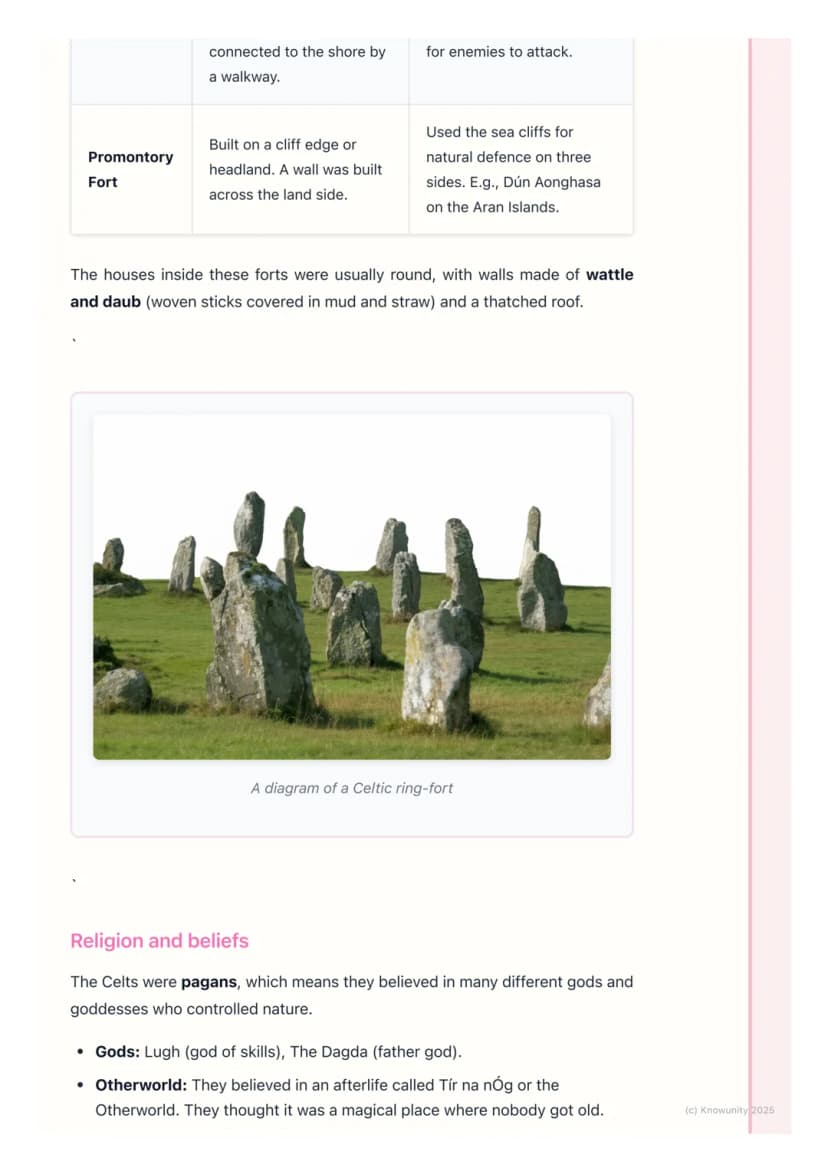
Celtic homes were built for protection. Ring-forts (or raths) were circular farmsteads surrounded by earth banks and ditches to keep out wild animals and raiders. For extra security, some families built crannógs - houses on artificial islands in lakes connected to shore by hidden walkways.
Remember this: In any exam answer about Celtic society, always mention that cattle = wealth. It's the golden rule!
3
of 7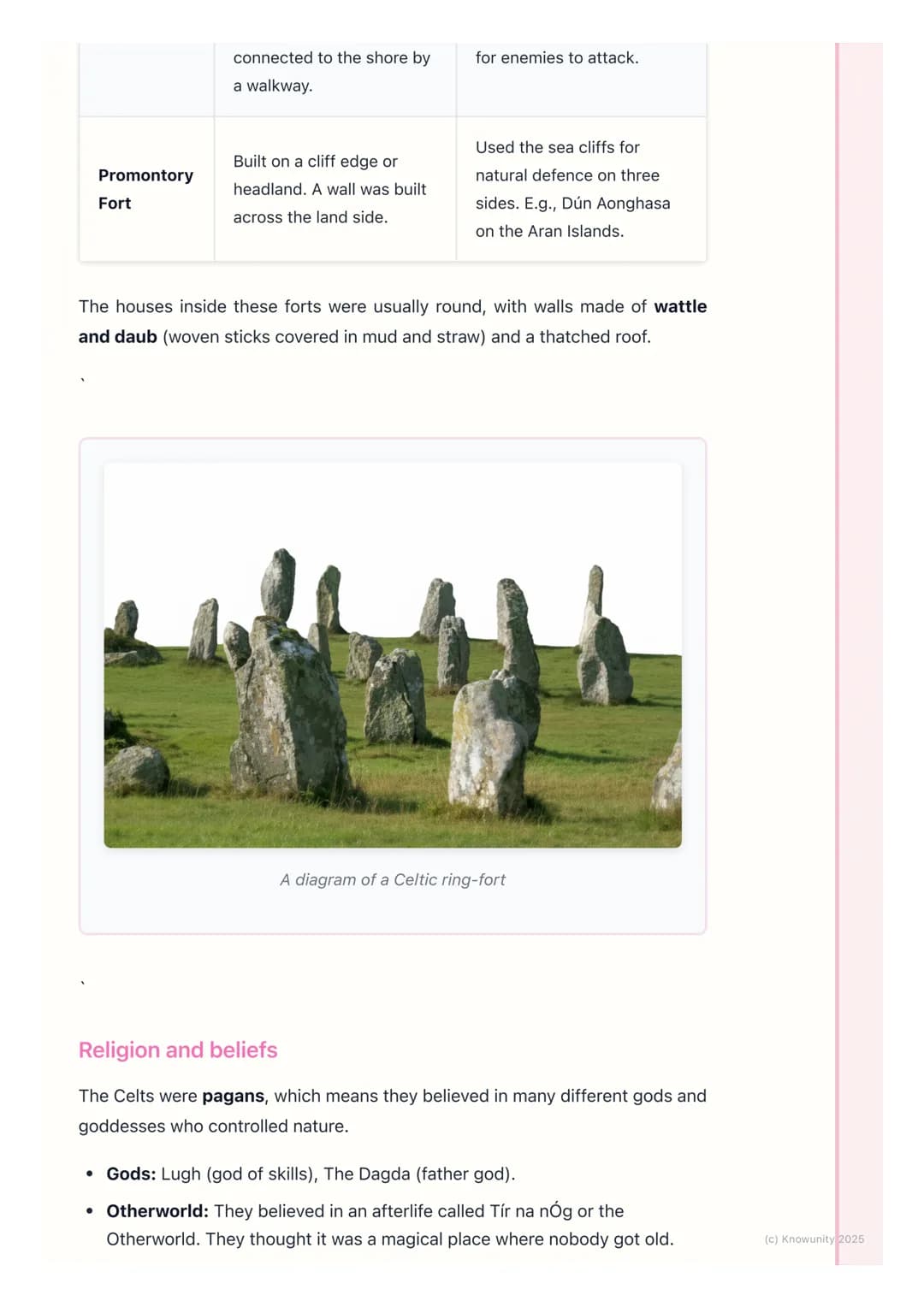
Daily Life and Beliefs
The Celts loved a good party! They celebrated four major festivals that matched the seasons: Samhain (Halloween's ancestor), Imbolc (spring's start), Bealtaine (summer begins), and Lughnasa (harvest time). These weren't just parties - they were serious religious events.
Celtic religion was all about nature gods and the Otherworld - their version of the afterlife. When important people died, they were buried with grave goods like swords, shields, and jewelry because they'd need them in the next life. The druids ran religious ceremonies and acted as judges using Brehon Law - ancient Irish laws they memorized word for word.
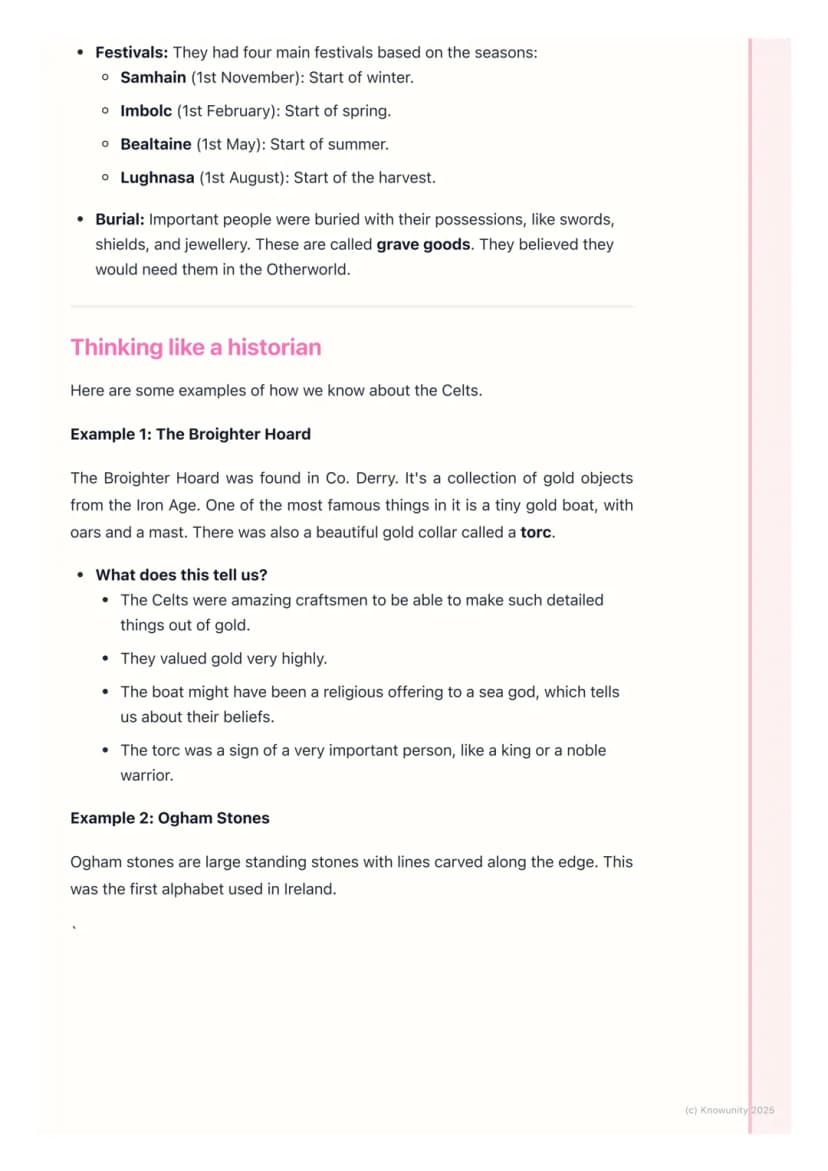
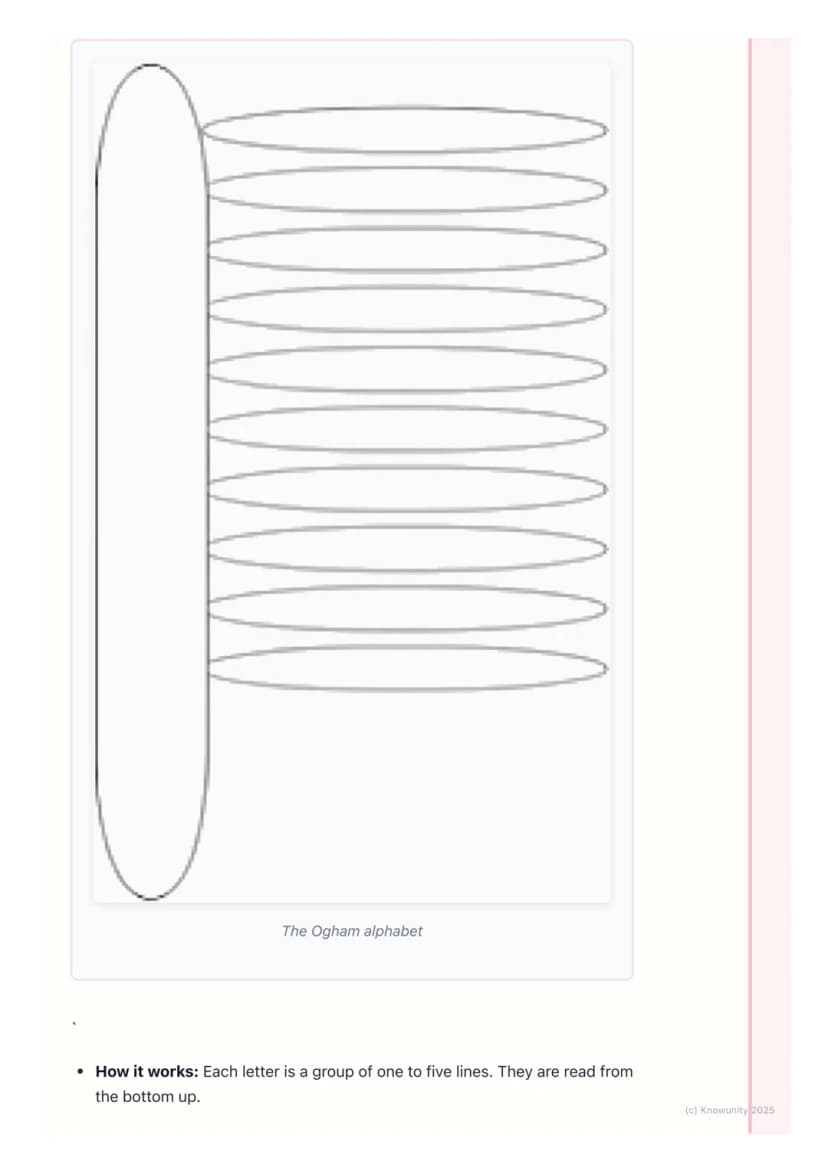
The Celts created the first writing system in Ireland called Ogham. These were lines and notches carved into stone edges, read from bottom to top. Most Ogham stones just marked graves or boundaries with simple messages like "this belonged to so-and-so."
Cool fact: The tiny gold boat in the Broighter Hoard might have been thrown into water as an offering to sea gods - showing how seriously Celts took their religion!
4
of 7
Evidence and Legacy
How do we know all this stuff about people from over 2,000 years ago? Archaeologists are like detectives! The Broighter Hoard found in County Derry shows us incredible Celtic craftsmanship - especially a tiny gold boat with working oars and mast, plus a gorgeous gold collar called a torc that screamed "I'm important!"
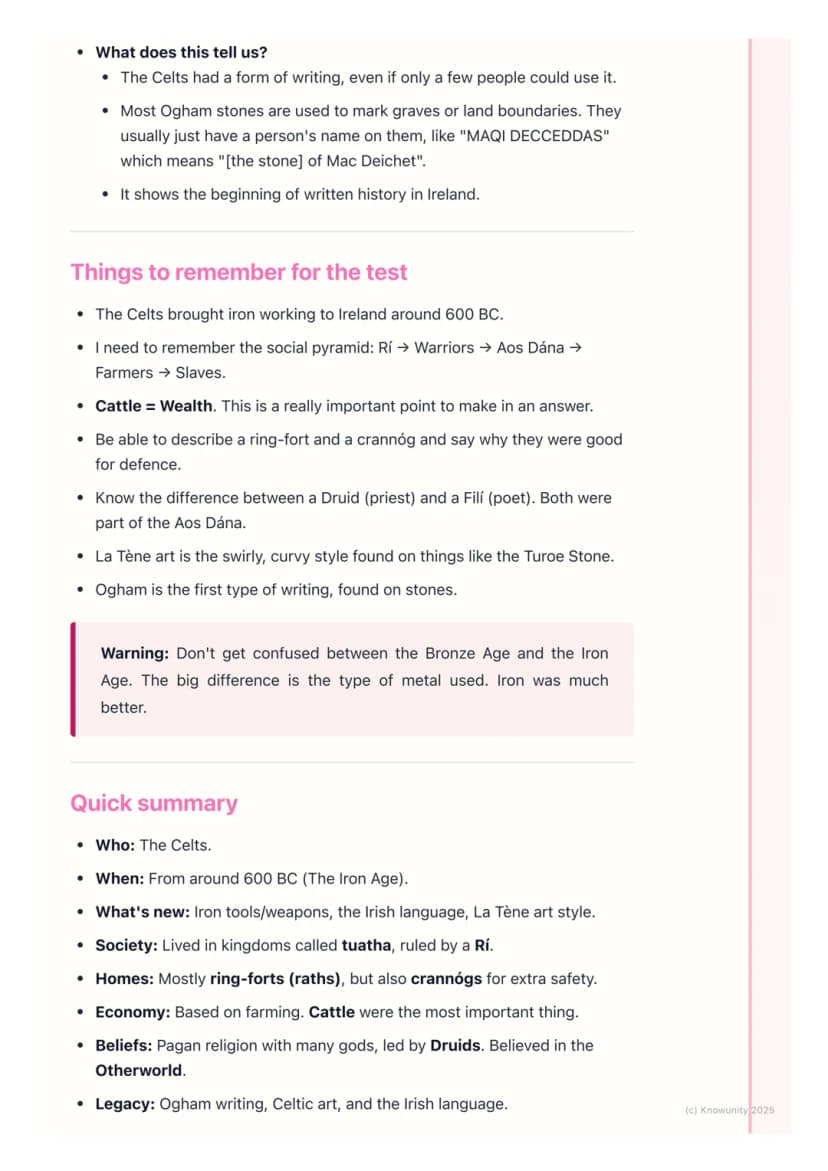
La Tène art was the Celtic style - think swirls, spirals, and animal patterns that flow together beautifully. You can see this on artifacts like the Turoe Stone. This art style proves the Celts weren't just tough warriors - they were seriously talented artists too.
The Ogham stones scattered around Ireland are like ancient text messages. Each letter was made of one to five lines carved along the stone's edge. Though most just say someone's name, they mark the beginning of written history in Ireland - pretty amazing for people whose priests weren't allowed to write!
Exam tip: Don't mix up Bronze Age and Iron Age! The big difference is the metal used - iron was much stronger and more available than bronze.
5
of 7
6
of 7
7
of 7
Pensavamo che non l'avreste mai chiesto....
Che cos'è l'assistente AI di Knowunity?
Il nostro assistente AI è costruito specificamente per le esigenze degli studenti. Sulla base dei milioni di contenuti presenti sulla piattaforma, possiamo fornire agli studenti risposte davvero significative e pertinenti. Ma non si tratta solo di risposte, l'assistente è in grado di guidare gli studenti attraverso le loro sfide quotidiane di studio, con piani di studio personalizzati, quiz o contenuti nella chat e una personalizzazione al 100% basata sulle competenze e sugli sviluppi degli studenti.
Dove posso scaricare l'applicazione Knowunity?
È possibile scaricare l'applicazione dal Google Play Store e dall'Apple App Store.
Knowunity è davvero gratuita?
Sì, hai accesso completamente gratuito a tutti i contenuti nell'app e puoi chattare o seguire i Creatori in qualsiasi momento. Sbloccherai nuove funzioni crescendo il tuo numero di follower. Inoltre, offriamo Knowunity Premium, che consente di studiare senza alcun limite!!
Contenuti più popolari di History
9Contenuti più popolari
9Non c'è niente di adatto? Esplorare altre aree tematiche.
Recensioni dei nostri utenti. Ci adorano - e anche tu, vedrai .
4.6/5App Store
4.7/5Google Play
L'applicazione è molto facile da usare e ben progettata. Finora ho trovato tutto quello che cercavo e ho potuto imparare molto dalle presentazioni! Utilizzerò sicuramente l'app per i compiti in classe! È molto utile anche come fonte di ispirazione.
Stefano Sutente iOS
Questa applicazione è davvero grande! Ci sono tantissimi appunti e aiuti con lo studio [...]. La mia materia problematica, per esempio, è il francese e l'app ha così tante opzioni per aiutarmi. Grazie a questa app ho migliorato il mio francese. La consiglio a tutti.
Samantha Klichutente Android
Wow, sono davvero stupita. Ho appena provato l'app perché l'ho vista pubblicizzata molte volte e sono rimasta assolutamente sbalordita. Questa app è L'AIUTO che cercate per la scuola e soprattutto offre tantissime cose, come allenamenti e schede, che a me personalmente sono state MOLTO utili.
Annautente iOS
History1 visualizzazioni·Aggiornato Jun 8, 2026·7 pagineThe Celts and Their Iron Age Legacy in Ireland
Ever wondered who the Irish people were before Christianity arrived? Meet the Celts- the warriors, craftspeople, and storytellers who shaped Ireland from around 600 BC. They brought iron tools, the Irish language, and amazing art that you can still...
1
of 7
Iscriviti per mostrare il contenuto. È gratis!
- Accesso a tutti i documenti
- Migliora i tuoi voti
- Unisciti a milioni di studenti
The Iron Age Arrives in Ireland
Picture Ireland around 600 BC - everything's about to change! The Celts arrived from central Europe (think Austria and Switzerland) bringing something revolutionary: the ability to make tools and weapons from iron ore. This was massive because iron was way stronger than bronze and much easier to find.
The Iron Age wasn't just about better metal - the Celts brought the Irish language, incredible art, and a whole new way of organizing society. They divided Ireland into about 150 small kingdoms called tuatha , each ruled by a warrior king called a Rí.
The Aos Dána were the celebrities of Celtic society - these "skilled people" included powerful druids (priests who memorized everything because they couldn't write), poets called filí, doctors, and judges. They were so respected that even kings had to listen to them!
Did you know? Druids had to memorize 20 years' worth of laws, stories, and religious knowledge because writing was forbidden in their training!
2
of 7Iscriviti per mostrare il contenuto. È gratis!
- Accesso a tutti i documenti
- Migliora i tuoi voti
- Unisciti a milioni di studenti
Celtic Society: All About the Pyramid
Think of Celtic society like a pyramid with the Rí (king) at the top of each tuath. Below him were warriors and nobles who owned land and fought battles. The Aos Dána came next - these skilled people were incredibly important even though they weren't necessarily warriors.
Most people were farmers who rented land from nobles and paid them with crops. At the bottom were slaves - usually people captured in raids or those who couldn't pay their debts. Here's the key thing: wealth was measured in cattle. No joke - cows were literally money! They provided milk, butter, meat, and leather.
Celtic homes were built for protection. Ring-forts (or raths) were circular farmsteads surrounded by earth banks and ditches to keep out wild animals and raiders. For extra security, some families built crannógs - houses on artificial islands in lakes connected to shore by hidden walkways.
Remember this: In any exam answer about Celtic society, always mention that cattle = wealth. It's the golden rule!
3
of 7Iscriviti per mostrare il contenuto. È gratis!
- Accesso a tutti i documenti
- Migliora i tuoi voti
- Unisciti a milioni di studenti
Daily Life and Beliefs
The Celts loved a good party! They celebrated four major festivals that matched the seasons: Samhain (Halloween's ancestor), Imbolc (spring's start), Bealtaine (summer begins), and Lughnasa (harvest time). These weren't just parties - they were serious religious events.
Celtic religion was all about nature gods and the Otherworld - their version of the afterlife. When important people died, they were buried with grave goods like swords, shields, and jewelry because they'd need them in the next life. The druids ran religious ceremonies and acted as judges using Brehon Law - ancient Irish laws they memorized word for word.
The Celts created the first writing system in Ireland called Ogham. These were lines and notches carved into stone edges, read from bottom to top. Most Ogham stones just marked graves or boundaries with simple messages like "this belonged to so-and-so."
Cool fact: The tiny gold boat in the Broighter Hoard might have been thrown into water as an offering to sea gods - showing how seriously Celts took their religion!
4
of 7Iscriviti per mostrare il contenuto. È gratis!
- Accesso a tutti i documenti
- Migliora i tuoi voti
- Unisciti a milioni di studenti
Evidence and Legacy
How do we know all this stuff about people from over 2,000 years ago? Archaeologists are like detectives! The Broighter Hoard found in County Derry shows us incredible Celtic craftsmanship - especially a tiny gold boat with working oars and mast, plus a gorgeous gold collar called a torc that screamed "I'm important!"
La Tène art was the Celtic style - think swirls, spirals, and animal patterns that flow together beautifully. You can see this on artifacts like the Turoe Stone. This art style proves the Celts weren't just tough warriors - they were seriously talented artists too.
The Ogham stones scattered around Ireland are like ancient text messages. Each letter was made of one to five lines carved along the stone's edge. Though most just say someone's name, they mark the beginning of written history in Ireland - pretty amazing for people whose priests weren't allowed to write!
Exam tip: Don't mix up Bronze Age and Iron Age! The big difference is the metal used - iron was much stronger and more available than bronze.
5
of 7Iscriviti per mostrare il contenuto. È gratis!
- Accesso a tutti i documenti
- Migliora i tuoi voti
- Unisciti a milioni di studenti
6
of 7Iscriviti per mostrare il contenuto. È gratis!
- Accesso a tutti i documenti
- Migliora i tuoi voti
- Unisciti a milioni di studenti
7
of 7Iscriviti per mostrare il contenuto. È gratis!
- Accesso a tutti i documenti
- Migliora i tuoi voti
- Unisciti a milioni di studenti
Pensavamo che non l'avreste mai chiesto....
Che cos'è l'assistente AI di Knowunity?
Il nostro assistente AI è costruito specificamente per le esigenze degli studenti. Sulla base dei milioni di contenuti presenti sulla piattaforma, possiamo fornire agli studenti risposte davvero significative e pertinenti. Ma non si tratta solo di risposte, l'assistente è in grado di guidare gli studenti attraverso le loro sfide quotidiane di studio, con piani di studio personalizzati, quiz o contenuti nella chat e una personalizzazione al 100% basata sulle competenze e sugli sviluppi degli studenti.
Dove posso scaricare l'applicazione Knowunity?
È possibile scaricare l'applicazione dal Google Play Store e dall'Apple App Store.
Knowunity è davvero gratuita?
Sì, hai accesso completamente gratuito a tutti i contenuti nell'app e puoi chattare o seguire i Creatori in qualsiasi momento. Sbloccherai nuove funzioni crescendo il tuo numero di follower. Inoltre, offriamo Knowunity Premium, che consente di studiare senza alcun limite!!
Contenuti più popolari di History
9Contenuti più popolari
9Non c'è niente di adatto? Esplorare altre aree tematiche.
Recensioni dei nostri utenti. Ci adorano - e anche tu, vedrai .
4.6/5App Store
4.7/5Google Play
L'applicazione è molto facile da usare e ben progettata. Finora ho trovato tutto quello che cercavo e ho potuto imparare molto dalle presentazioni! Utilizzerò sicuramente l'app per i compiti in classe! È molto utile anche come fonte di ispirazione.
Stefano Sutente iOS
Questa applicazione è davvero grande! Ci sono tantissimi appunti e aiuti con lo studio [...]. La mia materia problematica, per esempio, è il francese e l'app ha così tante opzioni per aiutarmi. Grazie a questa app ho migliorato il mio francese. La consiglio a tutti.
Samantha Klichutente Android
Wow, sono davvero stupita. Ho appena provato l'app perché l'ho vista pubblicizzata molte volte e sono rimasta assolutamente sbalordita. Questa app è L'AIUTO che cercate per la scuola e soprattutto offre tantissime cose, come allenamenti e schede, che a me personalmente sono state MOLTO utili.
Annautente iOS