
The French Revolution was one of the most dramatic periods... Mostra di più
 History6 visualizzazioni·Aggiornato Jun 15, 2026·6 pagine
Understanding the French Revolution
1 / 6
1
of 6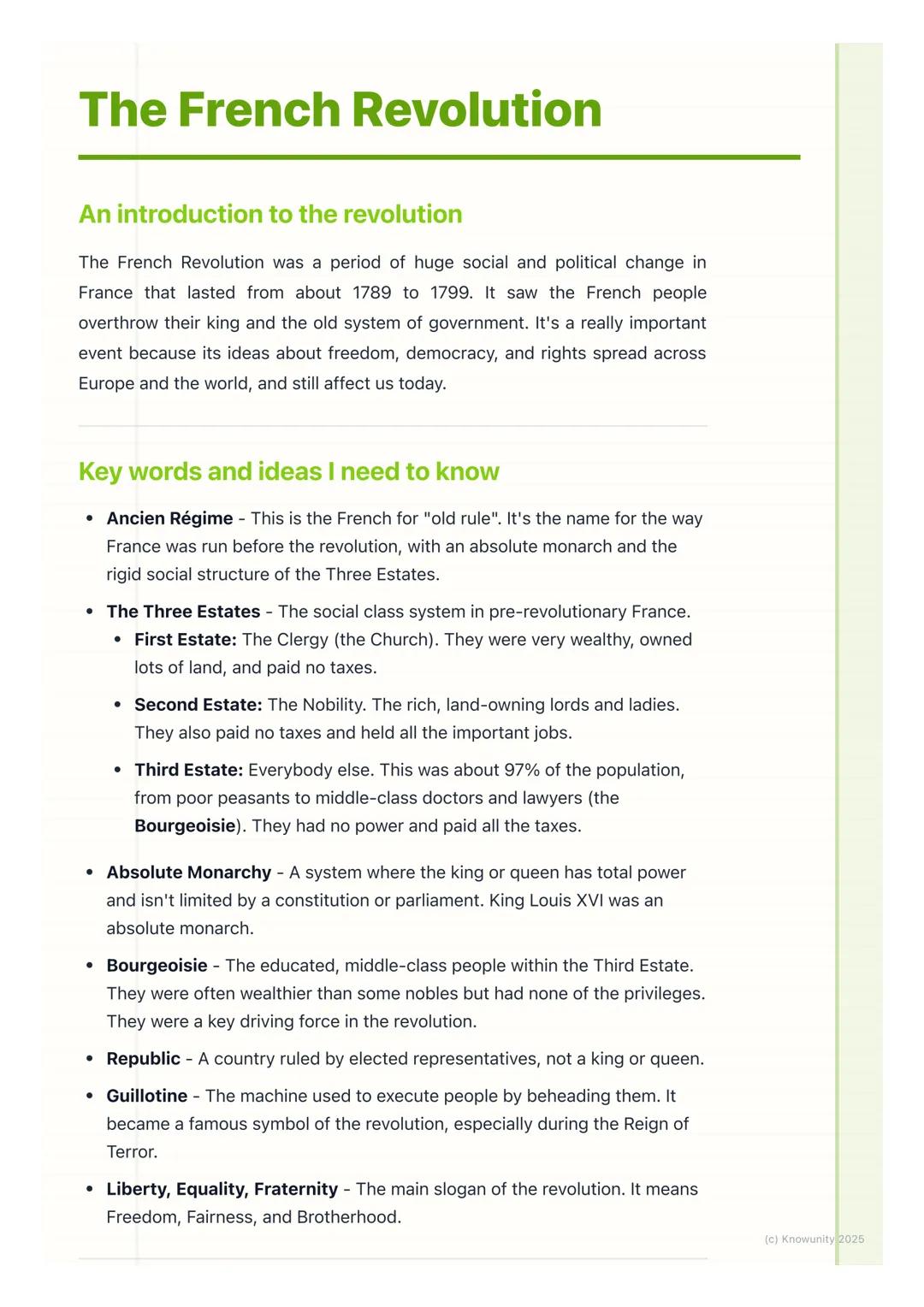
Introduction to the Revolution
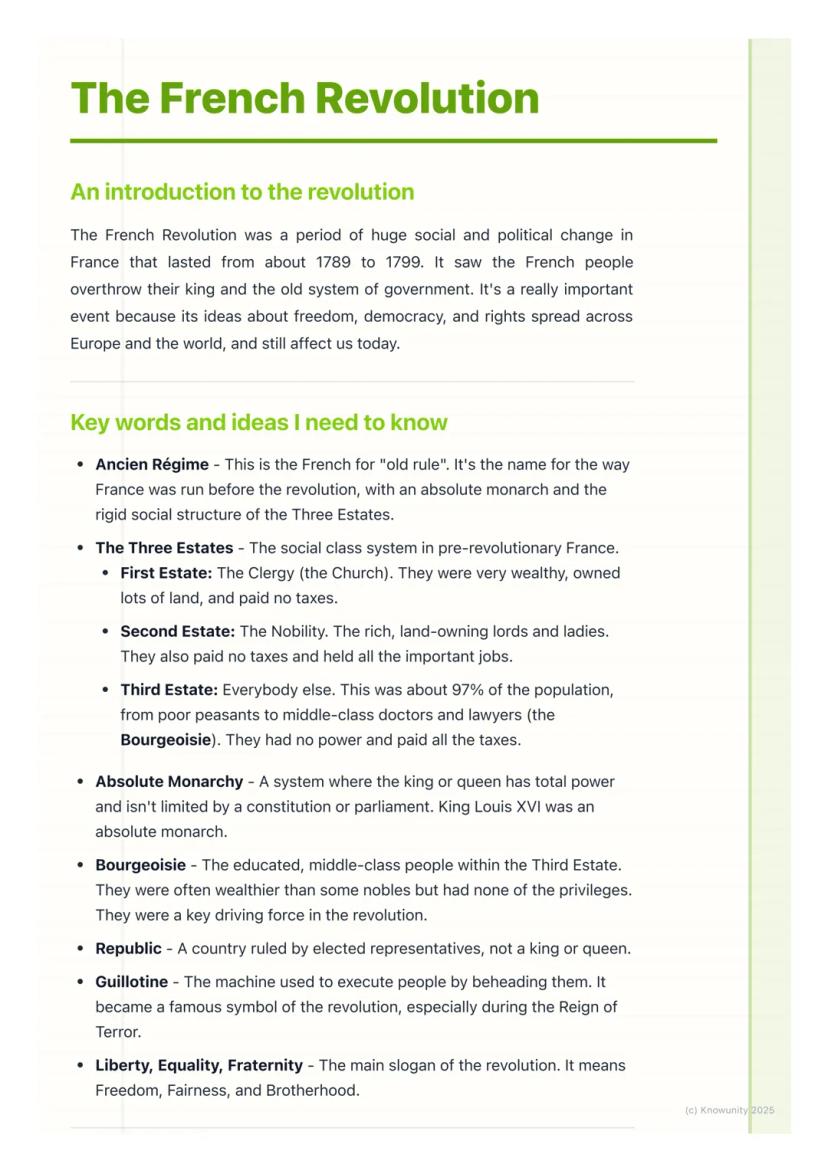
Imagine living in a country where 3% of people hold all the power whilst you're stuck paying crushing taxes with no say in government. That's exactly what sparked the French Revolution - a decade of chaos that changed everything.
The revolution demolished France's old system called the Ancien Régime and introduced ideas that seem obvious to us now. Liberty, Equality, Fraternity became the battle cry that echoed across Europe and inspired countless other revolutions.
Understanding this period is crucial because it shows how quickly societies can transform when people decide they've had enough. The French didn't just complain about unfairness - they completely rebuilt their country from scratch.
Key Insight: The revolution started with peaceful demands for reform but spiralled into violence when the king refused to give up power.
You'll need to know the key terms like the Three Estates (the rigid class system), absolute monarchy (total royal power), and the guillotine (the revolution's most feared symbol). These concepts form the foundation for understanding how one of Europe's most powerful kingdoms collapsed in just ten years.
2
of 6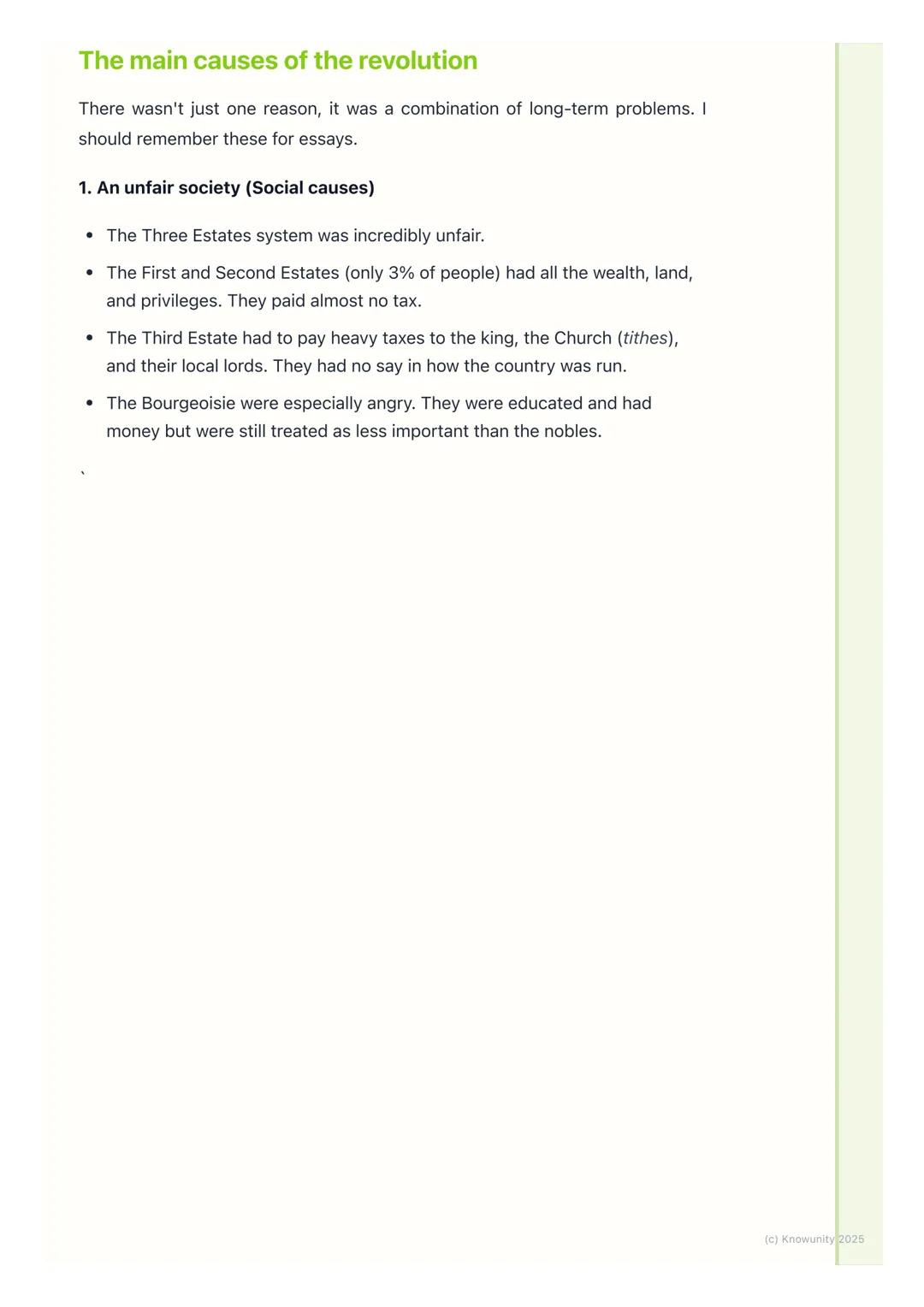
The Main Causes of Revolution
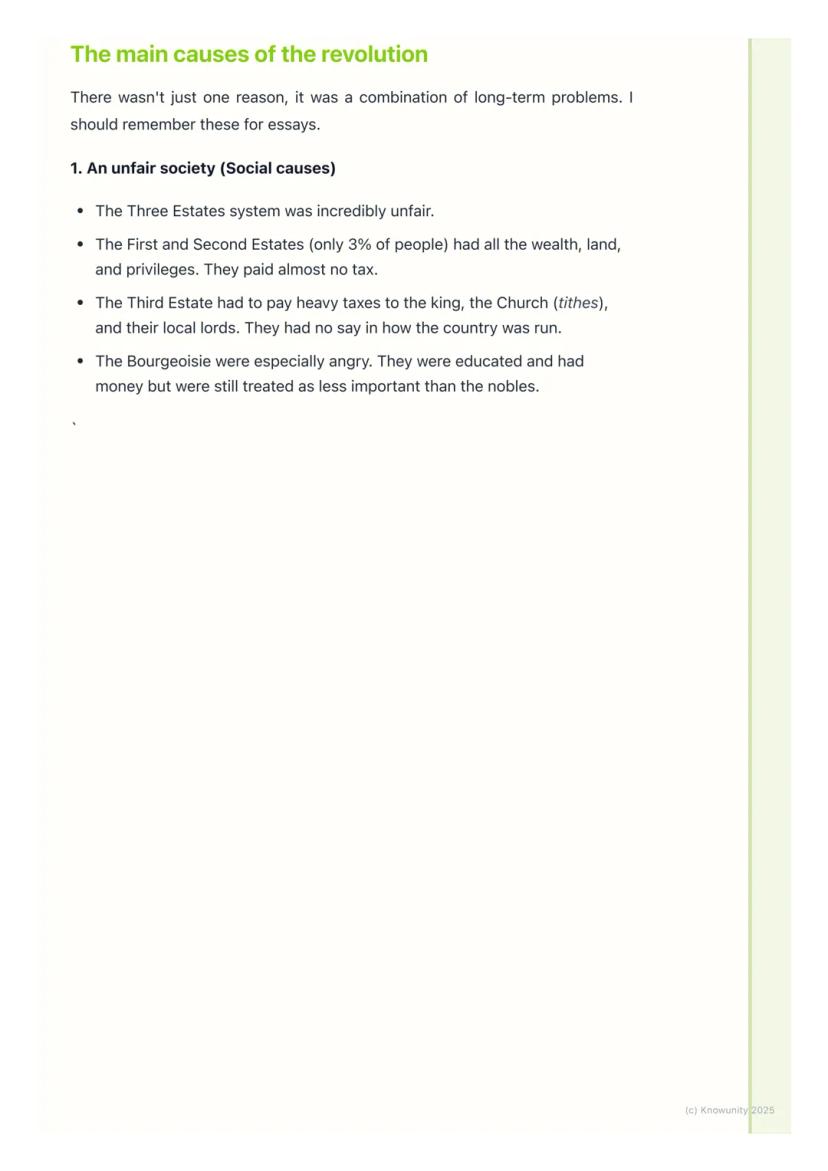
Why did the French suddenly decide to overthrow their entire system? It wasn't just one dramatic moment - multiple problems had been building up for decades like pressure in a volcano.
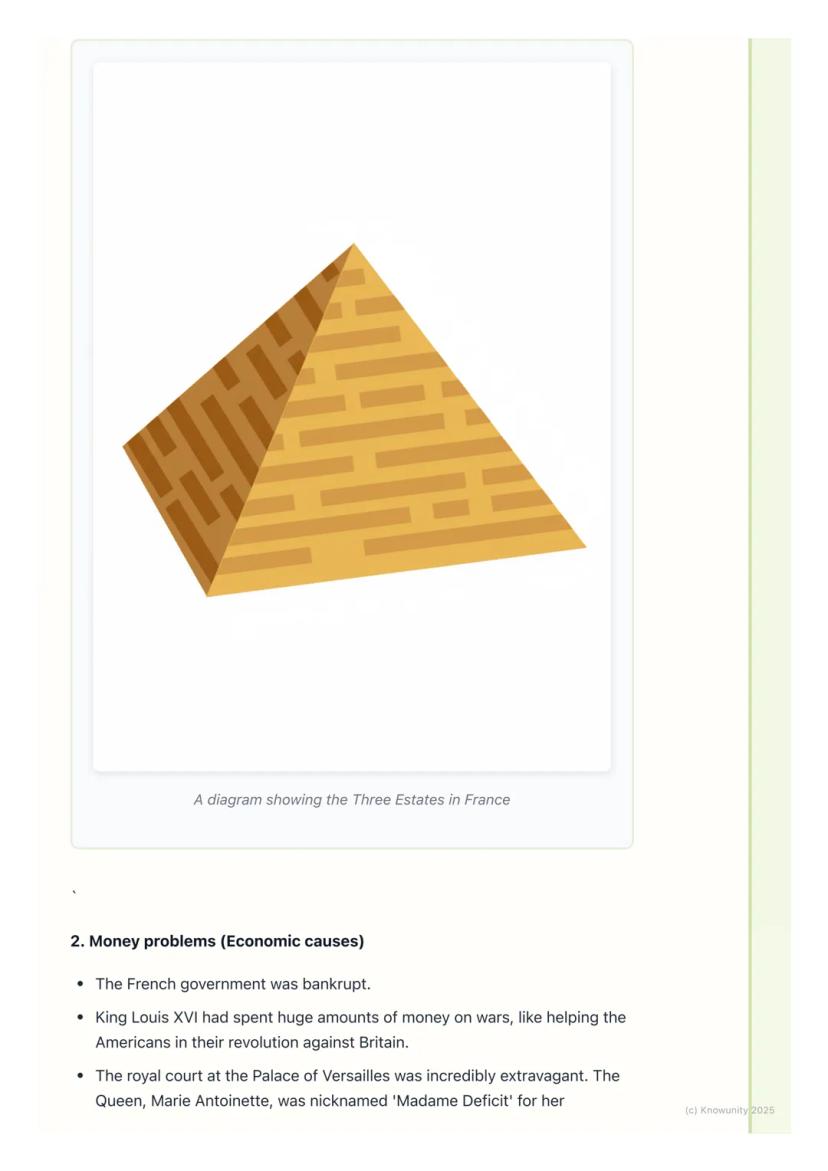
Social inequality was the biggest issue. The Three Estates system meant the clergy (First Estate) and nobles (Second Estate) owned most land and paid zero taxes, whilst everyone else (Third Estate) carried the entire tax burden. The educated middle class, called the Bourgeoisie, were especially frustrated because they had money but no political power.
France's government was completely bankrupt from expensive wars, including helping America fight Britain. Meanwhile, bad harvests in the 1780s sent bread prices soaring, leaving ordinary people literally starving whilst the royal court at Versailles threw lavish parties.
King Louis XVI proved too weak and indecisive to solve these mounting crises. At the same time, Enlightenment ideas about democracy and human rights were spreading rapidly, making people question why they should accept absolute royal rule.
Remember This: The revolution had economic, social, and political causes all happening simultaneously - never blame it on just one factor in your essays.
3
of 6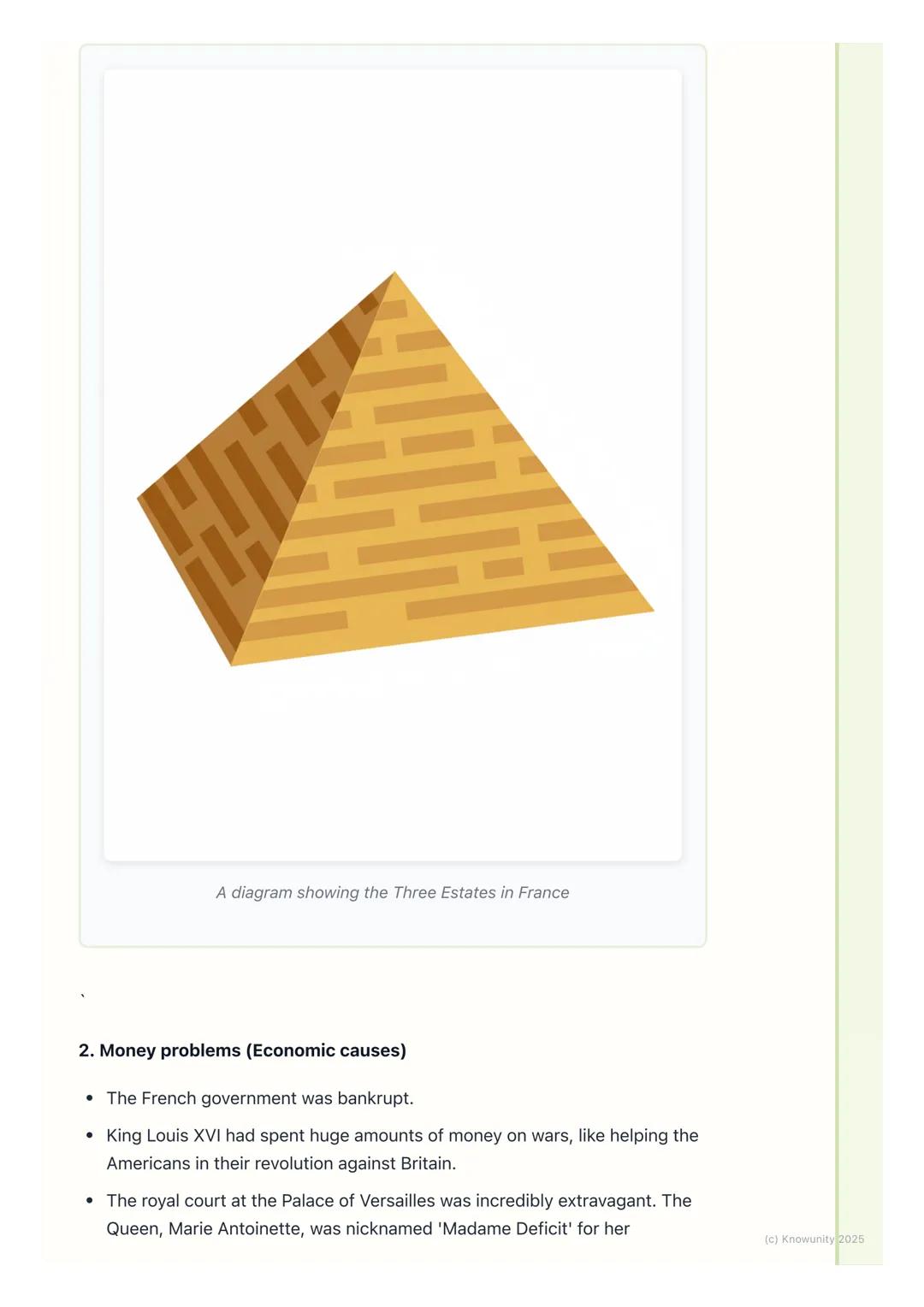
Key Events Timeline - The Revolution Begins
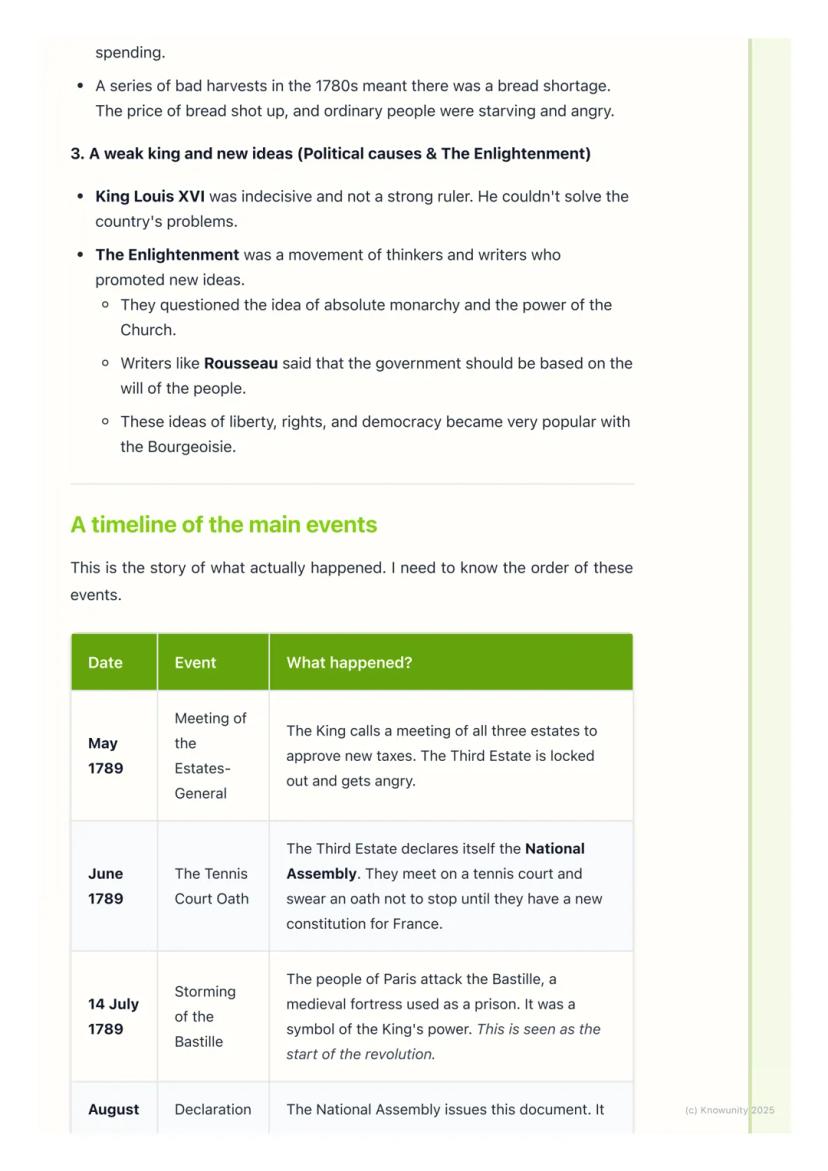
The revolution exploded in 1789 when King Louis XVI made a fatal mistake - he called the Estates-General to approve new taxes, not realising this would give his opponents a platform to demand change.
When the Third Estate got locked out of meetings in May 1789, they formed their own National Assembly and took the famous Tennis Court Oath in June. They literally met on a tennis court and swore not to stop until France had a new constitution - talk about determination!
14th July 1789 became the most important date in French history when angry Parisians stormed the Bastille fortress. This medieval prison symbolised royal oppression, and its capture marked the revolution's violent beginning. That's why the French still celebrate Bastille Day as their national holiday.
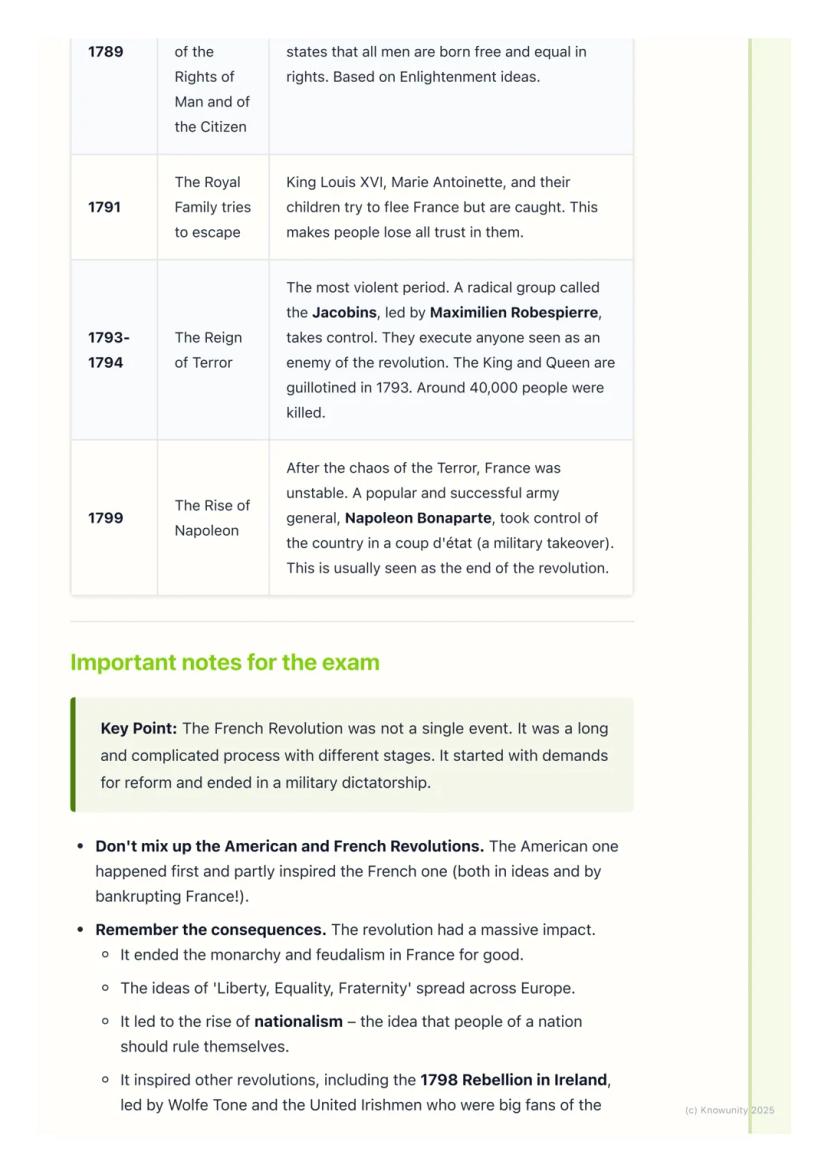
The Declaration of the Rights of Man followed in August 1789, stating that all men are born free and equal. Based on Enlightenment principles, this document challenged everything the old system represented.
Exam Tip: Learn the chronological order - Estates-General, Tennis Court Oath, Storming of Bastille, Declaration of Rights. This sequence shows how peaceful protest escalated into revolution.
4
of 6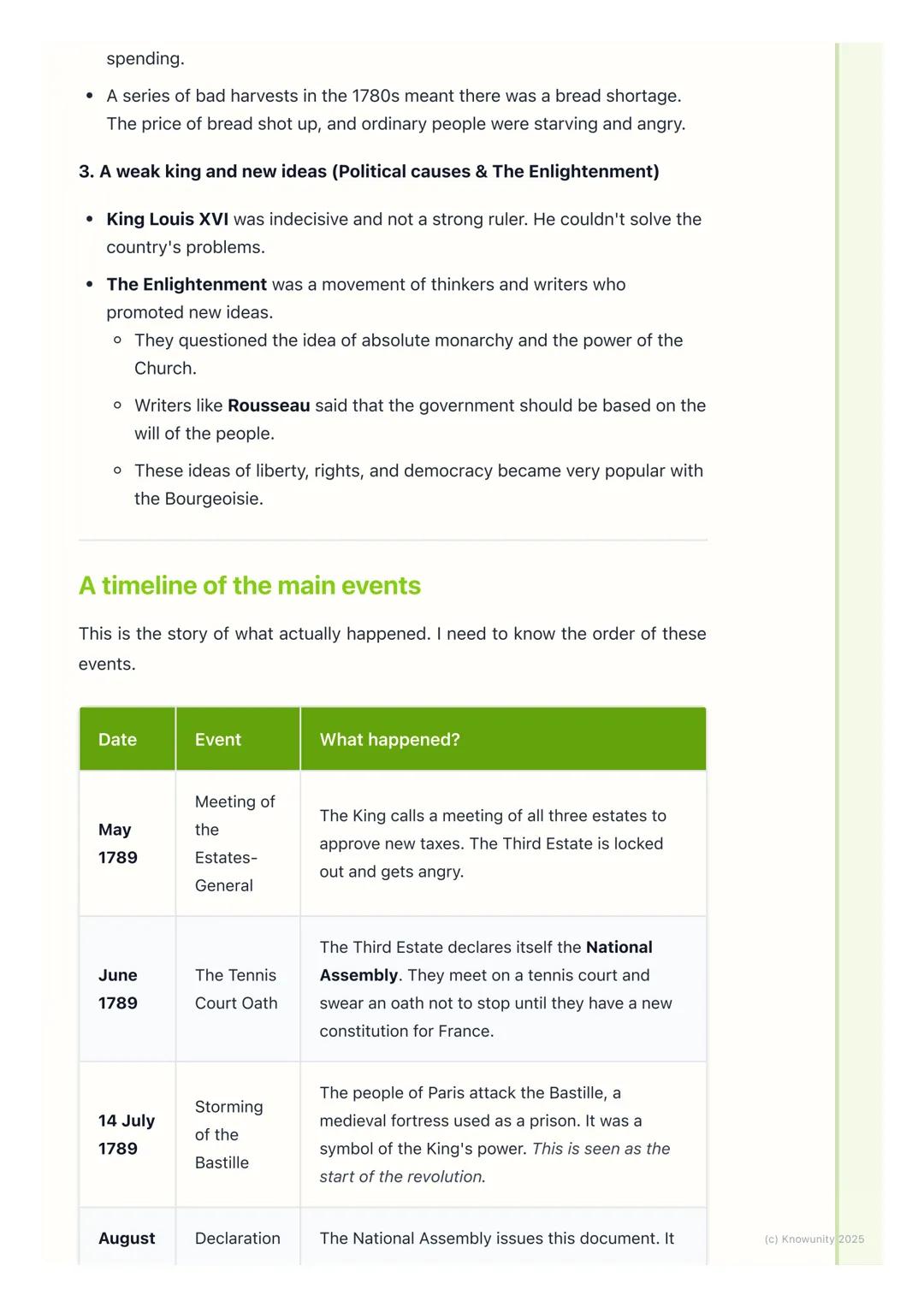
The Terror and Napoleon's Rise
Things got seriously dark during the Reign of Terror (1793-1794) when radical revolutionaries called the Jacobins took control under Maximilien Robespierre. Their solution to opposition? The guillotine.
King Louis XVI and Marie Antoinette lost their heads in 1793, along with around 40,000 other people deemed "enemies of the revolution". The royal family's failed escape attempt in 1791 had already destroyed any remaining public trust in them.
Robespierre believed terror was necessary to protect the revolution, but ironically, he ended up getting guillotined himself when people grew sick of the bloodshed. The revolution was eating its own children.
By 1799, France was exhausted from years of chaos and war. Enter Napoleon Bonaparte - a brilliant general who seized power in a military coup. Most people welcomed strong leadership after a decade of uncertainty, even if it meant giving up their hard-won freedoms.
Historical Irony: The revolution that started to limit royal power ended up creating an emperor who had more authority than any French king ever possessed.
5
of 6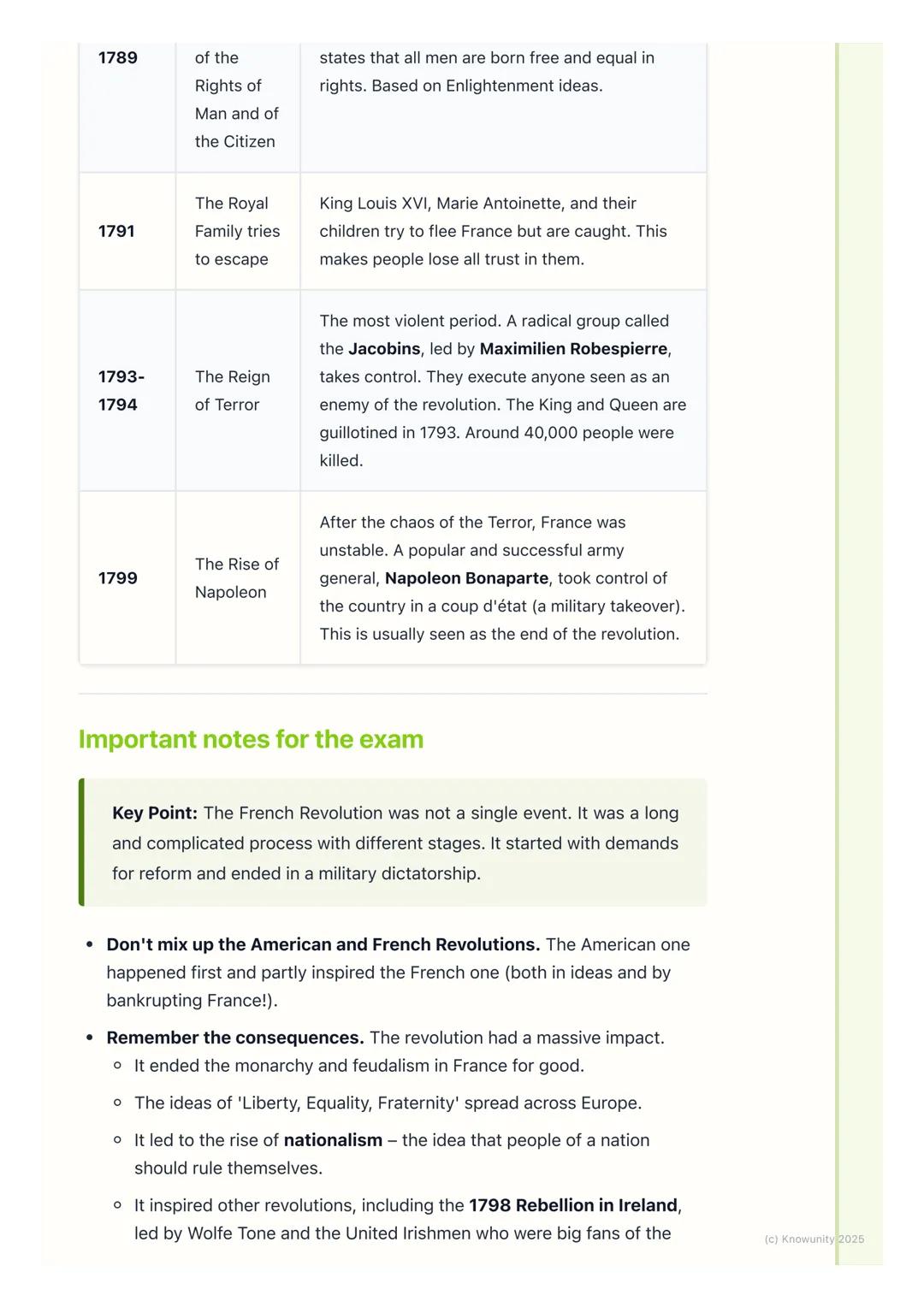
Revolution's Impact and Legacy
Don't think the French Revolution was just a local French affair - its consequences rippled across the entire world and still affect us today.
The revolution permanently destroyed feudalism and absolute monarchy in France. More importantly, it spread revolutionary ideas about democracy, nationalism, and human rights throughout Europe like wildfire.
These concepts directly inspired the 1798 Rebellion in Ireland, where Wolfe Tone and the United Irishmen tried to copy French revolutionary principles. The idea that ordinary people could overthrow their rulers terrified monarchs everywhere.
However, the revolution's immediate results were mixed. The dream of stable democracy failed spectacularly, leading instead to Napoleon's dictatorship and decades of European warfare. Sometimes revolutions don't end up where their supporters intended.
Long-term Perspective: While the revolution caused massive short-term suffering, its core ideas about equality and popular sovereignty eventually became the foundation of modern democracy.
The revolution proved that even the most powerful systems can collapse when people unite behind shared grievances and alternative visions for society.
6
of 6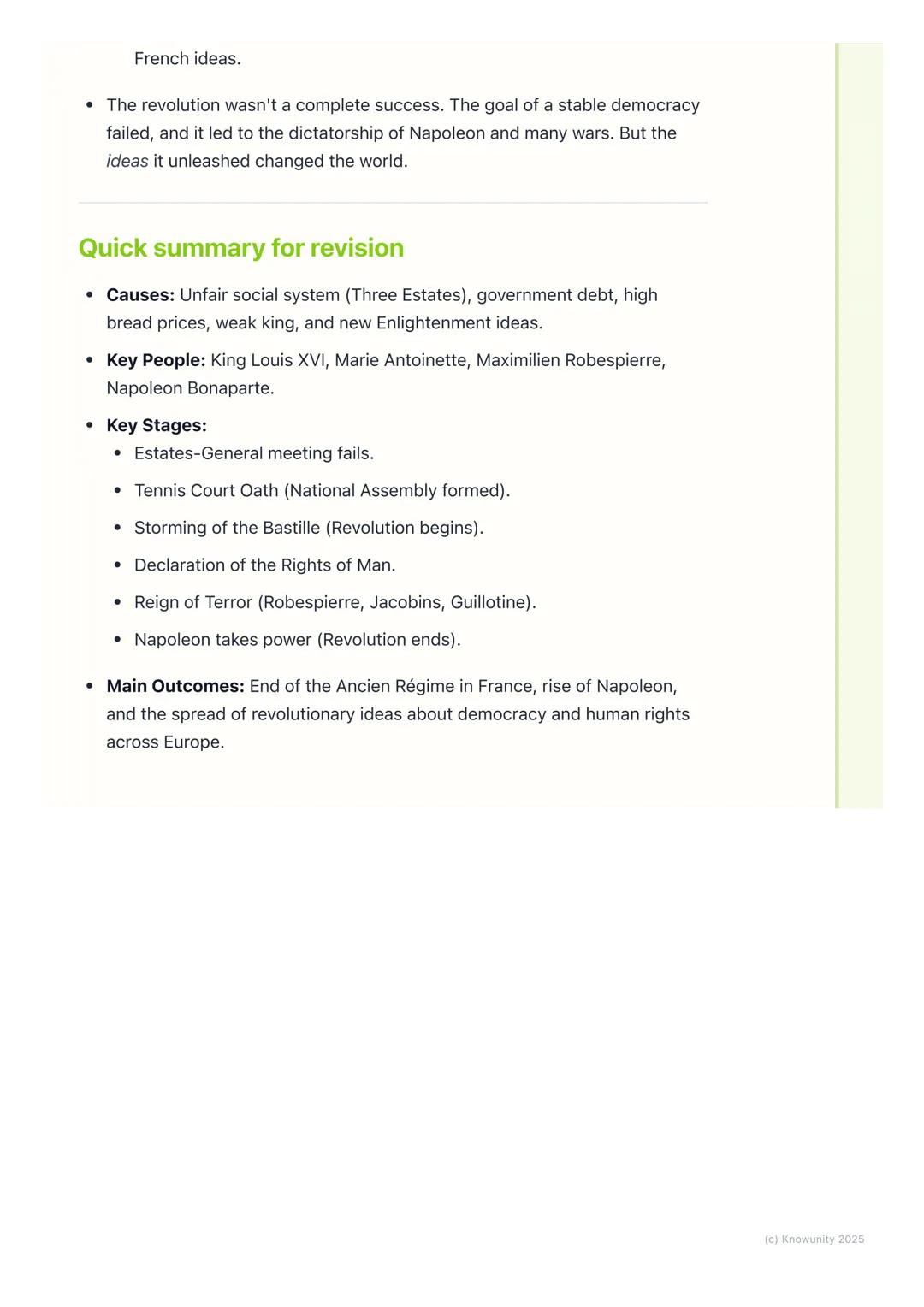
Quick Revision Summary
Here's everything you need to remember for your exam, organised clearly so you can revise efficiently.
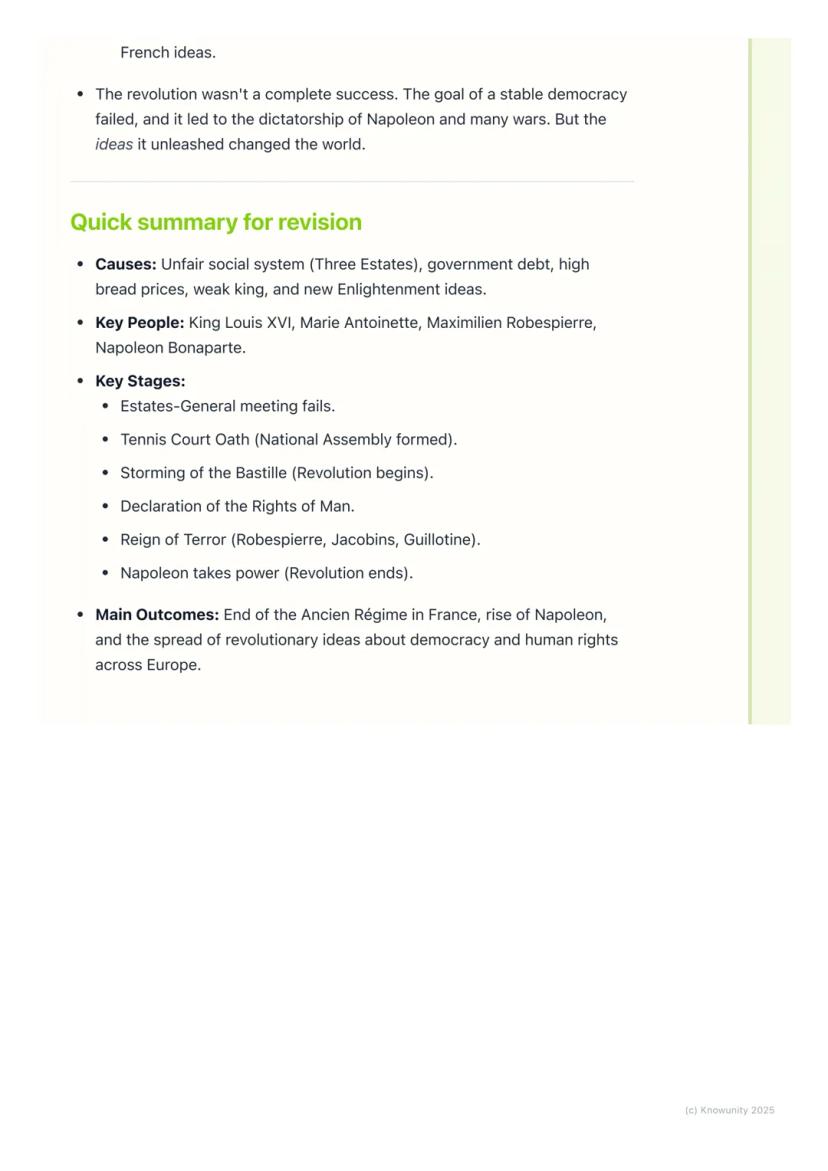
Main Causes: Unfair Three Estates system, government bankruptcy, bread shortages, weak King Louis XVI, and Enlightenment ideas about democracy spreading rapidly.
Key People: Louis XVI (weak king), Marie Antoinette (unpopular queen), Robespierre (Terror leader), Napoleon (military dictator who ended the revolution).
Essential Timeline: Estates-General crisis → Tennis Court Oath → Storming of Bastille → Declaration of Rights → Reign of Terror → Napoleon's coup.
Major Outcomes: End of Ancien Régime, spread of democratic ideas across Europe, rise of nationalism, inspiration for other revolutions including Ireland's 1798 Rebellion.
Exam Success: Always explain how causes connected together rather than listing them separately - examiners love seeing you understand the links between different factors.
Remember that the French Revolution wasn't just about France. Its ideas about liberty, equality, and popular sovereignty transformed political thinking worldwide and laid the groundwork for modern democratic societies.
Pensavamo che non l'avreste mai chiesto....
Che cos'è l'assistente AI di Knowunity?
Il nostro assistente AI è costruito specificamente per le esigenze degli studenti. Sulla base dei milioni di contenuti presenti sulla piattaforma, possiamo fornire agli studenti risposte davvero significative e pertinenti. Ma non si tratta solo di risposte, l'assistente è in grado di guidare gli studenti attraverso le loro sfide quotidiane di studio, con piani di studio personalizzati, quiz o contenuti nella chat e una personalizzazione al 100% basata sulle competenze e sugli sviluppi degli studenti.
Dove posso scaricare l'applicazione Knowunity?
È possibile scaricare l'applicazione dal Google Play Store e dall'Apple App Store.
Knowunity è davvero gratuita?
Sì, hai accesso completamente gratuito a tutti i contenuti nell'app e puoi chattare o seguire i Creatori in qualsiasi momento. Sbloccherai nuove funzioni crescendo il tuo numero di follower. Inoltre, offriamo Knowunity Premium, che consente di studiare senza alcun limite!!
Contenuti più popolari di History
9HistoryThe Great Famine (An Gorta Mór)
Students will learn about the causes, devastating impact, and long-term consequences of the potato famine on Irish population and society.
2nd Year282
HistoryThe renaissance
junior cert renaissance summary
1st Year361
HistoryCauses and Consequences of World War II
This subtopic covers the origins of the Second World War, its global scale, and its devastating human and political consequences, including the atomic bomb.
3rd Year152
HistoryThe 1798 Rebellion in Ireland
Learning about the causes, events, and aftermath of the United Irishmen's rebellion against British rule, inspired by revolutionary ideals.
3rd Year211
HistoryAmerican revolution
junior cert american revolution summary
1st Year442
HistoryThe Great Famine (An Gorta Mór)
This critical subtopic examines the causes, devastating impact, and long-term consequences of the potato famine on Irish society, population, and emigration.
3rd Year140
HistoryThe Renaissance
Students will learn about a time of 'rebirth' in Europe, where new ideas in art, science, and literature flourished.
1st Year140
History1916 Rising Revison Sheet
revision sheet
3rd Year211
HistoryThe Reformation in Europe
Students will learn about the causes and key figures of the Protestant Reformation and its impact on European society and politics.
3rd Year110
Contenuti più popolari
9 Irish
IrishIrish oral questions and answers
Questions and answers for the leaving cert oral
5th Year4264
 English
Key Quotes : Sive
Key Quotes and explanations: Sive
6th Year2842
IrishIrish oral questions
Outline of oral questions
5th Year2055
IrishIníon- le hÁine Durkin
Aine Durkin’s poem, Iníon: Themes & summary
5th Year850
IrishIrish poetry 2027
Iníon + Dínit an Bhróin
5th Year1133
IrishLC HL notes- Iníon (poem)
Includes poem in English and Irish, theme, key words & phrases
5th Year2284
EnglishCultural Context : Shawshank Redemption : Sive : Small Things Like These
Comparative Study : Cultural Context : Shawshank Redemption, Sive and Small Things Like These
6th Year1430
IrishMo Ghrá-sa (Idir Lúibíní)
Notes on mo ghrá-sa
5th Year380
IrishAn Gaeilge Aiste
Irish Language essay
6th Year1320
Non c'è niente di adatto? Esplorare altre aree tematiche.
Recensioni dei nostri utenti. Ci adorano - e anche tu, vedrai .
4.6/5App Store
4.7/5Google Play
L'applicazione è molto facile da usare e ben progettata. Finora ho trovato tutto quello che cercavo e ho potuto imparare molto dalle presentazioni! Utilizzerò sicuramente l'app per i compiti in classe! È molto utile anche come fonte di ispirazione.
Stefano Sutente iOS
Questa applicazione è davvero grande! Ci sono tantissimi appunti e aiuti con lo studio [...]. La mia materia problematica, per esempio, è il francese e l'app ha così tante opzioni per aiutarmi. Grazie a questa app ho migliorato il mio francese. La consiglio a tutti.
Samantha Klichutente Android
Wow, sono davvero stupita. Ho appena provato l'app perché l'ho vista pubblicizzata molte volte e sono rimasta assolutamente sbalordita. Questa app è L'AIUTO che cercate per la scuola e soprattutto offre tantissime cose, come allenamenti e schede, che a me personalmente sono state MOLTO utili.
Annautente iOS
History6 visualizzazioni·Aggiornato Jun 15, 2026·6 pagineUnderstanding the French Revolution
The French Revolution was one of the most dramatic periods in European history, completely transforming France between 1789 and 1799. This bloody upheaval saw ordinary people overthrow their king and create a whole new society based on revolutionary ideas about... Mostra di più
1
of 6Iscriviti per mostrare il contenuto. È gratis!
- Accesso a tutti i documenti
- Migliora i tuoi voti
- Unisciti a milioni di studenti
Introduction to the Revolution
Imagine living in a country where 3% of people hold all the power whilst you're stuck paying crushing taxes with no say in government. That's exactly what sparked the French Revolution - a decade of chaos that changed everything.
The revolution demolished France's old system called the Ancien Régime and introduced ideas that seem obvious to us now. Liberty, Equality, Fraternity became the battle cry that echoed across Europe and inspired countless other revolutions.
Understanding this period is crucial because it shows how quickly societies can transform when people decide they've had enough. The French didn't just complain about unfairness - they completely rebuilt their country from scratch.
Key Insight: The revolution started with peaceful demands for reform but spiralled into violence when the king refused to give up power.
You'll need to know the key terms like the Three Estates (the rigid class system), absolute monarchy (total royal power), and the guillotine (the revolution's most feared symbol). These concepts form the foundation for understanding how one of Europe's most powerful kingdoms collapsed in just ten years.
2
of 6Iscriviti per mostrare il contenuto. È gratis!
- Accesso a tutti i documenti
- Migliora i tuoi voti
- Unisciti a milioni di studenti
The Main Causes of Revolution
Why did the French suddenly decide to overthrow their entire system? It wasn't just one dramatic moment - multiple problems had been building up for decades like pressure in a volcano.
Social inequality was the biggest issue. The Three Estates system meant the clergy (First Estate) and nobles (Second Estate) owned most land and paid zero taxes, whilst everyone else (Third Estate) carried the entire tax burden. The educated middle class, called the Bourgeoisie, were especially frustrated because they had money but no political power.
France's government was completely bankrupt from expensive wars, including helping America fight Britain. Meanwhile, bad harvests in the 1780s sent bread prices soaring, leaving ordinary people literally starving whilst the royal court at Versailles threw lavish parties.
King Louis XVI proved too weak and indecisive to solve these mounting crises. At the same time, Enlightenment ideas about democracy and human rights were spreading rapidly, making people question why they should accept absolute royal rule.
Remember This: The revolution had economic, social, and political causes all happening simultaneously - never blame it on just one factor in your essays.
3
of 6Iscriviti per mostrare il contenuto. È gratis!
- Accesso a tutti i documenti
- Migliora i tuoi voti
- Unisciti a milioni di studenti
Key Events Timeline - The Revolution Begins
The revolution exploded in 1789 when King Louis XVI made a fatal mistake - he called the Estates-General to approve new taxes, not realising this would give his opponents a platform to demand change.
When the Third Estate got locked out of meetings in May 1789, they formed their own National Assembly and took the famous Tennis Court Oath in June. They literally met on a tennis court and swore not to stop until France had a new constitution - talk about determination!
14th July 1789 became the most important date in French history when angry Parisians stormed the Bastille fortress. This medieval prison symbolised royal oppression, and its capture marked the revolution's violent beginning. That's why the French still celebrate Bastille Day as their national holiday.
The Declaration of the Rights of Man followed in August 1789, stating that all men are born free and equal. Based on Enlightenment principles, this document challenged everything the old system represented.
Exam Tip: Learn the chronological order - Estates-General, Tennis Court Oath, Storming of Bastille, Declaration of Rights. This sequence shows how peaceful protest escalated into revolution.
4
of 6Iscriviti per mostrare il contenuto. È gratis!
- Accesso a tutti i documenti
- Migliora i tuoi voti
- Unisciti a milioni di studenti
The Terror and Napoleon's Rise
Things got seriously dark during the Reign of Terror (1793-1794) when radical revolutionaries called the Jacobins took control under Maximilien Robespierre. Their solution to opposition? The guillotine.
King Louis XVI and Marie Antoinette lost their heads in 1793, along with around 40,000 other people deemed "enemies of the revolution". The royal family's failed escape attempt in 1791 had already destroyed any remaining public trust in them.
Robespierre believed terror was necessary to protect the revolution, but ironically, he ended up getting guillotined himself when people grew sick of the bloodshed. The revolution was eating its own children.
By 1799, France was exhausted from years of chaos and war. Enter Napoleon Bonaparte - a brilliant general who seized power in a military coup. Most people welcomed strong leadership after a decade of uncertainty, even if it meant giving up their hard-won freedoms.
Historical Irony: The revolution that started to limit royal power ended up creating an emperor who had more authority than any French king ever possessed.
5
of 6Iscriviti per mostrare il contenuto. È gratis!
- Accesso a tutti i documenti
- Migliora i tuoi voti
- Unisciti a milioni di studenti
Revolution's Impact and Legacy
Don't think the French Revolution was just a local French affair - its consequences rippled across the entire world and still affect us today.
The revolution permanently destroyed feudalism and absolute monarchy in France. More importantly, it spread revolutionary ideas about democracy, nationalism, and human rights throughout Europe like wildfire.
These concepts directly inspired the 1798 Rebellion in Ireland, where Wolfe Tone and the United Irishmen tried to copy French revolutionary principles. The idea that ordinary people could overthrow their rulers terrified monarchs everywhere.
However, the revolution's immediate results were mixed. The dream of stable democracy failed spectacularly, leading instead to Napoleon's dictatorship and decades of European warfare. Sometimes revolutions don't end up where their supporters intended.
Long-term Perspective: While the revolution caused massive short-term suffering, its core ideas about equality and popular sovereignty eventually became the foundation of modern democracy.
The revolution proved that even the most powerful systems can collapse when people unite behind shared grievances and alternative visions for society.
6
of 6Iscriviti per mostrare il contenuto. È gratis!
- Accesso a tutti i documenti
- Migliora i tuoi voti
- Unisciti a milioni di studenti
Quick Revision Summary
Here's everything you need to remember for your exam, organised clearly so you can revise efficiently.
Main Causes: Unfair Three Estates system, government bankruptcy, bread shortages, weak King Louis XVI, and Enlightenment ideas about democracy spreading rapidly.
Key People: Louis XVI (weak king), Marie Antoinette (unpopular queen), Robespierre (Terror leader), Napoleon (military dictator who ended the revolution).
Essential Timeline: Estates-General crisis → Tennis Court Oath → Storming of Bastille → Declaration of Rights → Reign of Terror → Napoleon's coup.
Major Outcomes: End of Ancien Régime, spread of democratic ideas across Europe, rise of nationalism, inspiration for other revolutions including Ireland's 1798 Rebellion.
Exam Success: Always explain how causes connected together rather than listing them separately - examiners love seeing you understand the links between different factors.
Remember that the French Revolution wasn't just about France. Its ideas about liberty, equality, and popular sovereignty transformed political thinking worldwide and laid the groundwork for modern democratic societies.
Pensavamo che non l'avreste mai chiesto....
Che cos'è l'assistente AI di Knowunity?
Il nostro assistente AI è costruito specificamente per le esigenze degli studenti. Sulla base dei milioni di contenuti presenti sulla piattaforma, possiamo fornire agli studenti risposte davvero significative e pertinenti. Ma non si tratta solo di risposte, l'assistente è in grado di guidare gli studenti attraverso le loro sfide quotidiane di studio, con piani di studio personalizzati, quiz o contenuti nella chat e una personalizzazione al 100% basata sulle competenze e sugli sviluppi degli studenti.
Dove posso scaricare l'applicazione Knowunity?
È possibile scaricare l'applicazione dal Google Play Store e dall'Apple App Store.
Knowunity è davvero gratuita?
Sì, hai accesso completamente gratuito a tutti i contenuti nell'app e puoi chattare o seguire i Creatori in qualsiasi momento. Sbloccherai nuove funzioni crescendo il tuo numero di follower. Inoltre, offriamo Knowunity Premium, che consente di studiare senza alcun limite!!
Contenuti più popolari di History
9HistoryThe Great Famine (An Gorta Mór)
Students will learn about the causes, devastating impact, and long-term consequences of the potato famine on Irish population and society.
2nd Year282
HistoryThe renaissance
junior cert renaissance summary
1st Year361
HistoryCauses and Consequences of World War II
This subtopic covers the origins of the Second World War, its global scale, and its devastating human and political consequences, including the atomic bomb.
3rd Year152
HistoryThe 1798 Rebellion in Ireland
Learning about the causes, events, and aftermath of the United Irishmen's rebellion against British rule, inspired by revolutionary ideals.
3rd Year211
HistoryAmerican revolution
junior cert american revolution summary
1st Year442
HistoryThe Great Famine (An Gorta Mór)
This critical subtopic examines the causes, devastating impact, and long-term consequences of the potato famine on Irish society, population, and emigration.
3rd Year140
HistoryThe Renaissance
Students will learn about a time of 'rebirth' in Europe, where new ideas in art, science, and literature flourished.
1st Year140
History1916 Rising Revison Sheet
revision sheet
3rd Year211
HistoryThe Reformation in Europe
Students will learn about the causes and key figures of the Protestant Reformation and its impact on European society and politics.
3rd Year110
Contenuti più popolari
9IrishIrish oral questions and answers
Questions and answers for the leaving cert oral
5th Year4264
EnglishKey Quotes : Sive
Key Quotes and explanations: Sive
6th Year2842
IrishIrish oral questions
Outline of oral questions
5th Year2055
IrishIníon- le hÁine Durkin
Aine Durkin’s poem, Iníon: Themes & summary
5th Year850
IrishIrish poetry 2027
Iníon + Dínit an Bhróin
5th Year1133
IrishLC HL notes- Iníon (poem)
Includes poem in English and Irish, theme, key words & phrases
5th Year2284
EnglishCultural Context : Shawshank Redemption : Sive : Small Things Like These
Comparative Study : Cultural Context : Shawshank Redemption, Sive and Small Things Like These
6th Year1430
IrishMo Ghrá-sa (Idir Lúibíní)
Notes on mo ghrá-sa
5th Year380
IrishAn Gaeilge Aiste
Irish Language essay
6th Year1320
Non c'è niente di adatto? Esplorare altre aree tematiche.
Recensioni dei nostri utenti. Ci adorano - e anche tu, vedrai .
4.6/5App Store
4.7/5Google Play
L'applicazione è molto facile da usare e ben progettata. Finora ho trovato tutto quello che cercavo e ho potuto imparare molto dalle presentazioni! Utilizzerò sicuramente l'app per i compiti in classe! È molto utile anche come fonte di ispirazione.
Stefano Sutente iOS
Questa applicazione è davvero grande! Ci sono tantissimi appunti e aiuti con lo studio [...]. La mia materia problematica, per esempio, è il francese e l'app ha così tante opzioni per aiutarmi. Grazie a questa app ho migliorato il mio francese. La consiglio a tutti.
Samantha Klichutente Android
Wow, sono davvero stupita. Ho appena provato l'app perché l'ho vista pubblicizzata molte volte e sono rimasta assolutamente sbalordita. Questa app è L'AIUTO che cercate per la scuola e soprattutto offre tantissime cose, come allenamenti e schede, che a me personalmente sono state MOLTO utili.
Annautente iOS