
The Cold War was one of the most important periods... Mostra di più
 History22 visualizzazioni·Aggiornato May 22, 2026·6 pagine
Understanding the Cold War Era
1 / 6
1
of 6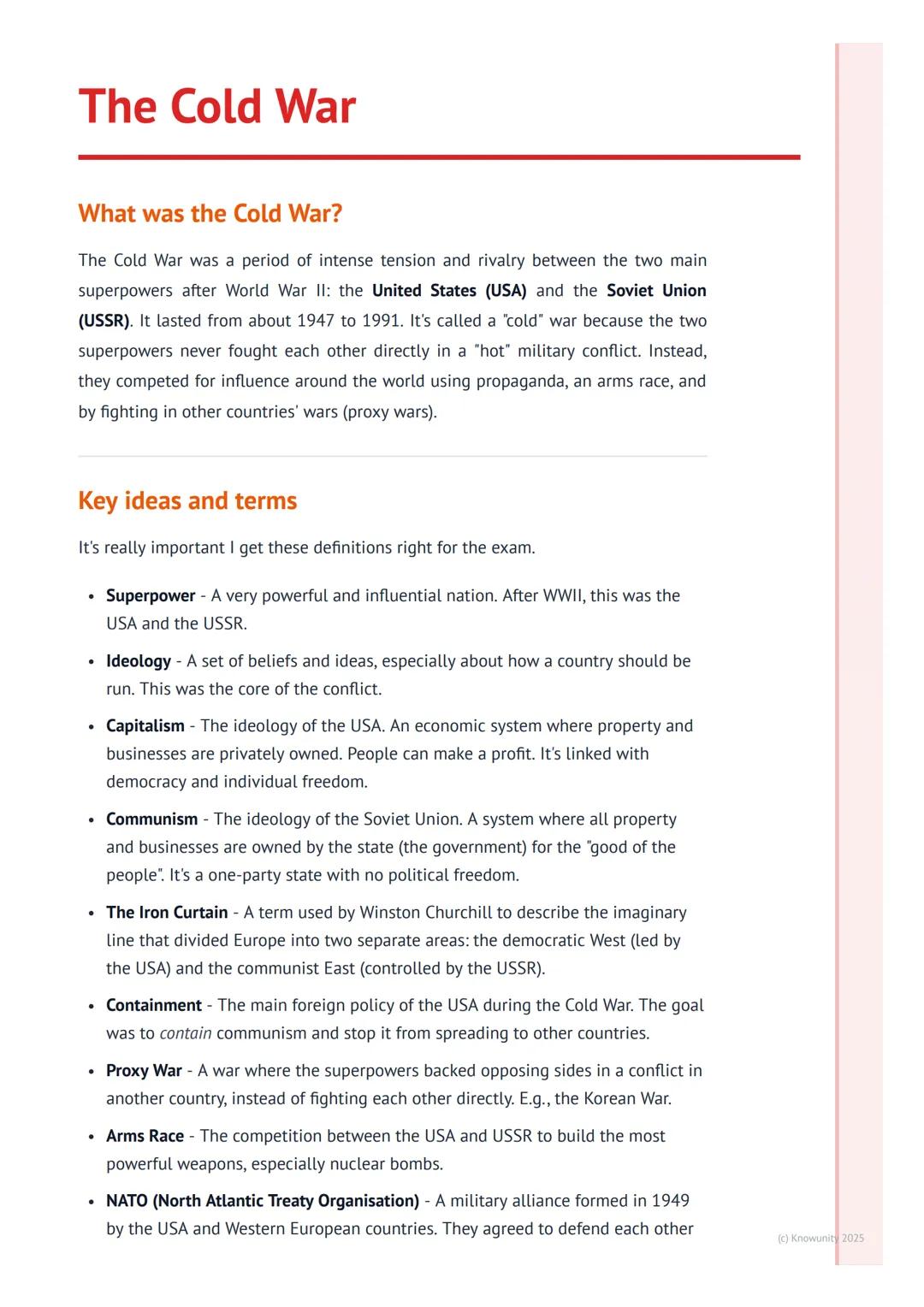
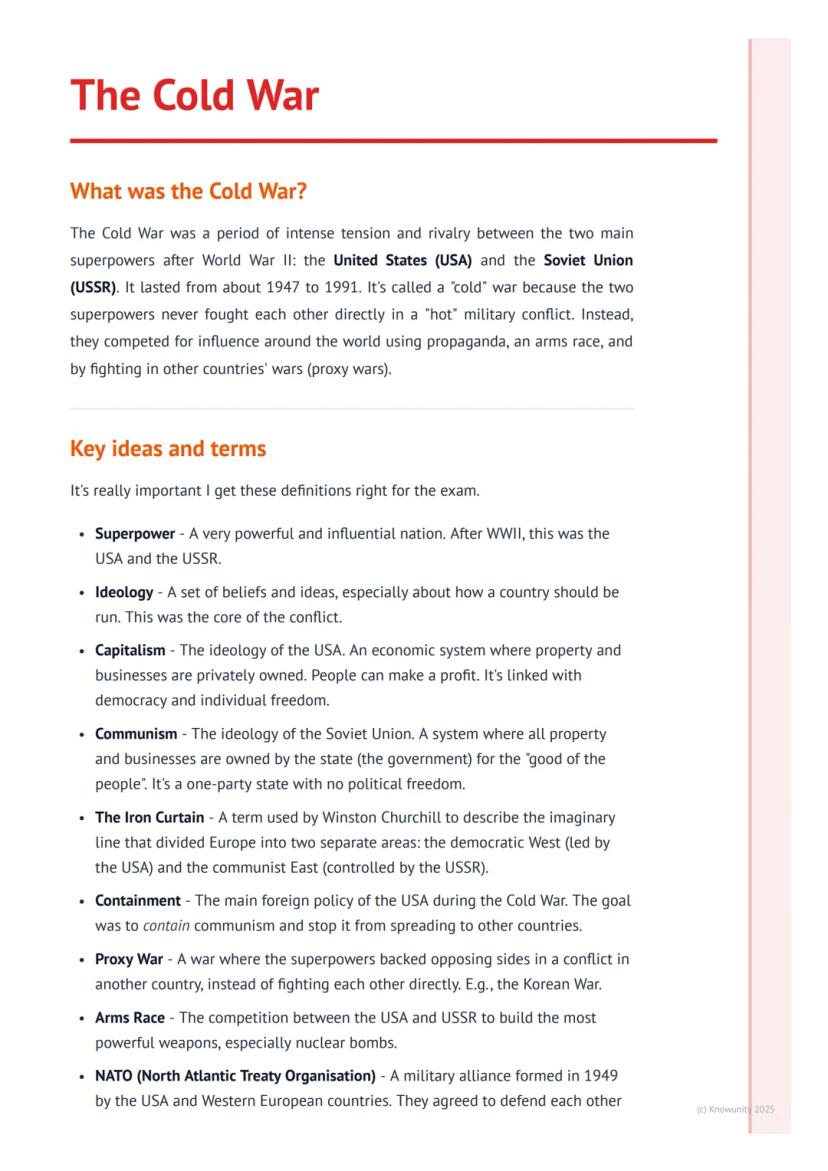
What Was the Cold War?
Ever wondered why it's called a "cold" war when tensions were so heated? The Cold War was the period of intense rivalry between the USA and USSR after World War II, but they never actually fought each other directly in battle.
Instead of tanks and soldiers clashing, these two superpowers competed through propaganda, spying, and backing opposite sides in other countries' conflicts. Think of it like two football rivals who never play each other but constantly try to prove who's better by beating everyone else.
The real fight was about ideology - completely different ideas about how countries should be run. The USA championed capitalism (private ownership, free markets, democracy), whilst the USSR promoted communism . These opposing beliefs would drive nearly half a century of global tension.
Key Point: The Cold War wasn't just about politics - it affected everything from space exploration to sports, dividing the entire world into two opposing camps.
2
of 6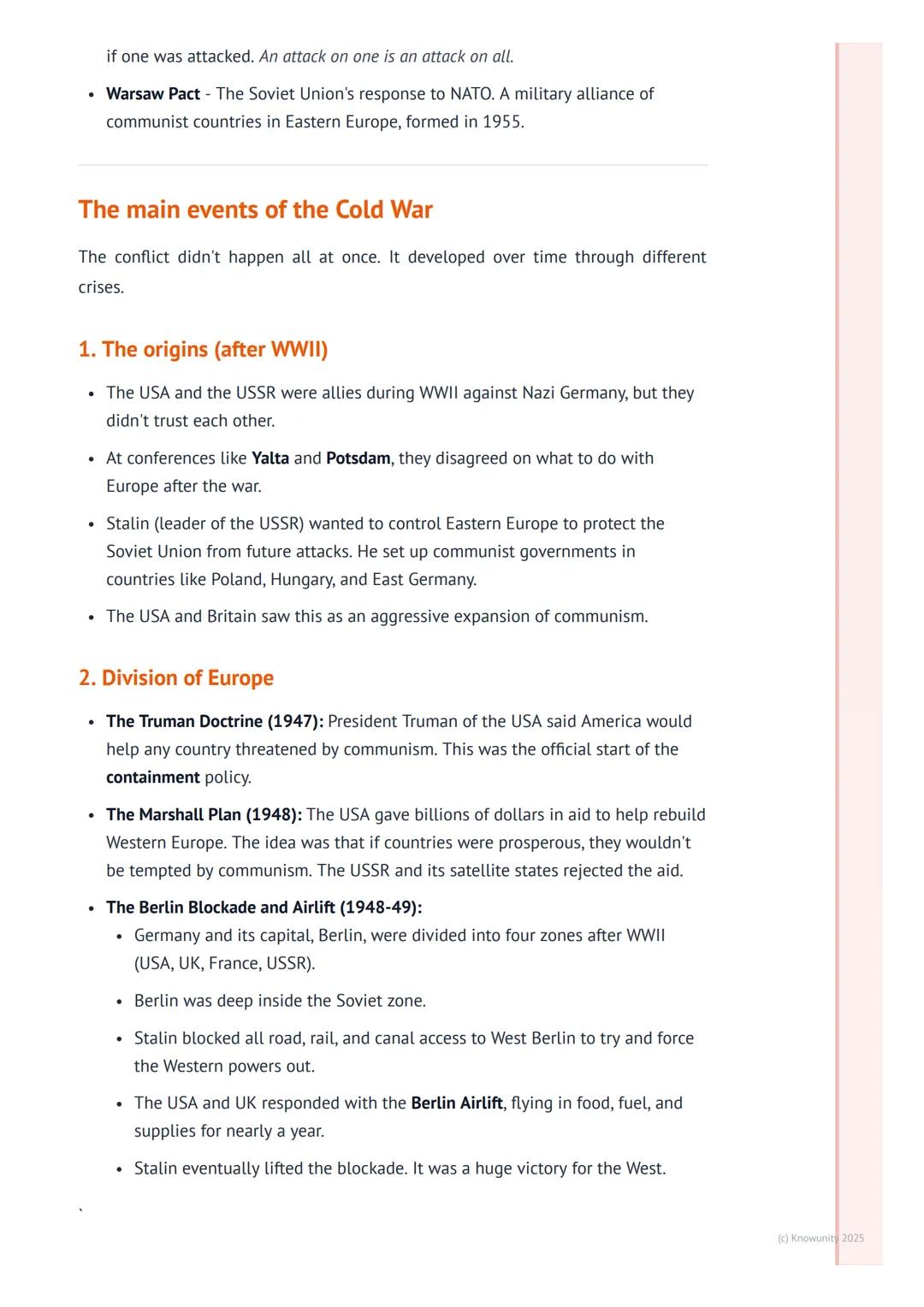
The World Splits in Two
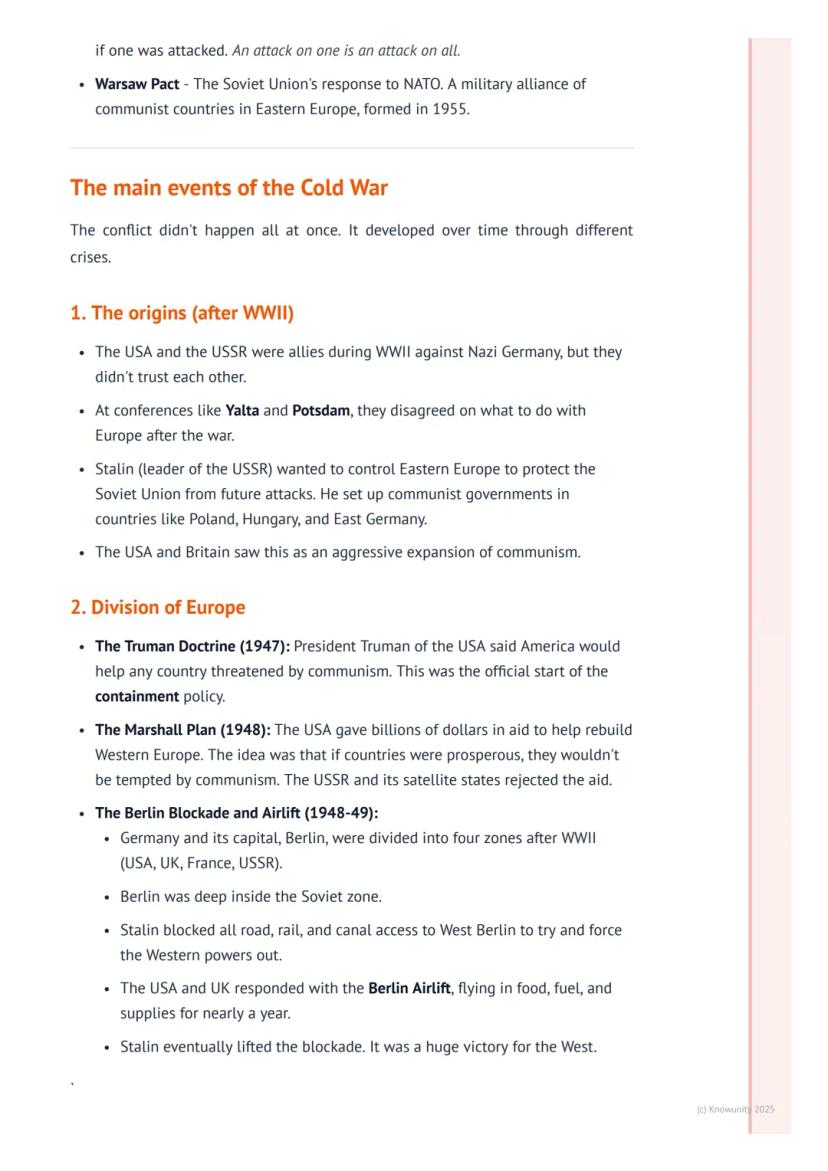
Right after WWII ended, former allies became bitter enemies. Stalin wanted to control Eastern Europe to protect Russia from future attacks, so he installed communist governments across countries like Poland and Hungary.
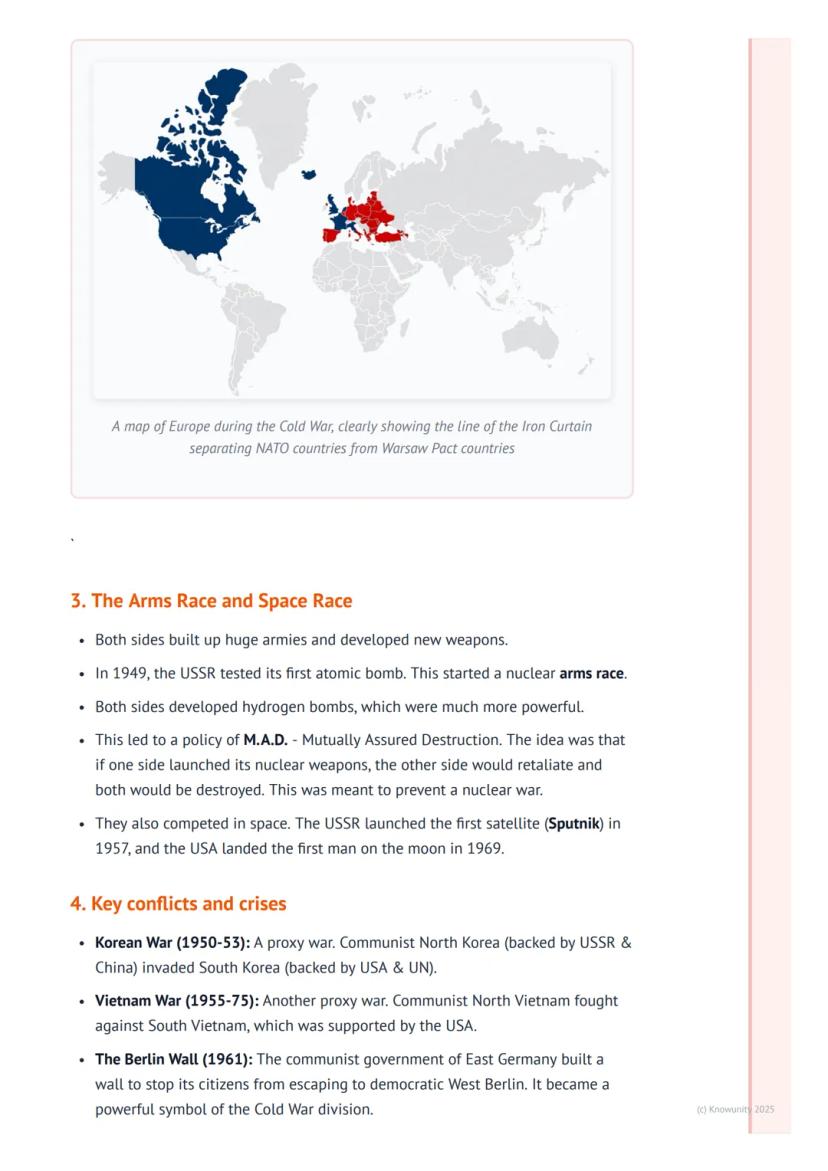
The West saw this as aggressive expansion. Winston Churchill famously described an "Iron Curtain" falling across Europe, separating the democratic West from the communist East. This wasn't an actual wall - it was an invisible line that divided families, friends, and entire nations.
America responded with the Truman Doctrine in 1947, promising to help any country threatened by communism. This containment policy became America's main strategy throughout the Cold War. The Marshall Plan followed, pumping billions of dollars into rebuilding Western Europe - because prosperous countries were less likely to turn communist.
The first major showdown came with the Berlin Blockade (1948-49). Stalin cut off all access to West Berlin, but America and Britain responded with a massive airlift, flying in supplies for nearly a year until Stalin backed down.
Remember This: The Truman Doctrine and Marshall Plan weren't just generous gestures - they were strategic moves to stop communism spreading westward.
3
of 6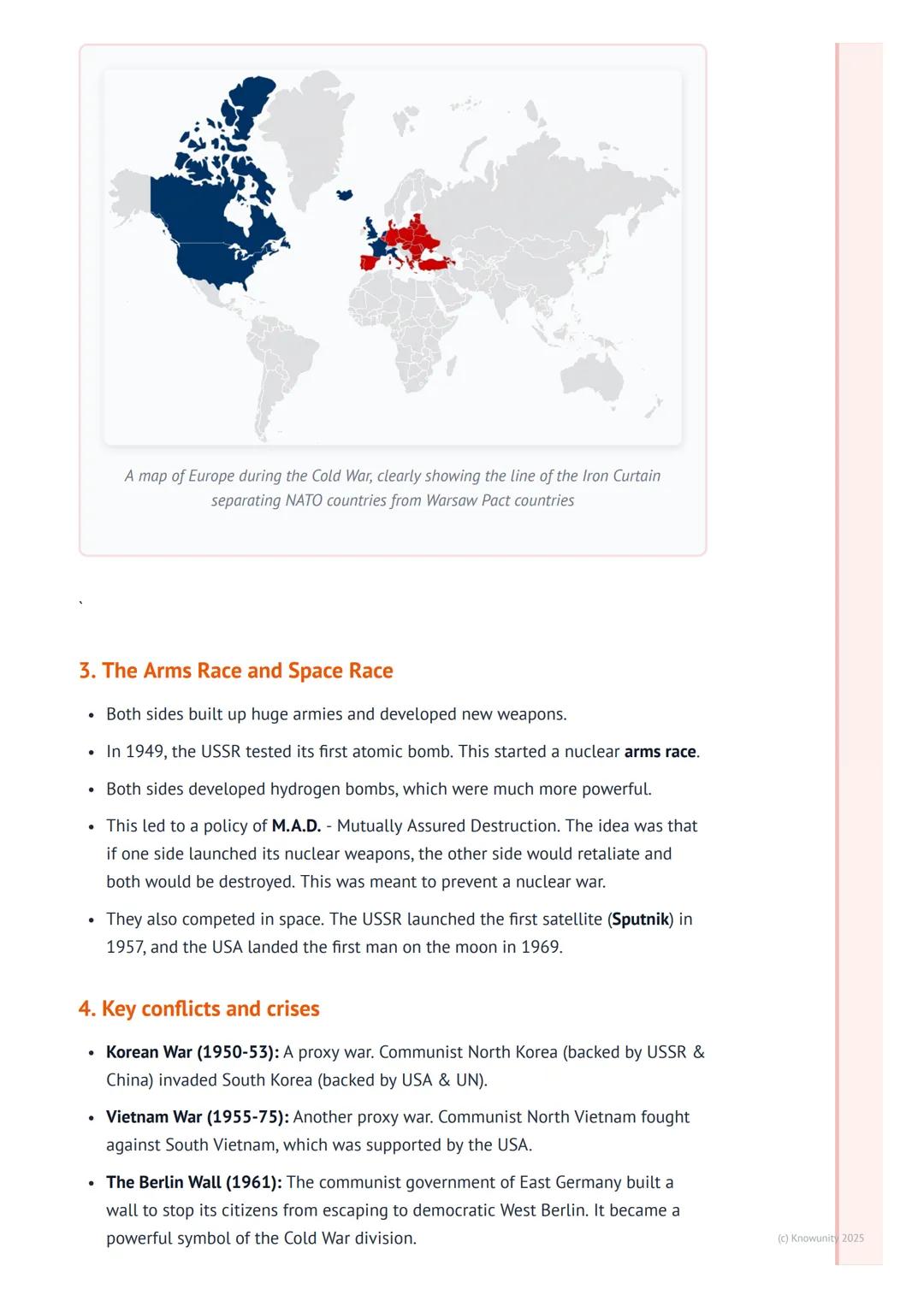
The Arms Race and Major Conflicts
The 1950s and 60s saw an terrifying nuclear arms race. When the USSR tested its first atomic bomb in 1949, both sides began building increasingly powerful weapons. This led to M.A.D. - Mutually Assured Destruction - the terrifying logic that neither side would start a nuclear war because both would be completely destroyed.
The superpowers also fought proxy wars - backing opposing sides in conflicts around the world rather than fighting directly. The Korean War (1950-53) saw communist North Korea battle American-backed South Korea. The Vietnam War dragged on even longer, becoming America's longest and most controversial conflict of the era.
Meanwhile, the Berlin Wall went up in 1961, physically dividing East and West Berlin. Families were separated overnight, and the wall became the most powerful symbol of Cold War division. East German guards shot anyone trying to escape to the West.
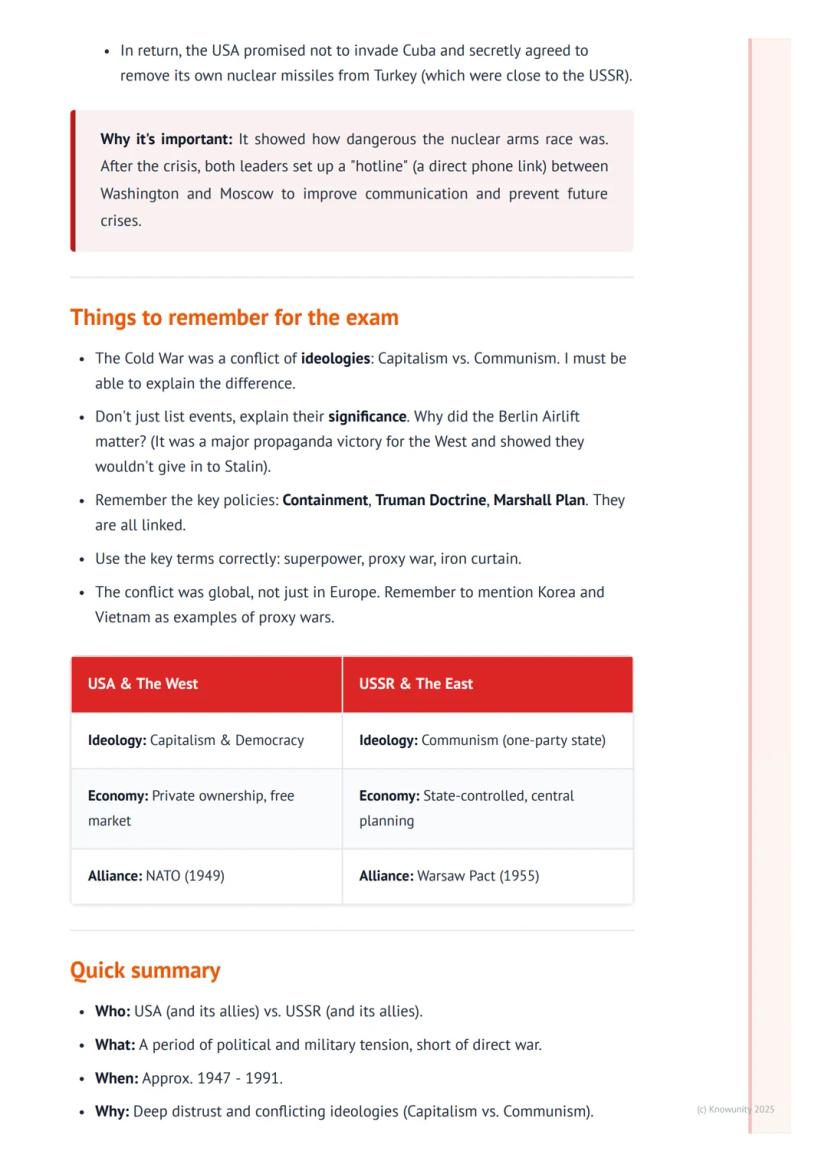
The Cuban Missile Crisis in 1962 brought the world closest to nuclear war. For 13 terrifying days, American and Soviet leaders played a deadly game of brinkmanship over Soviet missiles in Cuba, just 90 miles from Florida.
Exam Tip: Don't just memorise dates - understand why these events mattered and how they increased or decreased tensions between the superpowers.
4
of 6
The Cuban Missile Crisis - 13 Days That Nearly Ended the World
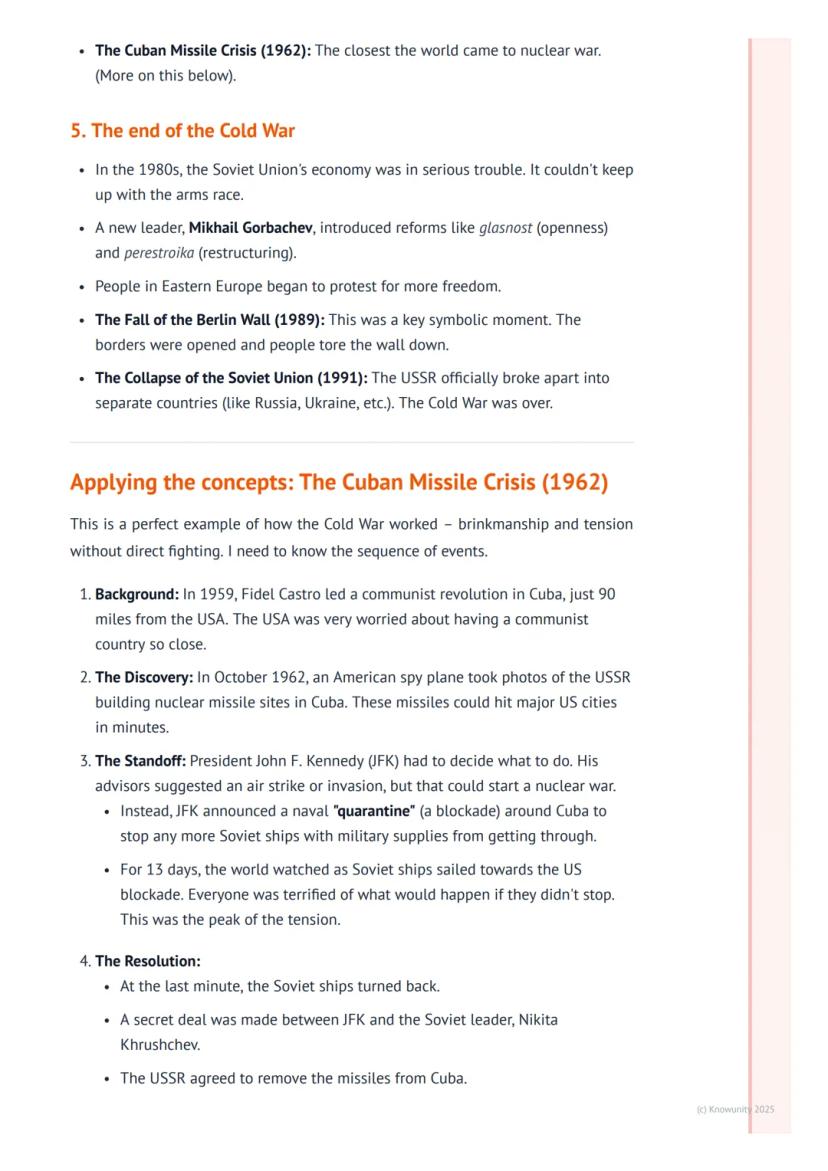
October 1962 was the most dangerous moment in human history. American spy planes discovered Soviet nuclear missiles being installed in Cuba, capable of hitting major US cities within minutes of launch.
President John F. Kennedy faced an impossible choice. Military advisors wanted to bomb the sites or invade Cuba, but that could trigger World War III. Instead, JFK announced a naval blockade around Cuba, stopping Soviet ships from delivering more weapons.
For 13 days, the world held its breath as Soviet ships approached the American blockade. Would they stop or force their way through? Nuclear submarines lurked beneath the waves, and both sides' militaries were on highest alert.
Finally, Soviet leader Khrushchev blinked first. The ships turned back, and a secret deal was struck: Russia would remove missiles from Cuba, America would promise not to invade Cuba, and secretly remove its own missiles from Turkey. The crisis established a "hotline" between Washington and Moscow to prevent future misunderstandings.
Why It Matters: The Cuban Missile Crisis showed how quickly the Cold War could turn hot - and how important communication was in preventing nuclear disaster.
5
of 6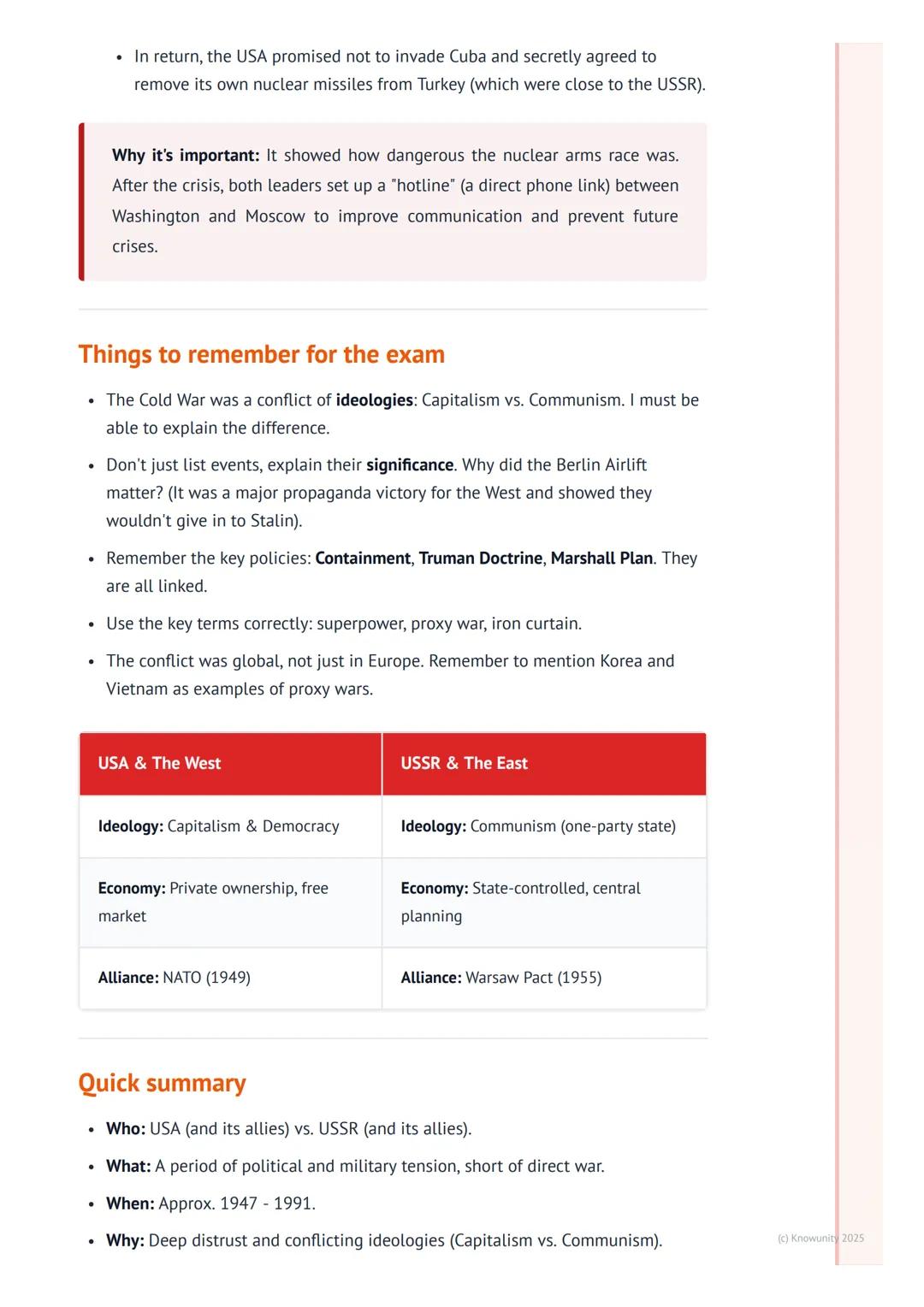
Military Alliances and the Space Race
Both sides built military alliances to strengthen their positions. NATO (North Atlantic Treaty Organisation) formed in 1949, uniting America with Western European countries under the principle that an attack on one was an attack on all. The Soviets responded with the Warsaw Pact in 1955, binding Eastern European communist countries together.
The competition extended beyond Earth into space. The USSR shocked the world by launching Sputnik, the first satellite, in 1957. This space race became another front in the Cold War, with each side trying to prove their technological superiority.
America eventually won this particular contest by landing the first humans on the moon in 1969, but the space race pushed both nations to incredible technological achievements that benefit us today.
Throughout this period, both sides used propaganda, spying, and economic pressure to gain advantages. The KGB and CIA became household names as secret agents operated across the globe, gathering intelligence and supporting friendly governments.
Think About It: Many technologies we use daily - from GPS to the internet - originated from Cold War military research and the space race.
6
of 6
The End of an Era
By the 1980s, the Soviet Union was cracking under pressure. The arms race had drained their economy, and their outdated system couldn't compete with Western prosperity. When Mikhail Gorbachev became Soviet leader, he introduced glasnost (openness) and perestroika (restructuring) to save the system.
Instead, these reforms unleashed forces that destroyed Soviet control. People across Eastern Europe demanded freedom, and communist governments began toppling like dominoes. The most symbolic moment came in 1989 when the Berlin Wall fell, with ordinary citizens taking sledgehammers to the concrete barrier that had divided their city for 28 years.
The Soviet Union officially collapsed in 1991, splitting into separate countries like Russia, Ukraine, and the Baltic states. The Cold War was finally over, leaving America as the world's only superpower.
The Cold War's end didn't solve all global problems, but it removed the constant threat of nuclear annihilation that had haunted two generations. Understanding this period helps explain many current world issues, from NATO expansion to tensions with Russia.
For Your Exams: Focus on key turning points, understand the difference between capitalism and communism, and be able to explain how specific events like the Berlin Airlift showed the broader conflict between the superpowers.
Pensavamo che non l'avreste mai chiesto....
Che cos'è l'assistente AI di Knowunity?
Il nostro assistente AI è costruito specificamente per le esigenze degli studenti. Sulla base dei milioni di contenuti presenti sulla piattaforma, possiamo fornire agli studenti risposte davvero significative e pertinenti. Ma non si tratta solo di risposte, l'assistente è in grado di guidare gli studenti attraverso le loro sfide quotidiane di studio, con piani di studio personalizzati, quiz o contenuti nella chat e una personalizzazione al 100% basata sulle competenze e sugli sviluppi degli studenti.
Dove posso scaricare l'applicazione Knowunity?
È possibile scaricare l'applicazione dal Google Play Store e dall'Apple App Store.
Knowunity è davvero gratuita?
Sì, hai accesso completamente gratuito a tutti i contenuti nell'app e puoi chattare o seguire i Creatori in qualsiasi momento. Sbloccherai nuove funzioni crescendo il tuo numero di follower. Inoltre, offriamo Knowunity Premium, che consente di studiare senza alcun limite!!
Contenuti più popolari di History
9Contenuti più popolari
9Non c'è niente di adatto? Esplorare altre aree tematiche.
Recensioni dei nostri utenti. Ci adorano - e anche tu, vedrai .
4.6/5App Store
4.7/5Google Play
L'applicazione è molto facile da usare e ben progettata. Finora ho trovato tutto quello che cercavo e ho potuto imparare molto dalle presentazioni! Utilizzerò sicuramente l'app per i compiti in classe! È molto utile anche come fonte di ispirazione.
Stefano Sutente iOS
Questa applicazione è davvero grande! Ci sono tantissimi appunti e aiuti con lo studio [...]. La mia materia problematica, per esempio, è il francese e l'app ha così tante opzioni per aiutarmi. Grazie a questa app ho migliorato il mio francese. La consiglio a tutti.
Samantha Klichutente Android
Wow, sono davvero stupita. Ho appena provato l'app perché l'ho vista pubblicizzata molte volte e sono rimasta assolutamente sbalordita. Questa app è L'AIUTO che cercate per la scuola e soprattutto offre tantissime cose, come allenamenti e schede, che a me personalmente sono state MOLTO utili.
Annautente iOS
History22 visualizzazioni·Aggiornato May 22, 2026·6 pagineUnderstanding the Cold War Era
The Cold War was one of the most important periods in modern history, shaping the world we live in today. From 1947 to 1991, two superpowers - the USA and USSR - faced off in a tense rivalry that nearly... Mostra di più
1
of 6Iscriviti per mostrare il contenuto. È gratis!
- Accesso a tutti i documenti
- Migliora i tuoi voti
- Unisciti a milioni di studenti
What Was the Cold War?
Ever wondered why it's called a "cold" war when tensions were so heated? The Cold War was the period of intense rivalry between the USA and USSR after World War II, but they never actually fought each other directly in battle.
Instead of tanks and soldiers clashing, these two superpowers competed through propaganda, spying, and backing opposite sides in other countries' conflicts. Think of it like two football rivals who never play each other but constantly try to prove who's better by beating everyone else.
The real fight was about ideology - completely different ideas about how countries should be run. The USA championed capitalism (private ownership, free markets, democracy), whilst the USSR promoted communism . These opposing beliefs would drive nearly half a century of global tension.
Key Point: The Cold War wasn't just about politics - it affected everything from space exploration to sports, dividing the entire world into two opposing camps.
2
of 6Iscriviti per mostrare il contenuto. È gratis!
- Accesso a tutti i documenti
- Migliora i tuoi voti
- Unisciti a milioni di studenti
The World Splits in Two
Right after WWII ended, former allies became bitter enemies. Stalin wanted to control Eastern Europe to protect Russia from future attacks, so he installed communist governments across countries like Poland and Hungary.
The West saw this as aggressive expansion. Winston Churchill famously described an "Iron Curtain" falling across Europe, separating the democratic West from the communist East. This wasn't an actual wall - it was an invisible line that divided families, friends, and entire nations.
America responded with the Truman Doctrine in 1947, promising to help any country threatened by communism. This containment policy became America's main strategy throughout the Cold War. The Marshall Plan followed, pumping billions of dollars into rebuilding Western Europe - because prosperous countries were less likely to turn communist.
The first major showdown came with the Berlin Blockade (1948-49). Stalin cut off all access to West Berlin, but America and Britain responded with a massive airlift, flying in supplies for nearly a year until Stalin backed down.
Remember This: The Truman Doctrine and Marshall Plan weren't just generous gestures - they were strategic moves to stop communism spreading westward.
3
of 6Iscriviti per mostrare il contenuto. È gratis!
- Accesso a tutti i documenti
- Migliora i tuoi voti
- Unisciti a milioni di studenti
The Arms Race and Major Conflicts
The 1950s and 60s saw an terrifying nuclear arms race. When the USSR tested its first atomic bomb in 1949, both sides began building increasingly powerful weapons. This led to M.A.D. - Mutually Assured Destruction - the terrifying logic that neither side would start a nuclear war because both would be completely destroyed.
The superpowers also fought proxy wars - backing opposing sides in conflicts around the world rather than fighting directly. The Korean War (1950-53) saw communist North Korea battle American-backed South Korea. The Vietnam War dragged on even longer, becoming America's longest and most controversial conflict of the era.
Meanwhile, the Berlin Wall went up in 1961, physically dividing East and West Berlin. Families were separated overnight, and the wall became the most powerful symbol of Cold War division. East German guards shot anyone trying to escape to the West.
The Cuban Missile Crisis in 1962 brought the world closest to nuclear war. For 13 terrifying days, American and Soviet leaders played a deadly game of brinkmanship over Soviet missiles in Cuba, just 90 miles from Florida.
Exam Tip: Don't just memorise dates - understand why these events mattered and how they increased or decreased tensions between the superpowers.
4
of 6Iscriviti per mostrare il contenuto. È gratis!
- Accesso a tutti i documenti
- Migliora i tuoi voti
- Unisciti a milioni di studenti
The Cuban Missile Crisis - 13 Days That Nearly Ended the World
October 1962 was the most dangerous moment in human history. American spy planes discovered Soviet nuclear missiles being installed in Cuba, capable of hitting major US cities within minutes of launch.
President John F. Kennedy faced an impossible choice. Military advisors wanted to bomb the sites or invade Cuba, but that could trigger World War III. Instead, JFK announced a naval blockade around Cuba, stopping Soviet ships from delivering more weapons.
For 13 days, the world held its breath as Soviet ships approached the American blockade. Would they stop or force their way through? Nuclear submarines lurked beneath the waves, and both sides' militaries were on highest alert.
Finally, Soviet leader Khrushchev blinked first. The ships turned back, and a secret deal was struck: Russia would remove missiles from Cuba, America would promise not to invade Cuba, and secretly remove its own missiles from Turkey. The crisis established a "hotline" between Washington and Moscow to prevent future misunderstandings.
Why It Matters: The Cuban Missile Crisis showed how quickly the Cold War could turn hot - and how important communication was in preventing nuclear disaster.
5
of 6Iscriviti per mostrare il contenuto. È gratis!
- Accesso a tutti i documenti
- Migliora i tuoi voti
- Unisciti a milioni di studenti
Military Alliances and the Space Race
Both sides built military alliances to strengthen their positions. NATO (North Atlantic Treaty Organisation) formed in 1949, uniting America with Western European countries under the principle that an attack on one was an attack on all. The Soviets responded with the Warsaw Pact in 1955, binding Eastern European communist countries together.
The competition extended beyond Earth into space. The USSR shocked the world by launching Sputnik, the first satellite, in 1957. This space race became another front in the Cold War, with each side trying to prove their technological superiority.
America eventually won this particular contest by landing the first humans on the moon in 1969, but the space race pushed both nations to incredible technological achievements that benefit us today.
Throughout this period, both sides used propaganda, spying, and economic pressure to gain advantages. The KGB and CIA became household names as secret agents operated across the globe, gathering intelligence and supporting friendly governments.
Think About It: Many technologies we use daily - from GPS to the internet - originated from Cold War military research and the space race.
6
of 6Iscriviti per mostrare il contenuto. È gratis!
- Accesso a tutti i documenti
- Migliora i tuoi voti
- Unisciti a milioni di studenti
The End of an Era
By the 1980s, the Soviet Union was cracking under pressure. The arms race had drained their economy, and their outdated system couldn't compete with Western prosperity. When Mikhail Gorbachev became Soviet leader, he introduced glasnost (openness) and perestroika (restructuring) to save the system.
Instead, these reforms unleashed forces that destroyed Soviet control. People across Eastern Europe demanded freedom, and communist governments began toppling like dominoes. The most symbolic moment came in 1989 when the Berlin Wall fell, with ordinary citizens taking sledgehammers to the concrete barrier that had divided their city for 28 years.
The Soviet Union officially collapsed in 1991, splitting into separate countries like Russia, Ukraine, and the Baltic states. The Cold War was finally over, leaving America as the world's only superpower.
The Cold War's end didn't solve all global problems, but it removed the constant threat of nuclear annihilation that had haunted two generations. Understanding this period helps explain many current world issues, from NATO expansion to tensions with Russia.
For Your Exams: Focus on key turning points, understand the difference between capitalism and communism, and be able to explain how specific events like the Berlin Airlift showed the broader conflict between the superpowers.
Pensavamo che non l'avreste mai chiesto....
Che cos'è l'assistente AI di Knowunity?
Il nostro assistente AI è costruito specificamente per le esigenze degli studenti. Sulla base dei milioni di contenuti presenti sulla piattaforma, possiamo fornire agli studenti risposte davvero significative e pertinenti. Ma non si tratta solo di risposte, l'assistente è in grado di guidare gli studenti attraverso le loro sfide quotidiane di studio, con piani di studio personalizzati, quiz o contenuti nella chat e una personalizzazione al 100% basata sulle competenze e sugli sviluppi degli studenti.
Dove posso scaricare l'applicazione Knowunity?
È possibile scaricare l'applicazione dal Google Play Store e dall'Apple App Store.
Knowunity è davvero gratuita?
Sì, hai accesso completamente gratuito a tutti i contenuti nell'app e puoi chattare o seguire i Creatori in qualsiasi momento. Sbloccherai nuove funzioni crescendo il tuo numero di follower. Inoltre, offriamo Knowunity Premium, che consente di studiare senza alcun limite!!
Contenuti più popolari di History
9Contenuti più popolari
9Non c'è niente di adatto? Esplorare altre aree tematiche.
Recensioni dei nostri utenti. Ci adorano - e anche tu, vedrai .
4.6/5App Store
4.7/5Google Play
L'applicazione è molto facile da usare e ben progettata. Finora ho trovato tutto quello che cercavo e ho potuto imparare molto dalle presentazioni! Utilizzerò sicuramente l'app per i compiti in classe! È molto utile anche come fonte di ispirazione.
Stefano Sutente iOS
Questa applicazione è davvero grande! Ci sono tantissimi appunti e aiuti con lo studio [...]. La mia materia problematica, per esempio, è il francese e l'app ha così tante opzioni per aiutarmi. Grazie a questa app ho migliorato il mio francese. La consiglio a tutti.
Samantha Klichutente Android
Wow, sono davvero stupita. Ho appena provato l'app perché l'ho vista pubblicizzata molte volte e sono rimasta assolutamente sbalordita. Questa app è L'AIUTO che cercate per la scuola e soprattutto offre tantissime cose, come allenamenti e schede, che a me personalmente sono state MOLTO utili.
Annautente iOS