
Ever wonder how ordinary people decided to take on the...
 History21 visualizzazioni·Aggiornato Jun 9, 2026·6 pagine
Ireland's 1798 Rebellion: Causes and Impact
1 / 6
1
of 6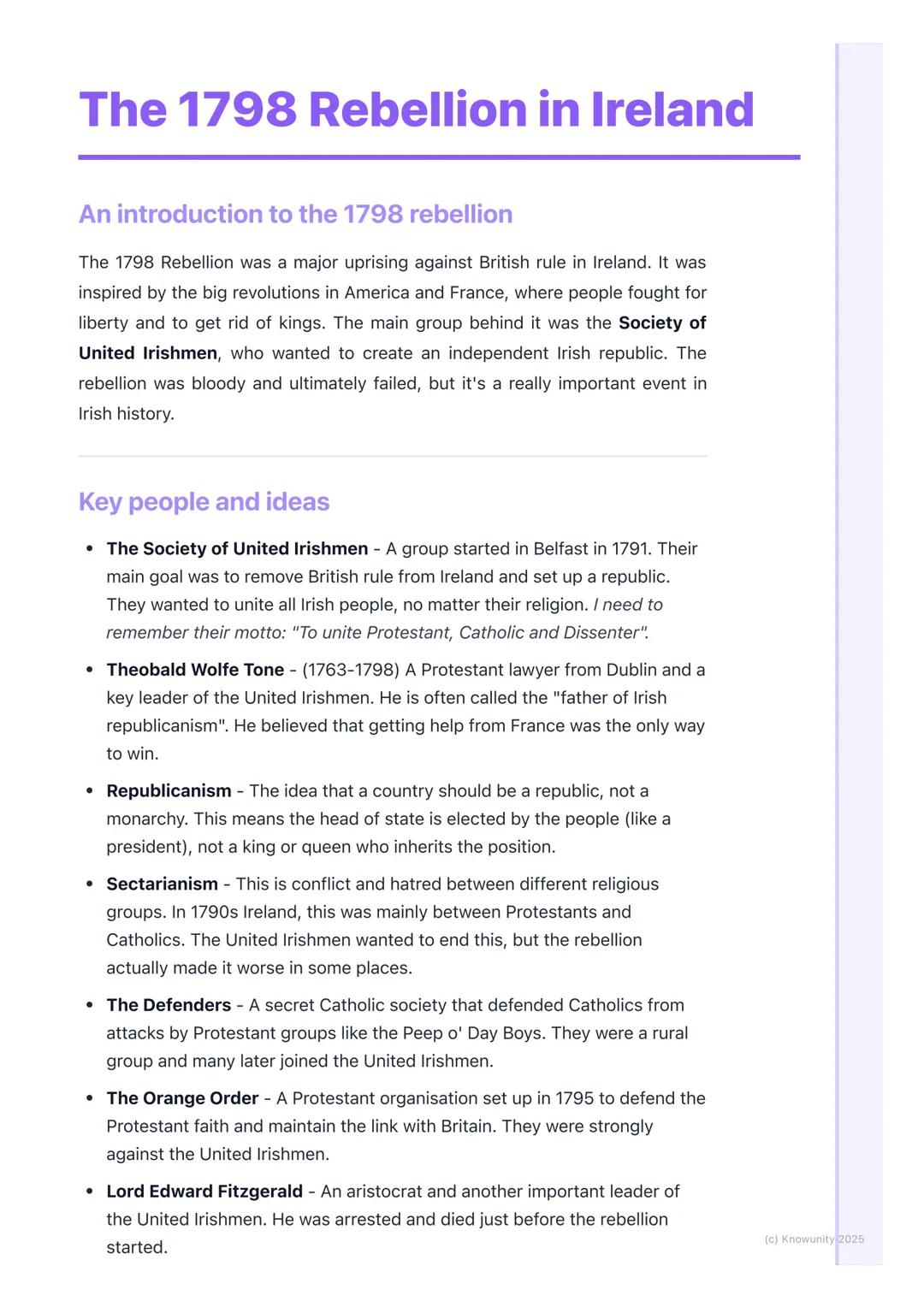
The Key Players and Big Ideas
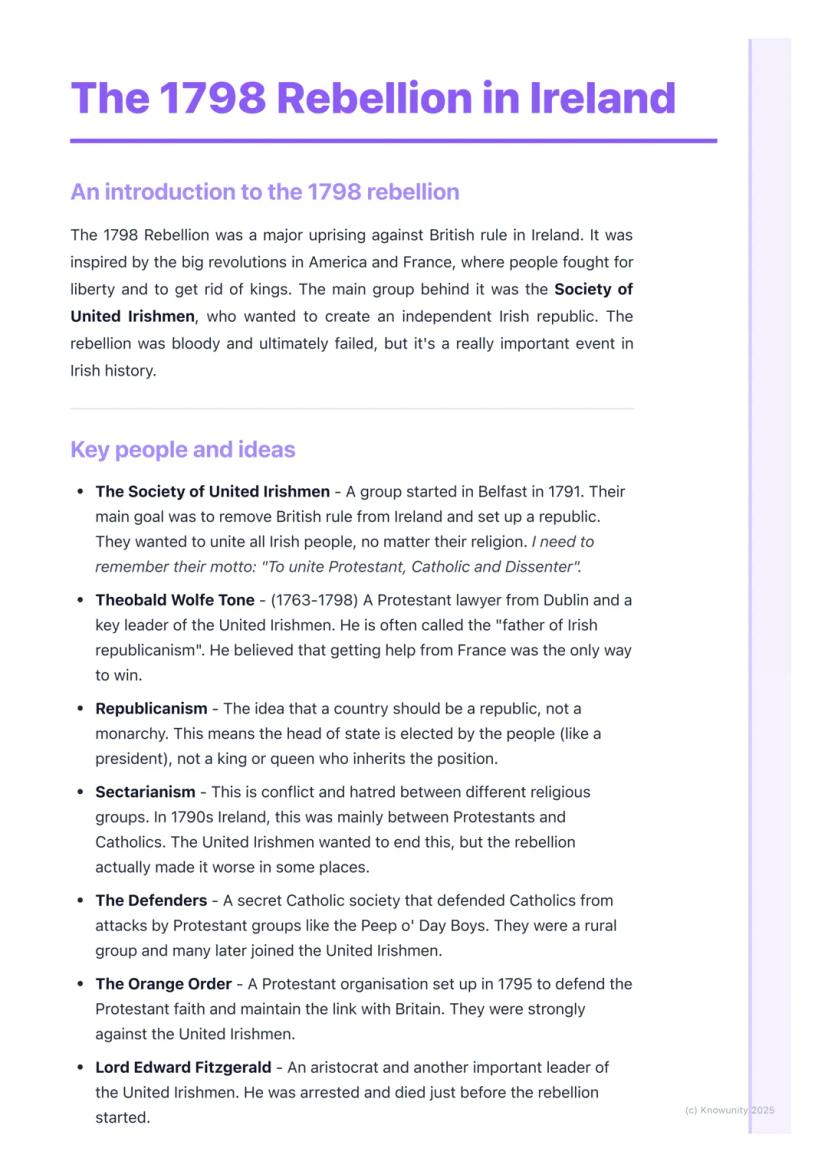
The Society of United Irishmen started this whole thing back in 1791 in Belfast. These weren't your typical rebels - they wanted something revolutionary for the time: to unite "Protestant, Catholic and Dissenter" under one Irish republic.
Theobald Wolfe Tone, a Protestant lawyer from Dublin, became the mastermind behind the movement. He's often called the "father of Irish republicanism" because he believed Ireland could only be free with French military help. Think of him as the diplomatic brain of the operation.
The big idea was republicanism - basically ditching kings and queens for elected leaders like presidents. This was pretty radical stuff in the 1790s! The United Irishmen wanted to end sectarianism (religious hatred between Protestants and Catholics) and create a fair society for everyone.
Key Point: The rebellion wasn't just Catholics vs Protestants - the leaders came from all religious backgrounds and wanted to end religious divisions completely.
Other major players included Lord Edward Fitzgerald (an aristocrat who joined the cause), Henry Joy McCracken (who led the Ulster rising), and Fr. John Murphy (a Catholic priest who became a military leader in Wexford).
2
of 6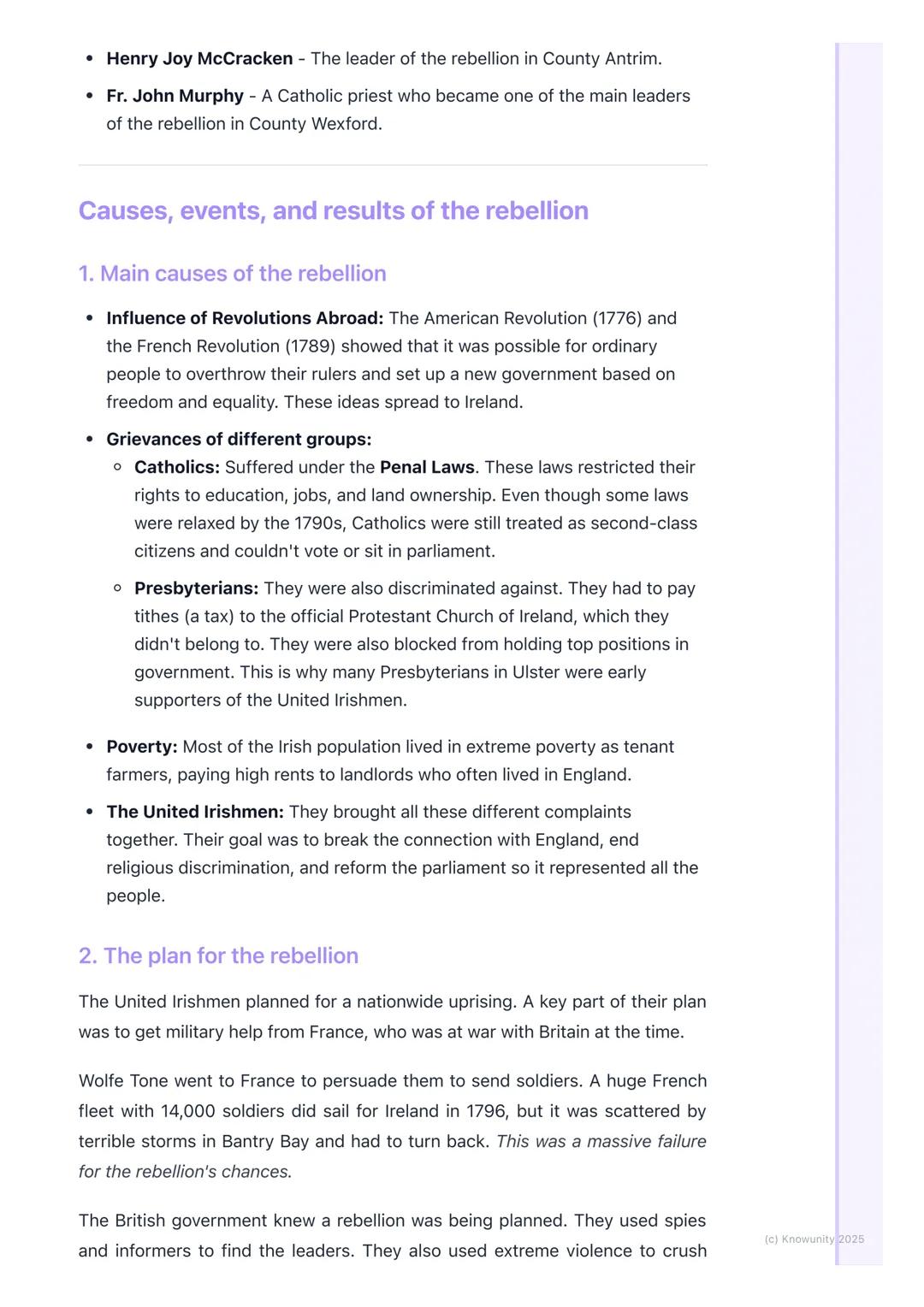
Why Ireland Was Ready to Explode
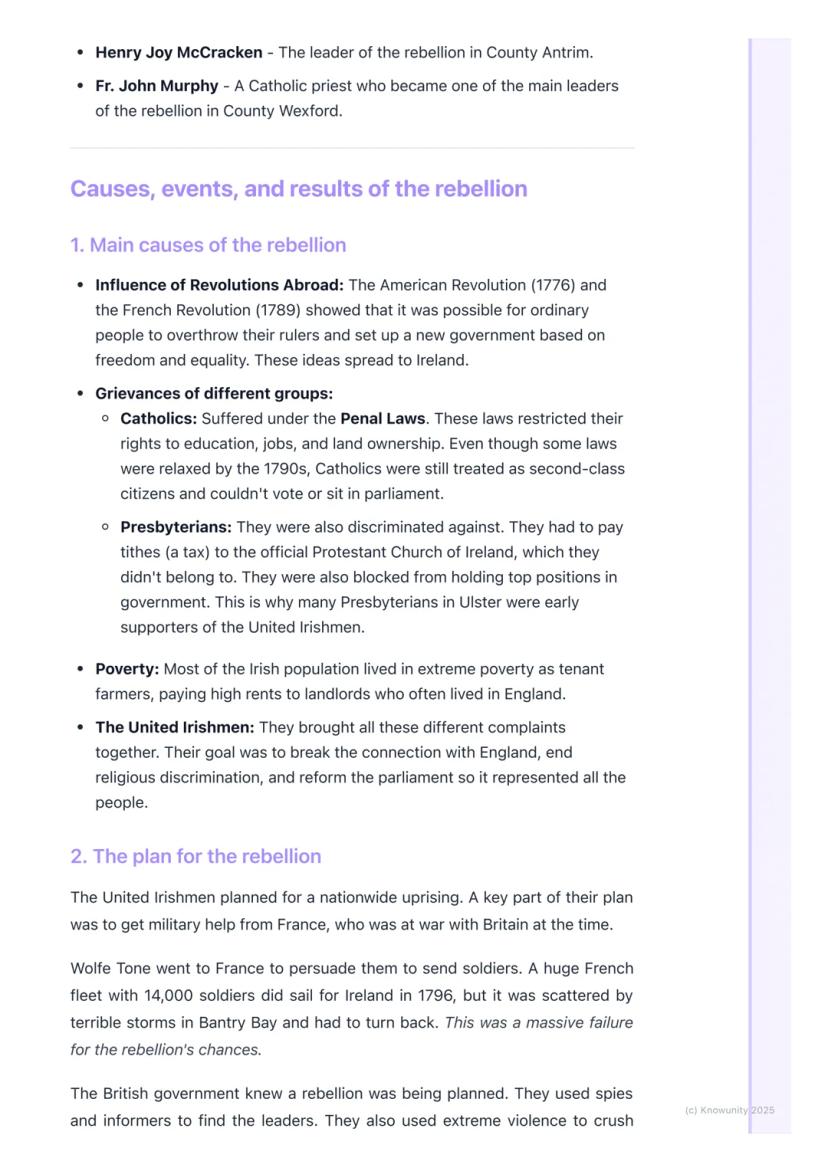
The American Revolution (1776) and French Revolution (1789) showed Irish people that ordinary folks could actually beat powerful governments. These weren't just distant news stories - they were proof that change was possible.
But Ireland had its own massive problems brewing. Catholics couldn't vote, hold government jobs, or freely buy land because of the harsh Penal Laws. Even though some restrictions were lifted by the 1790s, Catholics were still treated like second-class citizens in their own country.
Presbyterians in Ulster were also fed up - they had to pay taxes (called tithes) to support the official Protestant Church of Ireland, which wasn't even their church! Plus, they were blocked from top government positions. Most Irish people lived in desperate poverty as tenant farmers, paying massive rents to landlords who often didn't even live in Ireland.
Remember This: The United Irishmen didn't create these problems - they just gave angry people from different backgrounds a common plan to fix them.
The rebels planned a nationwide uprising with crucial French military support. Wolfe Tone convinced France to send a massive fleet in 1796, but storms scattered the ships at Bantry Bay. This disaster seriously weakened their chances before the rebellion even started.
3
of 6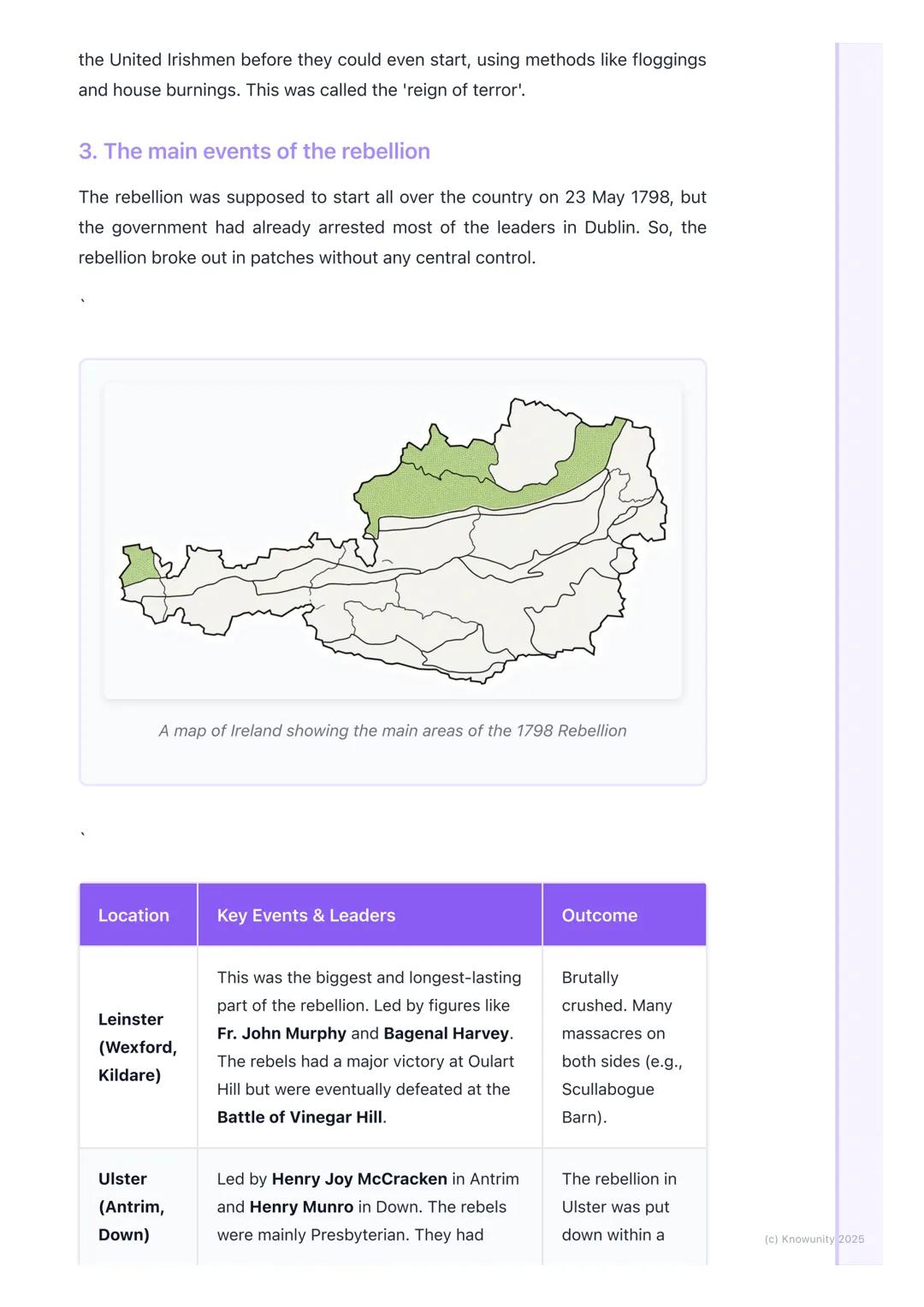
When Everything Kicked Off
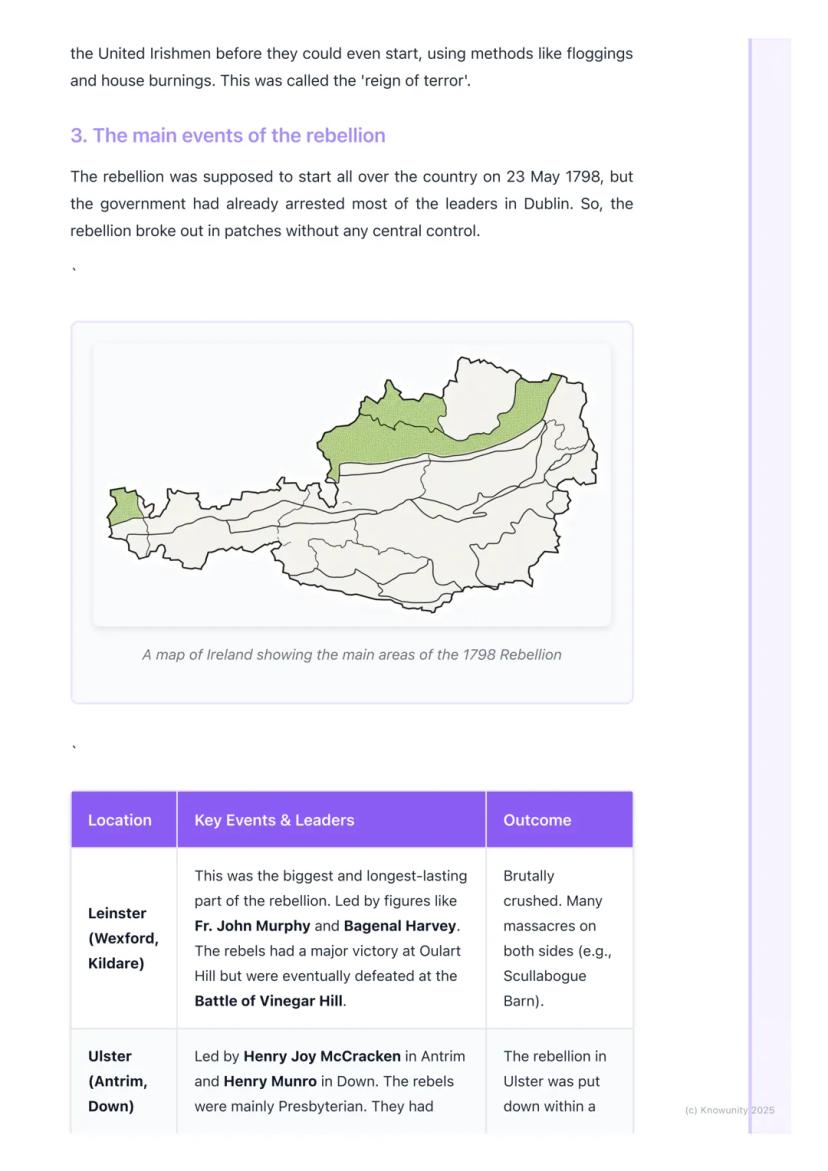
The 1798 Rebellion was supposed to start everywhere on 23 May, but British spies had already arrested most Dublin leaders. Instead of one coordinated uprising, rebellions broke out in scattered patches across the country.
Wexford saw the biggest and longest-lasting fighting. Fr. John Murphy led rebels to victory at Oulart Hill, but they were eventually crushed at the Battle of Vinegar Hill on 21 June. This battle effectively ended the Wexford rising, with rebels surrounded on a hilltop by a massive British army.
In Ulster, Henry Joy McCracken led mainly Presbyterian rebels in Antrim, whilst Henry Munro commanded in Down. They had some early success but were quickly defeated at the battles of Antrim and Ballynahinch. The whole Ulster rebellion was over within a week.
Battle Focus: Vinegar Hill was the rebellion's death blow - once the Wexford rebels were defeated here, the uprising lost its main stronghold.
The most dramatic moment came in August when French General Humbert finally landed in Mayo with 1,000 soldiers. They shocked everyone by beating the British at Castlebar (nicknamed "The Races of Castlebar"), but were eventually surrounded and defeated at Ballinamuck.
4
of 6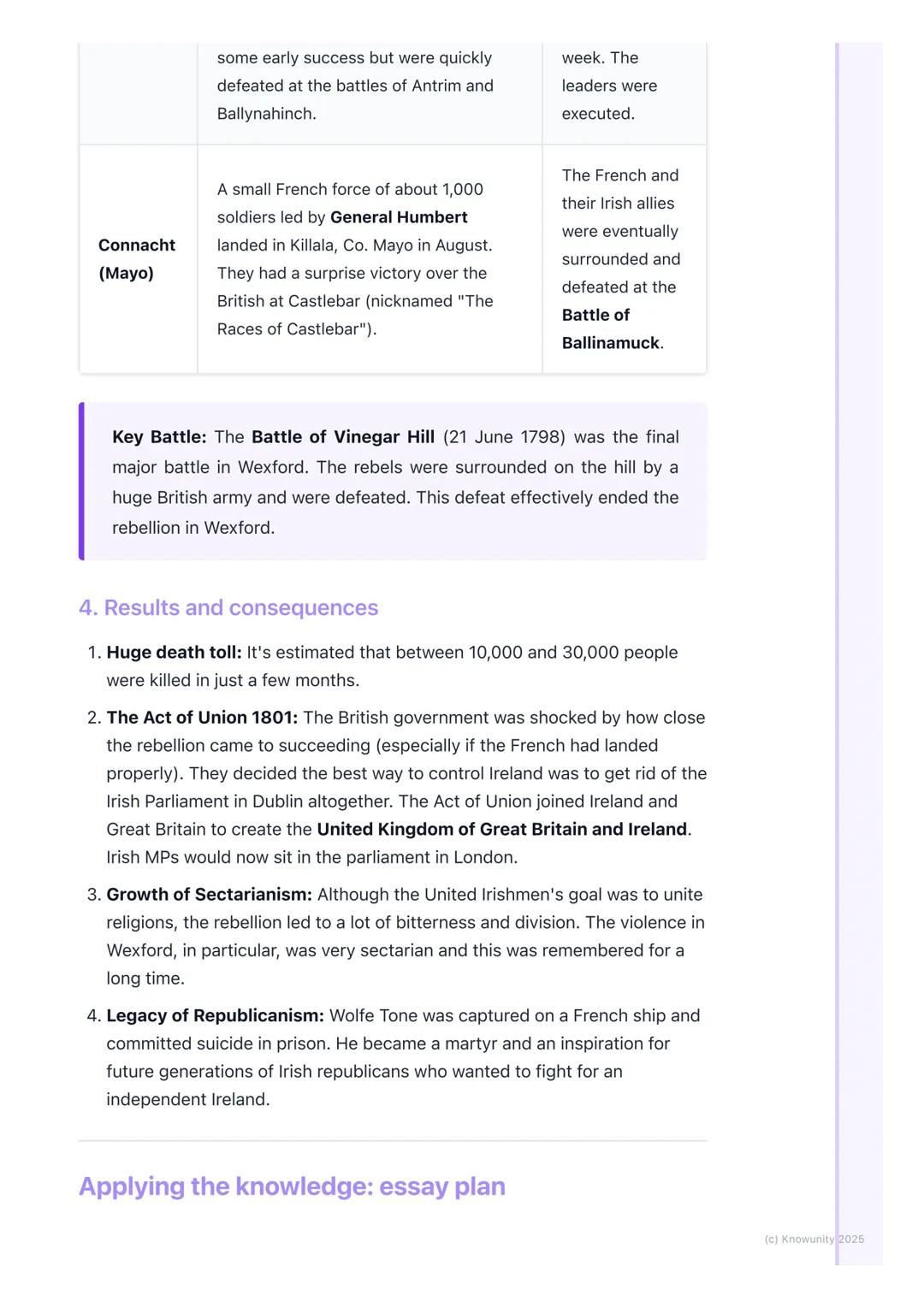
The Bloody Aftermath and Lasting Consequences
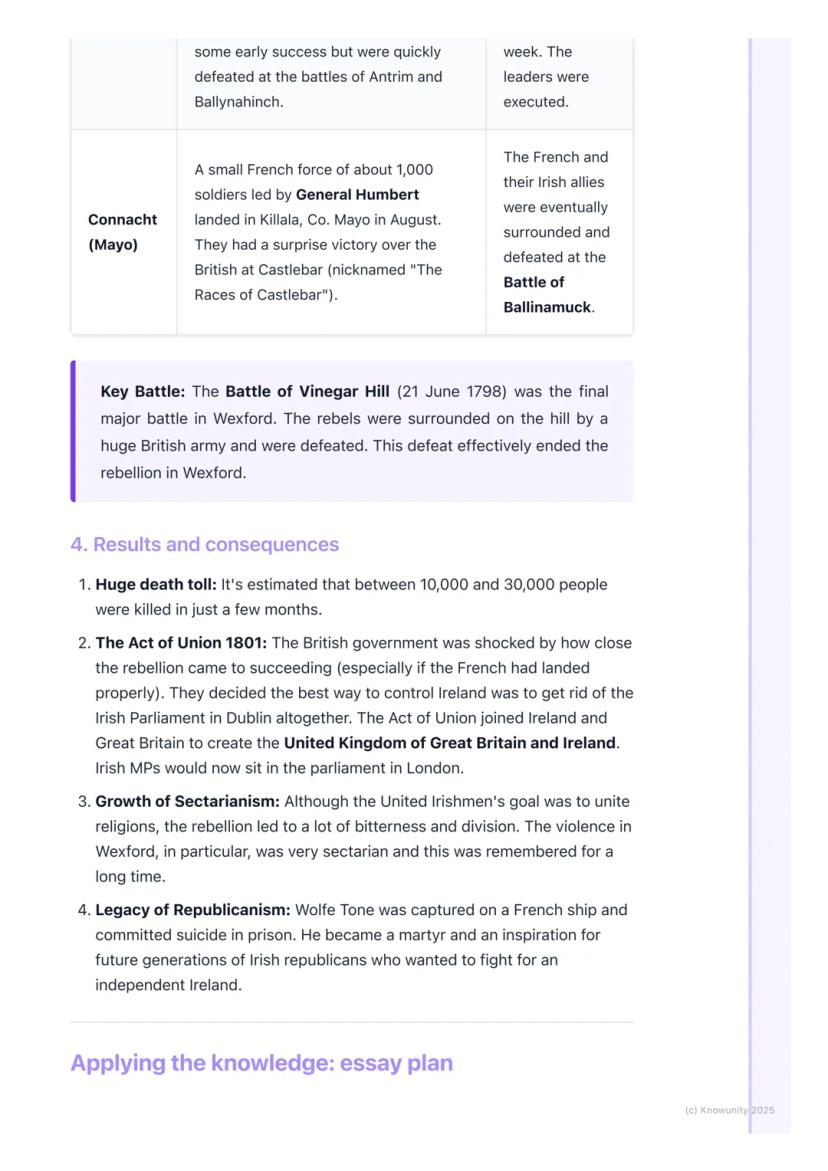
The rebellion's failure came at a horrific cost - somewhere between 10,000 and 30,000 people died in just a few months. Both sides committed terrible massacres, and the violence was often brutally sectarian despite the United Irishmen's goals of unity.
The Act of Union 1801 was Britain's direct response to how close the rebellion came to succeeding. Terrified of future uprisings, the British government abolished Ireland's parliament in Dublin completely. From now on, Irish MPs would sit in London as part of the new United Kingdom of Great Britain and Ireland.
Instead of reducing religious divisions, the rebellion actually made sectarianism worse in many areas. The violence and bitterness created memories that lasted for generations, particularly in places like Wexford where the fighting was most brutal.
Long-term Impact: The Act of Union fundamentally changed Irish politics for the next 120 years - no more Irish parliament until 1922.
Wolfe Tone was captured on a French ship and died in prison (probably suicide), but he became a powerful symbol for future Irish republicans. His ideas about an independent Irish republic would inspire rebellions right up to 1916 and beyond.
5
of 6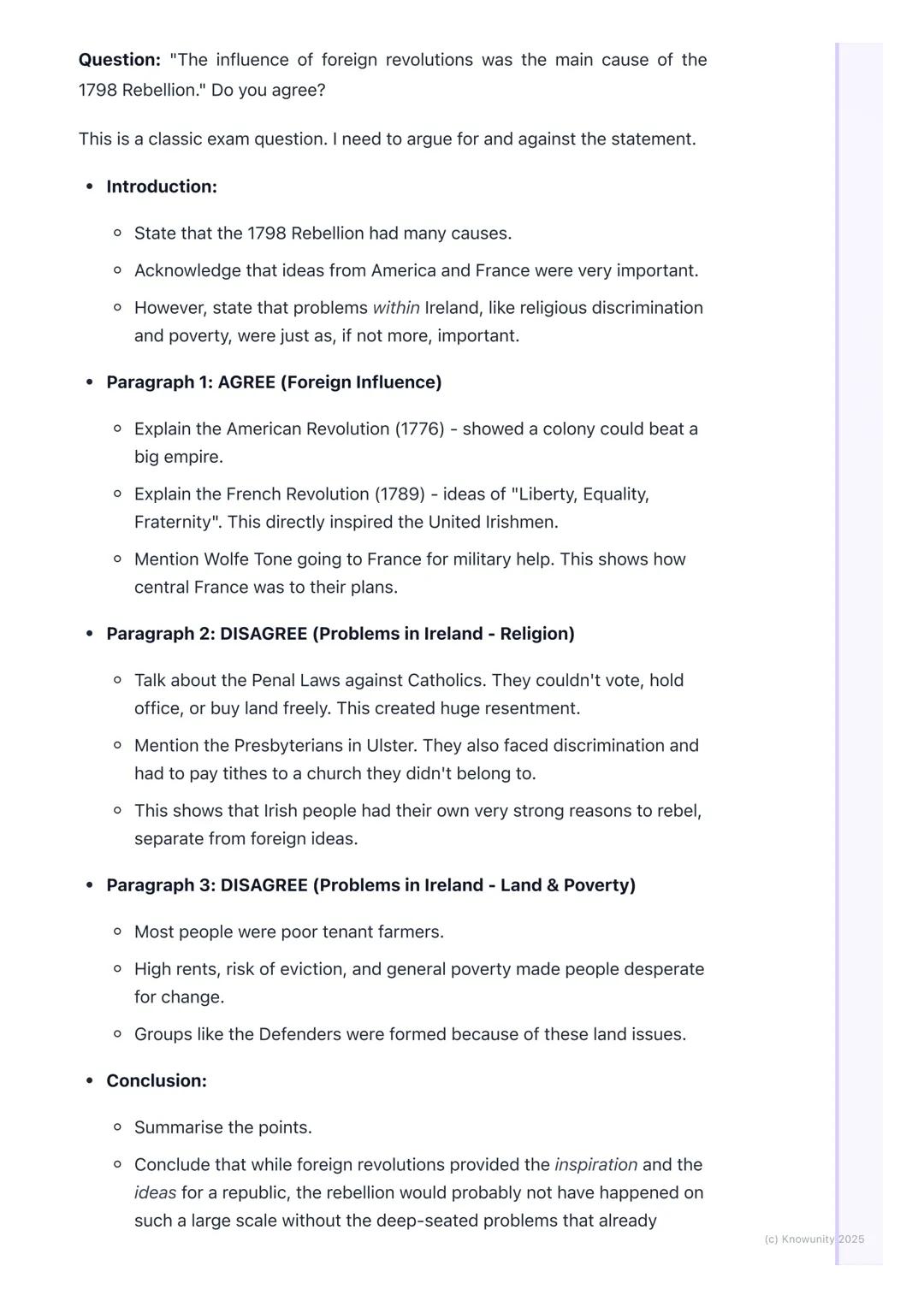
Exam Success: Tackling Essay Questions
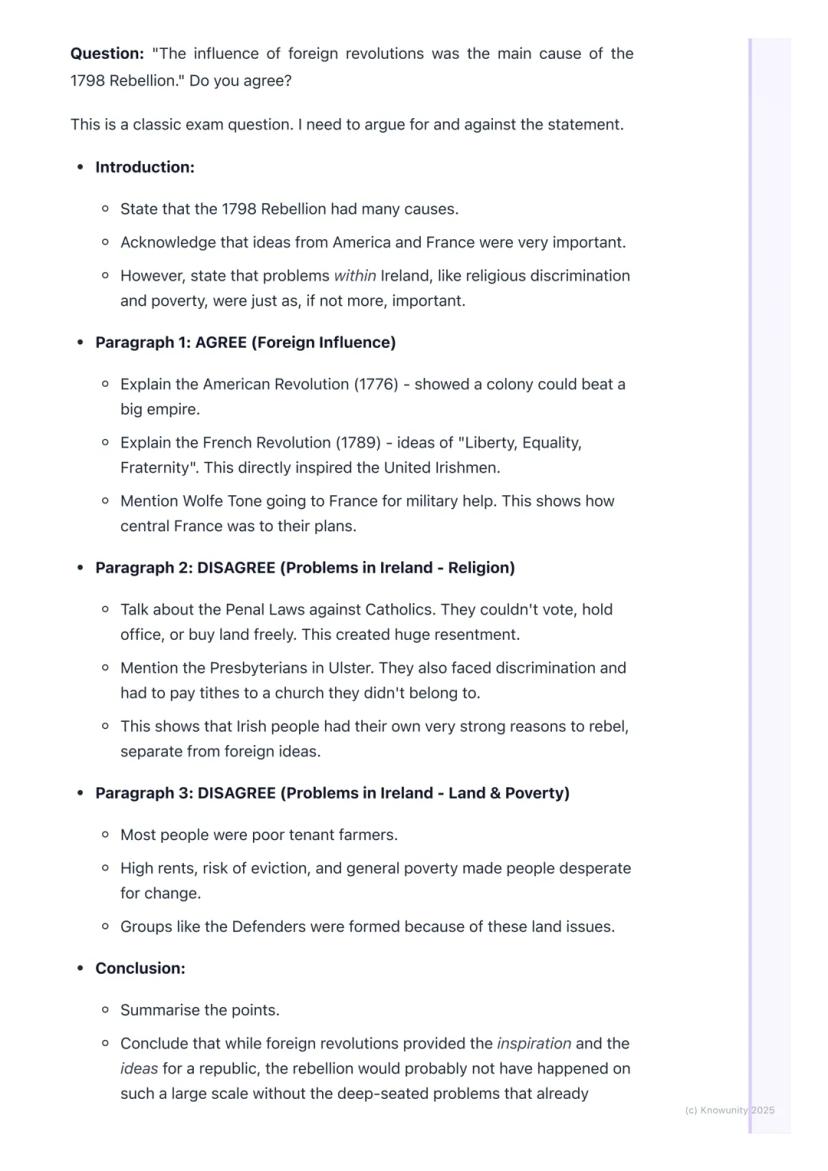
You'll definitely face questions about the causes of the 1798 Rebellion. A classic one asks whether foreign revolutions were the main cause - here's how to smash it.
Start strong by acknowledging that the rebellion had multiple causes. Yes, the American and French revolutions provided crucial inspiration, but Ireland's internal problems were equally important as driving forces.
Argue FOR foreign influence: The American Revolution proved colonies could beat empires, while the French Revolution gave the United Irishmen their core ideas about "Liberty, Equality, Fraternity." Wolfe Tone's trips to France show how central foreign support was to their strategy.
Argue AGAINST: Irish people had massive grievances that existed long before foreign revolutions. Catholics faced the Penal Laws, Presbyterians paid tithes to the wrong church, and most people lived in desperate poverty. These weren't imported problems - they were homegrown Irish issues.
Essay Tip: Think of foreign revolutions as the spark, but Irish grievances as the fuel - you need both for an explosion.
Conclude smartly: Foreign revolutions provided the blueprint and inspiration, but without Ireland's deep-rooted religious discrimination and poverty, there wouldn't have been enough anger to fuel such a massive uprising.
6
of 6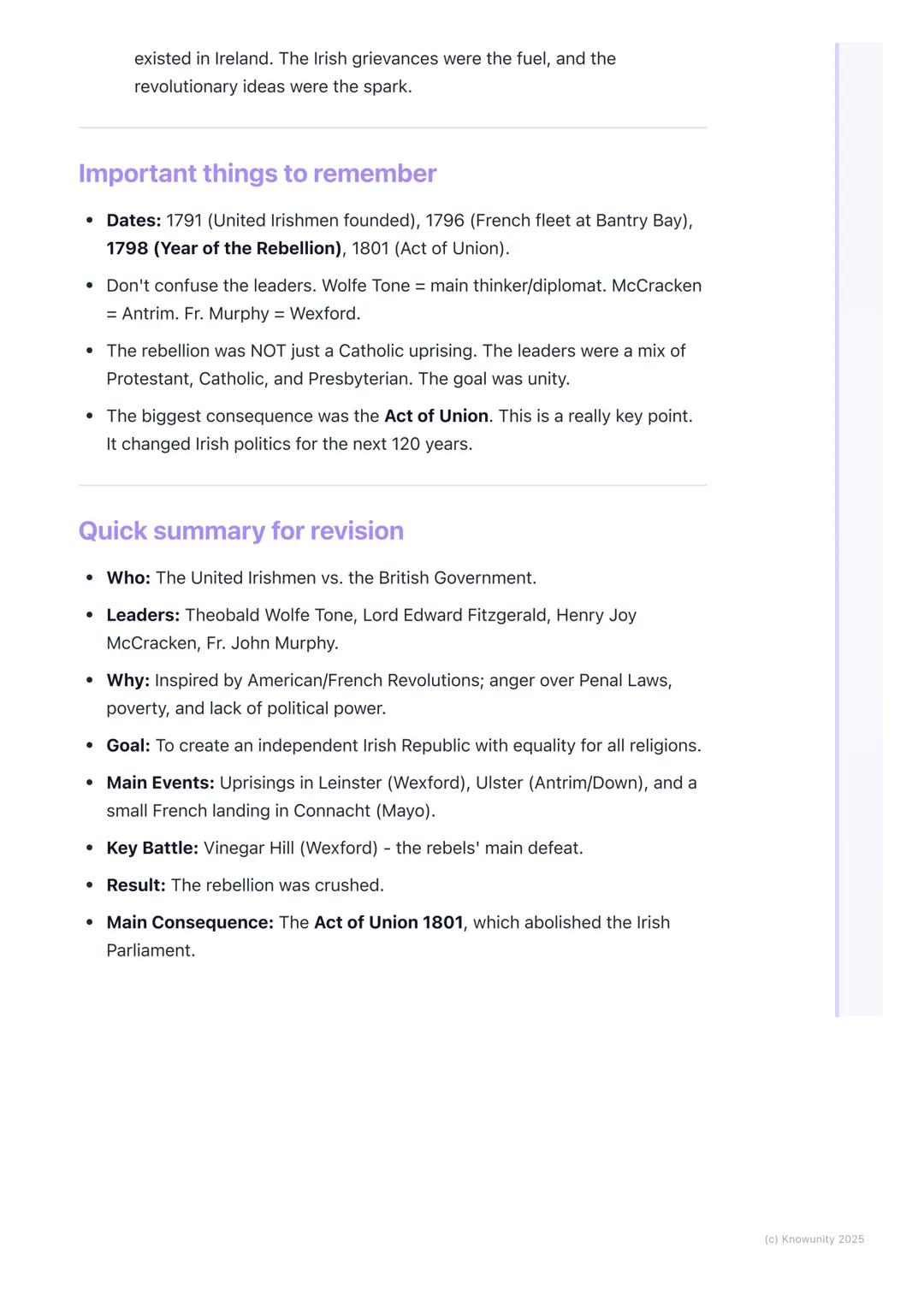
Quick Revision Checklist
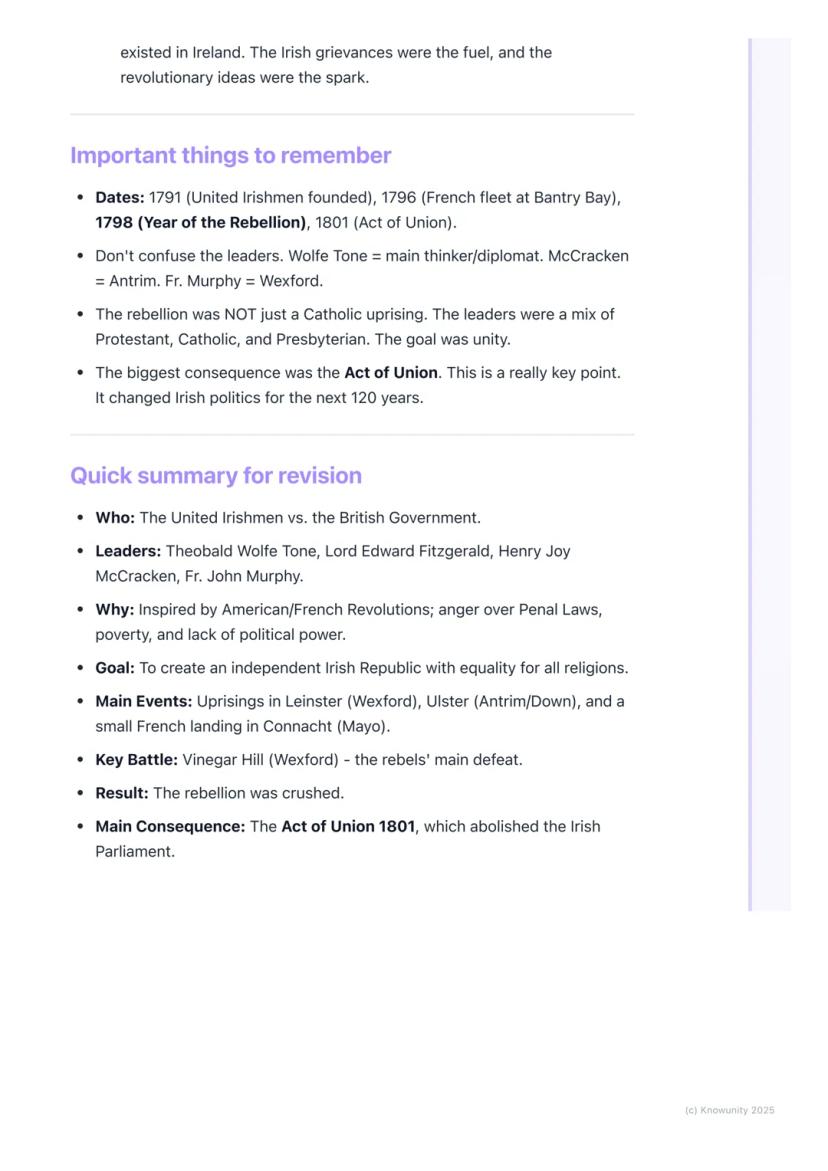
Key Dates: 1791 (United Irishmen founded), 1796 (French fleet fails), 1798 (rebellion year), 1801 (Act of Union ends Irish parliament).
Don't Mix Up the Leaders: Wolfe Tone was the main thinker and diplomat, McCracken led in Antrim, and Fr. Murphy commanded in Wexford. Each had their own patch and role.
Main Locations: Wexford (longest fighting), Ulster (quick defeat), Mayo (French landing). Remember that Vinegar Hill in Wexford was the rebellion's crushing defeat.
Crucial Point: This wasn't a simple Catholic vs Protestant fight - leaders came from all religions and wanted to end religious divisions completely.
The Big Consequence: The Act of Union 1801 abolished Ireland's parliament and created the United Kingdom. This single change shaped Irish politics until the 1920s.
Remember the Goal: The United Irishmen wanted an independent Irish republic where religion didn't matter - "to unite Protestant, Catholic and Dissenter" was their revolutionary motto that challenged everything about how Irish society worked.
Pensavamo che non l'avreste mai chiesto....
Che cos'è l'assistente AI di Knowunity?
Il nostro assistente AI è costruito specificamente per le esigenze degli studenti. Sulla base dei milioni di contenuti presenti sulla piattaforma, possiamo fornire agli studenti risposte davvero significative e pertinenti. Ma non si tratta solo di risposte, l'assistente è in grado di guidare gli studenti attraverso le loro sfide quotidiane di studio, con piani di studio personalizzati, quiz o contenuti nella chat e una personalizzazione al 100% basata sulle competenze e sugli sviluppi degli studenti.
Dove posso scaricare l'applicazione Knowunity?
È possibile scaricare l'applicazione dal Google Play Store e dall'Apple App Store.
Knowunity è davvero gratuita?
Sì, hai accesso completamente gratuito a tutti i contenuti nell'app e puoi chattare o seguire i Creatori in qualsiasi momento. Sbloccherai nuove funzioni crescendo il tuo numero di follower. Inoltre, offriamo Knowunity Premium, che consente di studiare senza alcun limite!!
Contenuti più popolari di History
9HistoryThe Great Famine (An Gorta Mór)
Students will learn about the causes, devastating impact, and long-term consequences of the potato famine on Irish population and society.
2nd Year282
HistoryThe renaissance
junior cert renaissance summary
1st Year361
HistoryCauses and Consequences of World War II
This subtopic covers the origins of the Second World War, its global scale, and its devastating human and political consequences, including the atomic bomb.
3rd Year152
HistoryAmerican revolution
junior cert american revolution summary
1st Year442
HistoryThe Great Famine (An Gorta Mór)
This critical subtopic examines the causes, devastating impact, and long-term consequences of the potato famine on Irish society, population, and emigration.
3rd Year140
HistoryThe Renaissance
Students will learn about a time of 'rebirth' in Europe, where new ideas in art, science, and literature flourished.
1st Year140
History1916 Rising Revison Sheet
revision sheet
3rd Year211
HistoryThe American Revolution
Exploring the causes and consequences of the American colonies' fight for independence from British rule and its global significance.
3rd Year180
HistoryHome Rule Crisis and World War I
Exploring the political tensions surrounding Home Rule, the rise of paramilitary groups like the UVF and Irish Volunteers, and Ireland's involvement in the First World War.
3rd Year110
Contenuti più popolari
9 English
Key Quotes : Sive
Key Quotes and explanations: Sive
6th Year2842
 Irish
IrishIrish oral questions and answers
Questions and answers for the leaving cert oral
5th Year4264
 Physics
Balanced and Unbalanced Forces
Students will explore how balanced forces result in no change in motion, while unbalanced forces cause an object to accelerate or change direction.
2nd Year562
IrishIníon- le hÁine Durkin
Aine Durkin’s poem, Iníon: Themes & summary
5th Year890
EnglishCultural Context : Shawshank Redemption : Sive : Small Things Like These
Comparative Study : Cultural Context : Shawshank Redemption, Sive and Small Things Like These
6th Year1430
IrishLC HL notes- Iníon (poem)
Includes poem in English and Irish, theme, key words & phrases
5th Year2314
IrishIrish oral questions
Outline of oral questions
5th Year2055
IrishMo Ghrá-sa (Idir Lúibíní)
Notes on mo ghrá-sa
5th Year380
IrishAn Gaeilge Aiste
Irish Language essay
6th Year1320
Non c'è niente di adatto? Esplorare altre aree tematiche.
Recensioni dei nostri utenti. Ci adorano - e anche tu, vedrai .
4.6/5App Store
4.7/5Google Play
L'applicazione è molto facile da usare e ben progettata. Finora ho trovato tutto quello che cercavo e ho potuto imparare molto dalle presentazioni! Utilizzerò sicuramente l'app per i compiti in classe! È molto utile anche come fonte di ispirazione.
Stefano Sutente iOS
Questa applicazione è davvero grande! Ci sono tantissimi appunti e aiuti con lo studio [...]. La mia materia problematica, per esempio, è il francese e l'app ha così tante opzioni per aiutarmi. Grazie a questa app ho migliorato il mio francese. La consiglio a tutti.
Samantha Klichutente Android
Wow, sono davvero stupita. Ho appena provato l'app perché l'ho vista pubblicizzata molte volte e sono rimasta assolutamente sbalordita. Questa app è L'AIUTO che cercate per la scuola e soprattutto offre tantissime cose, come allenamenti e schede, che a me personalmente sono state MOLTO utili.
Annautente iOS
History21 visualizzazioni·Aggiornato Jun 9, 2026·6 pagineIreland's 1798 Rebellion: Causes and Impact
Ever wonder how ordinary people decided to take on the mighty British Empire? The 1798 Rebellionwas Ireland's most serious attempt to break free from British rule, inspired by the successful revolutions in America and France. Though it failed, this...
1
of 6
Iscriviti per mostrare il contenuto. È gratis!
- Accesso a tutti i documenti
- Migliora i tuoi voti
- Unisciti a milioni di studenti
The Key Players and Big Ideas
The Society of United Irishmen started this whole thing back in 1791 in Belfast. These weren't your typical rebels - they wanted something revolutionary for the time: to unite "Protestant, Catholic and Dissenter" under one Irish republic.
Theobald Wolfe Tone, a Protestant lawyer from Dublin, became the mastermind behind the movement. He's often called the "father of Irish republicanism" because he believed Ireland could only be free with French military help. Think of him as the diplomatic brain of the operation.
The big idea was republicanism - basically ditching kings and queens for elected leaders like presidents. This was pretty radical stuff in the 1790s! The United Irishmen wanted to end sectarianism (religious hatred between Protestants and Catholics) and create a fair society for everyone.
Key Point: The rebellion wasn't just Catholics vs Protestants - the leaders came from all religious backgrounds and wanted to end religious divisions completely.
Other major players included Lord Edward Fitzgerald (an aristocrat who joined the cause), Henry Joy McCracken (who led the Ulster rising), and Fr. John Murphy (a Catholic priest who became a military leader in Wexford).
2
of 6Iscriviti per mostrare il contenuto. È gratis!
- Accesso a tutti i documenti
- Migliora i tuoi voti
- Unisciti a milioni di studenti
Why Ireland Was Ready to Explode
The American Revolution (1776) and French Revolution (1789) showed Irish people that ordinary folks could actually beat powerful governments. These weren't just distant news stories - they were proof that change was possible.
But Ireland had its own massive problems brewing. Catholics couldn't vote, hold government jobs, or freely buy land because of the harsh Penal Laws. Even though some restrictions were lifted by the 1790s, Catholics were still treated like second-class citizens in their own country.
Presbyterians in Ulster were also fed up - they had to pay taxes (called tithes) to support the official Protestant Church of Ireland, which wasn't even their church! Plus, they were blocked from top government positions. Most Irish people lived in desperate poverty as tenant farmers, paying massive rents to landlords who often didn't even live in Ireland.
Remember This: The United Irishmen didn't create these problems - they just gave angry people from different backgrounds a common plan to fix them.
The rebels planned a nationwide uprising with crucial French military support. Wolfe Tone convinced France to send a massive fleet in 1796, but storms scattered the ships at Bantry Bay. This disaster seriously weakened their chances before the rebellion even started.
3
of 6Iscriviti per mostrare il contenuto. È gratis!
- Accesso a tutti i documenti
- Migliora i tuoi voti
- Unisciti a milioni di studenti
When Everything Kicked Off
The 1798 Rebellion was supposed to start everywhere on 23 May, but British spies had already arrested most Dublin leaders. Instead of one coordinated uprising, rebellions broke out in scattered patches across the country.
Wexford saw the biggest and longest-lasting fighting. Fr. John Murphy led rebels to victory at Oulart Hill, but they were eventually crushed at the Battle of Vinegar Hill on 21 June. This battle effectively ended the Wexford rising, with rebels surrounded on a hilltop by a massive British army.
In Ulster, Henry Joy McCracken led mainly Presbyterian rebels in Antrim, whilst Henry Munro commanded in Down. They had some early success but were quickly defeated at the battles of Antrim and Ballynahinch. The whole Ulster rebellion was over within a week.
Battle Focus: Vinegar Hill was the rebellion's death blow - once the Wexford rebels were defeated here, the uprising lost its main stronghold.
The most dramatic moment came in August when French General Humbert finally landed in Mayo with 1,000 soldiers. They shocked everyone by beating the British at Castlebar (nicknamed "The Races of Castlebar"), but were eventually surrounded and defeated at Ballinamuck.
4
of 6Iscriviti per mostrare il contenuto. È gratis!
- Accesso a tutti i documenti
- Migliora i tuoi voti
- Unisciti a milioni di studenti
The Bloody Aftermath and Lasting Consequences
The rebellion's failure came at a horrific cost - somewhere between 10,000 and 30,000 people died in just a few months. Both sides committed terrible massacres, and the violence was often brutally sectarian despite the United Irishmen's goals of unity.
The Act of Union 1801 was Britain's direct response to how close the rebellion came to succeeding. Terrified of future uprisings, the British government abolished Ireland's parliament in Dublin completely. From now on, Irish MPs would sit in London as part of the new United Kingdom of Great Britain and Ireland.
Instead of reducing religious divisions, the rebellion actually made sectarianism worse in many areas. The violence and bitterness created memories that lasted for generations, particularly in places like Wexford where the fighting was most brutal.
Long-term Impact: The Act of Union fundamentally changed Irish politics for the next 120 years - no more Irish parliament until 1922.
Wolfe Tone was captured on a French ship and died in prison (probably suicide), but he became a powerful symbol for future Irish republicans. His ideas about an independent Irish republic would inspire rebellions right up to 1916 and beyond.
5
of 6Iscriviti per mostrare il contenuto. È gratis!
- Accesso a tutti i documenti
- Migliora i tuoi voti
- Unisciti a milioni di studenti
Exam Success: Tackling Essay Questions
You'll definitely face questions about the causes of the 1798 Rebellion. A classic one asks whether foreign revolutions were the main cause - here's how to smash it.
Start strong by acknowledging that the rebellion had multiple causes. Yes, the American and French revolutions provided crucial inspiration, but Ireland's internal problems were equally important as driving forces.
Argue FOR foreign influence: The American Revolution proved colonies could beat empires, while the French Revolution gave the United Irishmen their core ideas about "Liberty, Equality, Fraternity." Wolfe Tone's trips to France show how central foreign support was to their strategy.
Argue AGAINST: Irish people had massive grievances that existed long before foreign revolutions. Catholics faced the Penal Laws, Presbyterians paid tithes to the wrong church, and most people lived in desperate poverty. These weren't imported problems - they were homegrown Irish issues.
Essay Tip: Think of foreign revolutions as the spark, but Irish grievances as the fuel - you need both for an explosion.
Conclude smartly: Foreign revolutions provided the blueprint and inspiration, but without Ireland's deep-rooted religious discrimination and poverty, there wouldn't have been enough anger to fuel such a massive uprising.
6
of 6Iscriviti per mostrare il contenuto. È gratis!
- Accesso a tutti i documenti
- Migliora i tuoi voti
- Unisciti a milioni di studenti
Quick Revision Checklist
Key Dates: 1791 (United Irishmen founded), 1796 (French fleet fails), 1798 (rebellion year), 1801 (Act of Union ends Irish parliament).
Don't Mix Up the Leaders: Wolfe Tone was the main thinker and diplomat, McCracken led in Antrim, and Fr. Murphy commanded in Wexford. Each had their own patch and role.
Main Locations: Wexford (longest fighting), Ulster (quick defeat), Mayo (French landing). Remember that Vinegar Hill in Wexford was the rebellion's crushing defeat.
Crucial Point: This wasn't a simple Catholic vs Protestant fight - leaders came from all religions and wanted to end religious divisions completely.
The Big Consequence: The Act of Union 1801 abolished Ireland's parliament and created the United Kingdom. This single change shaped Irish politics until the 1920s.
Remember the Goal: The United Irishmen wanted an independent Irish republic where religion didn't matter - "to unite Protestant, Catholic and Dissenter" was their revolutionary motto that challenged everything about how Irish society worked.
Pensavamo che non l'avreste mai chiesto....
Che cos'è l'assistente AI di Knowunity?
Il nostro assistente AI è costruito specificamente per le esigenze degli studenti. Sulla base dei milioni di contenuti presenti sulla piattaforma, possiamo fornire agli studenti risposte davvero significative e pertinenti. Ma non si tratta solo di risposte, l'assistente è in grado di guidare gli studenti attraverso le loro sfide quotidiane di studio, con piani di studio personalizzati, quiz o contenuti nella chat e una personalizzazione al 100% basata sulle competenze e sugli sviluppi degli studenti.
Dove posso scaricare l'applicazione Knowunity?
È possibile scaricare l'applicazione dal Google Play Store e dall'Apple App Store.
Knowunity è davvero gratuita?
Sì, hai accesso completamente gratuito a tutti i contenuti nell'app e puoi chattare o seguire i Creatori in qualsiasi momento. Sbloccherai nuove funzioni crescendo il tuo numero di follower. Inoltre, offriamo Knowunity Premium, che consente di studiare senza alcun limite!!
Contenuti più popolari di History
9HistoryThe Great Famine (An Gorta Mór)
Students will learn about the causes, devastating impact, and long-term consequences of the potato famine on Irish population and society.
2nd Year282
HistoryThe renaissance
junior cert renaissance summary
1st Year361
HistoryCauses and Consequences of World War II
This subtopic covers the origins of the Second World War, its global scale, and its devastating human and political consequences, including the atomic bomb.
3rd Year152
HistoryAmerican revolution
junior cert american revolution summary
1st Year442
HistoryThe Great Famine (An Gorta Mór)
This critical subtopic examines the causes, devastating impact, and long-term consequences of the potato famine on Irish society, population, and emigration.
3rd Year140
HistoryThe Renaissance
Students will learn about a time of 'rebirth' in Europe, where new ideas in art, science, and literature flourished.
1st Year140
History1916 Rising Revison Sheet
revision sheet
3rd Year211
HistoryThe American Revolution
Exploring the causes and consequences of the American colonies' fight for independence from British rule and its global significance.
3rd Year180
HistoryHome Rule Crisis and World War I
Exploring the political tensions surrounding Home Rule, the rise of paramilitary groups like the UVF and Irish Volunteers, and Ireland's involvement in the First World War.
3rd Year110
Contenuti più popolari
9EnglishKey Quotes : Sive
Key Quotes and explanations: Sive
6th Year2842
IrishIrish oral questions and answers
Questions and answers for the leaving cert oral
5th Year4264
PhysicsBalanced and Unbalanced Forces
Students will explore how balanced forces result in no change in motion, while unbalanced forces cause an object to accelerate or change direction.
2nd Year562
IrishIníon- le hÁine Durkin
Aine Durkin’s poem, Iníon: Themes & summary
5th Year890
EnglishCultural Context : Shawshank Redemption : Sive : Small Things Like These
Comparative Study : Cultural Context : Shawshank Redemption, Sive and Small Things Like These
6th Year1430
IrishLC HL notes- Iníon (poem)
Includes poem in English and Irish, theme, key words & phrases
5th Year2314
IrishIrish oral questions
Outline of oral questions
5th Year2055
IrishMo Ghrá-sa (Idir Lúibíní)
Notes on mo ghrá-sa
5th Year380
IrishAn Gaeilge Aiste
Irish Language essay
6th Year1320
Non c'è niente di adatto? Esplorare altre aree tematiche.
Recensioni dei nostri utenti. Ci adorano - e anche tu, vedrai .
4.6/5App Store
4.7/5Google Play
L'applicazione è molto facile da usare e ben progettata. Finora ho trovato tutto quello che cercavo e ho potuto imparare molto dalle presentazioni! Utilizzerò sicuramente l'app per i compiti in classe! È molto utile anche come fonte di ispirazione.
Stefano Sutente iOS
Questa applicazione è davvero grande! Ci sono tantissimi appunti e aiuti con lo studio [...]. La mia materia problematica, per esempio, è il francese e l'app ha così tante opzioni per aiutarmi. Grazie a questa app ho migliorato il mio francese. La consiglio a tutti.
Samantha Klichutente Android
Wow, sono davvero stupita. Ho appena provato l'app perché l'ho vista pubblicizzata molte volte e sono rimasta assolutamente sbalordita. Questa app è L'AIUTO che cercate per la scuola e soprattutto offre tantissime cose, come allenamenti e schede, che a me personalmente sono state MOLTO utili.
Annautente iOS