
Ever wondered how to talk about your favourite foods in...
 German2 visualizzazioni·Aggiornato Jun 9, 2026·6 pagine
Beliebte Mahlzeiten und Gerichte in Deutschland
1 / 6
1
of 6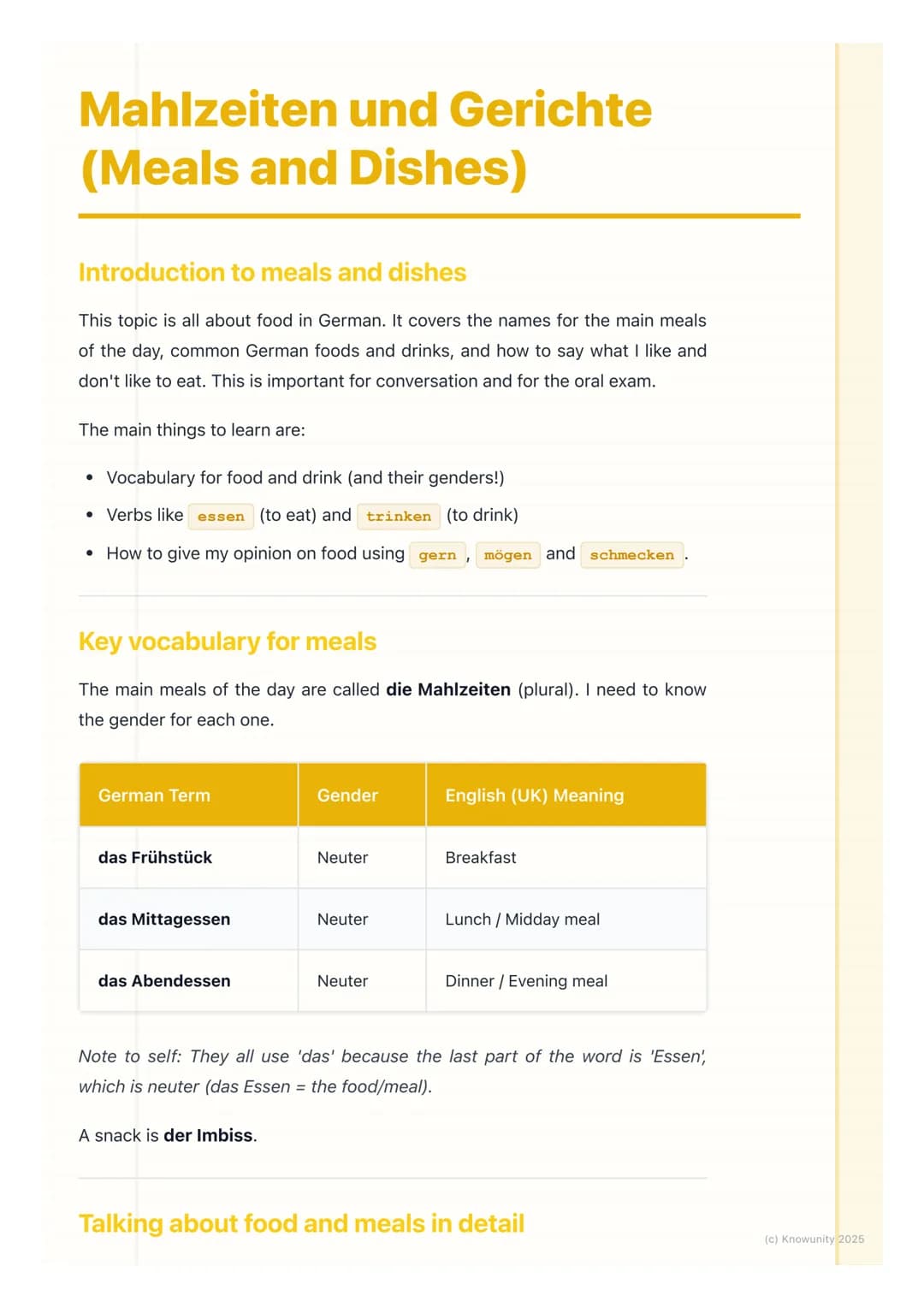
Meals and Key Food Vocabulary
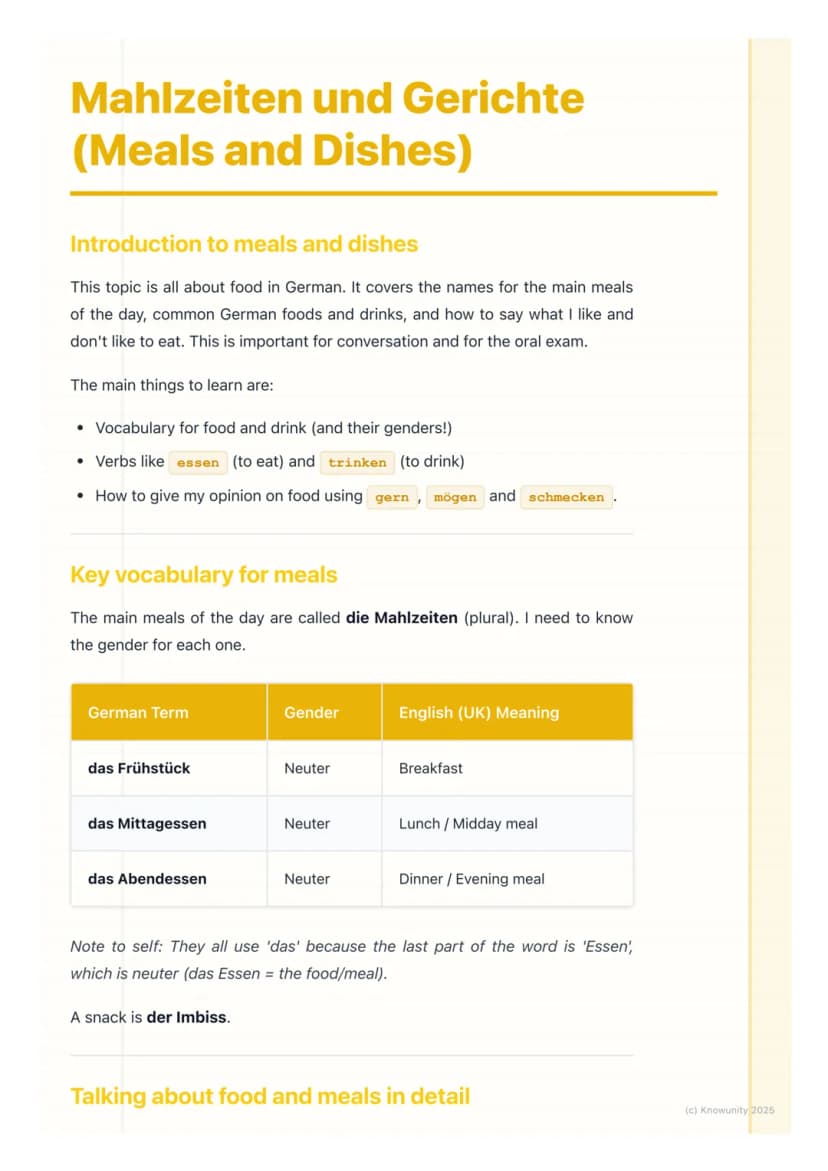
Learning German food vocabulary isn't just about memorising words - it's your ticket to authentic conversations and confident restaurant visits. The three main meals (die Mahlzeiten) are das Frühstück (breakfast), das Mittagessen (lunch), and das Abendessen (dinner).
Here's a clever trick: all three meal names use das because they contain the word "Essen" (food), which is neuter. This pattern-spotting will save you loads of time when learning genders!
For breakfast, you'll need words like das Brot (bread), die Marmelade (jam), and das Ei (egg). Lunch often features hearty options like das Hähnchen (chicken), die Pommes (chips), and das Gemüse (vegetables). Remember that lunch is typically the main hot meal in Germany, not dinner.
Top Tip: Create flashcards with the article in a different colour - your brain will start associating colours with genders automatically.
2
of 6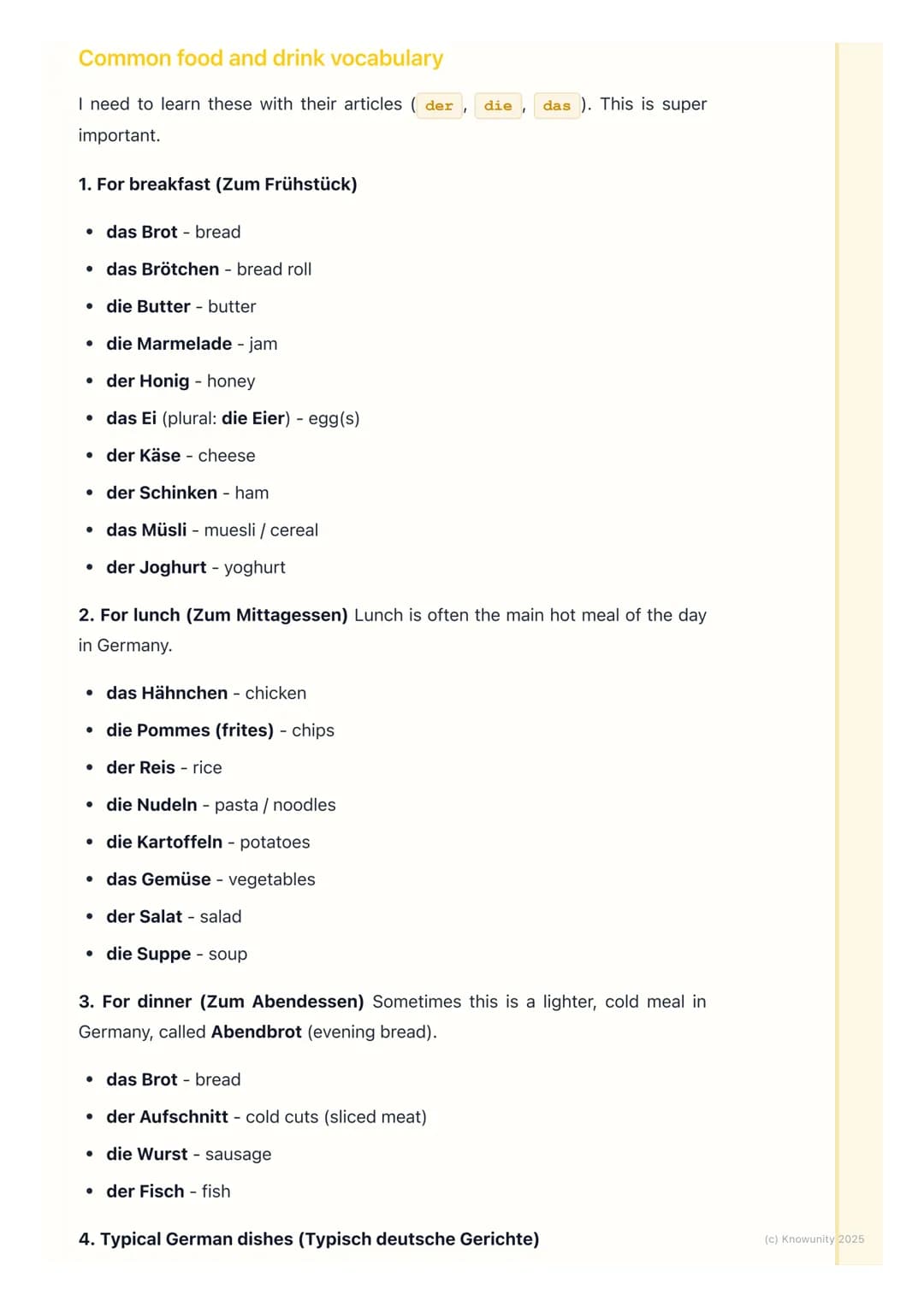
Popular German Dishes and Drinks
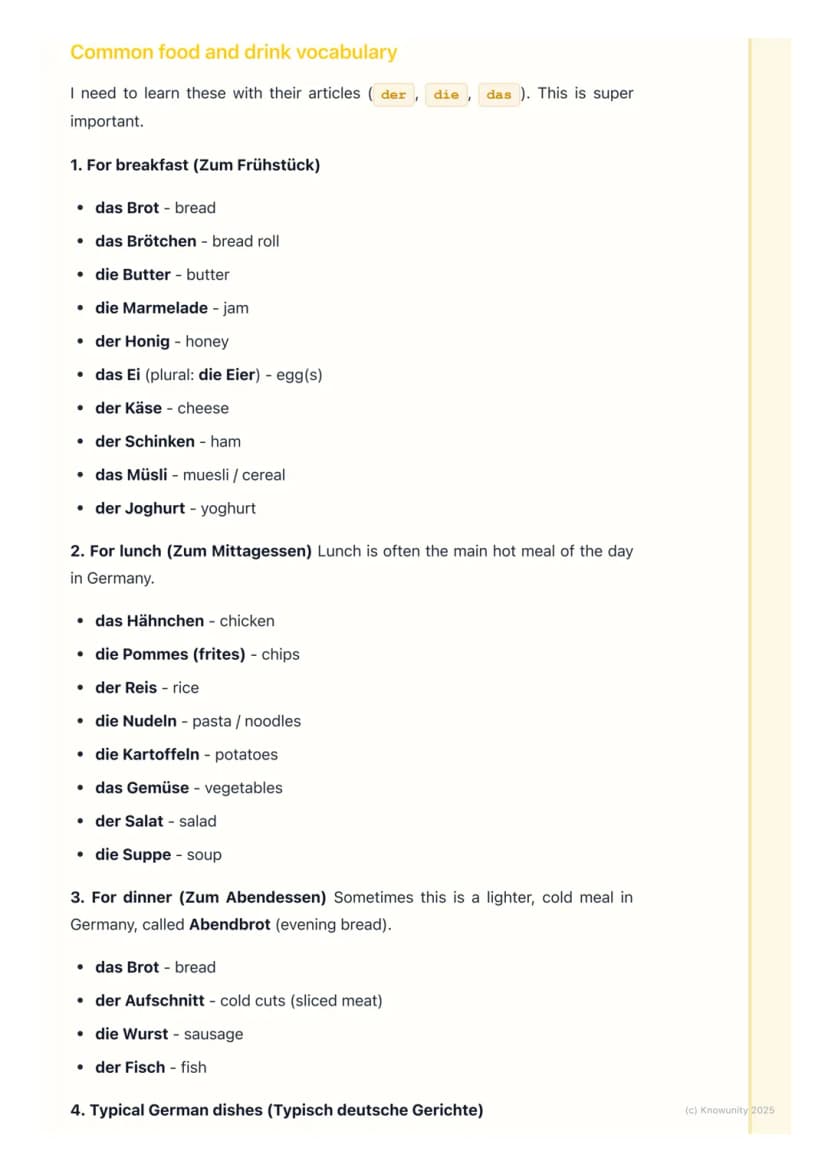
You'll sound much more natural knowing authentic German foods beyond basic vocabulary. Das Schnitzel (breaded cutlet), die Bratwurst (fried sausage), and die Currywurst (sausage with curry ketchup) are absolute classics you'll encounter everywhere.
Getränke (drinks) are equally important for daily conversations. Master das Wasser (water), der Saft (juice), die Milch (milk), and der Kaffee (coffee). Notice how drink genders vary - there's no shortcut here, so you'll need to memorise each one.
Don't forget regional favourites like der Döner (doner kebab), which is incredibly popular throughout Germany. These cultural details show examiners you understand real German life, not just textbook German.
Cultural Note: German evening meals (Abendbrot) are often lighter and colder than what we're used to in Ireland - think bread with cold cuts rather than a hot dinner.
3
of 6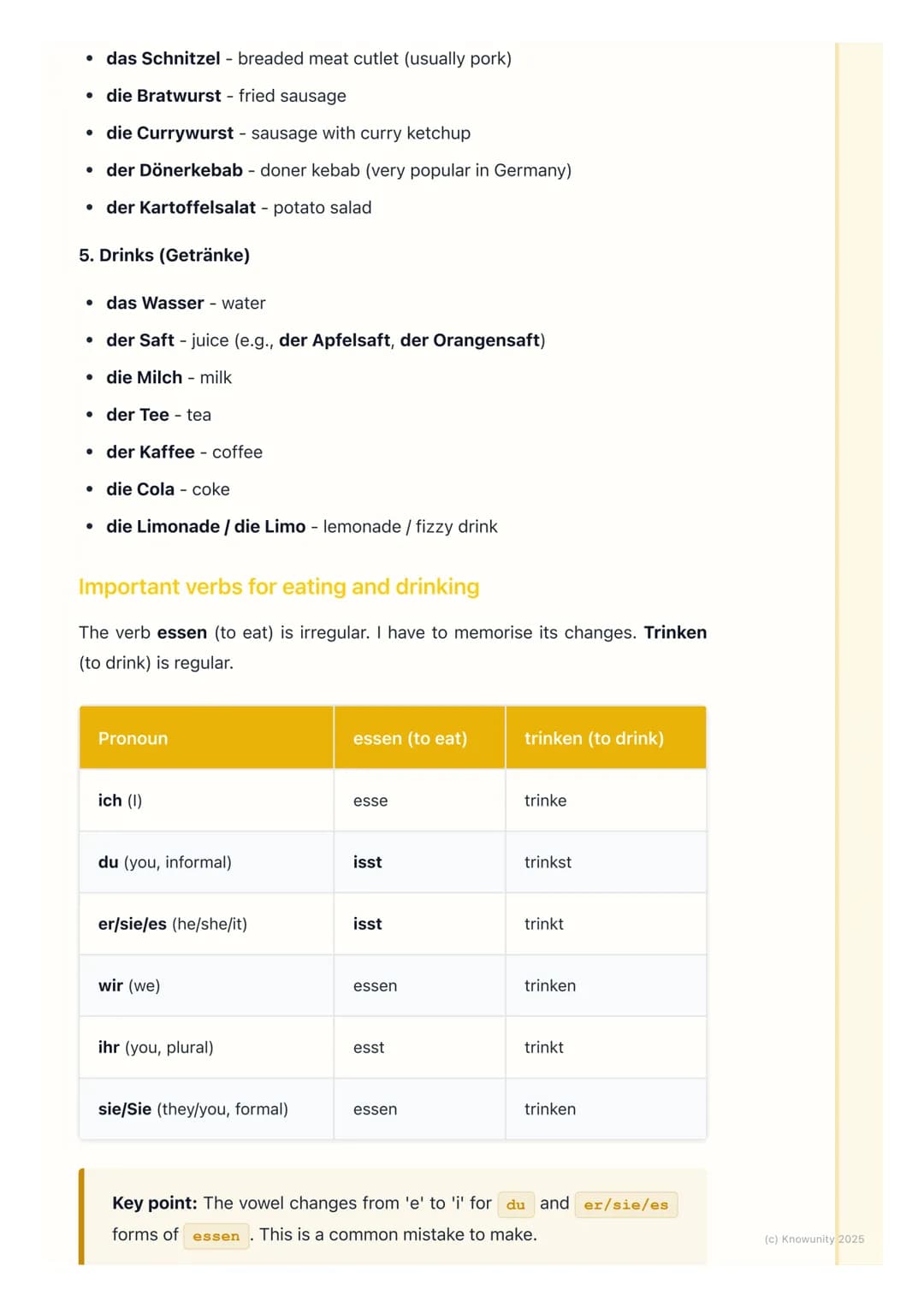
Essential Eating and Drinking Verbs
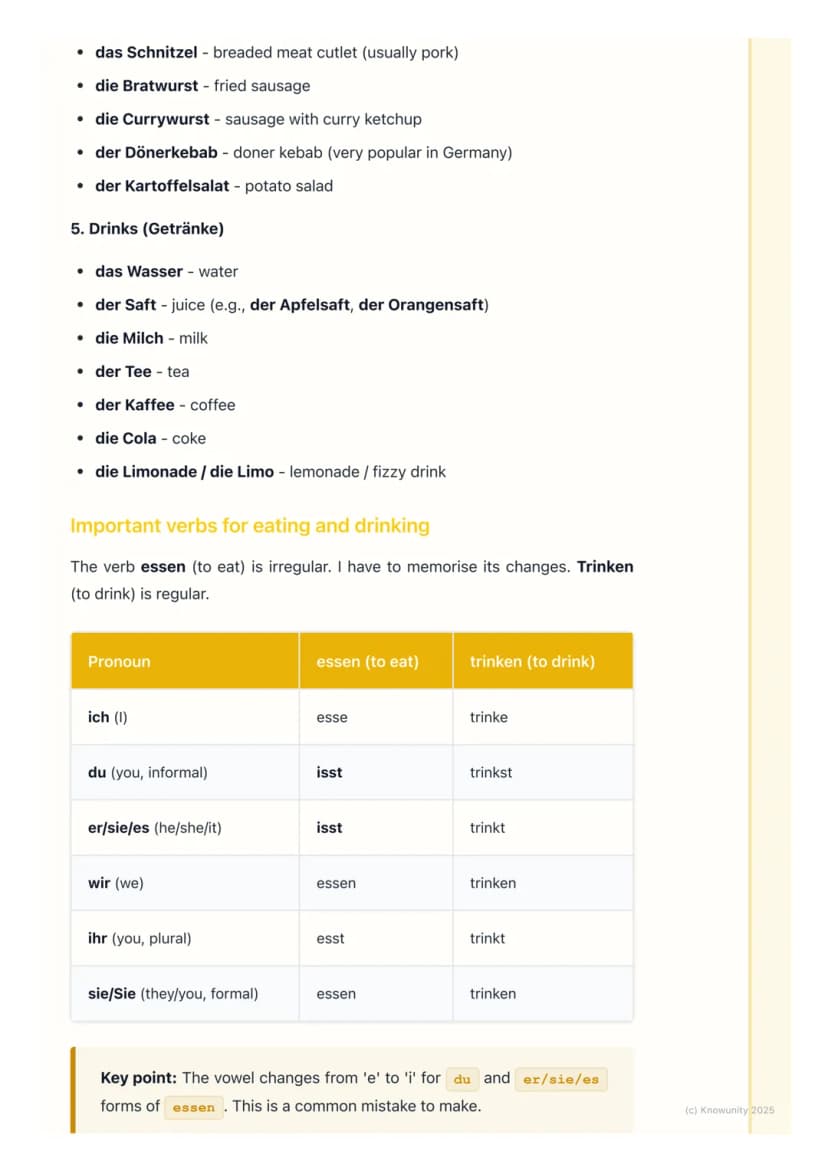
The verb essen (to eat) is your biggest challenge here because it's irregular. You absolutely must nail these forms: ich esse, du isst, er/sie/es isst. Notice that tricky vowel change from 'e' to 'i' - this trips up loads of students in exams.
Trinken (to drink) behaves much more predictably: ich trinke, du trinkst, er/sie/es trinkt. No vowel changes to worry about, just standard endings.
Practice makes perfect with irregular verbs. Try creating sentences about your daily routine: "Ich esse normalerweise Müsli zum Frühstück" (I normally eat muesli for breakfast). The more you use these verbs in context, the more automatic they become.
Memory Trick: Remember "Du isst" sounds like "Do eat" in English - a handy way to recall that irregular 'i' sound when you're stuck.
4
of 6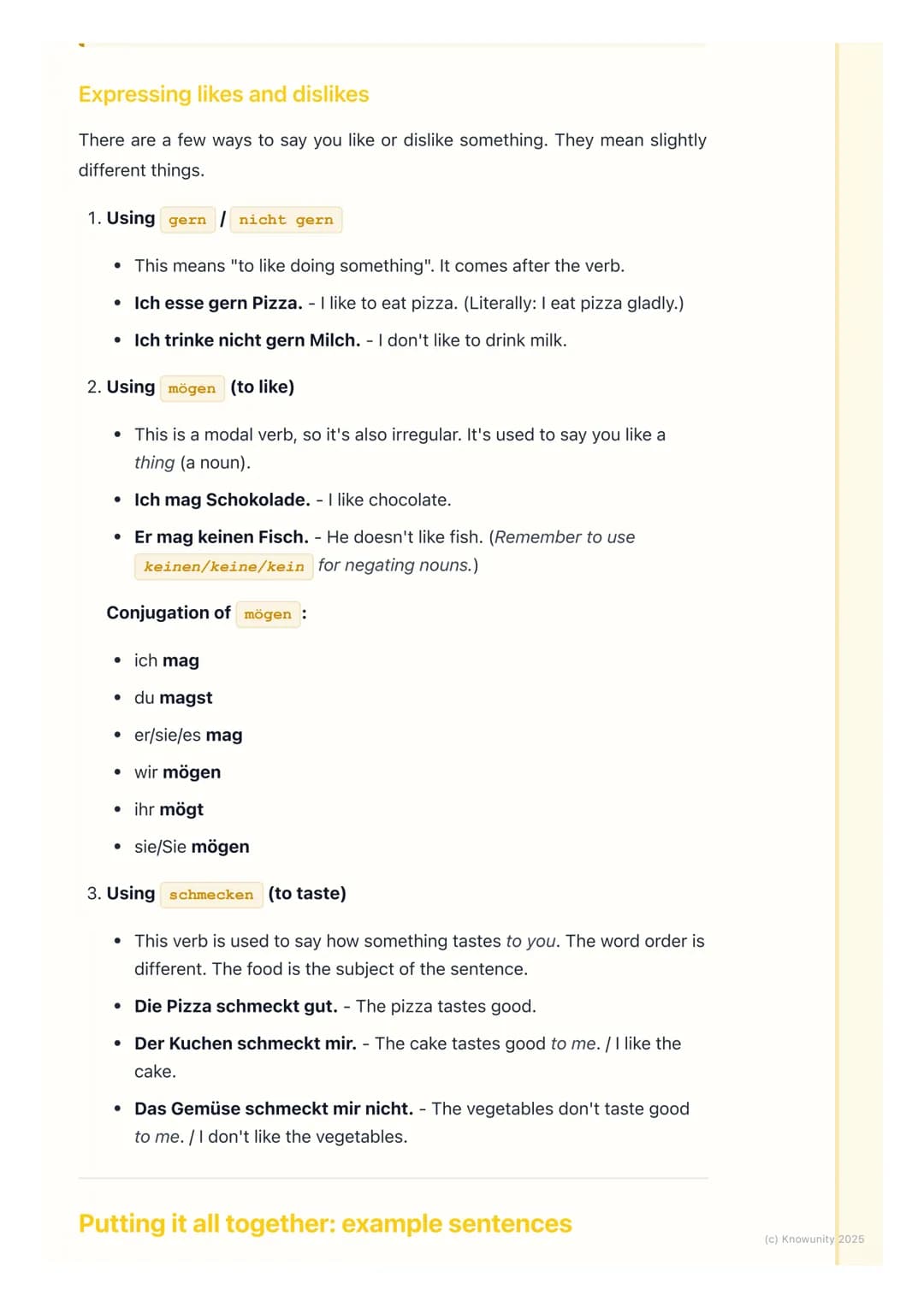
Expressing Food Preferences
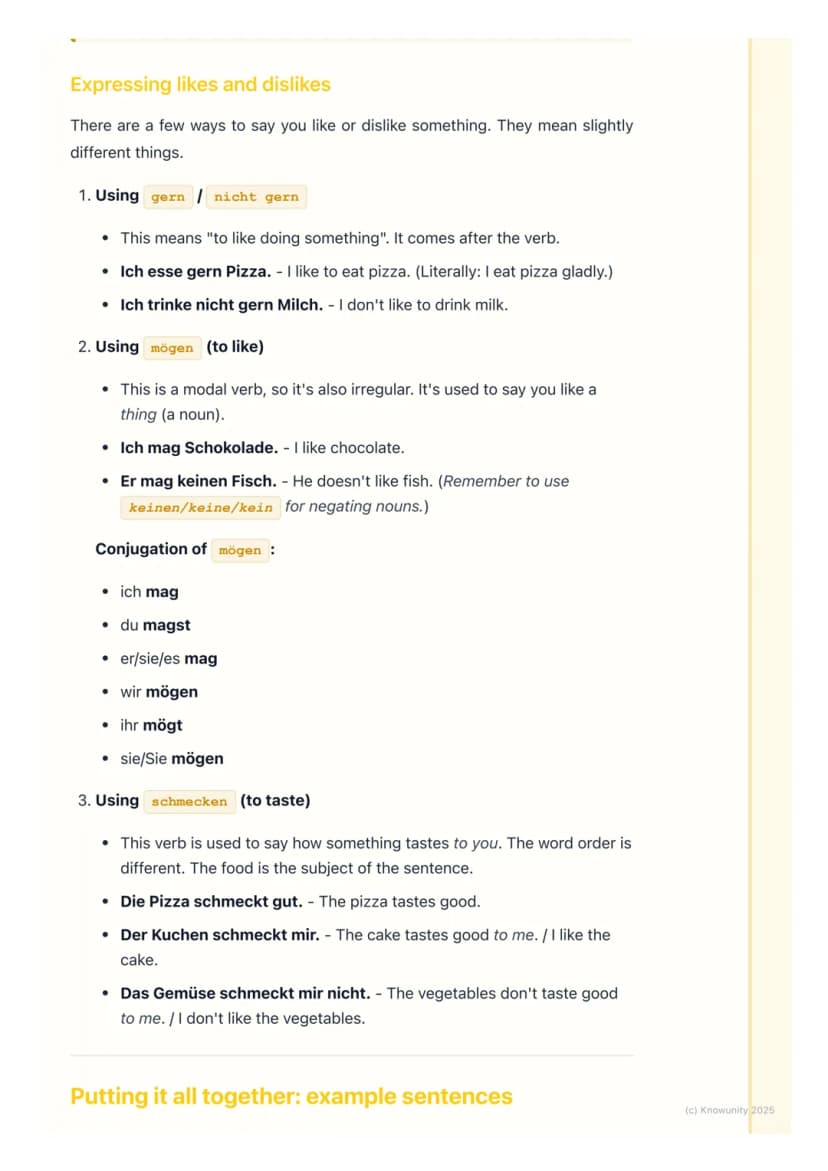
Mastering food opinions is crucial for natural conversations and exam success. Gern goes after the verb and means "to like doing something": "Ich esse gern Pizza" (I like eating pizza). This is probably the most useful structure for daily chat.
Mögen is a modal verb for liking things directly: "Ich mag Schokolade" (I like chocolate). Learn its irregular forms: ich mag, du magst, er/sie/es mag. For negatives, use kein: "Er mag keinen Fisch" (He doesn't like fish).
Schmecken has unique word order because the food becomes the subject: "Die Pizza schmeckt gut" (The pizza tastes good) or "Das schmeckt mir nicht" (I don't like that). This structure sounds sophisticated and impresses examiners.
Common Error Alert: Never say "Ich mag essen Pizza" - this mixing of mögen with another verb is a classic mistake that loses marks instantly.
5
of 6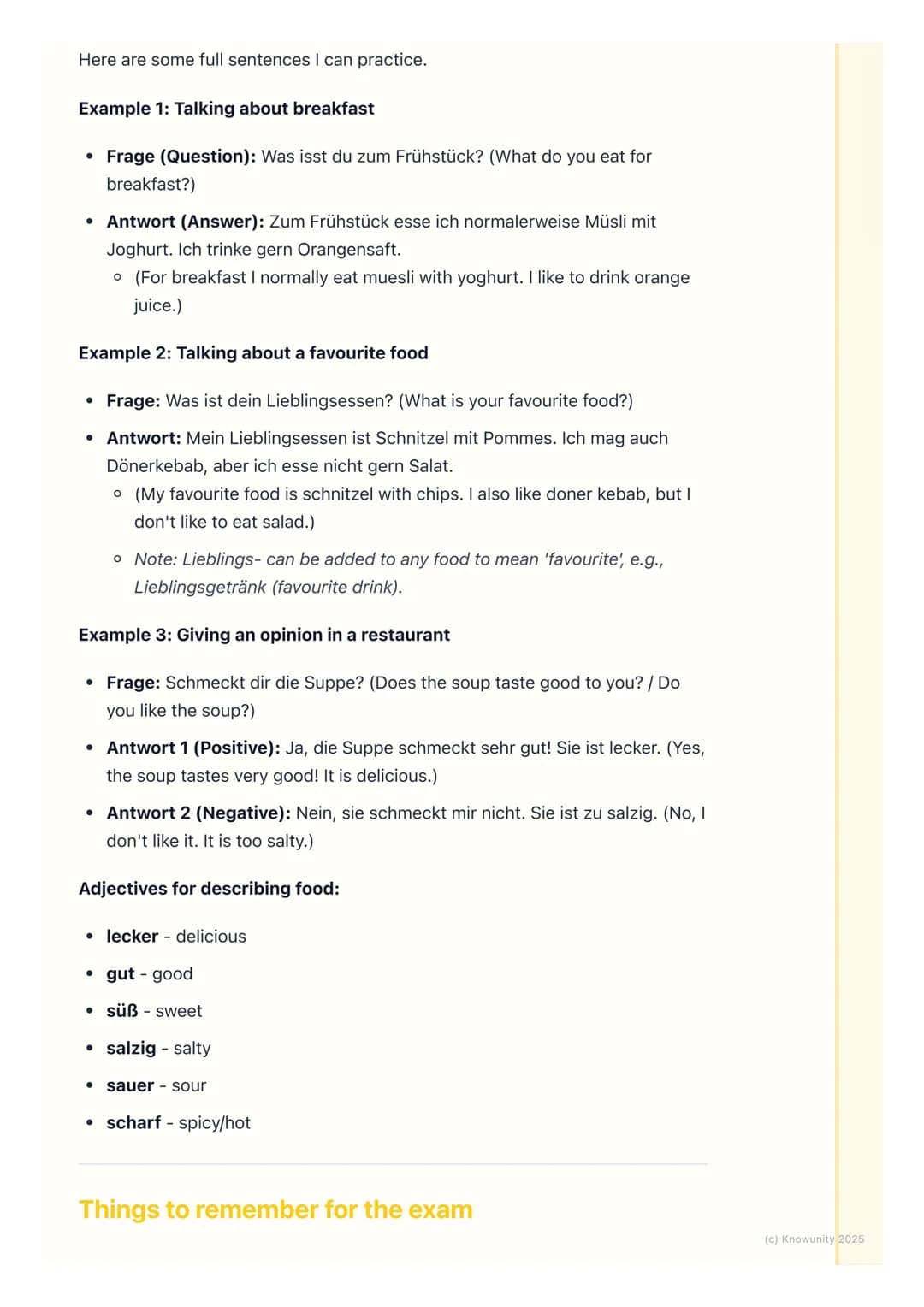
Practical Conversation Examples
Real exam questions often ask about your eating habits, so prepare solid answers. For "Was isst du zum Frühstück?" try: "Zum Frühstück esse ich normalerweise Müsli mit Joghurt. Ich trinke gern Orangensaft." This shows varied vocabulary and different opinion structures.
Lieblingsessen (favourite food) questions are exam favourites. Build impressive responses: "Mein Lieblingsessen ist Schnitzel mit Pommes. Ich mag auch Döner, aber ich esse nicht gern Salat." You're showing positive and negative opinions here.
Restaurant scenarios test your schmecken skills. "Schmeckt dir die Suppe?" needs confident responses like "Ja, sie schmeckt sehr gut! Sie ist lecker" or "Nein, sie schmeckt mir nicht. Sie ist zu salzig." Add descriptive adjectives like lecker (delicious), süß (sweet), or scharf (spicy) for extra impact.
Exam Strategy: Always give reasons for your opinions - "weil es lecker ist" (because it's delicious) shows sophisticated language use and earns higher marks.
6
of 6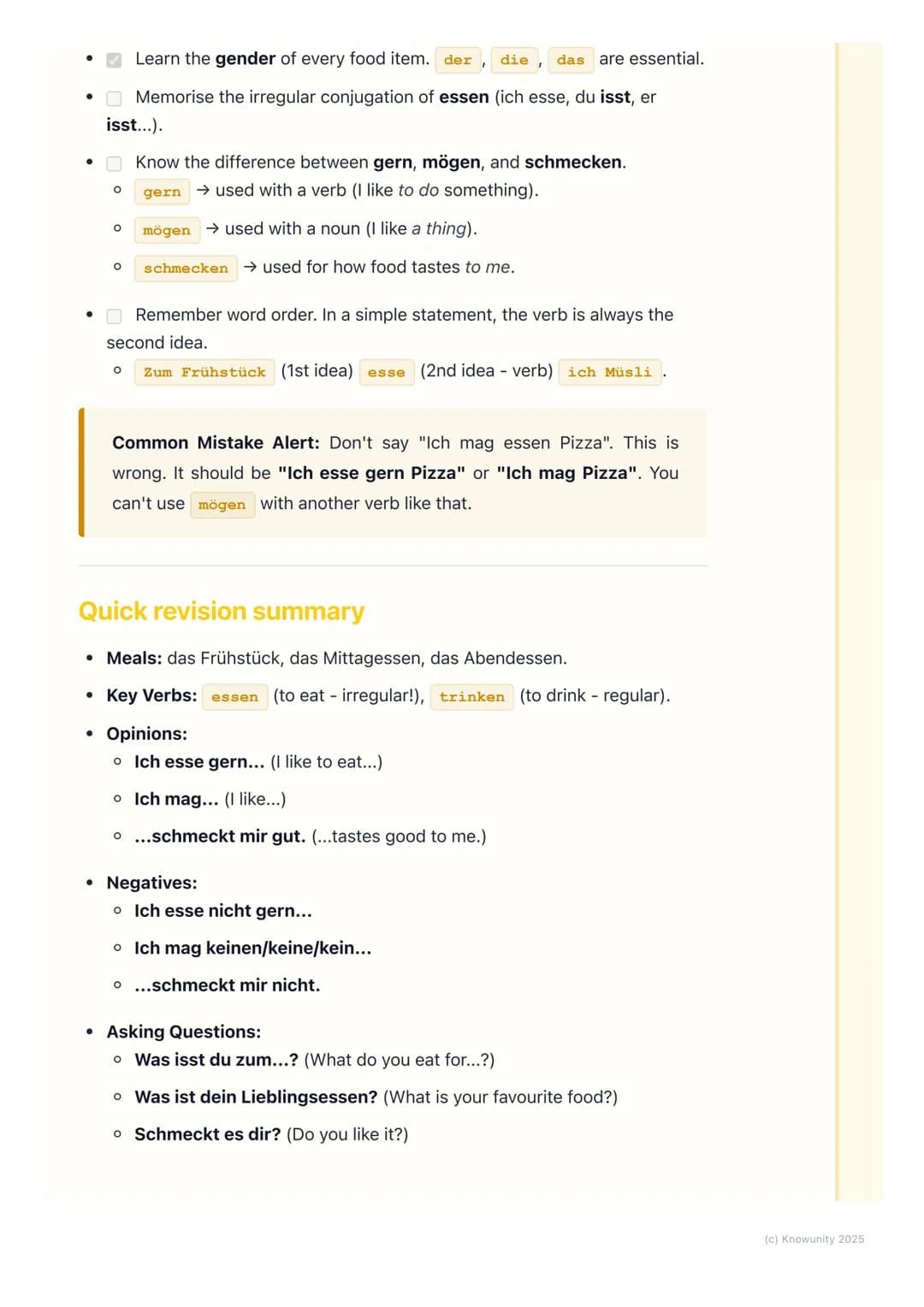
Key Points for Exam Success
Gender accuracy separates good students from great ones - learn every food item with its correct article. Der Käse, die Butter, das Brot must become automatic responses, not guesswork.
Word order in German follows strict rules. Remember that verbs always occupy the second position: "Zum Frühstück esse ich Müsli" not "Zum Frühstück ich esse Müsli." This fundamental pattern applies to every sentence you construct.
Keep your three opinion structures distinct: gern with verbs (Ich esse gern...), mögen with nouns (Ich mag...), and schmecken for taste descriptions (...schmeckt mir gut). Mixing these up signals confusion to examiners.
Essential question phrases like "Was isst du zum...?", "Was ist dein Lieblingsessen?", and "Schmeckt es dir?" prepare you for interactive speaking tasks where you'll need to ask questions, not just answer them.
Final Reminder: Practice negative forms too - "Ich esse nicht gern...", "Ich mag keinen/keine/kein...", "...schmeckt mir nicht" - because real conversations include dislikes as well as preferences.
Pensavamo che non l'avreste mai chiesto....
Che cos'è l'assistente AI di Knowunity?
Il nostro assistente AI è costruito specificamente per le esigenze degli studenti. Sulla base dei milioni di contenuti presenti sulla piattaforma, possiamo fornire agli studenti risposte davvero significative e pertinenti. Ma non si tratta solo di risposte, l'assistente è in grado di guidare gli studenti attraverso le loro sfide quotidiane di studio, con piani di studio personalizzati, quiz o contenuti nella chat e una personalizzazione al 100% basata sulle competenze e sugli sviluppi degli studenti.
Dove posso scaricare l'applicazione Knowunity?
È possibile scaricare l'applicazione dal Google Play Store e dall'Apple App Store.
Knowunity è davvero gratuita?
Sì, hai accesso completamente gratuito a tutti i contenuti nell'app e puoi chattare o seguire i Creatori in qualsiasi momento. Sbloccherai nuove funzioni crescendo il tuo numero di follower. Inoltre, offriamo Knowunity Premium, che consente di studiare senza alcun limite!!
Contenuti più popolari di German
2Contenuti più popolari
9 Irish
IrishIrish oral questions and answers
Questions and answers for the leaving cert oral
5th Year4264
 English
Key Quotes : Sive
Key Quotes and explanations: Sive
6th Year2842
IrishIrish oral questions
Outline of oral questions
5th Year2055
IrishIníon- le hÁine Durkin
Aine Durkin’s poem, Iníon: Themes & summary
5th Year890
IrishIrish poetry 2027
Iníon + Dínit an Bhróin
5th Year1153
IrishLC HL notes- Iníon (poem)
Includes poem in English and Irish, theme, key words & phrases
5th Year2304
EnglishCultural Context : Shawshank Redemption : Sive : Small Things Like These
Comparative Study : Cultural Context : Shawshank Redemption, Sive and Small Things Like These
6th Year1430
IrishMo Ghrá-sa (Idir Lúibíní)
Notes on mo ghrá-sa
5th Year380
IrishAn Gaeilge Aiste
Irish Language essay
6th Year1320
Non c'è niente di adatto? Esplorare altre aree tematiche.
Recensioni dei nostri utenti. Ci adorano - e anche tu, vedrai .
4.6/5App Store
4.7/5Google Play
L'applicazione è molto facile da usare e ben progettata. Finora ho trovato tutto quello che cercavo e ho potuto imparare molto dalle presentazioni! Utilizzerò sicuramente l'app per i compiti in classe! È molto utile anche come fonte di ispirazione.
Stefano Sutente iOS
Questa applicazione è davvero grande! Ci sono tantissimi appunti e aiuti con lo studio [...]. La mia materia problematica, per esempio, è il francese e l'app ha così tante opzioni per aiutarmi. Grazie a questa app ho migliorato il mio francese. La consiglio a tutti.
Samantha Klichutente Android
Wow, sono davvero stupita. Ho appena provato l'app perché l'ho vista pubblicizzata molte volte e sono rimasta assolutamente sbalordita. Questa app è L'AIUTO che cercate per la scuola e soprattutto offre tantissime cose, come allenamenti e schede, che a me personalmente sono state MOLTO utili.
Annautente iOS
German2 visualizzazioni·Aggiornato Jun 9, 2026·6 pagineBeliebte Mahlzeiten und Gerichte in Deutschland
Ever wondered how to talk about your favourite foods in German or order a meal when you visit Germany? This topic covers everything you need to know about meals, food vocabulary, and expressing what you love (or hate) to eat...
1
of 6
Iscriviti per mostrare il contenuto. È gratis!
- Accesso a tutti i documenti
- Migliora i tuoi voti
- Unisciti a milioni di studenti
Meals and Key Food Vocabulary
Learning German food vocabulary isn't just about memorising words - it's your ticket to authentic conversations and confident restaurant visits. The three main meals (die Mahlzeiten) are das Frühstück (breakfast), das Mittagessen (lunch), and das Abendessen (dinner).
Here's a clever trick: all three meal names use das because they contain the word "Essen" (food), which is neuter. This pattern-spotting will save you loads of time when learning genders!
For breakfast, you'll need words like das Brot (bread), die Marmelade (jam), and das Ei (egg). Lunch often features hearty options like das Hähnchen (chicken), die Pommes (chips), and das Gemüse (vegetables). Remember that lunch is typically the main hot meal in Germany, not dinner.
Top Tip: Create flashcards with the article in a different colour - your brain will start associating colours with genders automatically.
2
of 6Iscriviti per mostrare il contenuto. È gratis!
- Accesso a tutti i documenti
- Migliora i tuoi voti
- Unisciti a milioni di studenti
Popular German Dishes and Drinks
You'll sound much more natural knowing authentic German foods beyond basic vocabulary. Das Schnitzel (breaded cutlet), die Bratwurst (fried sausage), and die Currywurst (sausage with curry ketchup) are absolute classics you'll encounter everywhere.
Getränke (drinks) are equally important for daily conversations. Master das Wasser (water), der Saft (juice), die Milch (milk), and der Kaffee (coffee). Notice how drink genders vary - there's no shortcut here, so you'll need to memorise each one.
Don't forget regional favourites like der Döner (doner kebab), which is incredibly popular throughout Germany. These cultural details show examiners you understand real German life, not just textbook German.
Cultural Note: German evening meals (Abendbrot) are often lighter and colder than what we're used to in Ireland - think bread with cold cuts rather than a hot dinner.
3
of 6Iscriviti per mostrare il contenuto. È gratis!
- Accesso a tutti i documenti
- Migliora i tuoi voti
- Unisciti a milioni di studenti
Essential Eating and Drinking Verbs
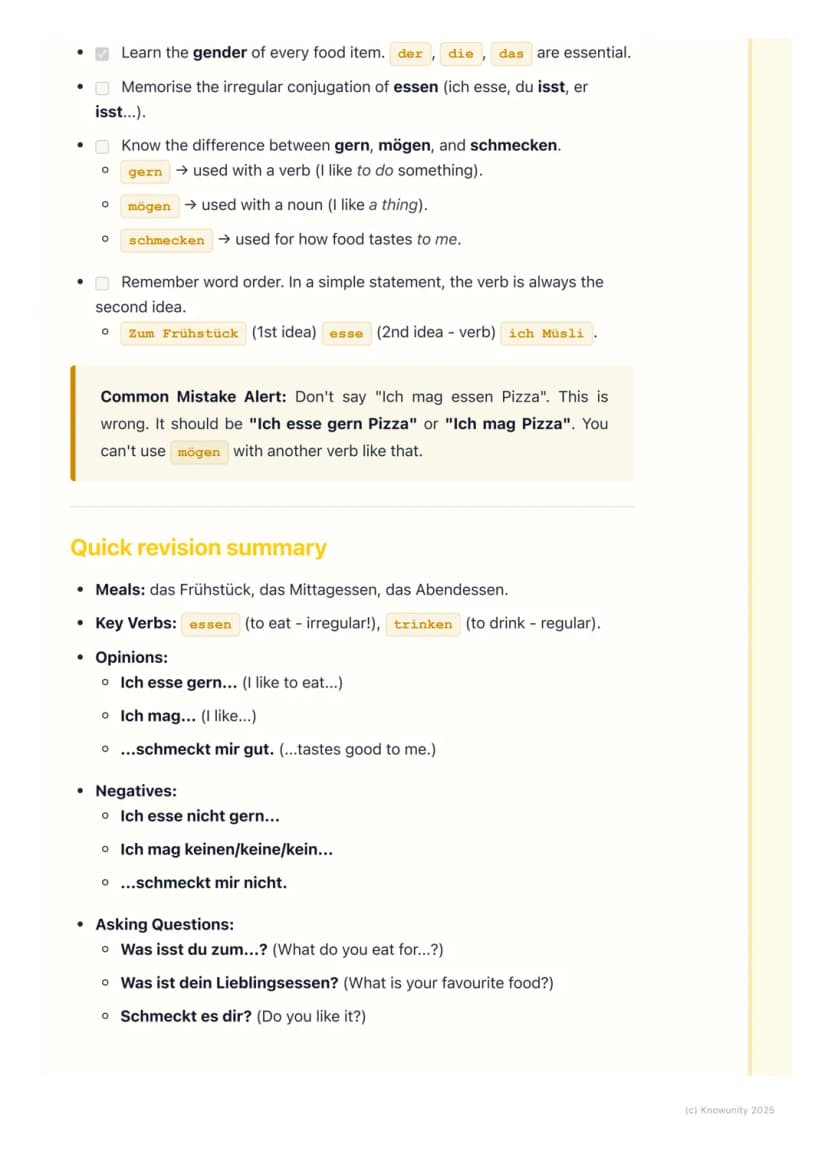
The verb essen (to eat) is your biggest challenge here because it's irregular. You absolutely must nail these forms: ich esse, du isst, er/sie/es isst. Notice that tricky vowel change from 'e' to 'i' - this trips up loads of students in exams.
Trinken (to drink) behaves much more predictably: ich trinke, du trinkst, er/sie/es trinkt. No vowel changes to worry about, just standard endings.
Practice makes perfect with irregular verbs. Try creating sentences about your daily routine: "Ich esse normalerweise Müsli zum Frühstück" (I normally eat muesli for breakfast). The more you use these verbs in context, the more automatic they become.
Memory Trick: Remember "Du isst" sounds like "Do eat" in English - a handy way to recall that irregular 'i' sound when you're stuck.
4
of 6Iscriviti per mostrare il contenuto. È gratis!
- Accesso a tutti i documenti
- Migliora i tuoi voti
- Unisciti a milioni di studenti
Expressing Food Preferences
Mastering food opinions is crucial for natural conversations and exam success. Gern goes after the verb and means "to like doing something": "Ich esse gern Pizza" (I like eating pizza). This is probably the most useful structure for daily chat.
Mögen is a modal verb for liking things directly: "Ich mag Schokolade" (I like chocolate). Learn its irregular forms: ich mag, du magst, er/sie/es mag. For negatives, use kein: "Er mag keinen Fisch" (He doesn't like fish).
Schmecken has unique word order because the food becomes the subject: "Die Pizza schmeckt gut" (The pizza tastes good) or "Das schmeckt mir nicht" (I don't like that). This structure sounds sophisticated and impresses examiners.
Common Error Alert: Never say "Ich mag essen Pizza" - this mixing of mögen with another verb is a classic mistake that loses marks instantly.
5
of 6Iscriviti per mostrare il contenuto. È gratis!
- Accesso a tutti i documenti
- Migliora i tuoi voti
- Unisciti a milioni di studenti
Practical Conversation Examples
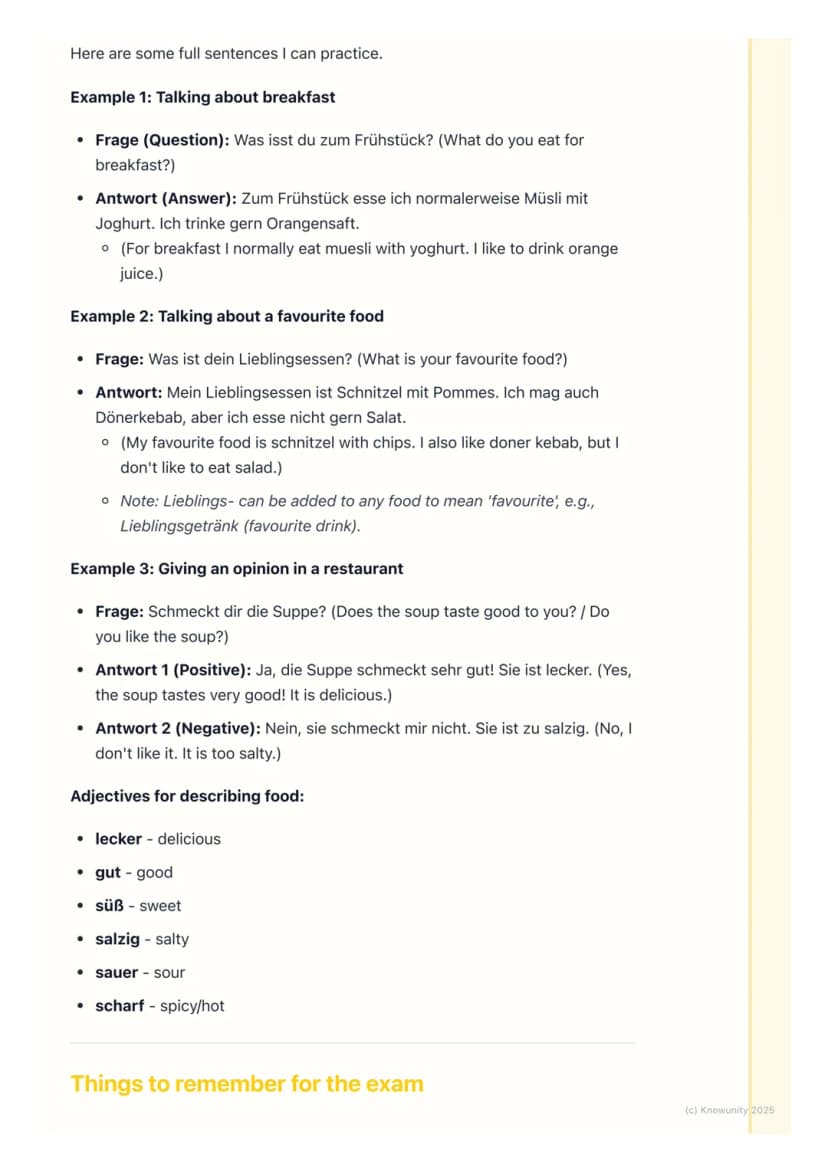
Real exam questions often ask about your eating habits, so prepare solid answers. For "Was isst du zum Frühstück?" try: "Zum Frühstück esse ich normalerweise Müsli mit Joghurt. Ich trinke gern Orangensaft." This shows varied vocabulary and different opinion structures.
Lieblingsessen (favourite food) questions are exam favourites. Build impressive responses: "Mein Lieblingsessen ist Schnitzel mit Pommes. Ich mag auch Döner, aber ich esse nicht gern Salat." You're showing positive and negative opinions here.
Restaurant scenarios test your schmecken skills. "Schmeckt dir die Suppe?" needs confident responses like "Ja, sie schmeckt sehr gut! Sie ist lecker" or "Nein, sie schmeckt mir nicht. Sie ist zu salzig." Add descriptive adjectives like lecker (delicious), süß (sweet), or scharf (spicy) for extra impact.
Exam Strategy: Always give reasons for your opinions - "weil es lecker ist" (because it's delicious) shows sophisticated language use and earns higher marks.
6
of 6Iscriviti per mostrare il contenuto. È gratis!
- Accesso a tutti i documenti
- Migliora i tuoi voti
- Unisciti a milioni di studenti
Key Points for Exam Success
Gender accuracy separates good students from great ones - learn every food item with its correct article. Der Käse, die Butter, das Brot must become automatic responses, not guesswork.
Word order in German follows strict rules. Remember that verbs always occupy the second position: "Zum Frühstück esse ich Müsli" not "Zum Frühstück ich esse Müsli." This fundamental pattern applies to every sentence you construct.
Keep your three opinion structures distinct: gern with verbs (Ich esse gern...), mögen with nouns (Ich mag...), and schmecken for taste descriptions (...schmeckt mir gut). Mixing these up signals confusion to examiners.
Essential question phrases like "Was isst du zum...?", "Was ist dein Lieblingsessen?", and "Schmeckt es dir?" prepare you for interactive speaking tasks where you'll need to ask questions, not just answer them.
Final Reminder: Practice negative forms too - "Ich esse nicht gern...", "Ich mag keinen/keine/kein...", "...schmeckt mir nicht" - because real conversations include dislikes as well as preferences.
Pensavamo che non l'avreste mai chiesto....
Che cos'è l'assistente AI di Knowunity?
Il nostro assistente AI è costruito specificamente per le esigenze degli studenti. Sulla base dei milioni di contenuti presenti sulla piattaforma, possiamo fornire agli studenti risposte davvero significative e pertinenti. Ma non si tratta solo di risposte, l'assistente è in grado di guidare gli studenti attraverso le loro sfide quotidiane di studio, con piani di studio personalizzati, quiz o contenuti nella chat e una personalizzazione al 100% basata sulle competenze e sugli sviluppi degli studenti.
Dove posso scaricare l'applicazione Knowunity?
È possibile scaricare l'applicazione dal Google Play Store e dall'Apple App Store.
Knowunity è davvero gratuita?
Sì, hai accesso completamente gratuito a tutti i contenuti nell'app e puoi chattare o seguire i Creatori in qualsiasi momento. Sbloccherai nuove funzioni crescendo il tuo numero di follower. Inoltre, offriamo Knowunity Premium, che consente di studiare senza alcun limite!!
Contenuti più popolari di German
2Contenuti più popolari
9IrishIrish oral questions and answers
Questions and answers for the leaving cert oral
5th Year4264
EnglishKey Quotes : Sive
Key Quotes and explanations: Sive
6th Year2842
IrishIrish oral questions
Outline of oral questions
5th Year2055
IrishIníon- le hÁine Durkin
Aine Durkin’s poem, Iníon: Themes & summary
5th Year890
IrishIrish poetry 2027
Iníon + Dínit an Bhróin
5th Year1153
IrishLC HL notes- Iníon (poem)
Includes poem in English and Irish, theme, key words & phrases
5th Year2304
EnglishCultural Context : Shawshank Redemption : Sive : Small Things Like These
Comparative Study : Cultural Context : Shawshank Redemption, Sive and Small Things Like These
6th Year1430
IrishMo Ghrá-sa (Idir Lúibíní)
Notes on mo ghrá-sa
5th Year380
IrishAn Gaeilge Aiste
Irish Language essay
6th Year1320
Non c'è niente di adatto? Esplorare altre aree tematiche.
Recensioni dei nostri utenti. Ci adorano - e anche tu, vedrai .
4.6/5App Store
4.7/5Google Play
L'applicazione è molto facile da usare e ben progettata. Finora ho trovato tutto quello che cercavo e ho potuto imparare molto dalle presentazioni! Utilizzerò sicuramente l'app per i compiti in classe! È molto utile anche come fonte di ispirazione.
Stefano Sutente iOS
Questa applicazione è davvero grande! Ci sono tantissimi appunti e aiuti con lo studio [...]. La mia materia problematica, per esempio, è il francese e l'app ha così tante opzioni per aiutarmi. Grazie a questa app ho migliorato il mio francese. La consiglio a tutti.
Samantha Klichutente Android
Wow, sono davvero stupita. Ho appena provato l'app perché l'ho vista pubblicizzata molte volte e sono rimasta assolutamente sbalordita. Questa app è L'AIUTO che cercate per la scuola e soprattutto offre tantissime cose, come allenamenti e schede, che a me personalmente sono state MOLTO utili.
Annautente iOS