
Ever wondered how massive mountain ranges like the Himalayas or... Mostra di più
 Geography8 visualizzazioni·Aggiornato May 26, 2026·5 pagine
Formation of Fold Mountains: Tectonic Plate Collisions
1 / 5
1
of 5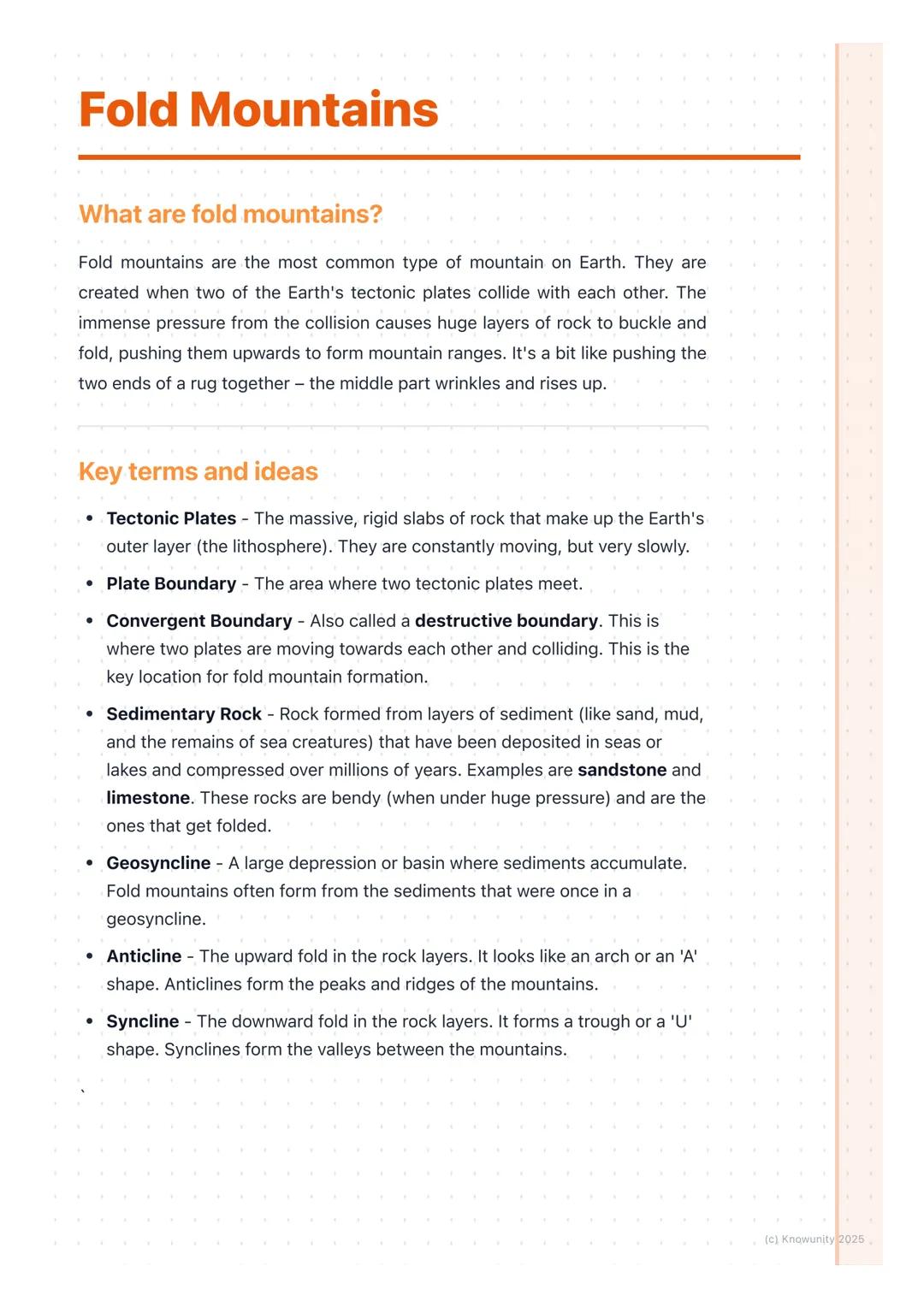
What Are Fold Mountains?
Think of fold mountains as Earth's most dramatic collision results. When tectonic plates - those massive slabs of rock that make up Earth's outer shell - smash into each other, the pressure is so intense that rock layers don't just break, they actually bend and fold upwards.
This process happens at convergent boundaries (also called destructive boundaries), where plates move towards each other. The key ingredient here is sedimentary rock - stuff like sandstone and limestone that formed from ancient sea deposits. These rocks are surprisingly bendy under extreme pressure!
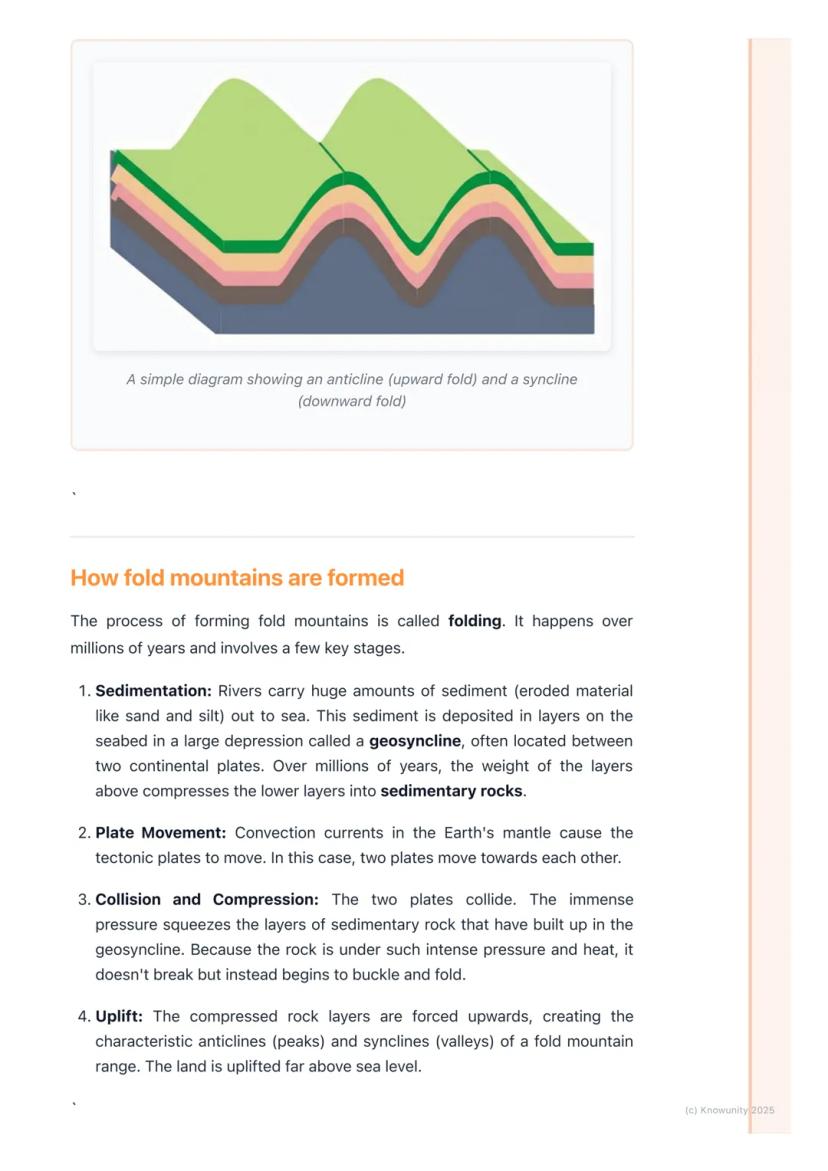
Understanding the basic structure is crucial for your exams. Anticlines are the upward folds that create mountain peaks (think of an 'A' shape), while synclines are the downward folds forming valleys between peaks (like a 'U' shape).
Quick Tip: Remember that fold mountains need sedimentary rock to work - it's flexible enough to fold rather than just snap under pressure!
2
of 5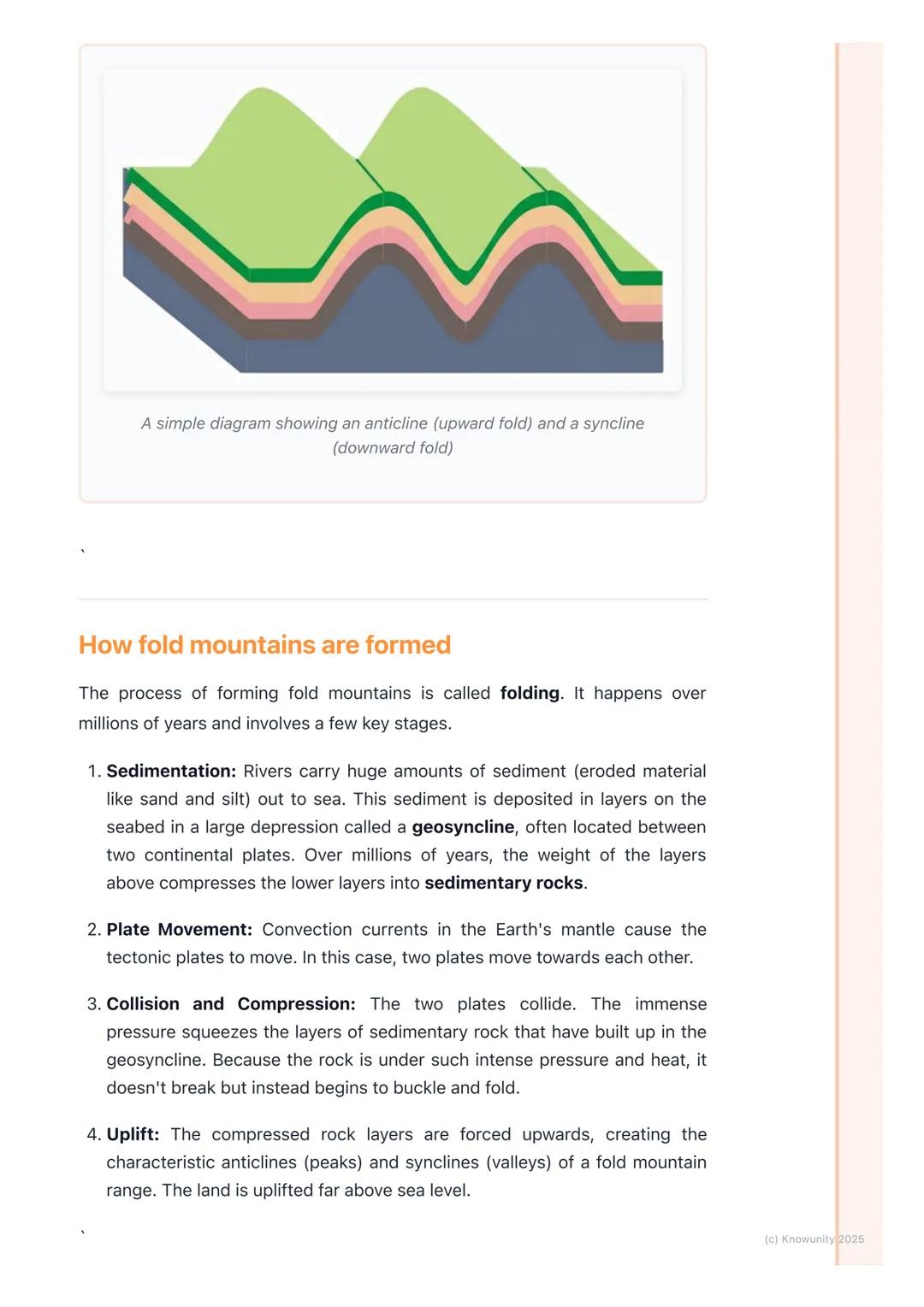
How Fold Mountains Form
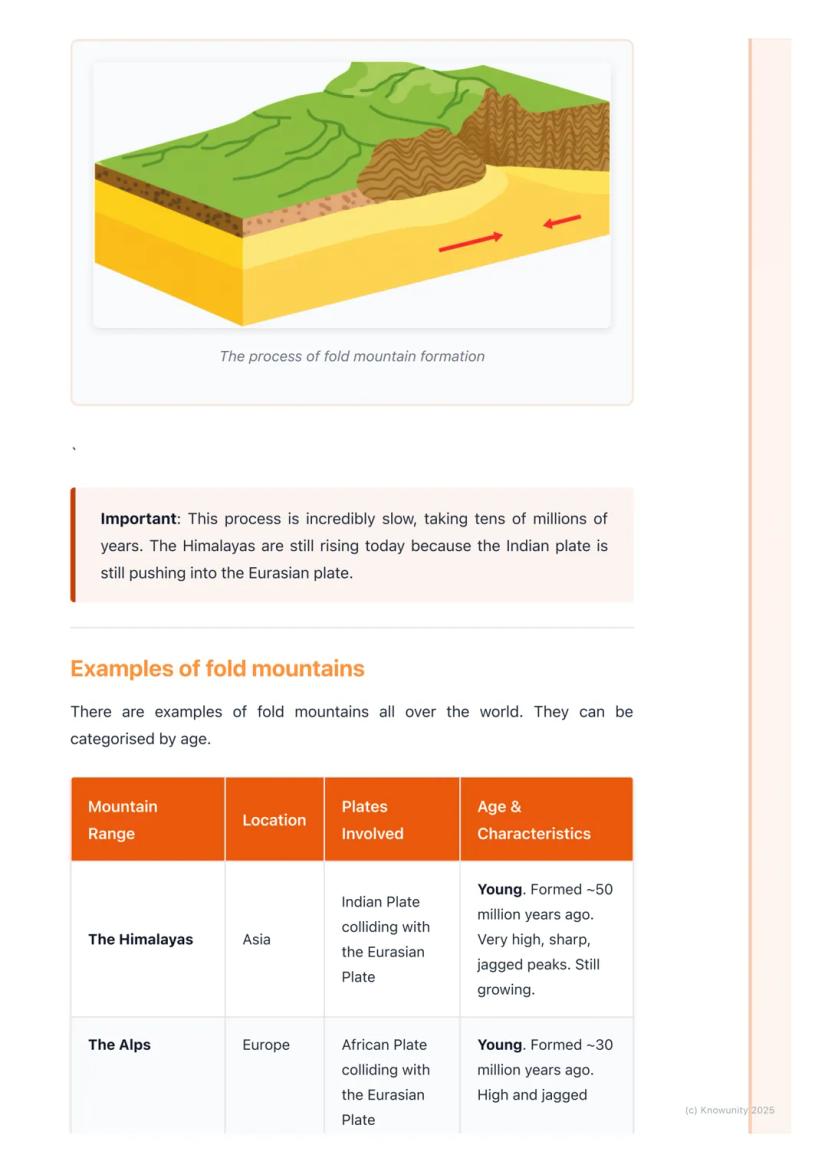
The formation process, called folding, happens in four main stages over millions of years. First, rivers dump loads of sediment into the sea, where it builds up in layers within a large depression called a geosyncline. These layers gradually compress into sedimentary rock under their own weight.
Next, convection currents in Earth's mantle start moving the tectonic plates towards each other. When they finally collide, the massive pressure squeezes all those sedimentary rock layers that have been sitting in the geosyncline.
Here's the magic bit - instead of breaking, the intense pressure and heat cause the rock layers to buckle and fold. Finally, this compressed rock gets forced upwards, creating the characteristic peaks and valleys we see in fold mountain ranges.
Mind-Blowing Fact: The Himalayas are still growing today because the Indian plate keeps pushing into the Eurasian plate - they rise about 5mm per year!
3
of 5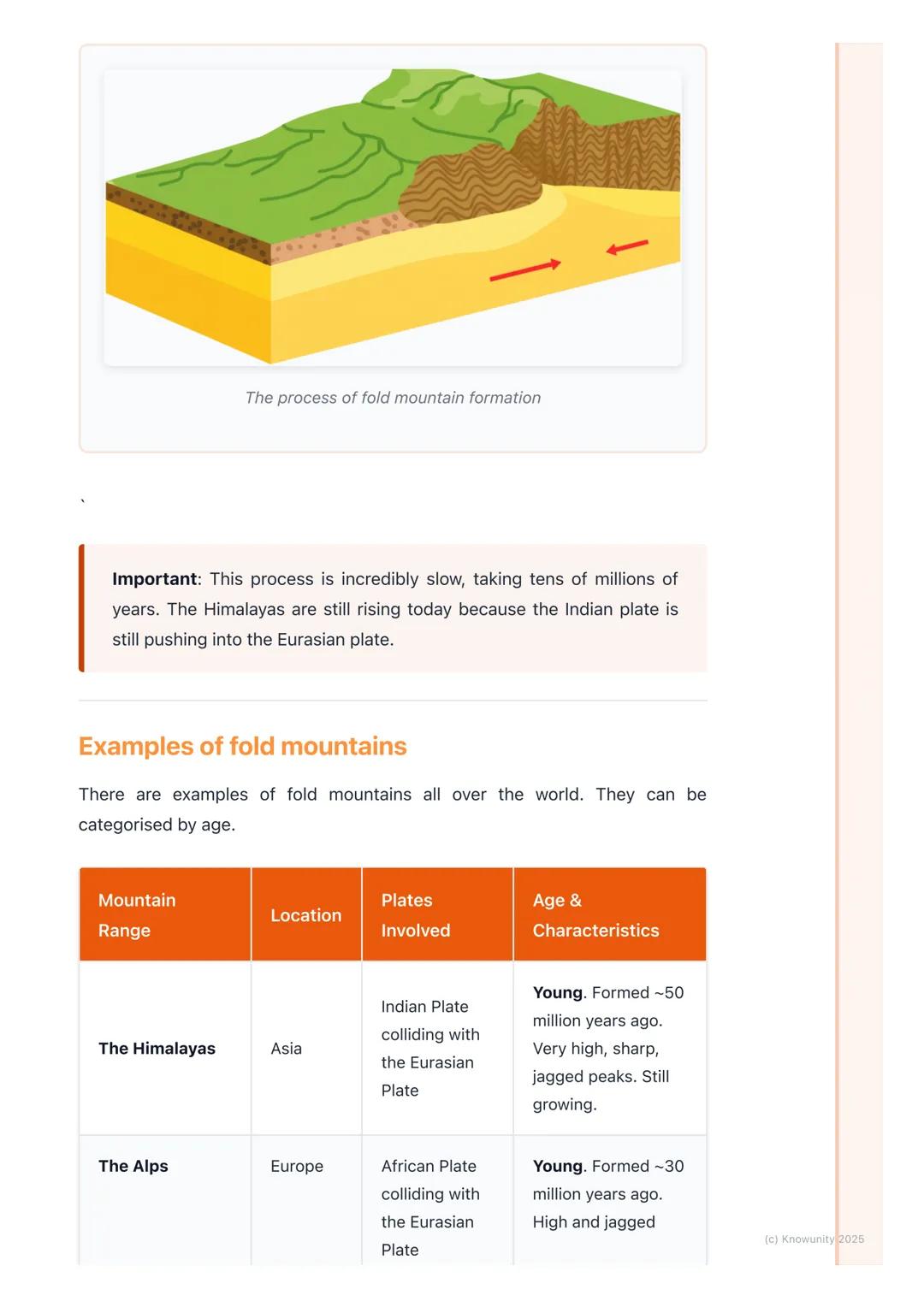
Global Examples You Need to Know
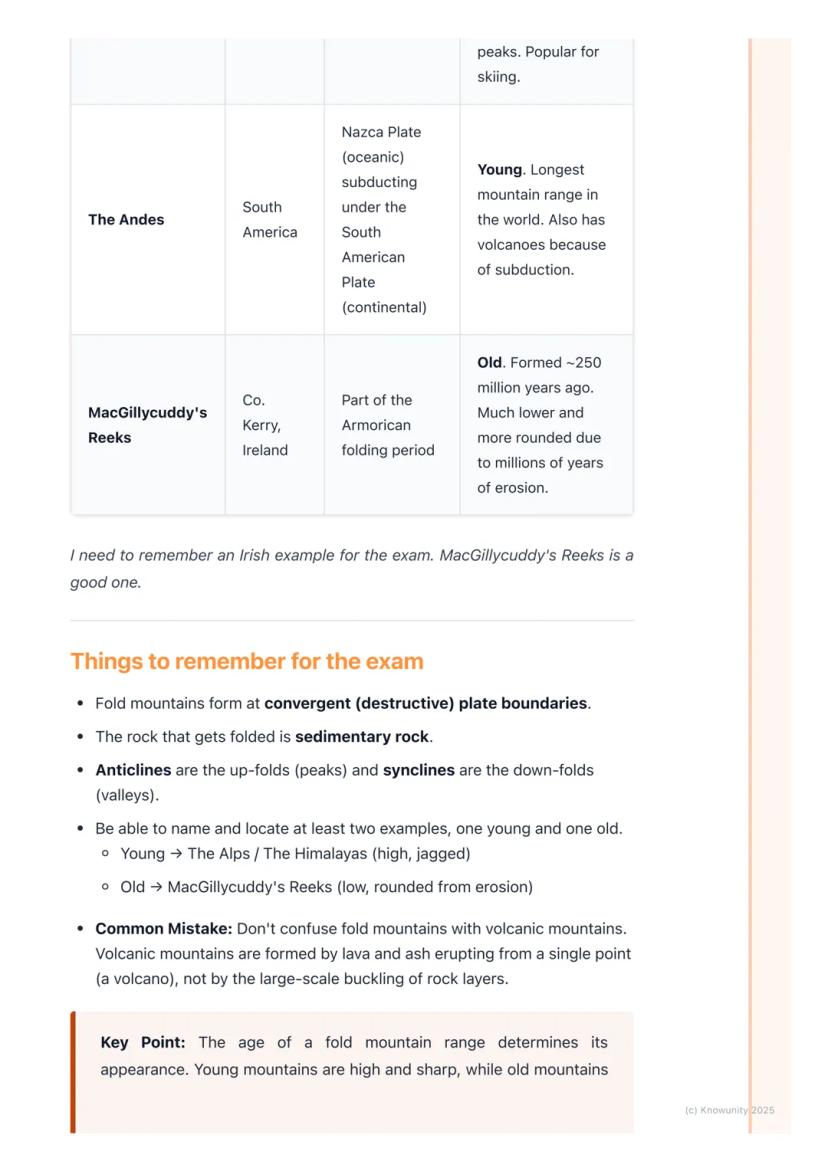
For your exams, you'll need to know both young and old fold mountain ranges. The Himalayas in Asia formed about 50 million years ago when the Indian Plate crashed into the Eurasian Plate - they're still the world's highest mountains with sharp, jagged peaks.
The Alps in Europe tell a similar story, created 30 million years ago as the African Plate collided with the Eurasian Plate. These young mountains are also high and jagged, making them perfect for skiing.
On the other end of the spectrum, MacGillycuddy's Reeks in Kerry represents Ireland's ancient fold mountains. Formed around 250 million years ago during the Armorican folding period, they're much lower and more rounded because erosion has been wearing them down for ages.
Exam Smart: Always include MacGillycuddy's Reeks as your Irish example - it's exactly what examiners want to see!
4
of 5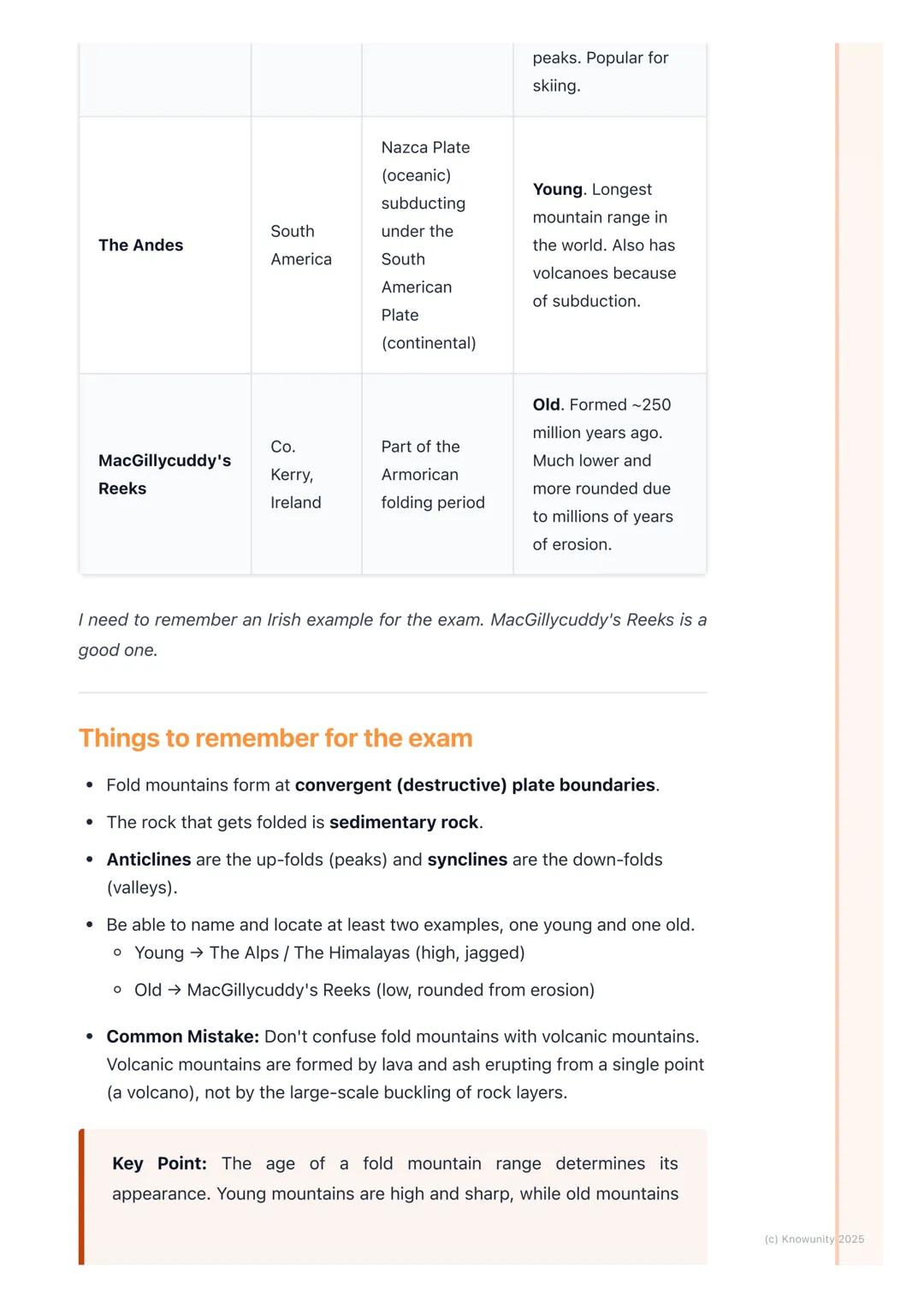
Age Matters: Young vs Old Mountains
The age of fold mountains completely changes their appearance, and this is a key concept for understanding mountain landscapes. Young fold mountains like the Himalayas and Alps are incredibly high with sharp, jagged peaks because they haven't had time for erosion to wear them down.
Old fold mountains like MacGillycuddy's Reeks look completely different - they're much lower and have rounded, gentle slopes. After millions of years of weathering and erosion, they've lost their dramatic height and sharp edges.
Don't get caught out by a common exam mistake! Fold mountains are completely different from volcanic mountains. Volcanic mountains form from lava and ash erupting from a single point, whilst fold mountains result from the large-scale buckling of entire rock layers across huge areas.
Key Insight: If you see high, sharp peaks, think young fold mountains. If you see low, rounded hills, think old fold mountains that have been eroded over time.
5
of 5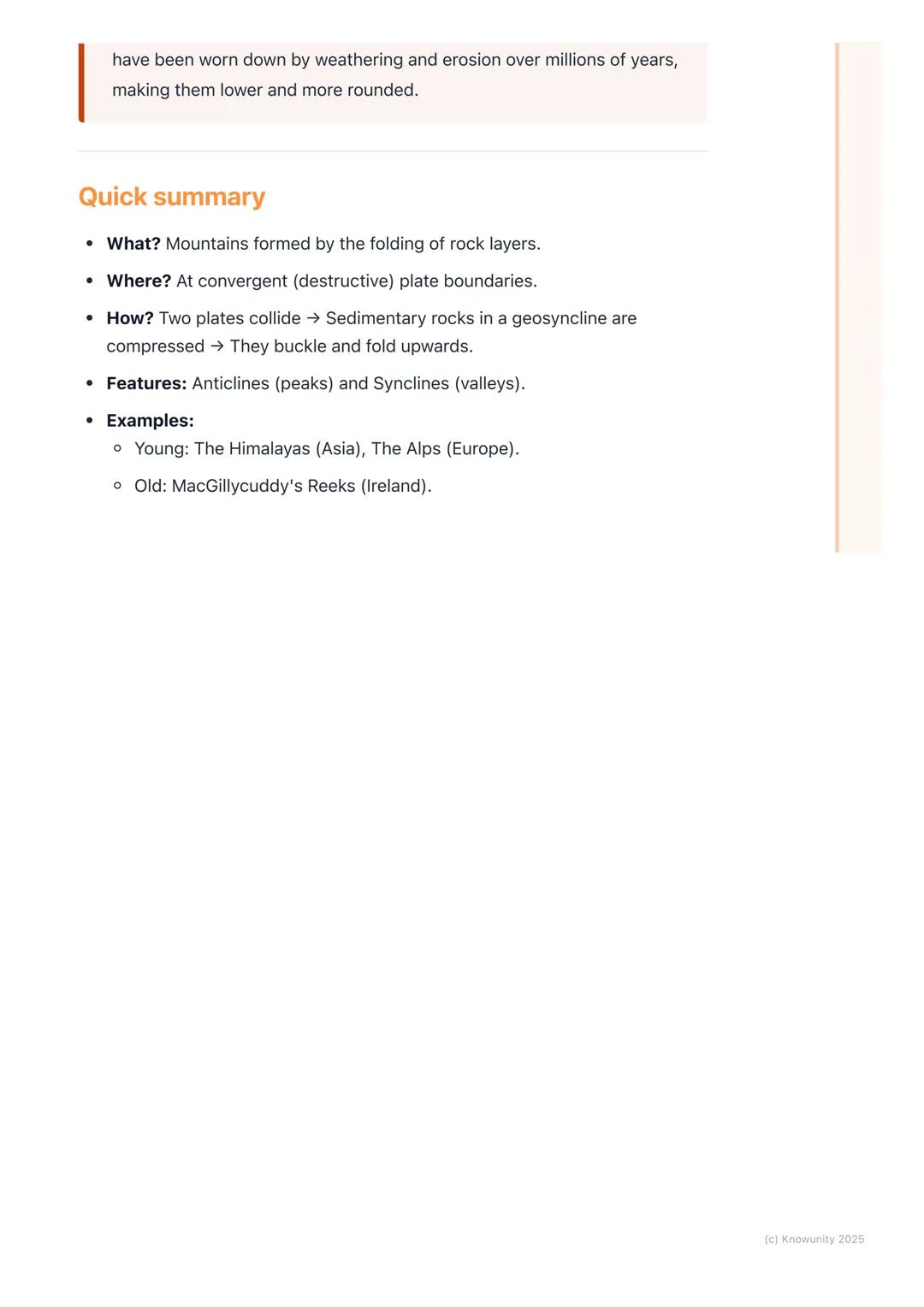
Quick Revision Summary
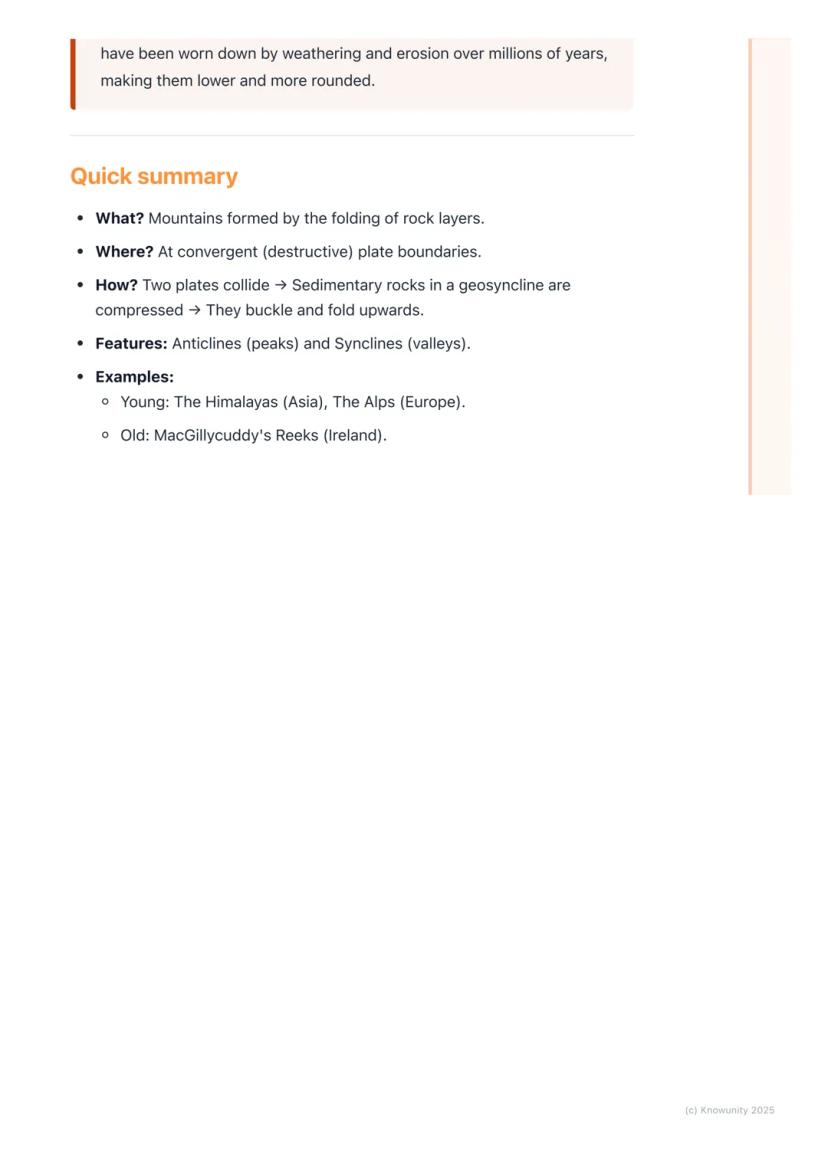
Here's everything you need to remember for your exams in a nutshell. Fold mountains form when sedimentary rocks get compressed and buckled upwards at convergent plate boundaries. The process creates anticlines (peaks) and synclines (valleys) over millions of years.
Your go-to examples should include young mountains like the Himalayas (Indian vs Eurasian plates) and the Alps (African vs Eurasian plates) - both high and jagged. For older examples, MacGillycuddy's Reeks in Ireland shows how erosion rounds off ancient fold mountains.
Remember the formation sequence: sedimentation in a geosyncline → plate movement → collision and compression → uplift into fold mountains. This process is still happening today in places like the Himalayas, proving that Earth's surface is constantly changing.
Exam Success: Focus on the plate boundary type (convergent), rock type (sedimentary), and be able to explain why young mountains look different from old ones!
Pensavamo che non l'avreste mai chiesto....
Che cos'è l'assistente AI di Knowunity?
Il nostro assistente AI è costruito specificamente per le esigenze degli studenti. Sulla base dei milioni di contenuti presenti sulla piattaforma, possiamo fornire agli studenti risposte davvero significative e pertinenti. Ma non si tratta solo di risposte, l'assistente è in grado di guidare gli studenti attraverso le loro sfide quotidiane di studio, con piani di studio personalizzati, quiz o contenuti nella chat e una personalizzazione al 100% basata sulle competenze e sugli sviluppi degli studenti.
Dove posso scaricare l'applicazione Knowunity?
È possibile scaricare l'applicazione dal Google Play Store e dall'Apple App Store.
Knowunity è davvero gratuita?
Sì, hai accesso completamente gratuito a tutti i contenuti nell'app e puoi chattare o seguire i Creatori in qualsiasi momento. Sbloccherai nuove funzioni crescendo il tuo numero di follower. Inoltre, offriamo Knowunity Premium, che consente di studiare senza alcun limite!!
Contenuti più popolari di Geography
9Contenuti più popolari
9Non c'è niente di adatto? Esplorare altre aree tematiche.
Recensioni dei nostri utenti. Ci adorano - e anche tu, vedrai .
4.6/5App Store
4.7/5Google Play
L'applicazione è molto facile da usare e ben progettata. Finora ho trovato tutto quello che cercavo e ho potuto imparare molto dalle presentazioni! Utilizzerò sicuramente l'app per i compiti in classe! È molto utile anche come fonte di ispirazione.
Stefano Sutente iOS
Questa applicazione è davvero grande! Ci sono tantissimi appunti e aiuti con lo studio [...]. La mia materia problematica, per esempio, è il francese e l'app ha così tante opzioni per aiutarmi. Grazie a questa app ho migliorato il mio francese. La consiglio a tutti.
Samantha Klichutente Android
Wow, sono davvero stupita. Ho appena provato l'app perché l'ho vista pubblicizzata molte volte e sono rimasta assolutamente sbalordita. Questa app è L'AIUTO che cercate per la scuola e soprattutto offre tantissime cose, come allenamenti e schede, che a me personalmente sono state MOLTO utili.
Annautente iOS
Geography8 visualizzazioni·Aggiornato May 26, 2026·5 pagineFormation of Fold Mountains: Tectonic Plate Collisions
Ever wondered how massive mountain ranges like the Himalayas or the Alps actually formed? Fold mountainsare created when Earth's tectonic plates crash into each other with such force that entire layers of rock buckle and fold upwards - imagine... Mostra di più
1
of 5Iscriviti per mostrare il contenuto. È gratis!
- Accesso a tutti i documenti
- Migliora i tuoi voti
- Unisciti a milioni di studenti
What Are Fold Mountains?
Think of fold mountains as Earth's most dramatic collision results. When tectonic plates - those massive slabs of rock that make up Earth's outer shell - smash into each other, the pressure is so intense that rock layers don't just break, they actually bend and fold upwards.
This process happens at convergent boundaries (also called destructive boundaries), where plates move towards each other. The key ingredient here is sedimentary rock - stuff like sandstone and limestone that formed from ancient sea deposits. These rocks are surprisingly bendy under extreme pressure!
Understanding the basic structure is crucial for your exams. Anticlines are the upward folds that create mountain peaks (think of an 'A' shape), while synclines are the downward folds forming valleys between peaks (like a 'U' shape).
Quick Tip: Remember that fold mountains need sedimentary rock to work - it's flexible enough to fold rather than just snap under pressure!
2
of 5Iscriviti per mostrare il contenuto. È gratis!
- Accesso a tutti i documenti
- Migliora i tuoi voti
- Unisciti a milioni di studenti
How Fold Mountains Form
The formation process, called folding, happens in four main stages over millions of years. First, rivers dump loads of sediment into the sea, where it builds up in layers within a large depression called a geosyncline. These layers gradually compress into sedimentary rock under their own weight.
Next, convection currents in Earth's mantle start moving the tectonic plates towards each other. When they finally collide, the massive pressure squeezes all those sedimentary rock layers that have been sitting in the geosyncline.
Here's the magic bit - instead of breaking, the intense pressure and heat cause the rock layers to buckle and fold. Finally, this compressed rock gets forced upwards, creating the characteristic peaks and valleys we see in fold mountain ranges.
Mind-Blowing Fact: The Himalayas are still growing today because the Indian plate keeps pushing into the Eurasian plate - they rise about 5mm per year!
3
of 5Iscriviti per mostrare il contenuto. È gratis!
- Accesso a tutti i documenti
- Migliora i tuoi voti
- Unisciti a milioni di studenti
Global Examples You Need to Know
For your exams, you'll need to know both young and old fold mountain ranges. The Himalayas in Asia formed about 50 million years ago when the Indian Plate crashed into the Eurasian Plate - they're still the world's highest mountains with sharp, jagged peaks.
The Alps in Europe tell a similar story, created 30 million years ago as the African Plate collided with the Eurasian Plate. These young mountains are also high and jagged, making them perfect for skiing.
On the other end of the spectrum, MacGillycuddy's Reeks in Kerry represents Ireland's ancient fold mountains. Formed around 250 million years ago during the Armorican folding period, they're much lower and more rounded because erosion has been wearing them down for ages.
Exam Smart: Always include MacGillycuddy's Reeks as your Irish example - it's exactly what examiners want to see!
4
of 5Iscriviti per mostrare il contenuto. È gratis!
- Accesso a tutti i documenti
- Migliora i tuoi voti
- Unisciti a milioni di studenti
Age Matters: Young vs Old Mountains
The age of fold mountains completely changes their appearance, and this is a key concept for understanding mountain landscapes. Young fold mountains like the Himalayas and Alps are incredibly high with sharp, jagged peaks because they haven't had time for erosion to wear them down.
Old fold mountains like MacGillycuddy's Reeks look completely different - they're much lower and have rounded, gentle slopes. After millions of years of weathering and erosion, they've lost their dramatic height and sharp edges.
Don't get caught out by a common exam mistake! Fold mountains are completely different from volcanic mountains. Volcanic mountains form from lava and ash erupting from a single point, whilst fold mountains result from the large-scale buckling of entire rock layers across huge areas.
Key Insight: If you see high, sharp peaks, think young fold mountains. If you see low, rounded hills, think old fold mountains that have been eroded over time.
5
of 5Iscriviti per mostrare il contenuto. È gratis!
- Accesso a tutti i documenti
- Migliora i tuoi voti
- Unisciti a milioni di studenti
Quick Revision Summary
Here's everything you need to remember for your exams in a nutshell. Fold mountains form when sedimentary rocks get compressed and buckled upwards at convergent plate boundaries. The process creates anticlines (peaks) and synclines (valleys) over millions of years.
Your go-to examples should include young mountains like the Himalayas (Indian vs Eurasian plates) and the Alps (African vs Eurasian plates) - both high and jagged. For older examples, MacGillycuddy's Reeks in Ireland shows how erosion rounds off ancient fold mountains.
Remember the formation sequence: sedimentation in a geosyncline → plate movement → collision and compression → uplift into fold mountains. This process is still happening today in places like the Himalayas, proving that Earth's surface is constantly changing.
Exam Success: Focus on the plate boundary type (convergent), rock type (sedimentary), and be able to explain why young mountains look different from old ones!
Pensavamo che non l'avreste mai chiesto....
Che cos'è l'assistente AI di Knowunity?
Il nostro assistente AI è costruito specificamente per le esigenze degli studenti. Sulla base dei milioni di contenuti presenti sulla piattaforma, possiamo fornire agli studenti risposte davvero significative e pertinenti. Ma non si tratta solo di risposte, l'assistente è in grado di guidare gli studenti attraverso le loro sfide quotidiane di studio, con piani di studio personalizzati, quiz o contenuti nella chat e una personalizzazione al 100% basata sulle competenze e sugli sviluppi degli studenti.
Dove posso scaricare l'applicazione Knowunity?
È possibile scaricare l'applicazione dal Google Play Store e dall'Apple App Store.
Knowunity è davvero gratuita?
Sì, hai accesso completamente gratuito a tutti i contenuti nell'app e puoi chattare o seguire i Creatori in qualsiasi momento. Sbloccherai nuove funzioni crescendo il tuo numero di follower. Inoltre, offriamo Knowunity Premium, che consente di studiare senza alcun limite!!
Contenuti più popolari di Geography
9Contenuti più popolari
9Non c'è niente di adatto? Esplorare altre aree tematiche.
Recensioni dei nostri utenti. Ci adorano - e anche tu, vedrai .
4.6/5App Store
4.7/5Google Play
L'applicazione è molto facile da usare e ben progettata. Finora ho trovato tutto quello che cercavo e ho potuto imparare molto dalle presentazioni! Utilizzerò sicuramente l'app per i compiti in classe! È molto utile anche come fonte di ispirazione.
Stefano Sutente iOS
Questa applicazione è davvero grande! Ci sono tantissimi appunti e aiuti con lo studio [...]. La mia materia problematica, per esempio, è il francese e l'app ha così tante opzioni per aiutarmi. Grazie a questa app ho migliorato il mio francese. La consiglio a tutti.
Samantha Klichutente Android
Wow, sono davvero stupita. Ho appena provato l'app perché l'ho vista pubblicizzata molte volte e sono rimasta assolutamente sbalordita. Questa app è L'AIUTO che cercate per la scuola e soprattutto offre tantissime cose, come allenamenti e schede, che a me personalmente sono state MOLTO utili.
Annautente iOS