
Ever wondered how to describe your daily routine in French?...
 French2 visualizzazioni·Aggiornato Jun 6, 2026·6 pagine
Ma journée typique : Une routine quotidienne illustrée
1 / 6
1
of 6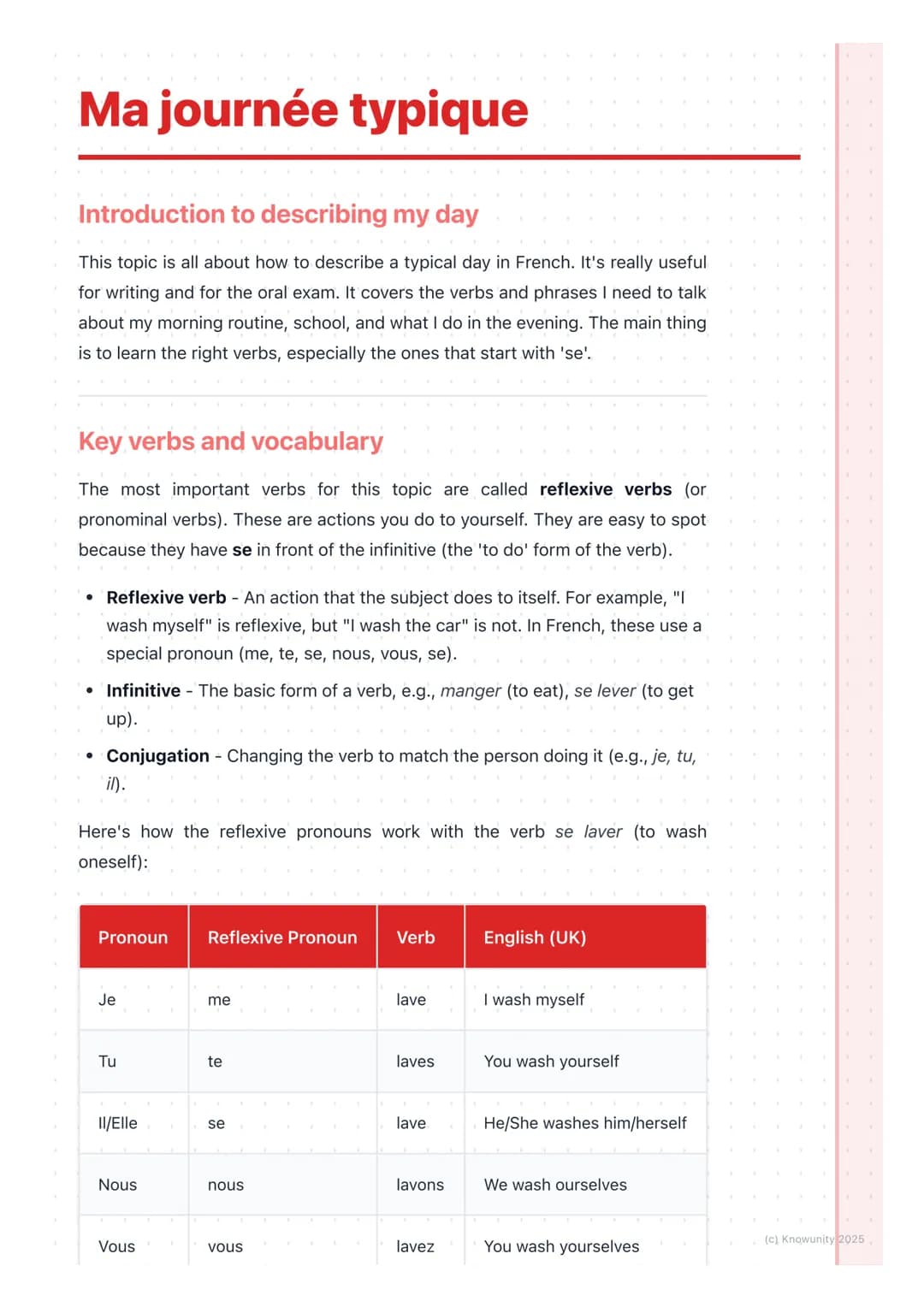
Getting Started with Daily Routines
Learning to describe your day in French is actually dead useful - you'll use it loads in your exams and it's proper practical for real conversations. The key is mastering reflexive verbs, which are actions you do to yourself like washing or getting dressed.
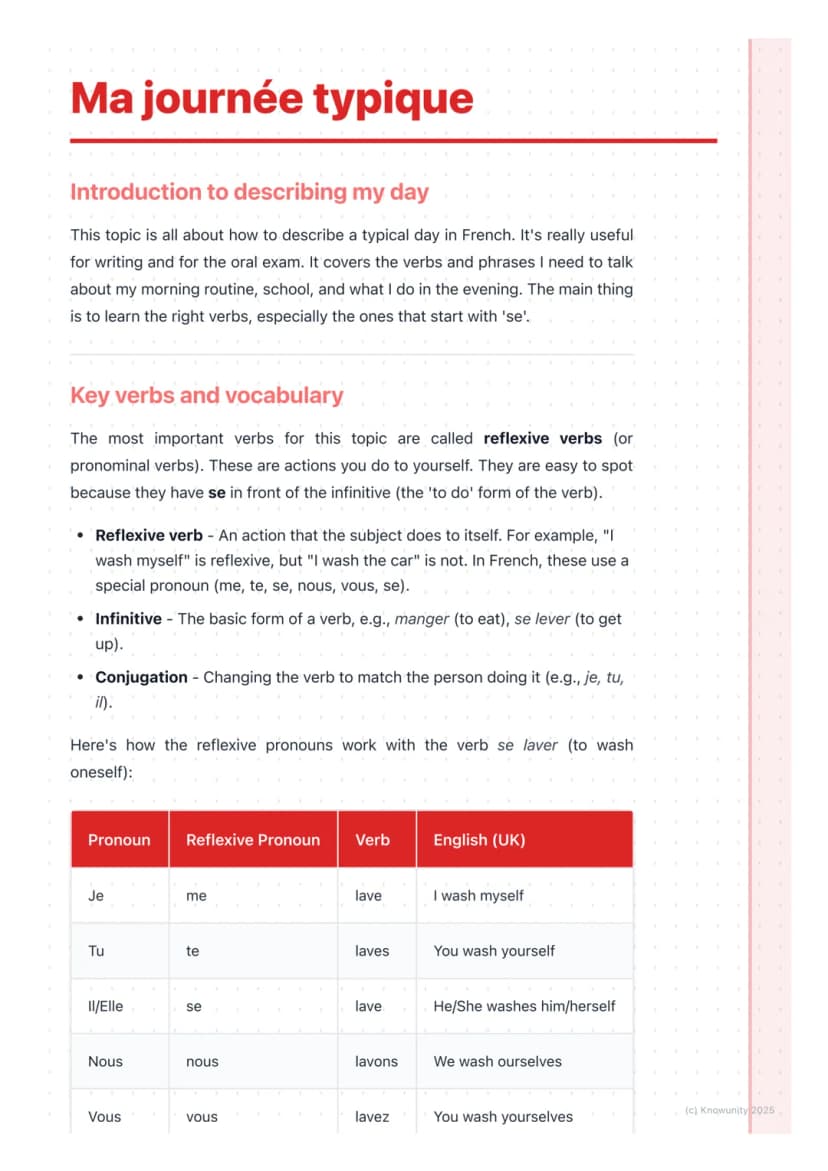
Reflexive verbs are easy to spot because they have 'se' in front of them when you see them in the dictionary. Think of "se laver" (to wash oneself) - the 'se' tells you it's something you do to yourself, not to someone else.
The magic happens with reflexive pronouns - these little words (me, te, se) go right before the verb. So "I wash myself" becomes "je me lave". Dead simple once you get the hang of it!
Top Tip: For verbs starting with a vowel, 'me' becomes 'm' - so it's "je m'habille" (I get dressed), not "je me habille".
2
of 6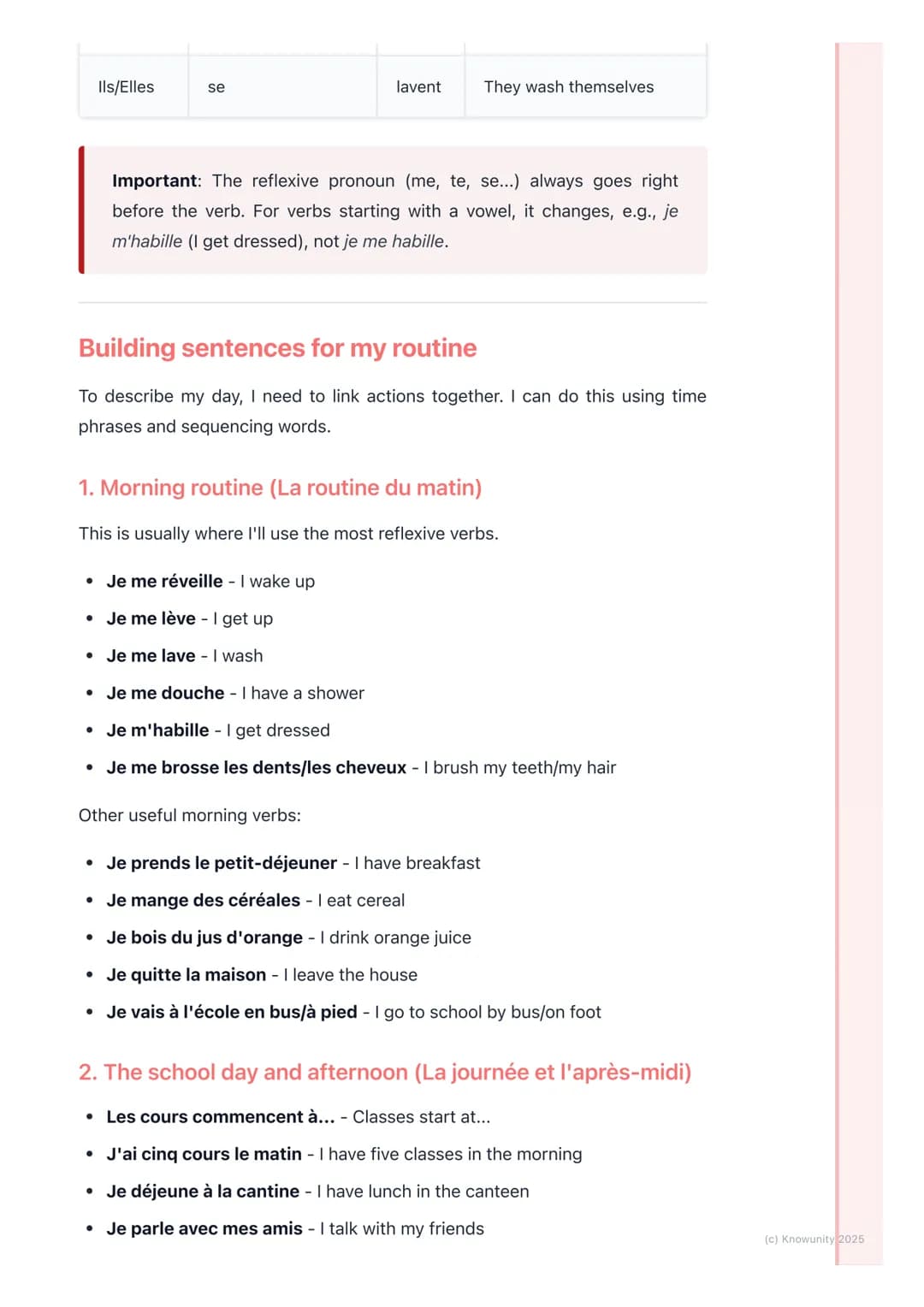
Morning Routine Vocabulary
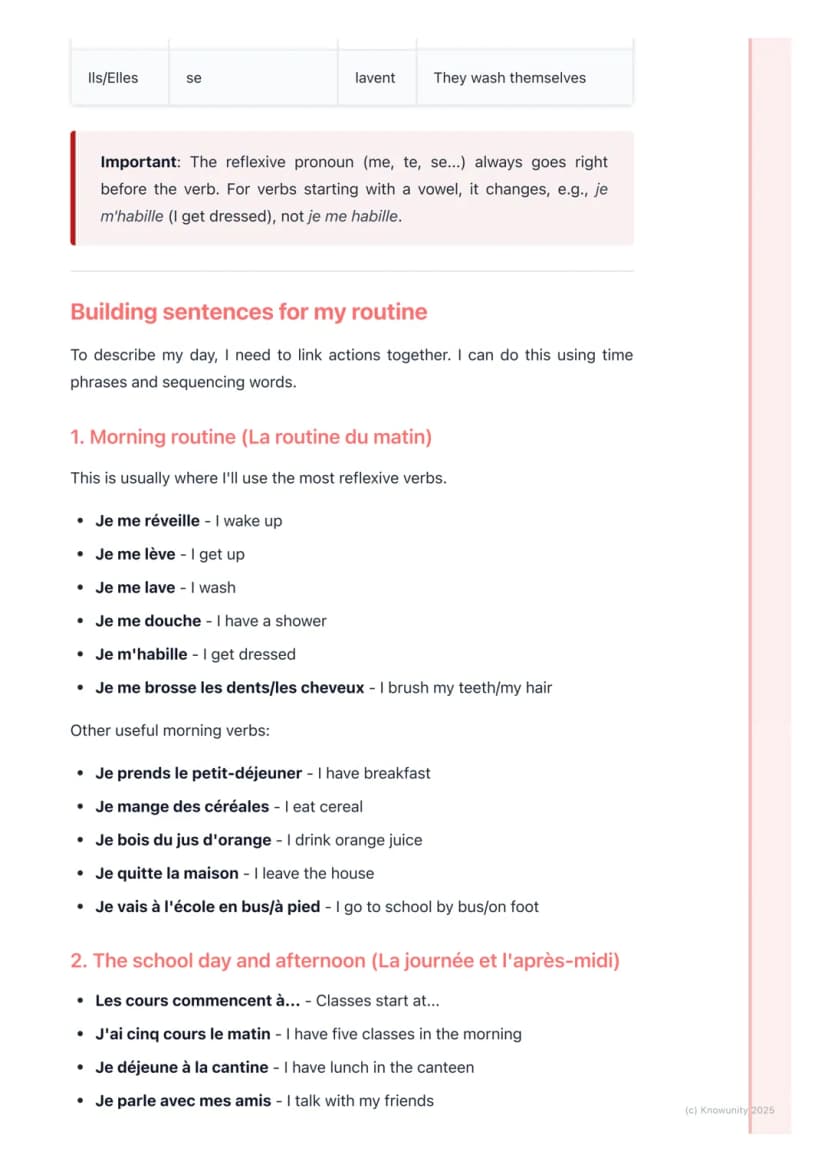
Your morning routine is where you'll use loads of reflexive verbs, so let's nail these first. Start with the basics: je me réveille (I wake up), je me lève (I get up), and je me douche (I have a shower).
Getting dressed and ready involves je m'habille (I get dressed) and je me brosse les dents (I brush my teeth). Don't forget breakfast vocabulary too - je prends le petit-déjeuner covers having breakfast in general.
For getting to school, you'll want je quitte la maison (I leave the house) and je vais à l'école (I go to school). Add "en bus" for by bus or "à pied" if you walk.
Remember: The reflexive pronoun always sits right before the verb - never forget that little 'me'!
3
of 6
School Day and Evening Activities
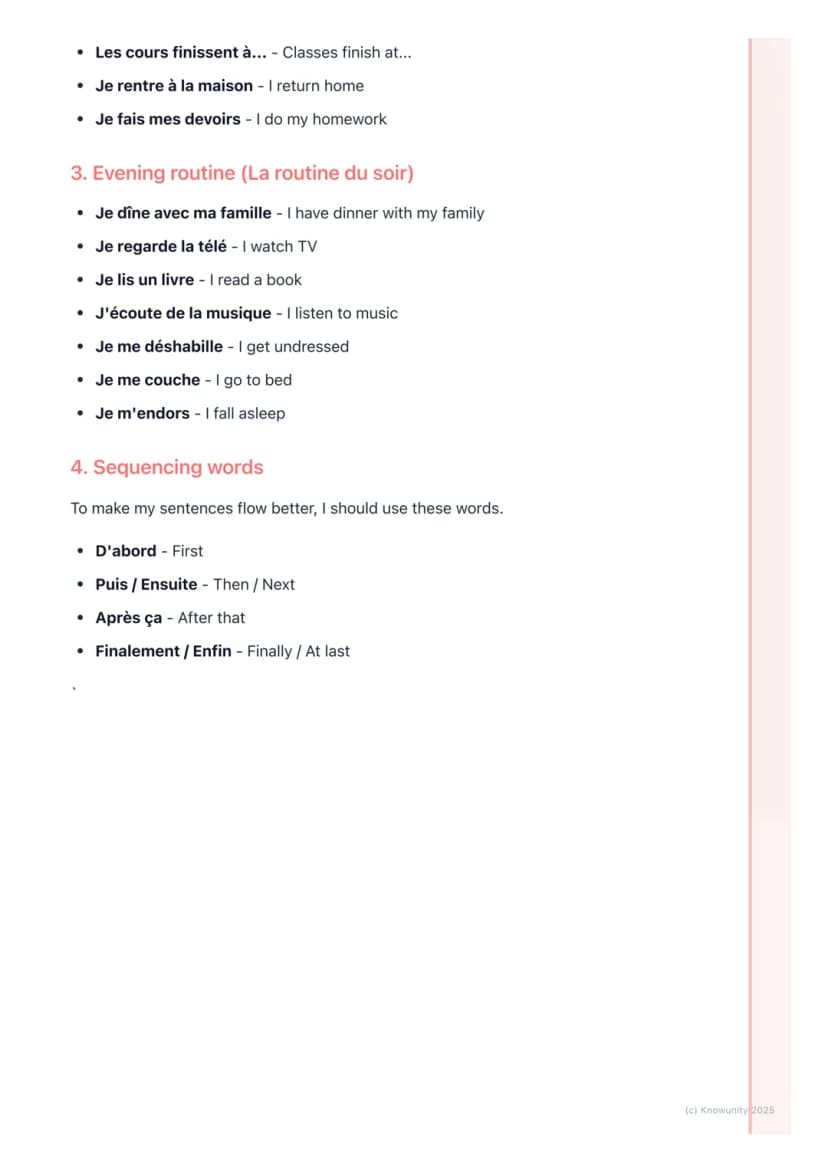
The school day gives you loads of chances to use regular verbs alongside your reflexives. Les cours commencent à... (classes start at...) and les cours finissent à... (classes finish at...) are brilliant for showing off your time-telling skills.
For afternoon activities, try je fais mes devoirs (I do my homework) - though you might want to add "c'est ennuyeux!" (it's boring!) to make it more interesting. Je déjeune à la cantine (I have lunch in the canteen) shows you know school vocabulary too.
Evening routines bring back those reflexive verbs: je me déshabille (I get undressed), je me couche (I go to bed), and je m'endors (I fall asleep). Mix these with regular verbs like je regarde la télé (I watch TV) for variety.
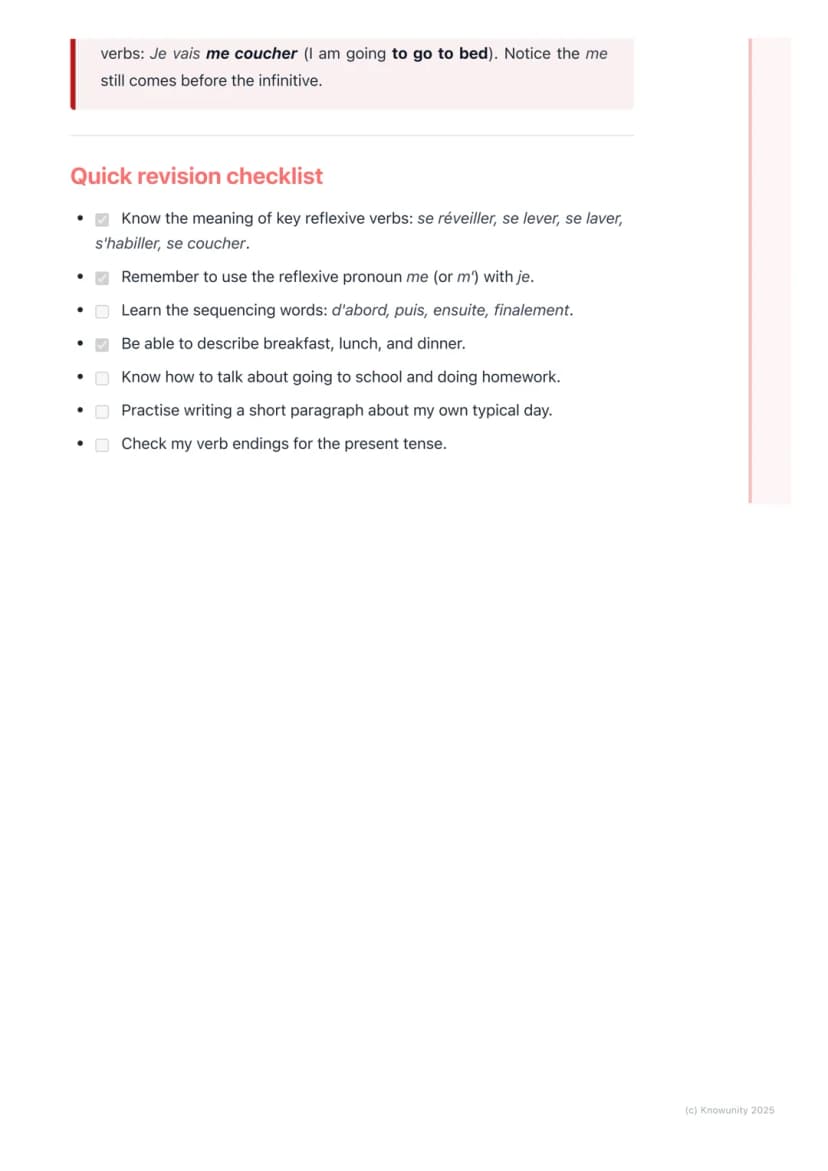
Quick Check: Don't mix up "se coucher" (getting into bed) with "dormir" (being asleep) - they're different actions!
4
of 6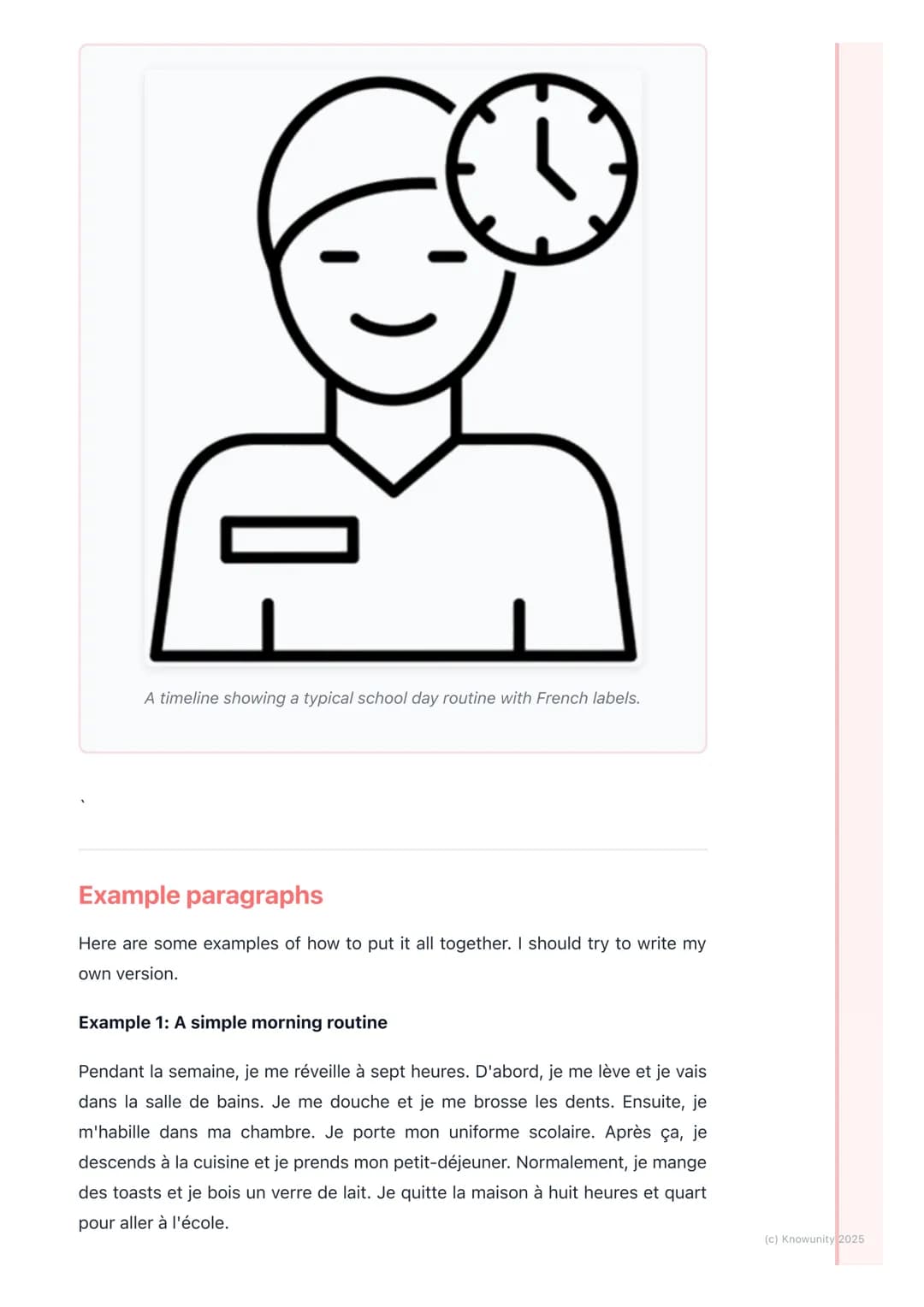
Linking It All Together
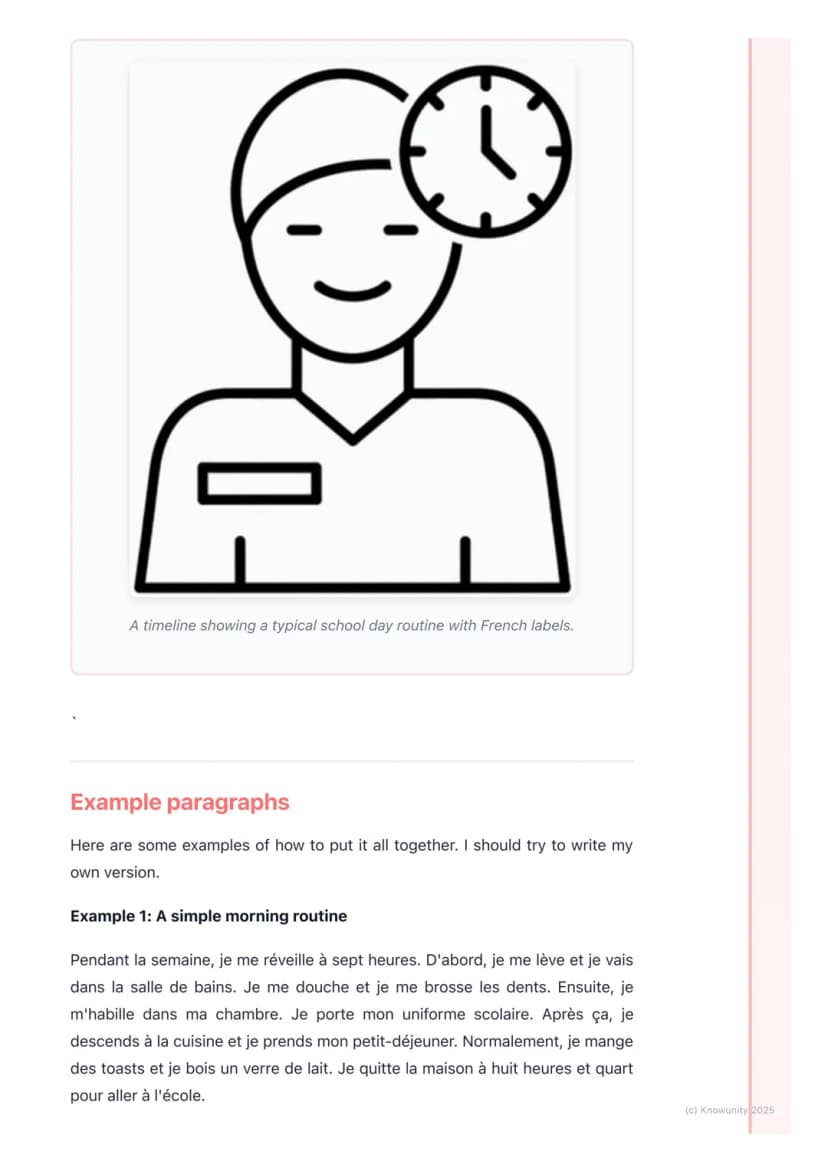
Sequencing words are your secret weapon for making your French sound natural and flowing. Start with "d'abord" (first), then use "puis" or "ensuite" , and finish with "finalement" (finally).
Time expressions make everything sound more authentic. Use "à" for exact times (à sept heures) and "vers" for approximate times (vers huit heures). This adds proper detail to your descriptions.
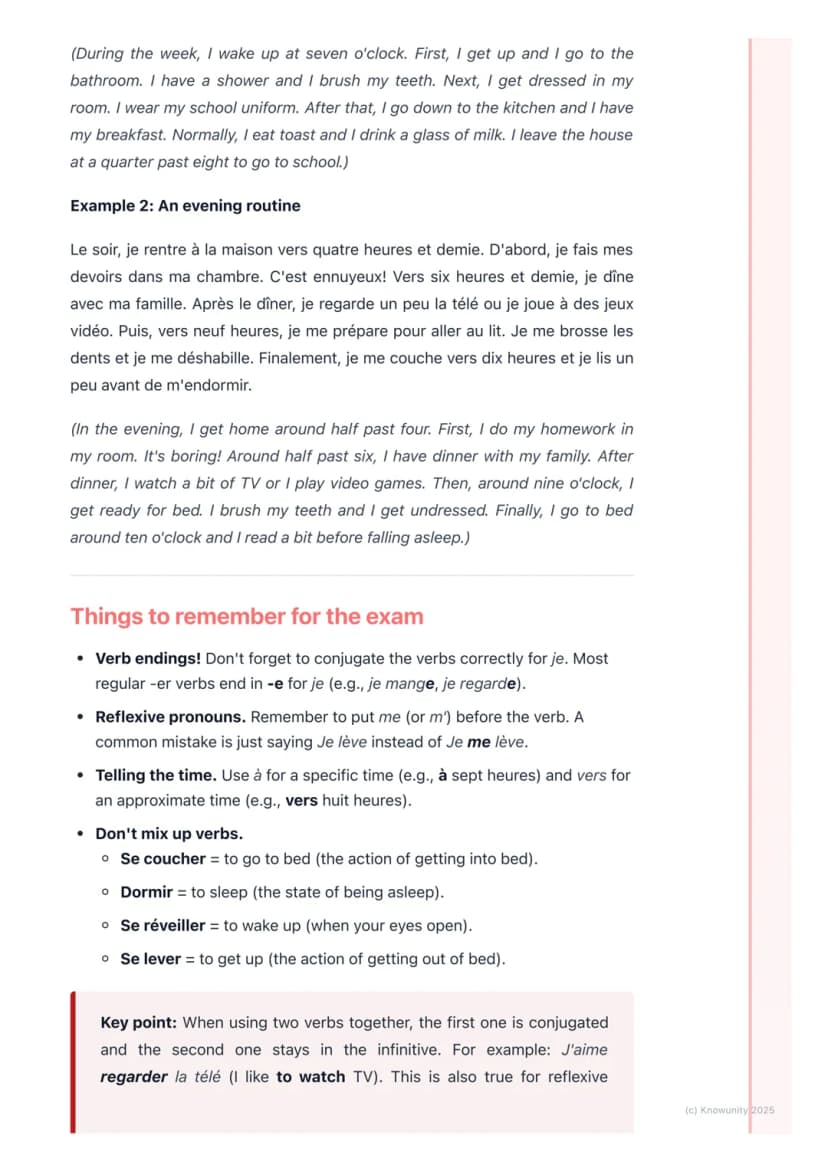
Here's a cracking example: "D'abord, je me réveille à sept heures. Ensuite, je me douche et je m'habille. Finalement, je prends mon petit-déjeuner." See how it flows nicely?
Pro Tip: When using two verbs together, only conjugate the first one - "Je vais me coucher" (I'm going to go to bed), not "Je vais me couche"!
5
of 6
Putting It Into Practice
Now you can build proper paragraphs about your day. Start simple - pick your most important morning activities and link them with sequencing words. Something like: "Je me réveille à sept heures. D'abord, je me lève et je vais dans la salle de bains."
Don't forget to add personality to your writing! Say what you normally eat (je mange des toasts) or mention your school uniform (je porte mon uniforme scolaire). These details make your French more interesting and realistic.
For evening routines, try mixing activities: "Le soir, je fais mes devoirs - c'est ennuyeux! Puis je regarde la télé avec ma famille." This shows you can handle different types of verbs and opinions.
Exam Gold: Always check your verb endings - most regular -er verbs with 'je' end in -e, and don't forget those reflexive pronouns!
6
of 6
Quick Revision Essentials
You're nearly sorted! Make sure you can rattle off the main reflexive verbs: se réveiller, se lever, se laver, s'habiller, se coucher. Remember, they all need that reflexive pronoun 'me' with 'je'.
Sequencing words are dead important for flowing sentences - d'abord, puis, ensuite, finalement. These make you sound like you really know what you're doing. Practice linking at least three activities together smoothly.
Finally, nail your time expressions and don't mix up similar verbs. Se réveiller is opening your eyes, se lever is getting out of bed - they're different actions! Get these right and you'll smash your exams.
Final Check: Write a short paragraph about your own day, check all your verb endings, and make sure every reflexive verb has its pronoun. You've got this!
Pensavamo che non l'avreste mai chiesto....
Che cos'è l'assistente AI di Knowunity?
Il nostro assistente AI è costruito specificamente per le esigenze degli studenti. Sulla base dei milioni di contenuti presenti sulla piattaforma, possiamo fornire agli studenti risposte davvero significative e pertinenti. Ma non si tratta solo di risposte, l'assistente è in grado di guidare gli studenti attraverso le loro sfide quotidiane di studio, con piani di studio personalizzati, quiz o contenuti nella chat e una personalizzazione al 100% basata sulle competenze e sugli sviluppi degli studenti.
Dove posso scaricare l'applicazione Knowunity?
È possibile scaricare l'applicazione dal Google Play Store e dall'Apple App Store.
Knowunity è davvero gratuita?
Sì, hai accesso completamente gratuito a tutti i contenuti nell'app e puoi chattare o seguire i Creatori in qualsiasi momento. Sbloccherai nuove funzioni crescendo il tuo numero di follower. Inoltre, offriamo Knowunity Premium, che consente di studiare senza alcun limite!!
Contenuti più popolari di French
2Contenuti più popolari
9 Irish
IrishIrish oral questions and answers
Questions and answers for the leaving cert oral
5th Year4264
 English
Key Quotes : Sive
Key Quotes and explanations: Sive
6th Year2842
IrishIrish oral questions
Outline of oral questions
5th Year2055
IrishIníon- le hÁine Durkin
Aine Durkin’s poem, Iníon: Themes & summary
5th Year890
IrishIrish poetry 2027
Iníon + Dínit an Bhróin
5th Year1153
IrishLC HL notes- Iníon (poem)
Includes poem in English and Irish, theme, key words & phrases
5th Year2304
EnglishCultural Context : Shawshank Redemption : Sive : Small Things Like These
Comparative Study : Cultural Context : Shawshank Redemption, Sive and Small Things Like These
6th Year1430
IrishMo Ghrá-sa (Idir Lúibíní)
Notes on mo ghrá-sa
5th Year380
IrishAn Gaeilge Aiste
Irish Language essay
6th Year1320
Non c'è niente di adatto? Esplorare altre aree tematiche.
Recensioni dei nostri utenti. Ci adorano - e anche tu, vedrai .
4.6/5App Store
4.7/5Google Play
L'applicazione è molto facile da usare e ben progettata. Finora ho trovato tutto quello che cercavo e ho potuto imparare molto dalle presentazioni! Utilizzerò sicuramente l'app per i compiti in classe! È molto utile anche come fonte di ispirazione.
Stefano Sutente iOS
Questa applicazione è davvero grande! Ci sono tantissimi appunti e aiuti con lo studio [...]. La mia materia problematica, per esempio, è il francese e l'app ha così tante opzioni per aiutarmi. Grazie a questa app ho migliorato il mio francese. La consiglio a tutti.
Samantha Klichutente Android
Wow, sono davvero stupita. Ho appena provato l'app perché l'ho vista pubblicizzata molte volte e sono rimasta assolutamente sbalordita. Questa app è L'AIUTO che cercate per la scuola e soprattutto offre tantissime cose, come allenamenti e schede, che a me personalmente sono state MOLTO utili.
Annautente iOS
French2 visualizzazioni·Aggiornato Jun 6, 2026·6 pagineMa journée typique : Une routine quotidienne illustrée
Ever wondered how to describe your daily routine in French? This topic covers all the essential vocabulary and grammar you need to talk about your typical day, from waking up to going to bed. It's brilliant for both writing tasks...
1
of 6
Iscriviti per mostrare il contenuto. È gratis!
- Accesso a tutti i documenti
- Migliora i tuoi voti
- Unisciti a milioni di studenti
Getting Started with Daily Routines
Learning to describe your day in French is actually dead useful - you'll use it loads in your exams and it's proper practical for real conversations. The key is mastering reflexive verbs, which are actions you do to yourself like washing or getting dressed.
Reflexive verbs are easy to spot because they have 'se' in front of them when you see them in the dictionary. Think of "se laver" (to wash oneself) - the 'se' tells you it's something you do to yourself, not to someone else.
The magic happens with reflexive pronouns - these little words (me, te, se) go right before the verb. So "I wash myself" becomes "je me lave". Dead simple once you get the hang of it!
Top Tip: For verbs starting with a vowel, 'me' becomes 'm' - so it's "je m'habille" (I get dressed), not "je me habille".
2
of 6Iscriviti per mostrare il contenuto. È gratis!
- Accesso a tutti i documenti
- Migliora i tuoi voti
- Unisciti a milioni di studenti
Morning Routine Vocabulary
Your morning routine is where you'll use loads of reflexive verbs, so let's nail these first. Start with the basics: je me réveille (I wake up), je me lève (I get up), and je me douche (I have a shower).
Getting dressed and ready involves je m'habille (I get dressed) and je me brosse les dents (I brush my teeth). Don't forget breakfast vocabulary too - je prends le petit-déjeuner covers having breakfast in general.
For getting to school, you'll want je quitte la maison (I leave the house) and je vais à l'école (I go to school). Add "en bus" for by bus or "à pied" if you walk.
Remember: The reflexive pronoun always sits right before the verb - never forget that little 'me'!
3
of 6Iscriviti per mostrare il contenuto. È gratis!
- Accesso a tutti i documenti
- Migliora i tuoi voti
- Unisciti a milioni di studenti
School Day and Evening Activities
The school day gives you loads of chances to use regular verbs alongside your reflexives. Les cours commencent à... (classes start at...) and les cours finissent à... (classes finish at...) are brilliant for showing off your time-telling skills.
For afternoon activities, try je fais mes devoirs (I do my homework) - though you might want to add "c'est ennuyeux!" (it's boring!) to make it more interesting. Je déjeune à la cantine (I have lunch in the canteen) shows you know school vocabulary too.
Evening routines bring back those reflexive verbs: je me déshabille (I get undressed), je me couche (I go to bed), and je m'endors (I fall asleep). Mix these with regular verbs like je regarde la télé (I watch TV) for variety.
Quick Check: Don't mix up "se coucher" (getting into bed) with "dormir" (being asleep) - they're different actions!
4
of 6Iscriviti per mostrare il contenuto. È gratis!
- Accesso a tutti i documenti
- Migliora i tuoi voti
- Unisciti a milioni di studenti
Linking It All Together
Sequencing words are your secret weapon for making your French sound natural and flowing. Start with "d'abord" (first), then use "puis" or "ensuite" , and finish with "finalement" (finally).
Time expressions make everything sound more authentic. Use "à" for exact times (à sept heures) and "vers" for approximate times (vers huit heures). This adds proper detail to your descriptions.
Here's a cracking example: "D'abord, je me réveille à sept heures. Ensuite, je me douche et je m'habille. Finalement, je prends mon petit-déjeuner." See how it flows nicely?
Pro Tip: When using two verbs together, only conjugate the first one - "Je vais me coucher" (I'm going to go to bed), not "Je vais me couche"!
5
of 6Iscriviti per mostrare il contenuto. È gratis!
- Accesso a tutti i documenti
- Migliora i tuoi voti
- Unisciti a milioni di studenti
Putting It Into Practice
Now you can build proper paragraphs about your day. Start simple - pick your most important morning activities and link them with sequencing words. Something like: "Je me réveille à sept heures. D'abord, je me lève et je vais dans la salle de bains."
Don't forget to add personality to your writing! Say what you normally eat (je mange des toasts) or mention your school uniform (je porte mon uniforme scolaire). These details make your French more interesting and realistic.
For evening routines, try mixing activities: "Le soir, je fais mes devoirs - c'est ennuyeux! Puis je regarde la télé avec ma famille." This shows you can handle different types of verbs and opinions.
Exam Gold: Always check your verb endings - most regular -er verbs with 'je' end in -e, and don't forget those reflexive pronouns!
6
of 6Iscriviti per mostrare il contenuto. È gratis!
- Accesso a tutti i documenti
- Migliora i tuoi voti
- Unisciti a milioni di studenti
Quick Revision Essentials
You're nearly sorted! Make sure you can rattle off the main reflexive verbs: se réveiller, se lever, se laver, s'habiller, se coucher. Remember, they all need that reflexive pronoun 'me' with 'je'.
Sequencing words are dead important for flowing sentences - d'abord, puis, ensuite, finalement. These make you sound like you really know what you're doing. Practice linking at least three activities together smoothly.
Finally, nail your time expressions and don't mix up similar verbs. Se réveiller is opening your eyes, se lever is getting out of bed - they're different actions! Get these right and you'll smash your exams.
Final Check: Write a short paragraph about your own day, check all your verb endings, and make sure every reflexive verb has its pronoun. You've got this!
Pensavamo che non l'avreste mai chiesto....
Che cos'è l'assistente AI di Knowunity?
Il nostro assistente AI è costruito specificamente per le esigenze degli studenti. Sulla base dei milioni di contenuti presenti sulla piattaforma, possiamo fornire agli studenti risposte davvero significative e pertinenti. Ma non si tratta solo di risposte, l'assistente è in grado di guidare gli studenti attraverso le loro sfide quotidiane di studio, con piani di studio personalizzati, quiz o contenuti nella chat e una personalizzazione al 100% basata sulle competenze e sugli sviluppi degli studenti.
Dove posso scaricare l'applicazione Knowunity?
È possibile scaricare l'applicazione dal Google Play Store e dall'Apple App Store.
Knowunity è davvero gratuita?
Sì, hai accesso completamente gratuito a tutti i contenuti nell'app e puoi chattare o seguire i Creatori in qualsiasi momento. Sbloccherai nuove funzioni crescendo il tuo numero di follower. Inoltre, offriamo Knowunity Premium, che consente di studiare senza alcun limite!!
Contenuti più popolari di French
2Contenuti più popolari
9IrishIrish oral questions and answers
Questions and answers for the leaving cert oral
5th Year4264
EnglishKey Quotes : Sive
Key Quotes and explanations: Sive
6th Year2842
IrishIrish oral questions
Outline of oral questions
5th Year2055
IrishIníon- le hÁine Durkin
Aine Durkin’s poem, Iníon: Themes & summary
5th Year890
IrishIrish poetry 2027
Iníon + Dínit an Bhróin
5th Year1153
IrishLC HL notes- Iníon (poem)
Includes poem in English and Irish, theme, key words & phrases
5th Year2304
EnglishCultural Context : Shawshank Redemption : Sive : Small Things Like These
Comparative Study : Cultural Context : Shawshank Redemption, Sive and Small Things Like These
6th Year1430
IrishMo Ghrá-sa (Idir Lúibíní)
Notes on mo ghrá-sa
5th Year380
IrishAn Gaeilge Aiste
Irish Language essay
6th Year1320
Non c'è niente di adatto? Esplorare altre aree tematiche.
Recensioni dei nostri utenti. Ci adorano - e anche tu, vedrai .
4.6/5App Store
4.7/5Google Play
L'applicazione è molto facile da usare e ben progettata. Finora ho trovato tutto quello che cercavo e ho potuto imparare molto dalle presentazioni! Utilizzerò sicuramente l'app per i compiti in classe! È molto utile anche come fonte di ispirazione.
Stefano Sutente iOS
Questa applicazione è davvero grande! Ci sono tantissimi appunti e aiuti con lo studio [...]. La mia materia problematica, per esempio, è il francese e l'app ha così tante opzioni per aiutarmi. Grazie a questa app ho migliorato il mio francese. La consiglio a tutti.
Samantha Klichutente Android
Wow, sono davvero stupita. Ho appena provato l'app perché l'ho vista pubblicizzata molte volte e sono rimasta assolutamente sbalordita. Questa app è L'AIUTO che cercate per la scuola e soprattutto offre tantissime cose, come allenamenti e schede, che a me personalmente sono state MOLTO utili.
Annautente iOS