
Engineering materials are at the heart of everything we build...
 Engineering2 visualizzazioni·Aggiornato Jun 6, 2026·6 pagine
Essential Types of Engineering Materials
1 / 6
1
of 6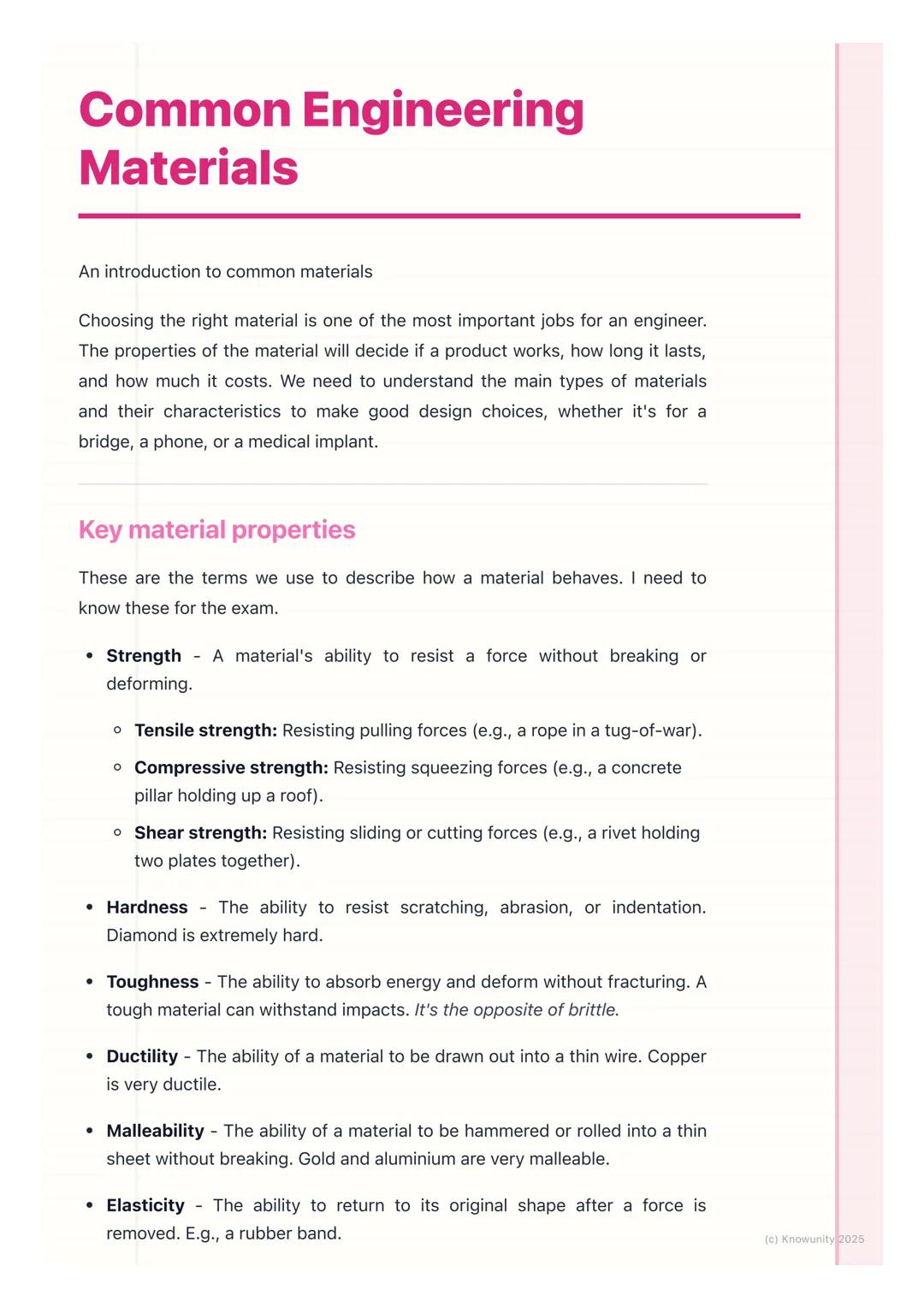
Key Material Properties
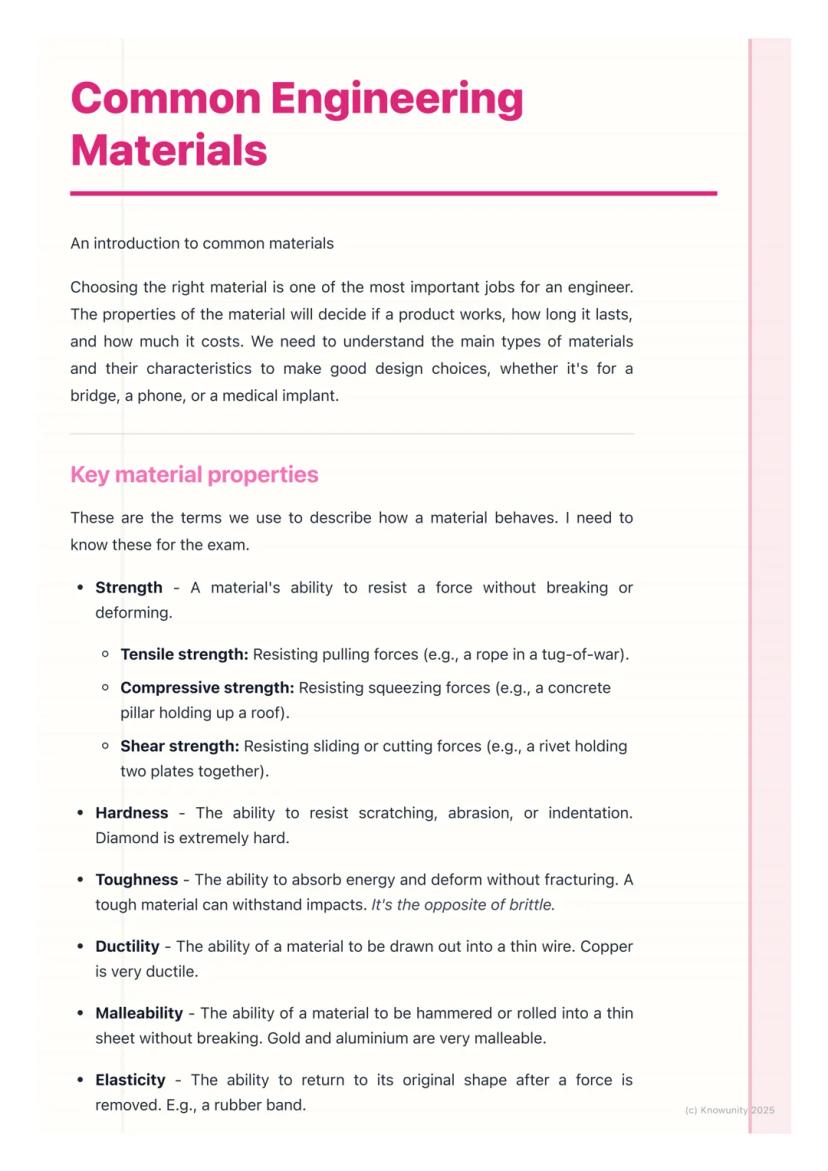
When designing products, engineers must understand how materials behave under different conditions. These properties determine which materials are suitable for specific applications.
Materials have different types of strength: tensile strength helps resist pulling forces , compressive strength resists squeezing forces (like concrete pillars supporting a roof), and shear strength resists sliding forces (like rivets holding plates together). Hardness measures resistance to scratching or indentation, while toughness is about absorbing energy without breaking.
Ductility and malleability are related but different properties. Ductile materials like copper can be drawn into wires, while malleable materials like gold can be hammered into sheets without breaking. Elasticity describes how well materials return to their original shape after a force is removed, like a rubber band. When materials permanently change shape, they've undergone plastic deformation.
Remember: Don't confuse hardness with toughness! A ceramic tile is hard but not tough (it shatters easily), while a car bumper is tough (absorbs impact) but not very hard.
2
of 6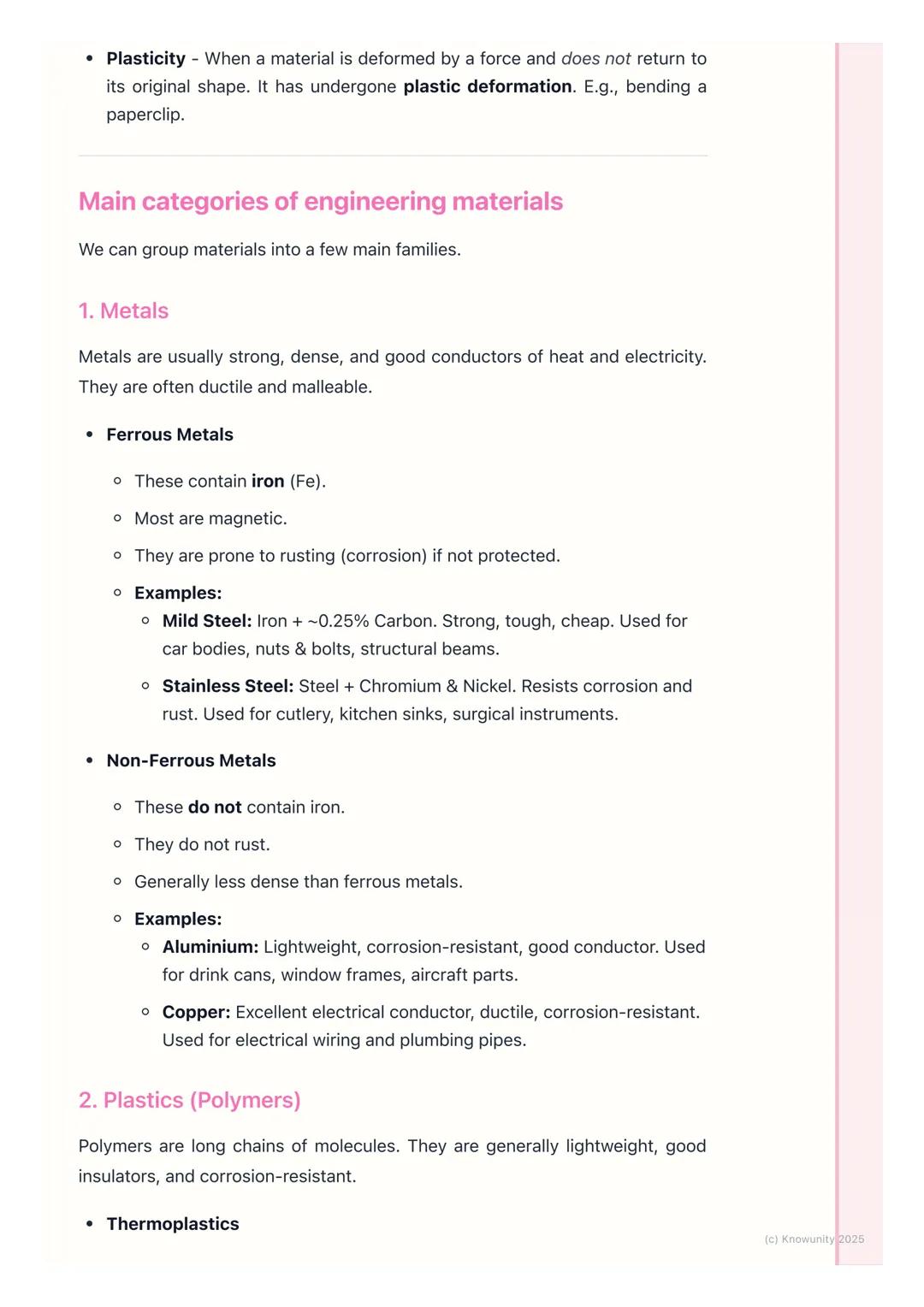
Metals and Their Properties
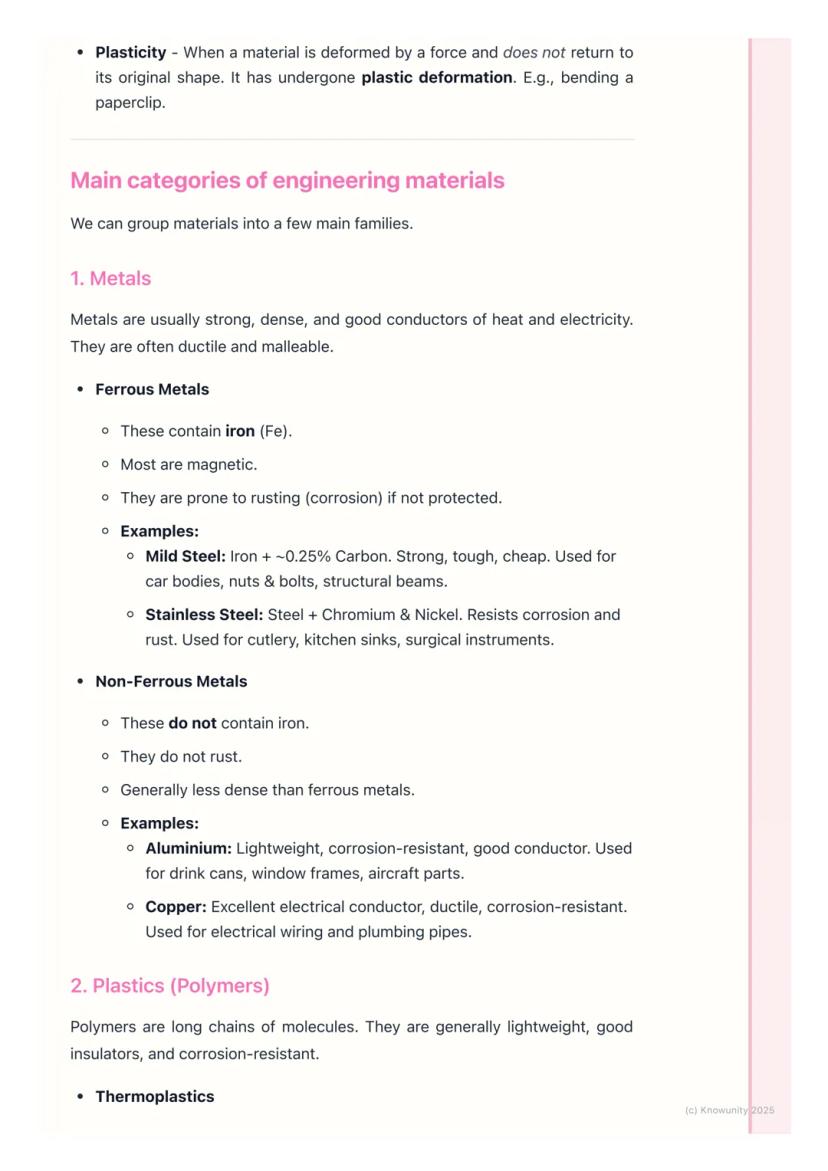
Metals are the workhorses of engineering materials, known for their strength and conductivity. You'll find them in everything from your smartphone to massive bridges.
Ferrous metals contain iron and include mild steel (iron with about 0.25% carbon) which is strong, tough, and affordable, making it perfect for car bodies and structural beams. Stainless steel adds chromium and nickel to create a rust-resistant metal ideal for cutlery and surgical instruments. Most ferrous metals are magnetic and prone to rusting if not protected.
Non-ferrous metals don't contain iron and don't rust, which makes them valuable for specific applications. Aluminium is lightweight and corrosion-resistant, making it perfect for aircraft parts and window frames. Copper is an excellent electrical conductor that's also ductile and corrosion-resistant, which is why it's used for electrical wiring and plumbing.
When choosing between ferrous and non-ferrous metals, consider the environment where they'll be used. For outdoor applications exposed to moisture, non-ferrous metals or specially treated ferrous metals are often better choices.
Pro tip: When preparing for exams, remember ferrous metals with the phrase "Fe-rrous" – Fe is the chemical symbol for iron!
3
of 6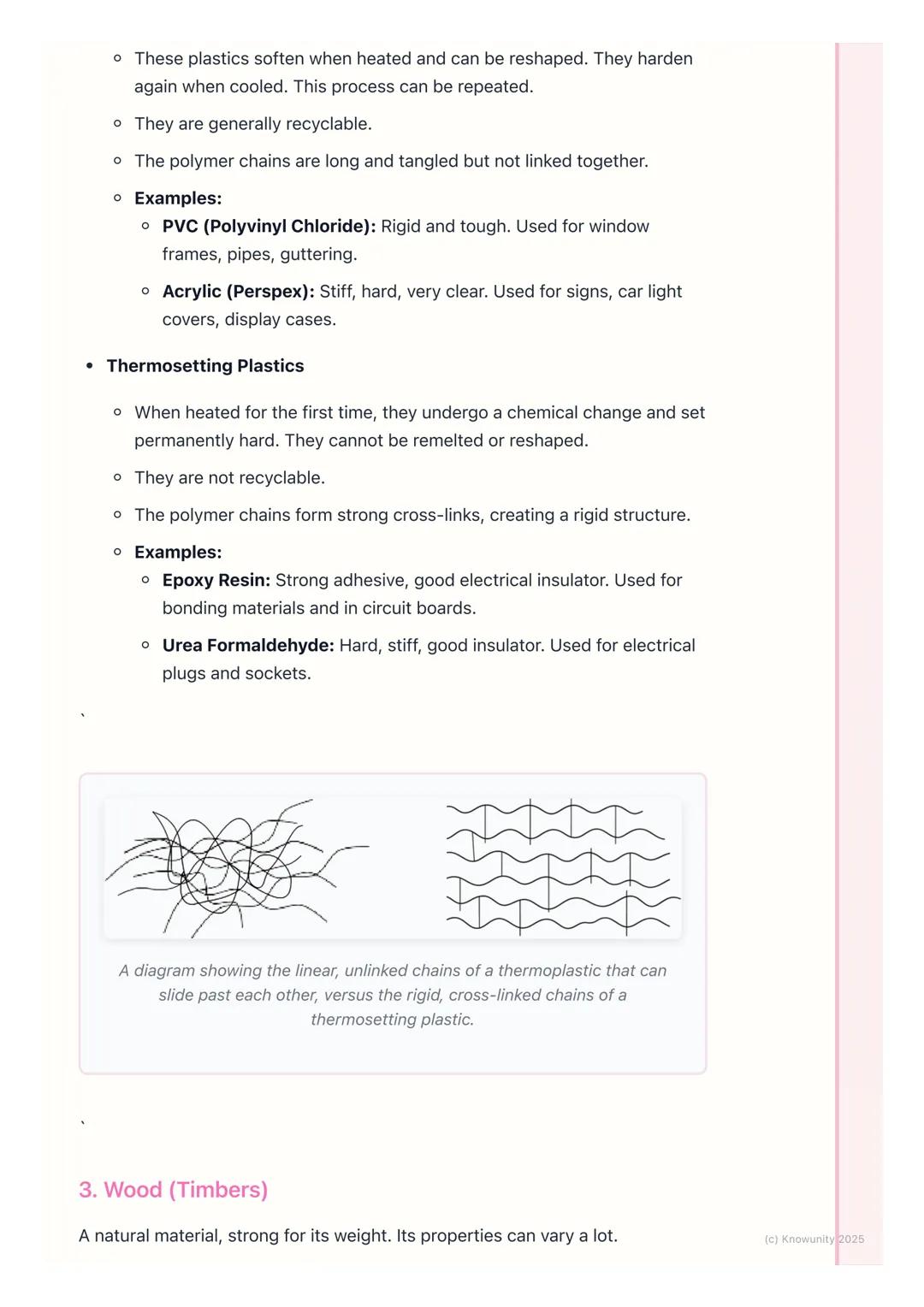
Plastics and Polymers
Plastics are everywhere in our modern world, from your water bottle to parts in your computer. Their versatility comes from their molecular structure.
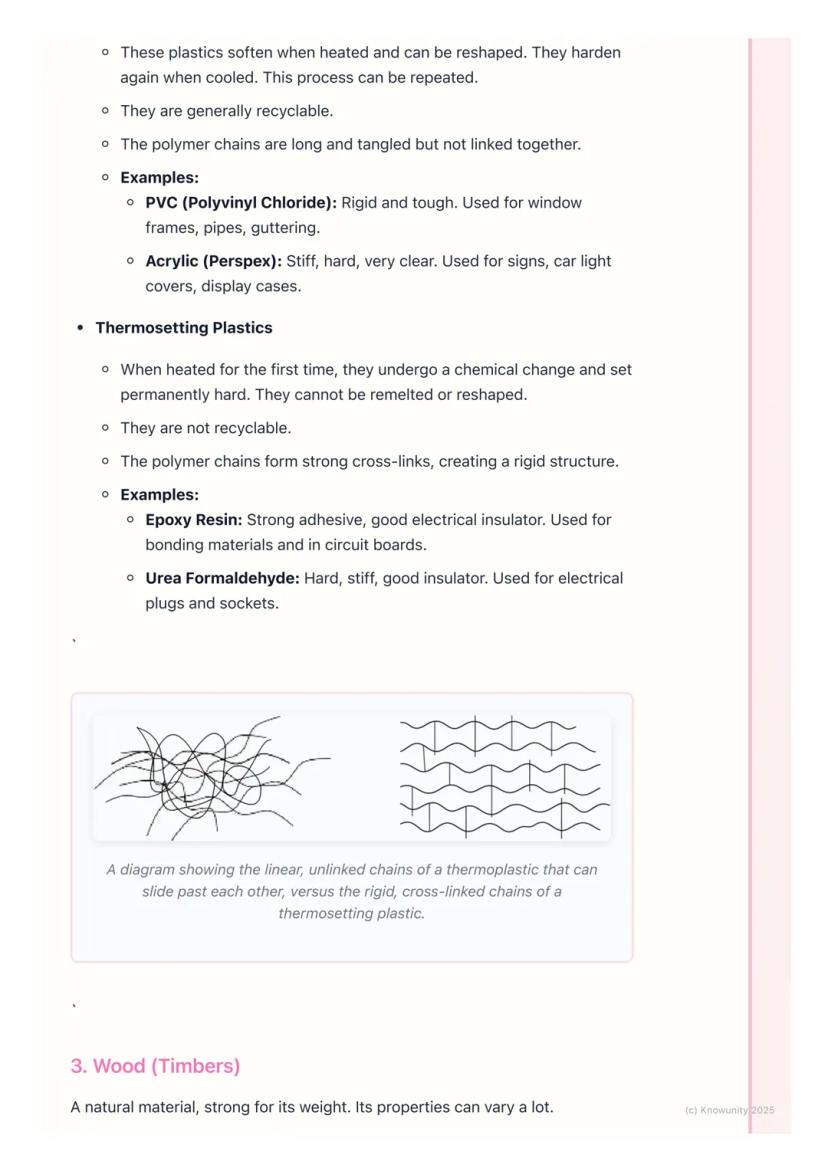
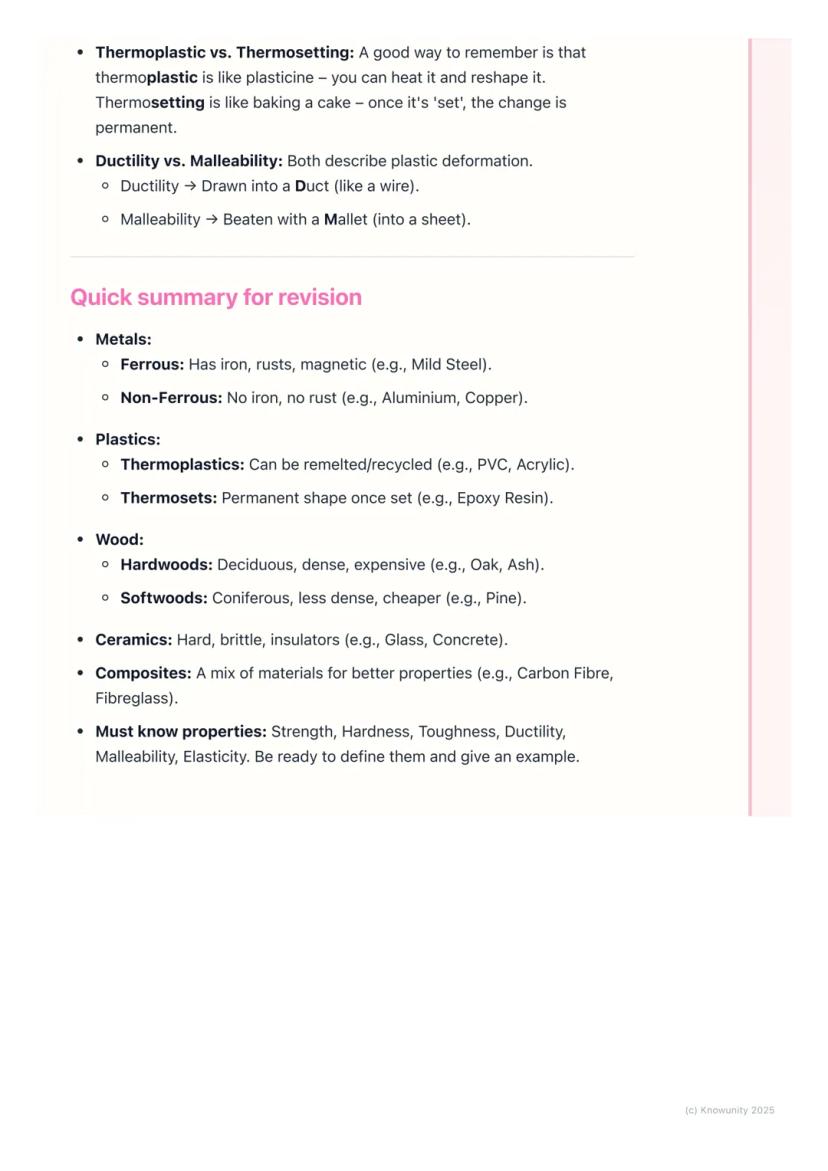
Thermoplastics can be melted and reshaped repeatedly, making them ideal for recycling. Their long polymer chains tangle but don't link together, allowing them to soften when heated. PVC (polyvinyl chloride) is a rigid, tough thermoplastic used for pipes and window frames, while acrylic (Perspex) offers clarity for signs and car light covers.
Thermosetting plastics undergo a permanent chemical change when first heated, creating strong cross-links between polymer chains. Once set, they can't be remelted or reshaped. Epoxy resin is a strong adhesive and electrical insulator used in circuit boards, while urea formaldehyde provides hard, stiff material for electrical plugs and sockets.
The key difference between these plastic types is in their molecular structure – thermoplastics have linear chains that can slide past each other when heated, while thermosets have rigid cross-linked structures that cannot be broken down by reheating.
Visual comparison: Think of thermoplastics as a bowl of spaghetti (strands can move) and thermosetting plastics as a fishing net (permanently connected at junction points).
4
of 6
Wood and Ceramics
Natural and traditional materials still play crucial roles in modern engineering despite advancements in synthetic options.
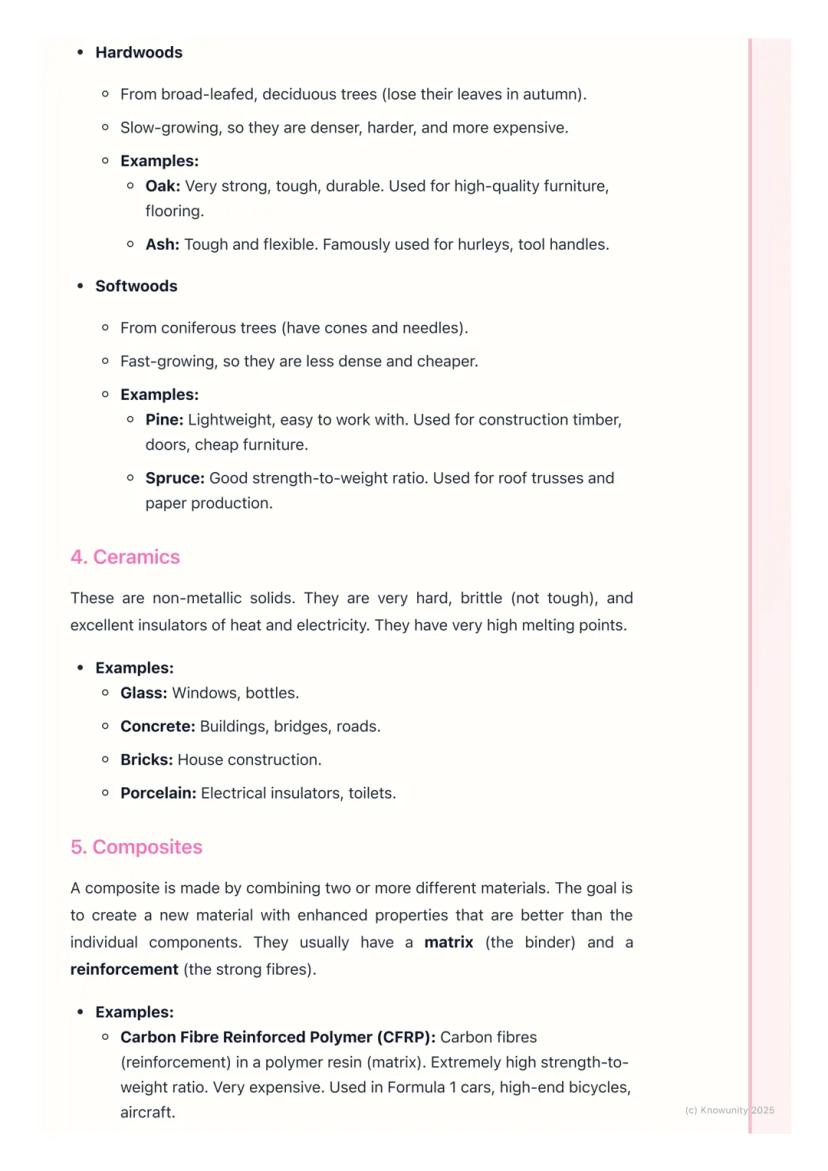
Wood offers excellent strength-to-weight properties and comes in two main categories. Hardwoods come from broad-leafed deciduous trees, grow slowly, and are generally denser and more expensive. Oak provides durability for high-quality furniture, while ash's flexibility makes it perfect for hurley sticks and tool handles. Softwoods from coniferous trees grow faster and are less dense and cheaper. Pine is lightweight and easy to work with, making it ideal for construction timber and affordable furniture.
Ceramics are non-metallic solids known for extreme hardness, brittleness, and excellent insulation properties. They have incredibly high melting points and maintain strength at high temperatures. Glass provides transparency for windows and bottles, while concrete creates the foundation for buildings and bridges. Bricks have been used in construction for centuries, and porcelain serves as both an electrical insulator and durable bathroom fixture material.
Wood and ceramics represent opposite ends of the materials spectrum – wood is flexible and organic, while ceramics are rigid and processed. Each has properties that make them irreplaceable in certain applications.
Interesting fact: Despite advances in synthetic materials, wood still has one of the best strength-to-weight ratios of any engineering material, which is why it remains popular for many applications.
5
of 6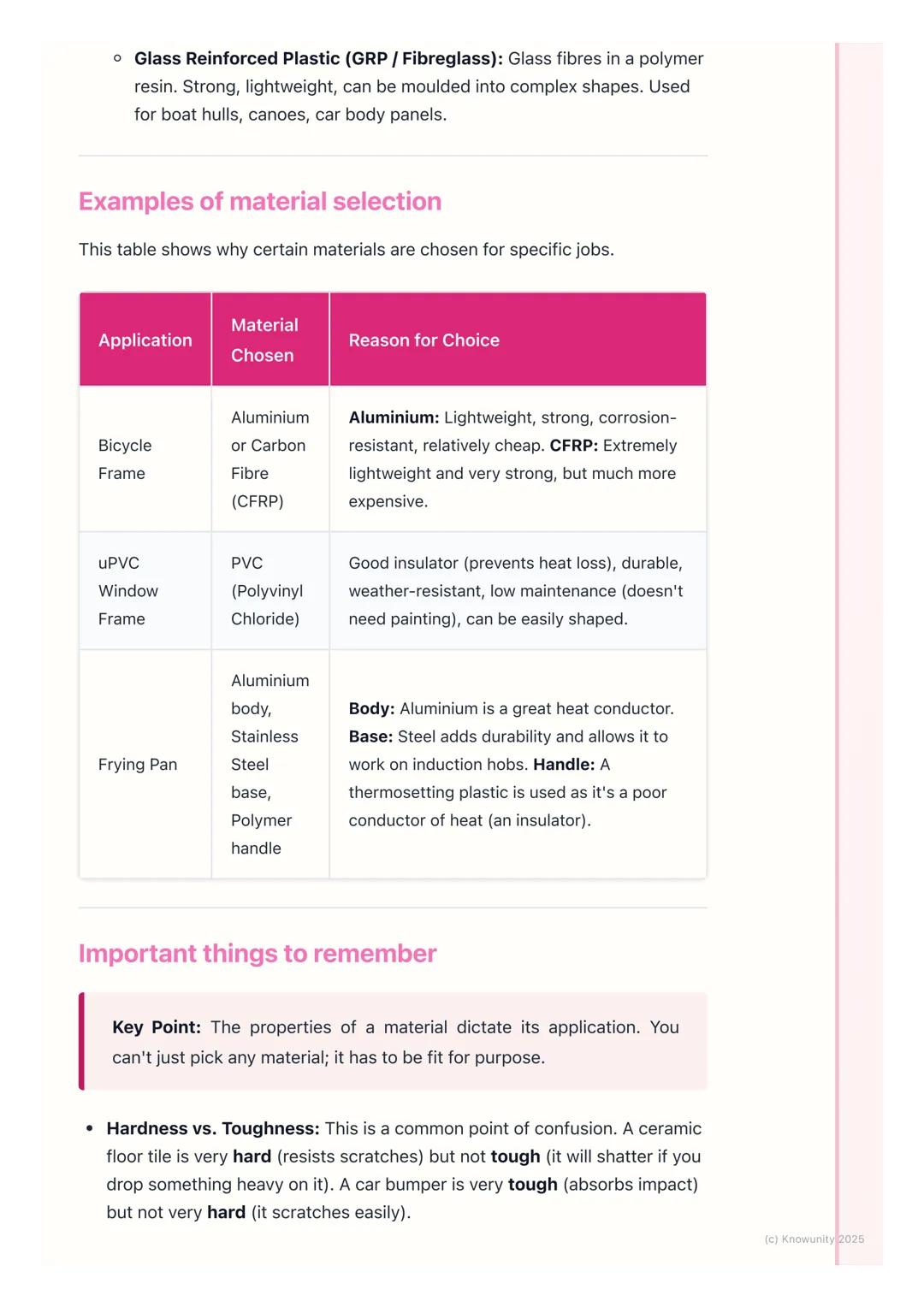
Composites and Material Selection
Composites represent the cutting edge of engineering materials, combining the best properties of different materials to create something superior to the individual components.
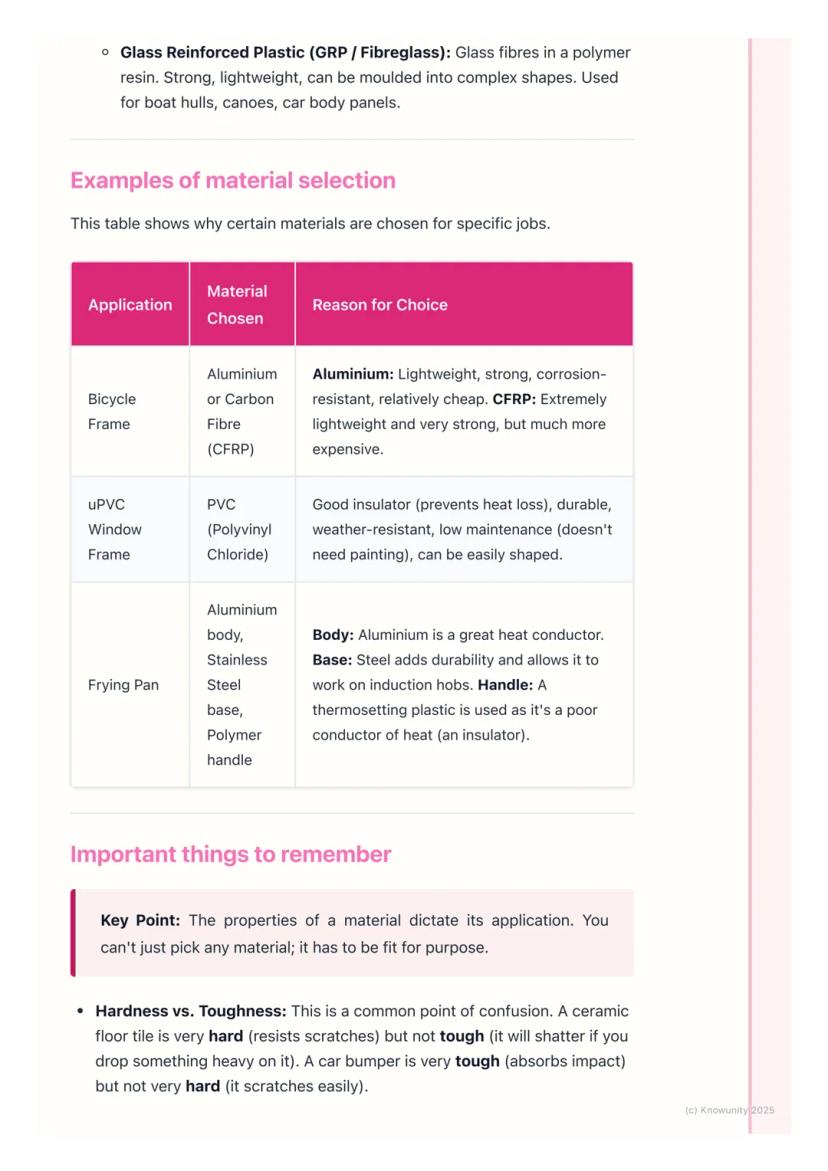
Composites typically consist of a matrix (binder) and reinforcement (strong fibres). Carbon Fibre Reinforced Polymer (CFRP) uses carbon fibres in a polymer resin to create an incredibly strong yet lightweight material used in Formula 1 cars and high-end bicycles. Glass Reinforced Plastic combines glass fibres with polymer resin for strong, lightweight boat hulls and car body panels.
Engineers select materials based on specific requirements. Bicycle frames use aluminium or carbon fibre for their strength-to-weight ratio and corrosion resistance. uPVC window frames offer insulation, weather resistance, and low maintenance. Frying pans combine aluminium bodies (good heat conductors) with stainless steel bases (durability) and polymer handles (heat insulation).
The key principle in material selection is fitness for purpose – you must consider all requirements, constraints, and environmental factors when choosing materials for a specific application.
Exam tip: When answering questions about material selection, always explain both the property AND why it matters for that specific application (e.g., "Aluminium is lightweight, which reduces the energy needed to propel a bicycle").
6
of 6
Key Concepts for Revision
As you prepare for your exams, focus on understanding the relationships between material properties and their applications in real-world engineering.
To distinguish between similar-sounding properties, use memory aids: think of ductility as drawing into a "duct" (wire), and malleability as beating with a "mallet" (sheet). For plastics, remember that thermoplastics are like plasticine (reheat to reshape), while thermosetting plastics are like a baked cake (once set, the change is permanent).
For quick revision, group materials by family: Metals , Plastics (thermoplastics can be remelted; thermosets cannot), Wood (hardwoods are dense and expensive; softwoods are less dense and cheaper), Ceramics (hard, brittle insulators), and Composites (material combinations with enhanced properties).
The essential properties to know include strength (tensile, compressive, shear), hardness, toughness, ductility, malleability, and elasticity. Be prepared to define each and provide relevant examples. Understanding these fundamentals will help you analyse and solve engineering material problems in your exams.
Final tip: When studying materials, try to physically handle examples of each type. The tactile experience of feeling the weight of metals, the flexibility of thermoplastics, or the grain of different woods will help cement your understanding better than text alone.
Pensavamo che non l'avreste mai chiesto....
Che cos'è l'assistente AI di Knowunity?
Il nostro assistente AI è costruito specificamente per le esigenze degli studenti. Sulla base dei milioni di contenuti presenti sulla piattaforma, possiamo fornire agli studenti risposte davvero significative e pertinenti. Ma non si tratta solo di risposte, l'assistente è in grado di guidare gli studenti attraverso le loro sfide quotidiane di studio, con piani di studio personalizzati, quiz o contenuti nella chat e una personalizzazione al 100% basata sulle competenze e sugli sviluppi degli studenti.
Dove posso scaricare l'applicazione Knowunity?
È possibile scaricare l'applicazione dal Google Play Store e dall'Apple App Store.
Knowunity è davvero gratuita?
Sì, hai accesso completamente gratuito a tutti i contenuti nell'app e puoi chattare o seguire i Creatori in qualsiasi momento. Sbloccherai nuove funzioni crescendo il tuo numero di follower. Inoltre, offriamo Knowunity Premium, che consente di studiare senza alcun limite!!
Contenuti più popolari di Engineering
1Contenuti più popolari
9 Irish
IrishIrish oral questions and answers
Questions and answers for the leaving cert oral
5th Year4264
 English
Key Quotes : Sive
Key Quotes and explanations: Sive
6th Year2842
IrishIrish oral questions
Outline of oral questions
5th Year2055
IrishIníon- le hÁine Durkin
Aine Durkin’s poem, Iníon: Themes & summary
5th Year890
IrishIrish poetry 2027
Iníon + Dínit an Bhróin
5th Year1153
IrishLC HL notes- Iníon (poem)
Includes poem in English and Irish, theme, key words & phrases
5th Year2304
EnglishCultural Context : Shawshank Redemption : Sive : Small Things Like These
Comparative Study : Cultural Context : Shawshank Redemption, Sive and Small Things Like These
6th Year1430
IrishMo Ghrá-sa (Idir Lúibíní)
Notes on mo ghrá-sa
5th Year380
IrishAn Gaeilge Aiste
Irish Language essay
6th Year1320
Non c'è niente di adatto? Esplorare altre aree tematiche.
Recensioni dei nostri utenti. Ci adorano - e anche tu, vedrai .
4.6/5App Store
4.7/5Google Play
L'applicazione è molto facile da usare e ben progettata. Finora ho trovato tutto quello che cercavo e ho potuto imparare molto dalle presentazioni! Utilizzerò sicuramente l'app per i compiti in classe! È molto utile anche come fonte di ispirazione.
Stefano Sutente iOS
Questa applicazione è davvero grande! Ci sono tantissimi appunti e aiuti con lo studio [...]. La mia materia problematica, per esempio, è il francese e l'app ha così tante opzioni per aiutarmi. Grazie a questa app ho migliorato il mio francese. La consiglio a tutti.
Samantha Klichutente Android
Wow, sono davvero stupita. Ho appena provato l'app perché l'ho vista pubblicizzata molte volte e sono rimasta assolutamente sbalordita. Questa app è L'AIUTO che cercate per la scuola e soprattutto offre tantissime cose, come allenamenti e schede, che a me personalmente sono state MOLTO utili.
Annautente iOS
Engineering2 visualizzazioni·Aggiornato Jun 6, 2026·6 pagineEssential Types of Engineering Materials
Engineering materials are at the heart of everything we build and use daily. Selecting the right material can make the difference between a product that excels and one that fails. This guide explores the key properties of materials and the...
1
of 6
Iscriviti per mostrare il contenuto. È gratis!
- Accesso a tutti i documenti
- Migliora i tuoi voti
- Unisciti a milioni di studenti
Key Material Properties
When designing products, engineers must understand how materials behave under different conditions. These properties determine which materials are suitable for specific applications.
Materials have different types of strength: tensile strength helps resist pulling forces , compressive strength resists squeezing forces (like concrete pillars supporting a roof), and shear strength resists sliding forces (like rivets holding plates together). Hardness measures resistance to scratching or indentation, while toughness is about absorbing energy without breaking.
Ductility and malleability are related but different properties. Ductile materials like copper can be drawn into wires, while malleable materials like gold can be hammered into sheets without breaking. Elasticity describes how well materials return to their original shape after a force is removed, like a rubber band. When materials permanently change shape, they've undergone plastic deformation.
Remember: Don't confuse hardness with toughness! A ceramic tile is hard but not tough (it shatters easily), while a car bumper is tough (absorbs impact) but not very hard.
2
of 6Iscriviti per mostrare il contenuto. È gratis!
- Accesso a tutti i documenti
- Migliora i tuoi voti
- Unisciti a milioni di studenti
Metals and Their Properties
Metals are the workhorses of engineering materials, known for their strength and conductivity. You'll find them in everything from your smartphone to massive bridges.
Ferrous metals contain iron and include mild steel (iron with about 0.25% carbon) which is strong, tough, and affordable, making it perfect for car bodies and structural beams. Stainless steel adds chromium and nickel to create a rust-resistant metal ideal for cutlery and surgical instruments. Most ferrous metals are magnetic and prone to rusting if not protected.
Non-ferrous metals don't contain iron and don't rust, which makes them valuable for specific applications. Aluminium is lightweight and corrosion-resistant, making it perfect for aircraft parts and window frames. Copper is an excellent electrical conductor that's also ductile and corrosion-resistant, which is why it's used for electrical wiring and plumbing.
When choosing between ferrous and non-ferrous metals, consider the environment where they'll be used. For outdoor applications exposed to moisture, non-ferrous metals or specially treated ferrous metals are often better choices.
Pro tip: When preparing for exams, remember ferrous metals with the phrase "Fe-rrous" – Fe is the chemical symbol for iron!
3
of 6Iscriviti per mostrare il contenuto. È gratis!
- Accesso a tutti i documenti
- Migliora i tuoi voti
- Unisciti a milioni di studenti
Plastics and Polymers
Plastics are everywhere in our modern world, from your water bottle to parts in your computer. Their versatility comes from their molecular structure.
Thermoplastics can be melted and reshaped repeatedly, making them ideal for recycling. Their long polymer chains tangle but don't link together, allowing them to soften when heated. PVC (polyvinyl chloride) is a rigid, tough thermoplastic used for pipes and window frames, while acrylic (Perspex) offers clarity for signs and car light covers.
Thermosetting plastics undergo a permanent chemical change when first heated, creating strong cross-links between polymer chains. Once set, they can't be remelted or reshaped. Epoxy resin is a strong adhesive and electrical insulator used in circuit boards, while urea formaldehyde provides hard, stiff material for electrical plugs and sockets.
The key difference between these plastic types is in their molecular structure – thermoplastics have linear chains that can slide past each other when heated, while thermosets have rigid cross-linked structures that cannot be broken down by reheating.
Visual comparison: Think of thermoplastics as a bowl of spaghetti (strands can move) and thermosetting plastics as a fishing net (permanently connected at junction points).
4
of 6Iscriviti per mostrare il contenuto. È gratis!
- Accesso a tutti i documenti
- Migliora i tuoi voti
- Unisciti a milioni di studenti
Wood and Ceramics
Natural and traditional materials still play crucial roles in modern engineering despite advancements in synthetic options.
Wood offers excellent strength-to-weight properties and comes in two main categories. Hardwoods come from broad-leafed deciduous trees, grow slowly, and are generally denser and more expensive. Oak provides durability for high-quality furniture, while ash's flexibility makes it perfect for hurley sticks and tool handles. Softwoods from coniferous trees grow faster and are less dense and cheaper. Pine is lightweight and easy to work with, making it ideal for construction timber and affordable furniture.
Ceramics are non-metallic solids known for extreme hardness, brittleness, and excellent insulation properties. They have incredibly high melting points and maintain strength at high temperatures. Glass provides transparency for windows and bottles, while concrete creates the foundation for buildings and bridges. Bricks have been used in construction for centuries, and porcelain serves as both an electrical insulator and durable bathroom fixture material.
Wood and ceramics represent opposite ends of the materials spectrum – wood is flexible and organic, while ceramics are rigid and processed. Each has properties that make them irreplaceable in certain applications.
Interesting fact: Despite advances in synthetic materials, wood still has one of the best strength-to-weight ratios of any engineering material, which is why it remains popular for many applications.
5
of 6Iscriviti per mostrare il contenuto. È gratis!
- Accesso a tutti i documenti
- Migliora i tuoi voti
- Unisciti a milioni di studenti
Composites and Material Selection
Composites represent the cutting edge of engineering materials, combining the best properties of different materials to create something superior to the individual components.
Composites typically consist of a matrix (binder) and reinforcement (strong fibres). Carbon Fibre Reinforced Polymer (CFRP) uses carbon fibres in a polymer resin to create an incredibly strong yet lightweight material used in Formula 1 cars and high-end bicycles. Glass Reinforced Plastic combines glass fibres with polymer resin for strong, lightweight boat hulls and car body panels.
Engineers select materials based on specific requirements. Bicycle frames use aluminium or carbon fibre for their strength-to-weight ratio and corrosion resistance. uPVC window frames offer insulation, weather resistance, and low maintenance. Frying pans combine aluminium bodies (good heat conductors) with stainless steel bases (durability) and polymer handles (heat insulation).
The key principle in material selection is fitness for purpose – you must consider all requirements, constraints, and environmental factors when choosing materials for a specific application.
Exam tip: When answering questions about material selection, always explain both the property AND why it matters for that specific application (e.g., "Aluminium is lightweight, which reduces the energy needed to propel a bicycle").
6
of 6Iscriviti per mostrare il contenuto. È gratis!
- Accesso a tutti i documenti
- Migliora i tuoi voti
- Unisciti a milioni di studenti
Key Concepts for Revision
As you prepare for your exams, focus on understanding the relationships between material properties and their applications in real-world engineering.
To distinguish between similar-sounding properties, use memory aids: think of ductility as drawing into a "duct" (wire), and malleability as beating with a "mallet" (sheet). For plastics, remember that thermoplastics are like plasticine (reheat to reshape), while thermosetting plastics are like a baked cake (once set, the change is permanent).
For quick revision, group materials by family: Metals , Plastics (thermoplastics can be remelted; thermosets cannot), Wood (hardwoods are dense and expensive; softwoods are less dense and cheaper), Ceramics (hard, brittle insulators), and Composites (material combinations with enhanced properties).
The essential properties to know include strength (tensile, compressive, shear), hardness, toughness, ductility, malleability, and elasticity. Be prepared to define each and provide relevant examples. Understanding these fundamentals will help you analyse and solve engineering material problems in your exams.
Final tip: When studying materials, try to physically handle examples of each type. The tactile experience of feeling the weight of metals, the flexibility of thermoplastics, or the grain of different woods will help cement your understanding better than text alone.
Pensavamo che non l'avreste mai chiesto....
Che cos'è l'assistente AI di Knowunity?
Il nostro assistente AI è costruito specificamente per le esigenze degli studenti. Sulla base dei milioni di contenuti presenti sulla piattaforma, possiamo fornire agli studenti risposte davvero significative e pertinenti. Ma non si tratta solo di risposte, l'assistente è in grado di guidare gli studenti attraverso le loro sfide quotidiane di studio, con piani di studio personalizzati, quiz o contenuti nella chat e una personalizzazione al 100% basata sulle competenze e sugli sviluppi degli studenti.
Dove posso scaricare l'applicazione Knowunity?
È possibile scaricare l'applicazione dal Google Play Store e dall'Apple App Store.
Knowunity è davvero gratuita?
Sì, hai accesso completamente gratuito a tutti i contenuti nell'app e puoi chattare o seguire i Creatori in qualsiasi momento. Sbloccherai nuove funzioni crescendo il tuo numero di follower. Inoltre, offriamo Knowunity Premium, che consente di studiare senza alcun limite!!
Contenuti più popolari di Engineering
1Contenuti più popolari
9IrishIrish oral questions and answers
Questions and answers for the leaving cert oral
5th Year4264
EnglishKey Quotes : Sive
Key Quotes and explanations: Sive
6th Year2842
IrishIrish oral questions
Outline of oral questions
5th Year2055
IrishIníon- le hÁine Durkin
Aine Durkin’s poem, Iníon: Themes & summary
5th Year890
IrishIrish poetry 2027
Iníon + Dínit an Bhróin
5th Year1153
IrishLC HL notes- Iníon (poem)
Includes poem in English and Irish, theme, key words & phrases
5th Year2304
EnglishCultural Context : Shawshank Redemption : Sive : Small Things Like These
Comparative Study : Cultural Context : Shawshank Redemption, Sive and Small Things Like These
6th Year1430
IrishMo Ghrá-sa (Idir Lúibíní)
Notes on mo ghrá-sa
5th Year380
IrishAn Gaeilge Aiste
Irish Language essay
6th Year1320
Non c'è niente di adatto? Esplorare altre aree tematiche.
Recensioni dei nostri utenti. Ci adorano - e anche tu, vedrai .
4.6/5App Store
4.7/5Google Play
L'applicazione è molto facile da usare e ben progettata. Finora ho trovato tutto quello che cercavo e ho potuto imparare molto dalle presentazioni! Utilizzerò sicuramente l'app per i compiti in classe! È molto utile anche come fonte di ispirazione.
Stefano Sutente iOS
Questa applicazione è davvero grande! Ci sono tantissimi appunti e aiuti con lo studio [...]. La mia materia problematica, per esempio, è il francese e l'app ha così tante opzioni per aiutarmi. Grazie a questa app ho migliorato il mio francese. La consiglio a tutti.
Samantha Klichutente Android
Wow, sono davvero stupita. Ho appena provato l'app perché l'ho vista pubblicizzata molte volte e sono rimasta assolutamente sbalordita. Questa app è L'AIUTO che cercate per la scuola e soprattutto offre tantissime cose, come allenamenti e schede, che a me personalmente sono state MOLTO utili.
Annautente iOS