
Ever wondered how chemists know exactly how strong a solution...
 Chemistry12 visualizzazioni·Aggiornato Jun 10, 2026·8 pagine
Understanding Solution Concentrations: Molarity and Parts per Million
1 / 8
1
of 8
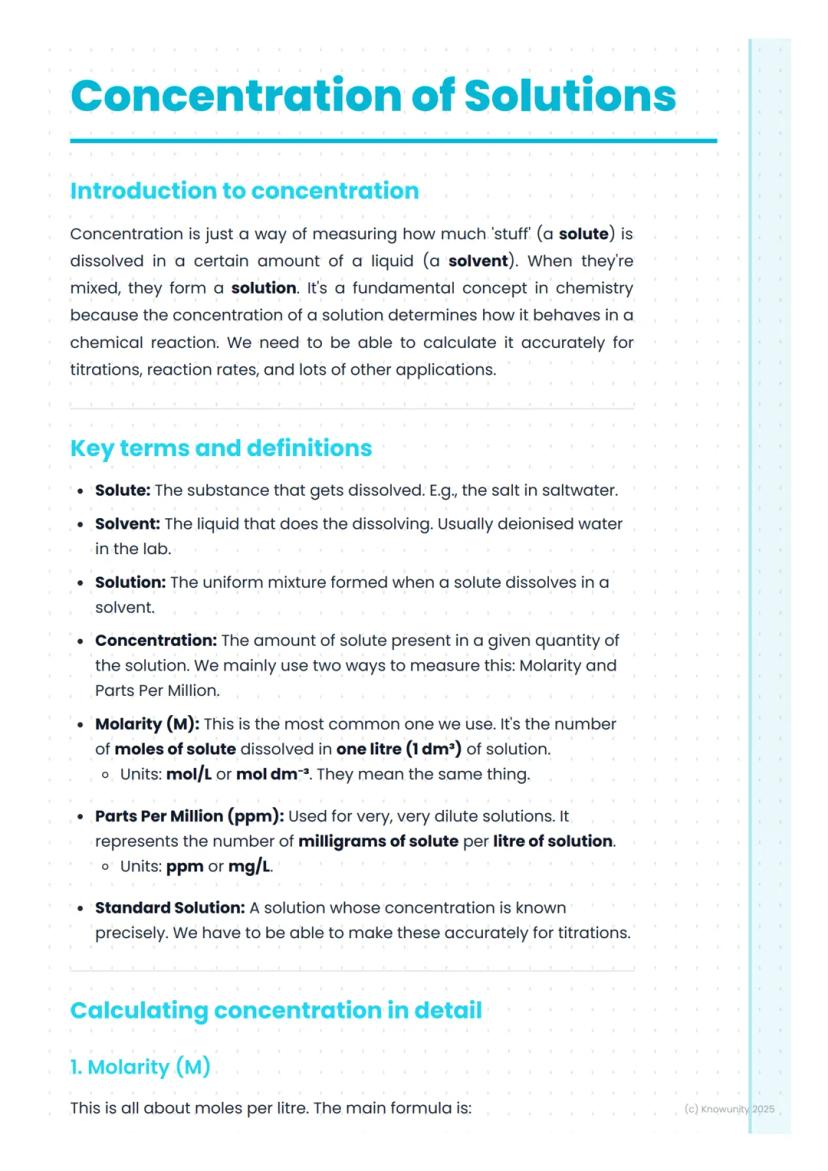
Introduction to Concentration
Think of concentration like making squash - the more cordial you add to water, the stronger it tastes. In chemistry, we're measuring how much solute (the thing being dissolved) is packed into a solvent (usually water).
When you mix them together, you get a solution. The concentration tells you exactly how strong that solution is, which determines how it'll behave in chemical reactions.
There are two main ways to measure concentration: Molarity (for most lab work) and Parts Per Million (for really dilute solutions like pollutants in water). You'll also need to know how to make standard solutions - these are solutions where you know the concentration precisely.
Quick Tip: Molarity uses mol/L, whilst ppm uses mg/L - don't mix up your units!
2
of 8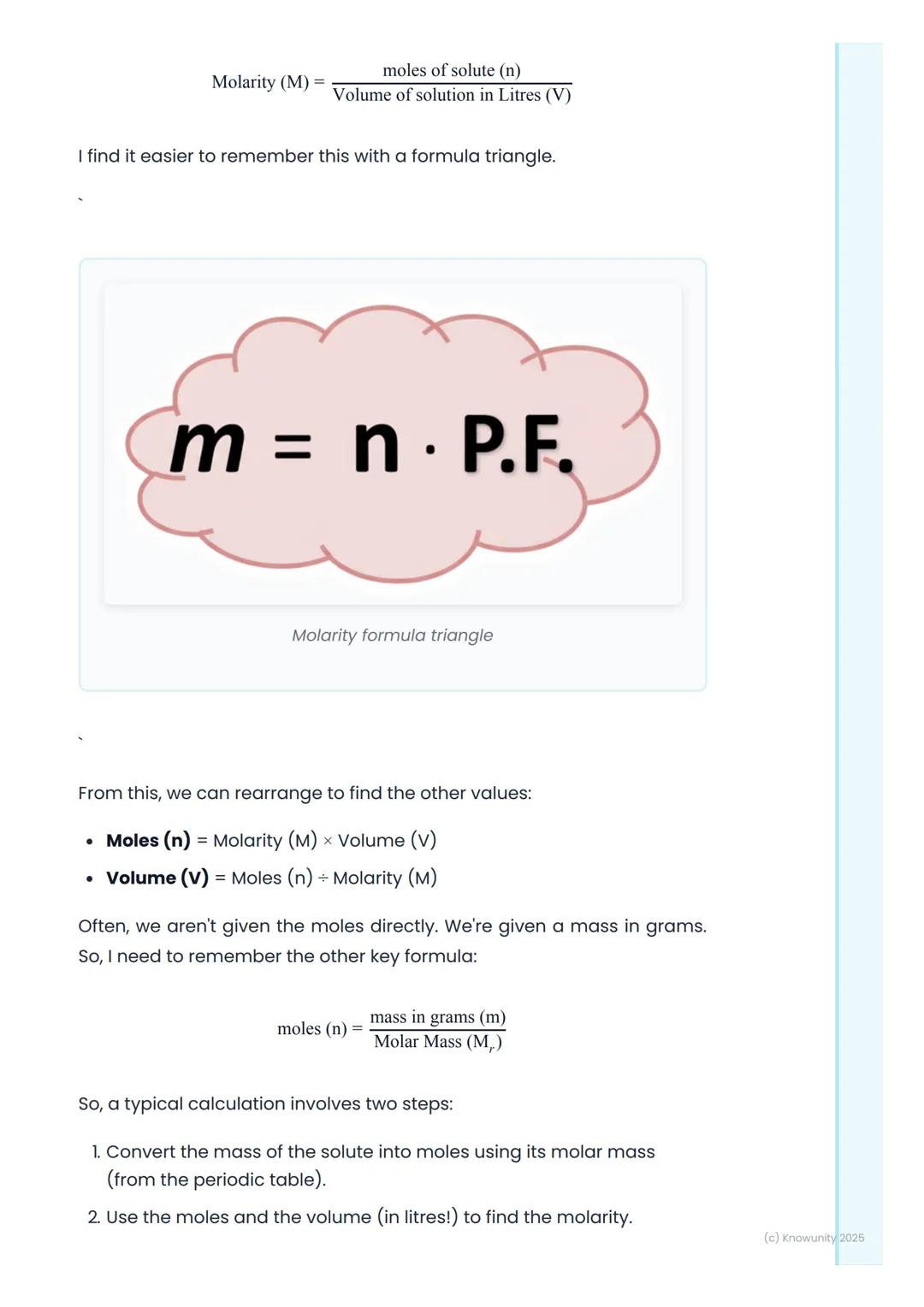
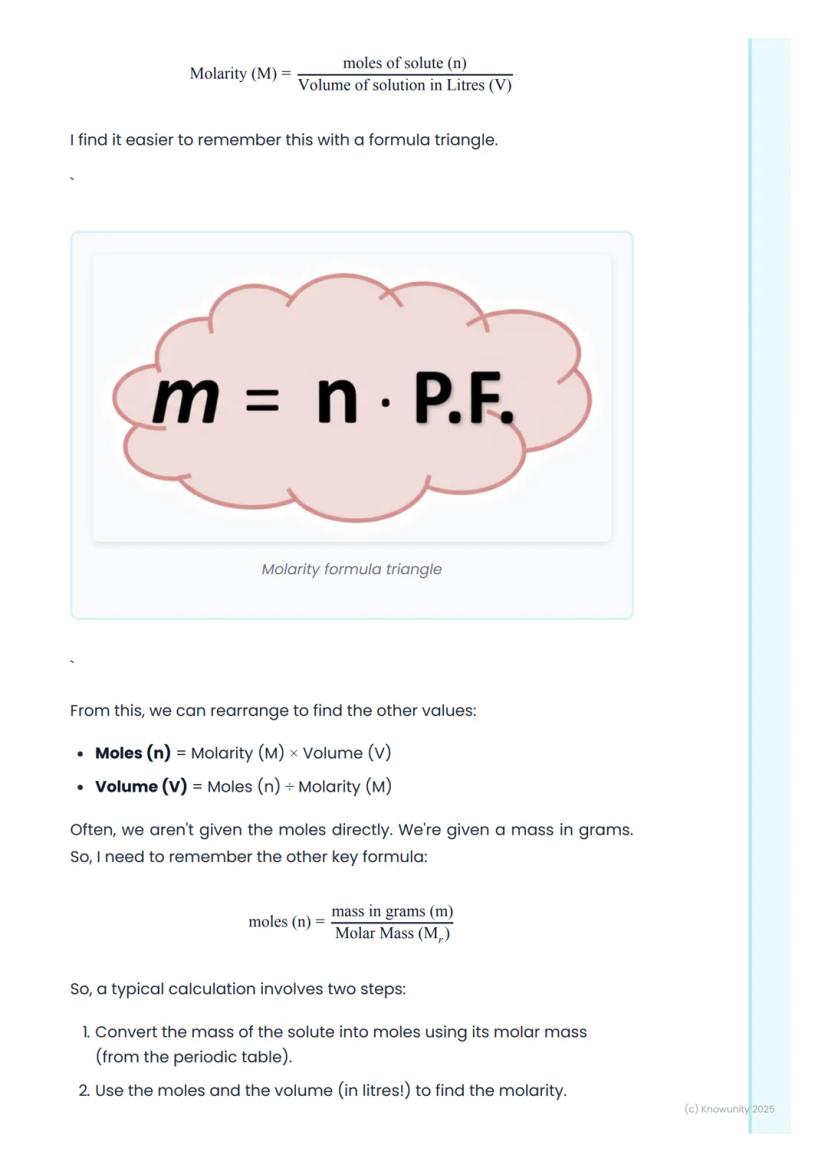
Calculating Molarity
Molarity is your go-to concentration unit. It's simply moles of solute per litre of solution, and the formula is dead easy: M = n/V.
The tricky bit is when you're given mass instead of moles. Then you need two steps: first convert mass to moles using n = m/Mr, then use those moles to find molarity.
Here's the classic setup: you've got some solid chemical, you dissolve it in water, and you need to find the concentration. Convert cm³ to litres (divide by 1000), work out the moles, then divide moles by volume.
Memory Trick: Use the formula triangle - cover what you want to find, and the triangle shows you what to do with the other two values!
3
of 8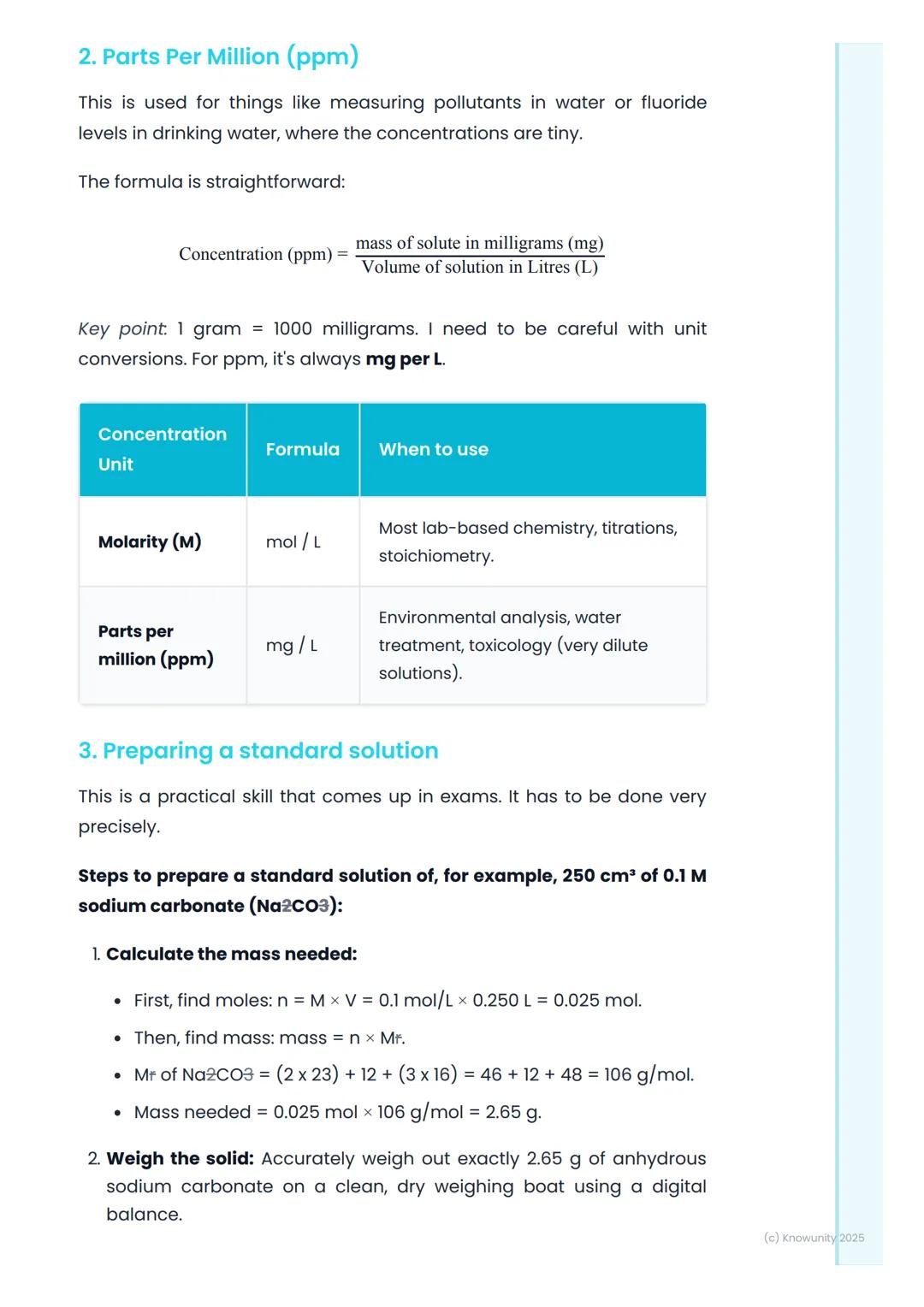
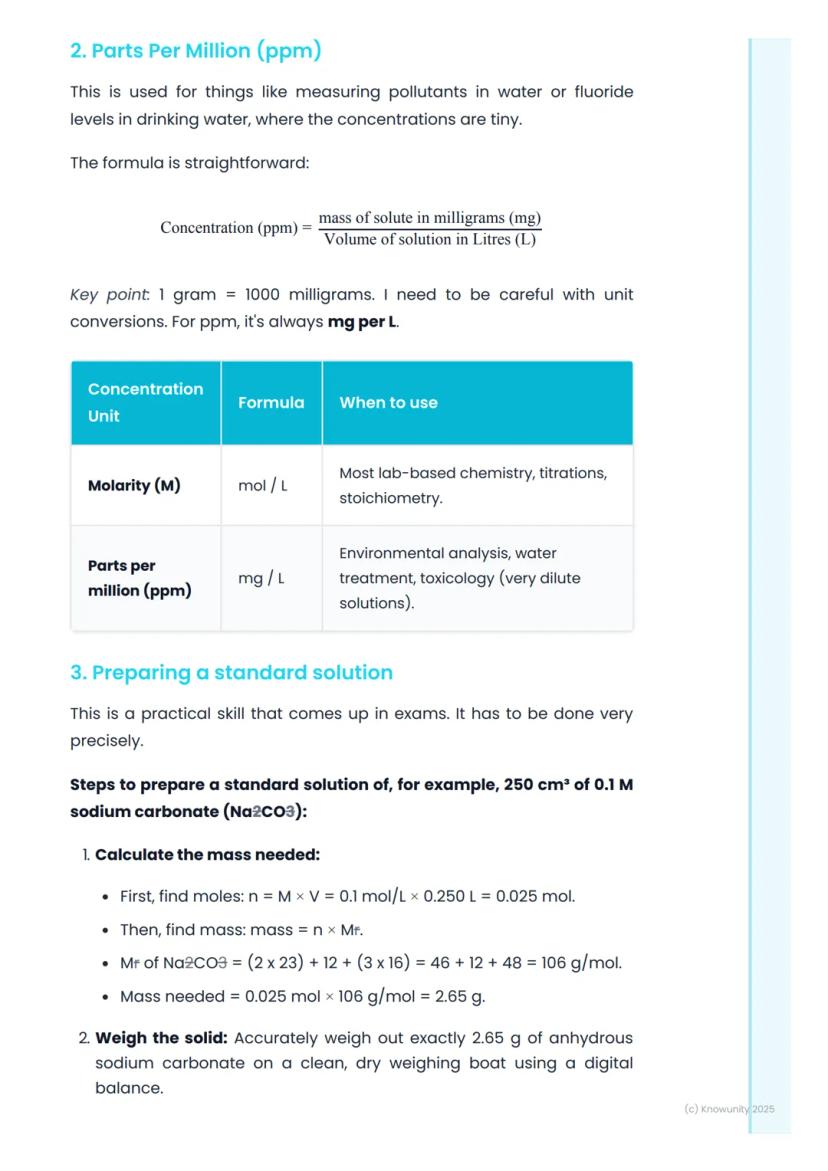
Parts Per Million (ppm)
When concentrations are absolutely tiny - think fluoride in drinking water or pollutants - we use Parts Per Million (ppm). It's much simpler than molarity: just mg of solute per litre of solution.
The formula is straightforward: ppm = mass (mg) / Volume (L). Just remember that 1 gram equals 1000 milligrams, so you might need to convert.
You'll see ppm in environmental chemistry, water treatment, and anywhere we're dealing with trace amounts. It's basically saying "out of a million parts of solution, how many parts are my solute?"
Real World: The WHO recommends fluoride levels in drinking water should be between 0.5-1.5 ppm for dental health.
4
of 8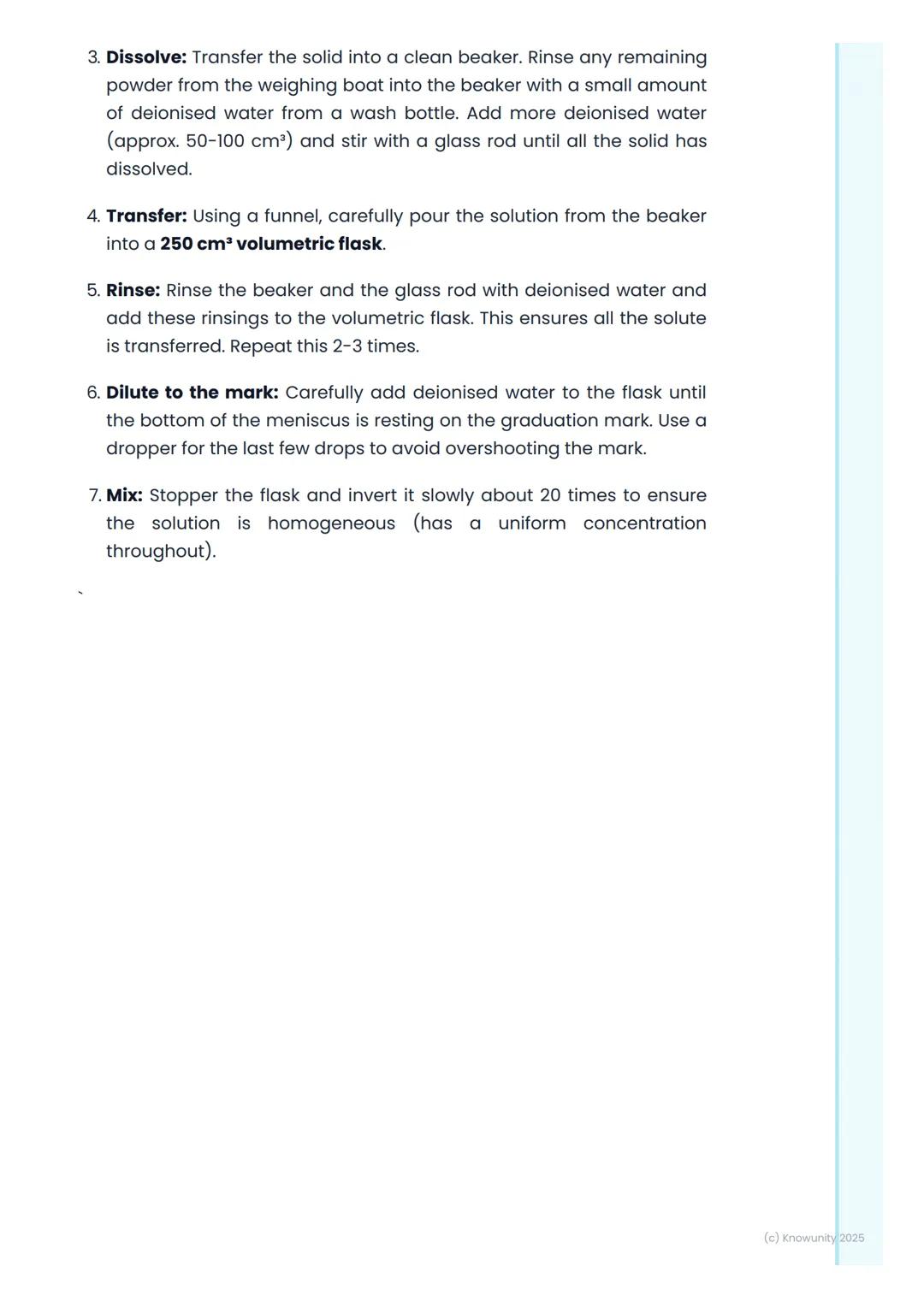
Preparing Standard Solutions
Making a standard solution is a practical skill that'll definitely come up in exams. You need to be absolutely precise because the whole point is knowing the exact concentration.
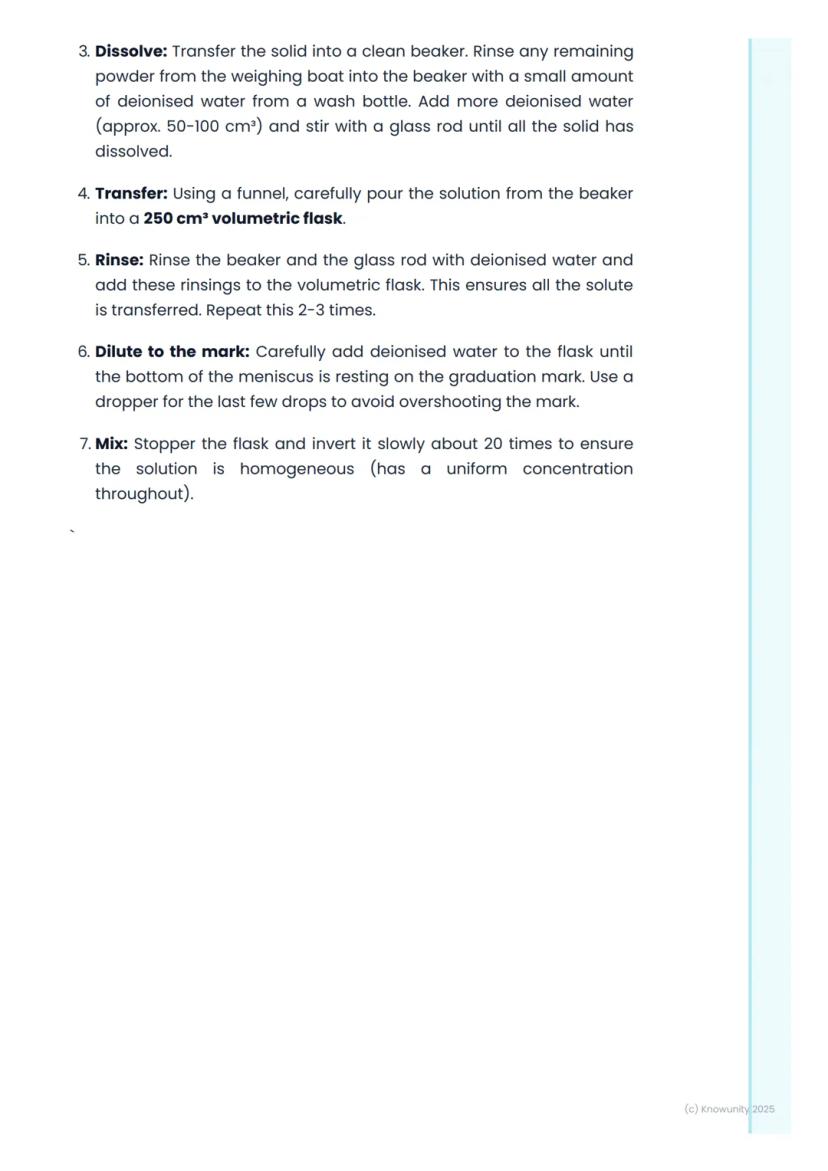
Here's the method: calculate the mass you need (using M × V to get moles, then moles × Mr to get mass). Weigh it accurately, dissolve it in a beaker with some distilled water, then transfer everything to a volumetric flask.
The key bits are rinsing the beaker multiple times (so you don't lose any solute) and filling to the graduation mark carefully. Use a dropper for the last few drops - you can't go back if you overshoot!
Exam Alert: Always use a volumetric flask, not a measuring cylinder or beaker - they're calibrated to be super accurate for one specific volume.
5
of 8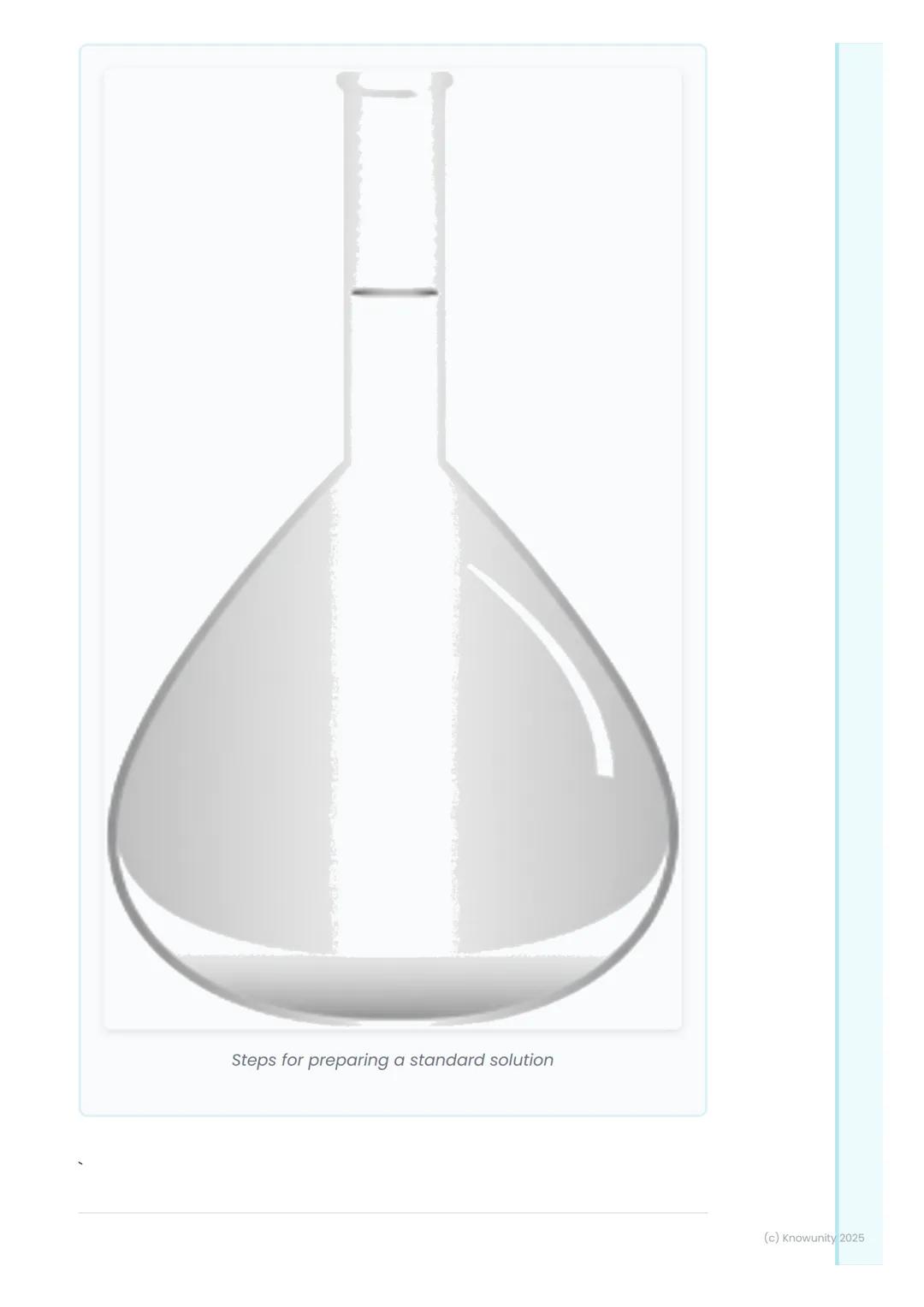
Visual Guide to Standard Solutions
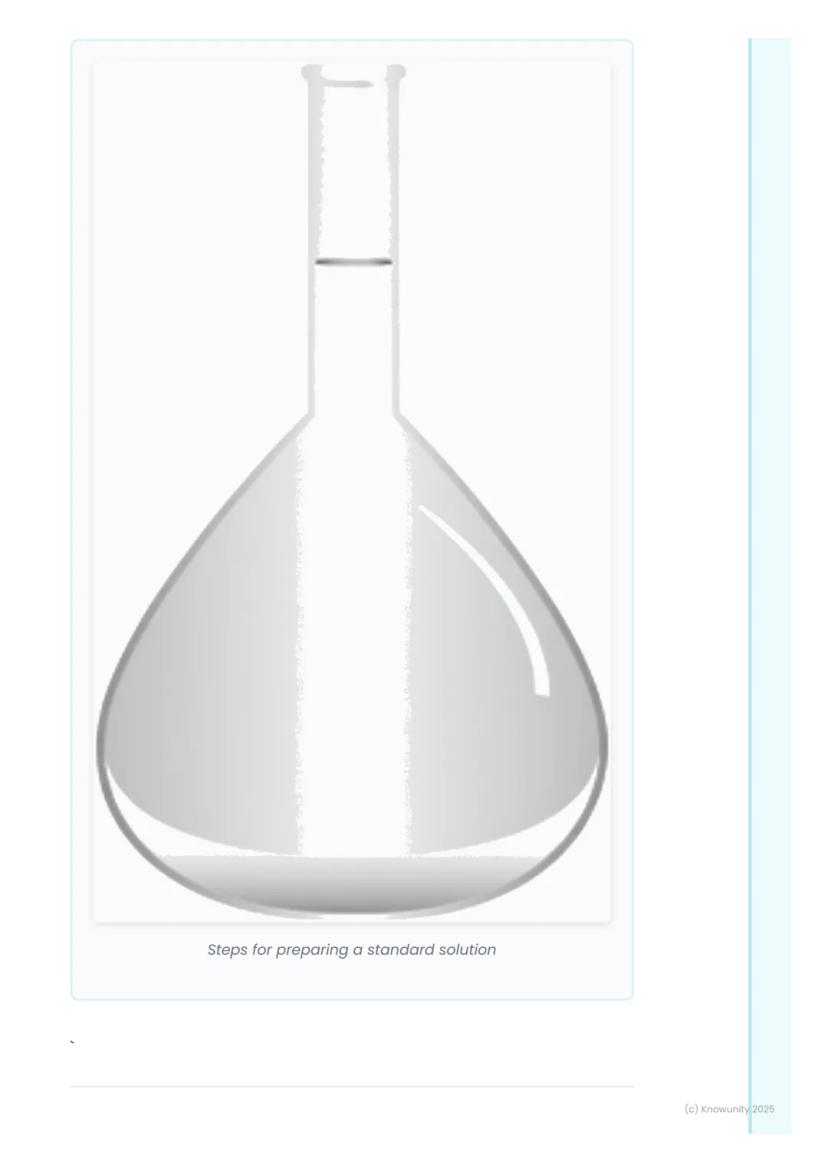
The diagram shows each step clearly: weigh your solid, dissolve it in a beaker, transfer to the volumetric flask with plenty of rinsing, then top up to the mark.
Notice how you rinse the beaker and glass rod multiple times - this ensures every bit of your solute makes it into the final solution. Missing this step will mess up your concentration.
The final step is inverting the stoppered flask about 20 times to mix thoroughly. You want a homogeneous solution - same concentration throughout.
Pro Tip: When reading the meniscus, get your eye level with the graduation mark and read from the bottom of the curve.
6
of 8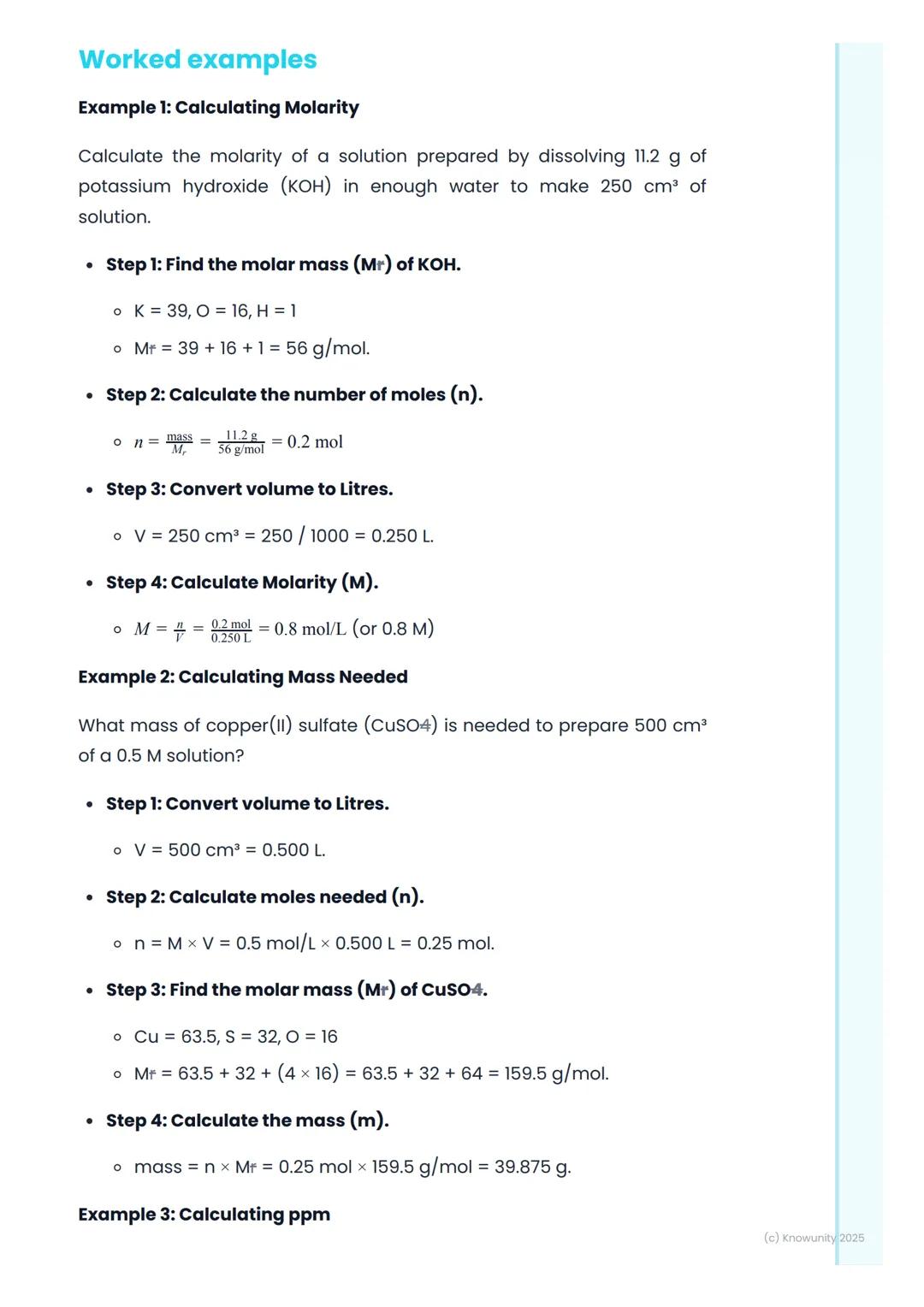
Worked Examples - Molarity and Mass
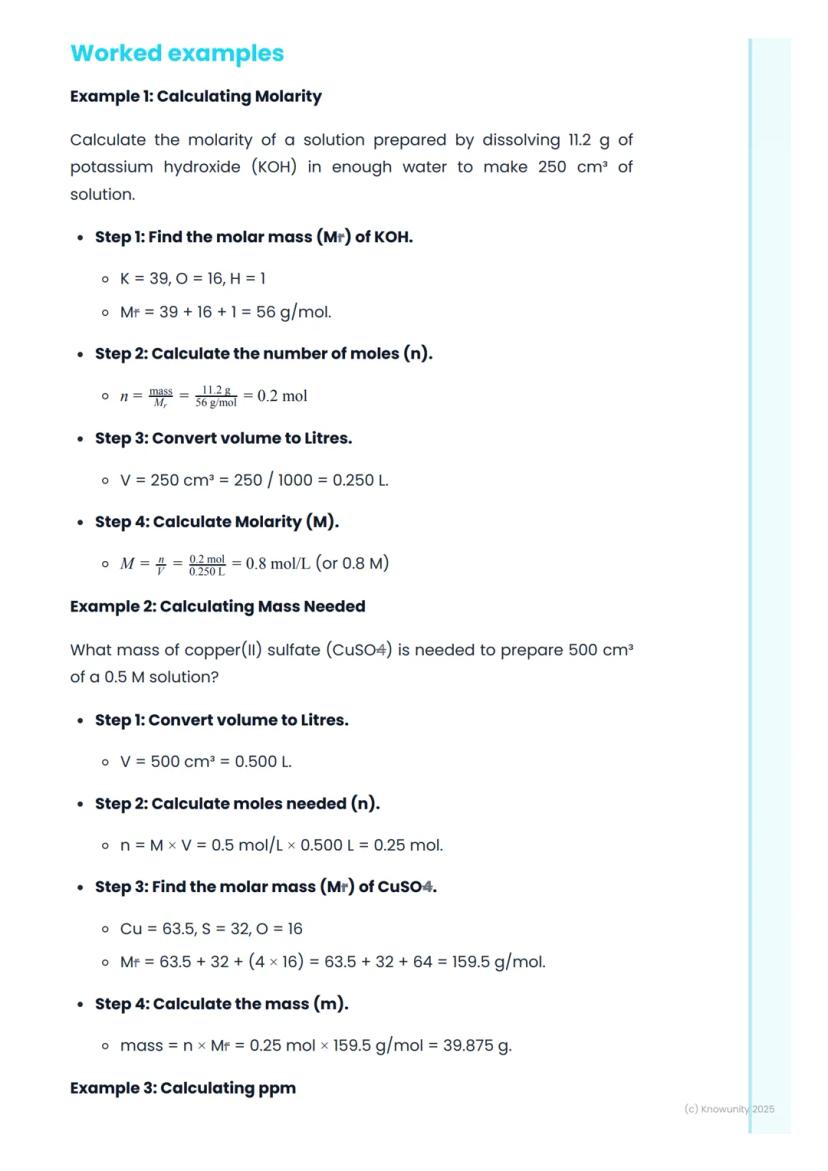
These examples show the step-by-step approach you need for exam success. Notice how every calculation starts by finding the molar mass from the periodic table - get this wrong and everything else falls apart.
For calculating molarity: mass → moles → molarity. Don't forget to convert cm³ to litres! For calculating mass needed: molarity × volume → moles → mass.
The copper sulfate example is typical of what you'll see - they give you a volume in cm³, so immediately convert to litres. Then it's just plugging numbers into formulas.
Common Error: Students often forget the volume conversion. 500 cm³ = 0.500 L, not 0.05 L!
7
of 8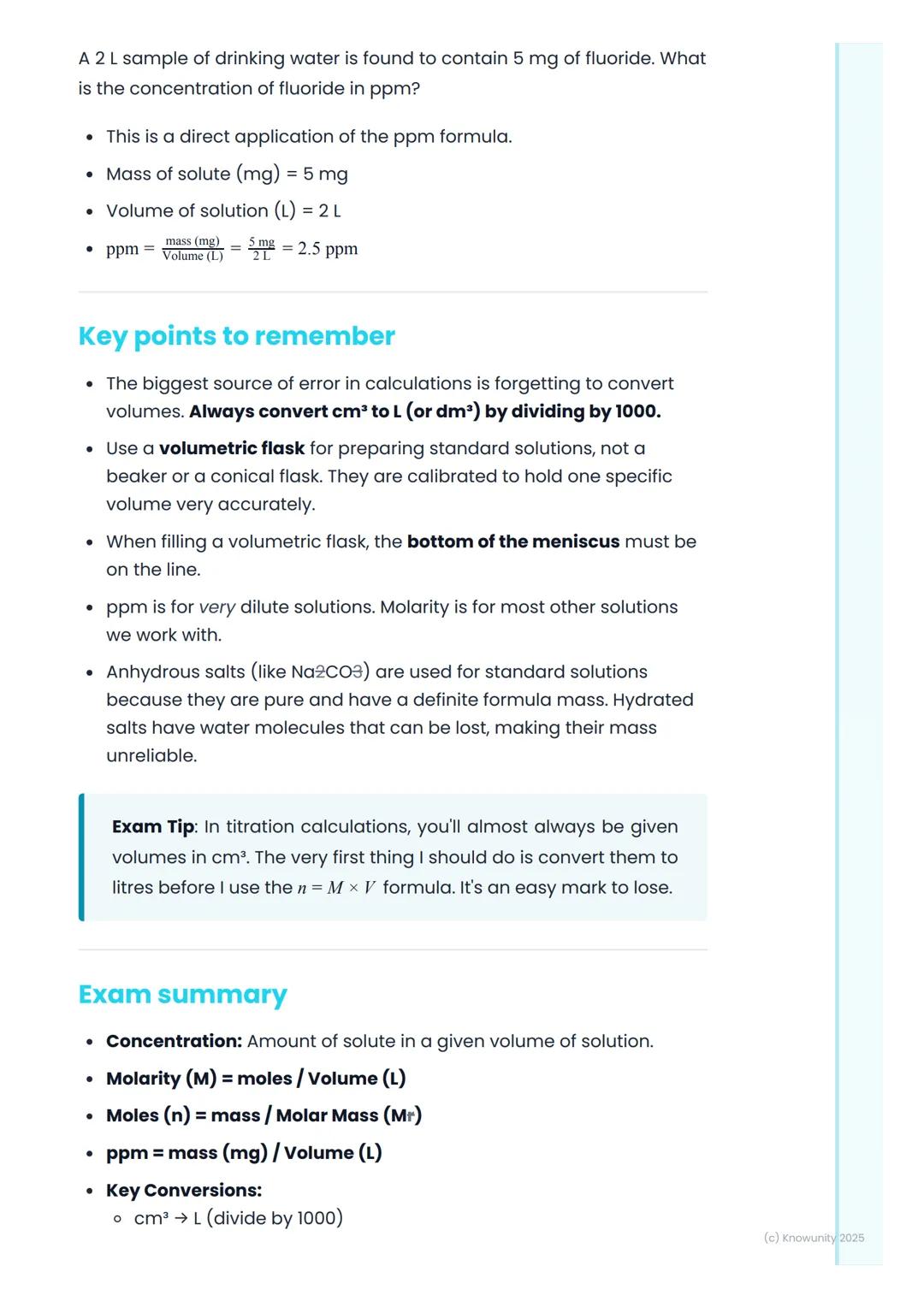
PPM Example and Key Reminders
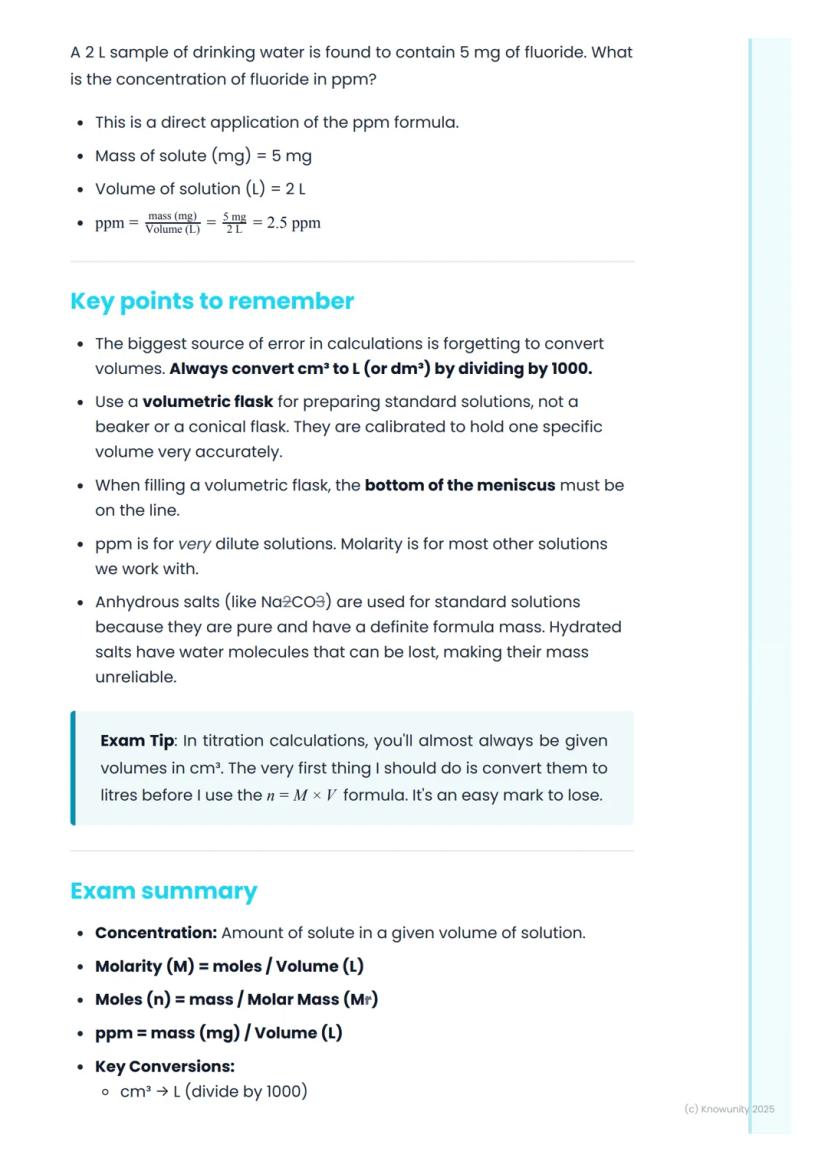
The fluoride example shows how simple ppm calculations can be - just divide mg by litres. No moles or molar masses to worry about.
The key points section highlights the biggest exam traps. Volume conversion trips up loads of students - always convert cm³ to L first thing. Volumetric flasks are essential for accurate standard solutions.
Remember that anhydrous salts are used for standard solutions because they don't have unpredictable water molecules attached. Hydrated salts can lose water, making their mass unreliable.
Exam Strategy: In titration questions, volumes are usually in cm³. Convert to litres before you do anything else - it's an easy mark to lose.
8
of 8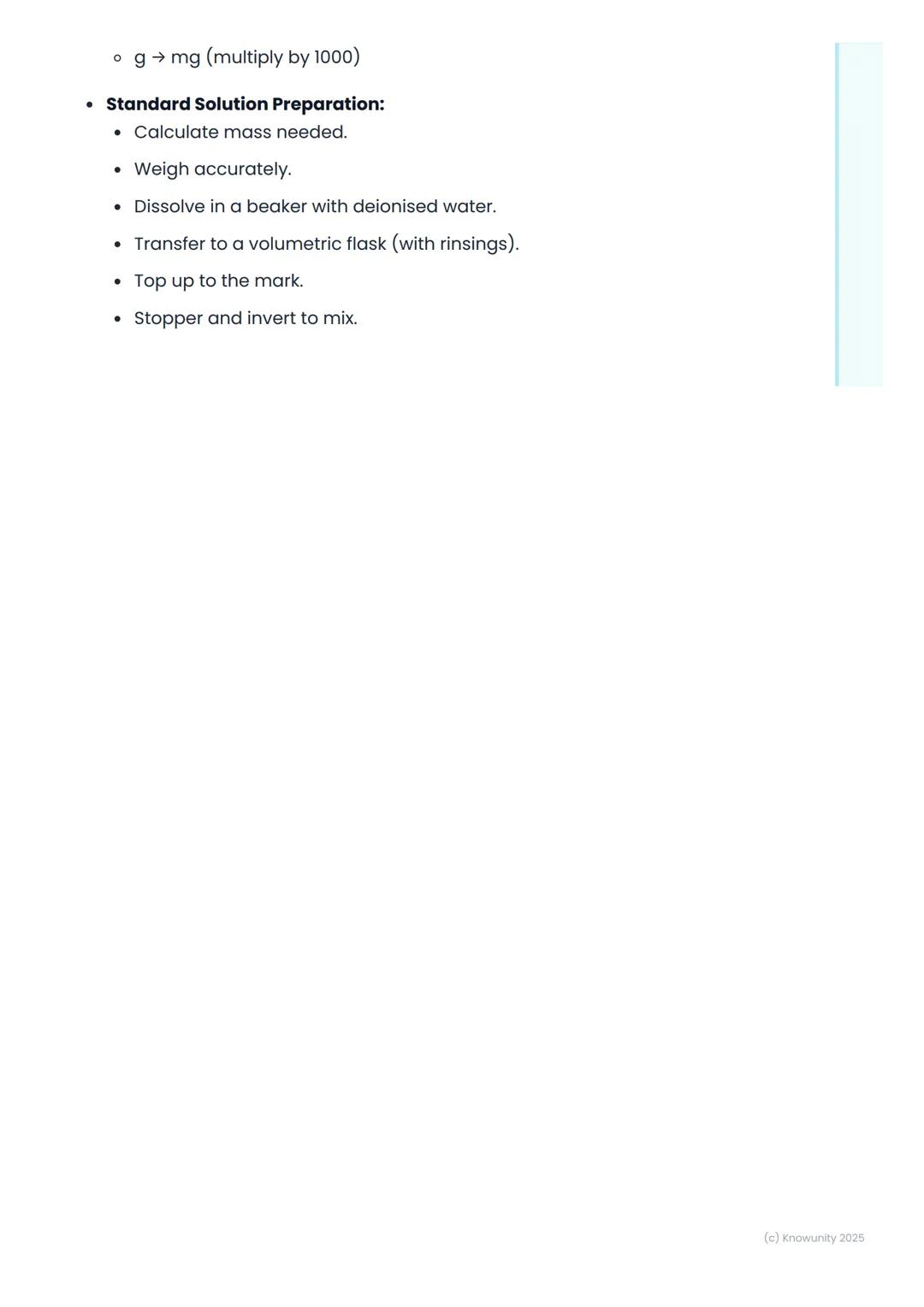
Exam Summary and Quick Reference
This final summary gives you everything you need for quick revision. The key formulas are M = n/V and n = m/Mr - master these and you can handle any concentration calculation.
The conversion reminders are crucial: cm³ to L (÷1000) and g to mg (×1000). Get these wrong and your whole answer is off.
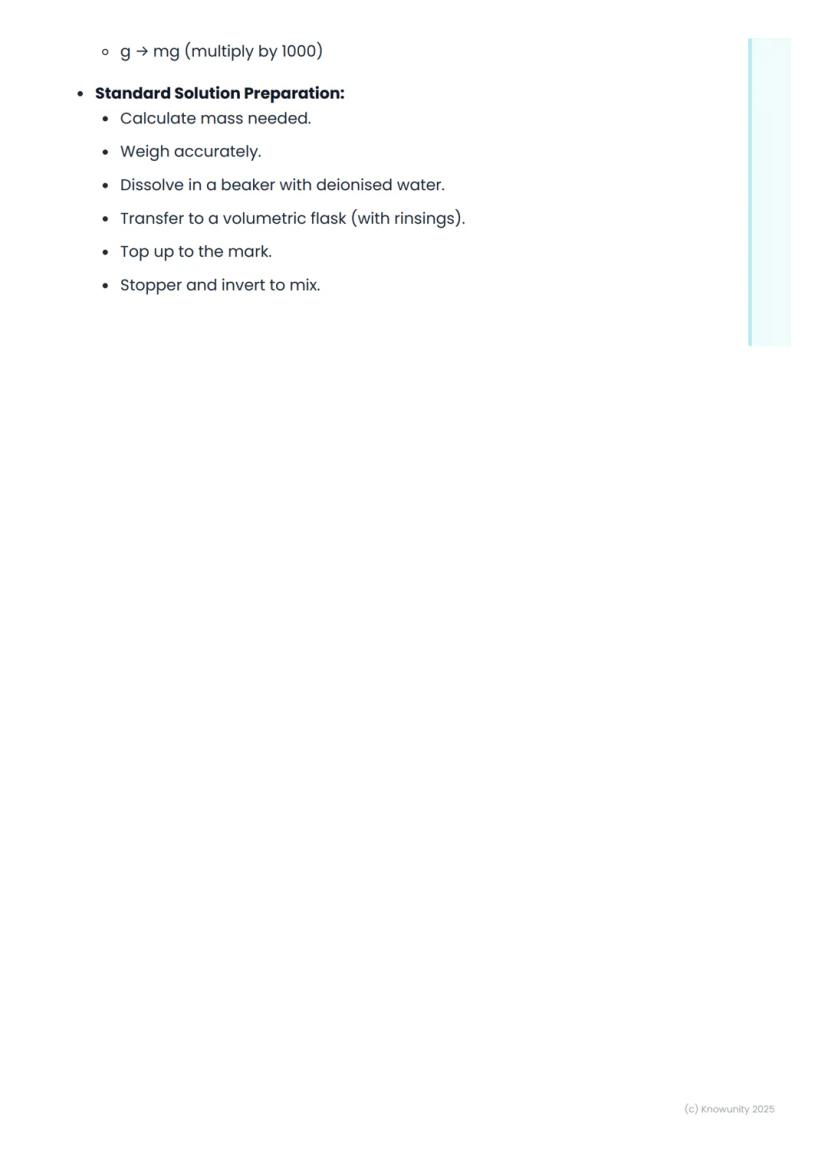
The standard solution steps are always the same: calculate, weigh, dissolve, transfer with rinsings, top up to mark, mix. Learn this sequence and you'll nail any practical question.
Final Tip: Practice switching between mass, moles, and molarity until it's automatic - these calculations come up everywhere in chemistry!
Pensavamo che non l'avreste mai chiesto....
Che cos'è l'assistente AI di Knowunity?
Il nostro assistente AI è costruito specificamente per le esigenze degli studenti. Sulla base dei milioni di contenuti presenti sulla piattaforma, possiamo fornire agli studenti risposte davvero significative e pertinenti. Ma non si tratta solo di risposte, l'assistente è in grado di guidare gli studenti attraverso le loro sfide quotidiane di studio, con piani di studio personalizzati, quiz o contenuti nella chat e una personalizzazione al 100% basata sulle competenze e sugli sviluppi degli studenti.
Dove posso scaricare l'applicazione Knowunity?
È possibile scaricare l'applicazione dal Google Play Store e dall'Apple App Store.
Knowunity è davvero gratuita?
Sì, hai accesso completamente gratuito a tutti i contenuti nell'app e puoi chattare o seguire i Creatori in qualsiasi momento. Sbloccherai nuove funzioni crescendo il tuo numero di follower. Inoltre, offriamo Knowunity Premium, che consente di studiare senza alcun limite!!
Contenuti più popolari
9 Irish
IrishIrish oral questions and answers
Questions and answers for the leaving cert oral
5th Year4264
 English
Key Quotes : Sive
Key Quotes and explanations: Sive
6th Year2842
IrishIrish oral questions
Outline of oral questions
5th Year2055
IrishIníon- le hÁine Durkin
Aine Durkin’s poem, Iníon: Themes & summary
5th Year850
IrishIrish poetry 2027
Iníon + Dínit an Bhróin
5th Year1133
IrishLC HL notes- Iníon (poem)
Includes poem in English and Irish, theme, key words & phrases
5th Year2284
EnglishCultural Context : Shawshank Redemption : Sive : Small Things Like These
Comparative Study : Cultural Context : Shawshank Redemption, Sive and Small Things Like These
6th Year1430
IrishMo Ghrá-sa (Idir Lúibíní)
Notes on mo ghrá-sa
5th Year380
IrishAn Gaeilge Aiste
Irish Language essay
6th Year1320
Non c'è niente di adatto? Esplorare altre aree tematiche.
Recensioni dei nostri utenti. Ci adorano - e anche tu, vedrai .
4.6/5App Store
4.7/5Google Play
L'applicazione è molto facile da usare e ben progettata. Finora ho trovato tutto quello che cercavo e ho potuto imparare molto dalle presentazioni! Utilizzerò sicuramente l'app per i compiti in classe! È molto utile anche come fonte di ispirazione.
Stefano Sutente iOS
Questa applicazione è davvero grande! Ci sono tantissimi appunti e aiuti con lo studio [...]. La mia materia problematica, per esempio, è il francese e l'app ha così tante opzioni per aiutarmi. Grazie a questa app ho migliorato il mio francese. La consiglio a tutti.
Samantha Klichutente Android
Wow, sono davvero stupita. Ho appena provato l'app perché l'ho vista pubblicizzata molte volte e sono rimasta assolutamente sbalordita. Questa app è L'AIUTO che cercate per la scuola e soprattutto offre tantissime cose, come allenamenti e schede, che a me personalmente sono state MOLTO utili.
Annautente iOS
Chemistry12 visualizzazioni·Aggiornato Jun 10, 2026·8 pagineUnderstanding Solution Concentrations: Molarity and Parts per Million
Ever wondered how chemists know exactly how strong a solution is? Concentrationis basically measuring how much stuff is dissolved in your solution - and it's crucial for everything from titrations to understanding reaction rates. Master this, and you'll ace...
1
of 8
Iscriviti per mostrare il contenuto. È gratis!
- Accesso a tutti i documenti
- Migliora i tuoi voti
- Unisciti a milioni di studenti
Introduction to Concentration
Think of concentration like making squash - the more cordial you add to water, the stronger it tastes. In chemistry, we're measuring how much solute (the thing being dissolved) is packed into a solvent (usually water).
When you mix them together, you get a solution. The concentration tells you exactly how strong that solution is, which determines how it'll behave in chemical reactions.
There are two main ways to measure concentration: Molarity (for most lab work) and Parts Per Million (for really dilute solutions like pollutants in water). You'll also need to know how to make standard solutions - these are solutions where you know the concentration precisely.
Quick Tip: Molarity uses mol/L, whilst ppm uses mg/L - don't mix up your units!
2
of 8Iscriviti per mostrare il contenuto. È gratis!
- Accesso a tutti i documenti
- Migliora i tuoi voti
- Unisciti a milioni di studenti
Calculating Molarity
Molarity is your go-to concentration unit. It's simply moles of solute per litre of solution, and the formula is dead easy: M = n/V.
The tricky bit is when you're given mass instead of moles. Then you need two steps: first convert mass to moles using n = m/Mr, then use those moles to find molarity.
Here's the classic setup: you've got some solid chemical, you dissolve it in water, and you need to find the concentration. Convert cm³ to litres (divide by 1000), work out the moles, then divide moles by volume.
Memory Trick: Use the formula triangle - cover what you want to find, and the triangle shows you what to do with the other two values!
3
of 8Iscriviti per mostrare il contenuto. È gratis!
- Accesso a tutti i documenti
- Migliora i tuoi voti
- Unisciti a milioni di studenti
Parts Per Million (ppm)
When concentrations are absolutely tiny - think fluoride in drinking water or pollutants - we use Parts Per Million (ppm). It's much simpler than molarity: just mg of solute per litre of solution.
The formula is straightforward: ppm = mass (mg) / Volume (L). Just remember that 1 gram equals 1000 milligrams, so you might need to convert.
You'll see ppm in environmental chemistry, water treatment, and anywhere we're dealing with trace amounts. It's basically saying "out of a million parts of solution, how many parts are my solute?"
Real World: The WHO recommends fluoride levels in drinking water should be between 0.5-1.5 ppm for dental health.
4
of 8Iscriviti per mostrare il contenuto. È gratis!
- Accesso a tutti i documenti
- Migliora i tuoi voti
- Unisciti a milioni di studenti
Preparing Standard Solutions
Making a standard solution is a practical skill that'll definitely come up in exams. You need to be absolutely precise because the whole point is knowing the exact concentration.
Here's the method: calculate the mass you need (using M × V to get moles, then moles × Mr to get mass). Weigh it accurately, dissolve it in a beaker with some distilled water, then transfer everything to a volumetric flask.
The key bits are rinsing the beaker multiple times (so you don't lose any solute) and filling to the graduation mark carefully. Use a dropper for the last few drops - you can't go back if you overshoot!
Exam Alert: Always use a volumetric flask, not a measuring cylinder or beaker - they're calibrated to be super accurate for one specific volume.
5
of 8Iscriviti per mostrare il contenuto. È gratis!
- Accesso a tutti i documenti
- Migliora i tuoi voti
- Unisciti a milioni di studenti
Visual Guide to Standard Solutions
The diagram shows each step clearly: weigh your solid, dissolve it in a beaker, transfer to the volumetric flask with plenty of rinsing, then top up to the mark.
Notice how you rinse the beaker and glass rod multiple times - this ensures every bit of your solute makes it into the final solution. Missing this step will mess up your concentration.
The final step is inverting the stoppered flask about 20 times to mix thoroughly. You want a homogeneous solution - same concentration throughout.
Pro Tip: When reading the meniscus, get your eye level with the graduation mark and read from the bottom of the curve.
6
of 8Iscriviti per mostrare il contenuto. È gratis!
- Accesso a tutti i documenti
- Migliora i tuoi voti
- Unisciti a milioni di studenti
Worked Examples - Molarity and Mass
These examples show the step-by-step approach you need for exam success. Notice how every calculation starts by finding the molar mass from the periodic table - get this wrong and everything else falls apart.
For calculating molarity: mass → moles → molarity. Don't forget to convert cm³ to litres! For calculating mass needed: molarity × volume → moles → mass.
The copper sulfate example is typical of what you'll see - they give you a volume in cm³, so immediately convert to litres. Then it's just plugging numbers into formulas.
Common Error: Students often forget the volume conversion. 500 cm³ = 0.500 L, not 0.05 L!
7
of 8Iscriviti per mostrare il contenuto. È gratis!
- Accesso a tutti i documenti
- Migliora i tuoi voti
- Unisciti a milioni di studenti
PPM Example and Key Reminders
The fluoride example shows how simple ppm calculations can be - just divide mg by litres. No moles or molar masses to worry about.
The key points section highlights the biggest exam traps. Volume conversion trips up loads of students - always convert cm³ to L first thing. Volumetric flasks are essential for accurate standard solutions.
Remember that anhydrous salts are used for standard solutions because they don't have unpredictable water molecules attached. Hydrated salts can lose water, making their mass unreliable.
Exam Strategy: In titration questions, volumes are usually in cm³. Convert to litres before you do anything else - it's an easy mark to lose.
8
of 8Iscriviti per mostrare il contenuto. È gratis!
- Accesso a tutti i documenti
- Migliora i tuoi voti
- Unisciti a milioni di studenti
Exam Summary and Quick Reference
This final summary gives you everything you need for quick revision. The key formulas are M = n/V and n = m/Mr - master these and you can handle any concentration calculation.
The conversion reminders are crucial: cm³ to L (÷1000) and g to mg (×1000). Get these wrong and your whole answer is off.
The standard solution steps are always the same: calculate, weigh, dissolve, transfer with rinsings, top up to mark, mix. Learn this sequence and you'll nail any practical question.
Final Tip: Practice switching between mass, moles, and molarity until it's automatic - these calculations come up everywhere in chemistry!
Pensavamo che non l'avreste mai chiesto....
Che cos'è l'assistente AI di Knowunity?
Il nostro assistente AI è costruito specificamente per le esigenze degli studenti. Sulla base dei milioni di contenuti presenti sulla piattaforma, possiamo fornire agli studenti risposte davvero significative e pertinenti. Ma non si tratta solo di risposte, l'assistente è in grado di guidare gli studenti attraverso le loro sfide quotidiane di studio, con piani di studio personalizzati, quiz o contenuti nella chat e una personalizzazione al 100% basata sulle competenze e sugli sviluppi degli studenti.
Dove posso scaricare l'applicazione Knowunity?
È possibile scaricare l'applicazione dal Google Play Store e dall'Apple App Store.
Knowunity è davvero gratuita?
Sì, hai accesso completamente gratuito a tutti i contenuti nell'app e puoi chattare o seguire i Creatori in qualsiasi momento. Sbloccherai nuove funzioni crescendo il tuo numero di follower. Inoltre, offriamo Knowunity Premium, che consente di studiare senza alcun limite!!
Contenuti più popolari
9IrishIrish oral questions and answers
Questions and answers for the leaving cert oral
5th Year4264
EnglishKey Quotes : Sive
Key Quotes and explanations: Sive
6th Year2842
IrishIrish oral questions
Outline of oral questions
5th Year2055
IrishIníon- le hÁine Durkin
Aine Durkin’s poem, Iníon: Themes & summary
5th Year850
IrishIrish poetry 2027
Iníon + Dínit an Bhróin
5th Year1133
IrishLC HL notes- Iníon (poem)
Includes poem in English and Irish, theme, key words & phrases
5th Year2284
EnglishCultural Context : Shawshank Redemption : Sive : Small Things Like These
Comparative Study : Cultural Context : Shawshank Redemption, Sive and Small Things Like These
6th Year1430
IrishMo Ghrá-sa (Idir Lúibíní)
Notes on mo ghrá-sa
5th Year380
IrishAn Gaeilge Aiste
Irish Language essay
6th Year1320
Non c'è niente di adatto? Esplorare altre aree tematiche.
Recensioni dei nostri utenti. Ci adorano - e anche tu, vedrai .
4.6/5App Store
4.7/5Google Play
L'applicazione è molto facile da usare e ben progettata. Finora ho trovato tutto quello che cercavo e ho potuto imparare molto dalle presentazioni! Utilizzerò sicuramente l'app per i compiti in classe! È molto utile anche come fonte di ispirazione.
Stefano Sutente iOS
Questa applicazione è davvero grande! Ci sono tantissimi appunti e aiuti con lo studio [...]. La mia materia problematica, per esempio, è il francese e l'app ha così tante opzioni per aiutarmi. Grazie a questa app ho migliorato il mio francese. La consiglio a tutti.
Samantha Klichutente Android
Wow, sono davvero stupita. Ho appena provato l'app perché l'ho vista pubblicizzata molte volte e sono rimasta assolutamente sbalordita. Questa app è L'AIUTO che cercate per la scuola e soprattutto offre tantissime cose, come allenamenti e schede, che a me personalmente sono state MOLTO utili.
Annautente iOS