
Ever wondered why your payslip shows different amounts or where... Mostra di più
 Business Studies6 visualizzazioni·Aggiornato May 13, 2026·6 pagine
Understanding Income and Expenses
1 / 6
1
of 6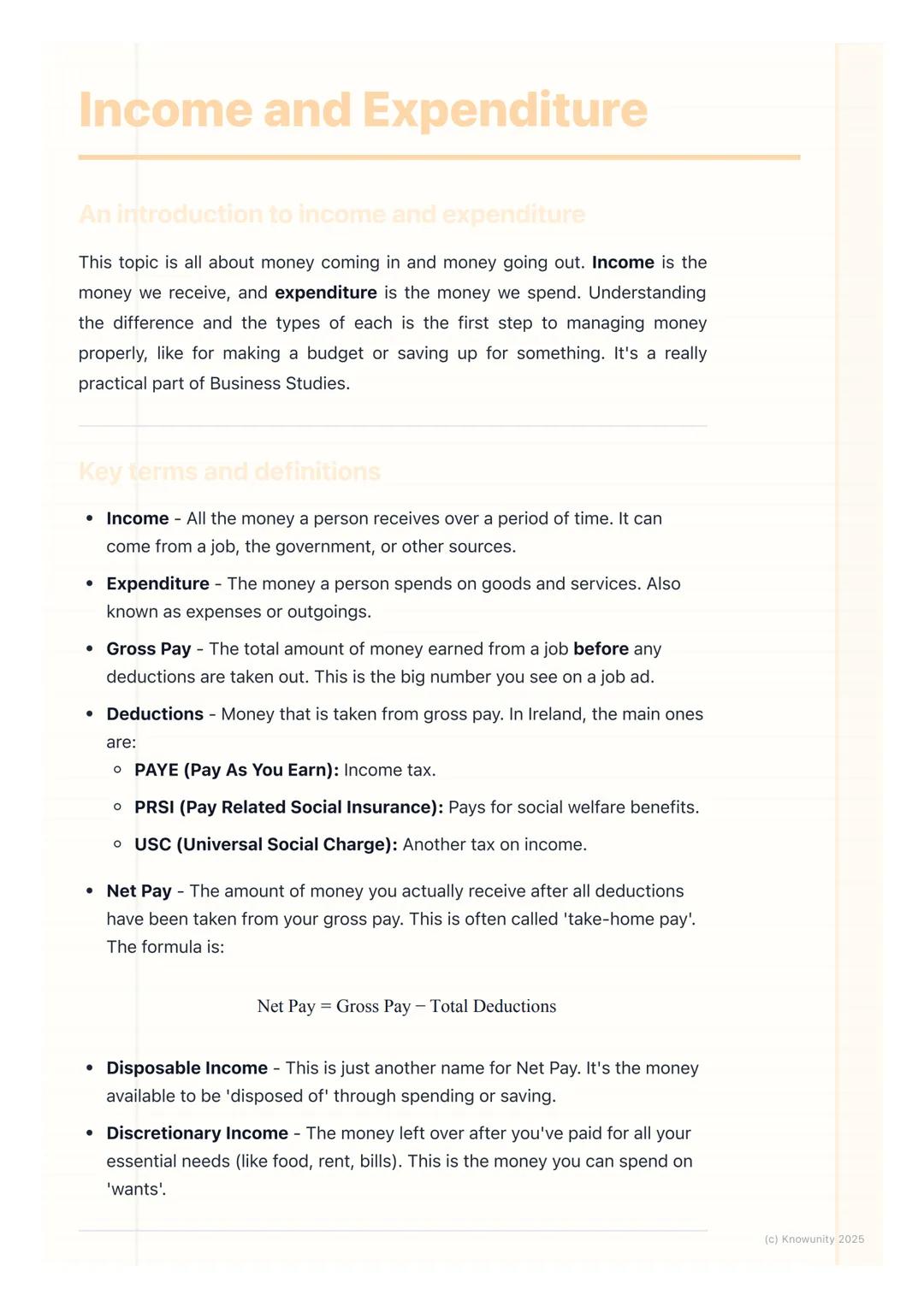
Income and Expenditure Basics
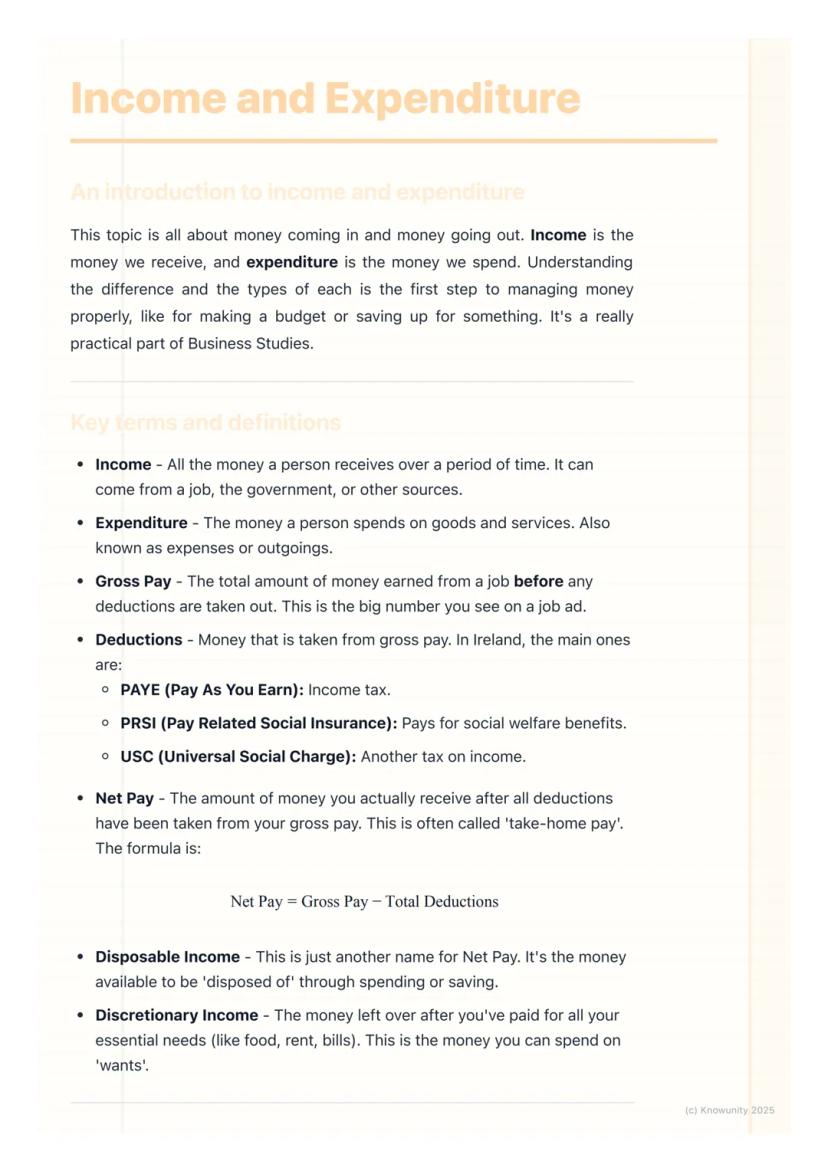
Money management starts with two simple concepts: money coming in (income) and money going out (expenditure). Think of it like your phone battery - you need to know what's charging it up and what's draining it.
Income is all the money you receive over time, whether that's from your weekend job, birthday money, or government payments. Expenditure (also called expenses) is everything you spend money on - from your weekly shop to that concert ticket you've been eyeing up.
The real game-changer here is understanding the difference between gross pay and net pay. Your gross pay is the big number you see on job adverts - the total amount before any deductions. But here's the reality check: you won't actually get all of that money.
Key Insight: Your net pay = Gross pay - Total deductions. This is the actual amount that hits your bank account and what you need to base your spending on.
2
of 6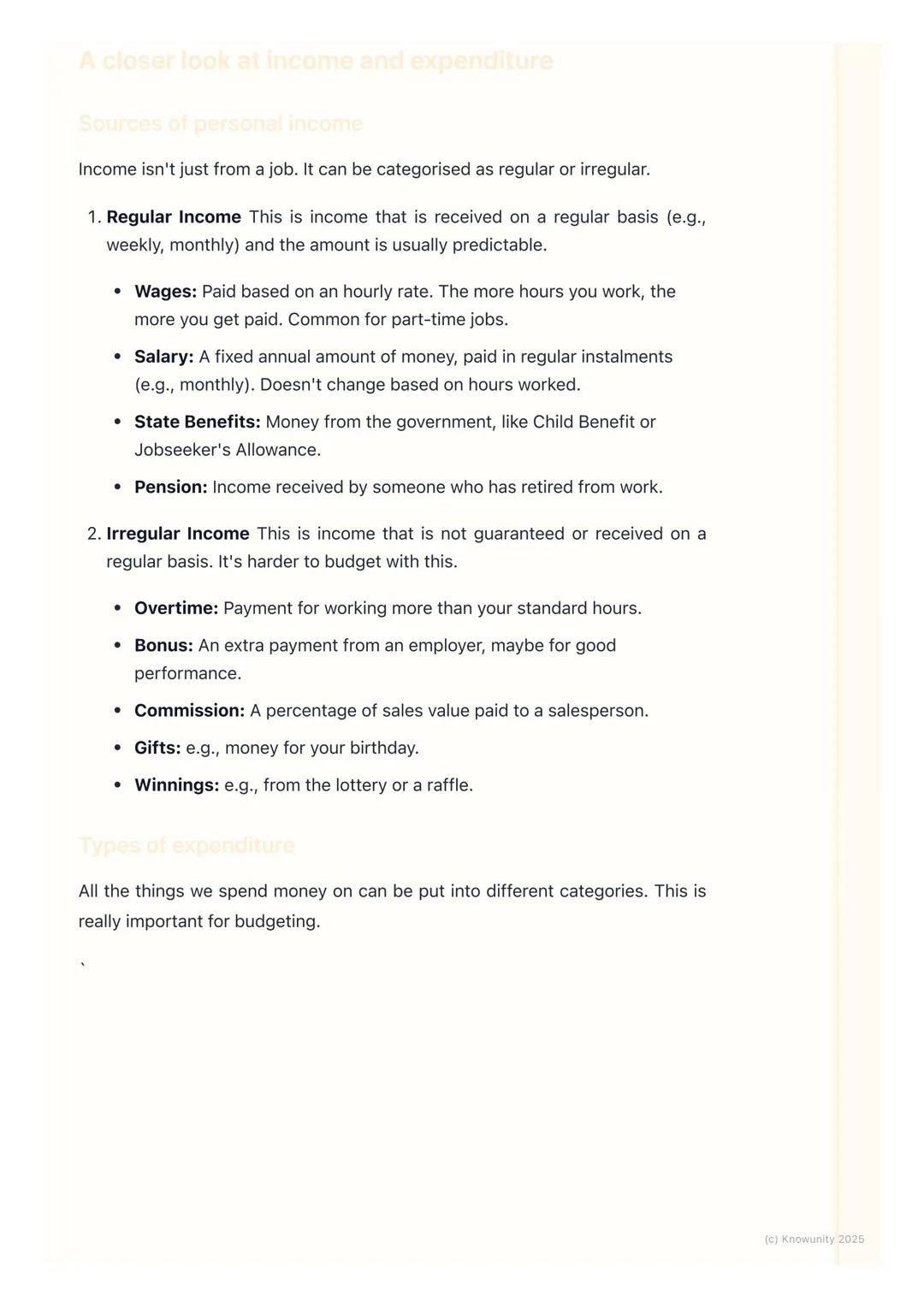
Types of Income: Regular vs Irregular
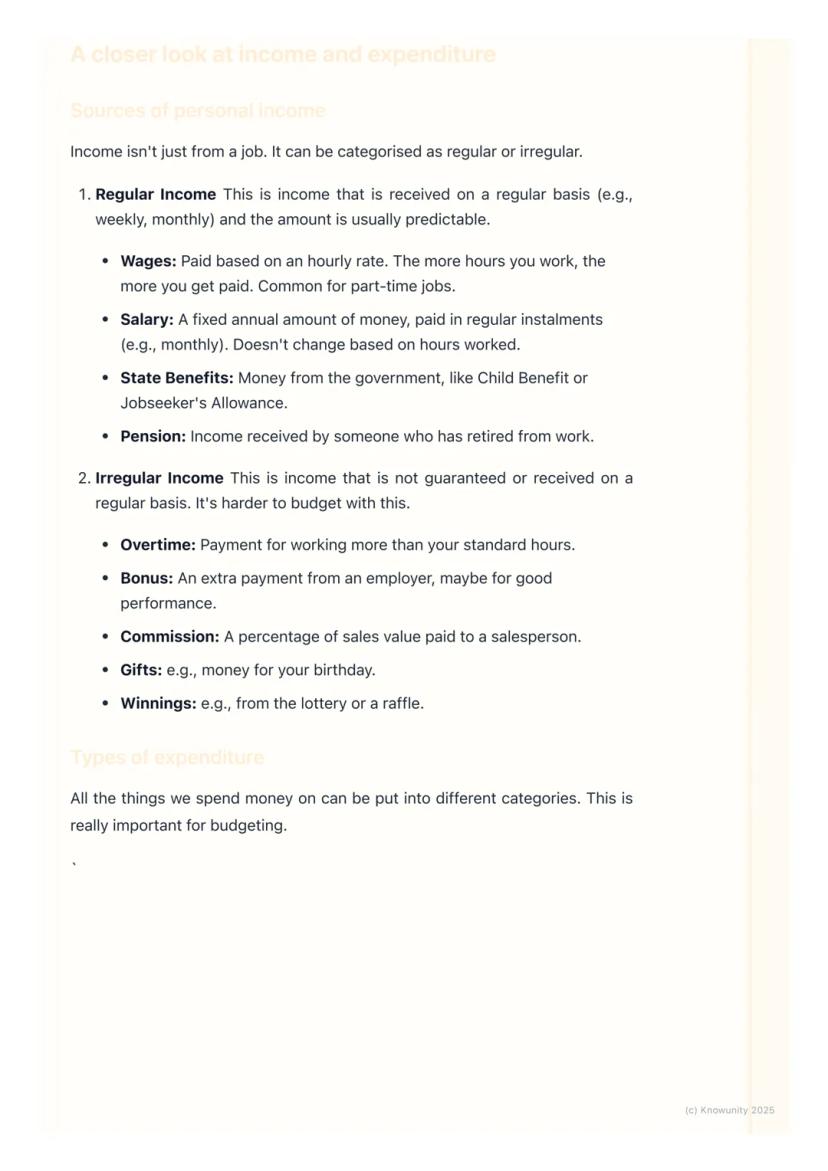
Your income isn't just about having a job - there are actually loads of different ways money can come your way, and they fall into two main categories.
Regular income is the reliable stuff you can count on. This includes wages , salaries (a fixed yearly amount paid monthly), state benefits like Child Benefit, and pensions for retired folks. You can predict this income, which makes budgeting much easier.
Irregular income is the unpredictable money that's harder to plan around. Think overtime payments, performance bonuses, commission from sales jobs, birthday money, or even lottery winnings. This type of income can be brilliant when it arrives, but you can't rely on it for your essential expenses.
Understanding this difference is crucial because you should only budget based on your regular income. Any irregular income? That's your bonus money for treats or building up your savings.
Smart Tip: Never budget based on irregular income like overtime or bonuses - treat these as extra money for savings or special purchases.
3
of 6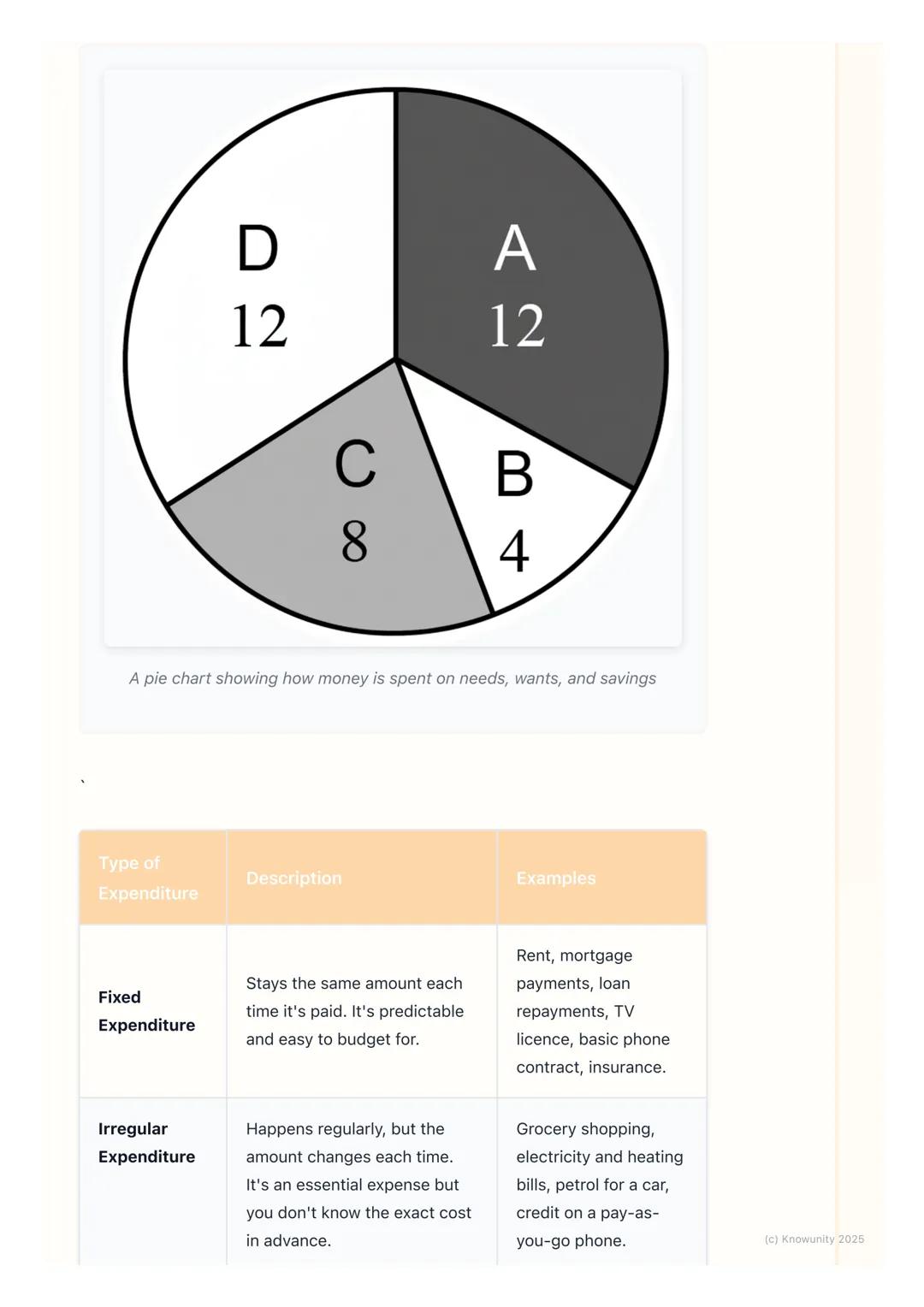
Understanding Your Payslip Deductions
When you get your first proper payslip, you might be shocked at how much gets taken out before the money reaches you. In Ireland, there are three main deductions you need to know about.
PAYE (Pay As You Earn) is basically income tax - the government's cut of your earnings. PRSI (Pay Related Social Insurance) funds social welfare benefits like unemployment support. USC (Universal Social Charge) is an additional tax on your income.
The good news? If you're earning smaller amounts , you might not pay much tax at all. Many part-time workers pay little to no PAYE because they earn below the tax threshold.
Your disposable income is just another name for your net pay - the money you can actually "dispose of" through spending or saving. But there's also discretionary income, which is what's left after you've covered all your essential needs like food and bills.
Reality Check: Your net pay is always less than your gross pay due to deductions, so always base your spending plans on your take-home amount.
4
of 6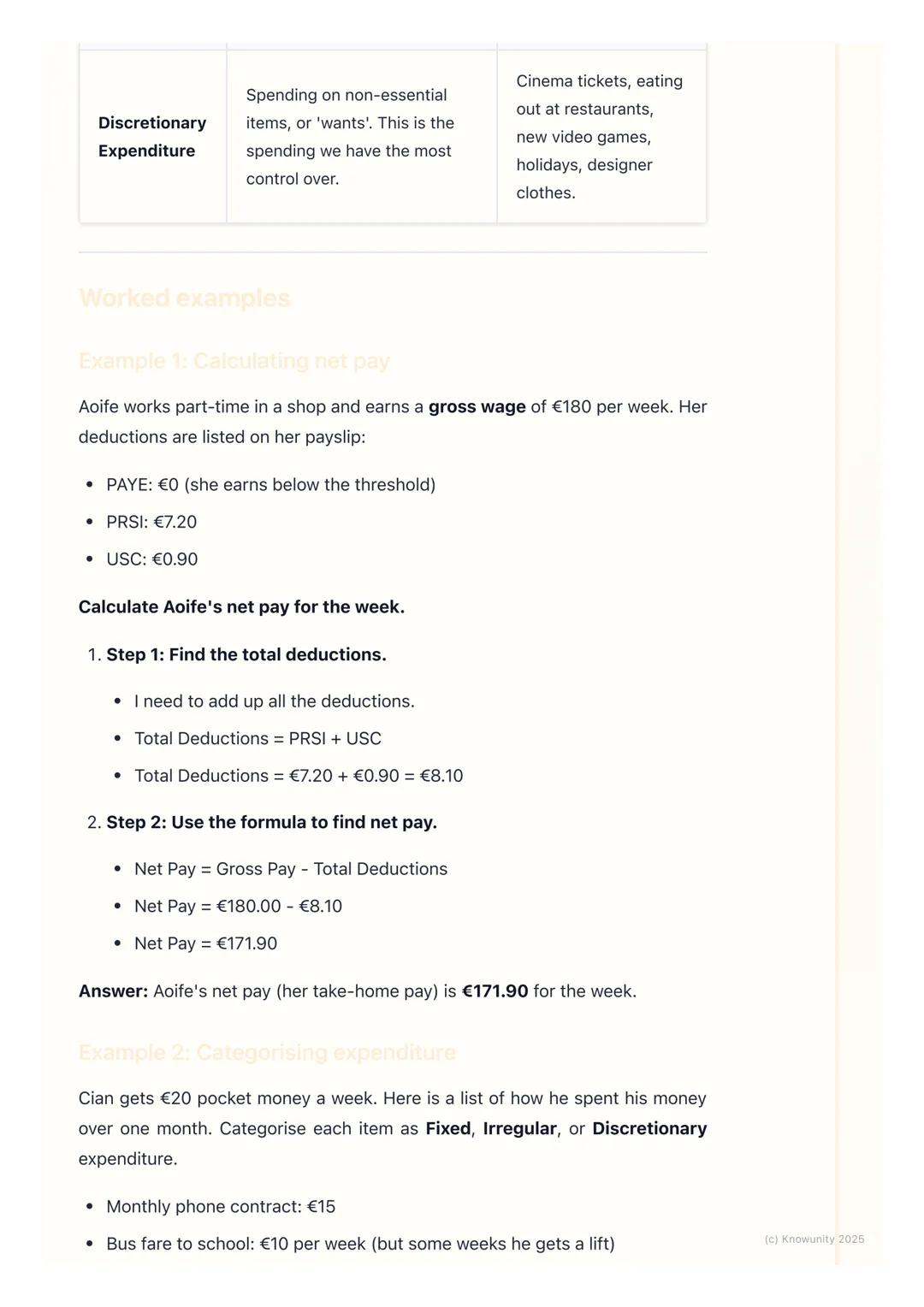
Types of Expenditure: Fixed, Irregular, and Discretionary
Not all spending is created equal, and understanding the three types of expenditure will transform how you manage money.
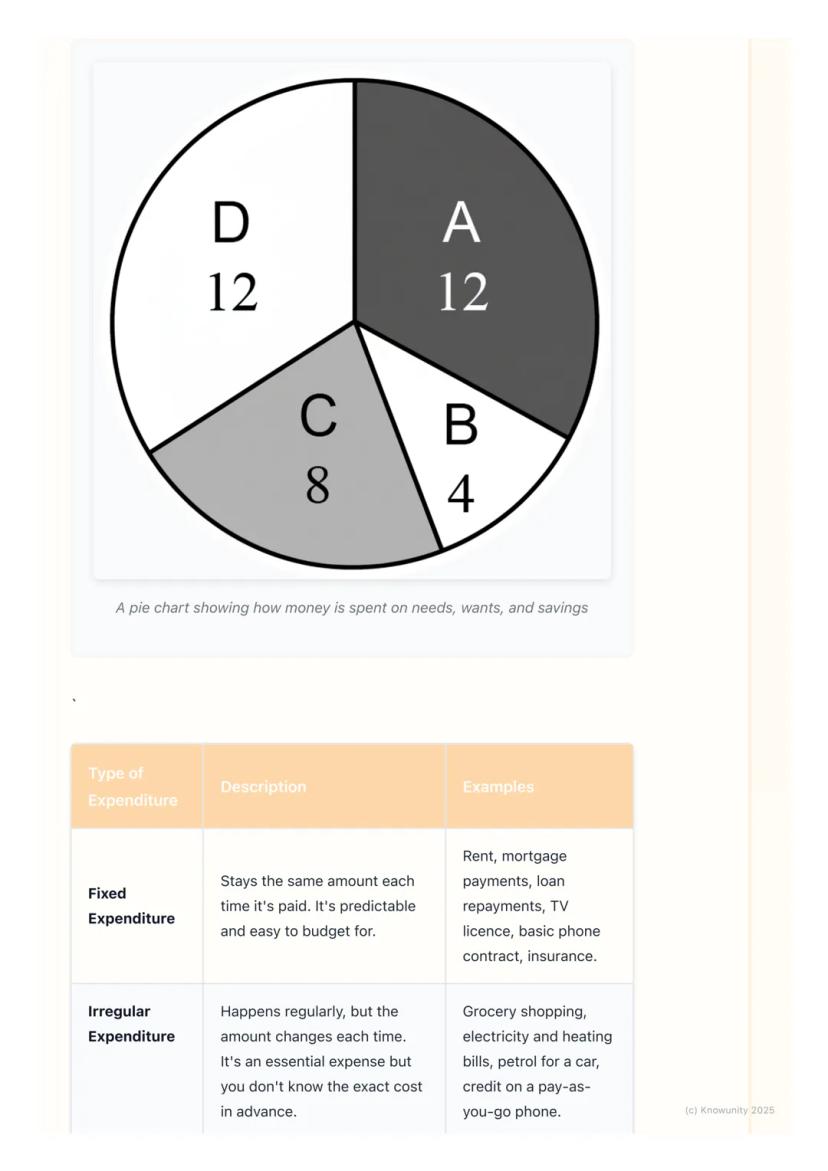
Fixed expenditure stays exactly the same each time you pay it. Think rent, loan repayments, Netflix subscriptions, or your monthly phone contract. These are predictable and easy to budget for because you know exactly what's coming out and when.
Irregular expenditure happens regularly but varies in amount. Your weekly food shop, electricity bills, or petrol costs fall into this category. You know you'll need to spend money on these things, but the exact amount changes each time.
Discretionary expenditure is where you have the most control - this is your "wants" spending. Cinema tickets, eating out, new games, holidays, or designer clothes all fit here. This is the spending you can easily cut back on when money's tight.
Money Management Tip: Track your spending for a week to see where your money actually goes - you might be surprised by how much goes on discretionary purchases!
5
of 6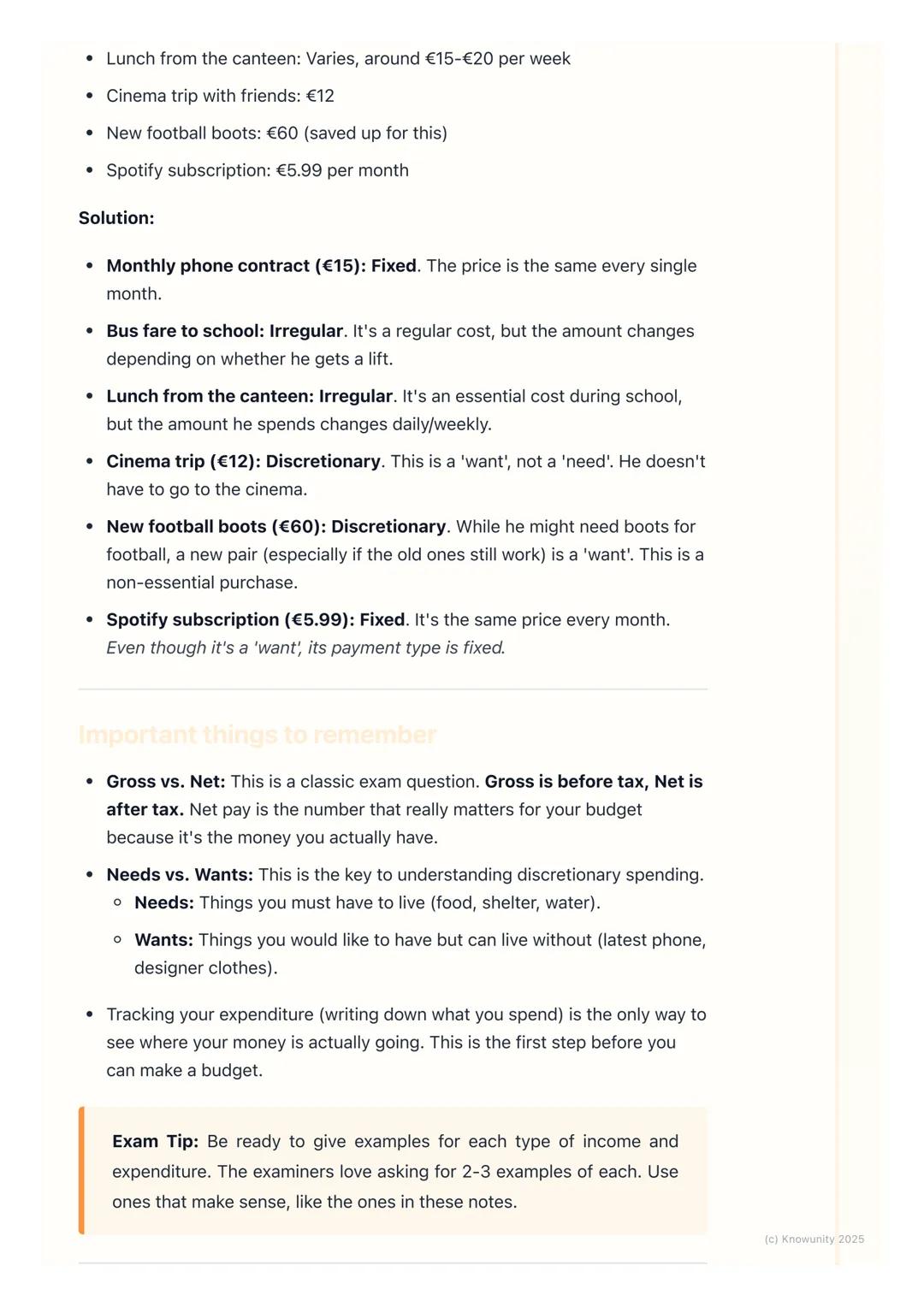
Worked Examples: Putting It All Together
Let's see how this works in practice with some real examples you might face.
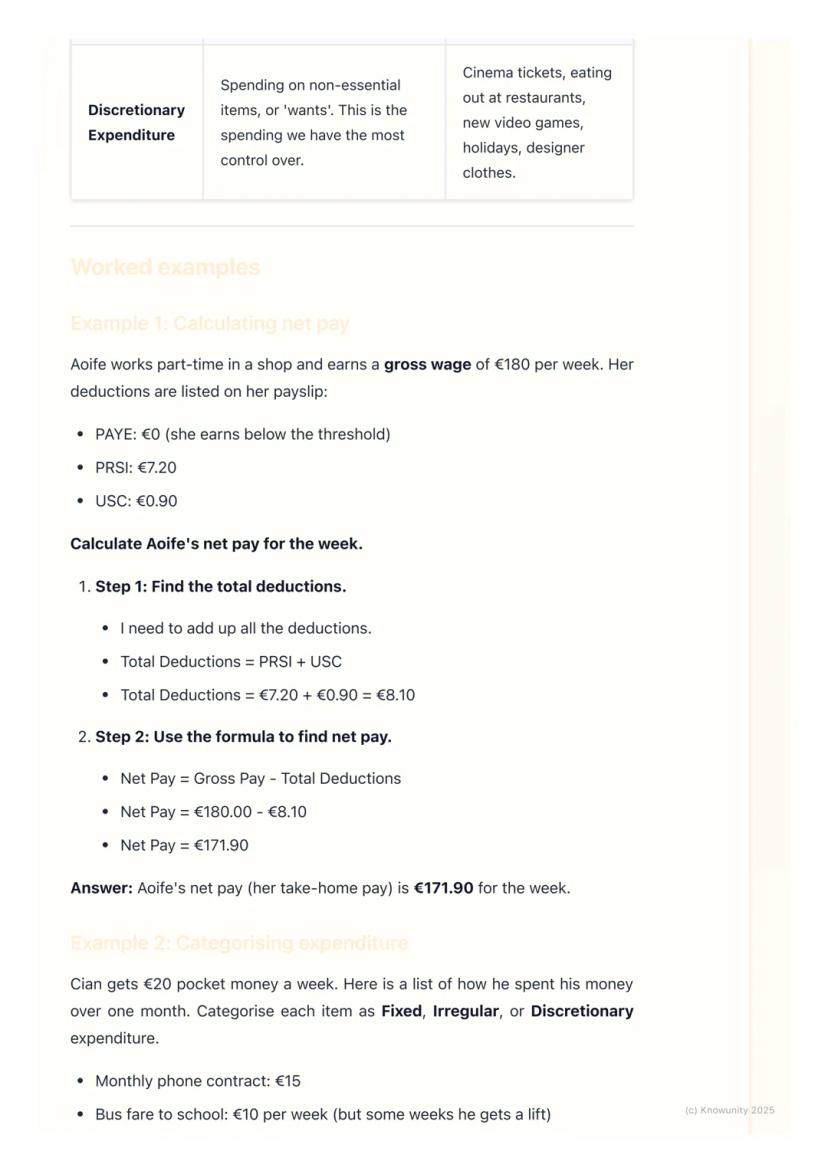
Example 1: Calculating Net Pay Aoife earns €180 gross per week with deductions of €7.20 PRSI and €0.90 USC (no PAYE as she's below the threshold). Her net pay = €180 - €8.10 = €171.90. That's what actually goes into her bank account.
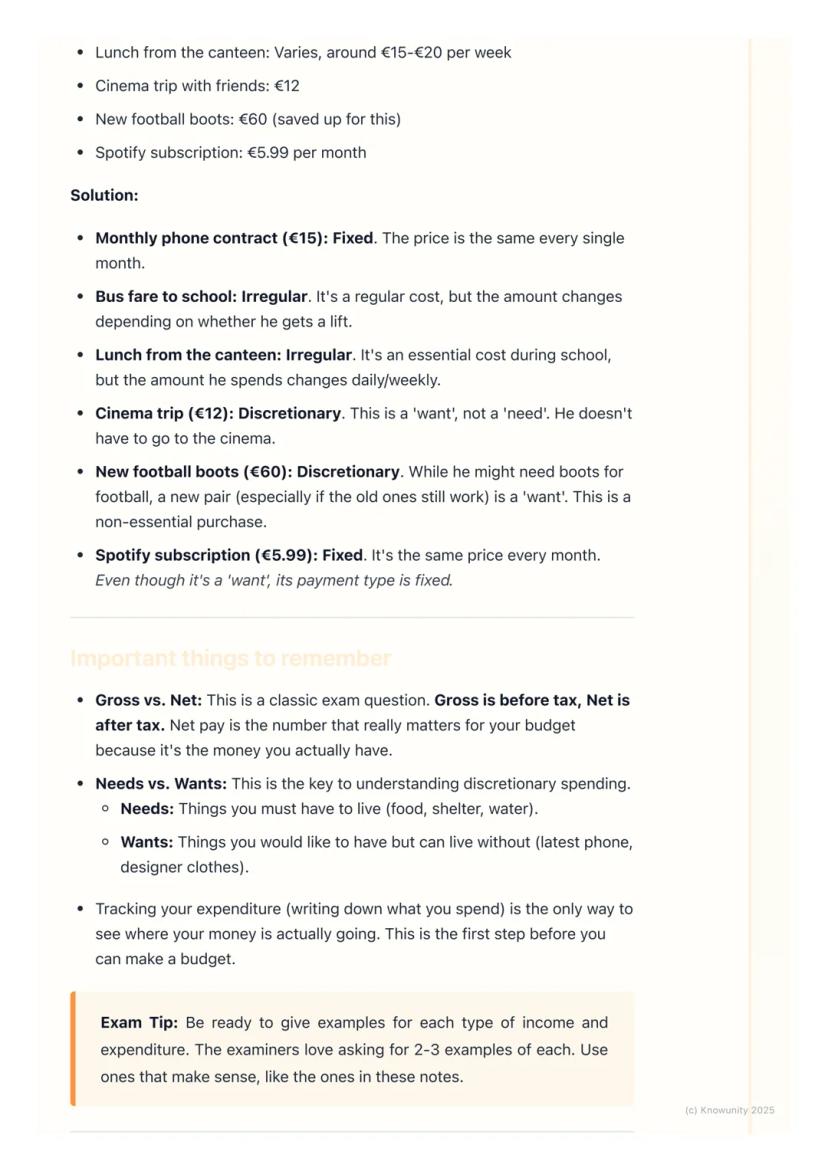
Example 2: Categorising Spending Cian gets €20 weekly pocket money. His monthly phone contract (€15) and Spotify (€5.99) are fixed - same amount every time. His varying bus fares and canteen lunches are irregular - he needs them but the amounts change. His cinema trip (€12) and new football boots (€60) are discretionary - wants rather than needs.
Remember the golden rule: needs vs wants. Needs are things you must have to survive (food, shelter, basic transport). Wants are things that would be nice to have but you could live without (latest trainers, takeaways, concert tickets).
Exam Success: Be ready to give 2-3 examples of each type of income and expenditure - this is a favourite exam question!
6
of 6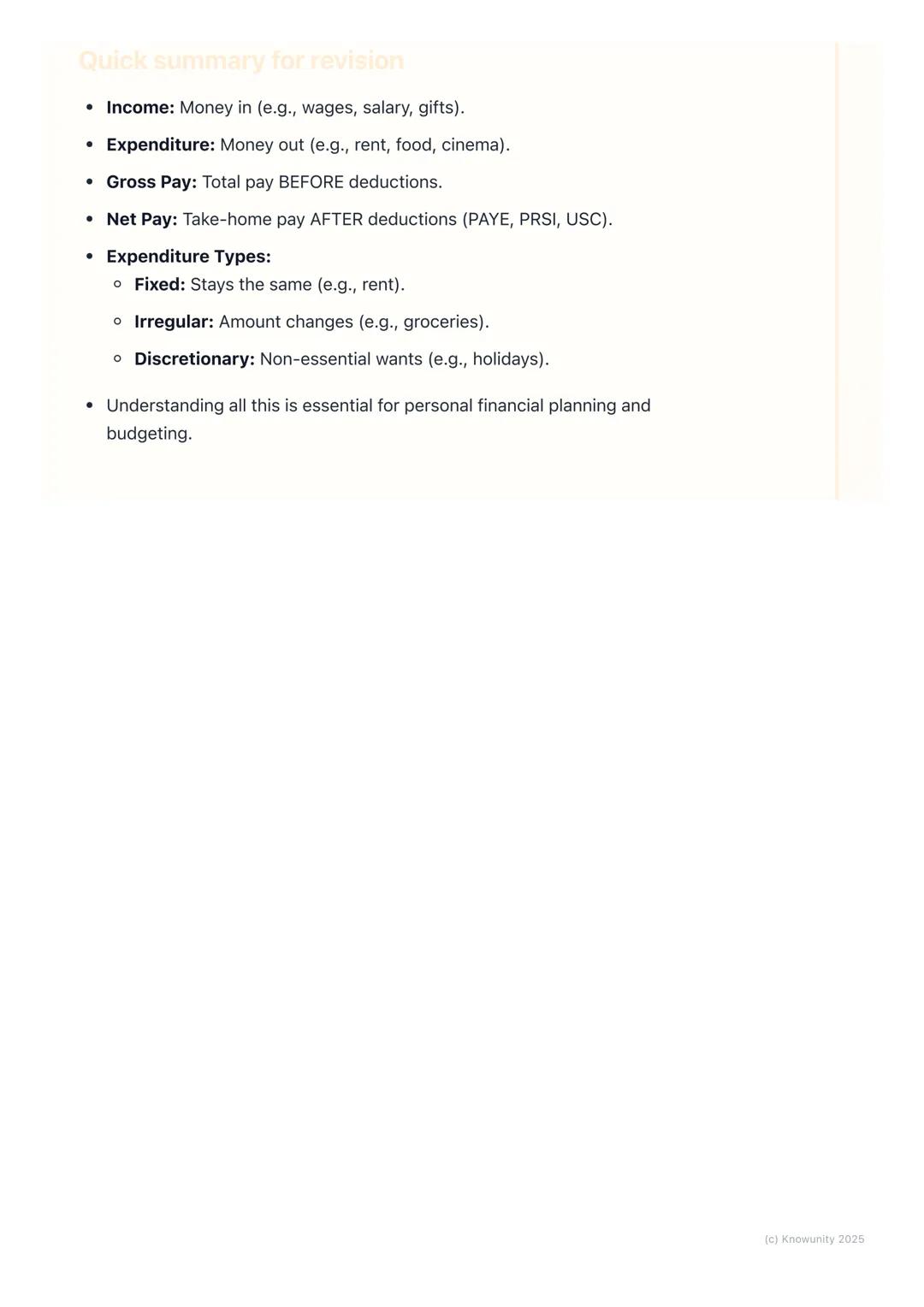
Quick Revision Summary
Here's everything you need to remember for your exams, condensed into bite-sized chunks.
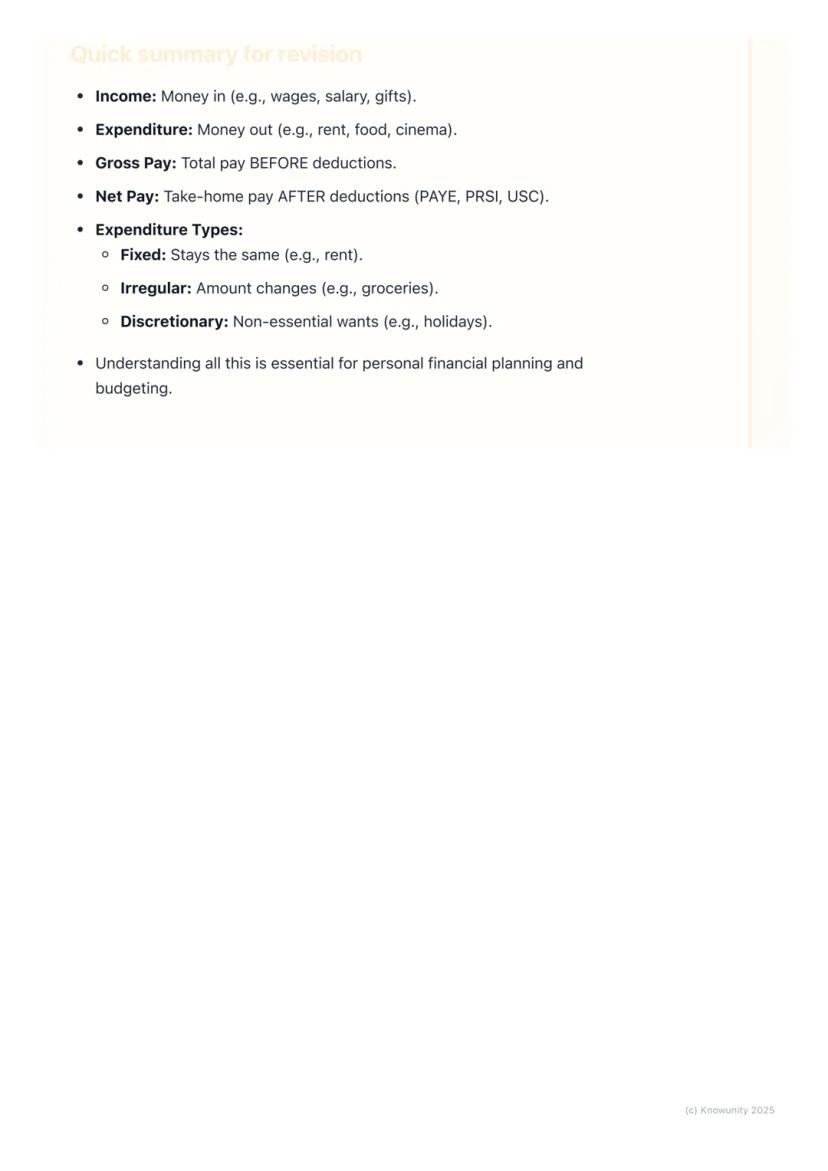
Income: Money coming in from wages, salary, benefits, gifts, or irregular sources like bonuses. Expenditure: Money going out on fixed costs (same amount each time), irregular costs (varies each time), or discretionary spending (wants, not needs).
The Payslip Formula: Net Pay = Gross Pay - Deductions . Your net pay is your actual spending money, not the gross amount advertised in job ads.
Spending Categories: Fixed (rent, subscriptions), Irregular (groceries, bills), Discretionary (entertainment, luxury items). Only discretionary spending gives you real control over your budget.
Understanding these concepts isn't just for passing Business Studies - it's your foundation for making smart money decisions throughout your life. Whether you're planning to save for college, buy a car, or just want to make your pocket money stretch further, these principles will serve you well.
Life Skill Alert: Mastering income and expenditure now sets you up for financial success later - these aren't just exam topics, they're real-life superpowers!
Pensavamo che non l'avreste mai chiesto....
Che cos'è l'assistente AI di Knowunity?
Il nostro assistente AI è costruito specificamente per le esigenze degli studenti. Sulla base dei milioni di contenuti presenti sulla piattaforma, possiamo fornire agli studenti risposte davvero significative e pertinenti. Ma non si tratta solo di risposte, l'assistente è in grado di guidare gli studenti attraverso le loro sfide quotidiane di studio, con piani di studio personalizzati, quiz o contenuti nella chat e una personalizzazione al 100% basata sulle competenze e sugli sviluppi degli studenti.
Dove posso scaricare l'applicazione Knowunity?
È possibile scaricare l'applicazione dal Google Play Store e dall'Apple App Store.
Knowunity è davvero gratuita?
Sì, hai accesso completamente gratuito a tutti i contenuti nell'app e puoi chattare o seguire i Creatori in qualsiasi momento. Sbloccherai nuove funzioni crescendo il tuo numero di follower. Inoltre, offriamo Knowunity Premium, che consente di studiare senza alcun limite!!
Contenuti più popolari di Business Studies
1Contenuti più popolari
9 Irish
IrishIrish oral questions and answers
Questions and answers for the leaving cert oral
5th Year4254
IrishIrish oral questions
Outline of oral questions
5th Year2055
IrishGaeilge Grammar Office
All the basics you need to know on Irish grammar.
6th Year893
 English
Key Quotes : Sive
Key Quotes and explanations: Sive
6th Year2211
IrishAn Gaeilge Aiste
Irish Language essay
6th Year1250
IrishIrish poetry 2027
Iníon + Dínit an Bhróin
5th Year1133
IrishMé Féin & Mo Chlann (Myself & My Family)
Students will learn vocabulary to describe themselves, their family members, and daily routines. This helps in personal introductions and discussions.
TY291
IrishLC HL notes- Iníon (poem)
Includes poem in English and Irish, theme, key words & phrases
5th Year2284
 Geography
Territory, economic activities in Paris basin
essay
6th Year80
Non c'è niente di adatto? Esplorare altre aree tematiche.
Recensioni dei nostri utenti. Ci adorano - e anche tu, vedrai .
4.6/5App Store
4.7/5Google Play
L'applicazione è molto facile da usare e ben progettata. Finora ho trovato tutto quello che cercavo e ho potuto imparare molto dalle presentazioni! Utilizzerò sicuramente l'app per i compiti in classe! È molto utile anche come fonte di ispirazione.
Stefano Sutente iOS
Questa applicazione è davvero grande! Ci sono tantissimi appunti e aiuti con lo studio [...]. La mia materia problematica, per esempio, è il francese e l'app ha così tante opzioni per aiutarmi. Grazie a questa app ho migliorato il mio francese. La consiglio a tutti.
Samantha Klichutente Android
Wow, sono davvero stupita. Ho appena provato l'app perché l'ho vista pubblicizzata molte volte e sono rimasta assolutamente sbalordita. Questa app è L'AIUTO che cercate per la scuola e soprattutto offre tantissime cose, come allenamenti e schede, che a me personalmente sono state MOLTO utili.
Annautente iOS
Business Studies6 visualizzazioni·Aggiornato May 13, 2026·6 pagineUnderstanding Income and Expenses
Ever wondered why your payslip shows different amounts or where all your money actually goes? Understanding income and expenditureis your key to taking control of your finances, whether it's budgeting for that new phone or figuring out how much... Mostra di più
1
of 6Iscriviti per mostrare il contenuto. È gratis!
- Accesso a tutti i documenti
- Migliora i tuoi voti
- Unisciti a milioni di studenti
Income and Expenditure Basics
Money management starts with two simple concepts: money coming in (income) and money going out (expenditure). Think of it like your phone battery - you need to know what's charging it up and what's draining it.
Income is all the money you receive over time, whether that's from your weekend job, birthday money, or government payments. Expenditure (also called expenses) is everything you spend money on - from your weekly shop to that concert ticket you've been eyeing up.
The real game-changer here is understanding the difference between gross pay and net pay. Your gross pay is the big number you see on job adverts - the total amount before any deductions. But here's the reality check: you won't actually get all of that money.
Key Insight: Your net pay = Gross pay - Total deductions. This is the actual amount that hits your bank account and what you need to base your spending on.
2
of 6Iscriviti per mostrare il contenuto. È gratis!
- Accesso a tutti i documenti
- Migliora i tuoi voti
- Unisciti a milioni di studenti
Types of Income: Regular vs Irregular
Your income isn't just about having a job - there are actually loads of different ways money can come your way, and they fall into two main categories.
Regular income is the reliable stuff you can count on. This includes wages , salaries (a fixed yearly amount paid monthly), state benefits like Child Benefit, and pensions for retired folks. You can predict this income, which makes budgeting much easier.
Irregular income is the unpredictable money that's harder to plan around. Think overtime payments, performance bonuses, commission from sales jobs, birthday money, or even lottery winnings. This type of income can be brilliant when it arrives, but you can't rely on it for your essential expenses.
Understanding this difference is crucial because you should only budget based on your regular income. Any irregular income? That's your bonus money for treats or building up your savings.
Smart Tip: Never budget based on irregular income like overtime or bonuses - treat these as extra money for savings or special purchases.
3
of 6Iscriviti per mostrare il contenuto. È gratis!
- Accesso a tutti i documenti
- Migliora i tuoi voti
- Unisciti a milioni di studenti
Understanding Your Payslip Deductions
When you get your first proper payslip, you might be shocked at how much gets taken out before the money reaches you. In Ireland, there are three main deductions you need to know about.
PAYE (Pay As You Earn) is basically income tax - the government's cut of your earnings. PRSI (Pay Related Social Insurance) funds social welfare benefits like unemployment support. USC (Universal Social Charge) is an additional tax on your income.
The good news? If you're earning smaller amounts , you might not pay much tax at all. Many part-time workers pay little to no PAYE because they earn below the tax threshold.
Your disposable income is just another name for your net pay - the money you can actually "dispose of" through spending or saving. But there's also discretionary income, which is what's left after you've covered all your essential needs like food and bills.
Reality Check: Your net pay is always less than your gross pay due to deductions, so always base your spending plans on your take-home amount.
4
of 6Iscriviti per mostrare il contenuto. È gratis!
- Accesso a tutti i documenti
- Migliora i tuoi voti
- Unisciti a milioni di studenti
Types of Expenditure: Fixed, Irregular, and Discretionary
Not all spending is created equal, and understanding the three types of expenditure will transform how you manage money.
Fixed expenditure stays exactly the same each time you pay it. Think rent, loan repayments, Netflix subscriptions, or your monthly phone contract. These are predictable and easy to budget for because you know exactly what's coming out and when.
Irregular expenditure happens regularly but varies in amount. Your weekly food shop, electricity bills, or petrol costs fall into this category. You know you'll need to spend money on these things, but the exact amount changes each time.
Discretionary expenditure is where you have the most control - this is your "wants" spending. Cinema tickets, eating out, new games, holidays, or designer clothes all fit here. This is the spending you can easily cut back on when money's tight.
Money Management Tip: Track your spending for a week to see where your money actually goes - you might be surprised by how much goes on discretionary purchases!
5
of 6Iscriviti per mostrare il contenuto. È gratis!
- Accesso a tutti i documenti
- Migliora i tuoi voti
- Unisciti a milioni di studenti
Worked Examples: Putting It All Together
Let's see how this works in practice with some real examples you might face.
Example 1: Calculating Net Pay Aoife earns €180 gross per week with deductions of €7.20 PRSI and €0.90 USC (no PAYE as she's below the threshold). Her net pay = €180 - €8.10 = €171.90. That's what actually goes into her bank account.
Example 2: Categorising Spending Cian gets €20 weekly pocket money. His monthly phone contract (€15) and Spotify (€5.99) are fixed - same amount every time. His varying bus fares and canteen lunches are irregular - he needs them but the amounts change. His cinema trip (€12) and new football boots (€60) are discretionary - wants rather than needs.
Remember the golden rule: needs vs wants. Needs are things you must have to survive (food, shelter, basic transport). Wants are things that would be nice to have but you could live without (latest trainers, takeaways, concert tickets).
Exam Success: Be ready to give 2-3 examples of each type of income and expenditure - this is a favourite exam question!
6
of 6Iscriviti per mostrare il contenuto. È gratis!
- Accesso a tutti i documenti
- Migliora i tuoi voti
- Unisciti a milioni di studenti
Quick Revision Summary
Here's everything you need to remember for your exams, condensed into bite-sized chunks.
Income: Money coming in from wages, salary, benefits, gifts, or irregular sources like bonuses. Expenditure: Money going out on fixed costs (same amount each time), irregular costs (varies each time), or discretionary spending (wants, not needs).
The Payslip Formula: Net Pay = Gross Pay - Deductions . Your net pay is your actual spending money, not the gross amount advertised in job ads.
Spending Categories: Fixed (rent, subscriptions), Irregular (groceries, bills), Discretionary (entertainment, luxury items). Only discretionary spending gives you real control over your budget.
Understanding these concepts isn't just for passing Business Studies - it's your foundation for making smart money decisions throughout your life. Whether you're planning to save for college, buy a car, or just want to make your pocket money stretch further, these principles will serve you well.
Life Skill Alert: Mastering income and expenditure now sets you up for financial success later - these aren't just exam topics, they're real-life superpowers!
Pensavamo che non l'avreste mai chiesto....
Che cos'è l'assistente AI di Knowunity?
Il nostro assistente AI è costruito specificamente per le esigenze degli studenti. Sulla base dei milioni di contenuti presenti sulla piattaforma, possiamo fornire agli studenti risposte davvero significative e pertinenti. Ma non si tratta solo di risposte, l'assistente è in grado di guidare gli studenti attraverso le loro sfide quotidiane di studio, con piani di studio personalizzati, quiz o contenuti nella chat e una personalizzazione al 100% basata sulle competenze e sugli sviluppi degli studenti.
Dove posso scaricare l'applicazione Knowunity?
È possibile scaricare l'applicazione dal Google Play Store e dall'Apple App Store.
Knowunity è davvero gratuita?
Sì, hai accesso completamente gratuito a tutti i contenuti nell'app e puoi chattare o seguire i Creatori in qualsiasi momento. Sbloccherai nuove funzioni crescendo il tuo numero di follower. Inoltre, offriamo Knowunity Premium, che consente di studiare senza alcun limite!!
Contenuti più popolari di Business Studies
1Contenuti più popolari
9IrishIrish oral questions and answers
Questions and answers for the leaving cert oral
5th Year4254
IrishIrish oral questions
Outline of oral questions
5th Year2055
IrishGaeilge Grammar Office
All the basics you need to know on Irish grammar.
6th Year893
EnglishKey Quotes : Sive
Key Quotes and explanations: Sive
6th Year2211
IrishAn Gaeilge Aiste
Irish Language essay
6th Year1250
IrishIrish poetry 2027
Iníon + Dínit an Bhróin
5th Year1133
IrishMé Féin & Mo Chlann (Myself & My Family)
Students will learn vocabulary to describe themselves, their family members, and daily routines. This helps in personal introductions and discussions.
TY291
IrishLC HL notes- Iníon (poem)
Includes poem in English and Irish, theme, key words & phrases
5th Year2284
GeographyTerritory, economic activities in Paris basin
essay
6th Year80
Non c'è niente di adatto? Esplorare altre aree tematiche.
Recensioni dei nostri utenti. Ci adorano - e anche tu, vedrai .
4.6/5App Store
4.7/5Google Play
L'applicazione è molto facile da usare e ben progettata. Finora ho trovato tutto quello che cercavo e ho potuto imparare molto dalle presentazioni! Utilizzerò sicuramente l'app per i compiti in classe! È molto utile anche come fonte di ispirazione.
Stefano Sutente iOS
Questa applicazione è davvero grande! Ci sono tantissimi appunti e aiuti con lo studio [...]. La mia materia problematica, per esempio, è il francese e l'app ha così tante opzioni per aiutarmi. Grazie a questa app ho migliorato il mio francese. La consiglio a tutti.
Samantha Klichutente Android
Wow, sono davvero stupita. Ho appena provato l'app perché l'ho vista pubblicizzata molte volte e sono rimasta assolutamente sbalordita. Questa app è L'AIUTO che cercate per la scuola e soprattutto offre tantissime cose, come allenamenti e schede, che a me personalmente sono state MOLTO utili.
Annautente iOS