
Ever wondered what connects you to a dolphin but not... Mostra di più
 Biology24 visualizzazioni·Aggiornato Jun 6, 2026·5 pagine
Vertebrates vs. Invertebrates: Understanding Animal Classes
1 / 5
1
of 5
Vertebrates and Invertebrates
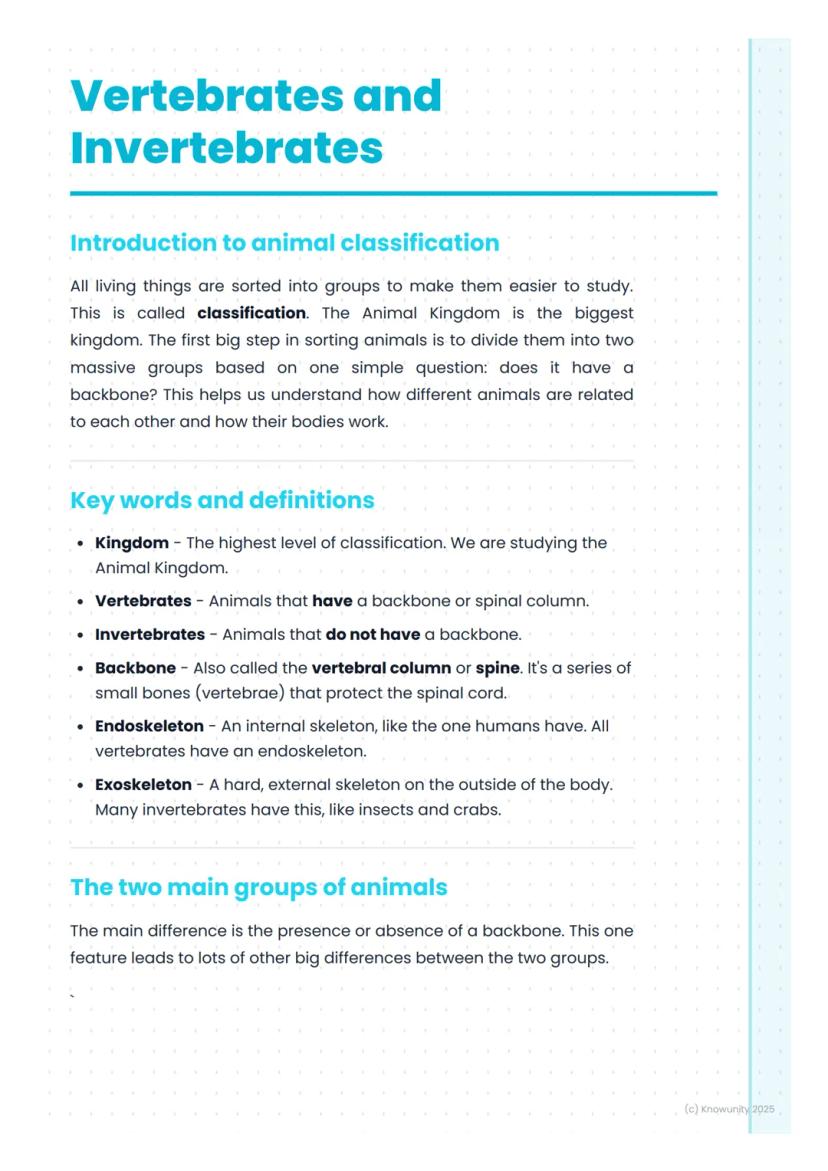
Classification is basically nature's filing system - it helps scientists organise millions of animals into groups that make sense. Think of it like sorting your music playlist, but instead of genres, we're using body structure.
The biggest question in animal classification is dead simple: does it have a backbone or not? This one feature creates two enormous groups that work completely differently. Animals with backbones are called vertebrates, whilst those without are invertebrates.
Your backbone (also called the spine) isn't just one bone - it's actually loads of small bones called vertebrae stacked on top of each other. It's brilliant protection for your spinal cord and gives your body structure. Vertebrates have an endoskeleton (internal skeleton), whilst many invertebrates have an exoskeleton (hard outer shell) or no skeleton at all.
Quick Tip: Don't get fooled by hard shells! A crab's tough exterior is an exoskeleton, not a backbone, so it's still an invertebrate.
2
of 5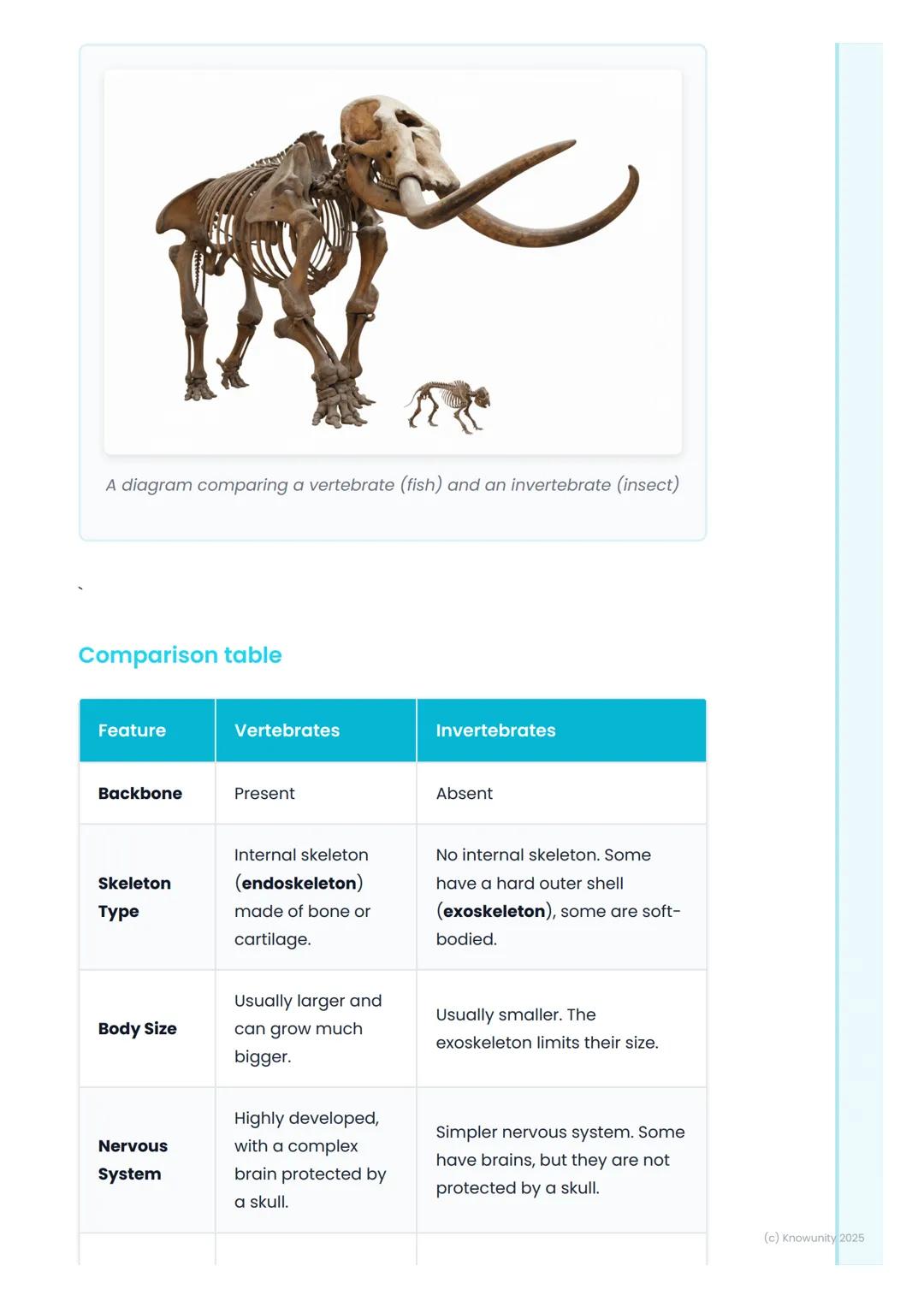
Comparing the Two Groups
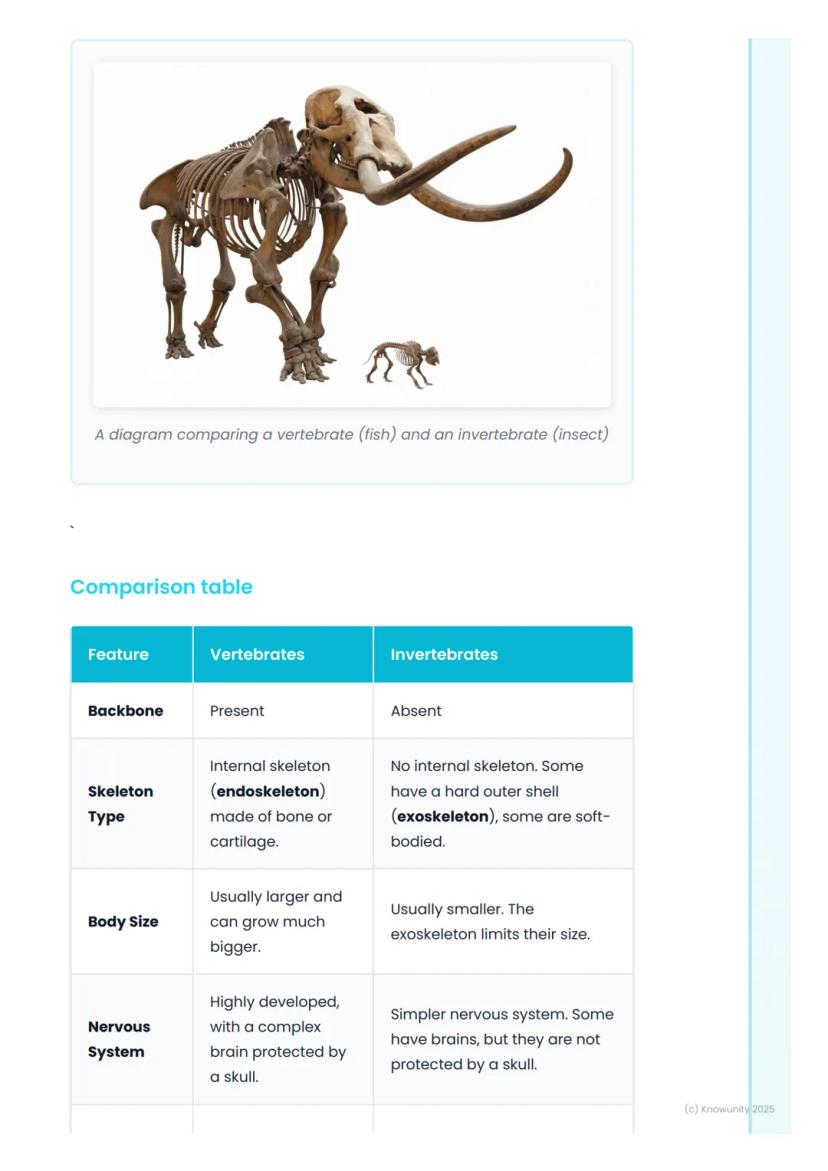
Here's where things get interesting - vertebrates and invertebrates are completely different in how they're built. Vertebrates have internal skeletons made of bone or cartilage, which means they can grow much larger than most invertebrates.
Invertebrates are way more varied - some have exoskeletons (like beetles), some have soft bodies (like worms), and others have shells (like snails). Their nervous systems are simpler too, though some like octopuses are surprisingly clever.
The size difference is huge. Vertebrates can become massive because their internal skeleton grows with them. Invertebrates with exoskeletons are limited because they'd need to shed their "armour" to grow bigger.
Mind-Blowing Fact: Even though we see vertebrates like dogs and birds everywhere, they only make up about 5% of all animal species! Invertebrates dominate at 95%.
3
of 5
Types of Vertebrates and Invertebrates
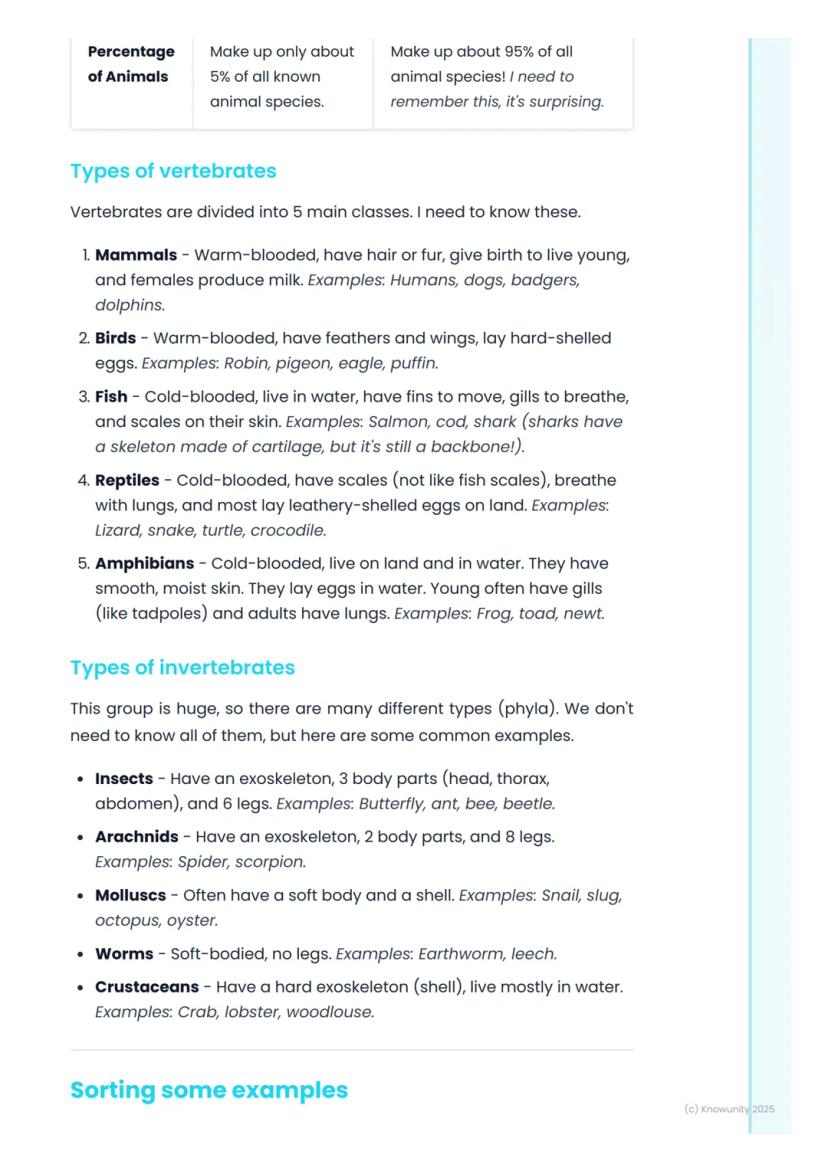
Vertebrates fall into five main classes you need to know. Mammals (like humans and dolphins) are warm-blooded with hair and produce milk. Birds have feathers and lay hard-shelled eggs. Fish live in water with gills and fins - yes, even sharks count because their cartilage skeleton still includes a backbone!
Reptiles are cold-blooded with scales and breathe air, whilst amphibians like frogs live both in water and on land. Each group has adapted brilliantly to their environment.
Invertebrates include insects (6 legs, 3 body parts), arachnids like spiders (8 legs, 2 body parts), molluscs such as snails and octopuses, worms, and crustaceans like crabs. The variety is absolutely mental - from tiny ants to giant squids!
Test Tip: Remember that backbone presence is the ONLY deciding factor. Not legs, wings, or where they live - just that spine!
4
of 5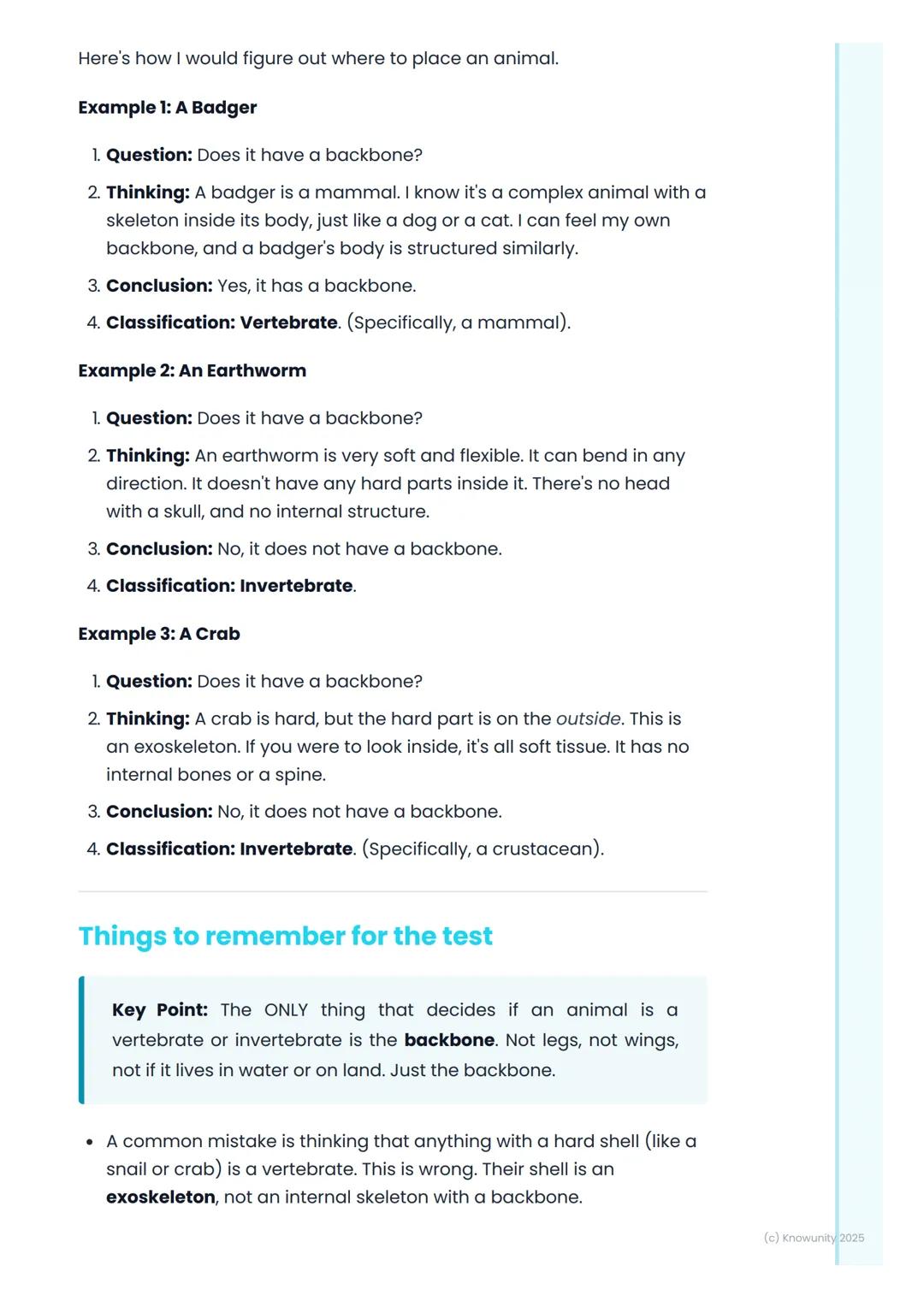
Working Out Classifications
Let's practise with real examples so you'll never get confused in tests. Take a badger - it's furry and walks on land, but most importantly, it has an internal skeleton with a backbone running down its body. Definitely a vertebrate (specifically a mammal).
An earthworm might seem tricky, but think about how bendy and soft it is. No internal hard parts whatsoever, just squishy tissue that can curl in any direction. Clear invertebrate.
Crabs catch loads of people out because they're so hard and tough. But that hardness is all on the outside - crack one open and it's soft inside with no bones. The shell is an exoskeleton, so it's an invertebrate (a crustacean).
Common Mistake Alert: Don't assume anything with a hard exterior is a vertebrate. Shells, exoskeletons, and tough skin don't count as backbones!
5
of 5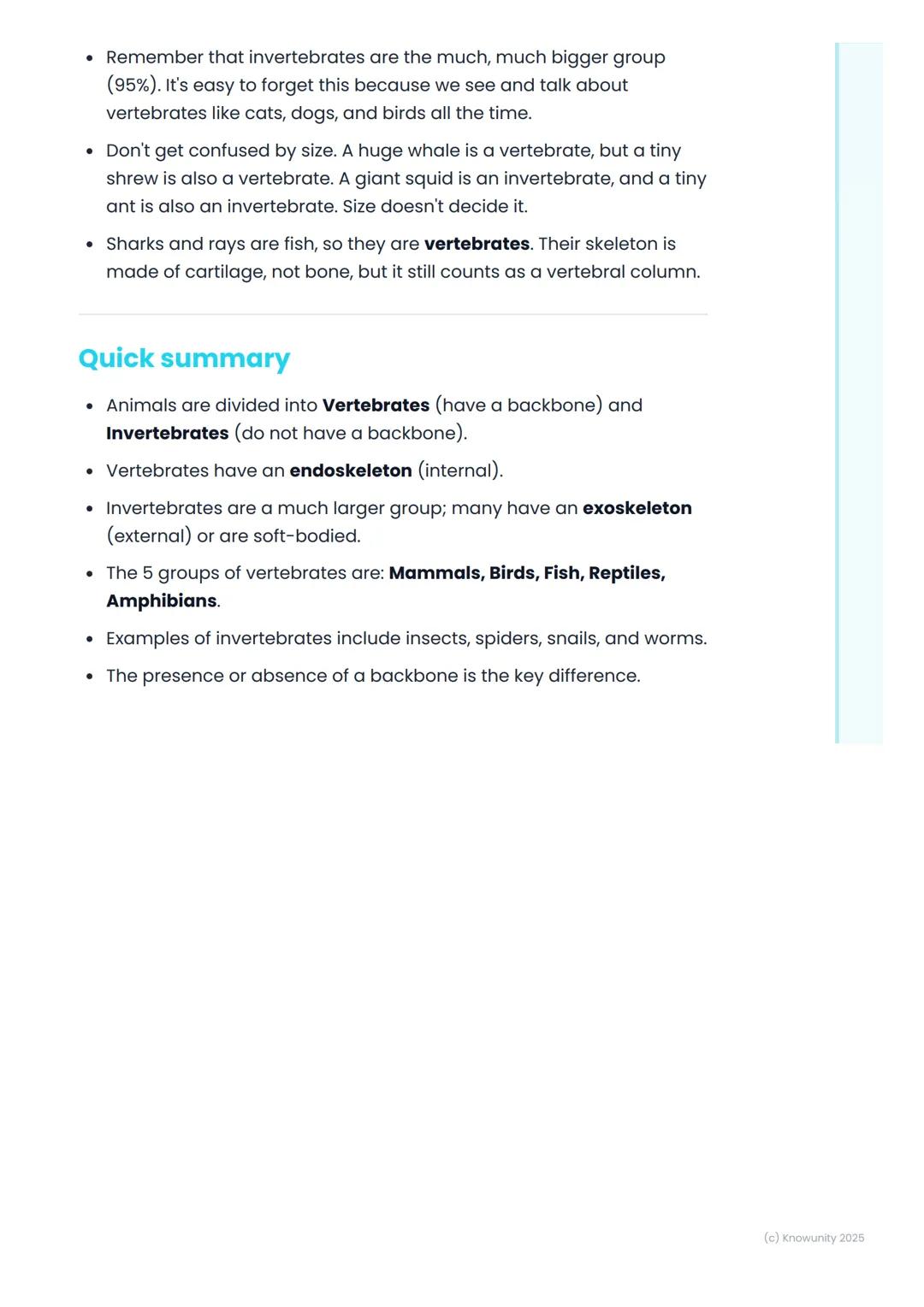
Key Points for Success
Size definitely doesn't matter here - a massive blue whale and a tiny mouse are both vertebrates, whilst a giant squid and a microscopic insect are both invertebrates. The backbone is literally the only thing that counts.
Remember that invertebrates massively outnumber vertebrates in the real world, even though we're more familiar with vertebrates like pets and farm animals. This often surprises people in tests.
Sharks and rays sometimes confuse students because their skeletons are made of cartilage instead of bone. But cartilage still forms a proper backbone structure, so they're definitely vertebrates (fish, specifically).
Final Reminder: When in doubt, imagine the animal's internal structure. Can you picture a spine running through its body? If yes, it's a vertebrate. If it's all soft tissue or has hard parts only on the outside, it's an invertebrate.
Pensavamo che non l'avreste mai chiesto....
Che cos'è l'assistente AI di Knowunity?
Il nostro assistente AI è costruito specificamente per le esigenze degli studenti. Sulla base dei milioni di contenuti presenti sulla piattaforma, possiamo fornire agli studenti risposte davvero significative e pertinenti. Ma non si tratta solo di risposte, l'assistente è in grado di guidare gli studenti attraverso le loro sfide quotidiane di studio, con piani di studio personalizzati, quiz o contenuti nella chat e una personalizzazione al 100% basata sulle competenze e sugli sviluppi degli studenti.
Dove posso scaricare l'applicazione Knowunity?
È possibile scaricare l'applicazione dal Google Play Store e dall'Apple App Store.
Knowunity è davvero gratuita?
Sì, hai accesso completamente gratuito a tutti i contenuti nell'app e puoi chattare o seguire i Creatori in qualsiasi momento. Sbloccherai nuove funzioni crescendo il tuo numero di follower. Inoltre, offriamo Knowunity Premium, che consente di studiare senza alcun limite!!
Contenuti più popolari di Biology
7Contenuti più popolari
9Non c'è niente di adatto? Esplorare altre aree tematiche.
Recensioni dei nostri utenti. Ci adorano - e anche tu, vedrai .
4.6/5App Store
4.7/5Google Play
L'applicazione è molto facile da usare e ben progettata. Finora ho trovato tutto quello che cercavo e ho potuto imparare molto dalle presentazioni! Utilizzerò sicuramente l'app per i compiti in classe! È molto utile anche come fonte di ispirazione.
Stefano Sutente iOS
Questa applicazione è davvero grande! Ci sono tantissimi appunti e aiuti con lo studio [...]. La mia materia problematica, per esempio, è il francese e l'app ha così tante opzioni per aiutarmi. Grazie a questa app ho migliorato il mio francese. La consiglio a tutti.
Samantha Klichutente Android
Wow, sono davvero stupita. Ho appena provato l'app perché l'ho vista pubblicizzata molte volte e sono rimasta assolutamente sbalordita. Questa app è L'AIUTO che cercate per la scuola e soprattutto offre tantissime cose, come allenamenti e schede, che a me personalmente sono state MOLTO utili.
Annautente iOS
Biology24 visualizzazioni·Aggiornato Jun 6, 2026·5 pagineVertebrates vs. Invertebrates: Understanding Animal Classes
Ever wondered what connects you to a dolphin but not to a spider? It's all about having a backbone! Scientists sort the entire Animal Kingdom into two massive groups based on this one simple feature, and understanding this helps us... Mostra di più
1
of 5Iscriviti per mostrare il contenuto. È gratis!
- Accesso a tutti i documenti
- Migliora i tuoi voti
- Unisciti a milioni di studenti
Vertebrates and Invertebrates
Classification is basically nature's filing system - it helps scientists organise millions of animals into groups that make sense. Think of it like sorting your music playlist, but instead of genres, we're using body structure.
The biggest question in animal classification is dead simple: does it have a backbone or not? This one feature creates two enormous groups that work completely differently. Animals with backbones are called vertebrates, whilst those without are invertebrates.
Your backbone (also called the spine) isn't just one bone - it's actually loads of small bones called vertebrae stacked on top of each other. It's brilliant protection for your spinal cord and gives your body structure. Vertebrates have an endoskeleton (internal skeleton), whilst many invertebrates have an exoskeleton (hard outer shell) or no skeleton at all.
Quick Tip: Don't get fooled by hard shells! A crab's tough exterior is an exoskeleton, not a backbone, so it's still an invertebrate.
2
of 5Iscriviti per mostrare il contenuto. È gratis!
- Accesso a tutti i documenti
- Migliora i tuoi voti
- Unisciti a milioni di studenti
Comparing the Two Groups
Here's where things get interesting - vertebrates and invertebrates are completely different in how they're built. Vertebrates have internal skeletons made of bone or cartilage, which means they can grow much larger than most invertebrates.
Invertebrates are way more varied - some have exoskeletons (like beetles), some have soft bodies (like worms), and others have shells (like snails). Their nervous systems are simpler too, though some like octopuses are surprisingly clever.
The size difference is huge. Vertebrates can become massive because their internal skeleton grows with them. Invertebrates with exoskeletons are limited because they'd need to shed their "armour" to grow bigger.
Mind-Blowing Fact: Even though we see vertebrates like dogs and birds everywhere, they only make up about 5% of all animal species! Invertebrates dominate at 95%.
3
of 5Iscriviti per mostrare il contenuto. È gratis!
- Accesso a tutti i documenti
- Migliora i tuoi voti
- Unisciti a milioni di studenti
Types of Vertebrates and Invertebrates
Vertebrates fall into five main classes you need to know. Mammals (like humans and dolphins) are warm-blooded with hair and produce milk. Birds have feathers and lay hard-shelled eggs. Fish live in water with gills and fins - yes, even sharks count because their cartilage skeleton still includes a backbone!
Reptiles are cold-blooded with scales and breathe air, whilst amphibians like frogs live both in water and on land. Each group has adapted brilliantly to their environment.
Invertebrates include insects (6 legs, 3 body parts), arachnids like spiders (8 legs, 2 body parts), molluscs such as snails and octopuses, worms, and crustaceans like crabs. The variety is absolutely mental - from tiny ants to giant squids!
Test Tip: Remember that backbone presence is the ONLY deciding factor. Not legs, wings, or where they live - just that spine!
4
of 5Iscriviti per mostrare il contenuto. È gratis!
- Accesso a tutti i documenti
- Migliora i tuoi voti
- Unisciti a milioni di studenti
Working Out Classifications
Let's practise with real examples so you'll never get confused in tests. Take a badger - it's furry and walks on land, but most importantly, it has an internal skeleton with a backbone running down its body. Definitely a vertebrate (specifically a mammal).
An earthworm might seem tricky, but think about how bendy and soft it is. No internal hard parts whatsoever, just squishy tissue that can curl in any direction. Clear invertebrate.
Crabs catch loads of people out because they're so hard and tough. But that hardness is all on the outside - crack one open and it's soft inside with no bones. The shell is an exoskeleton, so it's an invertebrate (a crustacean).
Common Mistake Alert: Don't assume anything with a hard exterior is a vertebrate. Shells, exoskeletons, and tough skin don't count as backbones!
5
of 5Iscriviti per mostrare il contenuto. È gratis!
- Accesso a tutti i documenti
- Migliora i tuoi voti
- Unisciti a milioni di studenti
Key Points for Success
Size definitely doesn't matter here - a massive blue whale and a tiny mouse are both vertebrates, whilst a giant squid and a microscopic insect are both invertebrates. The backbone is literally the only thing that counts.
Remember that invertebrates massively outnumber vertebrates in the real world, even though we're more familiar with vertebrates like pets and farm animals. This often surprises people in tests.
Sharks and rays sometimes confuse students because their skeletons are made of cartilage instead of bone. But cartilage still forms a proper backbone structure, so they're definitely vertebrates (fish, specifically).
Final Reminder: When in doubt, imagine the animal's internal structure. Can you picture a spine running through its body? If yes, it's a vertebrate. If it's all soft tissue or has hard parts only on the outside, it's an invertebrate.
Pensavamo che non l'avreste mai chiesto....
Che cos'è l'assistente AI di Knowunity?
Il nostro assistente AI è costruito specificamente per le esigenze degli studenti. Sulla base dei milioni di contenuti presenti sulla piattaforma, possiamo fornire agli studenti risposte davvero significative e pertinenti. Ma non si tratta solo di risposte, l'assistente è in grado di guidare gli studenti attraverso le loro sfide quotidiane di studio, con piani di studio personalizzati, quiz o contenuti nella chat e una personalizzazione al 100% basata sulle competenze e sugli sviluppi degli studenti.
Dove posso scaricare l'applicazione Knowunity?
È possibile scaricare l'applicazione dal Google Play Store e dall'Apple App Store.
Knowunity è davvero gratuita?
Sì, hai accesso completamente gratuito a tutti i contenuti nell'app e puoi chattare o seguire i Creatori in qualsiasi momento. Sbloccherai nuove funzioni crescendo il tuo numero di follower. Inoltre, offriamo Knowunity Premium, che consente di studiare senza alcun limite!!
Contenuti più popolari di Biology
7Contenuti più popolari
9Non c'è niente di adatto? Esplorare altre aree tematiche.
Recensioni dei nostri utenti. Ci adorano - e anche tu, vedrai .
4.6/5App Store
4.7/5Google Play
L'applicazione è molto facile da usare e ben progettata. Finora ho trovato tutto quello che cercavo e ho potuto imparare molto dalle presentazioni! Utilizzerò sicuramente l'app per i compiti in classe! È molto utile anche come fonte di ispirazione.
Stefano Sutente iOS
Questa applicazione è davvero grande! Ci sono tantissimi appunti e aiuti con lo studio [...]. La mia materia problematica, per esempio, è il francese e l'app ha così tante opzioni per aiutarmi. Grazie a questa app ho migliorato il mio francese. La consiglio a tutti.
Samantha Klichutente Android
Wow, sono davvero stupita. Ho appena provato l'app perché l'ho vista pubblicizzata molte volte e sono rimasta assolutamente sbalordita. Questa app è L'AIUTO che cercate per la scuola e soprattutto offre tantissime cose, come allenamenti e schede, che a me personalmente sono state MOLTO utili.
Annautente iOS