
Think of your circulatory system as the ultimate delivery service...
 Biology14 visualizzazioni·Aggiornato Jun 5, 2026·8 pagine
Understanding the Human Circulatory System

1 / 8
1
of 8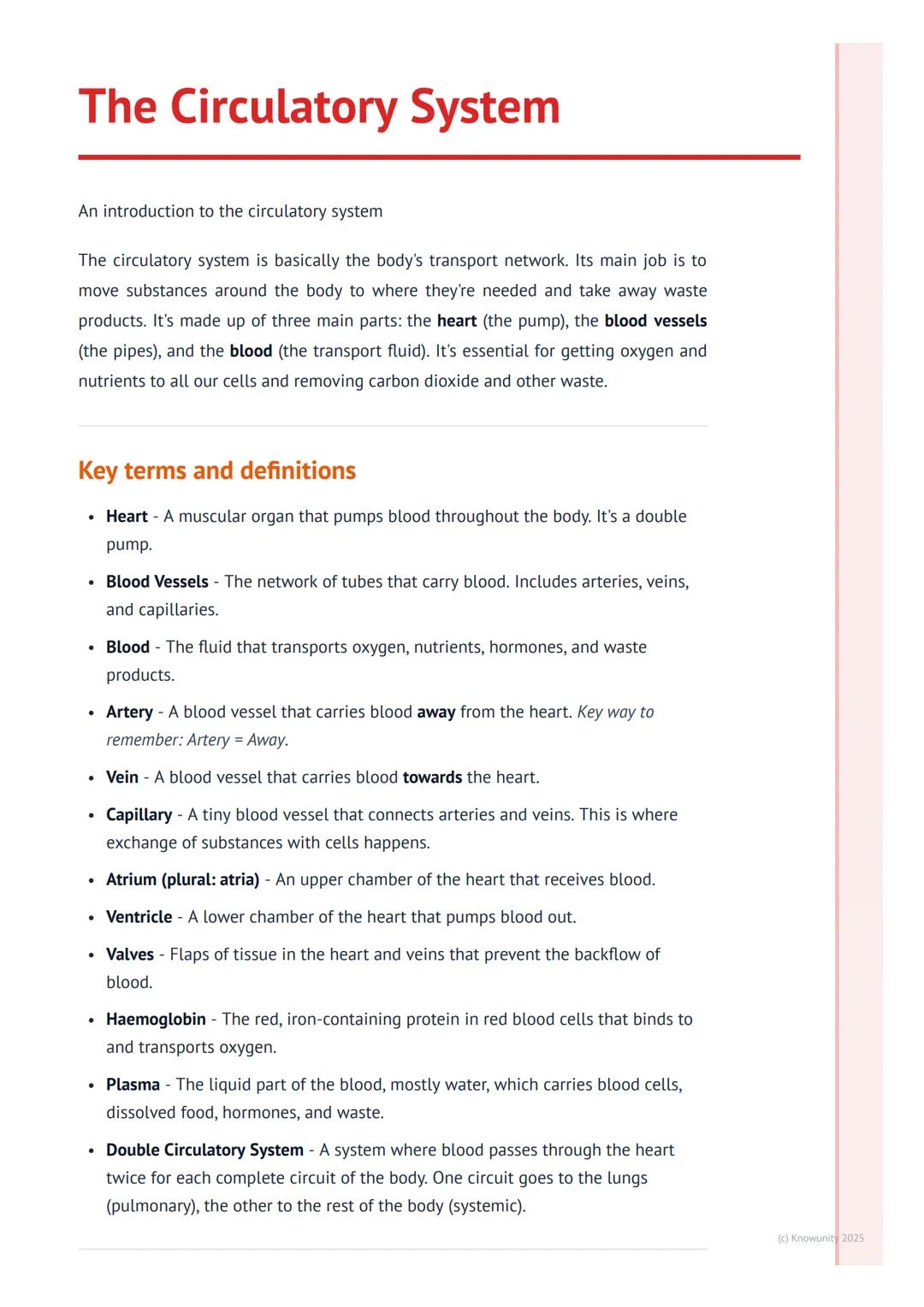
The Circulatory System Basics
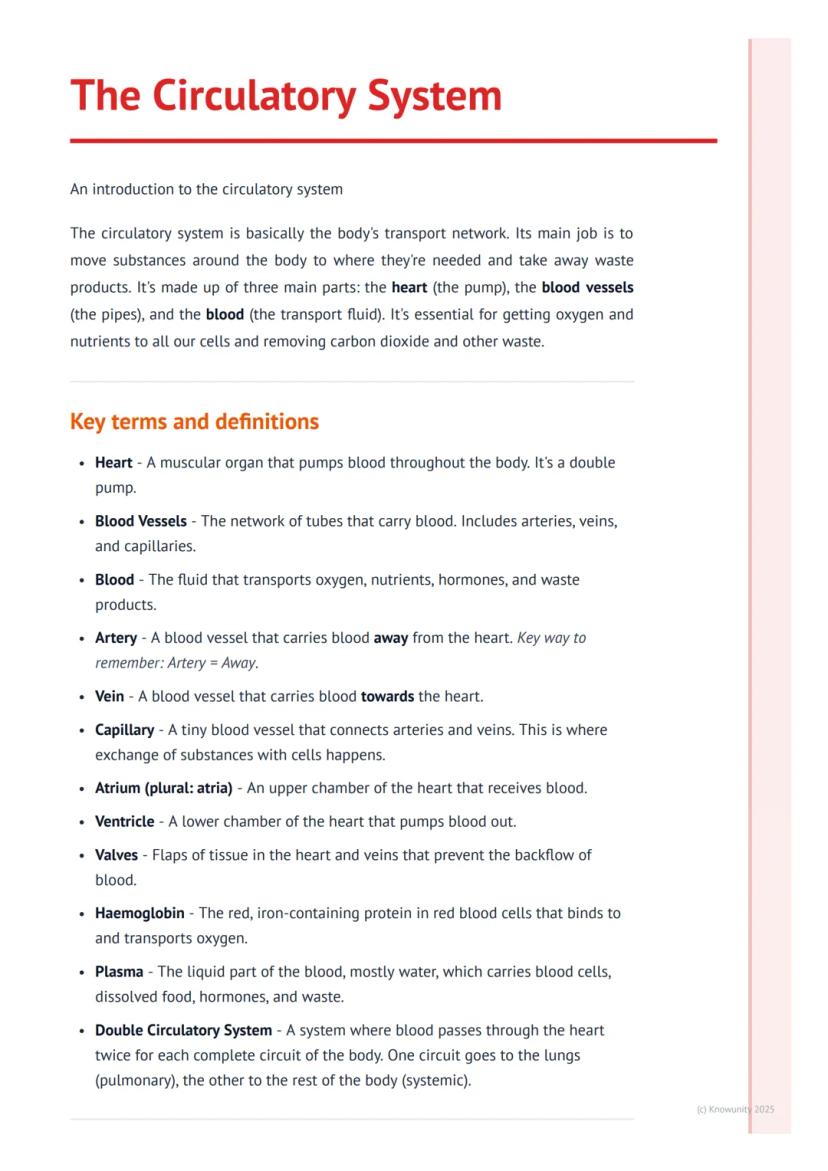
Your circulatory system is basically your body's motorway network, except instead of cars, it's moving blood packed with essential supplies. The system has three main components working together: the heart (your powerful pump), blood vessels (the roads), and blood (the delivery trucks).
Understanding the key players is crucial for your exams. Arteries always carry blood away from the heart , whilst veins bring blood back towards the heart. The tiny capillaries are where all the real action happens - they're so narrow that substances can easily hop between your blood and cells.
Your heart isn't just one pump - it's actually a double pump with four chambers. The upper chambers (atria) receive blood, whilst the lower chambers (ventricles) do the heavy lifting of pumping blood out. Valves act like one-way doors, making sure blood flows in the right direction and doesn't slosh backwards.
Quick Memory Trick: That "lub-dub" heartbeat sound? That's your valves snapping shut - "lub" is the valves between chambers closing, "dub" is the valves in your major arteries closing.
2
of 8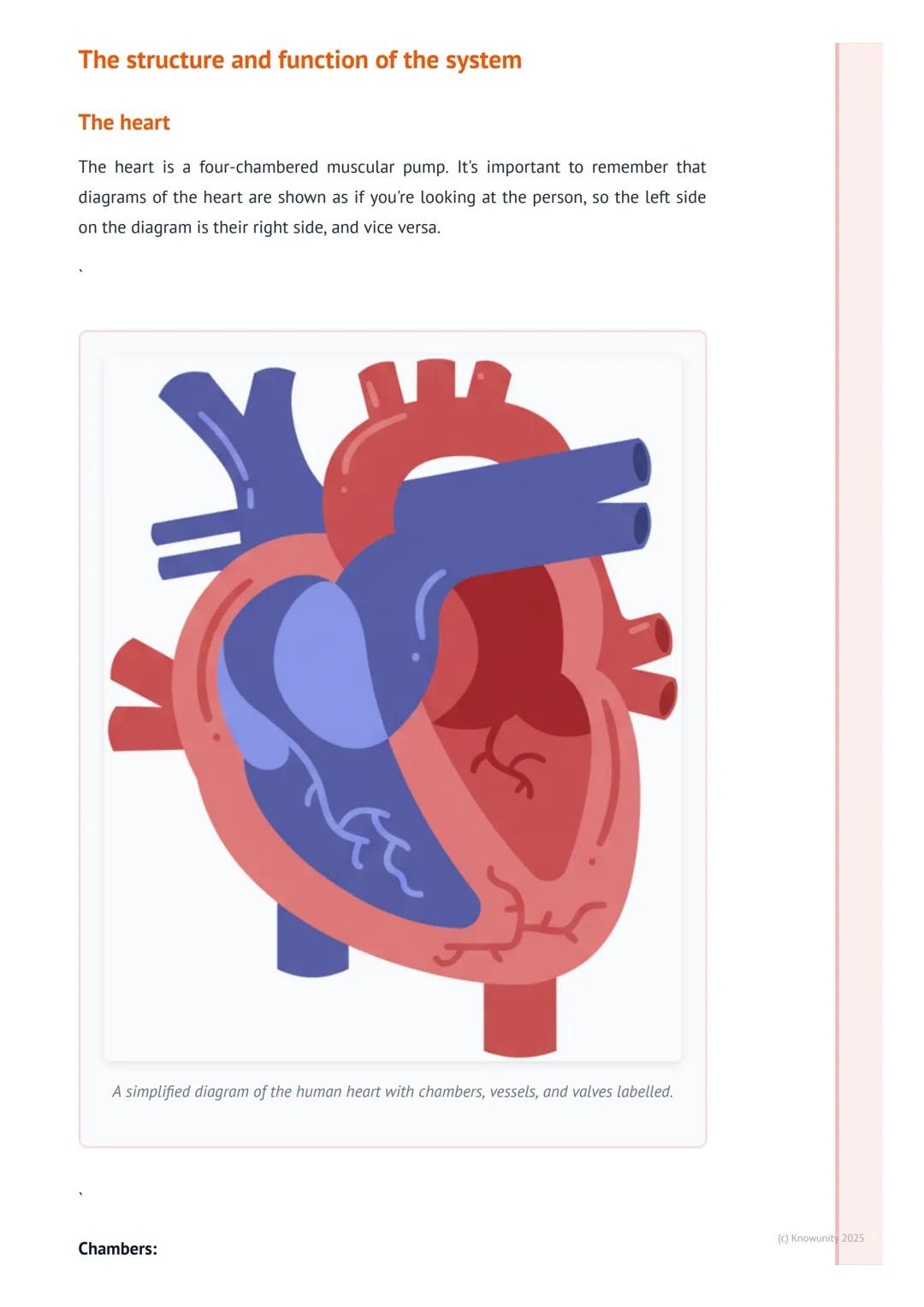
Heart Structure and Function
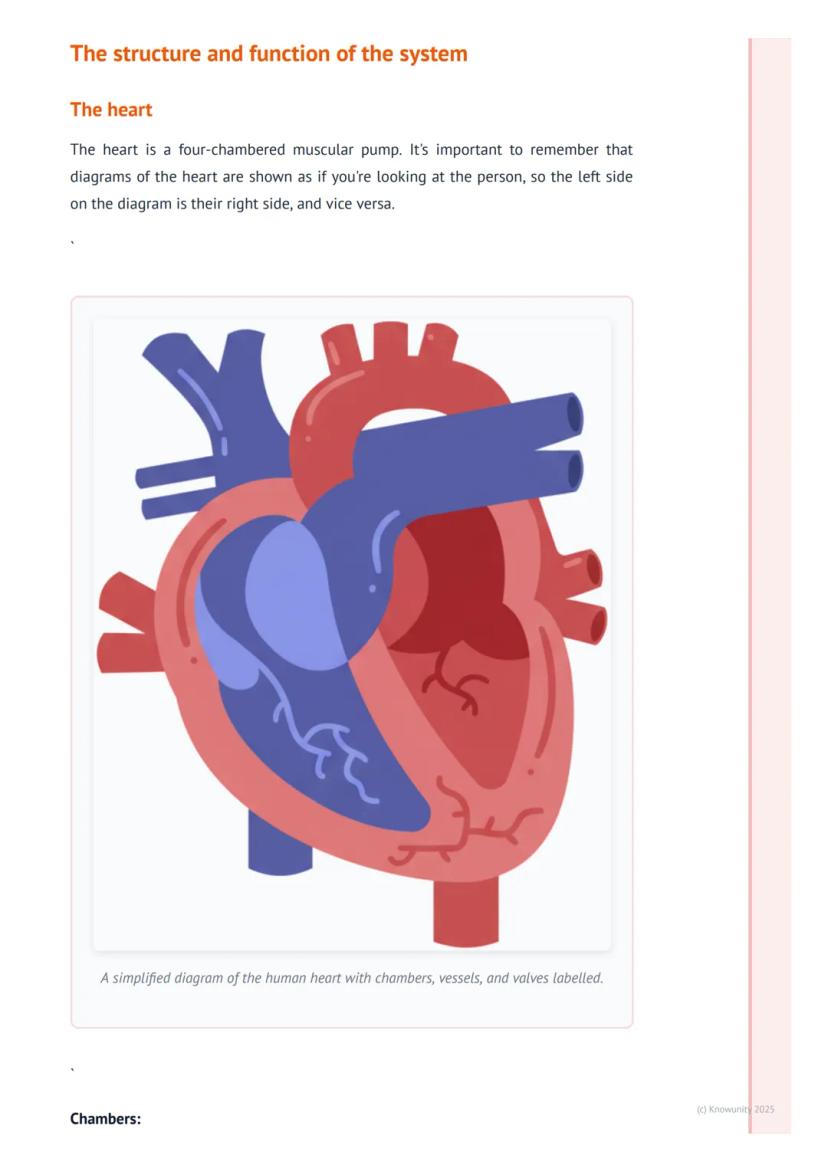
Here's something that trips up loads of students - when you're looking at a heart diagram, remember you're seeing it from the person's perspective, so their left is on your right! The heart's four chambers each have specific jobs that you need to know.
The right atrium collects deoxygenated blood returning from your body, whilst the right ventricle pumps this blood to your lungs for a fresh oxygen supply. Meanwhile, the left atrium receives the newly oxygenated blood from your lungs, and the powerful left ventricle pumps it out to your entire body.
Notice how the left ventricle has much thicker walls than the right? That's because it needs serious muscle power to pump blood all the way to your toes, whilst the right ventricle only needs to send blood to your nearby lungs.
Exam Tip: The thick left ventricle wall is a classic structure-function relationship question - always link the extra muscle to the job of pumping blood around the entire body!
3
of 8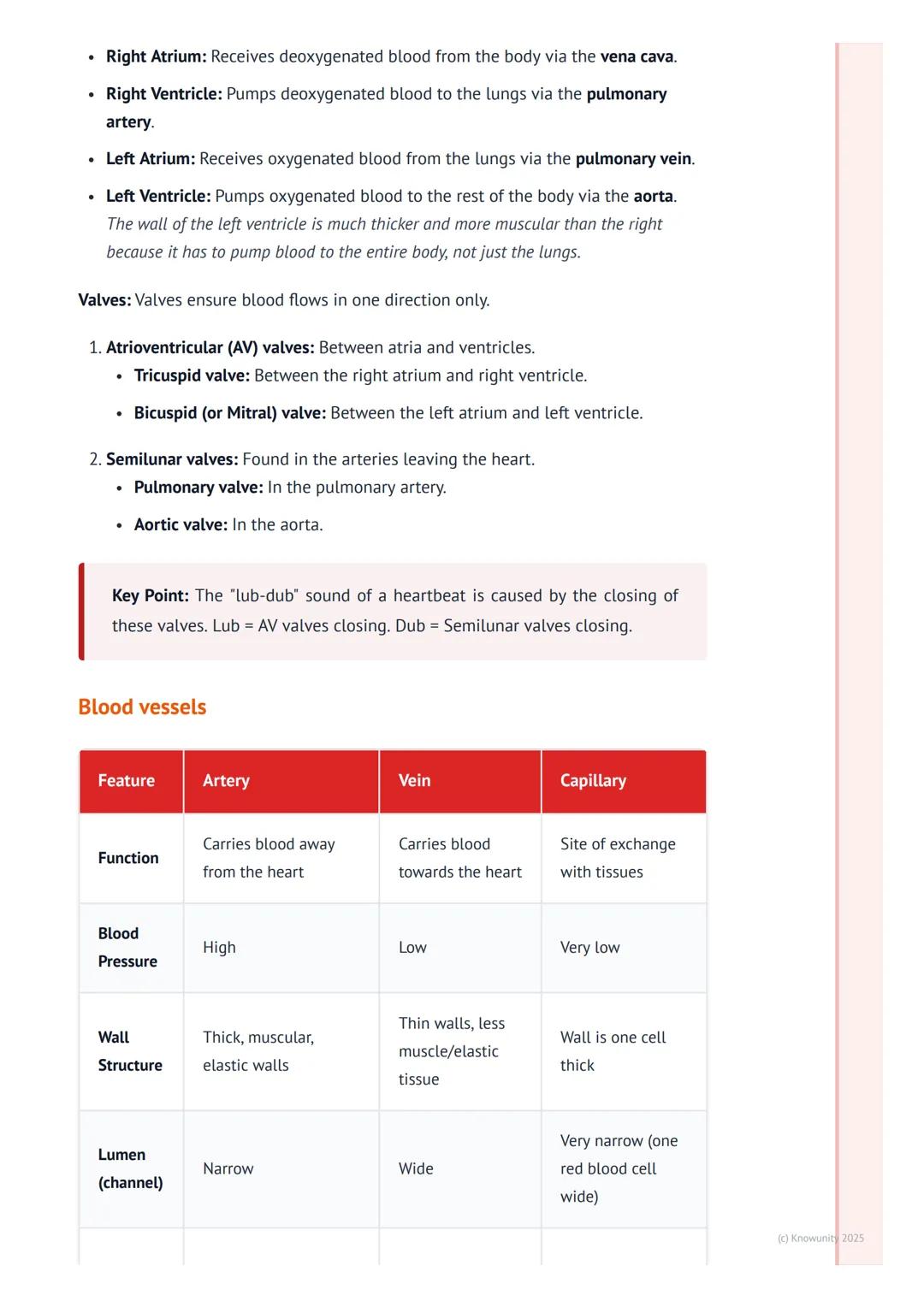
Blood Vessels - The Transport Network
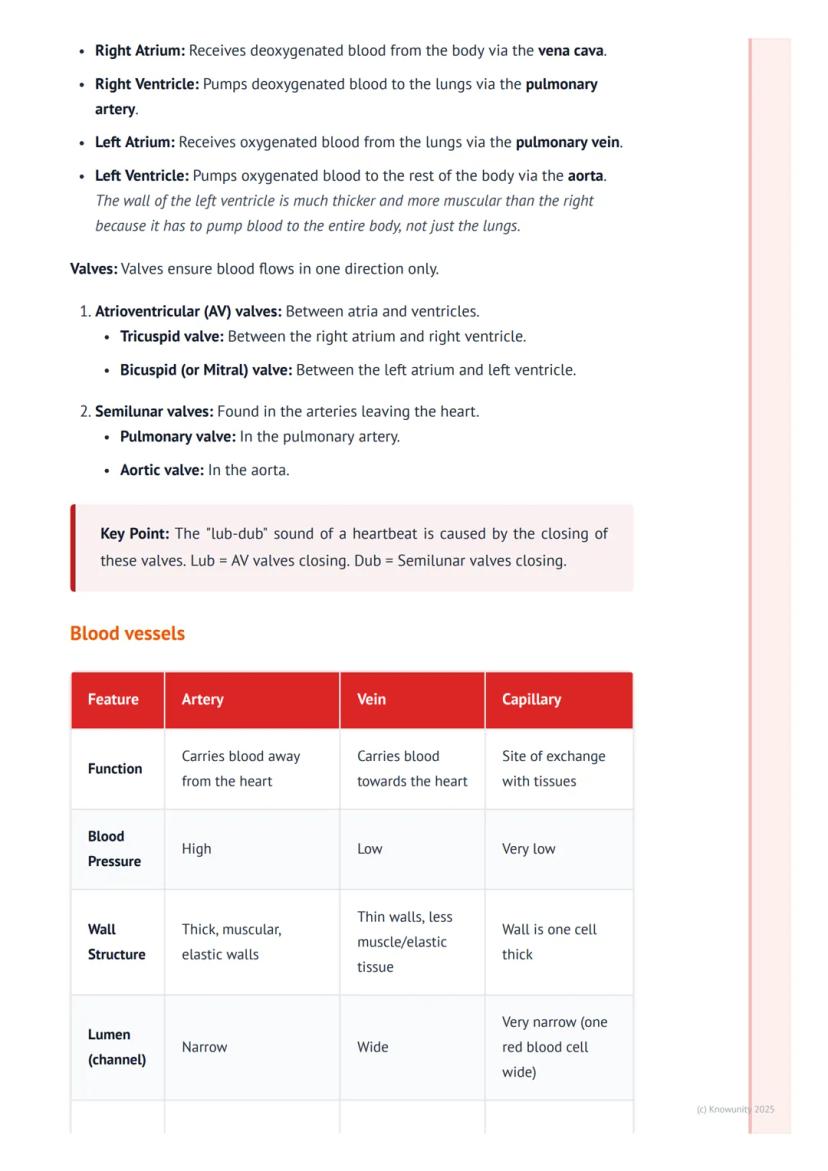
Each type of blood vessel is perfectly designed for its job, and these differences come up constantly in exams. Arteries handle the high-pressure job of carrying blood away from your heart, so they've got thick, muscular walls and narrow channels to keep that pressure up.
Veins have the opposite challenge - they're bringing blood back to your heart against gravity (especially from your legs), but the pressure is much lower. That's why they have thin walls, wide channels, and crucially, valves to stop blood flowing backwards.
Capillaries are the stars of the show for actual substance exchange. Their walls are literally one cell thick - imagine cling film - so oxygen, nutrients, and waste can easily pass through. They're so narrow that red blood cells have to squeeze through single file!
Remember: Don't fall into the trap of saying "arteries carry oxygenated blood" - the pulmonary artery carries deoxygenated blood to the lungs, breaking this rule!
4
of 8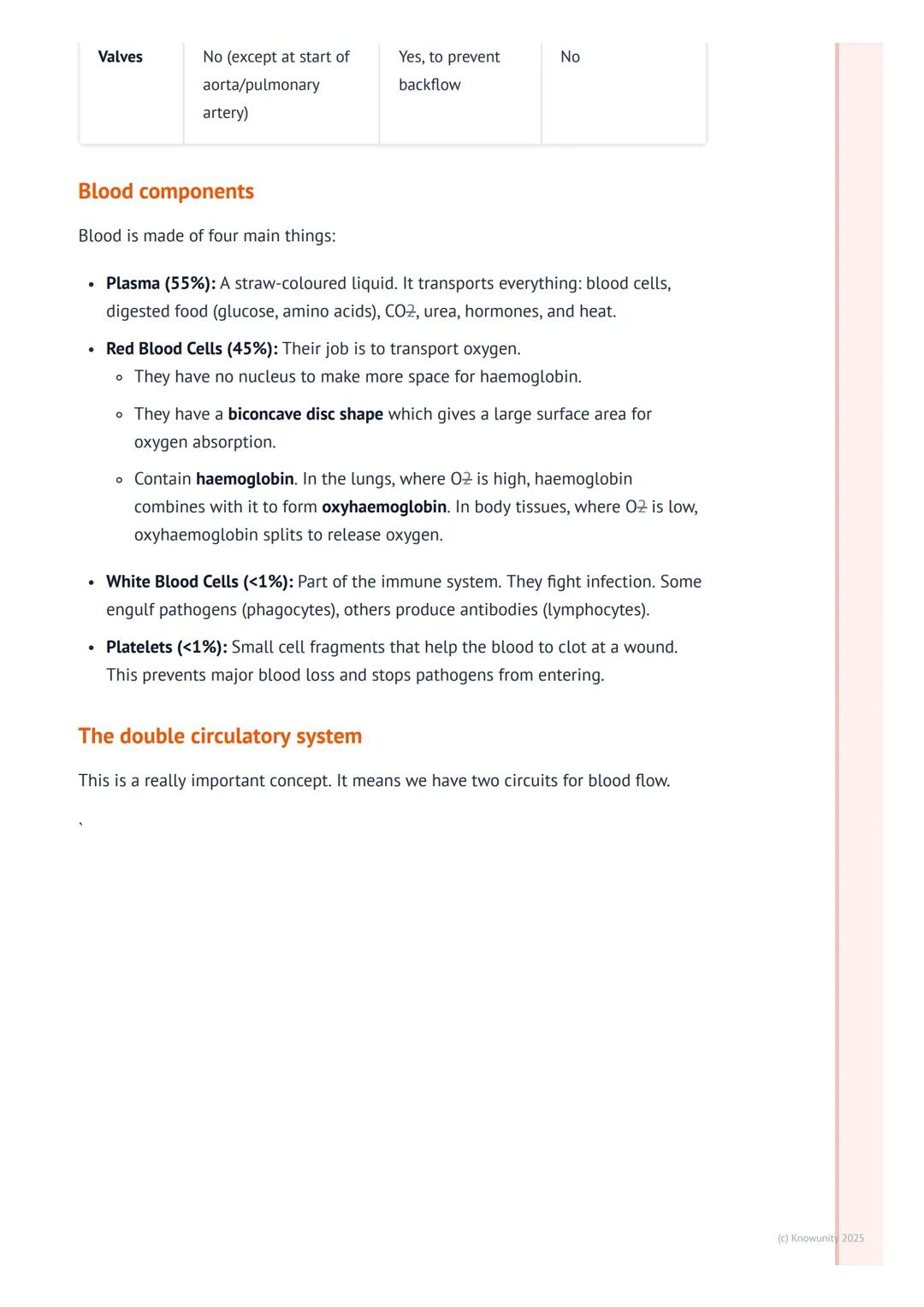
Blood Components
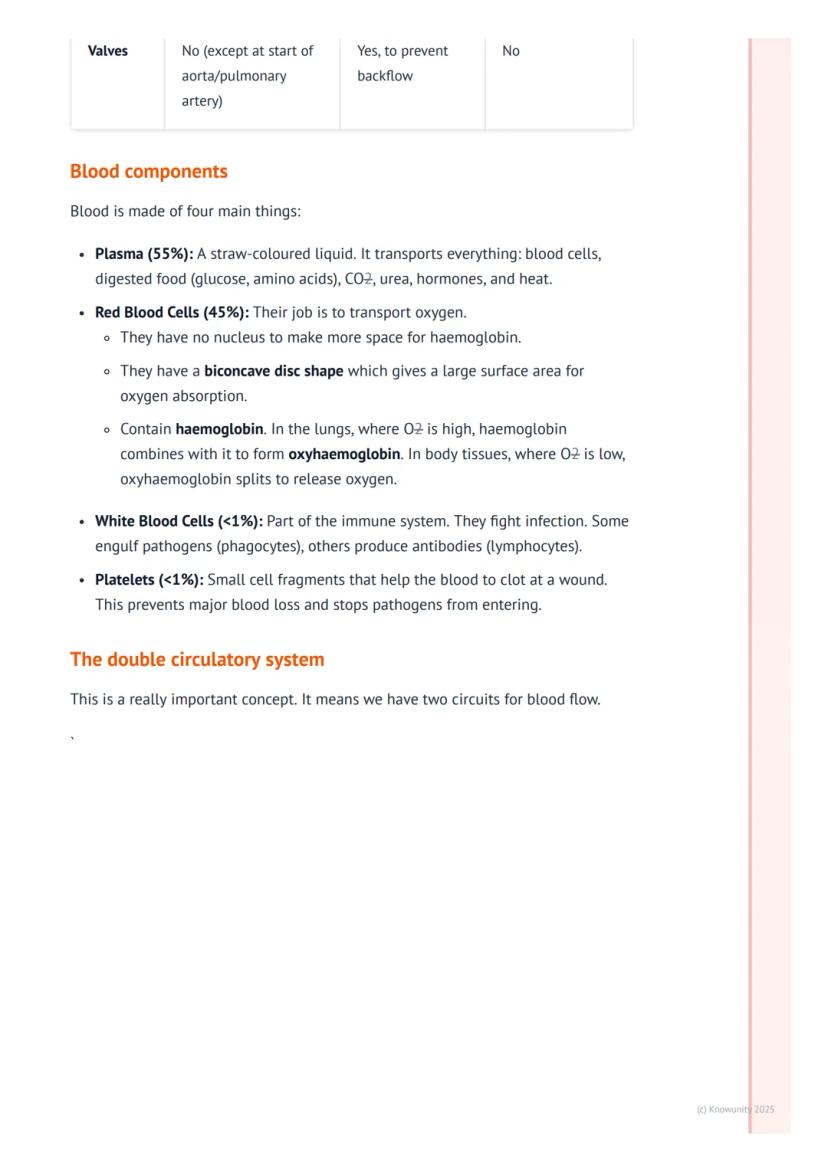
Blood isn't just red liquid - it's actually four different components doing separate jobs. Plasma makes up over half your blood and is basically the delivery van, carrying everything from glucose and hormones to carbon dioxide and waste products.
Red blood cells are oxygen-carrying specialists. They've ditched their nucleus to pack in more haemoglobin (the red protein that grabs onto oxygen), and they're shaped like squashed doughnuts to maximise their surface area. In your lungs, haemoglobin binds with oxygen to form oxyhaemoglobin, then releases it when it reaches tissues that need it.
White blood cells are your immune system's army - some engulf harmful bacteria whilst others produce antibodies to fight infections. Platelets are the emergency repair crew, rushing to any cuts to form clots and stop bleeding.
Key Point: Red blood cells' biconcave shape and lack of nucleus are perfect examples of form following function - more surface area and more space for haemoglobin!
5
of 8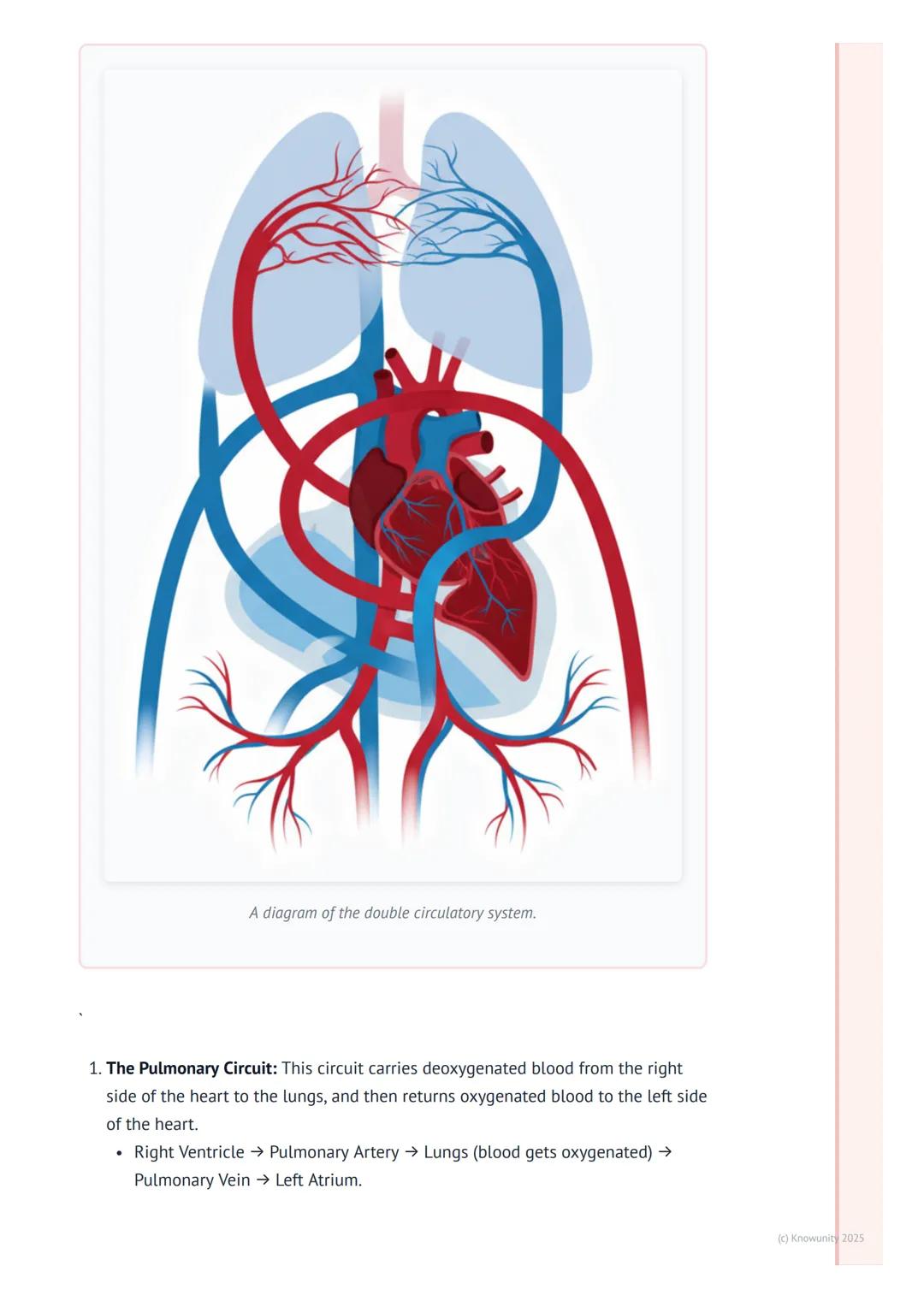
The Double Circulatory System
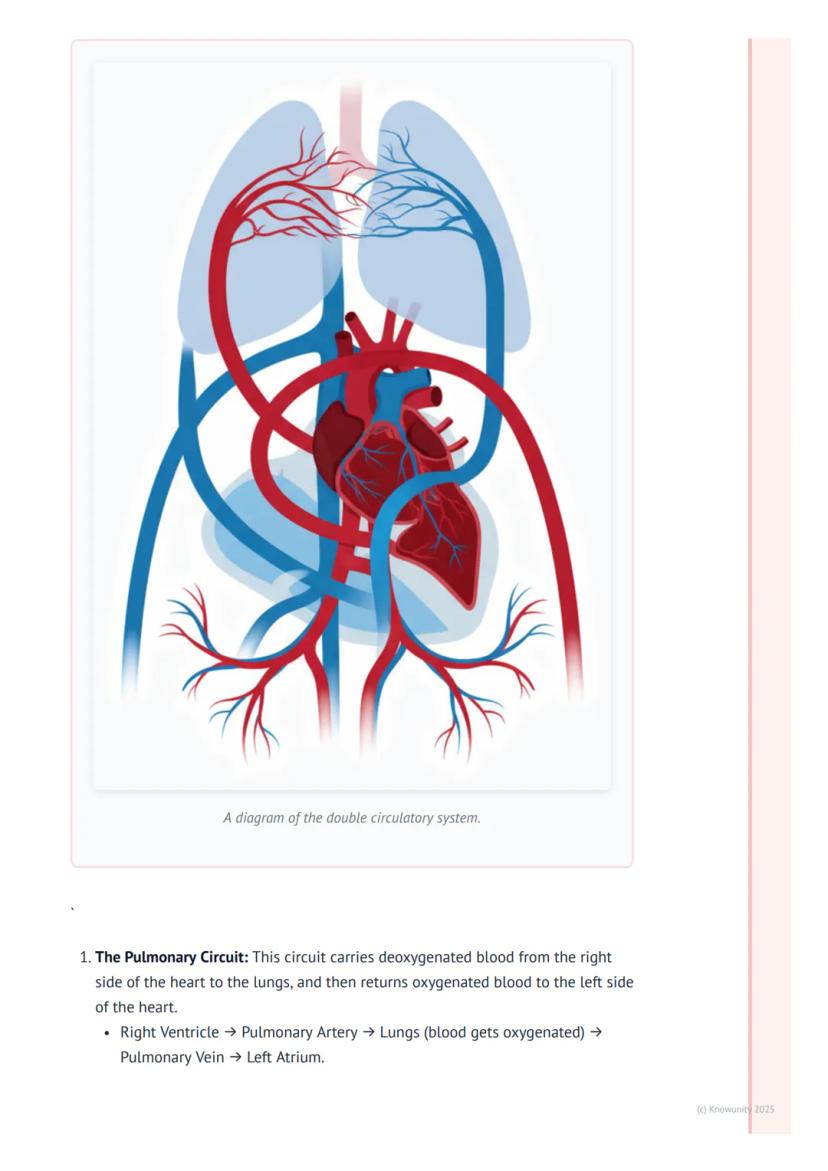
This concept is absolutely crucial for understanding how everything works together. Your double circulatory system means blood takes two separate journeys, and this setup gives humans a massive advantage over simpler animals.
The pulmonary circuit is blood's trip to the spa - deoxygenated blood travels from your right ventricle through the pulmonary artery to your lungs, gets a fresh oxygen supply, then returns via the pulmonary vein to your left atrium.
The systemic circuit is the main delivery route - oxygenated blood shoots out from your left ventricle through the aorta to supply your entire body, then returns deoxygenated through the vena cava to your right atrium. This separation means your body can maintain high pressure in the systemic circuit for efficient delivery.
Why It Matters: The double system keeps blood pressure high enough to push oxygen and nutrients to every corner of your body efficiently - single circulation systems can't manage this!
6
of 8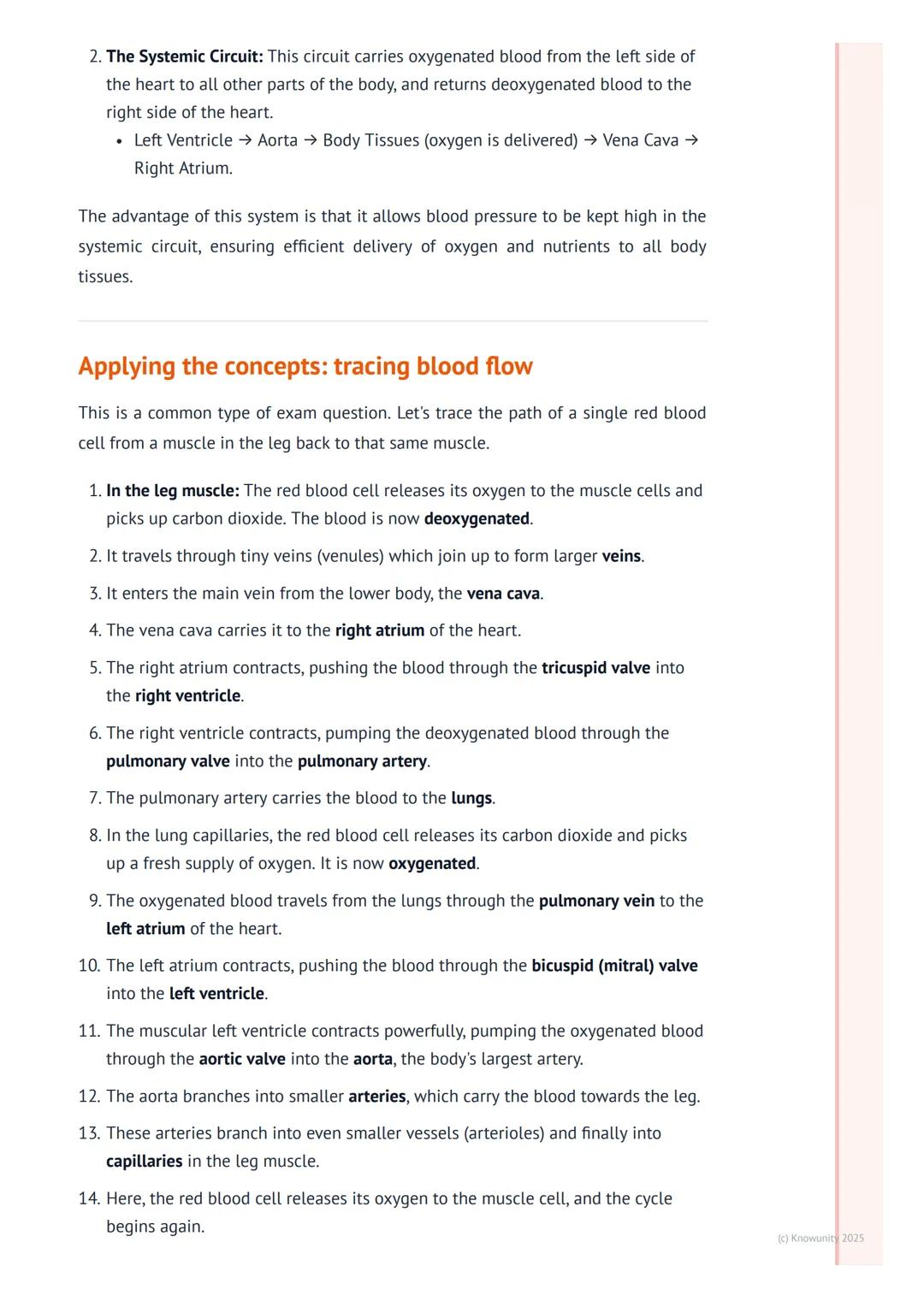
Tracing Blood Flow
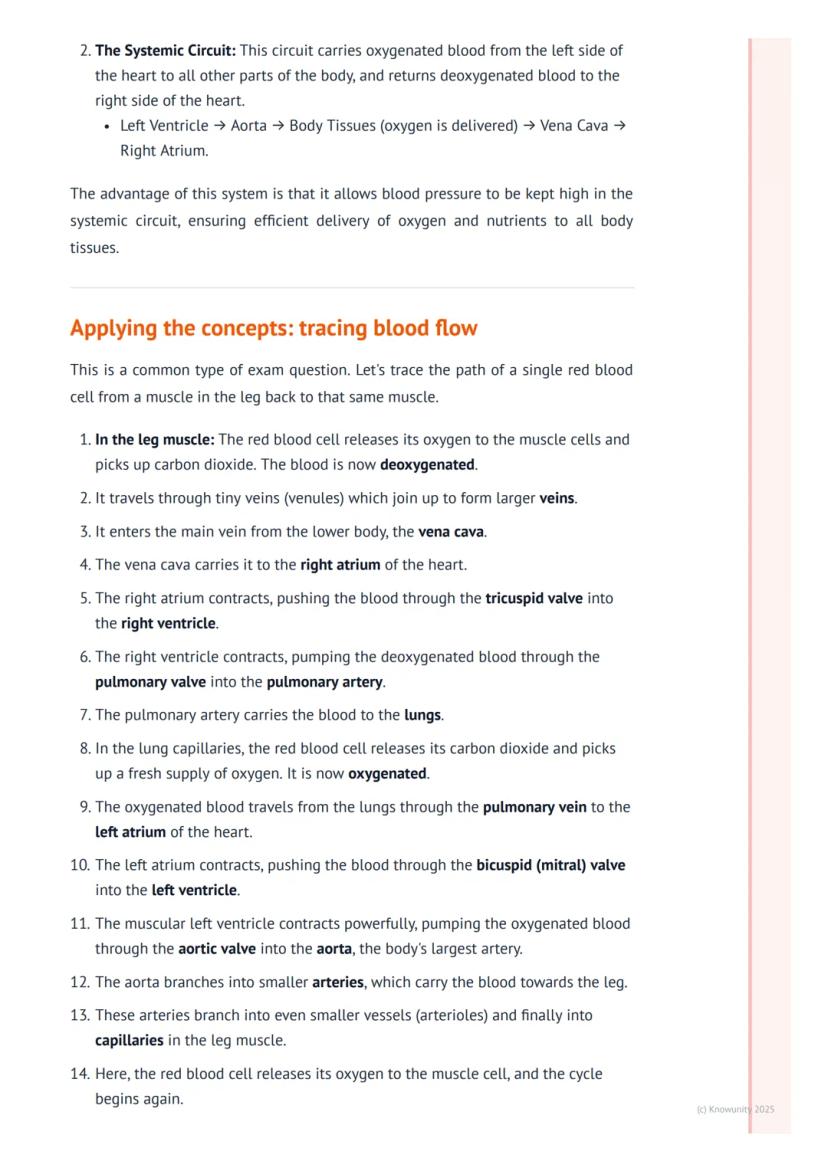
Exam questions love asking you to trace a red blood cell's journey, so let's follow one from a leg muscle back to the same spot. Starting in the muscle, our cell releases oxygen and picks up carbon dioxide, making the blood deoxygenated.
It travels through small veins that join into the vena cava, your body's main return highway to the right atrium. From there, it passes through the tricuspid valve into the right ventricle, which pumps it via the pulmonary artery to the lungs for refreshment.
In the lung capillaries, our cell swaps carbon dioxide for fresh oxygen, then travels through the pulmonary vein to the left atrium. Finally, it passes through the bicuspid valve into the powerful left ventricle, which launches it through the aorta and back towards that leg muscle.
Exam Strategy: Learn this pathway step-by-step - it's a guaranteed way to pick up easy marks and shows you understand how the whole system connects!
7
of 8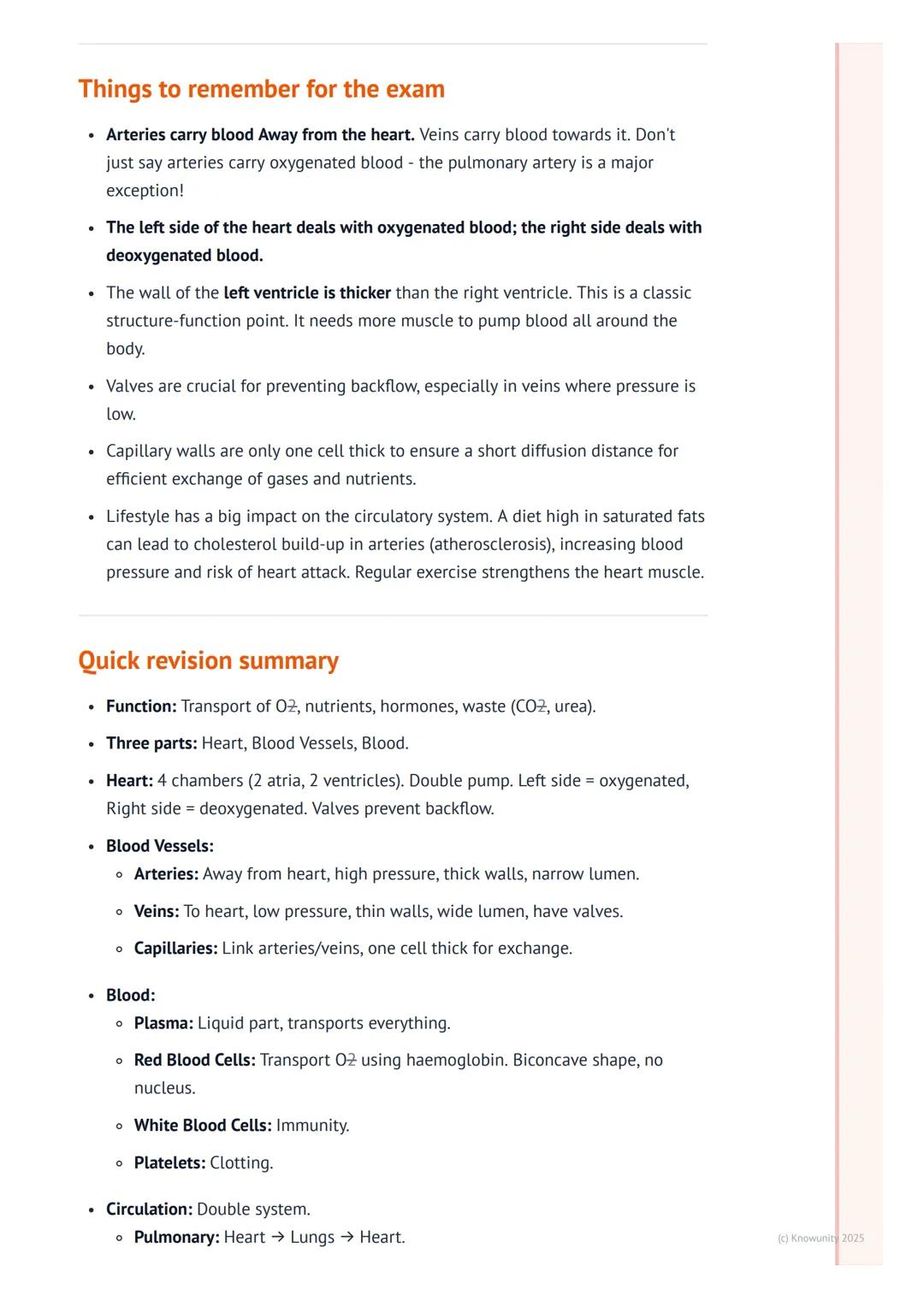
Essential Exam Knowledge
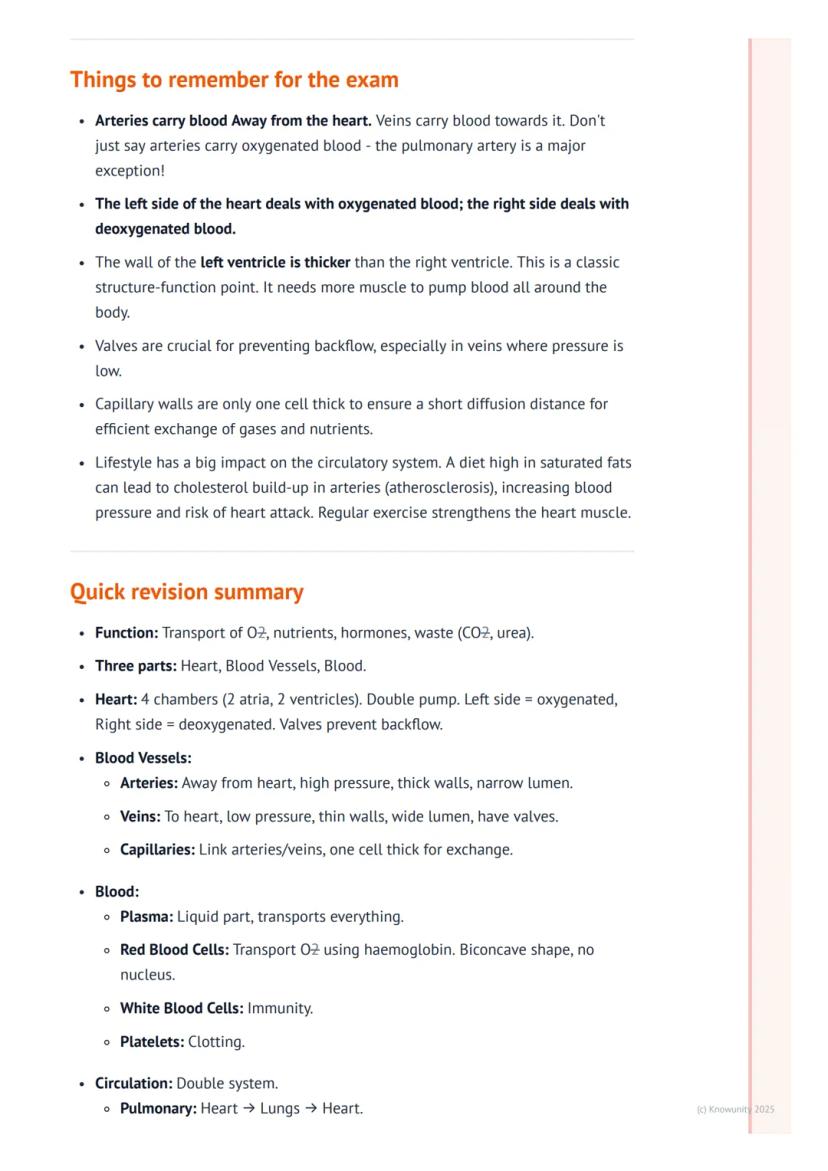
Don't get caught out by common mistakes that cost students marks. Remember that the pulmonary artery carries deoxygenated blood (it's still an artery because it goes away from the heart), and always link structure to function when describing the left ventricle's thick wall.
Lifestyle factors definitely affect your circulatory system and often appear in exam questions. Diets high in saturated fats can cause atherosclerosis , leading to high blood pressure and heart attacks. Regular exercise strengthens your heart muscle and keeps your system running smoothly.
Valve function is another exam favourite - they're essential for preventing backflow, especially in veins where blood pressure is naturally low. The capillaries' one-cell-thick walls ensure the shortest possible distance for diffusion of gases and nutrients.
Top Tip: Structure-function relationships are exam gold - always explain why each part is designed the way it is for its specific job!
8
of 8
Quick Revision Checklist
Master these key points and you'll ace any circulatory system question. The system transports oxygen, nutrients, hormones, and waste using three main parts: heart, blood vessels, and blood. Your four-chambered heart acts as a double pump with the left side handling oxygenated blood and the right side managing deoxygenated blood.
Blood vessels each have distinct roles: arteries (away from heart, high pressure, thick walls), veins (towards heart, low pressure, valves present), and capillaries (exchange sites, one cell thick). Blood contains plasma (transport medium), red blood cells (oxygen carriers with haemoglobin), white blood cells (immune defence), and platelets (clotting).
The double circulation includes the pulmonary circuit (heart to lungs to heart) and systemic circuit (heart to body to heart), ensuring efficient oxygen delivery throughout your body.
Final Reminder: Focus on connecting structure to function - understanding why each part is designed the way it is will help you tackle any exam question confidently!
Pensavamo che non l'avreste mai chiesto....
Che cos'è l'assistente AI di Knowunity?
Il nostro assistente AI è costruito specificamente per le esigenze degli studenti. Sulla base dei milioni di contenuti presenti sulla piattaforma, possiamo fornire agli studenti risposte davvero significative e pertinenti. Ma non si tratta solo di risposte, l'assistente è in grado di guidare gli studenti attraverso le loro sfide quotidiane di studio, con piani di studio personalizzati, quiz o contenuti nella chat e una personalizzazione al 100% basata sulle competenze e sugli sviluppi degli studenti.
Dove posso scaricare l'applicazione Knowunity?
È possibile scaricare l'applicazione dal Google Play Store e dall'Apple App Store.
Knowunity è davvero gratuita?
Sì, hai accesso completamente gratuito a tutti i contenuti nell'app e puoi chattare o seguire i Creatori in qualsiasi momento. Sbloccherai nuove funzioni crescendo il tuo numero di follower. Inoltre, offriamo Knowunity Premium, che consente di studiare senza alcun limite!!
Contenuti più popolari di Biology
8BiologyEcology introduction notes!
Start of the leaving cert ecology chapter
6th Year131
BiologyDNA & RNA
All notes on DNA & RNA including protein synthesis which is a HL topic
5th Year250
BiologyVertebrates and Invertebrates
Students will distinguish between animals that have a backbone (vertebrates) and those that do not (invertebrates), identifying examples of each.
2nd Year240
BiologyBiomolecules: chapter 8
Summary and easily understandable notes to revise chapter 8 biomolecules. Includes good labelled diagrams for visual learners
5th Year210
BiologyCirculatory System
Students will learn about the heart, blood, and blood vessels, and how this system transports oxygen, nutrients, and waste products around the body.
3rd Year140
BiologyRespiration
All respiration notes including simple diagrams and glycolysis and the Krebs cycle
5th Year120
BiologyPhotosynthesis : Biology
Photosynthesis
6th Year371
BiologyPlant Cells
Learning about the unique structures found in plant cells, such as the cell wall, chloroplasts, and large vacuole, and how they differ from animal cells.
1st Year80
Contenuti più popolari
9 Irish
IrishIrish oral questions and answers
Questions and answers for the leaving cert oral
5th Year4264
 English
Key Quotes : Sive
Key Quotes and explanations: Sive
6th Year2842
IrishIrish oral questions
Outline of oral questions
5th Year2055
IrishIníon- le hÁine Durkin
Aine Durkin’s poem, Iníon: Themes & summary
5th Year890
IrishIrish poetry 2027
Iníon + Dínit an Bhróin
5th Year1153
IrishLC HL notes- Iníon (poem)
Includes poem in English and Irish, theme, key words & phrases
5th Year2304
EnglishCultural Context : Shawshank Redemption : Sive : Small Things Like These
Comparative Study : Cultural Context : Shawshank Redemption, Sive and Small Things Like These
6th Year1430
IrishMo Ghrá-sa (Idir Lúibíní)
Notes on mo ghrá-sa
5th Year380
IrishAn Gaeilge Aiste
Irish Language essay
6th Year1320
Non c'è niente di adatto? Esplorare altre aree tematiche.
Recensioni dei nostri utenti. Ci adorano - e anche tu, vedrai .
4.6/5App Store
4.7/5Google Play
L'applicazione è molto facile da usare e ben progettata. Finora ho trovato tutto quello che cercavo e ho potuto imparare molto dalle presentazioni! Utilizzerò sicuramente l'app per i compiti in classe! È molto utile anche come fonte di ispirazione.
Stefano Sutente iOS
Questa applicazione è davvero grande! Ci sono tantissimi appunti e aiuti con lo studio [...]. La mia materia problematica, per esempio, è il francese e l'app ha così tante opzioni per aiutarmi. Grazie a questa app ho migliorato il mio francese. La consiglio a tutti.
Samantha Klichutente Android
Wow, sono davvero stupita. Ho appena provato l'app perché l'ho vista pubblicizzata molte volte e sono rimasta assolutamente sbalordita. Questa app è L'AIUTO che cercate per la scuola e soprattutto offre tantissime cose, come allenamenti e schede, che a me personalmente sono state MOLTO utili.
Annautente iOS
Biology14 visualizzazioni·Aggiornato Jun 5, 2026·8 pagineUnderstanding the Human Circulatory System
Think of your circulatory system as the ultimate delivery service - it's constantly moving oxygen, nutrients, and waste around your body 24/7. This amazing transport network keeps every single cell in your body alive and functioning properly.
1
of 8
Iscriviti per mostrare il contenuto. È gratis!
- Accesso a tutti i documenti
- Migliora i tuoi voti
- Unisciti a milioni di studenti
The Circulatory System Basics
Your circulatory system is basically your body's motorway network, except instead of cars, it's moving blood packed with essential supplies. The system has three main components working together: the heart (your powerful pump), blood vessels (the roads), and blood (the delivery trucks).
Understanding the key players is crucial for your exams. Arteries always carry blood away from the heart , whilst veins bring blood back towards the heart. The tiny capillaries are where all the real action happens - they're so narrow that substances can easily hop between your blood and cells.
Your heart isn't just one pump - it's actually a double pump with four chambers. The upper chambers (atria) receive blood, whilst the lower chambers (ventricles) do the heavy lifting of pumping blood out. Valves act like one-way doors, making sure blood flows in the right direction and doesn't slosh backwards.
Quick Memory Trick: That "lub-dub" heartbeat sound? That's your valves snapping shut - "lub" is the valves between chambers closing, "dub" is the valves in your major arteries closing.
2
of 8Iscriviti per mostrare il contenuto. È gratis!
- Accesso a tutti i documenti
- Migliora i tuoi voti
- Unisciti a milioni di studenti
Heart Structure and Function
Here's something that trips up loads of students - when you're looking at a heart diagram, remember you're seeing it from the person's perspective, so their left is on your right! The heart's four chambers each have specific jobs that you need to know.
The right atrium collects deoxygenated blood returning from your body, whilst the right ventricle pumps this blood to your lungs for a fresh oxygen supply. Meanwhile, the left atrium receives the newly oxygenated blood from your lungs, and the powerful left ventricle pumps it out to your entire body.
Notice how the left ventricle has much thicker walls than the right? That's because it needs serious muscle power to pump blood all the way to your toes, whilst the right ventricle only needs to send blood to your nearby lungs.
Exam Tip: The thick left ventricle wall is a classic structure-function relationship question - always link the extra muscle to the job of pumping blood around the entire body!
3
of 8Iscriviti per mostrare il contenuto. È gratis!
- Accesso a tutti i documenti
- Migliora i tuoi voti
- Unisciti a milioni di studenti
Blood Vessels - The Transport Network
Each type of blood vessel is perfectly designed for its job, and these differences come up constantly in exams. Arteries handle the high-pressure job of carrying blood away from your heart, so they've got thick, muscular walls and narrow channels to keep that pressure up.
Veins have the opposite challenge - they're bringing blood back to your heart against gravity (especially from your legs), but the pressure is much lower. That's why they have thin walls, wide channels, and crucially, valves to stop blood flowing backwards.
Capillaries are the stars of the show for actual substance exchange. Their walls are literally one cell thick - imagine cling film - so oxygen, nutrients, and waste can easily pass through. They're so narrow that red blood cells have to squeeze through single file!
Remember: Don't fall into the trap of saying "arteries carry oxygenated blood" - the pulmonary artery carries deoxygenated blood to the lungs, breaking this rule!
4
of 8Iscriviti per mostrare il contenuto. È gratis!
- Accesso a tutti i documenti
- Migliora i tuoi voti
- Unisciti a milioni di studenti
Blood Components
Blood isn't just red liquid - it's actually four different components doing separate jobs. Plasma makes up over half your blood and is basically the delivery van, carrying everything from glucose and hormones to carbon dioxide and waste products.
Red blood cells are oxygen-carrying specialists. They've ditched their nucleus to pack in more haemoglobin (the red protein that grabs onto oxygen), and they're shaped like squashed doughnuts to maximise their surface area. In your lungs, haemoglobin binds with oxygen to form oxyhaemoglobin, then releases it when it reaches tissues that need it.
White blood cells are your immune system's army - some engulf harmful bacteria whilst others produce antibodies to fight infections. Platelets are the emergency repair crew, rushing to any cuts to form clots and stop bleeding.
Key Point: Red blood cells' biconcave shape and lack of nucleus are perfect examples of form following function - more surface area and more space for haemoglobin!
5
of 8Iscriviti per mostrare il contenuto. È gratis!
- Accesso a tutti i documenti
- Migliora i tuoi voti
- Unisciti a milioni di studenti
The Double Circulatory System
This concept is absolutely crucial for understanding how everything works together. Your double circulatory system means blood takes two separate journeys, and this setup gives humans a massive advantage over simpler animals.
The pulmonary circuit is blood's trip to the spa - deoxygenated blood travels from your right ventricle through the pulmonary artery to your lungs, gets a fresh oxygen supply, then returns via the pulmonary vein to your left atrium.
The systemic circuit is the main delivery route - oxygenated blood shoots out from your left ventricle through the aorta to supply your entire body, then returns deoxygenated through the vena cava to your right atrium. This separation means your body can maintain high pressure in the systemic circuit for efficient delivery.
Why It Matters: The double system keeps blood pressure high enough to push oxygen and nutrients to every corner of your body efficiently - single circulation systems can't manage this!
6
of 8Iscriviti per mostrare il contenuto. È gratis!
- Accesso a tutti i documenti
- Migliora i tuoi voti
- Unisciti a milioni di studenti
Tracing Blood Flow
Exam questions love asking you to trace a red blood cell's journey, so let's follow one from a leg muscle back to the same spot. Starting in the muscle, our cell releases oxygen and picks up carbon dioxide, making the blood deoxygenated.
It travels through small veins that join into the vena cava, your body's main return highway to the right atrium. From there, it passes through the tricuspid valve into the right ventricle, which pumps it via the pulmonary artery to the lungs for refreshment.
In the lung capillaries, our cell swaps carbon dioxide for fresh oxygen, then travels through the pulmonary vein to the left atrium. Finally, it passes through the bicuspid valve into the powerful left ventricle, which launches it through the aorta and back towards that leg muscle.
Exam Strategy: Learn this pathway step-by-step - it's a guaranteed way to pick up easy marks and shows you understand how the whole system connects!
7
of 8Iscriviti per mostrare il contenuto. È gratis!
- Accesso a tutti i documenti
- Migliora i tuoi voti
- Unisciti a milioni di studenti
Essential Exam Knowledge
Don't get caught out by common mistakes that cost students marks. Remember that the pulmonary artery carries deoxygenated blood (it's still an artery because it goes away from the heart), and always link structure to function when describing the left ventricle's thick wall.
Lifestyle factors definitely affect your circulatory system and often appear in exam questions. Diets high in saturated fats can cause atherosclerosis , leading to high blood pressure and heart attacks. Regular exercise strengthens your heart muscle and keeps your system running smoothly.
Valve function is another exam favourite - they're essential for preventing backflow, especially in veins where blood pressure is naturally low. The capillaries' one-cell-thick walls ensure the shortest possible distance for diffusion of gases and nutrients.
Top Tip: Structure-function relationships are exam gold - always explain why each part is designed the way it is for its specific job!
8
of 8Iscriviti per mostrare il contenuto. È gratis!
- Accesso a tutti i documenti
- Migliora i tuoi voti
- Unisciti a milioni di studenti
Quick Revision Checklist
Master these key points and you'll ace any circulatory system question. The system transports oxygen, nutrients, hormones, and waste using three main parts: heart, blood vessels, and blood. Your four-chambered heart acts as a double pump with the left side handling oxygenated blood and the right side managing deoxygenated blood.
Blood vessels each have distinct roles: arteries (away from heart, high pressure, thick walls), veins (towards heart, low pressure, valves present), and capillaries (exchange sites, one cell thick). Blood contains plasma (transport medium), red blood cells (oxygen carriers with haemoglobin), white blood cells (immune defence), and platelets (clotting).
The double circulation includes the pulmonary circuit (heart to lungs to heart) and systemic circuit (heart to body to heart), ensuring efficient oxygen delivery throughout your body.
Final Reminder: Focus on connecting structure to function - understanding why each part is designed the way it is will help you tackle any exam question confidently!
Pensavamo che non l'avreste mai chiesto....
Che cos'è l'assistente AI di Knowunity?
Il nostro assistente AI è costruito specificamente per le esigenze degli studenti. Sulla base dei milioni di contenuti presenti sulla piattaforma, possiamo fornire agli studenti risposte davvero significative e pertinenti. Ma non si tratta solo di risposte, l'assistente è in grado di guidare gli studenti attraverso le loro sfide quotidiane di studio, con piani di studio personalizzati, quiz o contenuti nella chat e una personalizzazione al 100% basata sulle competenze e sugli sviluppi degli studenti.
Dove posso scaricare l'applicazione Knowunity?
È possibile scaricare l'applicazione dal Google Play Store e dall'Apple App Store.
Knowunity è davvero gratuita?
Sì, hai accesso completamente gratuito a tutti i contenuti nell'app e puoi chattare o seguire i Creatori in qualsiasi momento. Sbloccherai nuove funzioni crescendo il tuo numero di follower. Inoltre, offriamo Knowunity Premium, che consente di studiare senza alcun limite!!
Contenuti più popolari di Biology
8BiologyEcology introduction notes!
Start of the leaving cert ecology chapter
6th Year131
BiologyDNA & RNA
All notes on DNA & RNA including protein synthesis which is a HL topic
5th Year250
BiologyVertebrates and Invertebrates
Students will distinguish between animals that have a backbone (vertebrates) and those that do not (invertebrates), identifying examples of each.
2nd Year240
BiologyBiomolecules: chapter 8
Summary and easily understandable notes to revise chapter 8 biomolecules. Includes good labelled diagrams for visual learners
5th Year210
BiologyCirculatory System
Students will learn about the heart, blood, and blood vessels, and how this system transports oxygen, nutrients, and waste products around the body.
3rd Year140
BiologyRespiration
All respiration notes including simple diagrams and glycolysis and the Krebs cycle
5th Year120
BiologyPhotosynthesis : Biology
Photosynthesis
6th Year371
BiologyPlant Cells
Learning about the unique structures found in plant cells, such as the cell wall, chloroplasts, and large vacuole, and how they differ from animal cells.
1st Year80
Contenuti più popolari
9IrishIrish oral questions and answers
Questions and answers for the leaving cert oral
5th Year4264
EnglishKey Quotes : Sive
Key Quotes and explanations: Sive
6th Year2842
IrishIrish oral questions
Outline of oral questions
5th Year2055
IrishIníon- le hÁine Durkin
Aine Durkin’s poem, Iníon: Themes & summary
5th Year890
IrishIrish poetry 2027
Iníon + Dínit an Bhróin
5th Year1153
IrishLC HL notes- Iníon (poem)
Includes poem in English and Irish, theme, key words & phrases
5th Year2304
EnglishCultural Context : Shawshank Redemption : Sive : Small Things Like These
Comparative Study : Cultural Context : Shawshank Redemption, Sive and Small Things Like These
6th Year1430
IrishMo Ghrá-sa (Idir Lúibíní)
Notes on mo ghrá-sa
5th Year380
IrishAn Gaeilge Aiste
Irish Language essay
6th Year1320
Non c'è niente di adatto? Esplorare altre aree tematiche.
Recensioni dei nostri utenti. Ci adorano - e anche tu, vedrai .
4.6/5App Store
4.7/5Google Play
L'applicazione è molto facile da usare e ben progettata. Finora ho trovato tutto quello che cercavo e ho potuto imparare molto dalle presentazioni! Utilizzerò sicuramente l'app per i compiti in classe! È molto utile anche come fonte di ispirazione.
Stefano Sutente iOS
Questa applicazione è davvero grande! Ci sono tantissimi appunti e aiuti con lo studio [...]. La mia materia problematica, per esempio, è il francese e l'app ha così tante opzioni per aiutarmi. Grazie a questa app ho migliorato il mio francese. La consiglio a tutti.
Samantha Klichutente Android
Wow, sono davvero stupita. Ho appena provato l'app perché l'ho vista pubblicizzata molte volte e sono rimasta assolutamente sbalordita. Questa app è L'AIUTO che cercate per la scuola e soprattutto offre tantissime cose, come allenamenti e schede, che a me personalmente sono state MOLTO utili.
Annautente iOS