
Ever wonder how energy moves through nature and keeps everything... Mostra di più
 Biology7 visualizzazioni·Aggiornato Jun 13, 2026·7 pagine
Understanding Ecosystems: Food Chains and Webs
1 / 7
1
of 7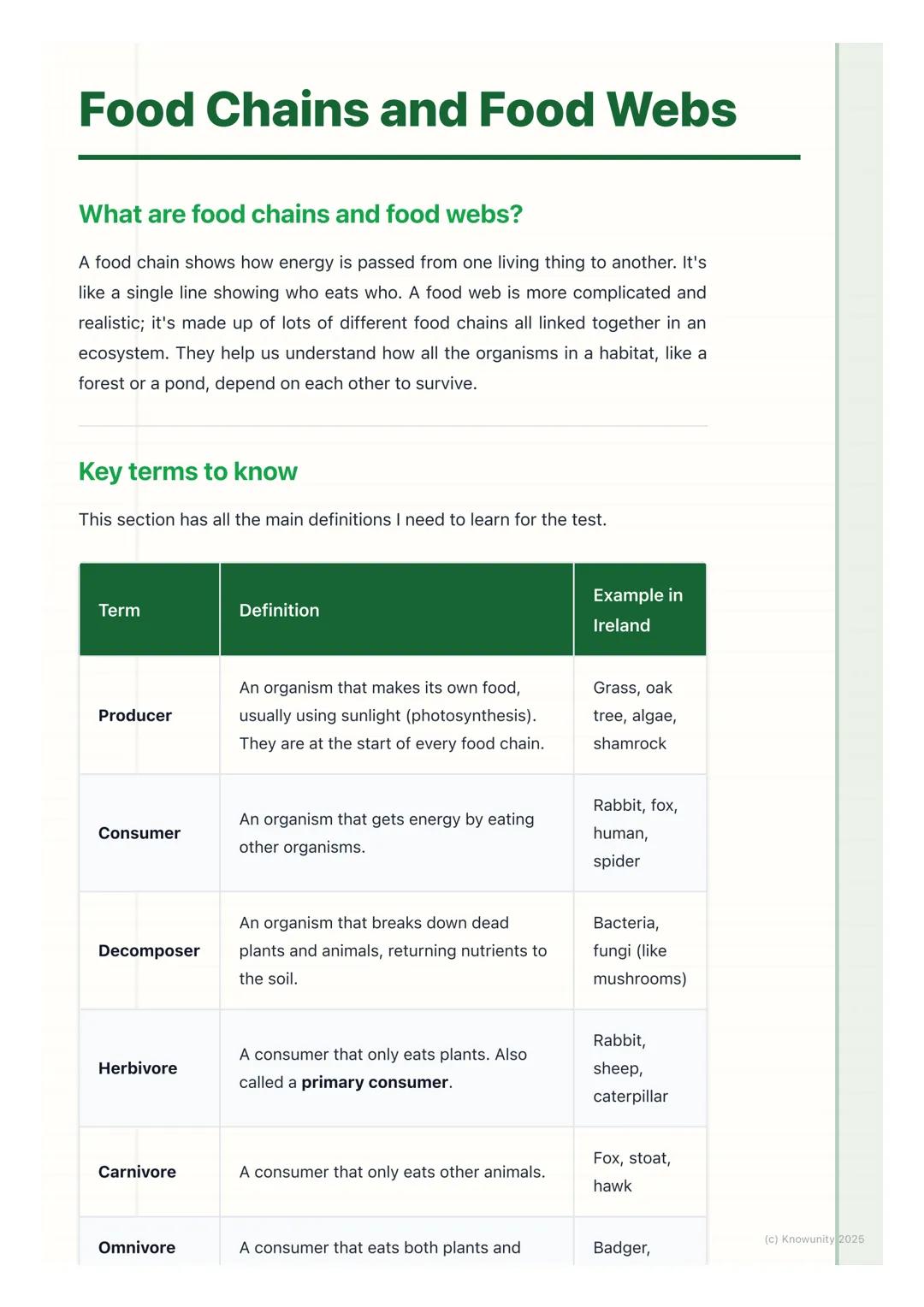
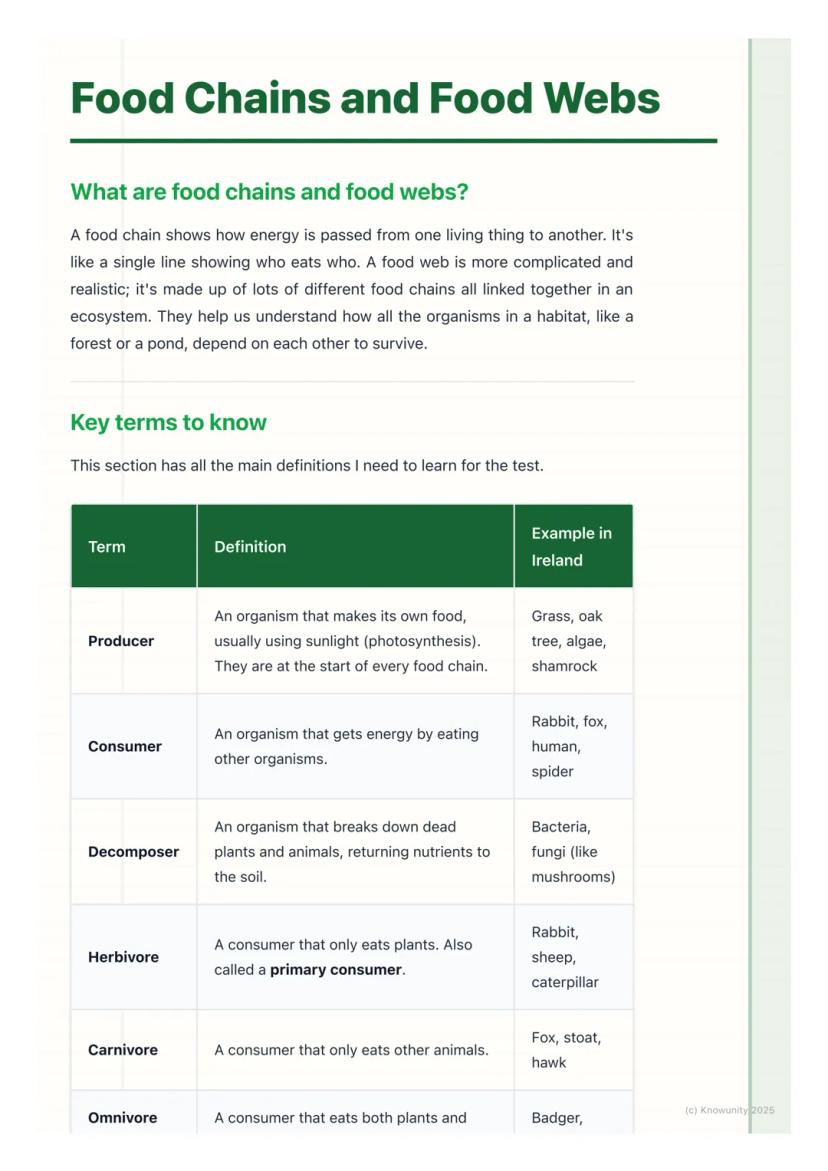
Food Chains and Food Webs Basics
Think of a food chain as nature's conveyor belt - it's a simple line showing who eats who. Energy passes from one living thing to another in a straight path. A food web is like having loads of these conveyor belts all tangled together, which is much closer to what actually happens in real ecosystems.
These diagrams help us understand how every creature in a habitat - whether it's the Wicklow Mountains or a Dublin park - relies on others to stay alive. It's all about survival and energy flow.
Key Point: Food webs are more realistic than food chains because animals usually have multiple food sources, making ecosystems more stable.
2
of 7
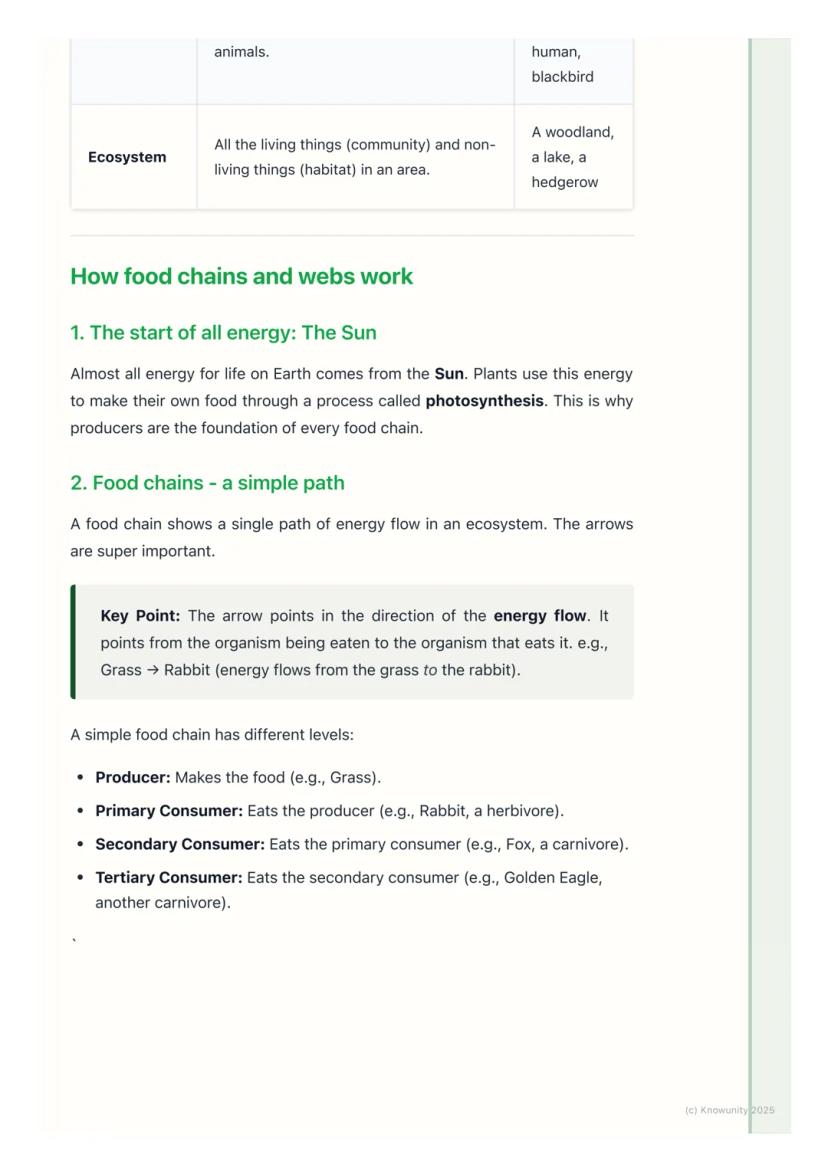
Essential Terms You Need to Know
Producers are the superstars that kick off every food chain by making their own food through photosynthesis. Think grass, oak trees, or algae in Irish ponds. Consumers can't make their own grub, so they eat other organisms instead.
There are different types of consumers: herbivores (like rabbits) only munch plants, carnivores (like foxes) only eat meat, and omnivores (like badgers and humans) eat both. Decomposers are nature's recycling crew - bacteria and fungi that break down dead stuff and return nutrients to the soil.
An ecosystem includes all the living things and their environment in one area. Whether it's a woodland, lake, or hedgerow, everything's connected in this complex web of life.
Remember: Every organism fits into one of these categories, and each plays a crucial role in keeping the ecosystem balanced.
3
of 7
How Energy Flows Through Nature
The Sun powers almost everything on Earth by giving plants energy for photosynthesis. This makes producers the foundation of every food chain - without them, everything else would collapse.
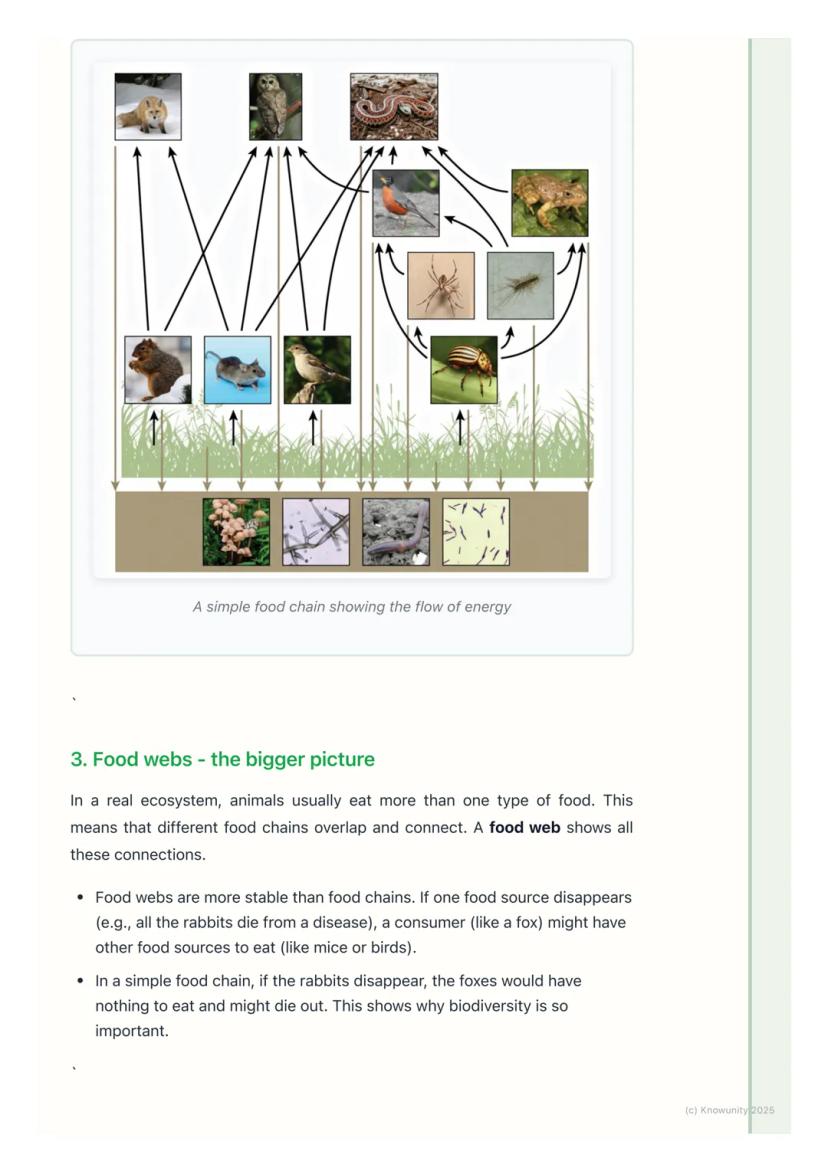
Food chains show energy moving in levels: producers → primary consumers (herbivores) → secondary consumers (carnivores) → tertiary consumers (top predators). The arrows are absolutely crucial - they point in the direction energy flows, from what's being eaten to what's doing the eating.
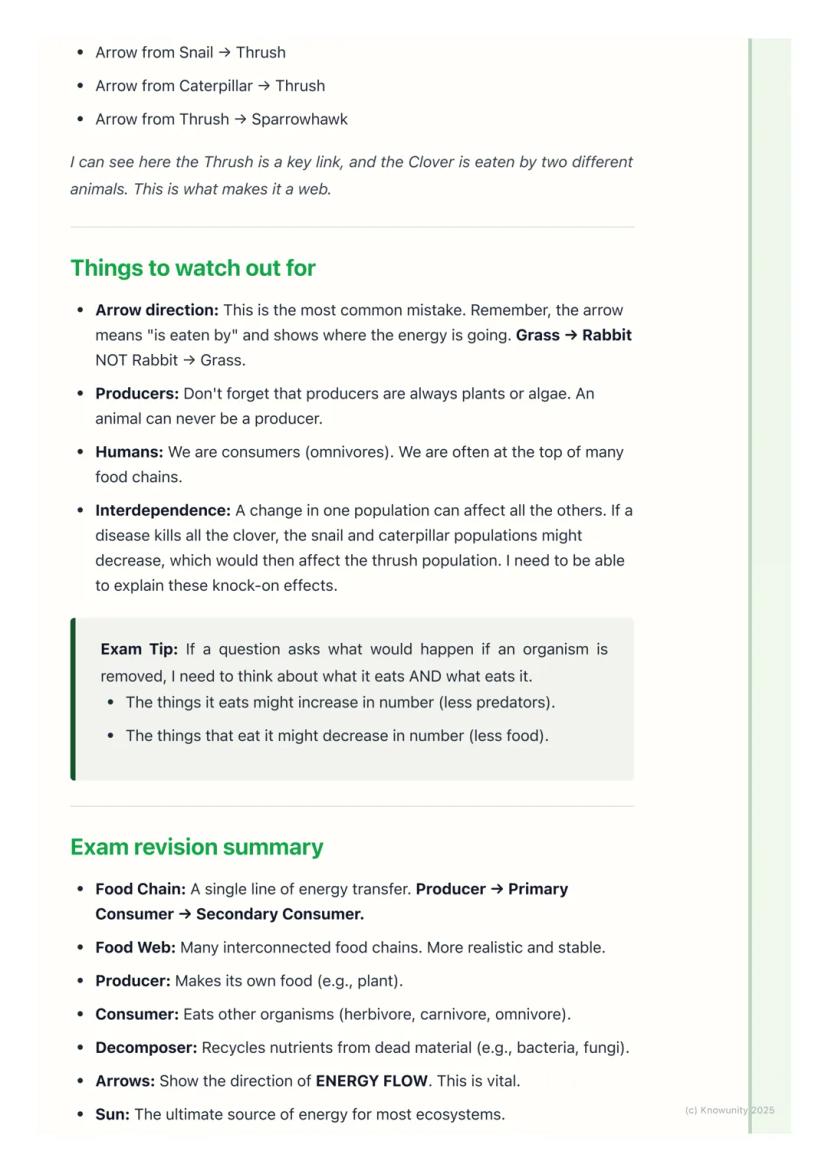
So "Grass → Rabbit" means energy flows from the grass into the rabbit when it gets eaten. Getting arrow direction wrong is the easiest way to lose marks in exams, so practice this loads.
Exam Tip: Always remember arrows show energy flow direction - "is eaten by" - not who does the eating!
4
of 7
Food Webs and Decomposers
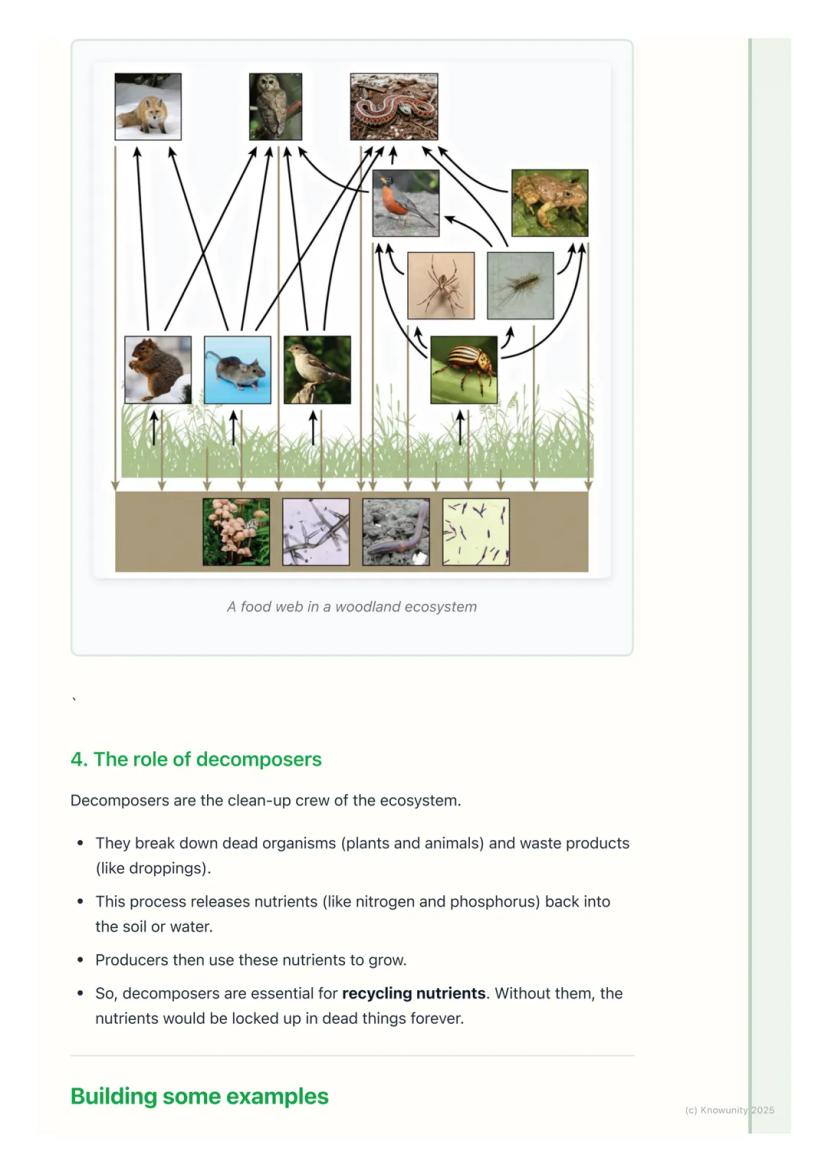
Food webs show the bigger picture because most animals eat several different things. If rabbits disappear from disease, foxes might survive by eating mice or birds instead. This makes food webs much more stable than simple food chains.
Decomposers are the unsung heroes that break down dead plants, animals, and waste. They release essential nutrients like nitrogen back into the soil, which producers then use to grow. Without decomposers, nutrients would stay locked up in dead material forever.
This creates a perfect cycle: decomposers feed the soil, producers use those nutrients to grow, consumers eat the producers, and when they die, decomposers start the process again.
Think About It: Decomposers are why forests aren't knee-deep in dead leaves and animal bodies!
5
of 7
Irish Ecosystem Examples
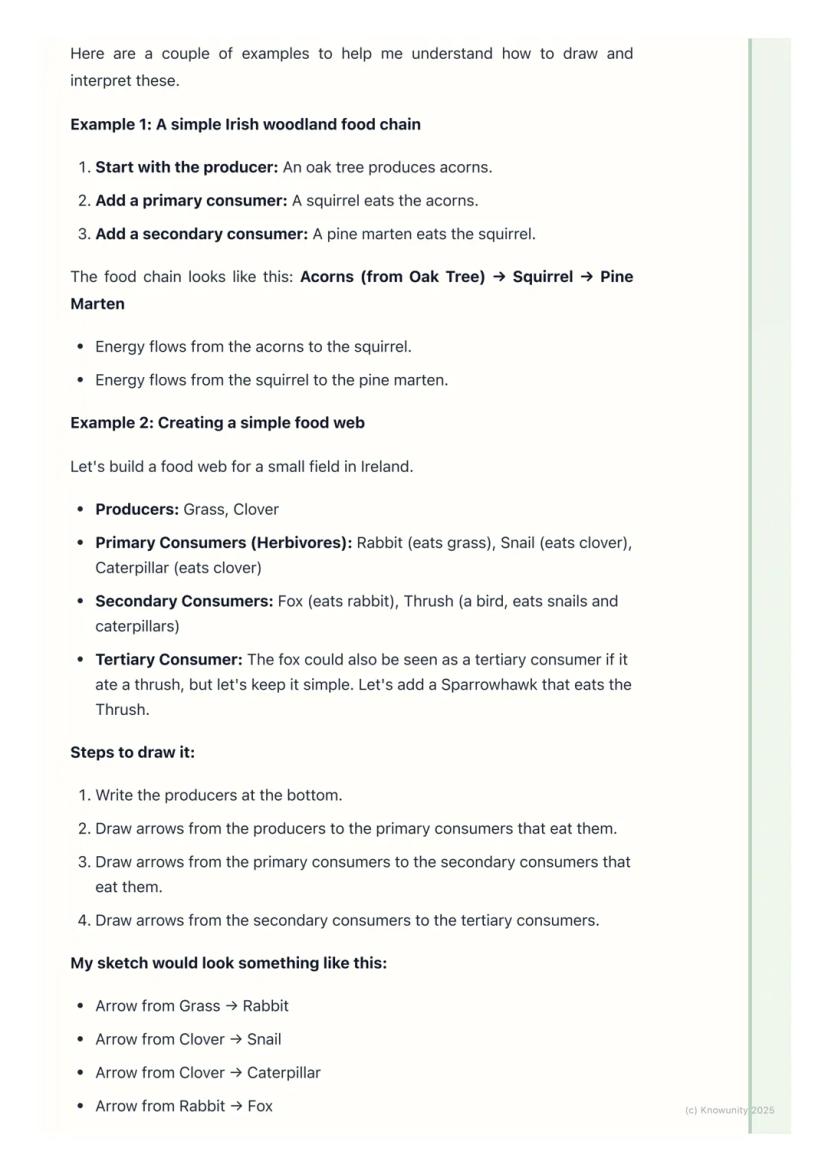
Let's build a simple Irish woodland food chain: Oak tree produces acorns → Squirrel eats acorns → Pine marten eats squirrel. The energy flows from acorns to squirrel to pine marten, following the arrows.
For a food web in an Irish field, you might have grass and clover as producers. Rabbits eat grass while snails and caterpillars munch clover. A fox hunts rabbits, and thrushes eat both snails and caterpillars. Finally, a sparrowhawk might prey on the thrush.
Notice how the thrush and clover connect to multiple organisms - this is what creates the "web" structure. Multiple connections mean if one food source disappears, others might still be available.
Drawing Tip: Start with producers at the bottom, then work your way up through primary, secondary, and tertiary consumers.
6
of 7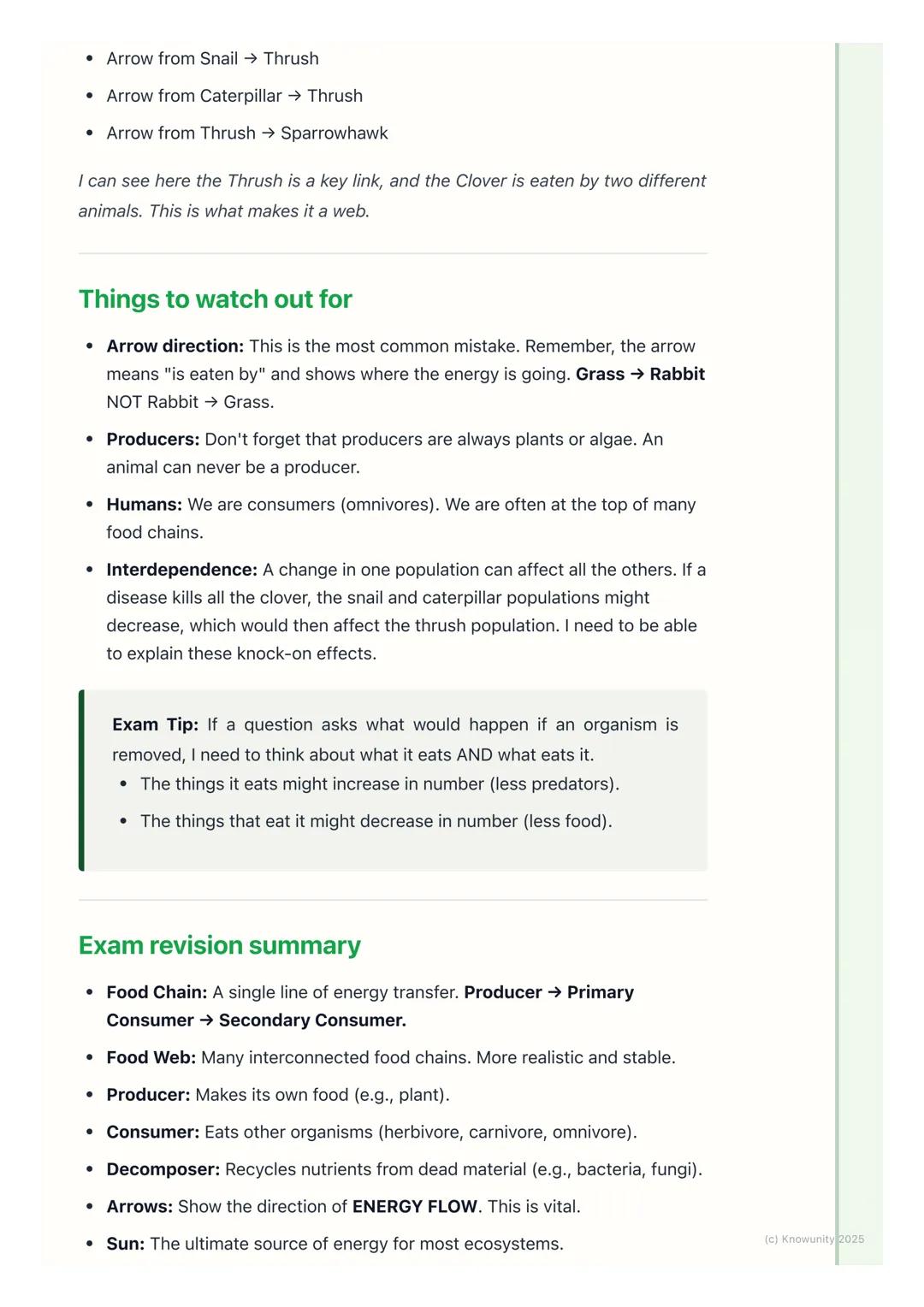
What Happens When Things Go Wrong?
Interdependence means every organism affects others in the food web. If you remove one species, it creates a ripple effect throughout the entire system. When something disappears, what it normally eats might increase in number (fewer predators), while what normally eats it might decrease (less food available).
Common exam mistakes include getting arrow directions backwards and forgetting that only plants and algae can be producers. Humans are always consumers (omnivores) and often sit at the top of food chains.
The key to exam success is understanding these knock-on effects. If clover dies from disease, snails and caterpillars lose food and their numbers drop, which then affects thrush populations that rely on them.
Exam Strategy: When asked about removing an organism, always consider what it eats AND what eats it - both will be affected!
7
of 7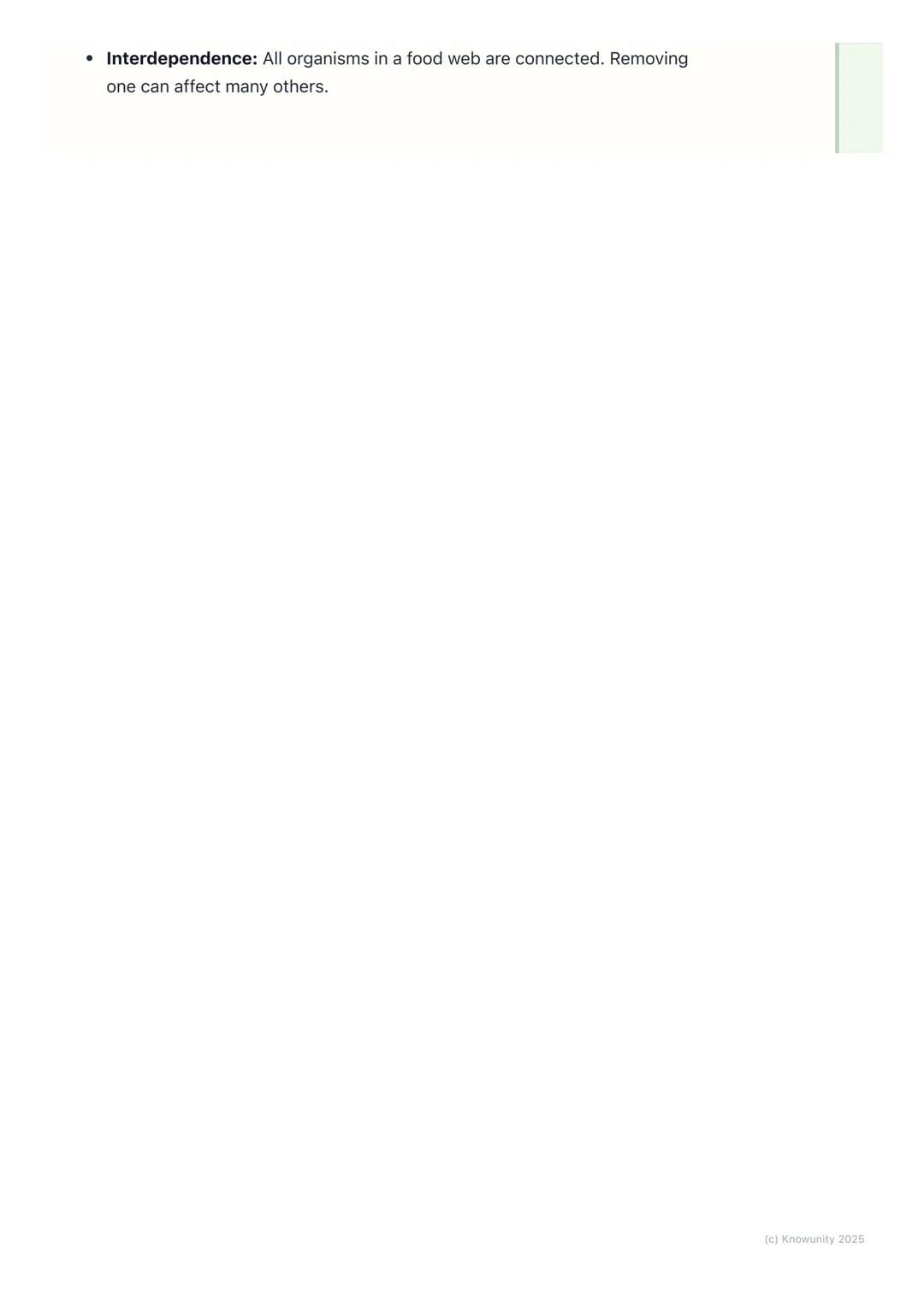
Pensavamo che non l'avreste mai chiesto....
Che cos'è l'assistente AI di Knowunity?
Il nostro assistente AI è costruito specificamente per le esigenze degli studenti. Sulla base dei milioni di contenuti presenti sulla piattaforma, possiamo fornire agli studenti risposte davvero significative e pertinenti. Ma non si tratta solo di risposte, l'assistente è in grado di guidare gli studenti attraverso le loro sfide quotidiane di studio, con piani di studio personalizzati, quiz o contenuti nella chat e una personalizzazione al 100% basata sulle competenze e sugli sviluppi degli studenti.
Dove posso scaricare l'applicazione Knowunity?
È possibile scaricare l'applicazione dal Google Play Store e dall'Apple App Store.
Knowunity è davvero gratuita?
Sì, hai accesso completamente gratuito a tutti i contenuti nell'app e puoi chattare o seguire i Creatori in qualsiasi momento. Sbloccherai nuove funzioni crescendo il tuo numero di follower. Inoltre, offriamo Knowunity Premium, che consente di studiare senza alcun limite!!
Contenuti più popolari di Biology
8BiologyEcology introduction notes!
Start of the leaving cert ecology chapter
6th Year131
BiologyDNA & RNA
All notes on DNA & RNA including protein synthesis which is a HL topic
5th Year250
BiologyVertebrates and Invertebrates
Students will distinguish between animals that have a backbone (vertebrates) and those that do not (invertebrates), identifying examples of each.
2nd Year240
BiologyBiomolecules: chapter 8
Summary and easily understandable notes to revise chapter 8 biomolecules. Includes good labelled diagrams for visual learners
5th Year210
BiologyCirculatory System
Students will learn about the heart, blood, and blood vessels, and how this system transports oxygen, nutrients, and waste products around the body.
3rd Year140
BiologyRespiration
All respiration notes including simple diagrams and glycolysis and the Krebs cycle
5th Year120
BiologyPhotosynthesis : Biology
Photosynthesis
6th Year371
BiologyPlant Cells
Learning about the unique structures found in plant cells, such as the cell wall, chloroplasts, and large vacuole, and how they differ from animal cells.
1st Year80
Contenuti più popolari
9 Irish
IrishIrish oral questions and answers
Questions and answers for the leaving cert oral
5th Year4264
 English
Key Quotes : Sive
Key Quotes and explanations: Sive
6th Year2842
IrishIrish oral questions
Outline of oral questions
5th Year2055
IrishIníon- le hÁine Durkin
Aine Durkin’s poem, Iníon: Themes & summary
5th Year850
IrishIrish poetry 2027
Iníon + Dínit an Bhróin
5th Year1133
IrishLC HL notes- Iníon (poem)
Includes poem in English and Irish, theme, key words & phrases
5th Year2284
EnglishCultural Context : Shawshank Redemption : Sive : Small Things Like These
Comparative Study : Cultural Context : Shawshank Redemption, Sive and Small Things Like These
6th Year1430
IrishMo Ghrá-sa (Idir Lúibíní)
Notes on mo ghrá-sa
5th Year380
IrishAn Gaeilge Aiste
Irish Language essay
6th Year1320
Non c'è niente di adatto? Esplorare altre aree tematiche.
Recensioni dei nostri utenti. Ci adorano - e anche tu, vedrai .
4.6/5App Store
4.7/5Google Play
L'applicazione è molto facile da usare e ben progettata. Finora ho trovato tutto quello che cercavo e ho potuto imparare molto dalle presentazioni! Utilizzerò sicuramente l'app per i compiti in classe! È molto utile anche come fonte di ispirazione.
Stefano Sutente iOS
Questa applicazione è davvero grande! Ci sono tantissimi appunti e aiuti con lo studio [...]. La mia materia problematica, per esempio, è il francese e l'app ha così tante opzioni per aiutarmi. Grazie a questa app ho migliorato il mio francese. La consiglio a tutti.
Samantha Klichutente Android
Wow, sono davvero stupita. Ho appena provato l'app perché l'ho vista pubblicizzata molte volte e sono rimasta assolutamente sbalordita. Questa app è L'AIUTO che cercate per la scuola e soprattutto offre tantissime cose, come allenamenti e schede, che a me personalmente sono state MOLTO utili.
Annautente iOS
Biology7 visualizzazioni·Aggiornato Jun 13, 2026·7 pagineUnderstanding Ecosystems: Food Chains and Webs
Ever wonder how energy moves through nature and keeps everything alive? Food chains and food webs show us exactly how organisms depend on each other for survival, from the tiniest bacteria to the largest predators.
1
of 7Iscriviti per mostrare il contenuto. È gratis!
- Accesso a tutti i documenti
- Migliora i tuoi voti
- Unisciti a milioni di studenti
Food Chains and Food Webs Basics
Think of a food chain as nature's conveyor belt - it's a simple line showing who eats who. Energy passes from one living thing to another in a straight path. A food web is like having loads of these conveyor belts all tangled together, which is much closer to what actually happens in real ecosystems.
These diagrams help us understand how every creature in a habitat - whether it's the Wicklow Mountains or a Dublin park - relies on others to stay alive. It's all about survival and energy flow.
Key Point: Food webs are more realistic than food chains because animals usually have multiple food sources, making ecosystems more stable.
2
of 7Iscriviti per mostrare il contenuto. È gratis!
- Accesso a tutti i documenti
- Migliora i tuoi voti
- Unisciti a milioni di studenti
Essential Terms You Need to Know
Producers are the superstars that kick off every food chain by making their own food through photosynthesis. Think grass, oak trees, or algae in Irish ponds. Consumers can't make their own grub, so they eat other organisms instead.
There are different types of consumers: herbivores (like rabbits) only munch plants, carnivores (like foxes) only eat meat, and omnivores (like badgers and humans) eat both. Decomposers are nature's recycling crew - bacteria and fungi that break down dead stuff and return nutrients to the soil.
An ecosystem includes all the living things and their environment in one area. Whether it's a woodland, lake, or hedgerow, everything's connected in this complex web of life.
Remember: Every organism fits into one of these categories, and each plays a crucial role in keeping the ecosystem balanced.
3
of 7Iscriviti per mostrare il contenuto. È gratis!
- Accesso a tutti i documenti
- Migliora i tuoi voti
- Unisciti a milioni di studenti
How Energy Flows Through Nature
The Sun powers almost everything on Earth by giving plants energy for photosynthesis. This makes producers the foundation of every food chain - without them, everything else would collapse.
Food chains show energy moving in levels: producers → primary consumers (herbivores) → secondary consumers (carnivores) → tertiary consumers (top predators). The arrows are absolutely crucial - they point in the direction energy flows, from what's being eaten to what's doing the eating.
So "Grass → Rabbit" means energy flows from the grass into the rabbit when it gets eaten. Getting arrow direction wrong is the easiest way to lose marks in exams, so practice this loads.
Exam Tip: Always remember arrows show energy flow direction - "is eaten by" - not who does the eating!
4
of 7Iscriviti per mostrare il contenuto. È gratis!
- Accesso a tutti i documenti
- Migliora i tuoi voti
- Unisciti a milioni di studenti
Food Webs and Decomposers
Food webs show the bigger picture because most animals eat several different things. If rabbits disappear from disease, foxes might survive by eating mice or birds instead. This makes food webs much more stable than simple food chains.
Decomposers are the unsung heroes that break down dead plants, animals, and waste. They release essential nutrients like nitrogen back into the soil, which producers then use to grow. Without decomposers, nutrients would stay locked up in dead material forever.
This creates a perfect cycle: decomposers feed the soil, producers use those nutrients to grow, consumers eat the producers, and when they die, decomposers start the process again.
Think About It: Decomposers are why forests aren't knee-deep in dead leaves and animal bodies!
5
of 7Iscriviti per mostrare il contenuto. È gratis!
- Accesso a tutti i documenti
- Migliora i tuoi voti
- Unisciti a milioni di studenti
Irish Ecosystem Examples
Let's build a simple Irish woodland food chain: Oak tree produces acorns → Squirrel eats acorns → Pine marten eats squirrel. The energy flows from acorns to squirrel to pine marten, following the arrows.
For a food web in an Irish field, you might have grass and clover as producers. Rabbits eat grass while snails and caterpillars munch clover. A fox hunts rabbits, and thrushes eat both snails and caterpillars. Finally, a sparrowhawk might prey on the thrush.
Notice how the thrush and clover connect to multiple organisms - this is what creates the "web" structure. Multiple connections mean if one food source disappears, others might still be available.
Drawing Tip: Start with producers at the bottom, then work your way up through primary, secondary, and tertiary consumers.
6
of 7Iscriviti per mostrare il contenuto. È gratis!
- Accesso a tutti i documenti
- Migliora i tuoi voti
- Unisciti a milioni di studenti
What Happens When Things Go Wrong?
Interdependence means every organism affects others in the food web. If you remove one species, it creates a ripple effect throughout the entire system. When something disappears, what it normally eats might increase in number (fewer predators), while what normally eats it might decrease (less food available).
Common exam mistakes include getting arrow directions backwards and forgetting that only plants and algae can be producers. Humans are always consumers (omnivores) and often sit at the top of food chains.
The key to exam success is understanding these knock-on effects. If clover dies from disease, snails and caterpillars lose food and their numbers drop, which then affects thrush populations that rely on them.
Exam Strategy: When asked about removing an organism, always consider what it eats AND what eats it - both will be affected!
7
of 7Iscriviti per mostrare il contenuto. È gratis!
- Accesso a tutti i documenti
- Migliora i tuoi voti
- Unisciti a milioni di studenti
Pensavamo che non l'avreste mai chiesto....
Che cos'è l'assistente AI di Knowunity?
Il nostro assistente AI è costruito specificamente per le esigenze degli studenti. Sulla base dei milioni di contenuti presenti sulla piattaforma, possiamo fornire agli studenti risposte davvero significative e pertinenti. Ma non si tratta solo di risposte, l'assistente è in grado di guidare gli studenti attraverso le loro sfide quotidiane di studio, con piani di studio personalizzati, quiz o contenuti nella chat e una personalizzazione al 100% basata sulle competenze e sugli sviluppi degli studenti.
Dove posso scaricare l'applicazione Knowunity?
È possibile scaricare l'applicazione dal Google Play Store e dall'Apple App Store.
Knowunity è davvero gratuita?
Sì, hai accesso completamente gratuito a tutti i contenuti nell'app e puoi chattare o seguire i Creatori in qualsiasi momento. Sbloccherai nuove funzioni crescendo il tuo numero di follower. Inoltre, offriamo Knowunity Premium, che consente di studiare senza alcun limite!!
Contenuti più popolari di Biology
8BiologyEcology introduction notes!
Start of the leaving cert ecology chapter
6th Year131
BiologyDNA & RNA
All notes on DNA & RNA including protein synthesis which is a HL topic
5th Year250
BiologyVertebrates and Invertebrates
Students will distinguish between animals that have a backbone (vertebrates) and those that do not (invertebrates), identifying examples of each.
2nd Year240
BiologyBiomolecules: chapter 8
Summary and easily understandable notes to revise chapter 8 biomolecules. Includes good labelled diagrams for visual learners
5th Year210
BiologyCirculatory System
Students will learn about the heart, blood, and blood vessels, and how this system transports oxygen, nutrients, and waste products around the body.
3rd Year140
BiologyRespiration
All respiration notes including simple diagrams and glycolysis and the Krebs cycle
5th Year120
BiologyPhotosynthesis : Biology
Photosynthesis
6th Year371
BiologyPlant Cells
Learning about the unique structures found in plant cells, such as the cell wall, chloroplasts, and large vacuole, and how they differ from animal cells.
1st Year80
Contenuti più popolari
9IrishIrish oral questions and answers
Questions and answers for the leaving cert oral
5th Year4264
EnglishKey Quotes : Sive
Key Quotes and explanations: Sive
6th Year2842
IrishIrish oral questions
Outline of oral questions
5th Year2055
IrishIníon- le hÁine Durkin
Aine Durkin’s poem, Iníon: Themes & summary
5th Year850
IrishIrish poetry 2027
Iníon + Dínit an Bhróin
5th Year1133
IrishLC HL notes- Iníon (poem)
Includes poem in English and Irish, theme, key words & phrases
5th Year2284
EnglishCultural Context : Shawshank Redemption : Sive : Small Things Like These
Comparative Study : Cultural Context : Shawshank Redemption, Sive and Small Things Like These
6th Year1430
IrishMo Ghrá-sa (Idir Lúibíní)
Notes on mo ghrá-sa
5th Year380
IrishAn Gaeilge Aiste
Irish Language essay
6th Year1320
Non c'è niente di adatto? Esplorare altre aree tematiche.
Recensioni dei nostri utenti. Ci adorano - e anche tu, vedrai .
4.6/5App Store
4.7/5Google Play
L'applicazione è molto facile da usare e ben progettata. Finora ho trovato tutto quello che cercavo e ho potuto imparare molto dalle presentazioni! Utilizzerò sicuramente l'app per i compiti in classe! È molto utile anche come fonte di ispirazione.
Stefano Sutente iOS
Questa applicazione è davvero grande! Ci sono tantissimi appunti e aiuti con lo studio [...]. La mia materia problematica, per esempio, è il francese e l'app ha così tante opzioni per aiutarmi. Grazie a questa app ho migliorato il mio francese. La consiglio a tutti.
Samantha Klichutente Android
Wow, sono davvero stupita. Ho appena provato l'app perché l'ho vista pubblicizzata molte volte e sono rimasta assolutamente sbalordita. Questa app è L'AIUTO che cercate per la scuola e soprattutto offre tantissime cose, come allenamenti e schede, che a me personalmente sono state MOLTO utili.
Annautente iOS