
Applied Mathematics is basically using the maths you learn in...
 Applied Mathematics11 visualizzazioni·Aggiornato Jun 11, 2026·6 pagine
Exploring Applied Mathematics: Tools for Real-World Problems


1 / 6
1
of 6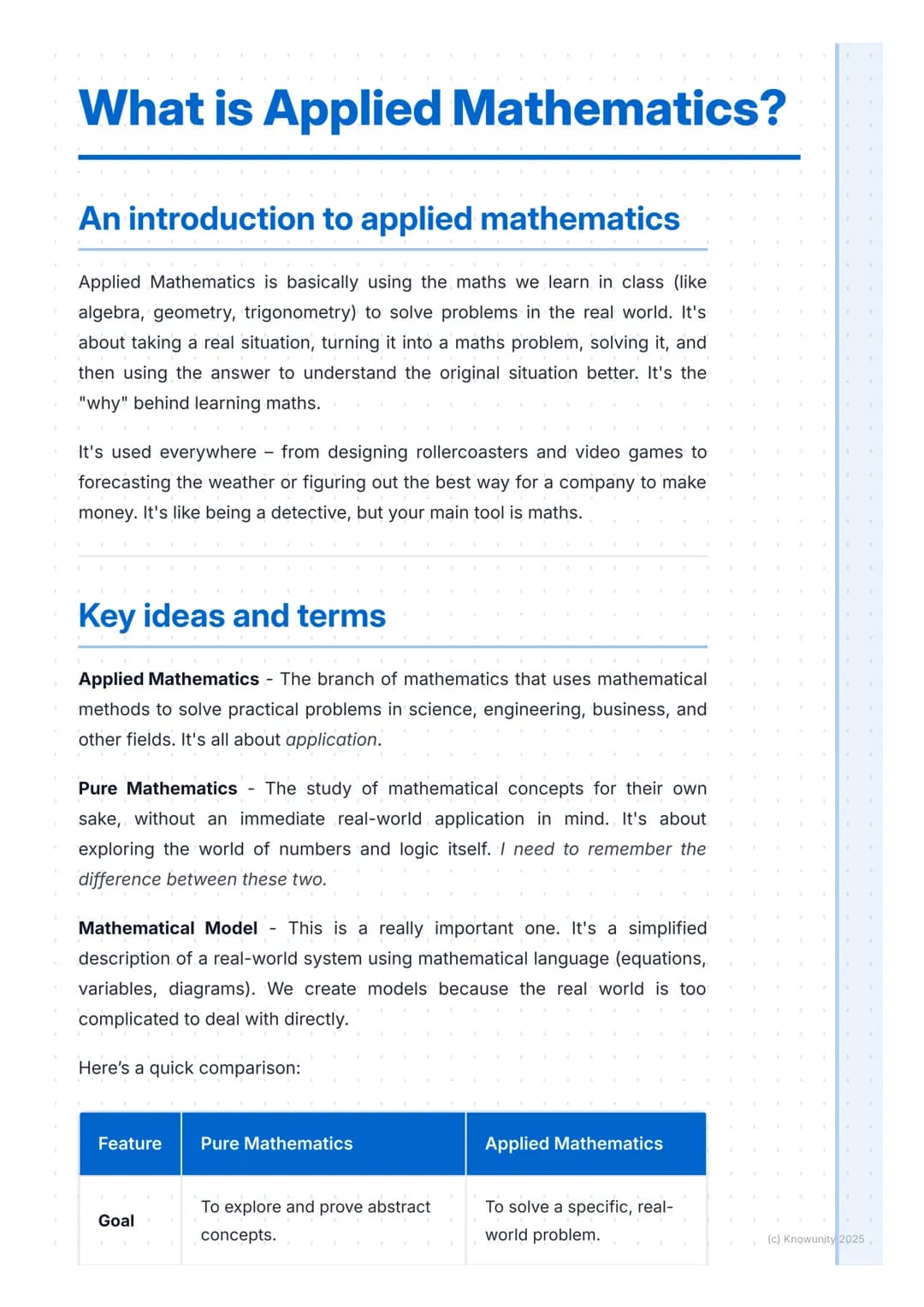
What is Applied Mathematics?
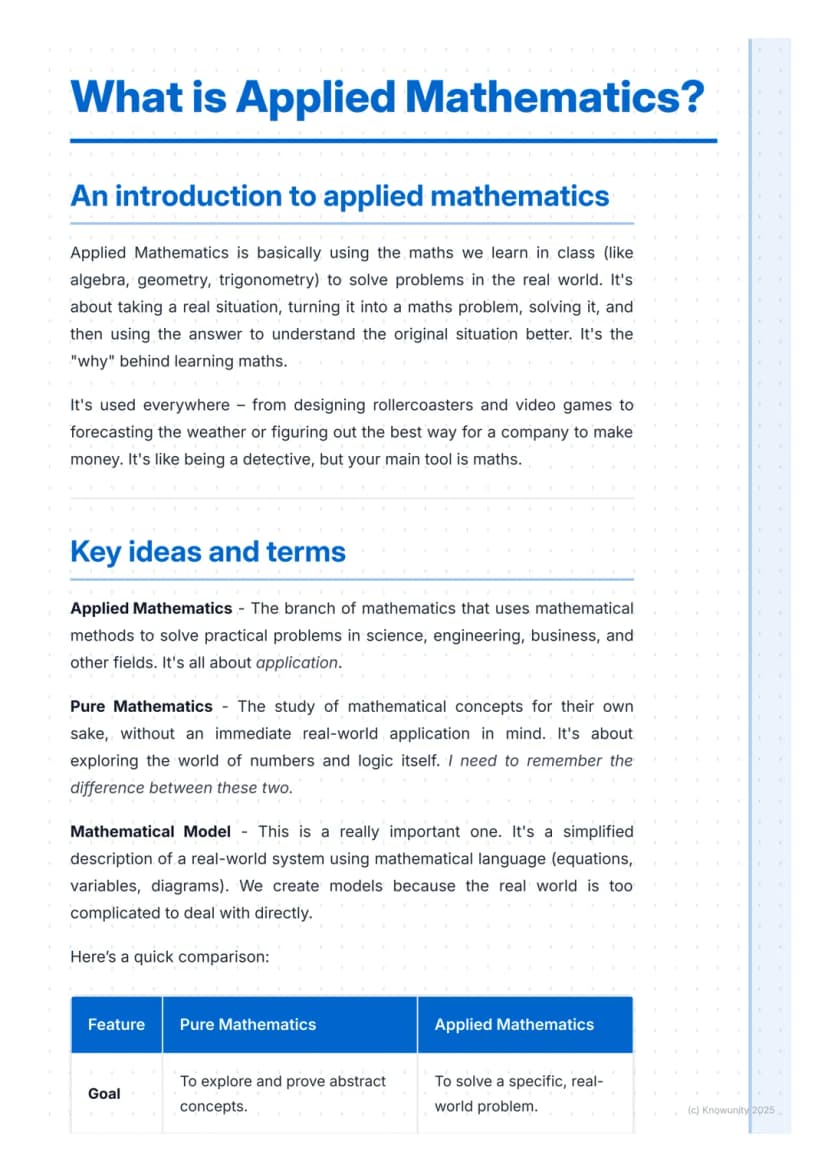
Ever wondered why you're learning algebra or trigonometry? Applied Mathematics is the answer - it's about taking those classroom concepts and using them to solve actual problems in the real world.
Unlike Pure Mathematics (which explores mathematical concepts just for the sake of it), applied maths has a clear goal: solve something practical. Whether it's figuring out the best angle for a football free kick or helping companies make more profit, you're always working towards a real solution.
The secret weapon in applied maths is the mathematical model - basically a simplified maths version of a complex real-world situation. Since the real world is incredibly messy and complicated, we create these models using equations and variables to make problems manageable.
Remember: Pure maths asks "What if?" whilst applied maths asks "How can we fix this?"
2
of 6
The Applied Mathematics Process
Solving problems with applied mathematics follows a clear cycle that you'll use again and again. It's like having a recipe for tackling any real-world challenge.
The process starts with a real-world problem and moves through several stages: making assumptions, creating a mathematical model, solving it, and interpreting your results. Think of it as translating between two languages - from real life to maths, then back to real life.
This modelling cycle is crucial because it shows that applied maths isn't just about getting the right answer. It's about understanding whether that answer actually makes sense in the original situation.
Key insight: The cycle often repeats - if your answer seems wrong, you go back and refine your model!
3
of 6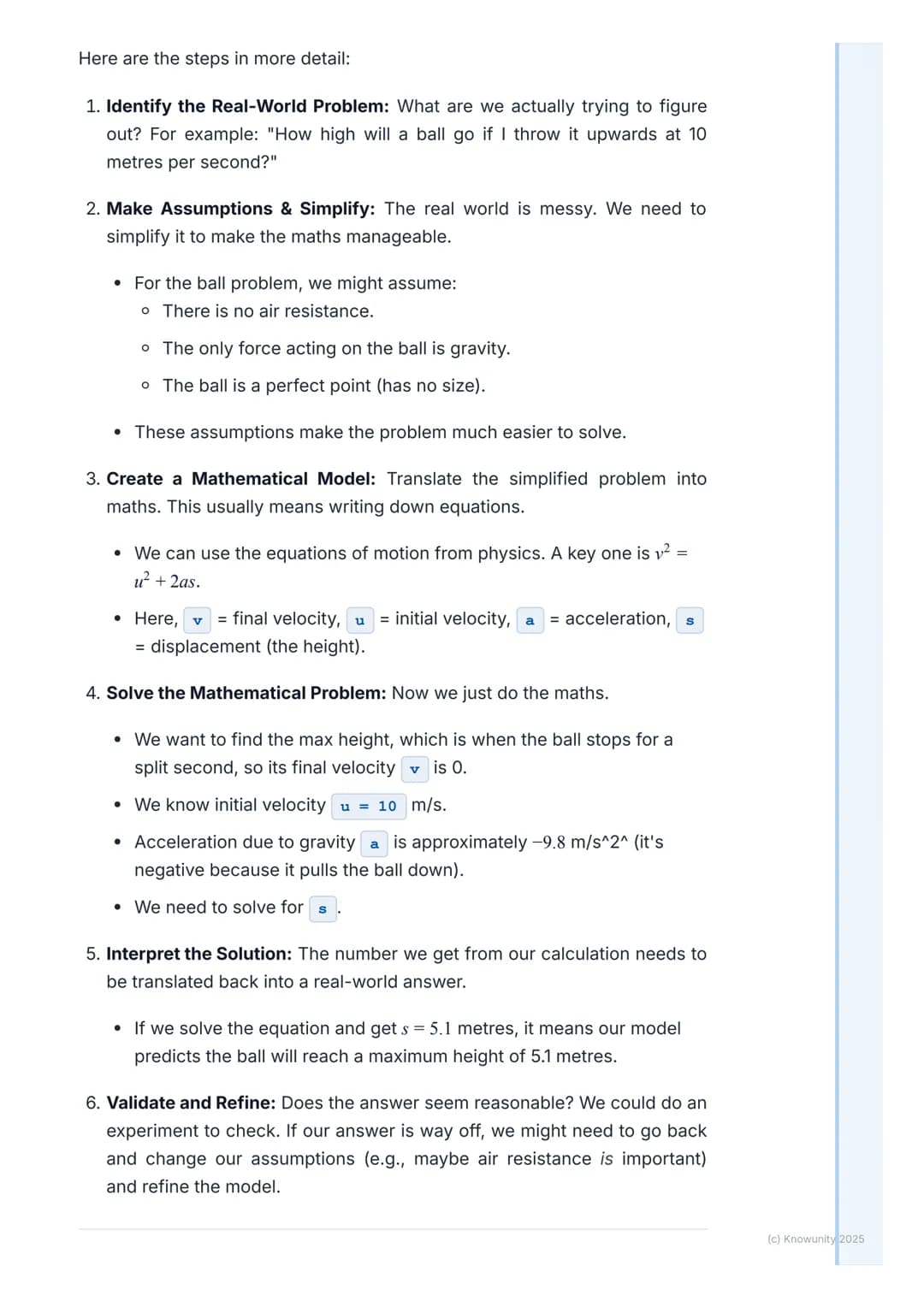
Breaking Down the Steps
Let's follow the mathematical modelling process with a simple example: "How high will a ball go if I throw it upwards at 10 metres per second?"
First, you identify the problem clearly. Then comes the crucial step of making assumptions - this is where you simplify reality. For our ball, we'll ignore air resistance and assume only gravity affects it.
Next, you create a mathematical model using equations. Here, we'd use physics equations like v² = u² + 2as, where the letters represent velocity, acceleration, and displacement. After solving the maths (plugging in numbers and calculating), you get a numerical answer.
The final steps are interpreting your solution and validating it . If something seems off, you might need to revisit your assumptions.
Pro tip: Always state your assumptions clearly in exams - it shows you understand that you're simplifying a complex problem!
4
of 6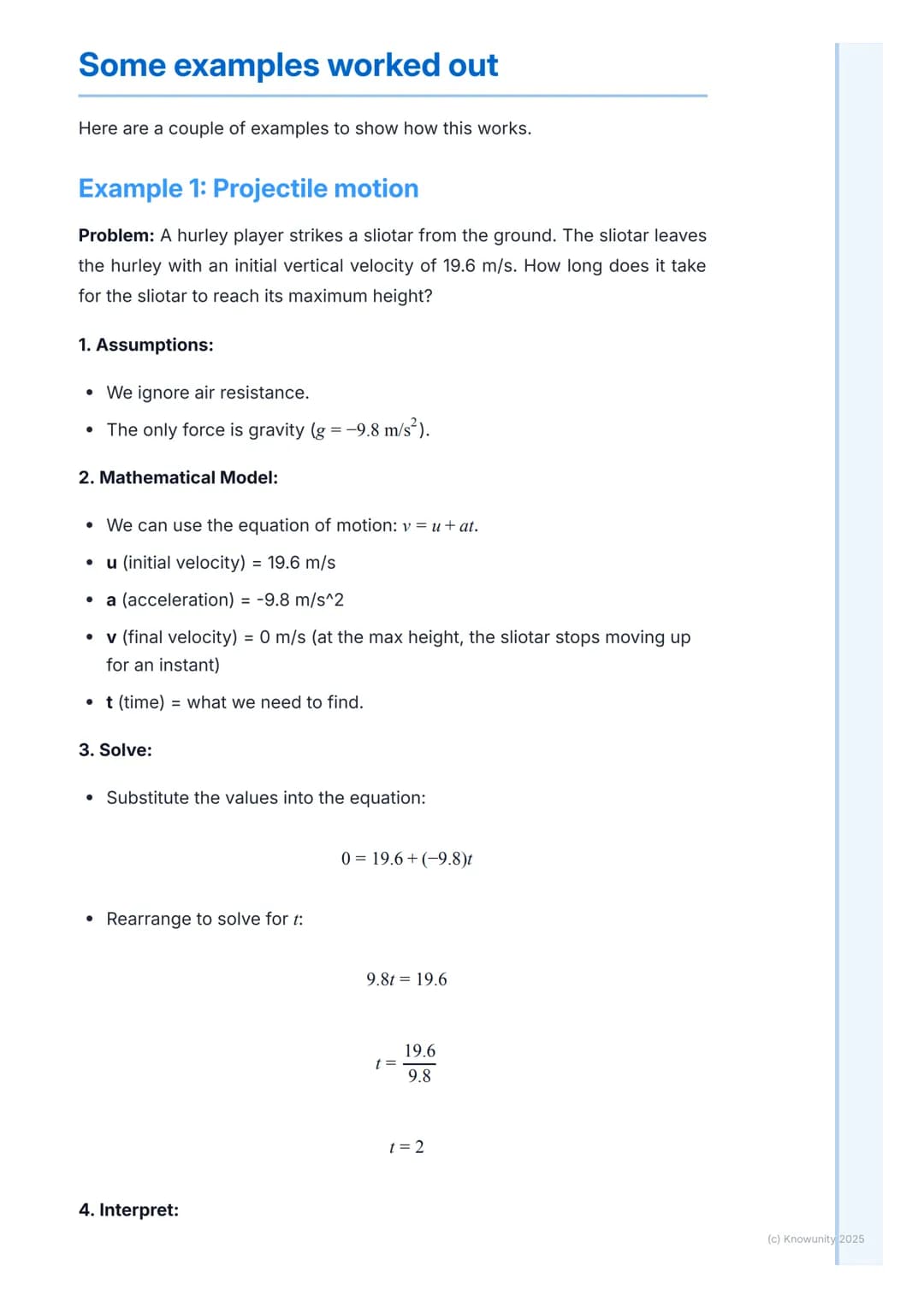
Worked Example: Hurling Physics
Here's how applied mathematics works with a proper Irish example: A hurler strikes a sliotar with an initial vertical velocity of 19.6 m/s. How long until it reaches maximum height?
Starting with assumptions: we ignore air resistance and only consider gravity . Our mathematical model uses the equation v = u + at, where v (final velocity) = 0 at maximum height, u (initial velocity) = 19.6 m/s, and a (acceleration) = -9.8 m/s².
Solving the equation: 0 = 19.6 + (-9.8)t, which rearranges to t = 19.6/9.8 = 2. The interpretation is straightforward: the sliotar takes 2 seconds to reach its maximum height.
This demonstrates how mathematical modelling transforms a sports scenario into a solvable equation, then translates the numerical result back into practical knowledge.
Reality check: Does 2 seconds seem reasonable for a sliotar to reach its peak? Trust your instincts!
5
of 6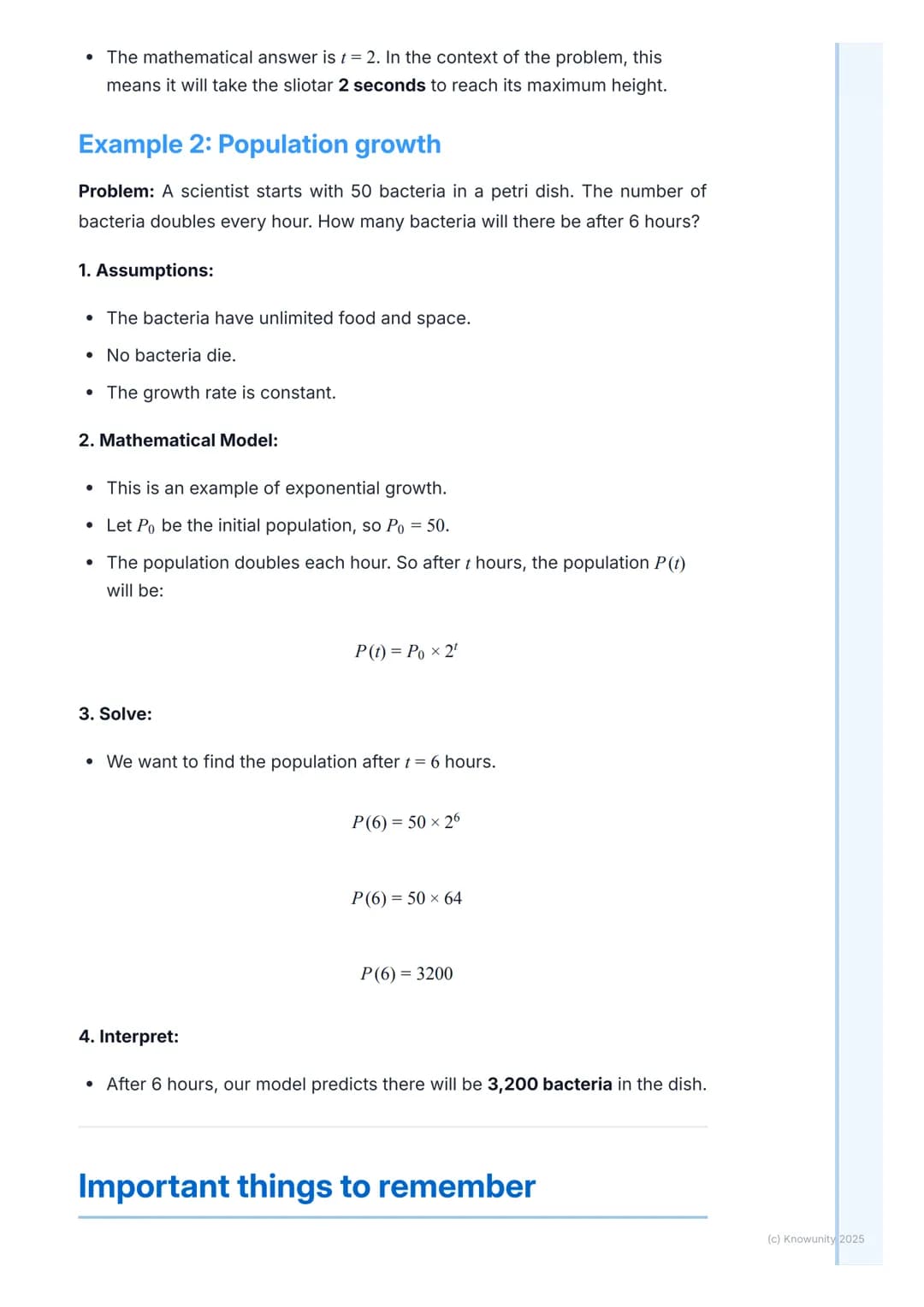
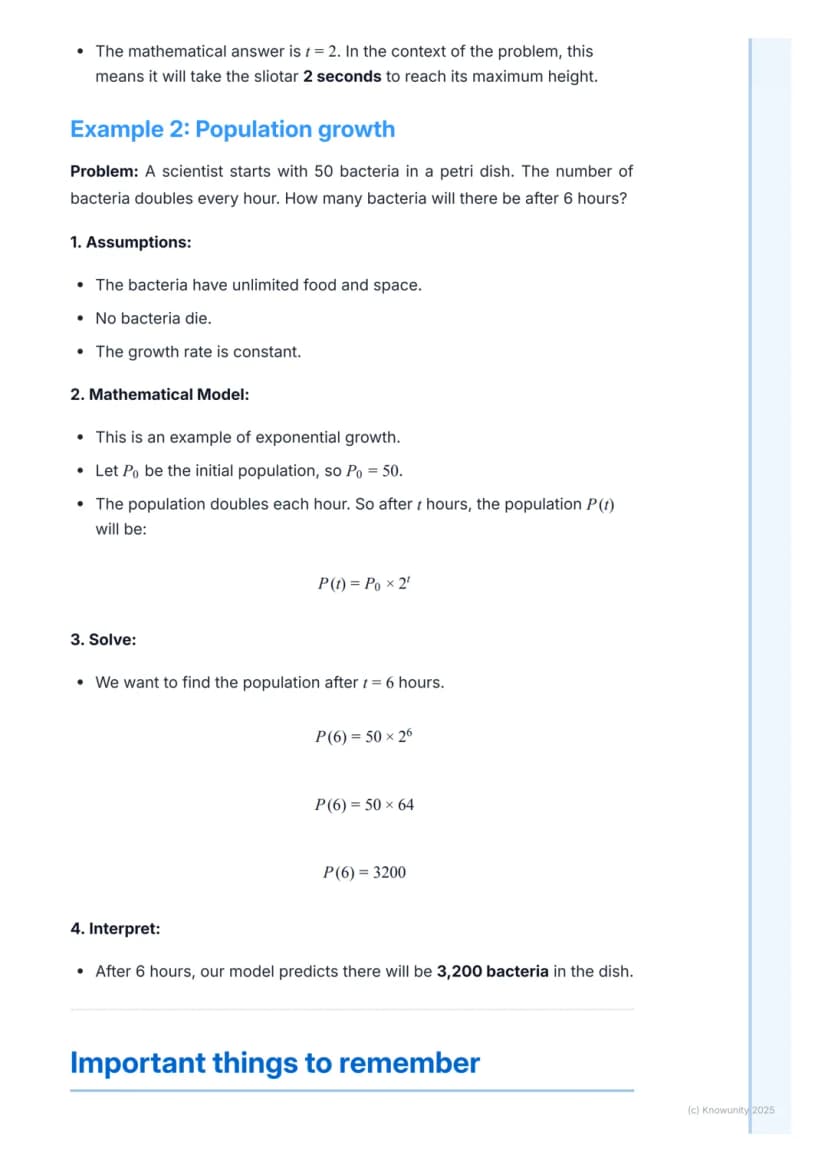
Population Growth Example
Applied mathematics also tackles biological problems brilliantly. Consider: 50 bacteria double every hour - how many after 6 hours?
Our assumptions include unlimited food, no deaths, and constant growth rate. The mathematical model for this exponential growth is P(t) = P₀ × 2ᵗ, where P₀ = 50 bacteria and t = time in hours.
Solving: P(6) = 50 × 2⁶ = 50 × 64 = 3,200 bacteria. The interpretation shows how quickly bacterial populations can explode under ideal conditions.
This example demonstrates how mathematical modelling applies across different fields - from sports physics to biological sciences. The same systematic approach works whether you're dealing with projectiles or populations.
Important: Notice how different real-world situations need completely different mathematical models!
6
of 6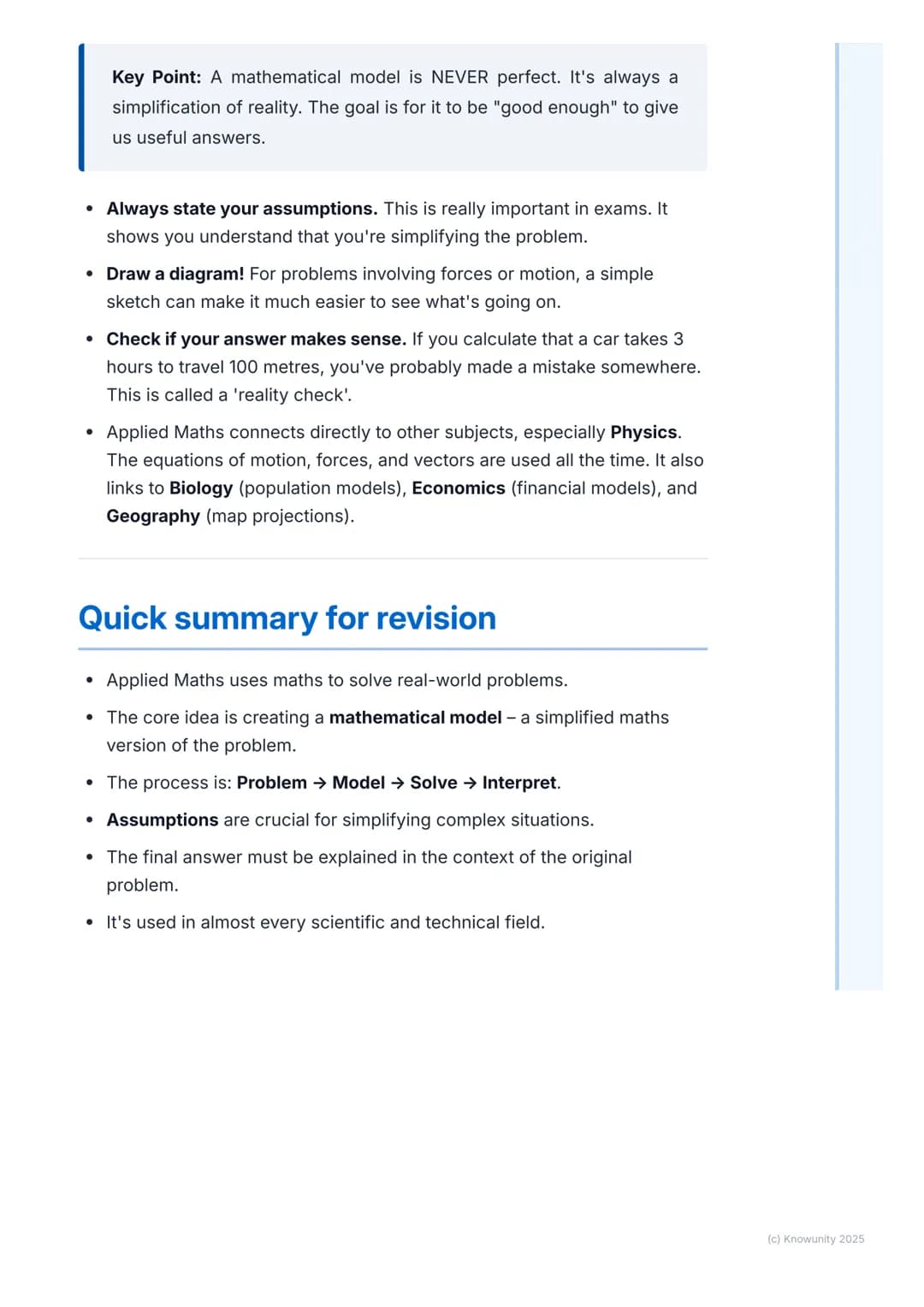
Key Points for Success
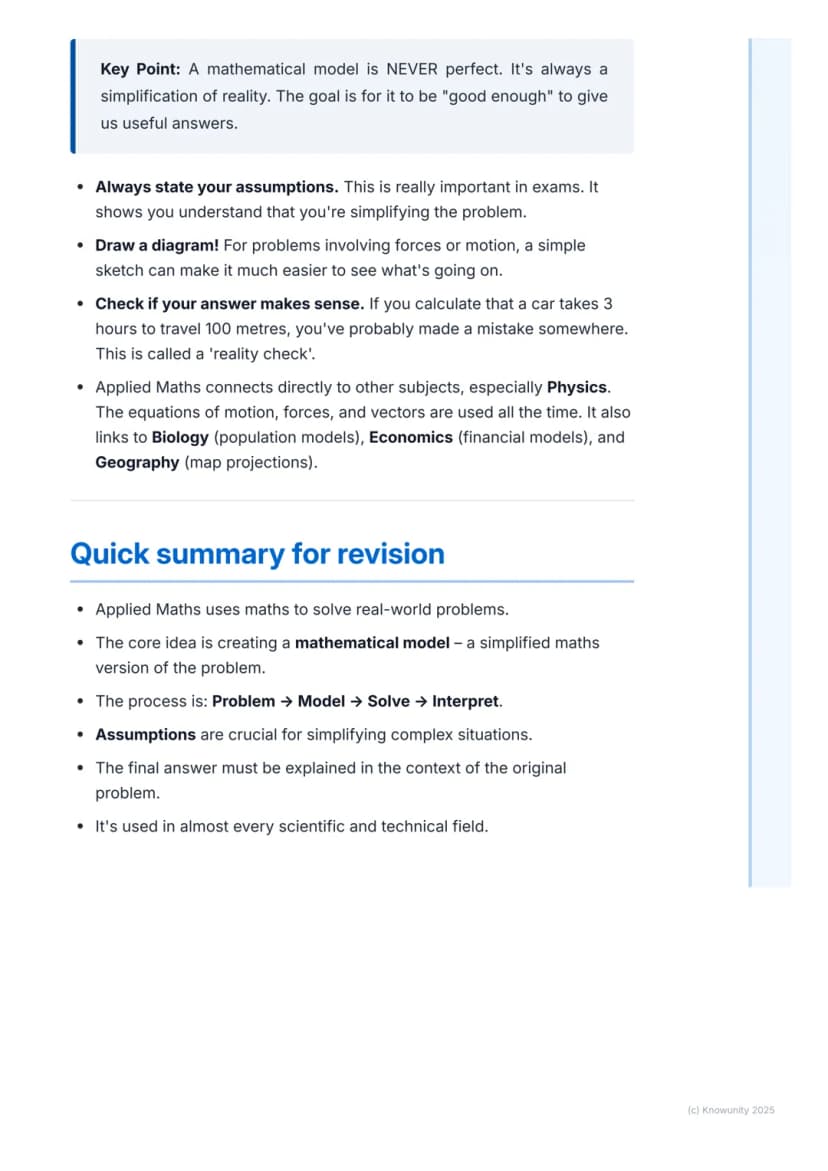
Remember that mathematical models are never perfect - they're always simplified versions of reality. The goal is making them "good enough" to provide useful answers, not to capture every tiny detail.
Always state your assumptions clearly and draw diagrams for physics problems. Your applied mathematics solutions should pass the reality check - if a car supposedly takes 3 hours to travel 100 metres, something's gone wrong!
Applied mathematics connects directly to Physics (motion and forces), Biology (population models), Economics (financial planning), and Geography (map projections). It's the bridge between classroom maths and real-world problem-solving.
The core process remains constant: Problem → Model → Solve → Interpret. Master this cycle, and you'll be able to tackle everything from engineering challenges to environmental predictions.
Exam success tip: Always explain your final answer in the context of the original problem - numbers alone aren't enough!
Pensavamo che non l'avreste mai chiesto....
Che cos'è l'assistente AI di Knowunity?
Il nostro assistente AI è costruito specificamente per le esigenze degli studenti. Sulla base dei milioni di contenuti presenti sulla piattaforma, possiamo fornire agli studenti risposte davvero significative e pertinenti. Ma non si tratta solo di risposte, l'assistente è in grado di guidare gli studenti attraverso le loro sfide quotidiane di studio, con piani di studio personalizzati, quiz o contenuti nella chat e una personalizzazione al 100% basata sulle competenze e sugli sviluppi degli studenti.
Dove posso scaricare l'applicazione Knowunity?
È possibile scaricare l'applicazione dal Google Play Store e dall'Apple App Store.
Knowunity è davvero gratuita?
Sì, hai accesso completamente gratuito a tutti i contenuti nell'app e puoi chattare o seguire i Creatori in qualsiasi momento. Sbloccherai nuove funzioni crescendo il tuo numero di follower. Inoltre, offriamo Knowunity Premium, che consente di studiare senza alcun limite!!
Non c'è niente di adatto? Esplorare altre aree tematiche.
Recensioni dei nostri utenti. Ci adorano - e anche tu, vedrai .
4.6/5App Store
4.7/5Google Play
L'applicazione è molto facile da usare e ben progettata. Finora ho trovato tutto quello che cercavo e ho potuto imparare molto dalle presentazioni! Utilizzerò sicuramente l'app per i compiti in classe! È molto utile anche come fonte di ispirazione.
Stefano Sutente iOS
Questa applicazione è davvero grande! Ci sono tantissimi appunti e aiuti con lo studio [...]. La mia materia problematica, per esempio, è il francese e l'app ha così tante opzioni per aiutarmi. Grazie a questa app ho migliorato il mio francese. La consiglio a tutti.
Samantha Klichutente Android
Wow, sono davvero stupita. Ho appena provato l'app perché l'ho vista pubblicizzata molte volte e sono rimasta assolutamente sbalordita. Questa app è L'AIUTO che cercate per la scuola e soprattutto offre tantissime cose, come allenamenti e schede, che a me personalmente sono state MOLTO utili.
Annautente iOS
Applied Mathematics11 visualizzazioni·Aggiornato Jun 11, 2026·6 pagineExploring Applied Mathematics: Tools for Real-World Problems
Applied Mathematics is basically using the maths you learn in class to solve real-world problems - from designing rollercoasters to predicting weather patterns. Think of it as being a detective where your main tool is maths instead of a magnifying...
1
of 6
Iscriviti per mostrare il contenuto. È gratis!
- Accesso a tutti i documenti
- Migliora i tuoi voti
- Unisciti a milioni di studenti
What is Applied Mathematics?
Ever wondered why you're learning algebra or trigonometry? Applied Mathematics is the answer - it's about taking those classroom concepts and using them to solve actual problems in the real world.
Unlike Pure Mathematics (which explores mathematical concepts just for the sake of it), applied maths has a clear goal: solve something practical. Whether it's figuring out the best angle for a football free kick or helping companies make more profit, you're always working towards a real solution.
The secret weapon in applied maths is the mathematical model - basically a simplified maths version of a complex real-world situation. Since the real world is incredibly messy and complicated, we create these models using equations and variables to make problems manageable.
Remember: Pure maths asks "What if?" whilst applied maths asks "How can we fix this?"
2
of 6Iscriviti per mostrare il contenuto. È gratis!
- Accesso a tutti i documenti
- Migliora i tuoi voti
- Unisciti a milioni di studenti
The Applied Mathematics Process
Solving problems with applied mathematics follows a clear cycle that you'll use again and again. It's like having a recipe for tackling any real-world challenge.
The process starts with a real-world problem and moves through several stages: making assumptions, creating a mathematical model, solving it, and interpreting your results. Think of it as translating between two languages - from real life to maths, then back to real life.
This modelling cycle is crucial because it shows that applied maths isn't just about getting the right answer. It's about understanding whether that answer actually makes sense in the original situation.
Key insight: The cycle often repeats - if your answer seems wrong, you go back and refine your model!
3
of 6Iscriviti per mostrare il contenuto. È gratis!
- Accesso a tutti i documenti
- Migliora i tuoi voti
- Unisciti a milioni di studenti
Breaking Down the Steps
Let's follow the mathematical modelling process with a simple example: "How high will a ball go if I throw it upwards at 10 metres per second?"
First, you identify the problem clearly. Then comes the crucial step of making assumptions - this is where you simplify reality. For our ball, we'll ignore air resistance and assume only gravity affects it.
Next, you create a mathematical model using equations. Here, we'd use physics equations like v² = u² + 2as, where the letters represent velocity, acceleration, and displacement. After solving the maths (plugging in numbers and calculating), you get a numerical answer.
The final steps are interpreting your solution and validating it . If something seems off, you might need to revisit your assumptions.
Pro tip: Always state your assumptions clearly in exams - it shows you understand that you're simplifying a complex problem!
4
of 6Iscriviti per mostrare il contenuto. È gratis!
- Accesso a tutti i documenti
- Migliora i tuoi voti
- Unisciti a milioni di studenti
Worked Example: Hurling Physics
Here's how applied mathematics works with a proper Irish example: A hurler strikes a sliotar with an initial vertical velocity of 19.6 m/s. How long until it reaches maximum height?
Starting with assumptions: we ignore air resistance and only consider gravity . Our mathematical model uses the equation v = u + at, where v (final velocity) = 0 at maximum height, u (initial velocity) = 19.6 m/s, and a (acceleration) = -9.8 m/s².
Solving the equation: 0 = 19.6 + (-9.8)t, which rearranges to t = 19.6/9.8 = 2. The interpretation is straightforward: the sliotar takes 2 seconds to reach its maximum height.
This demonstrates how mathematical modelling transforms a sports scenario into a solvable equation, then translates the numerical result back into practical knowledge.
Reality check: Does 2 seconds seem reasonable for a sliotar to reach its peak? Trust your instincts!
5
of 6Iscriviti per mostrare il contenuto. È gratis!
- Accesso a tutti i documenti
- Migliora i tuoi voti
- Unisciti a milioni di studenti
Population Growth Example
Applied mathematics also tackles biological problems brilliantly. Consider: 50 bacteria double every hour - how many after 6 hours?
Our assumptions include unlimited food, no deaths, and constant growth rate. The mathematical model for this exponential growth is P(t) = P₀ × 2ᵗ, where P₀ = 50 bacteria and t = time in hours.
Solving: P(6) = 50 × 2⁶ = 50 × 64 = 3,200 bacteria. The interpretation shows how quickly bacterial populations can explode under ideal conditions.
This example demonstrates how mathematical modelling applies across different fields - from sports physics to biological sciences. The same systematic approach works whether you're dealing with projectiles or populations.
Important: Notice how different real-world situations need completely different mathematical models!
6
of 6Iscriviti per mostrare il contenuto. È gratis!
- Accesso a tutti i documenti
- Migliora i tuoi voti
- Unisciti a milioni di studenti
Key Points for Success
Remember that mathematical models are never perfect - they're always simplified versions of reality. The goal is making them "good enough" to provide useful answers, not to capture every tiny detail.
Always state your assumptions clearly and draw diagrams for physics problems. Your applied mathematics solutions should pass the reality check - if a car supposedly takes 3 hours to travel 100 metres, something's gone wrong!
Applied mathematics connects directly to Physics (motion and forces), Biology (population models), Economics (financial planning), and Geography (map projections). It's the bridge between classroom maths and real-world problem-solving.
The core process remains constant: Problem → Model → Solve → Interpret. Master this cycle, and you'll be able to tackle everything from engineering challenges to environmental predictions.
Exam success tip: Always explain your final answer in the context of the original problem - numbers alone aren't enough!
Pensavamo che non l'avreste mai chiesto....
Che cos'è l'assistente AI di Knowunity?
Il nostro assistente AI è costruito specificamente per le esigenze degli studenti. Sulla base dei milioni di contenuti presenti sulla piattaforma, possiamo fornire agli studenti risposte davvero significative e pertinenti. Ma non si tratta solo di risposte, l'assistente è in grado di guidare gli studenti attraverso le loro sfide quotidiane di studio, con piani di studio personalizzati, quiz o contenuti nella chat e una personalizzazione al 100% basata sulle competenze e sugli sviluppi degli studenti.
Dove posso scaricare l'applicazione Knowunity?
È possibile scaricare l'applicazione dal Google Play Store e dall'Apple App Store.
Knowunity è davvero gratuita?
Sì, hai accesso completamente gratuito a tutti i contenuti nell'app e puoi chattare o seguire i Creatori in qualsiasi momento. Sbloccherai nuove funzioni crescendo il tuo numero di follower. Inoltre, offriamo Knowunity Premium, che consente di studiare senza alcun limite!!
Non c'è niente di adatto? Esplorare altre aree tematiche.
Recensioni dei nostri utenti. Ci adorano - e anche tu, vedrai .
4.6/5App Store
4.7/5Google Play
L'applicazione è molto facile da usare e ben progettata. Finora ho trovato tutto quello che cercavo e ho potuto imparare molto dalle presentazioni! Utilizzerò sicuramente l'app per i compiti in classe! È molto utile anche come fonte di ispirazione.
Stefano Sutente iOS
Questa applicazione è davvero grande! Ci sono tantissimi appunti e aiuti con lo studio [...]. La mia materia problematica, per esempio, è il francese e l'app ha così tante opzioni per aiutarmi. Grazie a questa app ho migliorato il mio francese. La consiglio a tutti.
Samantha Klichutente Android
Wow, sono davvero stupita. Ho appena provato l'app perché l'ho vista pubblicizzata molte volte e sono rimasta assolutamente sbalordita. Questa app è L'AIUTO che cercate per la scuola e soprattutto offre tantissime cose, come allenamenti e schede, che a me personalmente sono state MOLTO utili.
Annautente iOS