
Your soil isn't just mud - it's actually a bustling... Mostra di più
 Agricultural Science5 visualizzazioni·Aggiornato Jun 4, 2026·8 pagine
Understanding Soil's Biological Properties and Benefits


1 / 8
1
of 8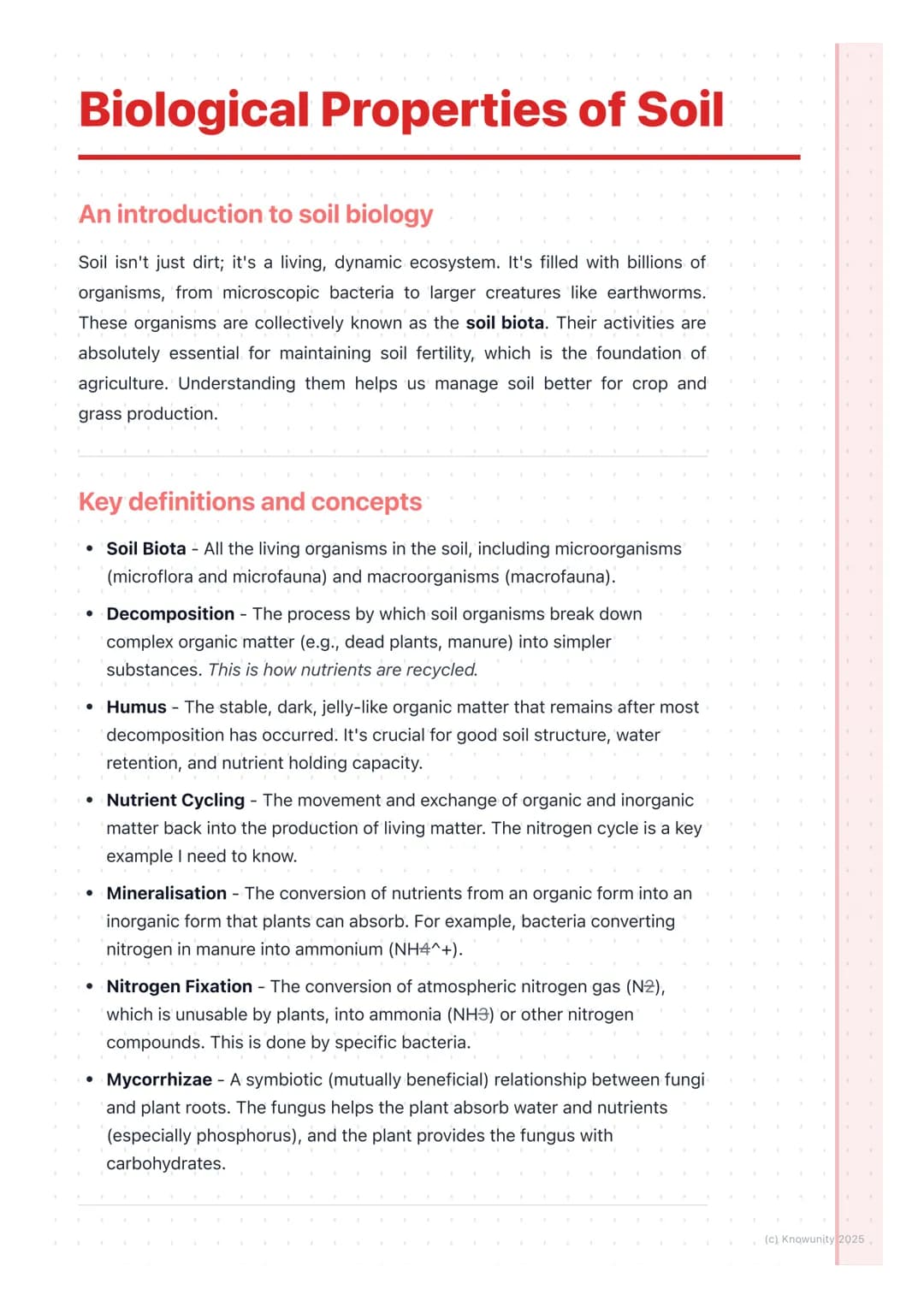
What Makes Soil Alive?
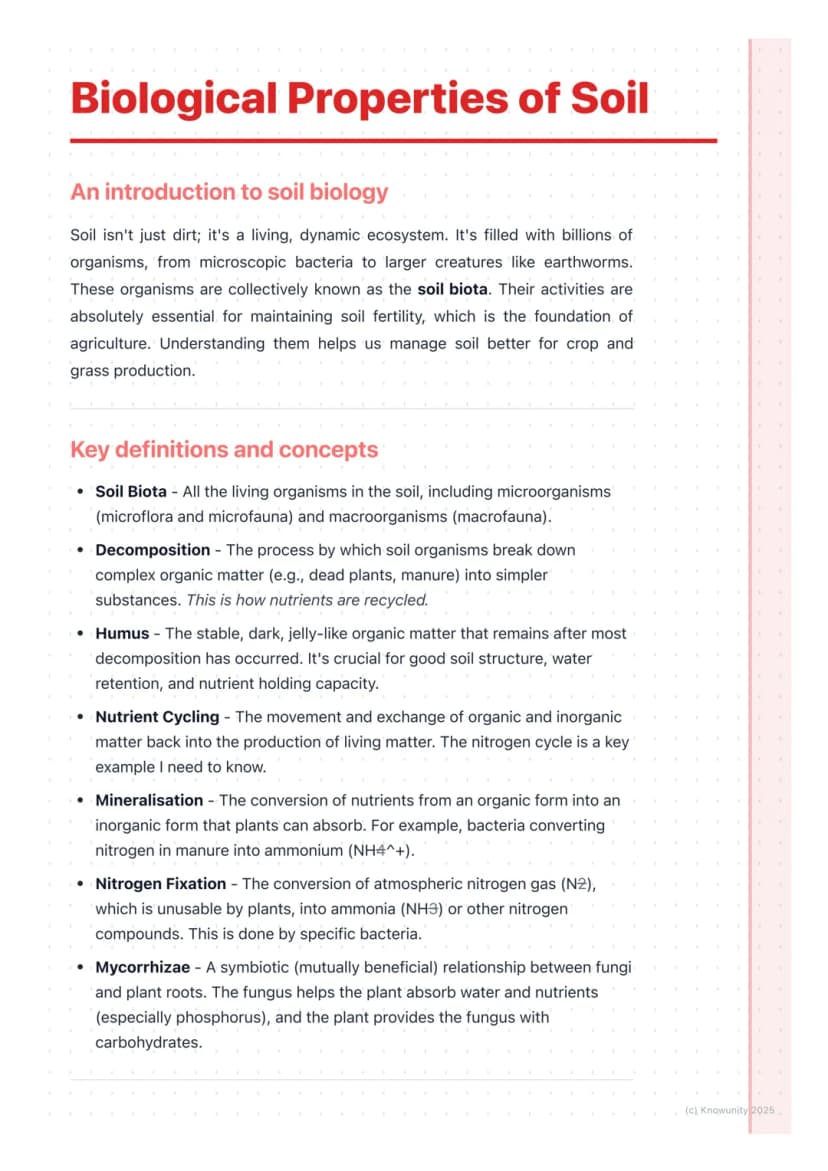
Think of soil as nature's recycling centre - it's packed with living organisms called soil biota that work 24/7 to keep everything running smoothly. These tiny workers include bacteria smaller than you can imagine and larger creatures like earthworms that you can actually see.
Decomposition is their main job - breaking down dead leaves, manure, and organic waste into simple nutrients that plants can actually use. It's like having a massive composting operation happening right under your feet.
The end result is humus - that dark, rich stuff that makes soil look healthy. This jelly-like material holds water brilliantly and acts like a nutrient bank for plants. Nutrient cycling keeps everything moving through the system, especially nitrogen, which plants desperately need to grow.
Key Point: Healthy soil biology = healthy crops. It's that simple!
Some bacteria even perform nitrogen fixation, converting useless atmospheric nitrogen into forms plants can absorb. Meanwhile, mycorrhizae are fungi that team up with plant roots in a win-win partnership - the fungi help plants grab nutrients whilst getting sugars in return.
2
of 8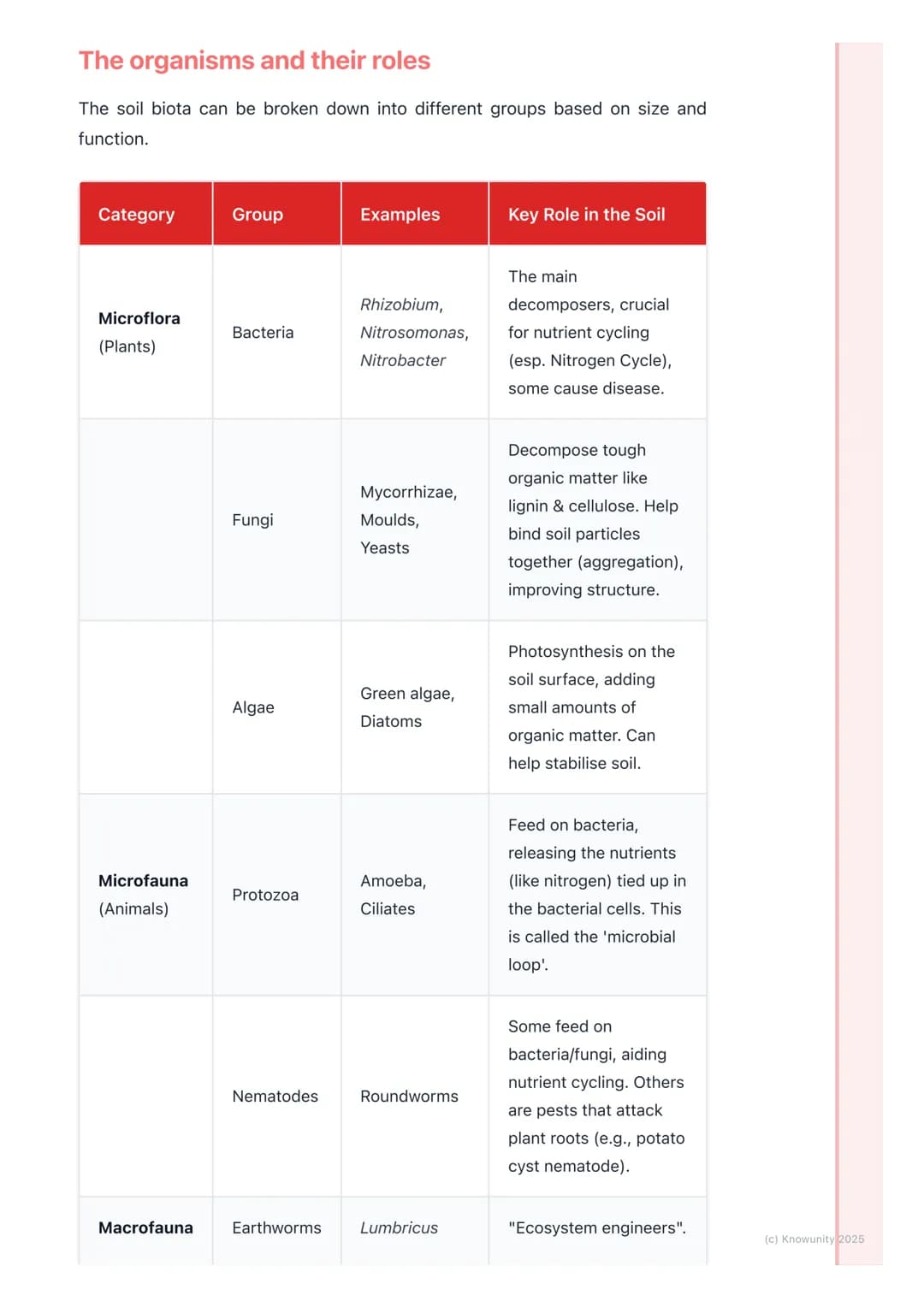
Meet the Underground Workers
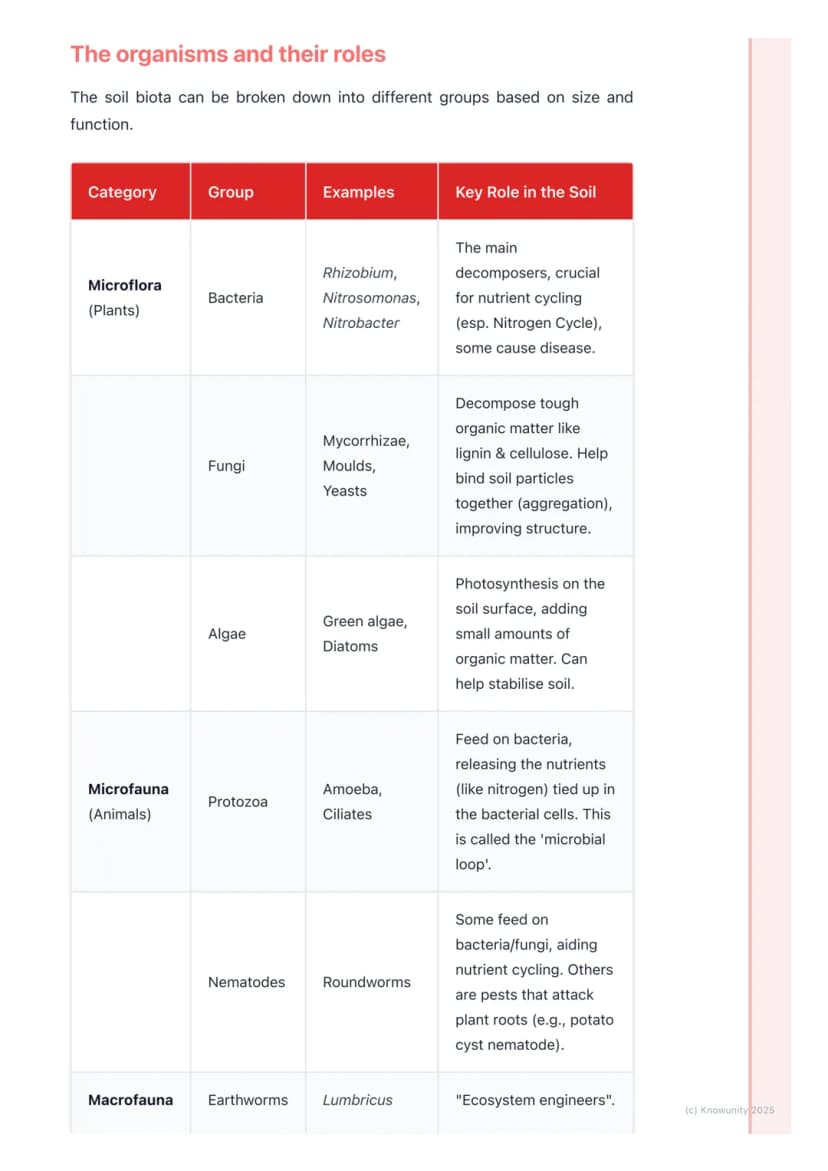
The soil biota are organised like a proper workforce, each group with specific jobs. Bacteria are the main decomposers - they're absolutely crucial for the nitrogen cycle and breaking down organic matter, though some can cause plant diseases.
Fungi tackle the tough stuff like wood fibres that bacteria can't handle. They also act like natural glue, sticking soil particles together to create better soil structure. Think of them as the construction crew of the soil world.
Protozoa are the quality controllers - they eat bacteria and release the nutrients locked inside bacterial cells. This process, called the 'microbial loop', keeps nutrients flowing freely through the system.
Remember: Each organism has a specific role - remove one group and the whole system struggles!
Earthworms are the superstars here. They're like underground engineers, creating tunnels for air and water whilst mixing different soil layers. Their droppings (called casts) are packed with nutrients that plants love.
3
of 8
The Soil Food Web in Action
Arthropods like beetles and mites work as the shredding crew, breaking large organic matter into smaller pieces so bacteria and fungi can finish the job. Their tunnelling also helps air move through the soil.
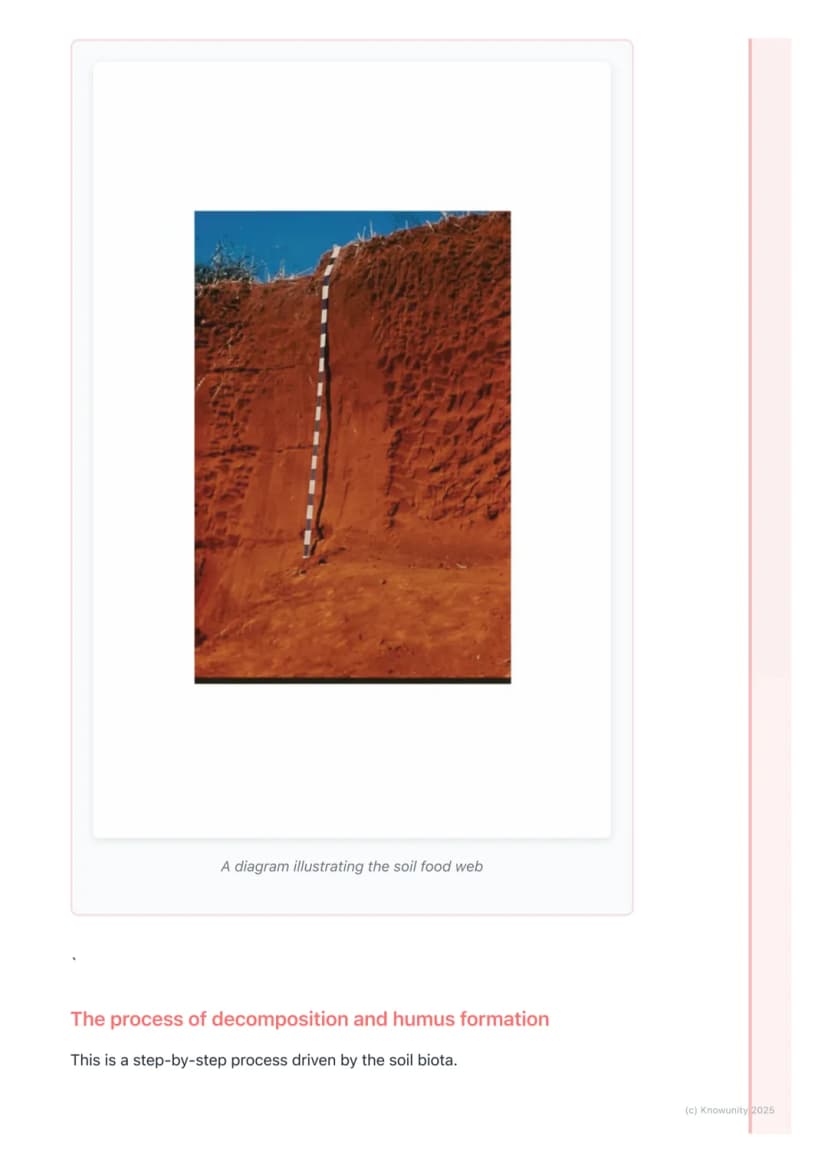
This creates a complex soil food web where everyone depends on someone else. Larger creatures break things down, smaller microbes finish the decomposition, and nutrients get recycled back to feed new plant growth.
The process starts with fragmentation - big pieces of dead material get physically chopped up by earthworms and insects. This increases the surface area so microbes can get to work more easily.
Think of it like this: It's easier to dissolve sugar cubes if you crush them first - same principle applies in soil!
4
of 8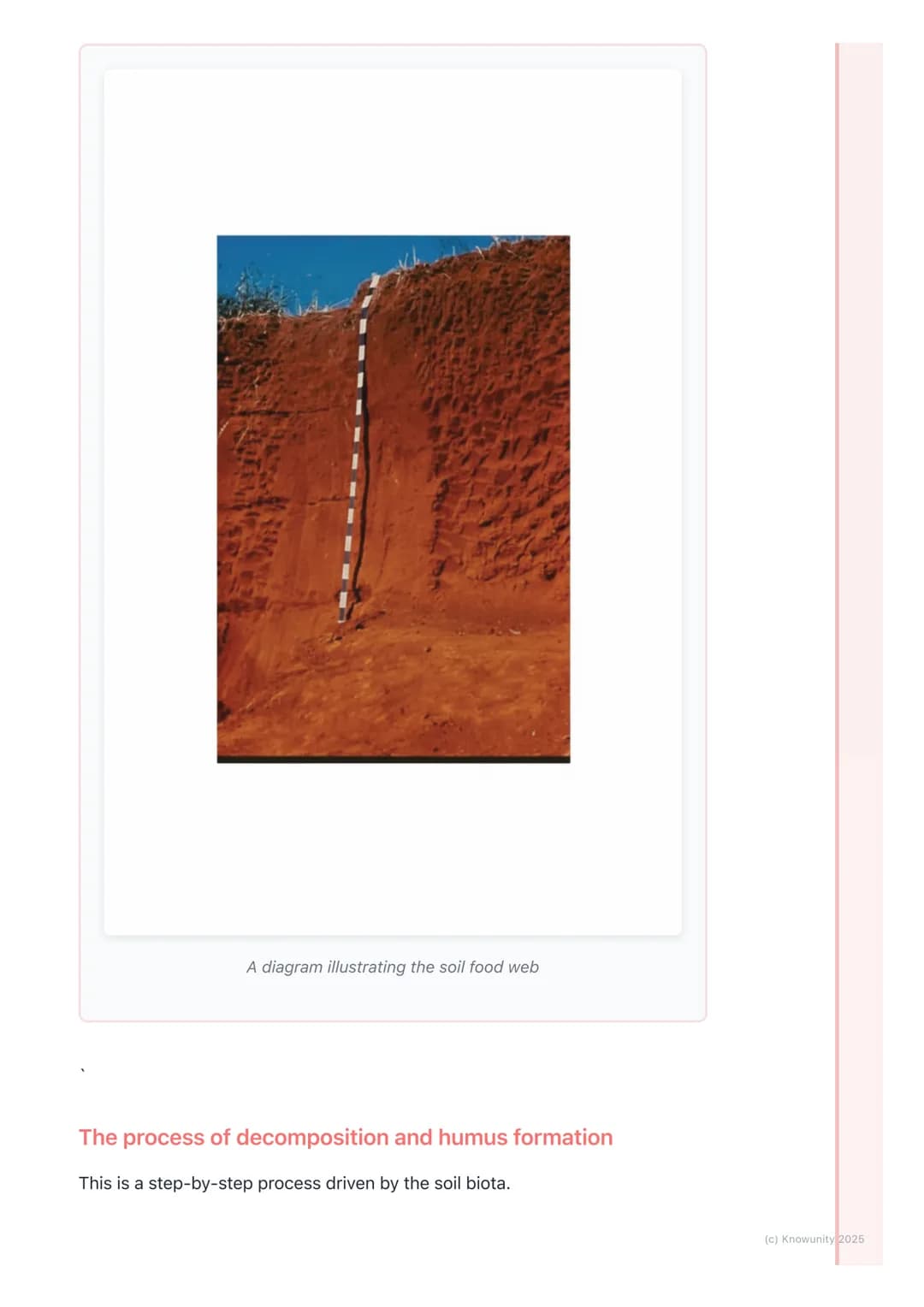
How Decomposition Actually Works
Chemical decomposition kicks in next, with bacteria and fungi releasing enzymes that break down complex molecules. It's like having millions of tiny chemical factories working simultaneously.
Mineralisation is where the magic happens - microbes release simple nutrients like nitrates and phosphates that plants can immediately absorb. Without this process, all those expensive fertilisers would be pointless.
Not everything gets fully broken down though. Humification transforms the toughest materials into stable humus - that dark, nutrient-rich material that makes soil so valuable for farming.
Exam Tip: Remember the sequence - fragmentation, chemical decomposition, mineralisation, humification!
5
of 8
The Nitrogen Cycle Explained
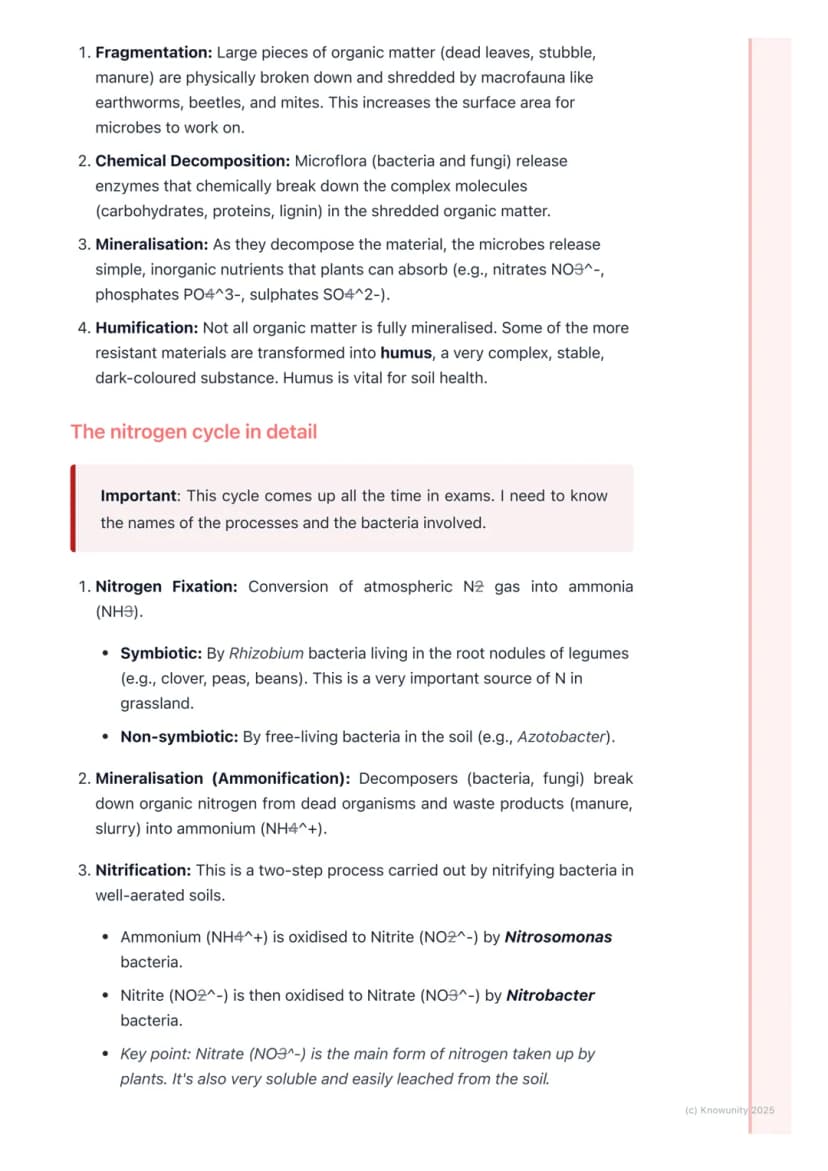
This is massive for your exams, so pay attention! Nitrogen fixation converts useless atmospheric nitrogen into ammonia that plants can use. Rhizobium bacteria living in clover and bean roots do this job brilliantly - it's why farmers love growing legumes.
Mineralisation breaks down organic nitrogen from manure and dead plants into ammonium. Then nitrification takes over - a two-step process where Nitrosomonas bacteria convert ammonium to nitrite, and Nitrobacter bacteria convert nitrite to nitrate.
Nitrate is what plants really want, but it's also easily washed away by rain. That's why timing fertiliser applications matters so much in farming.
Memory Trick: Rhizobium fixes, Nitrosomonas starts nitrification, Nitrobacter finishes it!
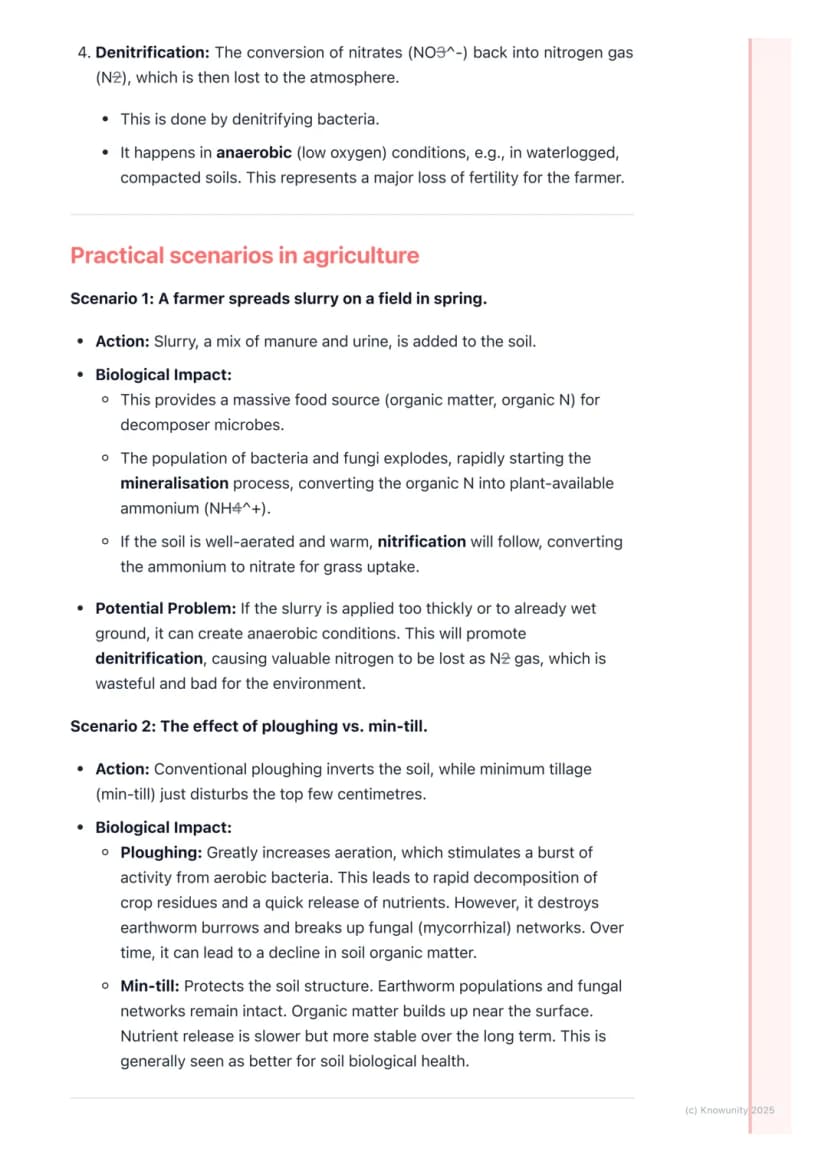
Denitrification is the villain here - it converts valuable nitrates back into nitrogen gas that escapes to the atmosphere. This happens in waterlogged, compacted soils and represents a massive loss for farmers.
6
of 8
Real Farm Scenarios
When farmers spread slurry in spring, they're basically throwing a massive party for soil microbes. The organic matter provides food, causing bacterial populations to explode and rapidly release nutrients for grass growth.
However, apply too much slurry to wet ground and you'll create anaerobic conditions. This promotes denitrification, causing valuable nitrogen to escape as gas - wasteful and environmentally damaging.
Ploughing versus minimum tillage shows how farming practices affect soil biology. Ploughing increases aeration and gives a quick nutrient burst, but destroys earthworm burrows and fungal networks.
Modern Thinking: Min-till protects soil structure and builds long-term biological health, even if nutrient release is slower initially.
7
of 8
Keeping Soil Biology Healthy
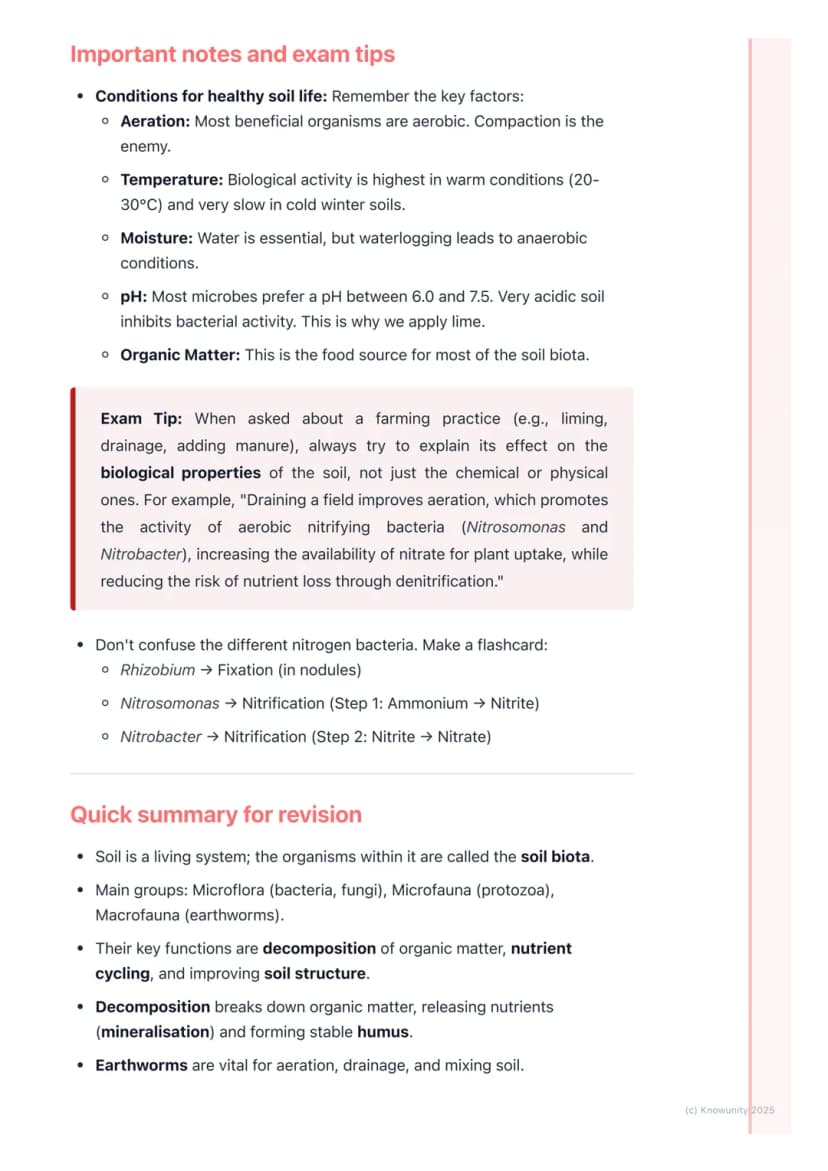
Your soil organisms need the right conditions to thrive. Aeration is crucial - most beneficial organisms need oxygen, so compaction kills soil life. Temperature matters too - biological activity peaks at 20-30°C and nearly stops in winter.
Moisture is essential but waterlogging creates anaerobic conditions that favour harmful processes. pH between 6.0-7.5 keeps most microbes happy - very acidic soil kills beneficial bacteria, which is why farmers apply lime.
Organic matter is literally food for soil life. No organic matter means no biological activity, which means poor nutrient cycling and soil structure.
Exam Success: Always explain how farming practices affect soil biology, not just chemistry or physics!
Remember your nitrogen bacteria: Rhizobium fixes nitrogen, Nitrosomonas starts nitrification, Nitrobacter completes it. Get these mixed up and you'll lose marks.
8
of 8
Quick Revision Summary
Soil biota includes microflora (bacteria, fungi), microfauna (protozoa), and macrofauna (earthworms). Their main jobs are decomposition, nutrient cycling, and improving soil structure.
The nitrogen cycle flows from fixation to mineralisation to nitrification to denitrification. Each step involves specific bacteria that you need to know for exams.
Good farm management creates ideal conditions for beneficial soil organisms by avoiding compaction, maintaining proper pH, and regularly adding organic matter.
Bottom Line: Healthy soil biology = productive farming. Everything else builds from this foundation!
Pensavamo che non l'avreste mai chiesto....
Che cos'è l'assistente AI di Knowunity?
Il nostro assistente AI è costruito specificamente per le esigenze degli studenti. Sulla base dei milioni di contenuti presenti sulla piattaforma, possiamo fornire agli studenti risposte davvero significative e pertinenti. Ma non si tratta solo di risposte, l'assistente è in grado di guidare gli studenti attraverso le loro sfide quotidiane di studio, con piani di studio personalizzati, quiz o contenuti nella chat e una personalizzazione al 100% basata sulle competenze e sugli sviluppi degli studenti.
Dove posso scaricare l'applicazione Knowunity?
È possibile scaricare l'applicazione dal Google Play Store e dall'Apple App Store.
Knowunity è davvero gratuita?
Sì, hai accesso completamente gratuito a tutti i contenuti nell'app e puoi chattare o seguire i Creatori in qualsiasi momento. Sbloccherai nuove funzioni crescendo il tuo numero di follower. Inoltre, offriamo Knowunity Premium, che consente di studiare senza alcun limite!!
Contenuti più popolari
9 Irish
IrishIrish oral questions and answers
Questions and answers for the leaving cert oral
5th Year4264
 English
Key Quotes : Sive
Key Quotes and explanations: Sive
6th Year2842
IrishIrish oral questions
Outline of oral questions
5th Year2055
IrishIníon- le hÁine Durkin
Aine Durkin’s poem, Iníon: Themes & summary
5th Year850
IrishIrish poetry 2027
Iníon + Dínit an Bhróin
5th Year1133
IrishLC HL notes- Iníon (poem)
Includes poem in English and Irish, theme, key words & phrases
5th Year2284
EnglishCultural Context : Shawshank Redemption : Sive : Small Things Like These
Comparative Study : Cultural Context : Shawshank Redemption, Sive and Small Things Like These
6th Year1430
IrishMo Ghrá-sa (Idir Lúibíní)
Notes on mo ghrá-sa
5th Year380
IrishAn Gaeilge Aiste
Irish Language essay
6th Year1320
Non c'è niente di adatto? Esplorare altre aree tematiche.
Recensioni dei nostri utenti. Ci adorano - e anche tu, vedrai .
4.6/5App Store
4.7/5Google Play
L'applicazione è molto facile da usare e ben progettata. Finora ho trovato tutto quello che cercavo e ho potuto imparare molto dalle presentazioni! Utilizzerò sicuramente l'app per i compiti in classe! È molto utile anche come fonte di ispirazione.
Stefano Sutente iOS
Questa applicazione è davvero grande! Ci sono tantissimi appunti e aiuti con lo studio [...]. La mia materia problematica, per esempio, è il francese e l'app ha così tante opzioni per aiutarmi. Grazie a questa app ho migliorato il mio francese. La consiglio a tutti.
Samantha Klichutente Android
Wow, sono davvero stupita. Ho appena provato l'app perché l'ho vista pubblicizzata molte volte e sono rimasta assolutamente sbalordita. Questa app è L'AIUTO che cercate per la scuola e soprattutto offre tantissime cose, come allenamenti e schede, che a me personalmente sono state MOLTO utili.
Annautente iOS
Agricultural Science5 visualizzazioni·Aggiornato Jun 4, 2026·8 pagineUnderstanding Soil's Biological Properties and Benefits
Your soil isn't just mud - it's actually a bustling underground city teeming with billions of tiny workers! These microscopic bacteria, fungi, earthworms and other creatures are constantly breaking down dead material, recycling nutrients, and keeping your soil healthy for... Mostra di più
1
of 8Iscriviti per mostrare il contenuto. È gratis!
- Accesso a tutti i documenti
- Migliora i tuoi voti
- Unisciti a milioni di studenti
What Makes Soil Alive?
Think of soil as nature's recycling centre - it's packed with living organisms called soil biota that work 24/7 to keep everything running smoothly. These tiny workers include bacteria smaller than you can imagine and larger creatures like earthworms that you can actually see.
Decomposition is their main job - breaking down dead leaves, manure, and organic waste into simple nutrients that plants can actually use. It's like having a massive composting operation happening right under your feet.
The end result is humus - that dark, rich stuff that makes soil look healthy. This jelly-like material holds water brilliantly and acts like a nutrient bank for plants. Nutrient cycling keeps everything moving through the system, especially nitrogen, which plants desperately need to grow.
Key Point: Healthy soil biology = healthy crops. It's that simple!
Some bacteria even perform nitrogen fixation, converting useless atmospheric nitrogen into forms plants can absorb. Meanwhile, mycorrhizae are fungi that team up with plant roots in a win-win partnership - the fungi help plants grab nutrients whilst getting sugars in return.
2
of 8Iscriviti per mostrare il contenuto. È gratis!
- Accesso a tutti i documenti
- Migliora i tuoi voti
- Unisciti a milioni di studenti
Meet the Underground Workers
The soil biota are organised like a proper workforce, each group with specific jobs. Bacteria are the main decomposers - they're absolutely crucial for the nitrogen cycle and breaking down organic matter, though some can cause plant diseases.
Fungi tackle the tough stuff like wood fibres that bacteria can't handle. They also act like natural glue, sticking soil particles together to create better soil structure. Think of them as the construction crew of the soil world.
Protozoa are the quality controllers - they eat bacteria and release the nutrients locked inside bacterial cells. This process, called the 'microbial loop', keeps nutrients flowing freely through the system.
Remember: Each organism has a specific role - remove one group and the whole system struggles!
Earthworms are the superstars here. They're like underground engineers, creating tunnels for air and water whilst mixing different soil layers. Their droppings (called casts) are packed with nutrients that plants love.
3
of 8Iscriviti per mostrare il contenuto. È gratis!
- Accesso a tutti i documenti
- Migliora i tuoi voti
- Unisciti a milioni di studenti
The Soil Food Web in Action
Arthropods like beetles and mites work as the shredding crew, breaking large organic matter into smaller pieces so bacteria and fungi can finish the job. Their tunnelling also helps air move through the soil.
This creates a complex soil food web where everyone depends on someone else. Larger creatures break things down, smaller microbes finish the decomposition, and nutrients get recycled back to feed new plant growth.
The process starts with fragmentation - big pieces of dead material get physically chopped up by earthworms and insects. This increases the surface area so microbes can get to work more easily.
Think of it like this: It's easier to dissolve sugar cubes if you crush them first - same principle applies in soil!
4
of 8Iscriviti per mostrare il contenuto. È gratis!
- Accesso a tutti i documenti
- Migliora i tuoi voti
- Unisciti a milioni di studenti
How Decomposition Actually Works
Chemical decomposition kicks in next, with bacteria and fungi releasing enzymes that break down complex molecules. It's like having millions of tiny chemical factories working simultaneously.
Mineralisation is where the magic happens - microbes release simple nutrients like nitrates and phosphates that plants can immediately absorb. Without this process, all those expensive fertilisers would be pointless.
Not everything gets fully broken down though. Humification transforms the toughest materials into stable humus - that dark, nutrient-rich material that makes soil so valuable for farming.
Exam Tip: Remember the sequence - fragmentation, chemical decomposition, mineralisation, humification!
5
of 8Iscriviti per mostrare il contenuto. È gratis!
- Accesso a tutti i documenti
- Migliora i tuoi voti
- Unisciti a milioni di studenti
The Nitrogen Cycle Explained
This is massive for your exams, so pay attention! Nitrogen fixation converts useless atmospheric nitrogen into ammonia that plants can use. Rhizobium bacteria living in clover and bean roots do this job brilliantly - it's why farmers love growing legumes.
Mineralisation breaks down organic nitrogen from manure and dead plants into ammonium. Then nitrification takes over - a two-step process where Nitrosomonas bacteria convert ammonium to nitrite, and Nitrobacter bacteria convert nitrite to nitrate.
Nitrate is what plants really want, but it's also easily washed away by rain. That's why timing fertiliser applications matters so much in farming.
Memory Trick: Rhizobium fixes, Nitrosomonas starts nitrification, Nitrobacter finishes it!
Denitrification is the villain here - it converts valuable nitrates back into nitrogen gas that escapes to the atmosphere. This happens in waterlogged, compacted soils and represents a massive loss for farmers.
6
of 8Iscriviti per mostrare il contenuto. È gratis!
- Accesso a tutti i documenti
- Migliora i tuoi voti
- Unisciti a milioni di studenti
Real Farm Scenarios
When farmers spread slurry in spring, they're basically throwing a massive party for soil microbes. The organic matter provides food, causing bacterial populations to explode and rapidly release nutrients for grass growth.
However, apply too much slurry to wet ground and you'll create anaerobic conditions. This promotes denitrification, causing valuable nitrogen to escape as gas - wasteful and environmentally damaging.
Ploughing versus minimum tillage shows how farming practices affect soil biology. Ploughing increases aeration and gives a quick nutrient burst, but destroys earthworm burrows and fungal networks.
Modern Thinking: Min-till protects soil structure and builds long-term biological health, even if nutrient release is slower initially.
7
of 8Iscriviti per mostrare il contenuto. È gratis!
- Accesso a tutti i documenti
- Migliora i tuoi voti
- Unisciti a milioni di studenti
Keeping Soil Biology Healthy
Your soil organisms need the right conditions to thrive. Aeration is crucial - most beneficial organisms need oxygen, so compaction kills soil life. Temperature matters too - biological activity peaks at 20-30°C and nearly stops in winter.
Moisture is essential but waterlogging creates anaerobic conditions that favour harmful processes. pH between 6.0-7.5 keeps most microbes happy - very acidic soil kills beneficial bacteria, which is why farmers apply lime.
Organic matter is literally food for soil life. No organic matter means no biological activity, which means poor nutrient cycling and soil structure.
Exam Success: Always explain how farming practices affect soil biology, not just chemistry or physics!
Remember your nitrogen bacteria: Rhizobium fixes nitrogen, Nitrosomonas starts nitrification, Nitrobacter completes it. Get these mixed up and you'll lose marks.
8
of 8Iscriviti per mostrare il contenuto. È gratis!
- Accesso a tutti i documenti
- Migliora i tuoi voti
- Unisciti a milioni di studenti
Quick Revision Summary
Soil biota includes microflora (bacteria, fungi), microfauna (protozoa), and macrofauna (earthworms). Their main jobs are decomposition, nutrient cycling, and improving soil structure.
The nitrogen cycle flows from fixation to mineralisation to nitrification to denitrification. Each step involves specific bacteria that you need to know for exams.
Good farm management creates ideal conditions for beneficial soil organisms by avoiding compaction, maintaining proper pH, and regularly adding organic matter.
Bottom Line: Healthy soil biology = productive farming. Everything else builds from this foundation!
Pensavamo che non l'avreste mai chiesto....
Che cos'è l'assistente AI di Knowunity?
Il nostro assistente AI è costruito specificamente per le esigenze degli studenti. Sulla base dei milioni di contenuti presenti sulla piattaforma, possiamo fornire agli studenti risposte davvero significative e pertinenti. Ma non si tratta solo di risposte, l'assistente è in grado di guidare gli studenti attraverso le loro sfide quotidiane di studio, con piani di studio personalizzati, quiz o contenuti nella chat e una personalizzazione al 100% basata sulle competenze e sugli sviluppi degli studenti.
Dove posso scaricare l'applicazione Knowunity?
È possibile scaricare l'applicazione dal Google Play Store e dall'Apple App Store.
Knowunity è davvero gratuita?
Sì, hai accesso completamente gratuito a tutti i contenuti nell'app e puoi chattare o seguire i Creatori in qualsiasi momento. Sbloccherai nuove funzioni crescendo il tuo numero di follower. Inoltre, offriamo Knowunity Premium, che consente di studiare senza alcun limite!!
Contenuti più popolari
9IrishIrish oral questions and answers
Questions and answers for the leaving cert oral
5th Year4264
EnglishKey Quotes : Sive
Key Quotes and explanations: Sive
6th Year2842
IrishIrish oral questions
Outline of oral questions
5th Year2055
IrishIníon- le hÁine Durkin
Aine Durkin’s poem, Iníon: Themes & summary
5th Year850
IrishIrish poetry 2027
Iníon + Dínit an Bhróin
5th Year1133
IrishLC HL notes- Iníon (poem)
Includes poem in English and Irish, theme, key words & phrases
5th Year2284
EnglishCultural Context : Shawshank Redemption : Sive : Small Things Like These
Comparative Study : Cultural Context : Shawshank Redemption, Sive and Small Things Like These
6th Year1430
IrishMo Ghrá-sa (Idir Lúibíní)
Notes on mo ghrá-sa
5th Year380
IrishAn Gaeilge Aiste
Irish Language essay
6th Year1320
Non c'è niente di adatto? Esplorare altre aree tematiche.
Recensioni dei nostri utenti. Ci adorano - e anche tu, vedrai .
4.6/5App Store
4.7/5Google Play
L'applicazione è molto facile da usare e ben progettata. Finora ho trovato tutto quello che cercavo e ho potuto imparare molto dalle presentazioni! Utilizzerò sicuramente l'app per i compiti in classe! È molto utile anche come fonte di ispirazione.
Stefano Sutente iOS
Questa applicazione è davvero grande! Ci sono tantissimi appunti e aiuti con lo studio [...]. La mia materia problematica, per esempio, è il francese e l'app ha così tante opzioni per aiutarmi. Grazie a questa app ho migliorato il mio francese. La consiglio a tutti.
Samantha Klichutente Android
Wow, sono davvero stupita. Ho appena provato l'app perché l'ho vista pubblicizzata molte volte e sono rimasta assolutamente sbalordita. Questa app è L'AIUTO che cercate per la scuola e soprattutto offre tantissime cose, come allenamenti e schede, che a me personalmente sono state MOLTO utili.
Annautente iOS